Soran university
faculty of education
second stage
ROTATION AND REFLECTION AND ADJUGATE
PREPARED BY: SUPERVISE:
-LAVIN ZAYNADIN MR.WORIA SOLTANAIN
-MALAK AHMAD
-ZHINO WUS
Content
1. Rotation
2. Rotations in two dimensions
3. Reflection
4. Adjugate
5. inverse of matrix 2 by 2
Definition of rotation
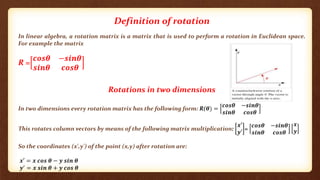
In linear algebra, a rotation matrix is a matrix that is used to perform a rotation in Euclidean space.
For example the matrix
R =
𝒄𝒐𝒔𝜽 −𝒔𝒊𝒏𝜽
𝒔𝒊𝒏𝜽 𝒄𝒐𝒔𝜽
Rotations in two dimensions
In two dimensions every rotation matrix has the following form: R(𝜽) =
𝒄𝒐𝒔𝜽 −𝒔𝒊𝒏𝜽
𝒔𝒊𝒏𝜽 𝒄𝒐𝒔𝜽
This rotates column vectors by means of the following matrix multiplication:
𝒙′
𝒚′
=
𝒄𝒐𝒔𝜽 −𝒔𝒊𝒏𝜽
𝒔𝒊𝒏𝜽 𝒄𝒐𝒔𝜽
𝒙
𝒚
So the coordinates (x',y') of the point (x,y) after rotation are:
𝒙′ = 𝒙 𝒄𝒐𝒔 𝜽 − 𝒚 𝒔𝒊𝒏 𝜽
𝒚′ = 𝒙 𝒔𝒊𝒏 𝜽 + 𝒚 𝒄𝒐𝒔 𝜽
Common rotations
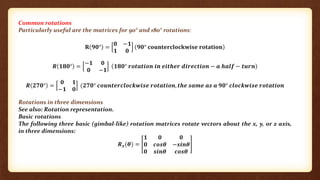
Particularly useful are the matrices for 90° and 180° rotations:
𝐑 𝟗𝟎° =
𝟎 −𝟏
𝟏 𝟎
𝟗𝟎° 𝐜𝐨𝐮𝐧𝐭𝐞𝐫𝐜𝐥𝐨𝐜𝐤𝐰𝐢𝐬𝐞 𝐫𝐨𝐭𝐚𝐭𝐢𝐨𝐧
𝑹 𝟏𝟖𝟎° =
−𝟏 𝟎
𝟎 −𝟏
𝟏𝟖𝟎° 𝒓𝒐𝒕𝒂𝒕𝒊𝒐𝒏 𝒊𝒏 𝒆𝒊𝒕𝒉𝒆𝒓 𝒅𝒊𝒓𝒆𝒄𝒕𝒊𝒐𝒏 − 𝒂 𝒉𝒂𝒍𝒇 − 𝒕𝒖𝒓𝒏
𝑹 𝟐𝟕𝟎° =
𝟎 𝟏
−𝟏 𝟎
(𝟐𝟕𝟎° 𝒄𝒐𝒖𝒏𝒕𝒆𝒓𝒄𝒍𝒐𝒄𝒌𝒘𝒊𝒔𝒆 𝒓𝒐𝒕𝒂𝒕𝒊𝒐𝒏, 𝒕𝒉𝒆 𝒔𝒂𝒎𝒆 𝒂𝒔 𝒂 𝟗𝟎° 𝒄𝒍𝒐𝒄𝒌𝒘𝒊𝒔𝒆 𝒓𝒐𝒕𝒂𝒕𝒊𝒐𝒏
Rotations in three dimensions
See also: Rotation representation.
Basic rotations
The following three basic (gimbal-like) rotation matrices rotate vectors about the x, y, or z axis,
in three dimensions:
𝑹𝒙(𝜽) =
𝟏 𝟎 𝟎
𝟎 𝒄𝒐𝒔𝜽 −𝒔𝒊𝒏𝜽
𝟎 𝒔𝒊𝒏𝜽 𝒄𝒐𝒔𝜽
𝑹𝒚(𝜽) =
𝒄𝒐𝒔𝜽 𝟎 𝒔𝒊𝒏𝜽
𝟎 𝟏 𝟎
−𝒔𝒊𝒏𝜽 𝟎 𝒄𝒐𝒔𝜽
𝑹𝒛(𝜽) =
𝒄𝒐𝒔𝜽 −𝒔𝒊𝒏𝜽 𝟎
𝒔𝒊𝒏𝜽 𝒄𝒐𝒔𝜽 𝟎
𝟎 𝟎 𝟏
Each of these basic vector rotations typically appears counter-clockwise when the axis about which
they occur points toward the observer, and the coordinate system is right-handed. Rz, for instance,
would rotate toward the y-axis a vector aligned with the x-axis. This is similar to the rotation
produced by the above mentioned 2-D rotation matrix. See below for alternative conventions which
may apparently or actually invert the sense of the rotation produced by these matrices.
Find rotation operation
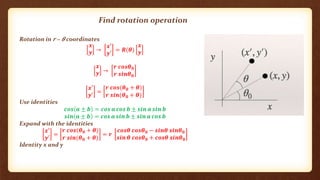
Rotation in 𝑟 − 𝜃 coordinates
𝒙
𝒚 →
𝒙′
𝒚′
= 𝑹(𝜽)
𝒙
𝒚
𝒙
𝒚 →
𝒓 𝒄𝒐𝒔𝜽𝟎
𝒓 𝒔𝒊𝒏𝜽𝟎
𝒙′
𝒚′
=
𝒓 𝒄𝒐𝒔(𝜽𝟎 + 𝜽)
𝒓 𝒔𝒊𝒏(𝜽𝟎 + 𝜽)
Use identities
𝒄𝒐𝒔 𝒂 ± 𝒃 = 𝒄𝒐𝒔 𝒂 𝒄𝒐𝒔 𝒃 ± 𝒔𝒊𝒏 𝒂 𝒔𝒊𝒏 𝒃
𝒔𝒊𝒏 𝒂 ± 𝒃 = 𝒄𝒐𝒔 𝒂 𝒔𝒊𝒏 𝒃 ± 𝒔𝒊𝒏 𝒂 𝒄𝒐𝒔 𝒃
Expand with the identities
𝒙′
𝒚′
=
𝒓 𝒄𝒐𝒔(𝜽𝟎 + 𝜽)
𝒓 𝒔𝒊𝒏(𝜽𝟎 + 𝜽)
= 𝒓
𝒄𝒐𝒔𝜽 𝒄𝒐𝒔𝜽𝟎 − 𝒔𝒊𝒏𝜽 𝒔𝒊𝒏𝜽𝟎
𝒔𝒊𝒏 𝜽 𝒄𝒐𝒔𝜽𝟎 + 𝒄𝒐𝒔𝜽 𝒔𝒊𝒏𝜽𝟎
Identity x and y
𝐱′
𝐲′
=
𝐫 𝐜𝐨𝐬𝛉𝟎 𝐜𝐨𝐬𝛉 − 𝐫 𝐬𝐢𝐧𝛉𝟎 𝐬𝐢𝐧𝛉
𝐫 𝐬𝐢𝐧𝛉𝟎 𝐜𝐨𝐬𝛉 + 𝐫 𝐜𝐨𝐬𝛉𝟎 𝐬𝐢𝐧𝛉
=
𝐱 𝐜𝐨𝐬𝛉 − 𝐲 𝐬𝐢𝐧𝛉
𝐲 𝐜𝐨𝐬𝛉 + 𝐱 𝐬𝐢𝐧𝛉
Matrix equation
𝐱′
𝐲′
=
𝐜𝐨𝐬𝛉 −𝐬𝐢𝐧𝛉
𝐬𝐢𝐧𝛉 𝐜𝐨𝐬𝛉
𝐱
𝐲
Rotation matrix
𝐑 𝛉 =
𝐜𝐨𝐬𝛉 −𝐬𝐢𝐧𝛉
𝐬𝐢𝐧𝛉 𝐜𝐨𝐬𝛉
Reflections
A reflection is a transformation representing a flip of a figure. Figures may be reflected in a
point, a line, or a plane. When reflecting a figure in a line or in a point, the image is
congruent to the preimage a reflection maps every point of a figure to an image across a fixed
line. The fixed line is called the line of reflection some simple reflections can be performed
easily in the coordinate plane using the general rules below
Reflection in the x-axis:
A reflection of a point over the x-axis.is shown.
The rule for a reflection over the x
x-axis is (x,y)→(x,−y)
reflection of a point over the y -axis is shown.
Reflection in the y -axis:
The rule for a reflection over the y-axis is (x,y)→(−x,y)
Reflection in the line y=x:
A reflection of a point over the line y=x is shown.
The rule for a reflection in the line y=x is
(x,y)→(y,x)
Reflection in the line y=−x:
A reflection of a point over the line y=−x is shown.
The rule for a reflection in the origin is (x,y)→(−y,−x)
Let A be the matrix representation of T with respect to the standard basis B Observe that each vector
on the line y=mx does not move under the linear transformation T
Since the vector
𝟏
𝒎
is on the line y=mx , it follows that
𝑨
𝟏
𝒎
=
𝟏
𝒎
Note that if m≠0 then the line 𝒚 = −𝟏𝒎𝒙 is perpendicular to the line y=mx at the origin.
If m=0 , then the line x=0 is perpendicular to the line y=0 at the origin.
In either case the vector
−𝒎
𝟏
is on the perpendicular line
Thus, by the reflection across the line y=mx , this vector is mapped to
𝒎
−𝟏
that is , we have
𝑨
−𝒎
𝟏
=
𝒎
−𝟏
It follows from (*) and (**) that
It follows from (**) and (**) that
𝑨
𝟏 −𝒎
𝒎 𝟏
= 𝑨
𝟏
𝒎
𝑨
−𝒎
𝟏
=
𝟏 𝒎
𝒎 −𝟏
The determinant of the matrix
𝟏 −𝒎
𝒎 𝟏
𝒊𝒔 𝟏 + 𝒎𝟐
𝒏𝒐𝒏 − 𝒛𝒆𝒓𝒐
hence it is invertible.(Note that since column vectors are nonzero orthogonal vectors, we knew it is
invertible.)
The inverse matrix is
𝟏 −𝒎
𝒎 𝟏
−𝟏
=
𝟏
𝟏 + 𝒎𝟐
𝟏 𝒎
−𝒎 𝟏
Therefore , we have
𝑨 =
𝟏 𝒎
𝒎 −𝟏
𝟏 −𝒎
𝒎 𝟏
−𝟏
=
𝟏 𝒎
𝒎 −𝟏
.
𝟏
𝟏 + 𝒎𝟐
𝟏 𝒎
−𝒎 𝟏
=
𝟏
𝟏 + 𝒎𝟐
𝟏 − 𝒎𝟐
𝟐𝒎
𝟐𝒎 𝒎𝟐 − 𝟏
In summary, the matrix representation A of the linear transformation T
across the line y=mx with respect to the standard basis is
𝑨 =
𝟏
𝟏 + 𝒎𝟐
𝟏 − 𝒎𝟐 𝟐𝒎
𝟐𝒎 𝒎𝟐
− 𝟏
adjugate
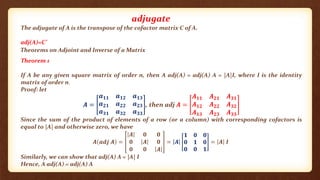
The adjugate of A is the transpose of the cofactor matrix C of A.
adj(A)=C’
Theorems on Adjoint and Inverse of a Matrix
Theorem 1
If A be any given square matrix of order n, then A adj(A) = adj(A) A = |A|I, where I is the identity
matrix of order n.
Proof: let
𝑨 =
𝒂𝟏𝟏 𝒂𝟏𝟐 𝒂𝟏𝟑
𝒂𝟐𝟏 𝒂𝟐𝟐 𝒂𝟐𝟑
𝒂𝟑𝟏 𝒂𝟑𝟐 𝒂𝟑𝟑
, then adj 𝑨 =
𝑨𝟏𝟏 𝑨𝟐𝟏 𝑨𝟑𝟏
𝑨𝟏𝟐 𝑨𝟐𝟐 𝑨𝟑𝟐
𝑨𝟏𝟑 𝑨𝟐𝟑 𝑨𝟑𝟑
Since the sum of the product of elements of a row (or a column) with corresponding cofactors is
equal to |A| and otherwise zero, we have
𝑨 𝒂𝒅𝒋 𝑨 =
𝑨 𝟎 𝟎
𝟎 𝑨 𝟎
𝟎 𝟎 𝑨
= 𝑨
𝟏 𝟎 𝟎
𝟎 𝟏 𝟎
𝟎 𝟎 𝟏
= 𝑨 𝑰
Similarly, we can show that adj(A) A = |A| I
Hence, A adj(A) = adj(A) A
Theorem 2
If A and B are non-singular matrices of the same order, then AB and BA are also non-singular
matrices of the same order.
Theorem 3
The determinant of the product matrices is equal to the product of their respective determinants,
that is, |AB| = |A||B|, where A and B are square matrices of the same order.
Remark: we know that
𝒂𝒅𝒋 𝑨 𝑨 = 𝑨 𝑰 =
𝑨 𝟎 𝟎
𝟎 𝑨 𝟎
𝟎 𝟎 𝑨
Writing determinants of matrices on both sides, we have
𝒂𝒅𝒋 𝑨 𝑨 =
𝑨 𝟎 𝟎
𝟎 𝑨 𝟎
𝟎 𝟎 𝑨
i.e.
|(𝒂𝒅𝒋 𝑨)||𝑨| = 𝑨 𝟑
𝟏 𝟎 𝟎
𝟎 𝟏 𝟎
𝟎 𝟎 𝟏
i.e.
𝒂𝒅𝒋(𝑨) 𝑨 = 𝑨 𝟑 𝒐𝒓 𝒂𝒅𝒋(𝑨) = 𝑨 𝟐
In general, if A is a square matrix of order n ,then 𝒂𝒅𝒋(𝑨) = 𝑨 𝒏−𝟏
Theorem 4
A square matrix A is invertible if and only if A is a non-singular matrix.
Proof: Let A be an invertible matrix of order n and I be the identity matrix of the same order.
Then there exists a square matrix B of order n such that AB = BA = I. Now, AB = I.
So |A| |B| = |I| = 1 (since |I| = 1 and |AB| = |A| |B|). This gives |A| to be a non-zero value. Hence A
is a non-singular matrix. Conversely, let A be a non-singular matrix, then |A| is non-zero. Now
A adj(A) = adj(A) A = |A| I (Theorem 1), or AB = BA = I, where 𝑨
𝟏
𝑨
𝒂𝒅𝒋 𝑨 =
𝟏
𝑨
𝒂𝒅𝒋 𝑨 𝑨 = 𝑰
𝑩 =
𝟏
𝑨
𝒂𝒅𝒋 𝑨 thus A is invertible and 𝑨−𝟏
=
𝟏
𝑨
𝒂𝒅𝒋 𝑨
Inverse of a 𝟐 ∗ 𝟐 matrix
Let
𝑨 =
𝟑 𝟐
𝟏 𝟒
We need to find it’s inverse
First, we will check if 𝑨 is non-zero
𝑨 =
𝟑 𝟐
𝟏 𝟒
= 𝟑 × 𝟒 − 𝟏 × 𝟐
= 𝟏𝟐 − 𝟐
= 𝟏𝟎
Since 𝑨 is non-zero
Inverse of A is possible
Now, let’s find adj A
𝒂𝒅𝒋 𝑨 =
𝟑 𝟐
𝟏 𝟒
We have a shortcut method to find adjoint of 𝟐 × 𝟐 matrix
Interchange change sign
𝒂𝒅𝒋 𝑨 =
𝟑 𝟐
𝟏 𝟒
=
𝟒 −𝟐
−𝟏 𝟑
Now we know that
𝑨−𝟏 =
𝟏
𝑨
𝒂𝒅𝒋 𝑨
=
𝟏
𝟏𝟎
𝟒 −𝟐
−𝟏 𝟑
=
𝟒
𝟏𝟎
−𝟐
𝟏𝟎
−𝟏
𝟏𝟎
𝟑
𝟏𝟎
=
𝟐
𝟓
−𝟏
𝟓
−𝟏
𝟏𝟎
𝟑
𝟏𝟎
Let’s check
𝑨𝑨−𝟏
=
𝟑 𝟐
𝟏 𝟒
𝟐
𝟓
−𝟏
𝟓
−𝟏
𝟏𝟎
𝟑
𝟏𝟎
=
𝟑 ×
𝟐
𝟓
+ 𝟐 ×
−𝟏
𝟏𝟎
𝟑 ×
−𝟏
𝟓
+ 𝟐 ×
𝟑
𝟏𝟎
𝟏 ×
𝟐
𝟓
+ 𝟒 ×
−𝟏
𝟏𝟎
𝟏 ×
−𝟏
𝟓
+ 𝟒 ×
𝟑
𝟏𝟎
=
𝟔
𝟓
−
𝟐
𝟏𝟎
−𝟑
𝟓
+
𝟑
𝟓
𝟐
𝟓
−
𝟒
𝟏𝟎
−𝟏
𝟓
+
𝟏𝟐
𝟏𝟎
=
𝟔
𝟓
−
𝟏
𝟓
𝟎
𝟐
𝟓
−
𝟐
𝟓
−𝟏
𝟓
+
𝟔
𝟓
=
𝟓
𝟓
𝟎
𝟎
𝟓
𝟓
=
𝟏 𝟎
𝟎 𝟏
Thus
𝑨𝑨−𝟏 = 𝑰
Matrix n by n
Let A be an n×n matrix. The (i,j)cofactor Cij of A is defined to be Cij=(−1)ij det(Mij),where Mij is
the (i,j)minor matrix obtained from Are moving the i-th row and j-th column. Then consider
the n×n matrix C=(Cij), and define the n×n
matrix Adj(A)=CT The matrix Adj(A)is called the adjoint matrix of When A is invertible, then
its inverse can be obtained by the formula
𝑨−𝟏 =
𝟏
𝒅𝒆𝒕 𝑨
× 𝒂𝒅𝒋 𝑨
Reference
1. https://www.varsitytutors.com/hotmath/hotmath_help/topics/reflections
2. https://www.toppr.com/guides/maths/determinants/
3. https://www.google.com/amp/s/www.teachoo.com/amp/9781/1207/Finding-inverse-
of-matrix-using-adjoint/category/Finding-Inverse-of-a-matrix/
Thank you for watching

linear algebra (malak,).pptx

  • 1.
    Soran university faculty ofeducation second stage ROTATION AND REFLECTION AND ADJUGATE PREPARED BY: SUPERVISE: -LAVIN ZAYNADIN MR.WORIA SOLTANAIN -MALAK AHMAD -ZHINO WUS
  • 2.
    Content 1. Rotation 2. Rotationsin two dimensions 3. Reflection 4. Adjugate 5. inverse of matrix 2 by 2
  • 3.
    Definition of rotation Inlinear algebra, a rotation matrix is a matrix that is used to perform a rotation in Euclidean space. For example the matrix R = 𝒄𝒐𝒔𝜽 −𝒔𝒊𝒏𝜽 𝒔𝒊𝒏𝜽 𝒄𝒐𝒔𝜽 Rotations in two dimensions In two dimensions every rotation matrix has the following form: R(𝜽) = 𝒄𝒐𝒔𝜽 −𝒔𝒊𝒏𝜽 𝒔𝒊𝒏𝜽 𝒄𝒐𝒔𝜽 This rotates column vectors by means of the following matrix multiplication: 𝒙′ 𝒚′ = 𝒄𝒐𝒔𝜽 −𝒔𝒊𝒏𝜽 𝒔𝒊𝒏𝜽 𝒄𝒐𝒔𝜽 𝒙 𝒚 So the coordinates (x',y') of the point (x,y) after rotation are: 𝒙′ = 𝒙 𝒄𝒐𝒔 𝜽 − 𝒚 𝒔𝒊𝒏 𝜽 𝒚′ = 𝒙 𝒔𝒊𝒏 𝜽 + 𝒚 𝒄𝒐𝒔 𝜽
  • 4.
    Common rotations Particularly usefulare the matrices for 90° and 180° rotations: 𝐑 𝟗𝟎° = 𝟎 −𝟏 𝟏 𝟎 𝟗𝟎° 𝐜𝐨𝐮𝐧𝐭𝐞𝐫𝐜𝐥𝐨𝐜𝐤𝐰𝐢𝐬𝐞 𝐫𝐨𝐭𝐚𝐭𝐢𝐨𝐧 𝑹 𝟏𝟖𝟎° = −𝟏 𝟎 𝟎 −𝟏 𝟏𝟖𝟎° 𝒓𝒐𝒕𝒂𝒕𝒊𝒐𝒏 𝒊𝒏 𝒆𝒊𝒕𝒉𝒆𝒓 𝒅𝒊𝒓𝒆𝒄𝒕𝒊𝒐𝒏 − 𝒂 𝒉𝒂𝒍𝒇 − 𝒕𝒖𝒓𝒏 𝑹 𝟐𝟕𝟎° = 𝟎 𝟏 −𝟏 𝟎 (𝟐𝟕𝟎° 𝒄𝒐𝒖𝒏𝒕𝒆𝒓𝒄𝒍𝒐𝒄𝒌𝒘𝒊𝒔𝒆 𝒓𝒐𝒕𝒂𝒕𝒊𝒐𝒏, 𝒕𝒉𝒆 𝒔𝒂𝒎𝒆 𝒂𝒔 𝒂 𝟗𝟎° 𝒄𝒍𝒐𝒄𝒌𝒘𝒊𝒔𝒆 𝒓𝒐𝒕𝒂𝒕𝒊𝒐𝒏 Rotations in three dimensions See also: Rotation representation. Basic rotations The following three basic (gimbal-like) rotation matrices rotate vectors about the x, y, or z axis, in three dimensions: 𝑹𝒙(𝜽) = 𝟏 𝟎 𝟎 𝟎 𝒄𝒐𝒔𝜽 −𝒔𝒊𝒏𝜽 𝟎 𝒔𝒊𝒏𝜽 𝒄𝒐𝒔𝜽
  • 5.
    𝑹𝒚(𝜽) = 𝒄𝒐𝒔𝜽 𝟎𝒔𝒊𝒏𝜽 𝟎 𝟏 𝟎 −𝒔𝒊𝒏𝜽 𝟎 𝒄𝒐𝒔𝜽 𝑹𝒛(𝜽) = 𝒄𝒐𝒔𝜽 −𝒔𝒊𝒏𝜽 𝟎 𝒔𝒊𝒏𝜽 𝒄𝒐𝒔𝜽 𝟎 𝟎 𝟎 𝟏 Each of these basic vector rotations typically appears counter-clockwise when the axis about which they occur points toward the observer, and the coordinate system is right-handed. Rz, for instance, would rotate toward the y-axis a vector aligned with the x-axis. This is similar to the rotation produced by the above mentioned 2-D rotation matrix. See below for alternative conventions which may apparently or actually invert the sense of the rotation produced by these matrices.
  • 6.
    Find rotation operation Rotationin 𝑟 − 𝜃 coordinates 𝒙 𝒚 → 𝒙′ 𝒚′ = 𝑹(𝜽) 𝒙 𝒚 𝒙 𝒚 → 𝒓 𝒄𝒐𝒔𝜽𝟎 𝒓 𝒔𝒊𝒏𝜽𝟎 𝒙′ 𝒚′ = 𝒓 𝒄𝒐𝒔(𝜽𝟎 + 𝜽) 𝒓 𝒔𝒊𝒏(𝜽𝟎 + 𝜽) Use identities 𝒄𝒐𝒔 𝒂 ± 𝒃 = 𝒄𝒐𝒔 𝒂 𝒄𝒐𝒔 𝒃 ± 𝒔𝒊𝒏 𝒂 𝒔𝒊𝒏 𝒃 𝒔𝒊𝒏 𝒂 ± 𝒃 = 𝒄𝒐𝒔 𝒂 𝒔𝒊𝒏 𝒃 ± 𝒔𝒊𝒏 𝒂 𝒄𝒐𝒔 𝒃 Expand with the identities 𝒙′ 𝒚′ = 𝒓 𝒄𝒐𝒔(𝜽𝟎 + 𝜽) 𝒓 𝒔𝒊𝒏(𝜽𝟎 + 𝜽) = 𝒓 𝒄𝒐𝒔𝜽 𝒄𝒐𝒔𝜽𝟎 − 𝒔𝒊𝒏𝜽 𝒔𝒊𝒏𝜽𝟎 𝒔𝒊𝒏 𝜽 𝒄𝒐𝒔𝜽𝟎 + 𝒄𝒐𝒔𝜽 𝒔𝒊𝒏𝜽𝟎 Identity x and y
  • 7.
    𝐱′ 𝐲′ = 𝐫 𝐜𝐨𝐬𝛉𝟎 𝐜𝐨𝐬𝛉− 𝐫 𝐬𝐢𝐧𝛉𝟎 𝐬𝐢𝐧𝛉 𝐫 𝐬𝐢𝐧𝛉𝟎 𝐜𝐨𝐬𝛉 + 𝐫 𝐜𝐨𝐬𝛉𝟎 𝐬𝐢𝐧𝛉 = 𝐱 𝐜𝐨𝐬𝛉 − 𝐲 𝐬𝐢𝐧𝛉 𝐲 𝐜𝐨𝐬𝛉 + 𝐱 𝐬𝐢𝐧𝛉 Matrix equation 𝐱′ 𝐲′ = 𝐜𝐨𝐬𝛉 −𝐬𝐢𝐧𝛉 𝐬𝐢𝐧𝛉 𝐜𝐨𝐬𝛉 𝐱 𝐲 Rotation matrix 𝐑 𝛉 = 𝐜𝐨𝐬𝛉 −𝐬𝐢𝐧𝛉 𝐬𝐢𝐧𝛉 𝐜𝐨𝐬𝛉
  • 8.
    Reflections A reflection isa transformation representing a flip of a figure. Figures may be reflected in a point, a line, or a plane. When reflecting a figure in a line or in a point, the image is congruent to the preimage a reflection maps every point of a figure to an image across a fixed line. The fixed line is called the line of reflection some simple reflections can be performed easily in the coordinate plane using the general rules below Reflection in the x-axis: A reflection of a point over the x-axis.is shown. The rule for a reflection over the x x-axis is (x,y)→(x,−y)
  • 9.
    reflection of apoint over the y -axis is shown. Reflection in the y -axis: The rule for a reflection over the y-axis is (x,y)→(−x,y)
  • 10.
    Reflection in theline y=x: A reflection of a point over the line y=x is shown. The rule for a reflection in the line y=x is (x,y)→(y,x)
  • 11.
    Reflection in theline y=−x: A reflection of a point over the line y=−x is shown. The rule for a reflection in the origin is (x,y)→(−y,−x)
  • 12.
    Let A bethe matrix representation of T with respect to the standard basis B Observe that each vector on the line y=mx does not move under the linear transformation T Since the vector 𝟏 𝒎 is on the line y=mx , it follows that 𝑨 𝟏 𝒎 = 𝟏 𝒎 Note that if m≠0 then the line 𝒚 = −𝟏𝒎𝒙 is perpendicular to the line y=mx at the origin. If m=0 , then the line x=0 is perpendicular to the line y=0 at the origin. In either case the vector −𝒎 𝟏 is on the perpendicular line Thus, by the reflection across the line y=mx , this vector is mapped to 𝒎 −𝟏 that is , we have 𝑨 −𝒎 𝟏 = 𝒎 −𝟏 It follows from (*) and (**) that It follows from (**) and (**) that 𝑨 𝟏 −𝒎 𝒎 𝟏 = 𝑨 𝟏 𝒎 𝑨 −𝒎 𝟏 = 𝟏 𝒎 𝒎 −𝟏 The determinant of the matrix 𝟏 −𝒎 𝒎 𝟏 𝒊𝒔 𝟏 + 𝒎𝟐 𝒏𝒐𝒏 − 𝒛𝒆𝒓𝒐 hence it is invertible.(Note that since column vectors are nonzero orthogonal vectors, we knew it is invertible.)
  • 13.
    The inverse matrixis 𝟏 −𝒎 𝒎 𝟏 −𝟏 = 𝟏 𝟏 + 𝒎𝟐 𝟏 𝒎 −𝒎 𝟏 Therefore , we have 𝑨 = 𝟏 𝒎 𝒎 −𝟏 𝟏 −𝒎 𝒎 𝟏 −𝟏 = 𝟏 𝒎 𝒎 −𝟏 . 𝟏 𝟏 + 𝒎𝟐 𝟏 𝒎 −𝒎 𝟏 = 𝟏 𝟏 + 𝒎𝟐 𝟏 − 𝒎𝟐 𝟐𝒎 𝟐𝒎 𝒎𝟐 − 𝟏 In summary, the matrix representation A of the linear transformation T across the line y=mx with respect to the standard basis is 𝑨 = 𝟏 𝟏 + 𝒎𝟐 𝟏 − 𝒎𝟐 𝟐𝒎 𝟐𝒎 𝒎𝟐 − 𝟏
  • 14.
    adjugate The adjugate ofA is the transpose of the cofactor matrix C of A. adj(A)=C’ Theorems on Adjoint and Inverse of a Matrix Theorem 1 If A be any given square matrix of order n, then A adj(A) = adj(A) A = |A|I, where I is the identity matrix of order n. Proof: let 𝑨 = 𝒂𝟏𝟏 𝒂𝟏𝟐 𝒂𝟏𝟑 𝒂𝟐𝟏 𝒂𝟐𝟐 𝒂𝟐𝟑 𝒂𝟑𝟏 𝒂𝟑𝟐 𝒂𝟑𝟑 , then adj 𝑨 = 𝑨𝟏𝟏 𝑨𝟐𝟏 𝑨𝟑𝟏 𝑨𝟏𝟐 𝑨𝟐𝟐 𝑨𝟑𝟐 𝑨𝟏𝟑 𝑨𝟐𝟑 𝑨𝟑𝟑 Since the sum of the product of elements of a row (or a column) with corresponding cofactors is equal to |A| and otherwise zero, we have 𝑨 𝒂𝒅𝒋 𝑨 = 𝑨 𝟎 𝟎 𝟎 𝑨 𝟎 𝟎 𝟎 𝑨 = 𝑨 𝟏 𝟎 𝟎 𝟎 𝟏 𝟎 𝟎 𝟎 𝟏 = 𝑨 𝑰 Similarly, we can show that adj(A) A = |A| I Hence, A adj(A) = adj(A) A
  • 15.
    Theorem 2 If Aand B are non-singular matrices of the same order, then AB and BA are also non-singular matrices of the same order. Theorem 3 The determinant of the product matrices is equal to the product of their respective determinants, that is, |AB| = |A||B|, where A and B are square matrices of the same order. Remark: we know that 𝒂𝒅𝒋 𝑨 𝑨 = 𝑨 𝑰 = 𝑨 𝟎 𝟎 𝟎 𝑨 𝟎 𝟎 𝟎 𝑨 Writing determinants of matrices on both sides, we have 𝒂𝒅𝒋 𝑨 𝑨 = 𝑨 𝟎 𝟎 𝟎 𝑨 𝟎 𝟎 𝟎 𝑨 i.e. |(𝒂𝒅𝒋 𝑨)||𝑨| = 𝑨 𝟑 𝟏 𝟎 𝟎 𝟎 𝟏 𝟎 𝟎 𝟎 𝟏
  • 16.
    i.e. 𝒂𝒅𝒋(𝑨) 𝑨 =𝑨 𝟑 𝒐𝒓 𝒂𝒅𝒋(𝑨) = 𝑨 𝟐 In general, if A is a square matrix of order n ,then 𝒂𝒅𝒋(𝑨) = 𝑨 𝒏−𝟏 Theorem 4 A square matrix A is invertible if and only if A is a non-singular matrix. Proof: Let A be an invertible matrix of order n and I be the identity matrix of the same order. Then there exists a square matrix B of order n such that AB = BA = I. Now, AB = I. So |A| |B| = |I| = 1 (since |I| = 1 and |AB| = |A| |B|). This gives |A| to be a non-zero value. Hence A is a non-singular matrix. Conversely, let A be a non-singular matrix, then |A| is non-zero. Now A adj(A) = adj(A) A = |A| I (Theorem 1), or AB = BA = I, where 𝑨 𝟏 𝑨 𝒂𝒅𝒋 𝑨 = 𝟏 𝑨 𝒂𝒅𝒋 𝑨 𝑨 = 𝑰 𝑩 = 𝟏 𝑨 𝒂𝒅𝒋 𝑨 thus A is invertible and 𝑨−𝟏 = 𝟏 𝑨 𝒂𝒅𝒋 𝑨
  • 17.
    Inverse of a𝟐 ∗ 𝟐 matrix Let 𝑨 = 𝟑 𝟐 𝟏 𝟒 We need to find it’s inverse First, we will check if 𝑨 is non-zero 𝑨 = 𝟑 𝟐 𝟏 𝟒 = 𝟑 × 𝟒 − 𝟏 × 𝟐 = 𝟏𝟐 − 𝟐 = 𝟏𝟎 Since 𝑨 is non-zero Inverse of A is possible Now, let’s find adj A 𝒂𝒅𝒋 𝑨 = 𝟑 𝟐 𝟏 𝟒 We have a shortcut method to find adjoint of 𝟐 × 𝟐 matrix Interchange change sign 𝒂𝒅𝒋 𝑨 = 𝟑 𝟐 𝟏 𝟒 = 𝟒 −𝟐 −𝟏 𝟑
  • 18.
    Now we knowthat 𝑨−𝟏 = 𝟏 𝑨 𝒂𝒅𝒋 𝑨 = 𝟏 𝟏𝟎 𝟒 −𝟐 −𝟏 𝟑 = 𝟒 𝟏𝟎 −𝟐 𝟏𝟎 −𝟏 𝟏𝟎 𝟑 𝟏𝟎 = 𝟐 𝟓 −𝟏 𝟓 −𝟏 𝟏𝟎 𝟑 𝟏𝟎 Let’s check 𝑨𝑨−𝟏 = 𝟑 𝟐 𝟏 𝟒 𝟐 𝟓 −𝟏 𝟓 −𝟏 𝟏𝟎 𝟑 𝟏𝟎
  • 19.
    = 𝟑 × 𝟐 𝟓 + 𝟐× −𝟏 𝟏𝟎 𝟑 × −𝟏 𝟓 + 𝟐 × 𝟑 𝟏𝟎 𝟏 × 𝟐 𝟓 + 𝟒 × −𝟏 𝟏𝟎 𝟏 × −𝟏 𝟓 + 𝟒 × 𝟑 𝟏𝟎 = 𝟔 𝟓 − 𝟐 𝟏𝟎 −𝟑 𝟓 + 𝟑 𝟓 𝟐 𝟓 − 𝟒 𝟏𝟎 −𝟏 𝟓 + 𝟏𝟐 𝟏𝟎 = 𝟔 𝟓 − 𝟏 𝟓 𝟎 𝟐 𝟓 − 𝟐 𝟓 −𝟏 𝟓 + 𝟔 𝟓 = 𝟓 𝟓 𝟎 𝟎 𝟓 𝟓
  • 20.
    = 𝟏 𝟎 𝟎 𝟏 Thus 𝑨𝑨−𝟏= 𝑰 Matrix n by n Let A be an n×n matrix. The (i,j)cofactor Cij of A is defined to be Cij=(−1)ij det(Mij),where Mij is the (i,j)minor matrix obtained from Are moving the i-th row and j-th column. Then consider the n×n matrix C=(Cij), and define the n×n matrix Adj(A)=CT The matrix Adj(A)is called the adjoint matrix of When A is invertible, then its inverse can be obtained by the formula 𝑨−𝟏 = 𝟏 𝒅𝒆𝒕 𝑨 × 𝒂𝒅𝒋 𝑨
  • 21.
    Reference 1. https://www.varsitytutors.com/hotmath/hotmath_help/topics/reflections 2. https://www.toppr.com/guides/maths/determinants/ 3.https://www.google.com/amp/s/www.teachoo.com/amp/9781/1207/Finding-inverse- of-matrix-using-adjoint/category/Finding-Inverse-of-a-matrix/
  • 23.
    Thank you forwatching