Forging new generations of engineers
Line ConventionsLine Conventions
Lines of varying style and thickness are used
in specific ways to develop and communicate
graphic messages about an object’s
geometry. The next few slides show some
basic line conventions and their use.
Line Conventions
Line Conventions
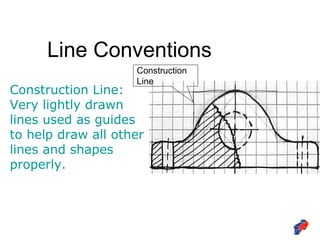
Construction Line:
Very lightly drawn
lines used as guides
to help draw all other
lines and shapes
properly.
Construction
Line
Line Conventions
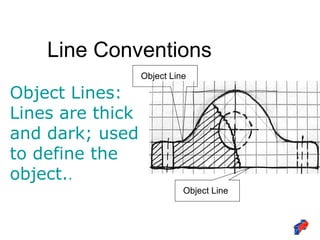
Object Lines:
Lines are thick
and dark; used
to define the
object..
Object Line
Object Line
Line Conventions
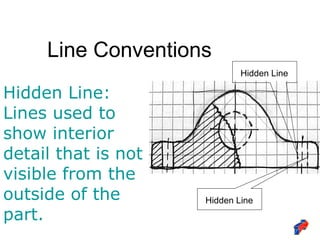
Hidden Line:
Lines used to
show interior
detail that is not
visible from the
outside of the
part.
Hidden Line
Hidden Line
Line Conventions
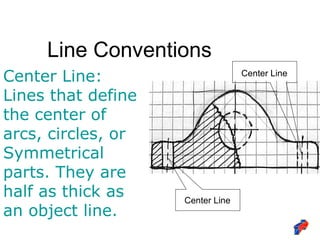
Center Line:
Lines that define
the center of
arcs, circles, or
Symmetrical
parts. They are
half as thick as
an object line.
Center Line
Center Line
Forging new generations of engineers
Line Conventions
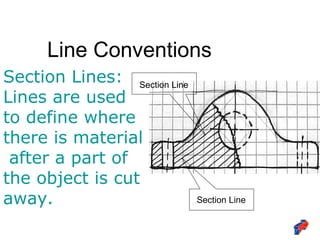
Section Lines:
Lines are used
to define where
there is material
after a part of
the object is cut
away.
Section Line
Section Line
Line Conventions
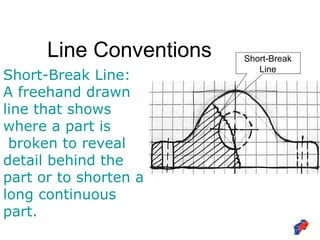
Short-Break Line:
A freehand drawn
line that shows
where a part is
broken to reveal
detail behind the
part or to shorten a
long continuous
part.
Short-Break
Line
Line Conventions
Dimension
Line
Dimension
Line
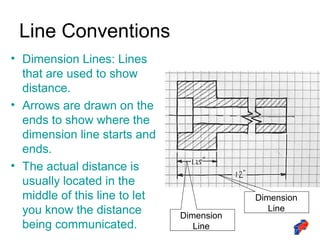
• Dimension Lines: Lines
that are used to show
distance.
• Arrows are drawn on the
ends to show where the
dimension line starts and
ends.
• The actual distance is
usually located in the
middle of this line to let
you know the distance
being communicated.
Line Conventions
Extension
Line
Extension
Line
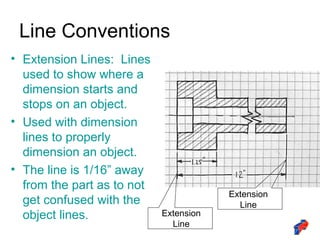
• Extension Lines: Lines
used to show where a
dimension starts and
stops on an object.
• Used with dimension
lines to properly
dimension an object.
• The line is 1/16” away
from the part as to not
get confused with the
object lines.
Line Conventions
Long-Break
Line
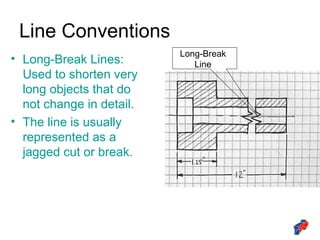
• Long-Break Lines:
Used to shorten very
long objects that do
not change in detail.
• The line is usually
represented as a
jagged cut or break.
Line Conventions
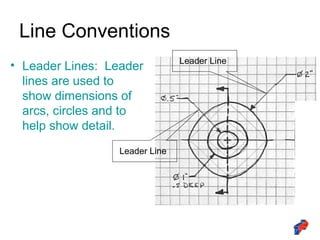
• Leader Lines: Leader
lines are used to
show dimensions of
arcs, circles and to
help show detail.
Leader Line
Leader Line
Though these standards relate to
technical drawing, which is far more
precise than freehand sketching,
their conventions should be used as
a guide when sketching.
Line Conventions
When sketching complex objects,
different line types will often overlap
each other. Therefore, line precedence
must be exercised.
Precedence of Lines
The following are rules that govern line
precedence in sketches and technical
drawings.
• Object lines take precedence over hidden and
center lines.
• Hidden lines take precedence over center lines.
• Cutting plane lines take precedence over all
others.
Precedence of Lines
Precedence of Lines
Object lines take precedence over
the hidden lines.
An object line here takes
precedence over the center line.
Precedence of Lines
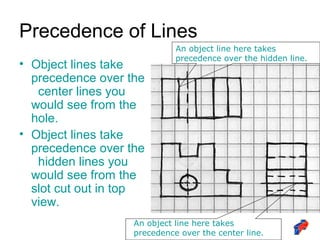
• Object lines take
precedence over the
center lines you
would see from the
hole.
• Object lines take
precedence over the
hidden lines you
would see from the
slot cut out in top
view.
An object line here takes
precedence over the center line.
An object line here takes
precedence over the hidden line.

Line conventions

  • 1.
  • 2.
  • 3.
    Lines of varyingstyle and thickness are used in specific ways to develop and communicate graphic messages about an object’s geometry. The next few slides show some basic line conventions and their use. Line Conventions
  • 4.
    Line Conventions Construction Line: Verylightly drawn lines used as guides to help draw all other lines and shapes properly. Construction Line
  • 5.
    Line Conventions Object Lines: Linesare thick and dark; used to define the object.. Object Line Object Line
  • 6.
    Line Conventions Hidden Line: Linesused to show interior detail that is not visible from the outside of the part. Hidden Line Hidden Line
  • 7.
    Line Conventions Center Line: Linesthat define the center of arcs, circles, or Symmetrical parts. They are half as thick as an object line. Center Line Center Line
  • 8.
  • 9.
    Line Conventions Section Lines: Linesare used to define where there is material after a part of the object is cut away. Section Line Section Line
  • 10.
    Line Conventions Short-Break Line: Afreehand drawn line that shows where a part is broken to reveal detail behind the part or to shorten a long continuous part. Short-Break Line
  • 11.
    Line Conventions Dimension Line Dimension Line • DimensionLines: Lines that are used to show distance. • Arrows are drawn on the ends to show where the dimension line starts and ends. • The actual distance is usually located in the middle of this line to let you know the distance being communicated.
  • 12.
    Line Conventions Extension Line Extension Line • ExtensionLines: Lines used to show where a dimension starts and stops on an object. • Used with dimension lines to properly dimension an object. • The line is 1/16” away from the part as to not get confused with the object lines.
  • 13.
    Line Conventions Long-Break Line • Long-BreakLines: Used to shorten very long objects that do not change in detail. • The line is usually represented as a jagged cut or break.
  • 14.
    Line Conventions • LeaderLines: Leader lines are used to show dimensions of arcs, circles and to help show detail. Leader Line Leader Line
  • 15.
    Though these standardsrelate to technical drawing, which is far more precise than freehand sketching, their conventions should be used as a guide when sketching. Line Conventions
  • 16.
    When sketching complexobjects, different line types will often overlap each other. Therefore, line precedence must be exercised. Precedence of Lines
  • 17.
    The following arerules that govern line precedence in sketches and technical drawings. • Object lines take precedence over hidden and center lines. • Hidden lines take precedence over center lines. • Cutting plane lines take precedence over all others. Precedence of Lines
  • 18.
    Precedence of Lines Objectlines take precedence over the hidden lines. An object line here takes precedence over the center line.
  • 19.
    Precedence of Lines •Object lines take precedence over the center lines you would see from the hole. • Object lines take precedence over the hidden lines you would see from the slot cut out in top view. An object line here takes precedence over the center line. An object line here takes precedence over the hidden line.

Editor's Notes

  • #5 Ask students after slide first appears: What do you notice about this sketch? (Making sure you lead them into looking at the different line conventions or types that appear in the sketch). Imagine if all the lines here had the same thickness, weight and consistency. What do you think this sketch would look like then?
  • #8 STOP PRESENTATION: Students have the line conventions needed for the activities in Lesson 1.2.
  • #9 The rest of this PowerPoint will be used in Unit 2.
  • #10 STOP PRESENTATION: Students have the line conventions needed for the activities in Lesson 1.2.
  • #11 STOP PRESENTATION: Students have the line conventions needed for the activities in Lesson 1.2.
  • #12 Understanding Line types and when to use them will help your sketches look cleaner and more professional.
  • #13 Understanding Line types and when to use them will help your sketches look cleaner and more professional.
  • #14 Understanding Line types and when to use them will help your sketches look cleaner and more professional.
  • #18 This will make more since to the students when they do the multiview sketch activities
  • #19 You may want to save this slide until you start multiview sketch activity.