Technical
Drawing: Alphabet
of Lines
TECHNICAL DRAWING: ALPHABET OF
LINES
Technical drawing, is the act and discipline of
composing drawings that visually communicate how
something functions or is constructed.
Line, can be defined as a straight one- dimensional
figure that has no thickness and extends endlessly in
both directions. It is often described as the shortest
distance between any two points.
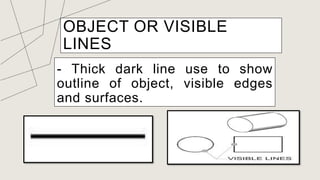
OBJECT OR VISIBLE
LINES
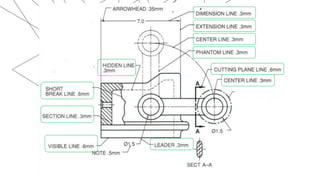
- Thick dark line use to show
outline of object, visible edges
and surfaces.
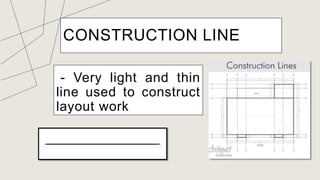
CONSTRUCTION LINE
- Very light and thin
line used to construct
layout work
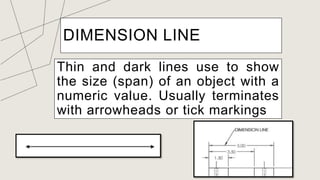
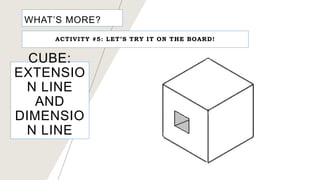
DIMENSION LINE
Thin and dark lines use to show
the size (span) of an object with a
numeric value. Usually terminates
with arrowheads or tick markings
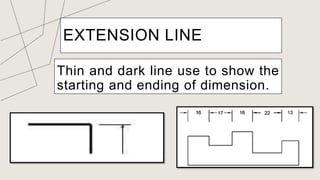
EXTENSION LINE
Thin and dark line use to show the
starting and ending of dimension.
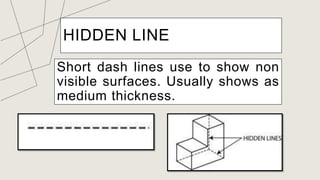
HIDDEN LINE
Short dash lines use to show non
visible surfaces. Usually shows as
medium thickness.
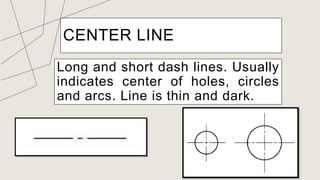
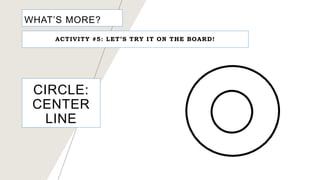
CENTER LINE
Long and short dash lines. Usually
indicates center of holes, circles
and arcs. Line is thin and dark.
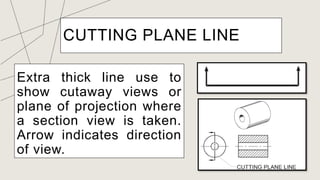
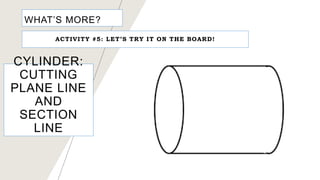
CUTTING PLANE LINE
Extra thick line use to
show cutaway views or
plane of projection where
a section view is taken.
Arrow indicates direction
of view.
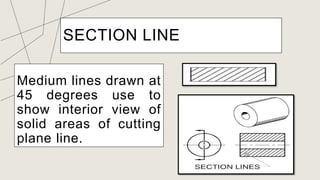
SECTION LINE
Medium lines drawn at
45 degrees use to
show interior view of
solid areas of cutting
plane line.
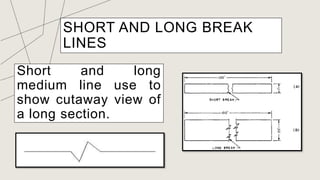
SHORT AND LONG BREAK
LINES
Short and long
medium line use to
show cutaway view of
a long section.
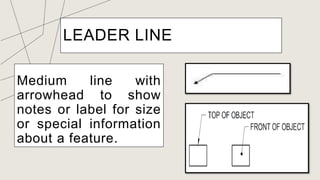
LEADER LINE
Medium line with
arrowhead to show
notes or label for size
or special information
about a feature.
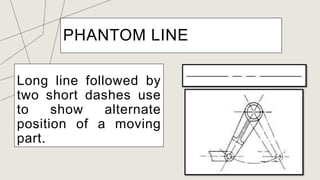
PHANTOM LINE
Long line followed by
two short dashes use
to show alternate
position of a moving
part.
WHAT’S MORE?
ACTIVITY #5: LET’S TRY IT ON THE BOARD!
Directions: Draw the lines
needed to complete the
drawing plan of different
geometrical shapes.
WHAT’S MORE?
ACTIVITY #5: LET’S TRY IT ON THE BOARD!
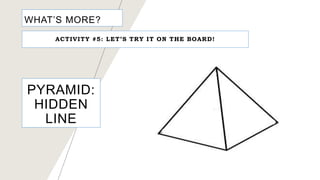
PYRAMID:
HIDDEN
LINE
WHAT’S MORE?
ACTIVITY #5: LET’S TRY IT ON THE BOARD!
CIRCLE:
CENTER
LINE
WHAT’S MORE?
ACTIVITY #5: LET’S TRY IT ON THE BOARD!
CUBE:
EXTENSIO
N LINE
AND
DIMENSIO
N LINE
WHAT’S MORE?
ACTIVITY #5: LET’S TRY IT ON THE BOARD!
CYLINDER:
CUTTING
PLANE LINE
AND
SECTION
LINE
TECHNICAL DRAWING:
ALPHABET OF LINES
1. OBJECT OR VISIBLE LINES
2. CONSTRUCTION LINE
3. DIMENSION LINE
4. HIDDEN LINE
5. CENTRE LINE
6. EXTENSION LINE
7. CUTTING PLANE LINE
8. SHORT AND LONG BREAK LINES
9. LEADER LINE
10.PHANTOM LINE
11.SECTION LINE
WHAT HAVE I
LEARNED?
ACTIVITY # 8: LET’S CHECK YOUR
UNDERSTANDING
Post – Test.
Directions: Read each statement
carefully with understanding. Write the
letter of the correct answer before each
number.
LET’S REFLECT:
I UNDERSTAND THAT_______________________
I REALIZE THAT____________________________
THANK YOU

TECHNICAL DRAFTING: ALPHABET OF LINES.pptx

  • 1.
  • 2.
    TECHNICAL DRAWING: ALPHABETOF LINES Technical drawing, is the act and discipline of composing drawings that visually communicate how something functions or is constructed. Line, can be defined as a straight one- dimensional figure that has no thickness and extends endlessly in both directions. It is often described as the shortest distance between any two points.
  • 3.
    OBJECT OR VISIBLE LINES -Thick dark line use to show outline of object, visible edges and surfaces.
  • 4.
    CONSTRUCTION LINE - Verylight and thin line used to construct layout work
  • 5.
    DIMENSION LINE Thin anddark lines use to show the size (span) of an object with a numeric value. Usually terminates with arrowheads or tick markings
  • 6.
    EXTENSION LINE Thin anddark line use to show the starting and ending of dimension.
  • 7.
    HIDDEN LINE Short dashlines use to show non visible surfaces. Usually shows as medium thickness.
  • 8.
    CENTER LINE Long andshort dash lines. Usually indicates center of holes, circles and arcs. Line is thin and dark.
  • 9.
    CUTTING PLANE LINE Extrathick line use to show cutaway views or plane of projection where a section view is taken. Arrow indicates direction of view.
  • 10.
    SECTION LINE Medium linesdrawn at 45 degrees use to show interior view of solid areas of cutting plane line.
  • 11.
    SHORT AND LONGBREAK LINES Short and long medium line use to show cutaway view of a long section.
  • 12.
    LEADER LINE Medium linewith arrowhead to show notes or label for size or special information about a feature.
  • 13.
    PHANTOM LINE Long linefollowed by two short dashes use to show alternate position of a moving part.
  • 15.
    WHAT’S MORE? ACTIVITY #5:LET’S TRY IT ON THE BOARD! Directions: Draw the lines needed to complete the drawing plan of different geometrical shapes.
  • 16.
    WHAT’S MORE? ACTIVITY #5:LET’S TRY IT ON THE BOARD! PYRAMID: HIDDEN LINE
  • 17.
    WHAT’S MORE? ACTIVITY #5:LET’S TRY IT ON THE BOARD! CIRCLE: CENTER LINE
  • 18.
    WHAT’S MORE? ACTIVITY #5:LET’S TRY IT ON THE BOARD! CUBE: EXTENSIO N LINE AND DIMENSIO N LINE
  • 19.
    WHAT’S MORE? ACTIVITY #5:LET’S TRY IT ON THE BOARD! CYLINDER: CUTTING PLANE LINE AND SECTION LINE
  • 20.
    TECHNICAL DRAWING: ALPHABET OFLINES 1. OBJECT OR VISIBLE LINES 2. CONSTRUCTION LINE 3. DIMENSION LINE 4. HIDDEN LINE 5. CENTRE LINE 6. EXTENSION LINE 7. CUTTING PLANE LINE 8. SHORT AND LONG BREAK LINES 9. LEADER LINE 10.PHANTOM LINE 11.SECTION LINE
  • 21.
    WHAT HAVE I LEARNED? ACTIVITY# 8: LET’S CHECK YOUR UNDERSTANDING Post – Test. Directions: Read each statement carefully with understanding. Write the letter of the correct answer before each number.
  • 22.
    LET’S REFLECT: I UNDERSTANDTHAT_______________________ I REALIZE THAT____________________________
  • 23.