Anilesh Seth
Ideator, Co Founder & CEO, KROW
www.krow.in
Strategic Advisor to the Qatalys Group of Companies
Mentor at the KYRON incubator
Visiting Faculty at CMR IT Exec MBA program
Ex-CEO/MD: LGSI, Qatalys & Supervalu India
www.slideshare.net/anilesh
http://In.linkedin.com/in/anileshseth
anileshseth@hotmail.com
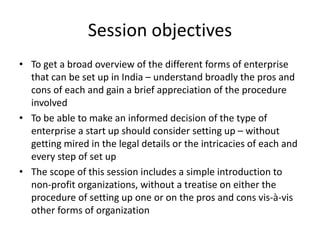
Session objectives
• To get a broad overview of the different forms of enterprise
that can be set up in India – understand broadly the pros and
cons of each and gain a brief appreciation of the procedure
involved
• To be able to make an informed decision of the type of
enterprise a start up should consider setting up – without
getting mired in the legal details or the intricacies of each and
every step of set up
• The scope of this session includes a simple introduction to
non-profit organizations, without a treatise on either the
procedure of setting up one or on the pros and cons vis-à-vis
other forms of organization
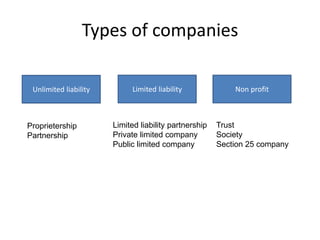
Types of companies
Unlimited liability Limited liability Non profit
Proprietership
Partnership
Limited liability partnership
Private limited company
Public limited company
Trust
Society
Section 25 company
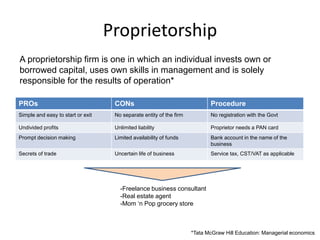
Proprietorship
A proprietorship firm is one in which an individual invests own or
borrowed capital, uses own skills in management and is solely
responsible for the results of operation*
PROs CONs Procedure
Simple and easy to start or exit No separate entity of the firm No registration with the Govt
Undivided profits Unlimited liability Proprietor needs a PAN card
Prompt decision making Limited availability of funds Bank account in the name of the
business
Secrets of trade Uncertain life of business Service tax, CST/VAT as applicable
*Tata McGraw Hill Education: Managerial economics
-Freelance business consultant
-Real estate agent
-Mom ‘n Pop grocery store
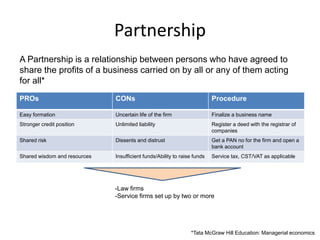
Partnership
A Partnership is a relationship between persons who have agreed to
share the profits of a business carried on by all or any of them acting
for all*
*Tata McGraw Hill Education: Managerial economics
-Law firms
-Service firms set up by two or more
PROs CONs Procedure
Easy formation Uncertain life of the firm Finalize a business name
Stronger credit position Unlimited liability Register a deed with the registrar of
companies
Shared risk Dissents and distrust Get a PAN no for the firm and open a
bank account
Shared wisdom and resources Insufficient funds/Ability to raise funds Service tax, CST/VAT as applicable
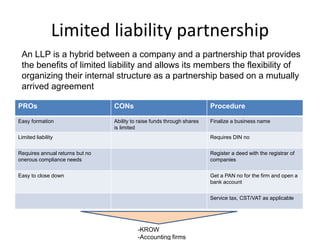
Limited liability partnership
An LLP is a hybrid between a company and a partnership that provides
the benefits of limited liability and allows its members the flexibility of
organizing their internal structure as a partnership based on a mutually
arrived agreement
-KROW
-Accounting firms
PROs CONs Procedure
Easy formation Ability to raise funds through shares
is limited
Finalize a business name
Limited liability Requires DIN no
Requires annual returns but no
onerous compliance needs
Register a deed with the registrar of
companies
Easy to close down Get a PAN no for the firm and open a
bank account
Service tax, CST/VAT as applicable
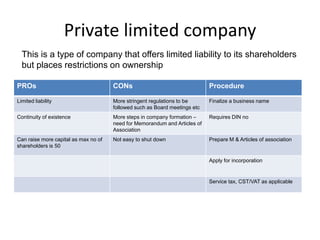
Private limited company
This is a type of company that offers limited liability to its shareholders
but places restrictions on ownership
PROs CONs Procedure
Limited liability More stringent regulations to be
followed such as Board meetings etc
Finalize a business name
Continuity of existence More steps in company formation –
need for Memorandum and Articles of
Association
Requires DIN no
Can raise more capital as max no of
shareholders is 50
Not easy to shut down Prepare M & Articles of association
Apply for incorporation
Service tax, CST/VAT as applicable
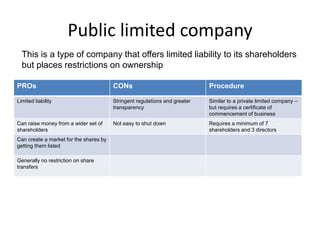
Public limited company
This is a type of company that offers limited liability to its shareholders
but places restrictions on ownership
PROs CONs Procedure
Limited liability Stringent regulations and greater
transparency
Similar to a private limited company –
but requires a certificate of
commencement of business
Can raise money from a wider set of
shareholders
Not easy to shut down Requires a minimum of 7
shareholders and 3 directors
Can create a market for the shares by
getting them listed
Generally no restriction on share
transfers
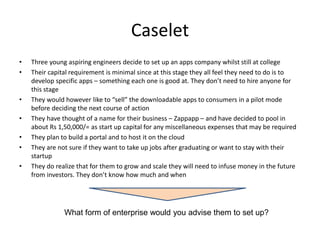
Caselet
• Three young aspiring engineers decide to set up an apps company whilst still at college
• Their capital requirement is minimal since at this stage they all feel they need to do is to
develop specific apps – something each one is good at. They don’t need to hire anyone for
this stage
• They would however like to “sell” the downloadable apps to consumers in a pilot mode
before deciding the next course of action
• They have thought of a name for their business – Zappapp – and have decided to pool in
about Rs 1,50,000/= as start up capital for any miscellaneous expenses that may be required
• They plan to build a portal and to host it on the cloud
• They are not sure if they want to take up jobs after graduating or want to stay with their
startup
• They do realize that for them to grow and scale they will need to infuse money in the future
from investors. They don’t know how much and when
What form of enterprise would you advise them to set up?
Thank you!

Session 6 type of enterprise to set up

  • 1.
    Anilesh Seth Ideator, CoFounder & CEO, KROW www.krow.in Strategic Advisor to the Qatalys Group of Companies Mentor at the KYRON incubator Visiting Faculty at CMR IT Exec MBA program Ex-CEO/MD: LGSI, Qatalys & Supervalu India www.slideshare.net/anilesh http://In.linkedin.com/in/anileshseth anileshseth@hotmail.com
  • 2.
    Session objectives • Toget a broad overview of the different forms of enterprise that can be set up in India – understand broadly the pros and cons of each and gain a brief appreciation of the procedure involved • To be able to make an informed decision of the type of enterprise a start up should consider setting up – without getting mired in the legal details or the intricacies of each and every step of set up • The scope of this session includes a simple introduction to non-profit organizations, without a treatise on either the procedure of setting up one or on the pros and cons vis-à-vis other forms of organization
  • 3.
    Types of companies Unlimitedliability Limited liability Non profit Proprietership Partnership Limited liability partnership Private limited company Public limited company Trust Society Section 25 company
  • 4.
    Proprietorship A proprietorship firmis one in which an individual invests own or borrowed capital, uses own skills in management and is solely responsible for the results of operation* PROs CONs Procedure Simple and easy to start or exit No separate entity of the firm No registration with the Govt Undivided profits Unlimited liability Proprietor needs a PAN card Prompt decision making Limited availability of funds Bank account in the name of the business Secrets of trade Uncertain life of business Service tax, CST/VAT as applicable *Tata McGraw Hill Education: Managerial economics -Freelance business consultant -Real estate agent -Mom ‘n Pop grocery store
  • 5.
    Partnership A Partnership isa relationship between persons who have agreed to share the profits of a business carried on by all or any of them acting for all* *Tata McGraw Hill Education: Managerial economics -Law firms -Service firms set up by two or more PROs CONs Procedure Easy formation Uncertain life of the firm Finalize a business name Stronger credit position Unlimited liability Register a deed with the registrar of companies Shared risk Dissents and distrust Get a PAN no for the firm and open a bank account Shared wisdom and resources Insufficient funds/Ability to raise funds Service tax, CST/VAT as applicable
  • 6.
    Limited liability partnership AnLLP is a hybrid between a company and a partnership that provides the benefits of limited liability and allows its members the flexibility of organizing their internal structure as a partnership based on a mutually arrived agreement -KROW -Accounting firms PROs CONs Procedure Easy formation Ability to raise funds through shares is limited Finalize a business name Limited liability Requires DIN no Requires annual returns but no onerous compliance needs Register a deed with the registrar of companies Easy to close down Get a PAN no for the firm and open a bank account Service tax, CST/VAT as applicable
  • 7.
    Private limited company Thisis a type of company that offers limited liability to its shareholders but places restrictions on ownership PROs CONs Procedure Limited liability More stringent regulations to be followed such as Board meetings etc Finalize a business name Continuity of existence More steps in company formation – need for Memorandum and Articles of Association Requires DIN no Can raise more capital as max no of shareholders is 50 Not easy to shut down Prepare M & Articles of association Apply for incorporation Service tax, CST/VAT as applicable
  • 8.
    Public limited company Thisis a type of company that offers limited liability to its shareholders but places restrictions on ownership PROs CONs Procedure Limited liability Stringent regulations and greater transparency Similar to a private limited company – but requires a certificate of commencement of business Can raise money from a wider set of shareholders Not easy to shut down Requires a minimum of 7 shareholders and 3 directors Can create a market for the shares by getting them listed Generally no restriction on share transfers
  • 9.
    Caselet • Three youngaspiring engineers decide to set up an apps company whilst still at college • Their capital requirement is minimal since at this stage they all feel they need to do is to develop specific apps – something each one is good at. They don’t need to hire anyone for this stage • They would however like to “sell” the downloadable apps to consumers in a pilot mode before deciding the next course of action • They have thought of a name for their business – Zappapp – and have decided to pool in about Rs 1,50,000/= as start up capital for any miscellaneous expenses that may be required • They plan to build a portal and to host it on the cloud • They are not sure if they want to take up jobs after graduating or want to stay with their startup • They do realize that for them to grow and scale they will need to infuse money in the future from investors. They don’t know how much and when What form of enterprise would you advise them to set up?
  • 10.