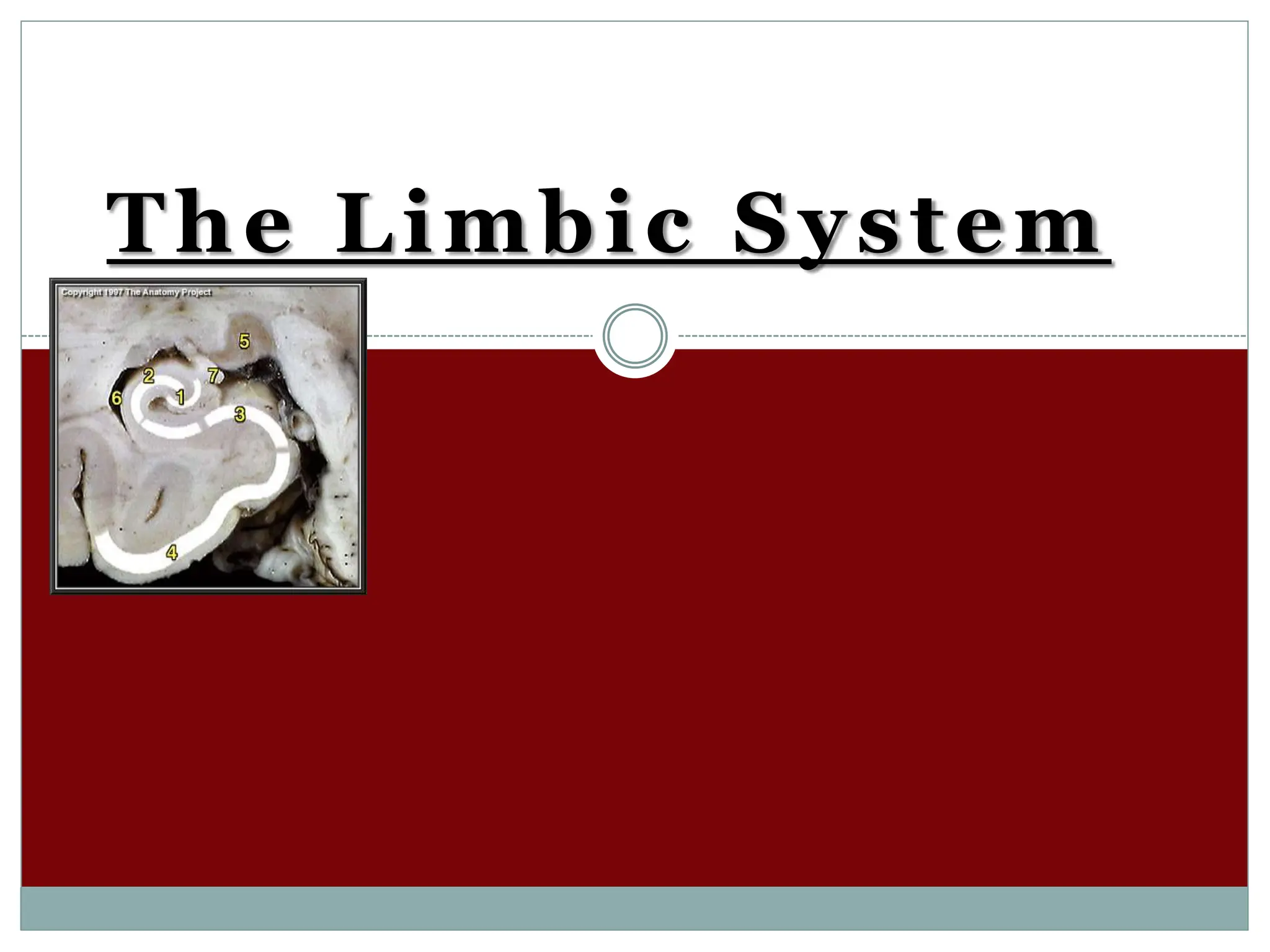
The Limbic System
Scheme of presentation
 Introduction
 Anatomy
 Physiology
 Applied aspects
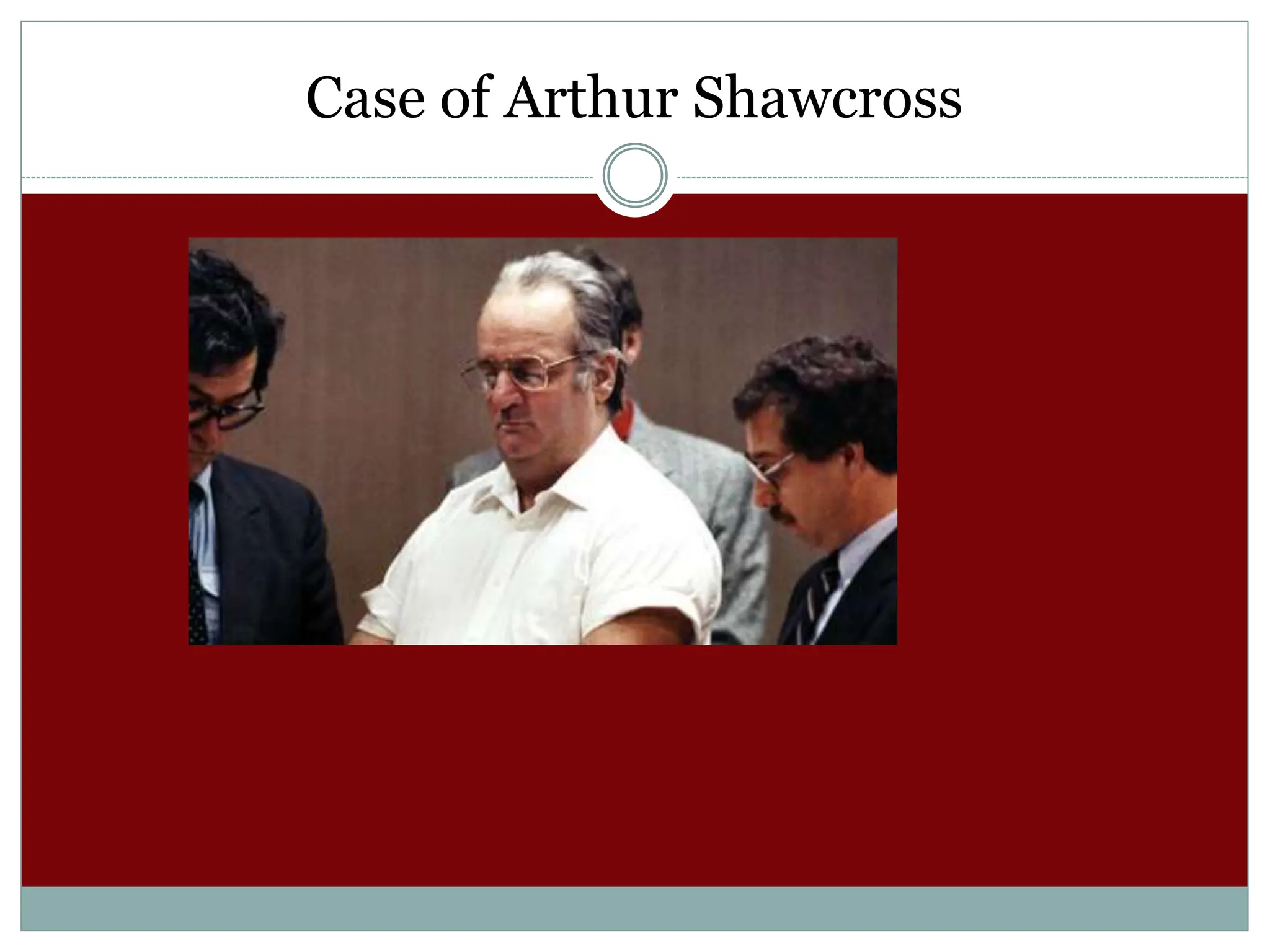
Case of Arthur Shawcross
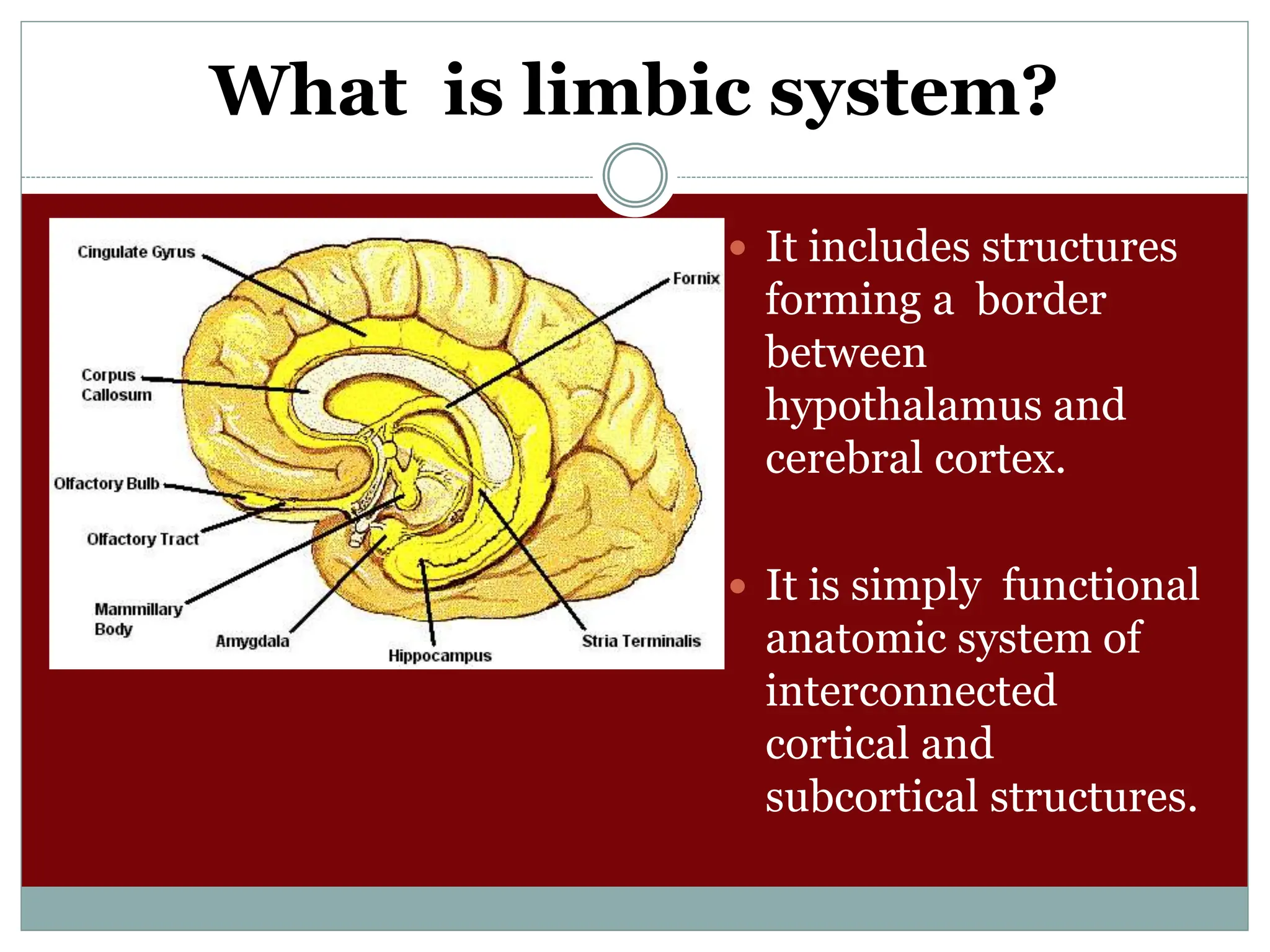
What is limbic system?
 It includes structures
forming a border
between
hypothalamus and
cerebral cortex.
 It is simply functional
anatomic system of
interconnected
cortical and
subcortical structures.
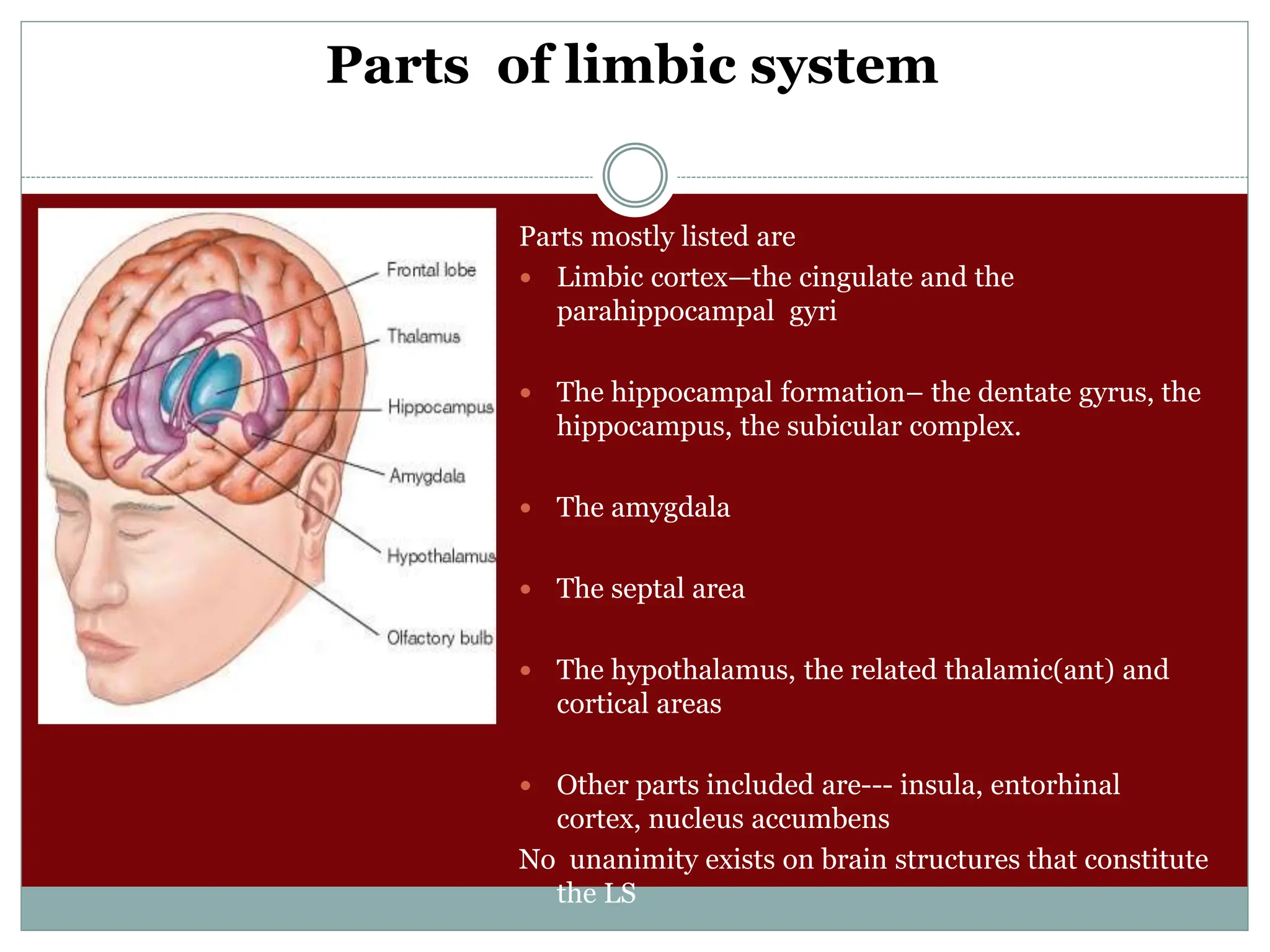
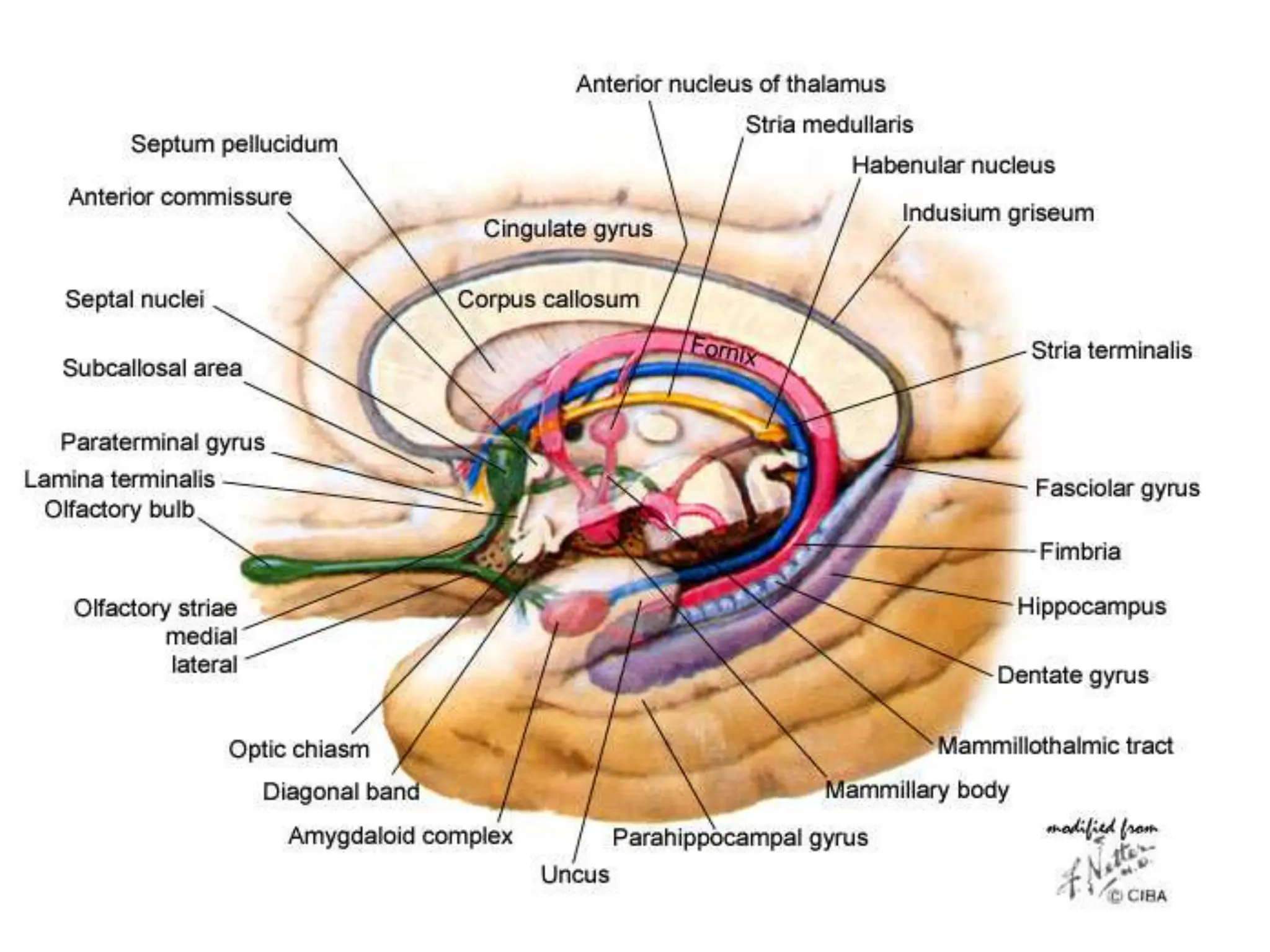
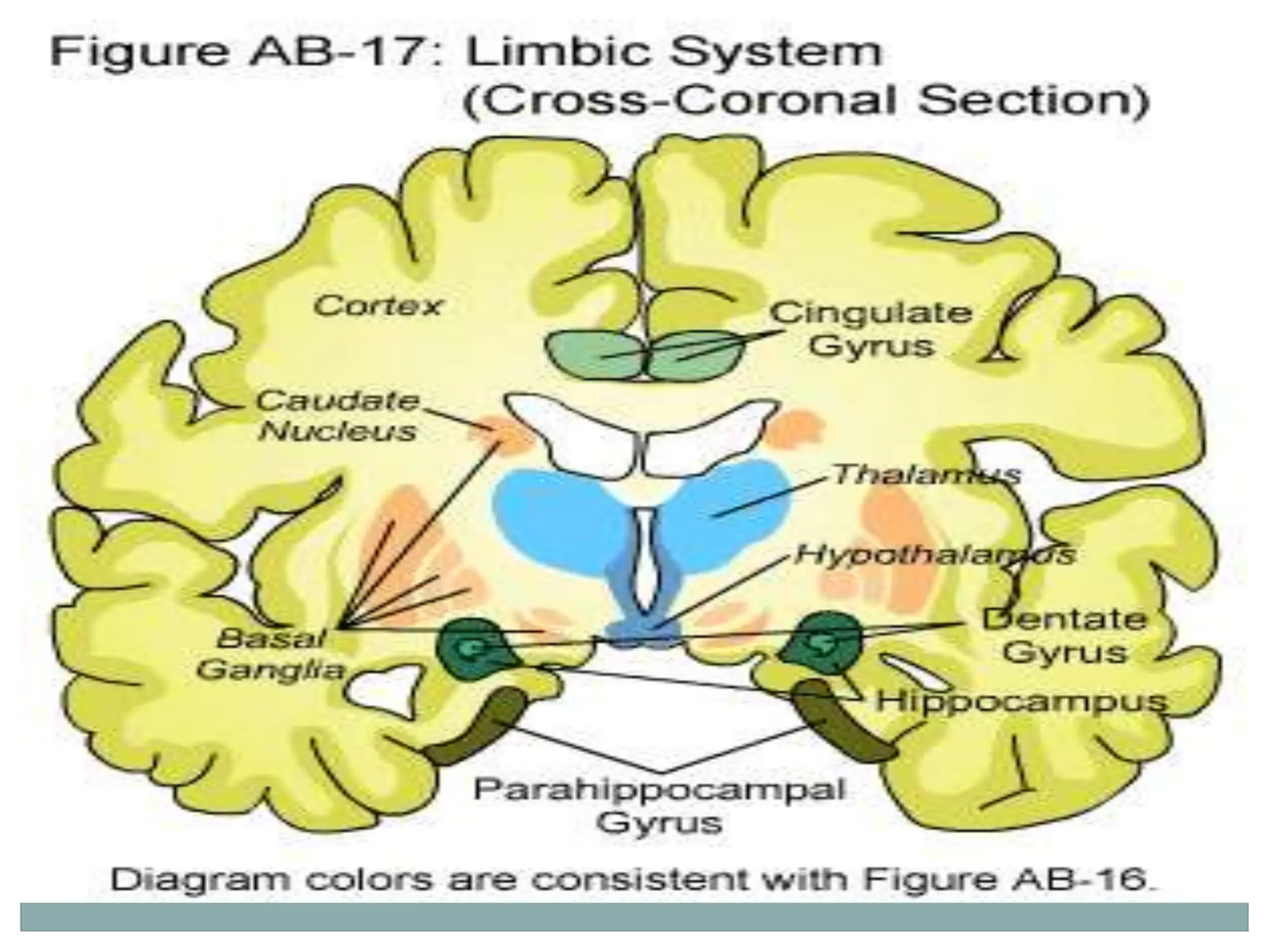
Parts of limbic system
Parts mostly listed are
 Limbic cortex—the cingulate and the
parahippocampal gyri
 The hippocampal formation– the dentate gyrus, the
hippocampus, the subicular complex.
 The amygdala
 The septal area
 The hypothalamus, the related thalamic(ant) and
cortical areas
 Other parts included are--- insula, entorhinal
cortex, nucleus accumbens
No unanimity exists on brain structures that constitute
the LS
History of concept of the limbic system 1
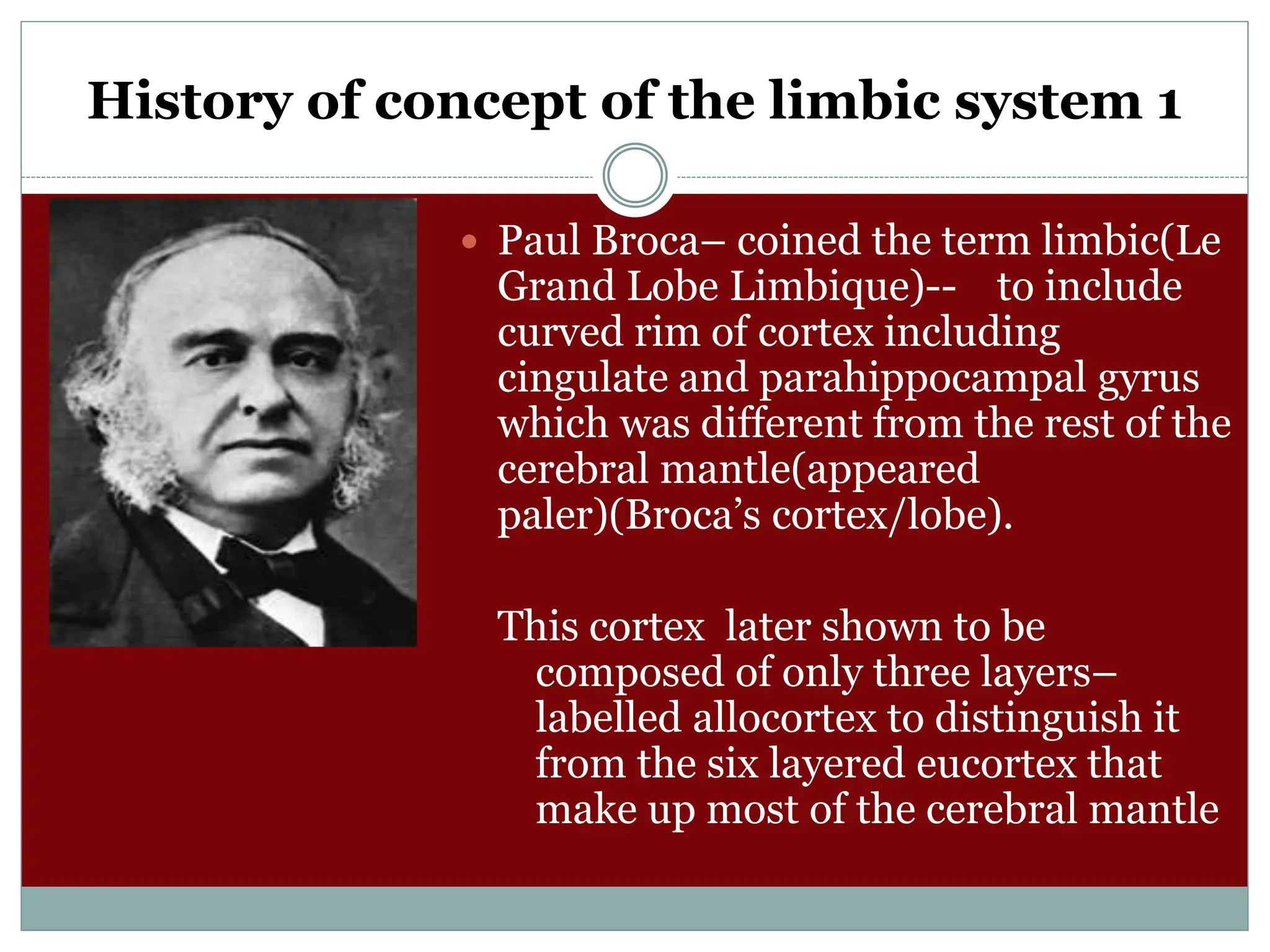
 Paul Broca– coined the term limbic(Le
Grand Lobe Limbique)-- to include
curved rim of cortex including
cingulate and parahippocampal gyrus
which was different from the rest of the
cerebral mantle(appeared
paler)(Broca’s cortex/lobe).
This cortex later shown to be
composed of only three layers–
labelled allocortex to distinguish it
from the six layered eucortex that
make up most of the cerebral mantle
History of concept of the limbic
system 2
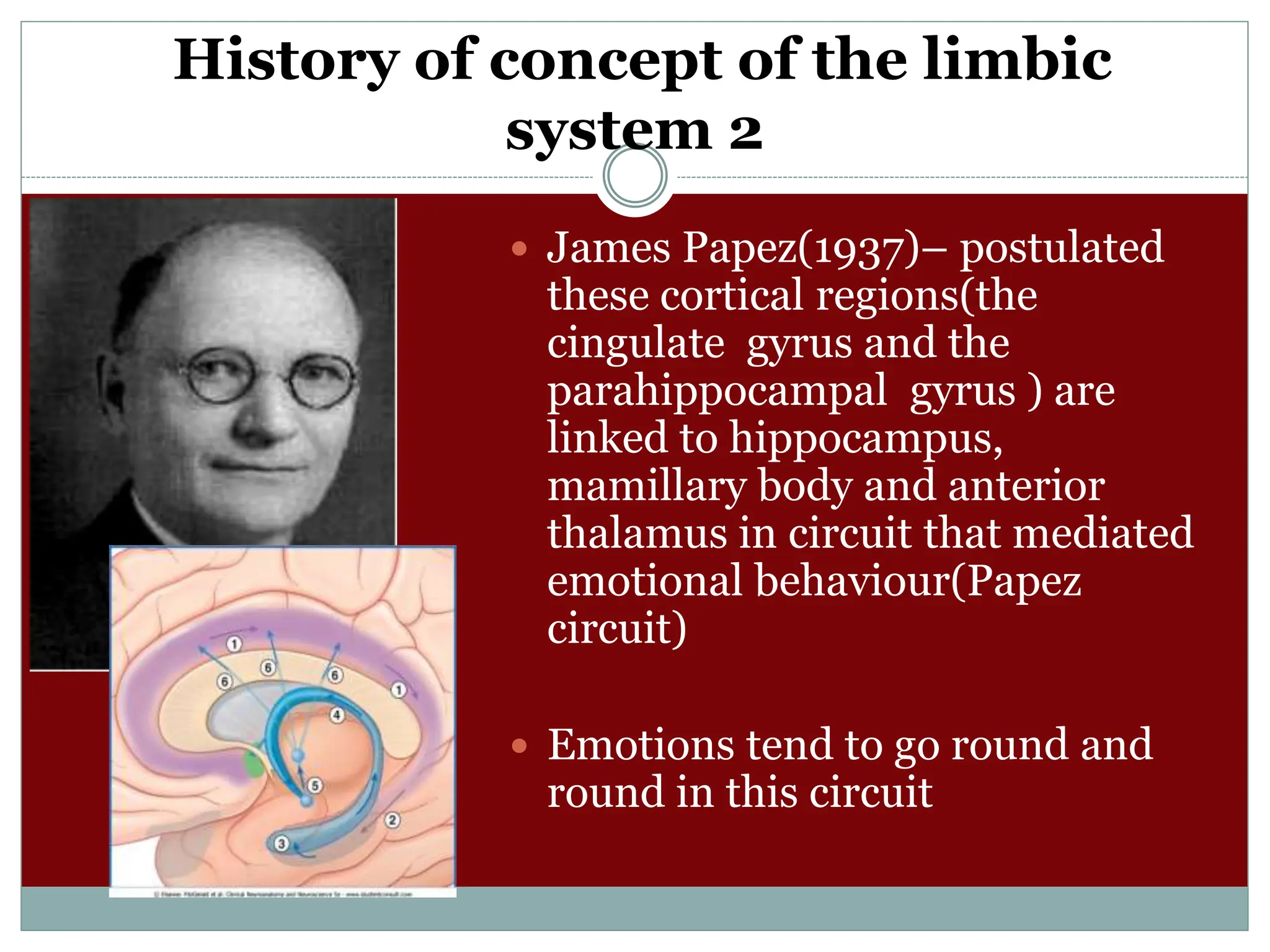
 James Papez(1937)– postulated
these cortical regions(the
cingulate gyrus and the
parahippocampal gyrus ) are
linked to hippocampus,
mamillary body and anterior
thalamus in circuit that mediated
emotional behaviour(Papez
circuit)
 Emotions tend to go round and
round in this circuit
History of concept of the LS 3
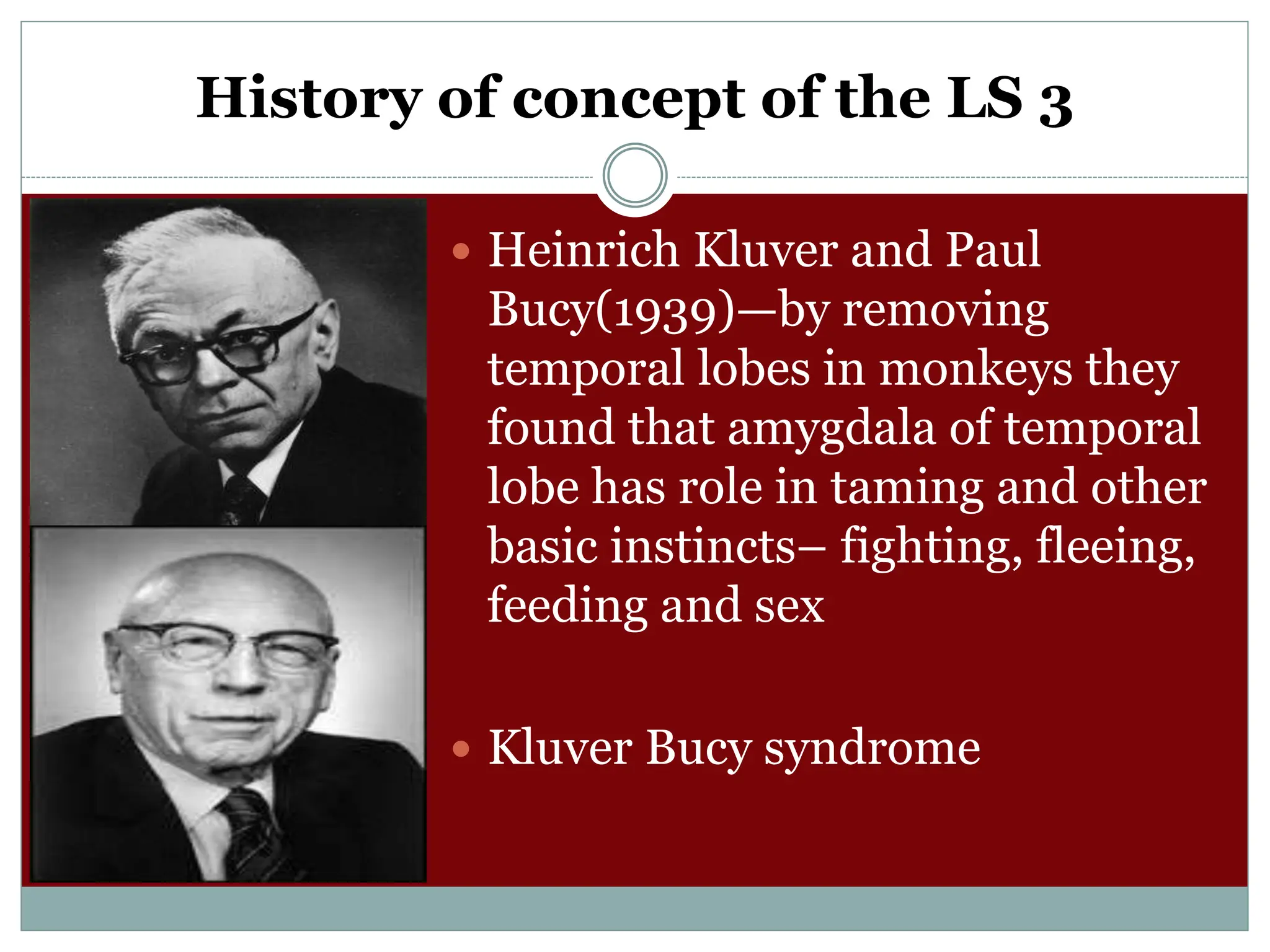
 Heinrich Kluver and Paul
Bucy(1939)—by removing
temporal lobes in monkeys they
found that amygdala of temporal
lobe has role in taming and other
basic instincts– fighting, fleeing,
feeding and sex
 Kluver Bucy syndrome
History of concept of the LS 4
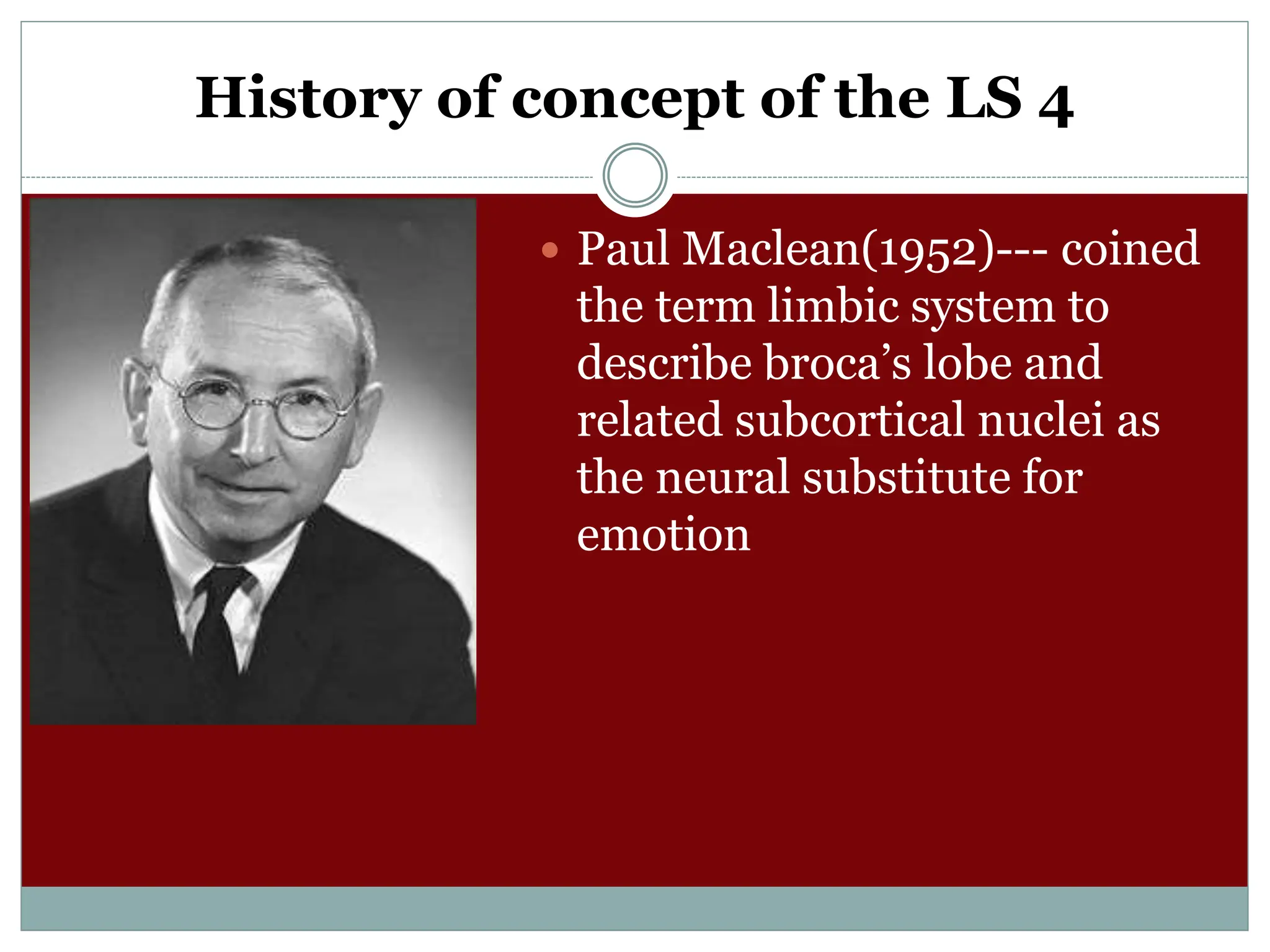
 Paul Maclean(1952)--- coined
the term limbic system to
describe broca’s lobe and
related subcortical nuclei as
the neural substitute for
emotion
History of concept of limbic system 5
 Originally term limbic system encompassed only
Broca’s cortex and Papez’s circuitry and later
amygdala is included
 Further, the functions of amygdala and
hippocampal system proved to have more to do
with attention and formation of specific memories
than with emotions
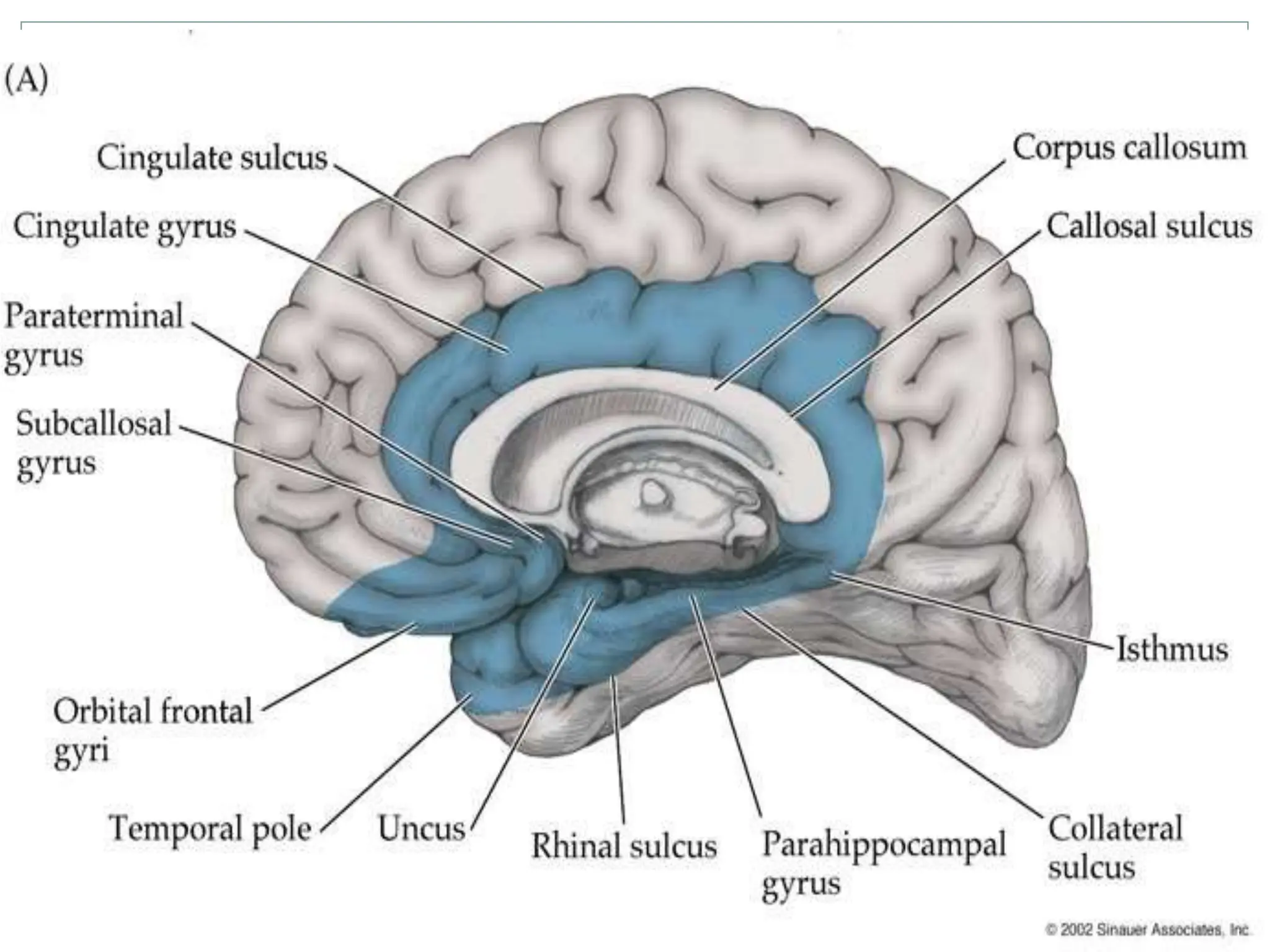
The Cingulate gyrus
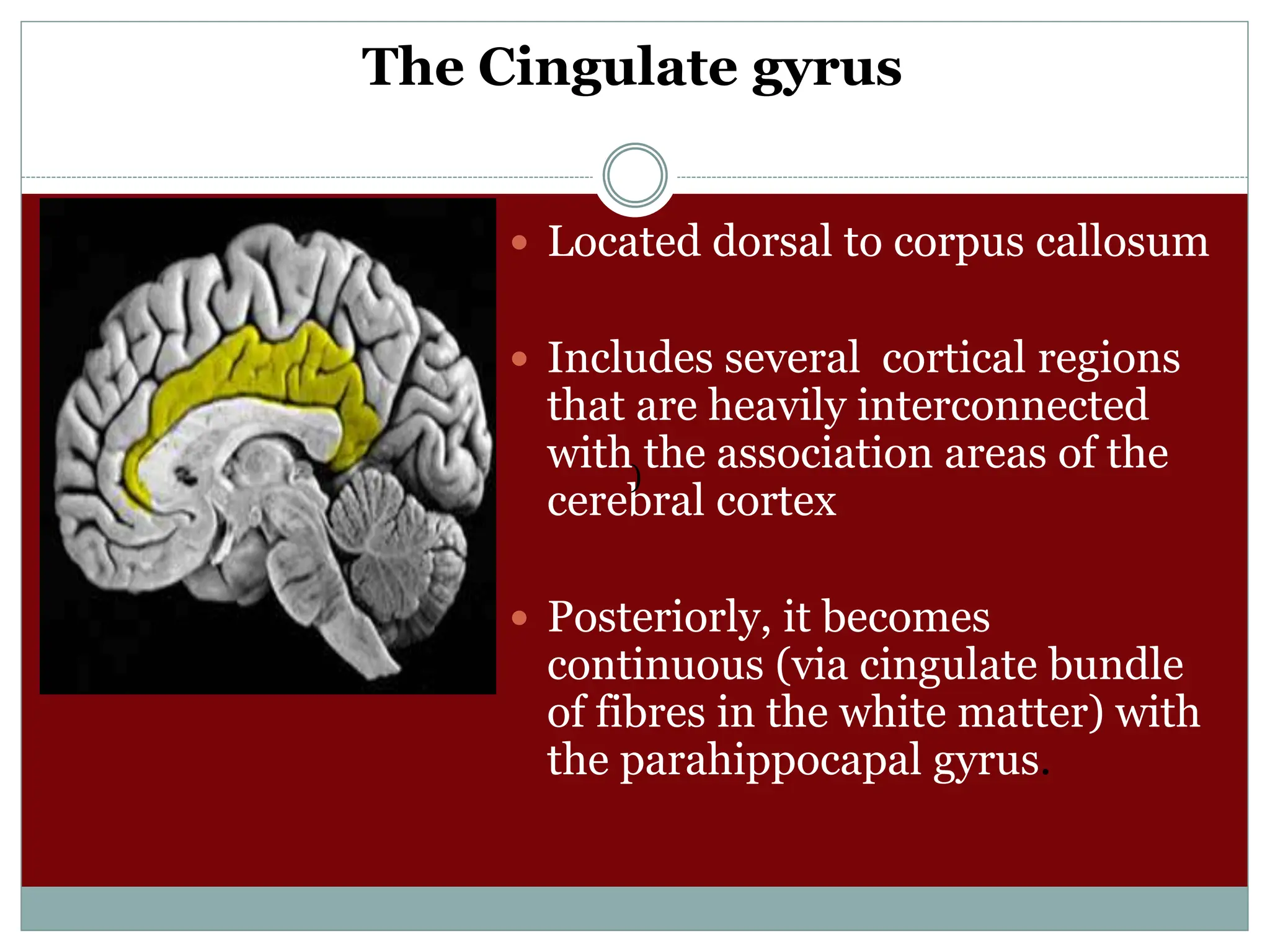
 Located dorsal to corpus callosum
 Includes several cortical regions
that are heavily interconnected
with the association areas of the
cerebral cortex
 Posteriorly, it becomes
continuous (via cingulate bundle
of fibres in the white matter) with
the parahippocapal gyrus.
)
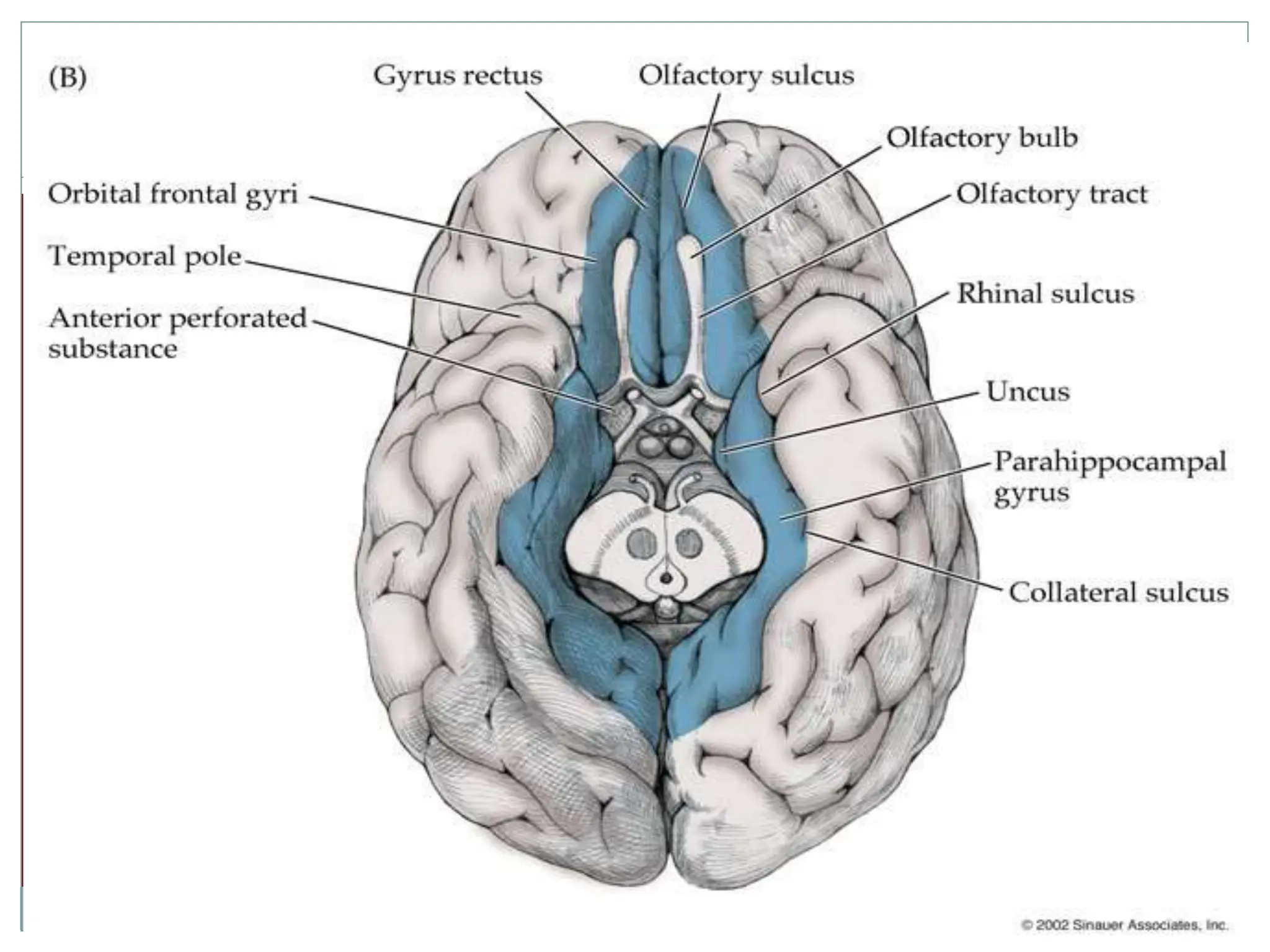
The Parahippocampal gyrus
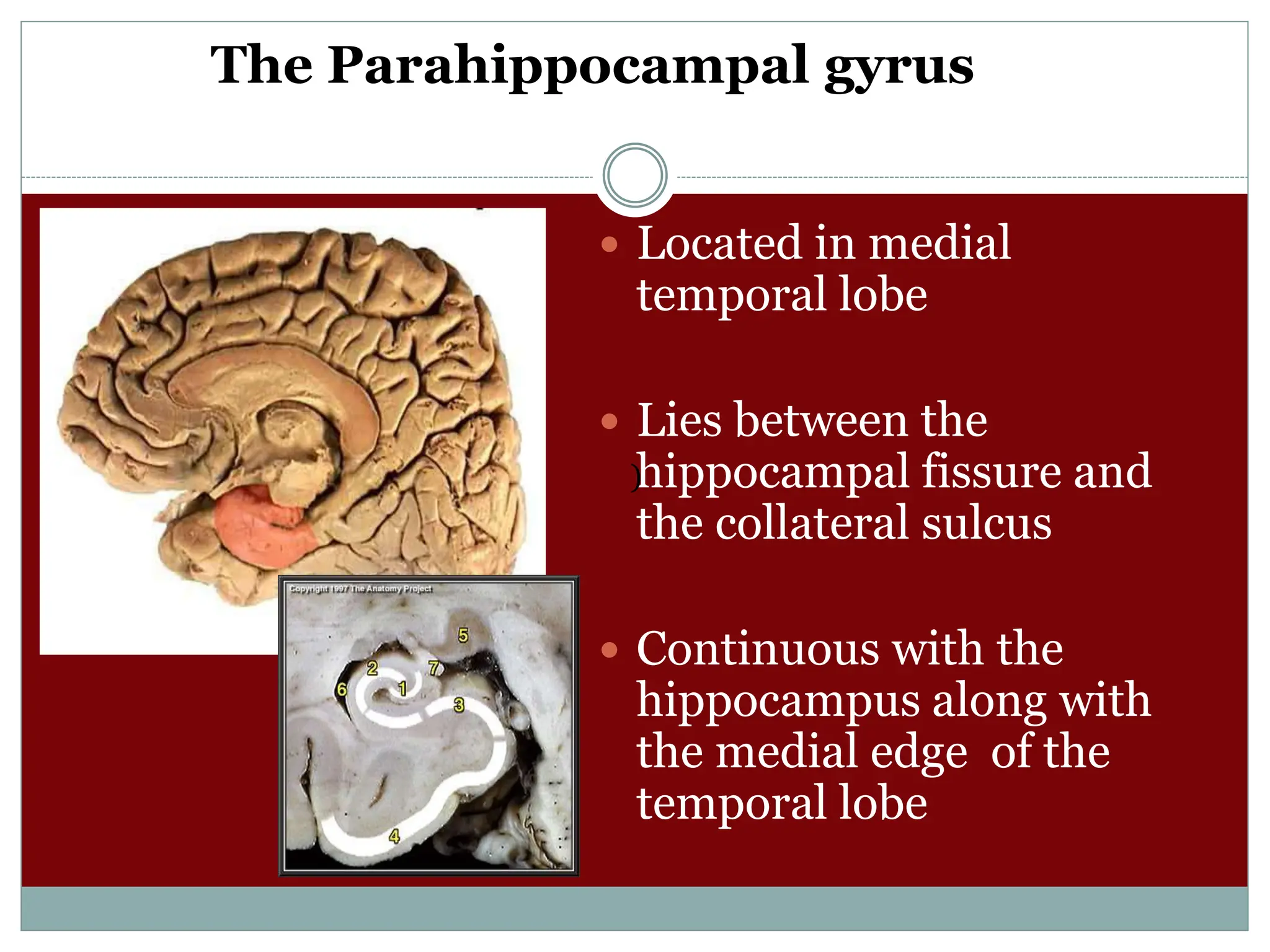
 Located in medial
temporal lobe
 Lies between the
hippocampal fissure and
the collateral sulcus
 Continuous with the
hippocampus along with
the medial edge of the
temporal lobe
)
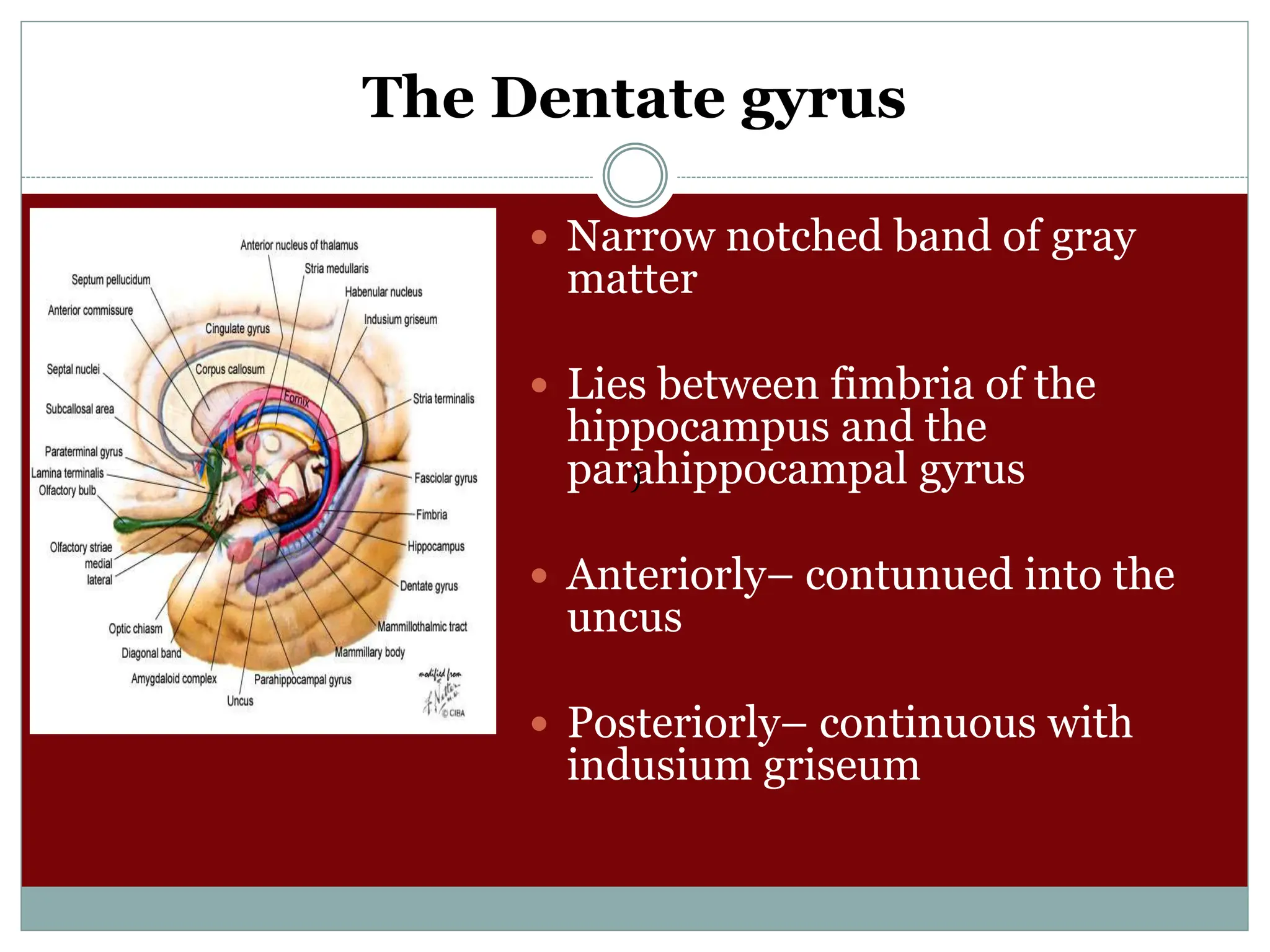
The Dentate gyrus
 Narrow notched band of gray
matter
 Lies between fimbria of the
hippocampus and the
parahippocampal gyrus
 Anteriorly– contunued into the
uncus
 Posteriorly– continuous with
indusium griseum
)
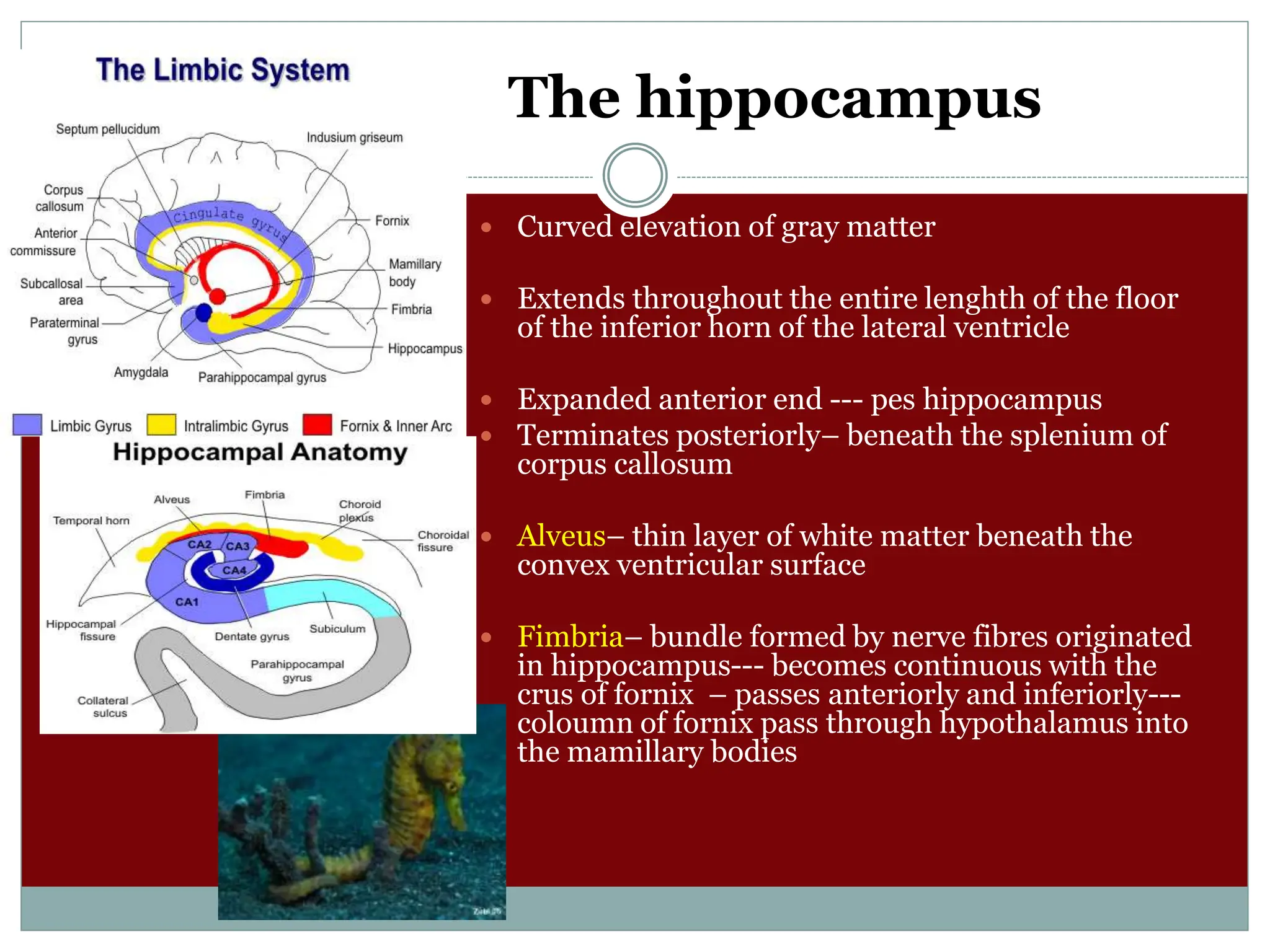
The hippocampus
 Curved elevation of gray matter
 Extends throughout the entire lenghth of the floor
of the inferior horn of the lateral ventricle
 Expanded anterior end --- pes hippocampus
 Terminates posteriorly– beneath the splenium of
corpus callosum
 Alveus– thin layer of white matter beneath the
convex ventricular surface
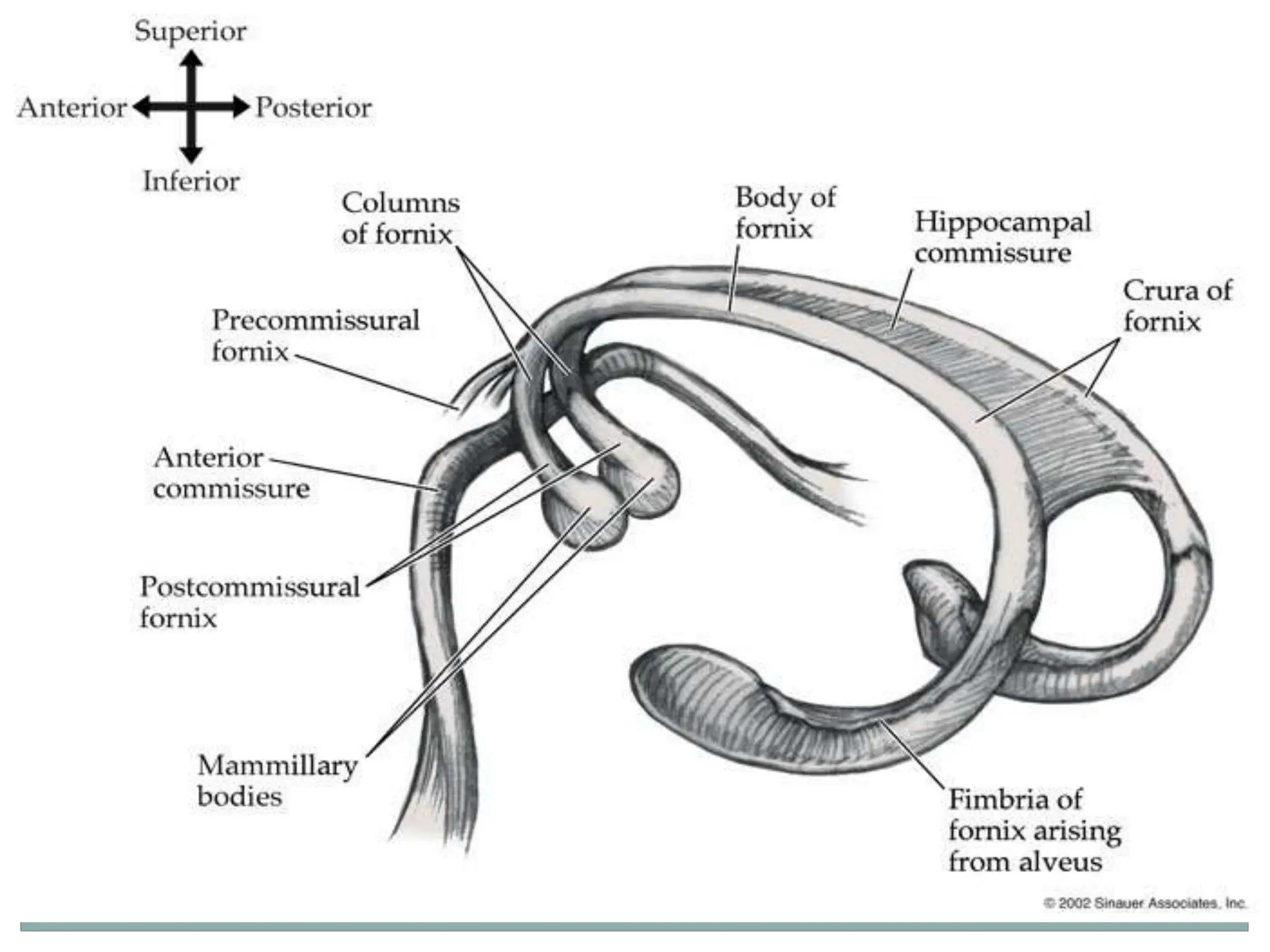
 Fimbria– bundle formed by nerve fibres originated
in hippocampus--- becomes continuous with the
crus of fornix – passes anteriorly and inferiorly---
coloumn of fornix pass through hypothalamus into
the mamillary bodies
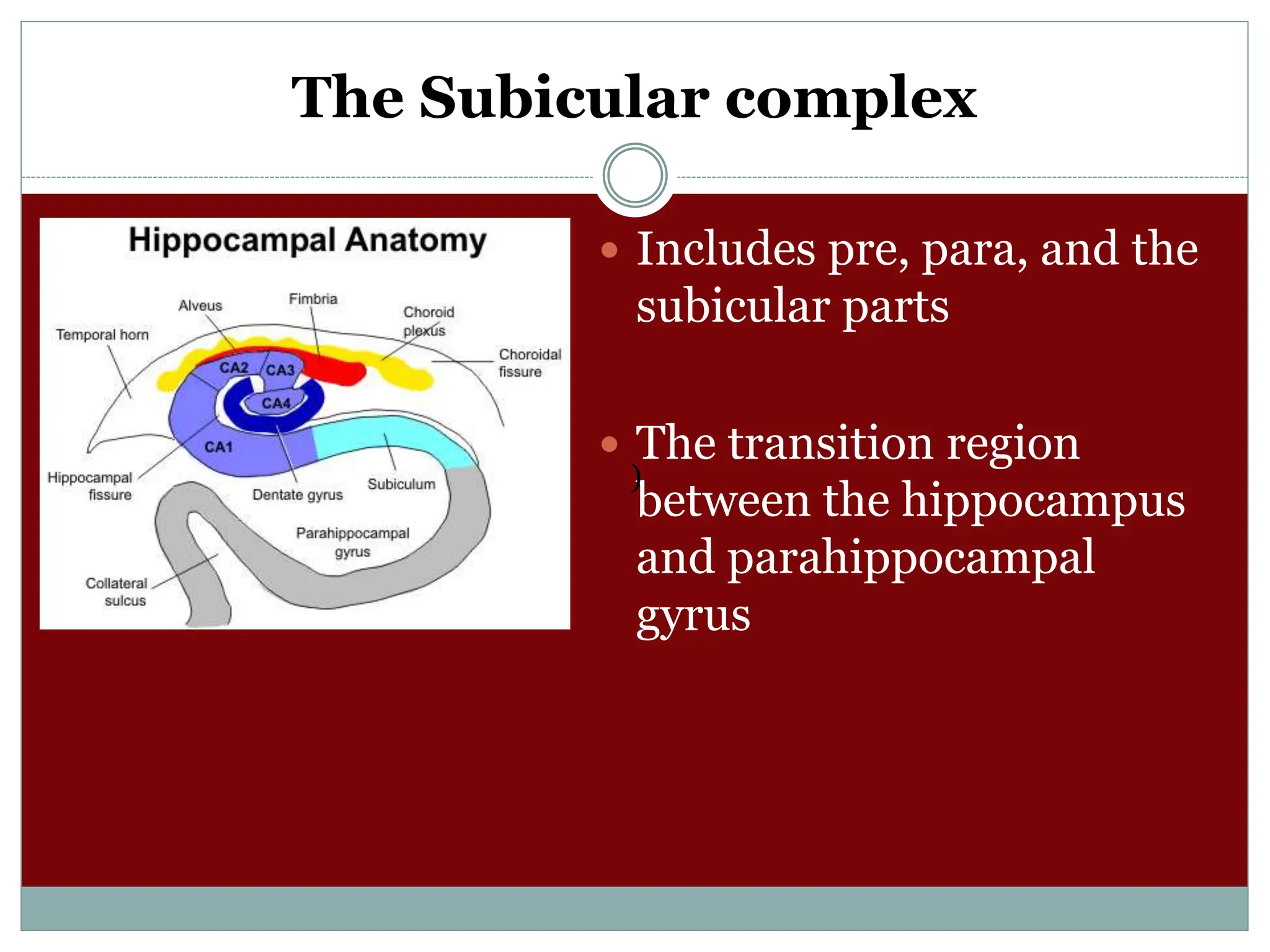
The Subicular complex
 Includes pre, para, and the
subicular parts
 The transition region
between the hippocampus
and parahippocampal
gyrus
)
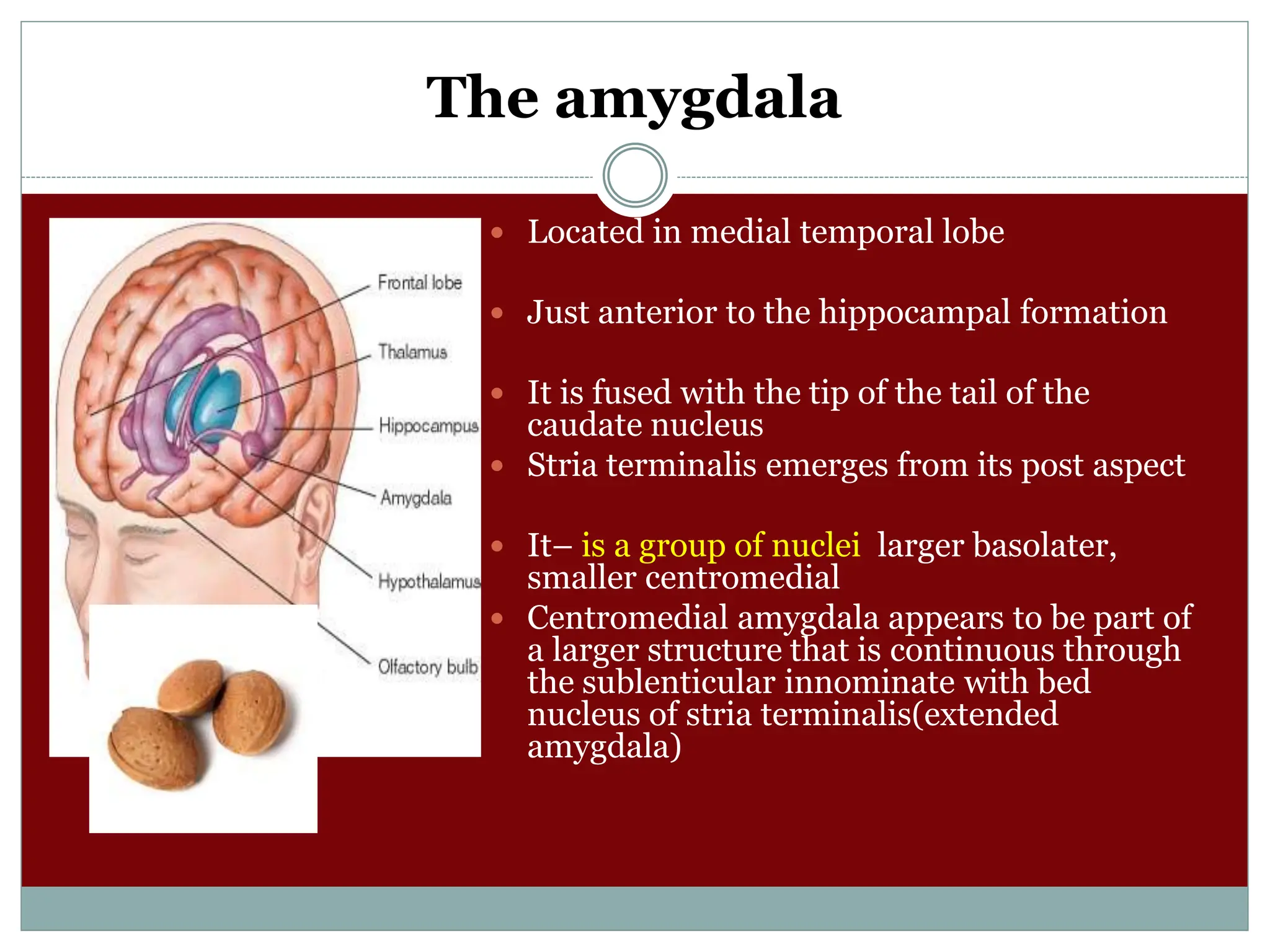
The amygdala
 Located in medial temporal lobe
 Just anterior to the hippocampal formation
 It is fused with the tip of the tail of the
caudate nucleus
 Stria terminalis emerges from its post aspect
 It– is a group of nuclei larger basolater,
smaller centromedial
 Centromedial amygdala appears to be part of
a larger structure that is continuous through
the sublenticular innominate with bed
nucleus of stria terminalis(extended
amygdala)
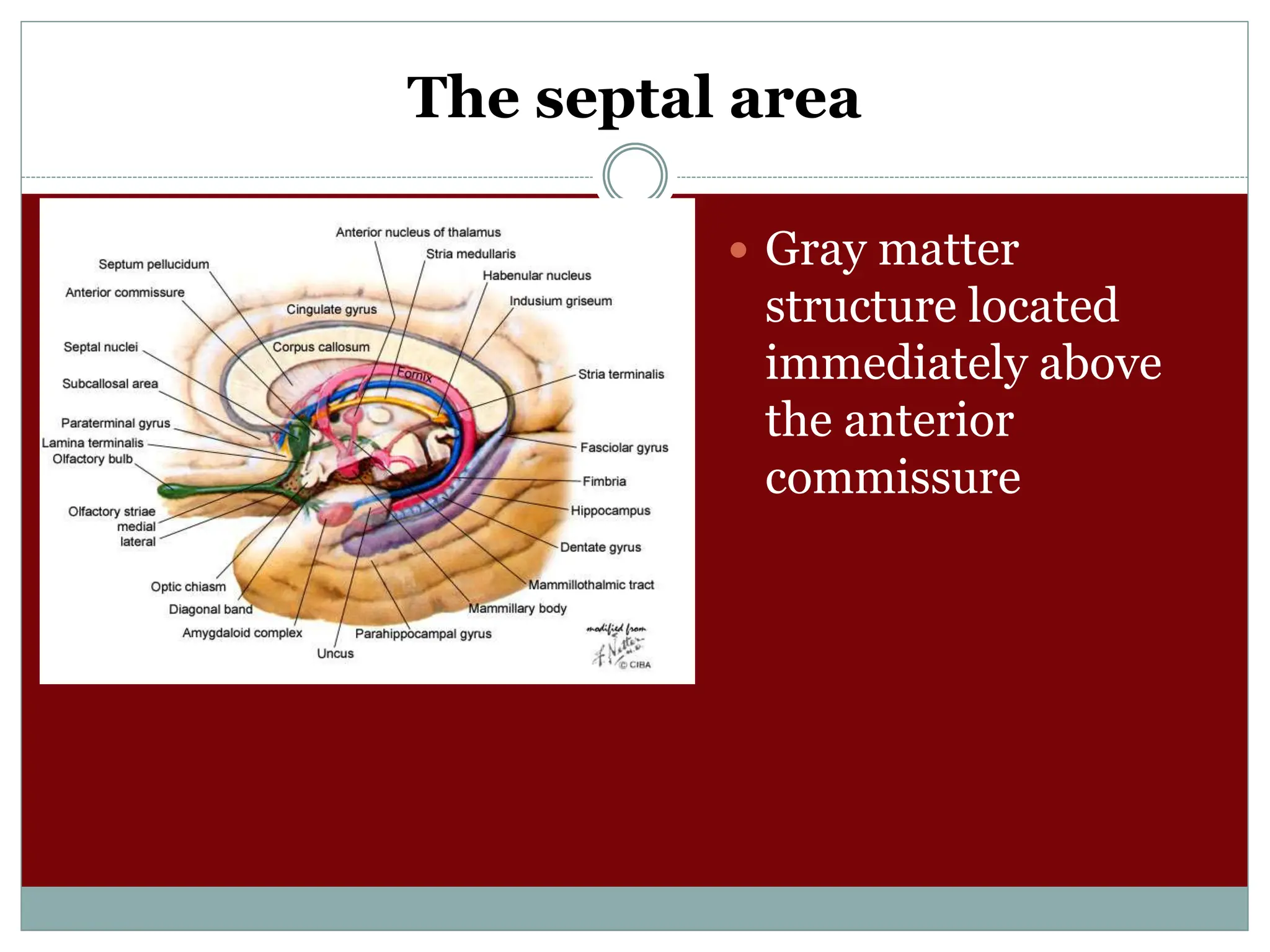
The septal area
 Gray matter
structure located
immediately above
the anterior
commissure
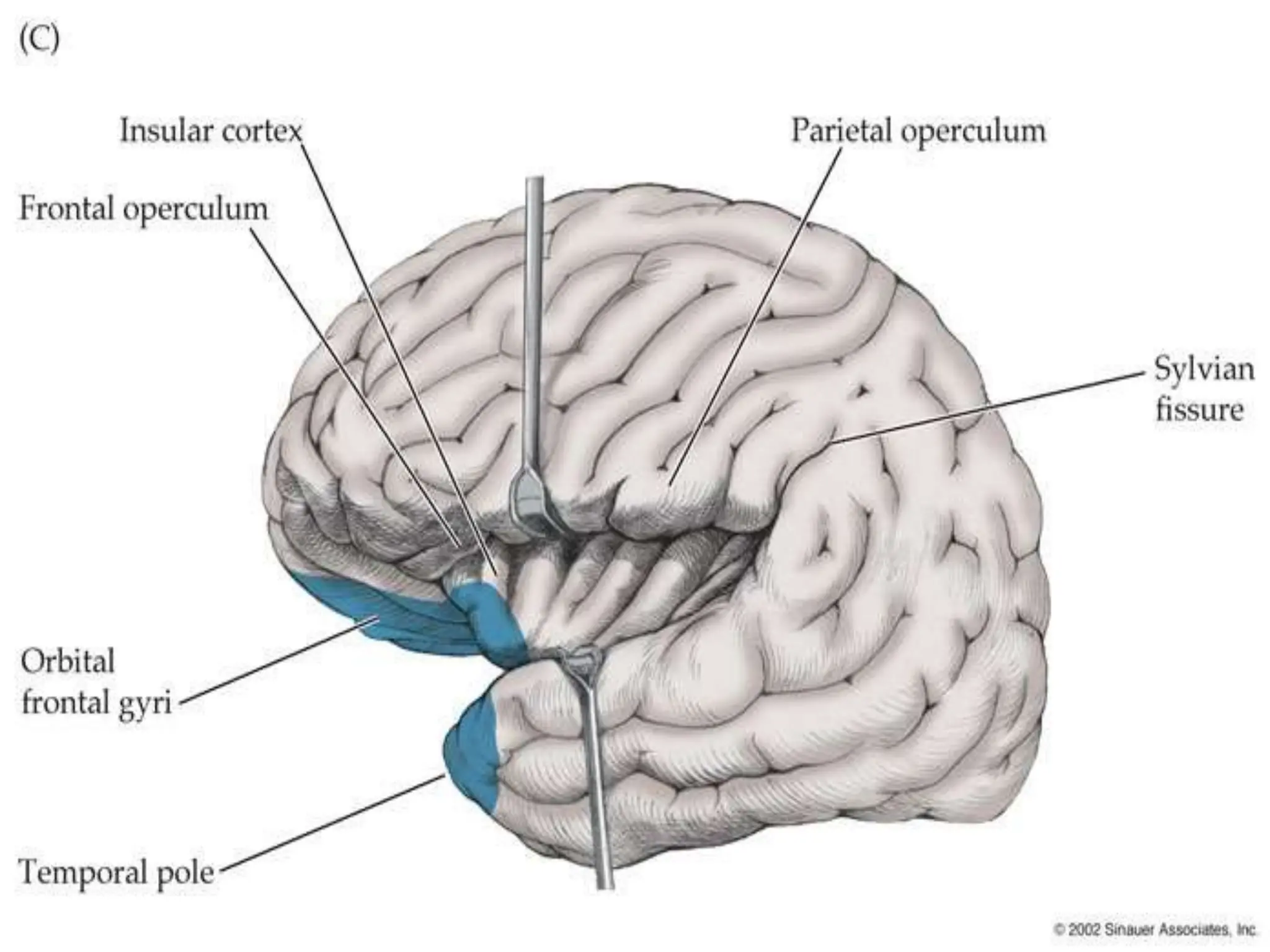
The insula
 Medial cortical gyrus located
between the amygdala and the
frontal lobe
)
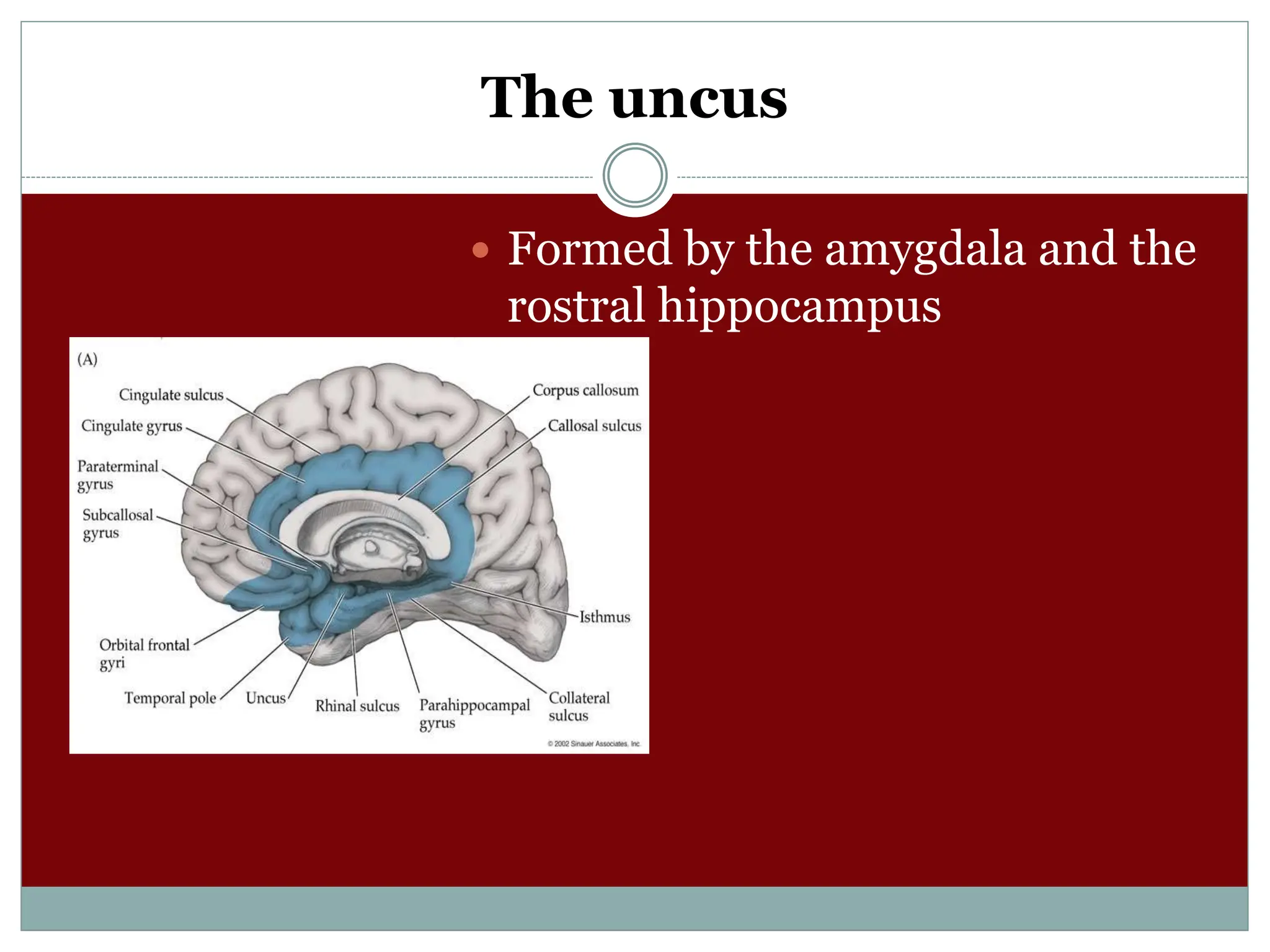
The uncus
 Formed by the amygdala and the
rostral hippocampus
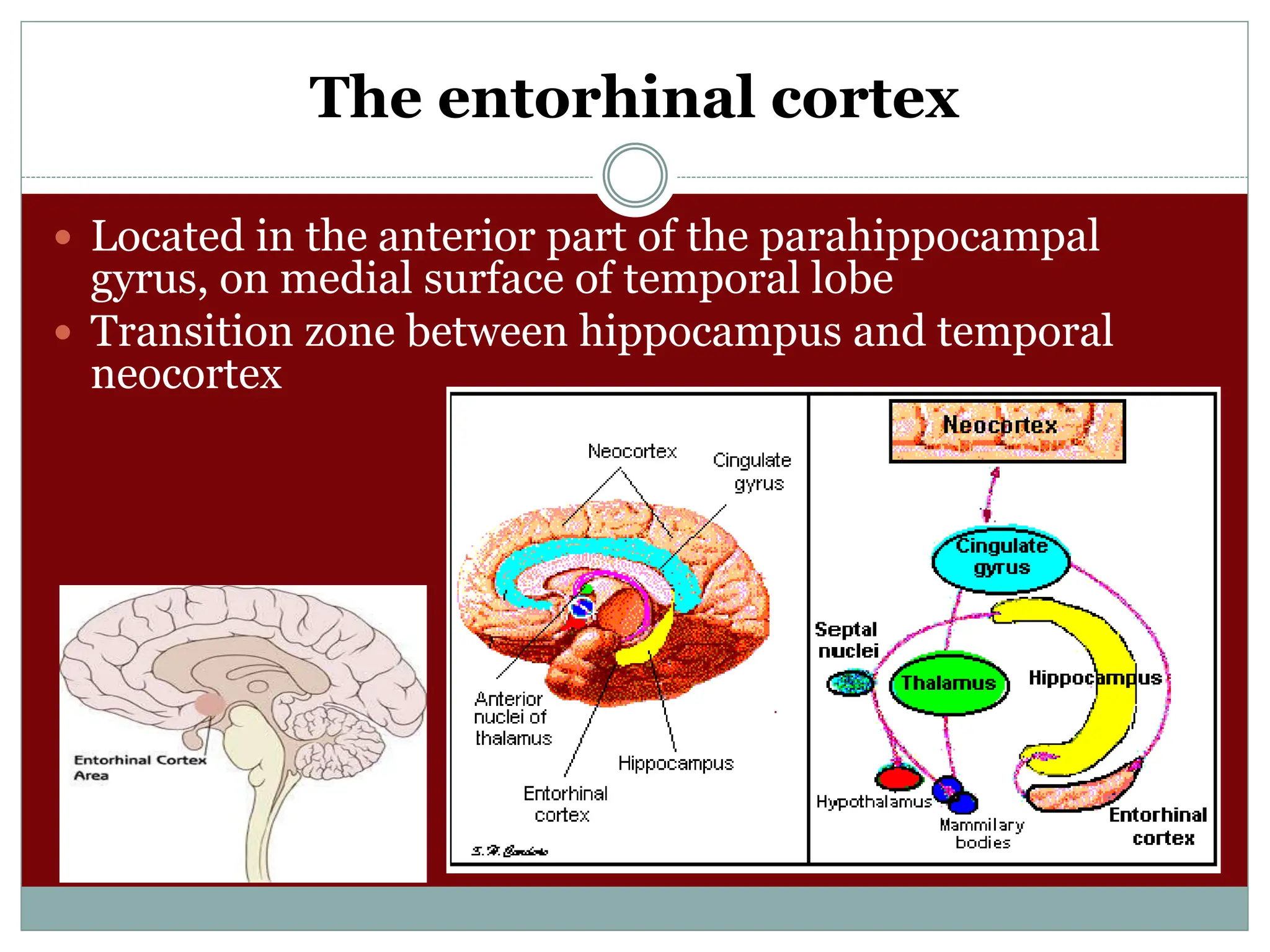
The entorhinal cortex
 Located in the anterior part of the parahippocampal
gyrus, on medial surface of temporal lobe
 Transition zone between hippocampus and temporal
neocortex
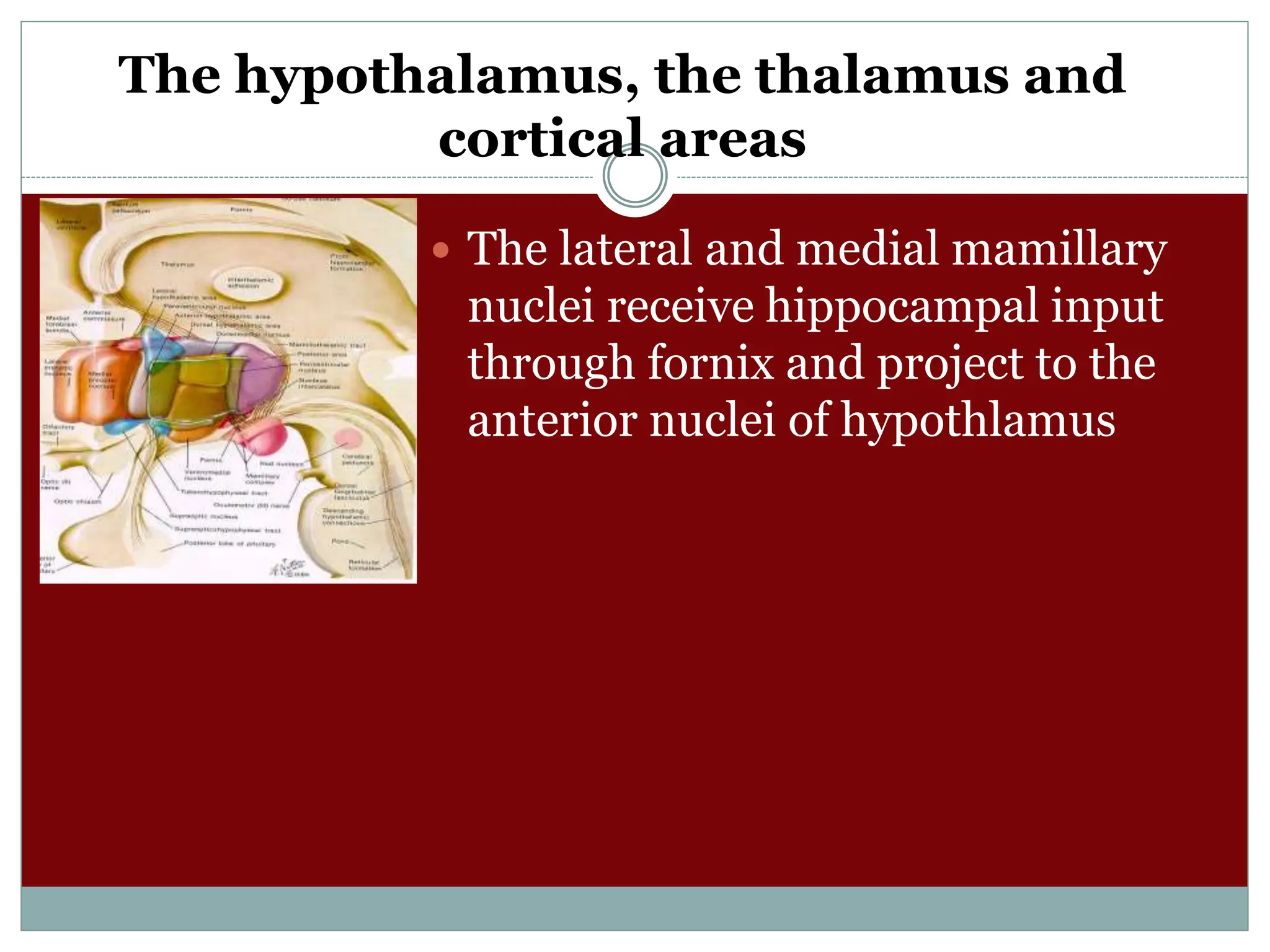
The hypothalamus, the thalamus and
cortical areas
 The lateral and medial mamillary
nuclei receive hippocampal input
through fornix and project to the
anterior nuclei of hypothlamus
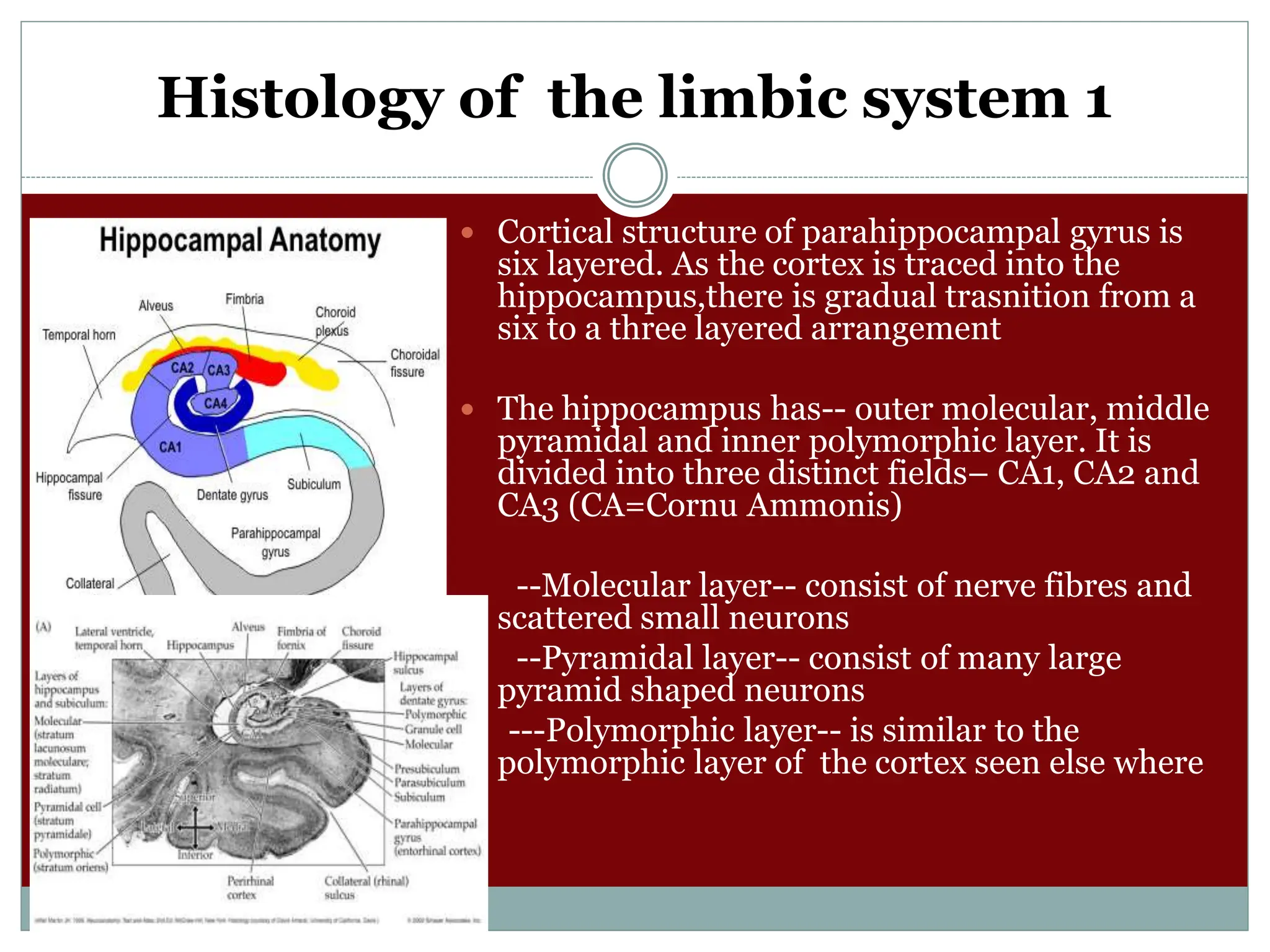
Histology of the limbic system 1
 Cortical structure of parahippocampal gyrus is
six layered. As the cortex is traced into the
hippocampus,there is gradual trasnition from a
six to a three layered arrangement
 The hippocampus has-- outer molecular, middle
pyramidal and inner polymorphic layer. It is
divided into three distinct fields– CA1, CA2 and
CA3 (CA=Cornu Ammonis)
--Molecular layer-- consist of nerve fibres and
scattered small neurons
--Pyramidal layer-- consist of many large
pyramid shaped neurons
---Polymorphic layer-- is similar to the
polymorphic layer of the cortex seen else where
Histology of limbic system 2
 The dentate gyrus comprises three layers– outer acellular
molecular, middle granular and inner polymorphic layer.
Pyramidal layer is replaced by the granular layer
---Granular layer is composed of densely arranged
rounded or oval neurons that give rise to axons that
terminate upon the dendrites of the pyramidal cells in
hippocampus
 Basolateral nuclei of amygdala– have connectivity and
some other anatomical characteristics similar to cortical
region
Histology of limbic system 3
 John Allman and Giacomo
Rizzolatti identified the limbic
spindle cells and mirror cells the
undergrid prosocial mentation
 Spindle cells(Von Economo)–20
times more in humans than apes---
concentrated in ant cingulate
gyrus, prefrontal cortex, the insula-
-- central to governance of social
emotion and moral judgement
Histology of limbic system 4
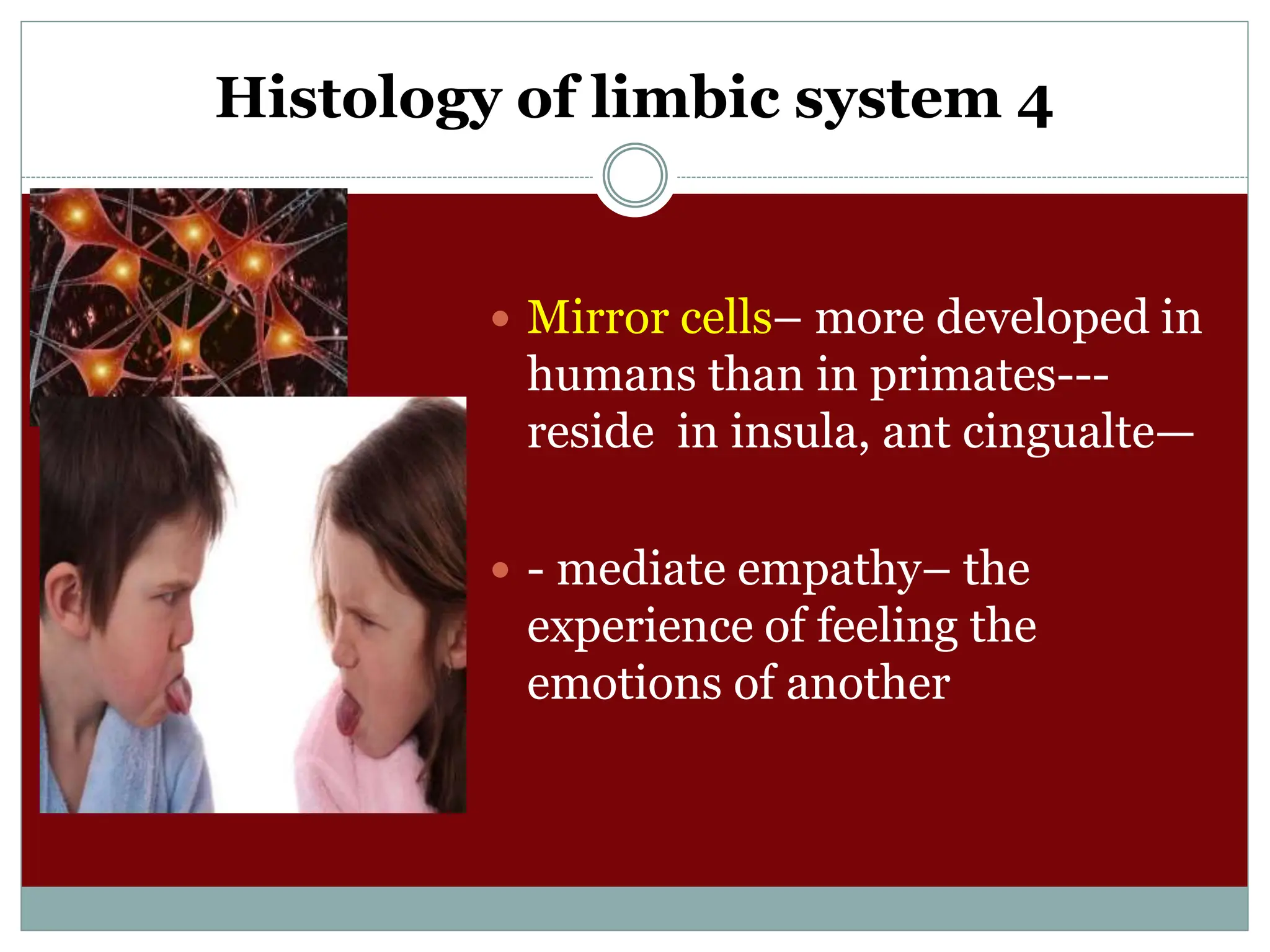
 Mirror cells– more developed in
humans than in primates---
reside in insula, ant cingualte—
 - mediate empathy– the
experience of feeling the
emotions of another
Connections of the limbic system 1
 The major structures of limbic system are
interconnected with each other and with other
components of nervous system in various ways.
 In generel, it is area of intimate processing between
hypothalamus and cortical information processing
 The connecting pathways of limbic system are– the
alveus, the fimbriae, the fornix, the mamillothalamic
tract, and the stria terminalis
Connections of limbic system 2
 Entorhinal cortex funnesl highly processed cortical
information to the hippocampal formation and dentate
gyrus
 The layers of dentate gyrus connected each other and
finally project to the hippocampus
 The fields CA3 and CA1 of hippocampus are connected
each other and finally project to subicular complex
Connections of limbic system 3
 Basolateral nuclei of amygdala directly and reciprocally
connected with the temporal, insular and prefrontal
cortices---- n shares bidirectional connctions with the
medial dorsal thalamic nuclei
 Medial amygdaloid nucleus has reciprocal connections
with endocrine portion of hypothalamus
 Lateral part of extended amygdala connected with
brainstem and lateral hypothalamus and receives cortical
limbic region and the basolateral amygdaloid complex
Connections of the LS 4
 The septal area reciprocally connected with the hippocampus,
the amygdala, and the hypothalamus and projects to
numerous structures in the brainstem
 Posterior nuclei of hypothalamus shares reciprocal
connections with extended amygdala
 LS also interacts with components of the basal ganglial
system. Thus functions of basal ganglia extens beyond the
regulation of motor activities
 Limbic system recieves inputs from the smell receptors in the
nose
Functions of the limbic system 1
 The Ls is involved in behaviour required for self-
preservation and the preservation of species
 control over instinctual behaviour regulated by
hypothalamus and brainstem
 Critical in emotions such as fear
 Plays a role is sexual behaviour
 Has special role in memory
Functions of limbic system(ant, post
cingulate) 2
 Ant cingulate -- for integrating affective and motor
behaviour– stimulation of the anterior cingulate
triggers autonomic nervous system
 Excessive stimulation leads to amplification of
emotions and motor responses and may lead to
anxiety, tics, impulsivity, and OCD. Inhibition leads
to akinetic mutism
 Post cingulate is important for visual spatial and
memory functions
Functions of limbic system(amygdala vs
adrenal gland)3
 Anatomy and physiology of the adrenal gland are
reflected in the anatomy and physiology of the
amygdala circuit and hippocampal circuit
 Adrenaline secreted by the adrenal core is processed
by the amygdala system
 Cortisone secreted by adrenal cortex is processed by
the hippocampal formation
Functions of limbic system (functional
divisions) 4
 Rostral limbic system—amygdala, septum,
orbitofrontal cortex, anterior insula, and anterior
cingulate --important for emotions
 Caudal system– hippocampus, posterior
parahippocampal cortex and posterior cingulate --
important for memory and visual spatial functions
The functions of limbic
system(neurotransmitters) 5
 Neurotransmitter system in limbic system include–
dopamine, serotonin, noradrenergic, and cholinergic
systems
The LS (amygdala) in emotions 1
 In generel, amygdala assign emotional significance
to sensory experiences
 Ls directs the hypothalamus to express the motor
and endocrine components of emotional states
The LS (amygdala) in emotions 2
 Emotional experiences and expressions per se are
accompanied and even initiated by body responses
(change in heart and respiratory rate and blood
pressure). The responses waned with repitition as
they become familiar(habituation)
 The amygdala was shown to be important to
processing these experiences.(selective activation of
amygdala=framing effect)
The LS(amygdala) in emotions 3
 The body responses help a person to attain via the
amygdala, a certain kind of memory and that
emotions is due to a challenge to the pattern of that
memory, not the body responses themselves
 Fear is not an expression of an experience per se, but
of a memory based anticipation of pain that may be
realistic and imagined
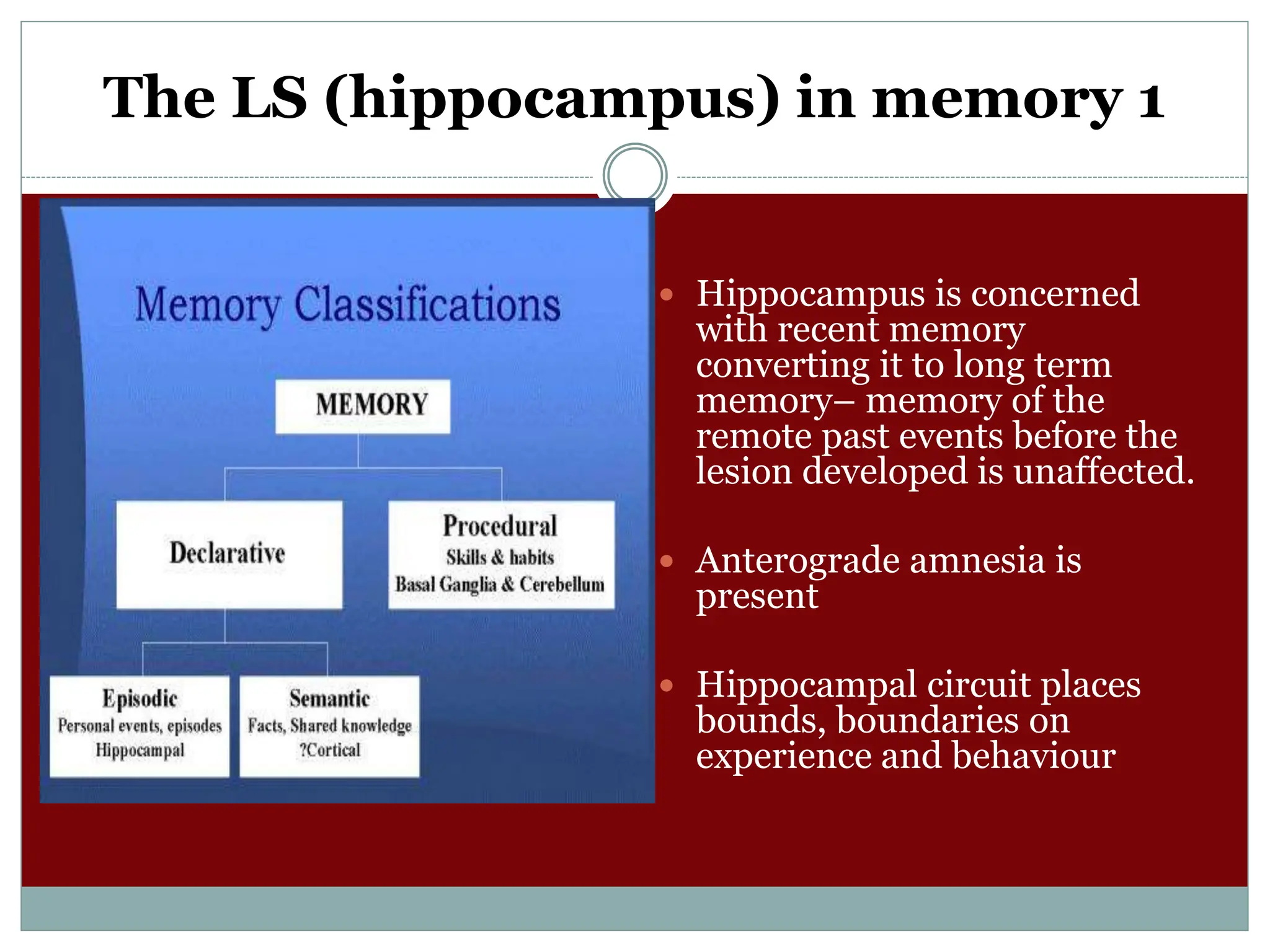
The LS (hippocampus) in memory 1
 Hippocampus is concerned
with recent memory
converting it to long term
memory– memory of the
remote past events before the
lesion developed is unaffected.
 Anterograde amnesia is
present
 Hippocampal circuit places
bounds, boundaries on
experience and behaviour
The LS (hippocamppus) in memory 2
 The hippocampus is important to an organism’s ability to
reset an internal co-ordinate system. This process is critical to
navigation and episodic memory
 While the amygdala is processing what is novel during
habituation, the hippocampus is processing the context within
which habituation is happening: the hippocampus is
processing what is already familiar
 The co-ordinates are constructed by attending to what is not,
at the moment, the focus of navigating our world. Eg: to walk
through a door we must process the walls so as not to bump
into them
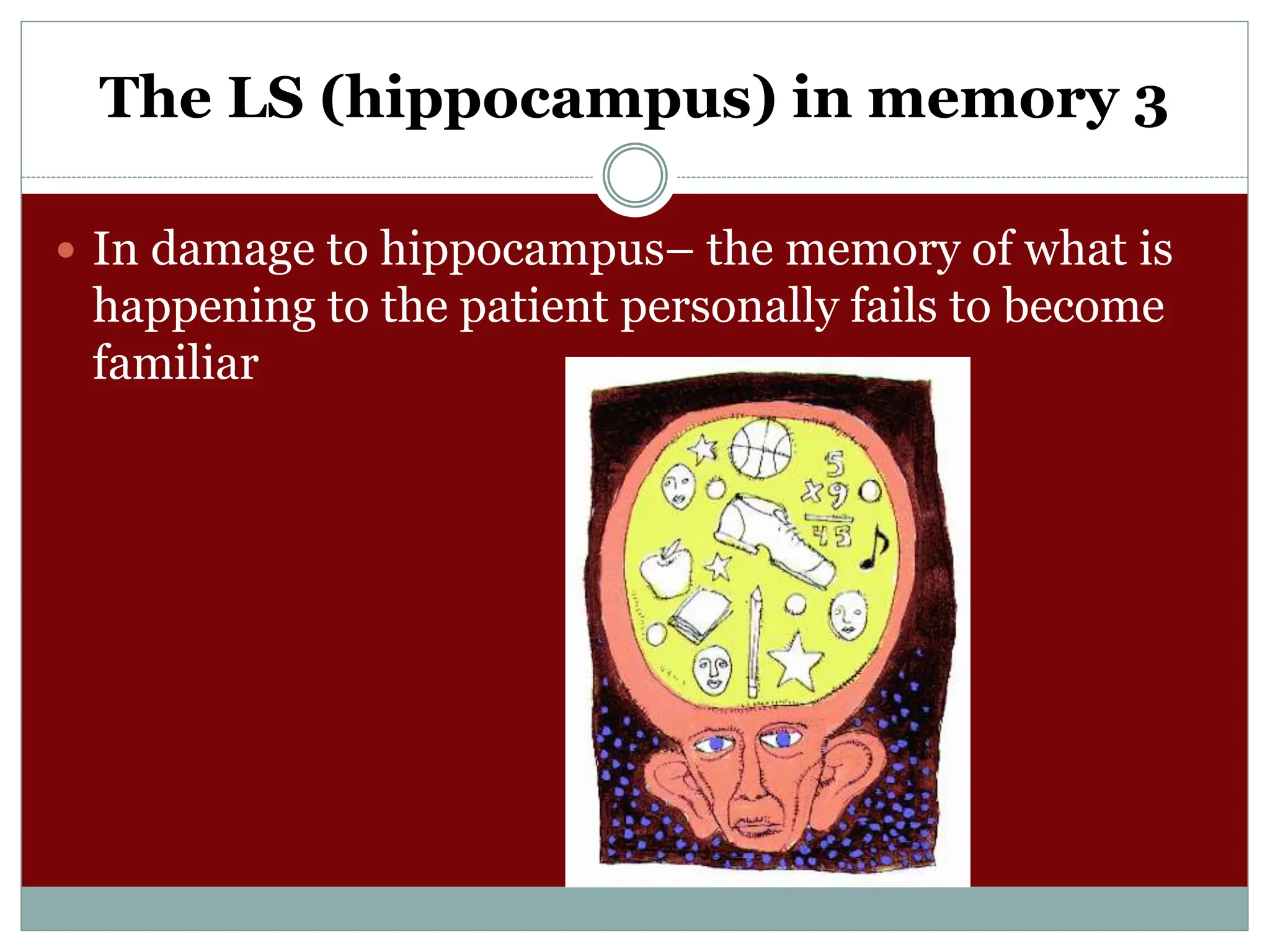
The LS (hippocampus) in memory 3
 In damage to hippocampus– the memory of what is
happening to the patient personally fails to become
familiar
The LS(hippocampus) in motivation and
attidude 1
 The hippocampal circuit brings together emotion
and motivation
---The emotion—the processing of familiarty
---The Motivation– the processing of readiness to
engage the world in practical manner
 Attitudes (emotions plus motivation) are
dispositional states that embody the experience of
the individual
The LS(hippocampus) in motivation and
attitude 2
 Freud’s project for a scientific psychology developed
a theory of motivation based on memory rather than
on drive. Freud noted that motivation are the
prospective aspects of memories
 Papez simply stated that the circuit could account for
attitudes without saying how
The LS in sexual behaviour
 Directly involved in elements of sexual functioning
 Stimulation of various sites of the limbic system have elicited penile
erection.
 Hippocampus– genital tumescence, regulation of release of
gonadotropins.
 Amagdala– in oral and then in genital benaviour
 Olfactory sense is strongly involved in both feeding and mating
 Those areas activated by emotions of fear and anxiety are notably
quiescent when the woman experience an orgasm
The LS in violence behaviour
 The fear is processed in amygdala – stimulation of it elicits
defensive and aggressive responses
 Other parts involved are– hypothalamus and septal area
 The prefrontal cortex allows humans to exercise some control
over their resposes
 Aggressive behaviour have been noted individual with damage
to the medial temporal lobe and with developing brain tumor
in the limbic system
 Frontal lobe injury commonest type in infancy and early
childhood have lifelong consequences
 Case of serial killer Arthur Shawcross
The LS in positive mental health(ant
cingulate and insula) 1
 Both the limbic anterior cingulate and insula appears
to be active in the positive emotions of humor, trust
and empathy
 The prosocial biological activity of the anterior
cingulate cortex and insula was highest in
individiuals with highest level of social awareness---
the biological differences for positive mental health
The LS(ant cingulate gyrus) in positive
mental health 2
 Anterior cingulate gyrus links valence and memory
to create attachment
 Along with the hippocampus, the anterior cingulate
is the brain region most responsible for making the
past meaningful
 Anterior cingulate fMRI images light up when a lover
gazes at a pictures of a partner’s face or when a new
mother hear her infant’s cry
The LD(insula) in positive mental health 3
 Helps to bring visceral feelings into consciousness
 The pain in one’s heart of grief , the warmth in one’s
heart of love, and the tightness in one’s gut from fear
all make their way into consciousness through the
insula
The LS in positive mental
health(hippocampus and amygdala) 4
 fMRI studies of kundalini yoga practitioners
demonstrates-- the meditation activates the activity
of the hippocampus and right lateral amygdala which
in turn leads to parasympathetic stimulation and
sensation of deep peacefulness
The LS in positive mental health(frontal
lobe) 5
 Frontal lobe connectivity to the limbic system
underscores its executive function which includes the
ability to delay gratification, comprehend symbolic
language, and most important, to establish temporal
sequencing
 Frontal lobes through their connection to the
amygdala, hippocampus and other limbic structures
encode emotional learning quite distinct from both
conventional conditioning and declarative memory
The LS in schizophrenia 1
 Because of its role in controlling emotions, the LS has
been hypothesized to be involved in pathophysiology of
schizophrenia
 Limbic activation is diminished
 Abnormally increased limbic activation time(threat
related fascial emotions of anger and fear)
 Antipsychotics block limbic receptors to dopamine as
well as receptors of the extrapyramidal system
The LS in schizophrenia 2
 Neuropathology findings—decrease
in size of regions including the
amygdala the hippocampus and
parahippocmapal gyrus
 Hippocampus is not only smaller,
but is functionally abnormal as
indicated by disturbances in
glutamate transmission
 Disorganisaion of neurons within
the hippocampus has also been
reported
The LS in BPAD
 Hyperactivity and hyperfunction of some limbic and
para limbic areas---including amygdala and ventrial
striation as well as in the cerebellum
The LS is anxiety and OCD
 In addition to receiving noradrenergic and
serotonergic innervation the LS contains highest
concentration of GABA A receptors
 Increased activity of the septohippocampal
pathway—leads to anxiety
 Cingulate gyrus has been particulary implicated in
pathophysiology of OCD
The LS in dementia
Involved in
 Alzheimers disease
 Limbic encephalitis
 Wernick/Korsakoff
 Anoxic encephalopathy
 HSV encephalitis
 Post traumatic amnesia
 Strokes involving PCA or thalamoperforators
 ACOM aneursyms
The LS in Alzhiemers
 Gross– medial temporal lobe atrophy and
hippocampal atrophy most common
 Plaques and tangles most frequently present in
hippocampal and entorhinal cortex
Limbic encephalopathy
 Usually due to metastatic ca of lung
 Marked disturbance of memory for recent events
 Affective disturbance– severe anxiety and depression
 Pathology– combination of degeneration and
inflammation on the medial temporal lobe structures—
the hippocampus, uncus, amygdaloid nucleus, dentate
gyrus, insular and posterior orbital cortex
 Where memory failure is predominat feature the
possibity of limbic encephalopathy should be considered
The LS in Wernicke and Korsakoff
 Caused by B1 deficiency
 Changes involve periventricular areas: medial
thalamus, hypothalamus, mamillary bodies, PAG,
reticular formation
 Lesions show petechial hemorrhages, edema, myelin
loss, and reactive gliosis. Neurons generally
preserved.
The LS in epilepsy n hippocampal
sclerosis
 Hippocampal cell loss can be considered a cause and
consequence of repeated seizures
 Hippocampal sclerosis—seen in 47—70% of all TLE
Limbic epilepsy
 Limbic epilepsy can originate in the amygdala,
hippocampus, entorhinal cortex, cingulate or orbital
frontal cortex
 Pts classically describe fear, déjà vu, jamais vu,
elementary and complex visual hallucinations,
illusions, forced thinking, or emotional distress.
Kluver Bucy syndrome
 Bilateral removal of temporal lobe– amygdala, para
amygdala area
 Features– no evidence of fear or anger, unable to
appreciate object visually, increased appetite,
increased sexual activity- indscriminatly seek
partnership with male, female animals
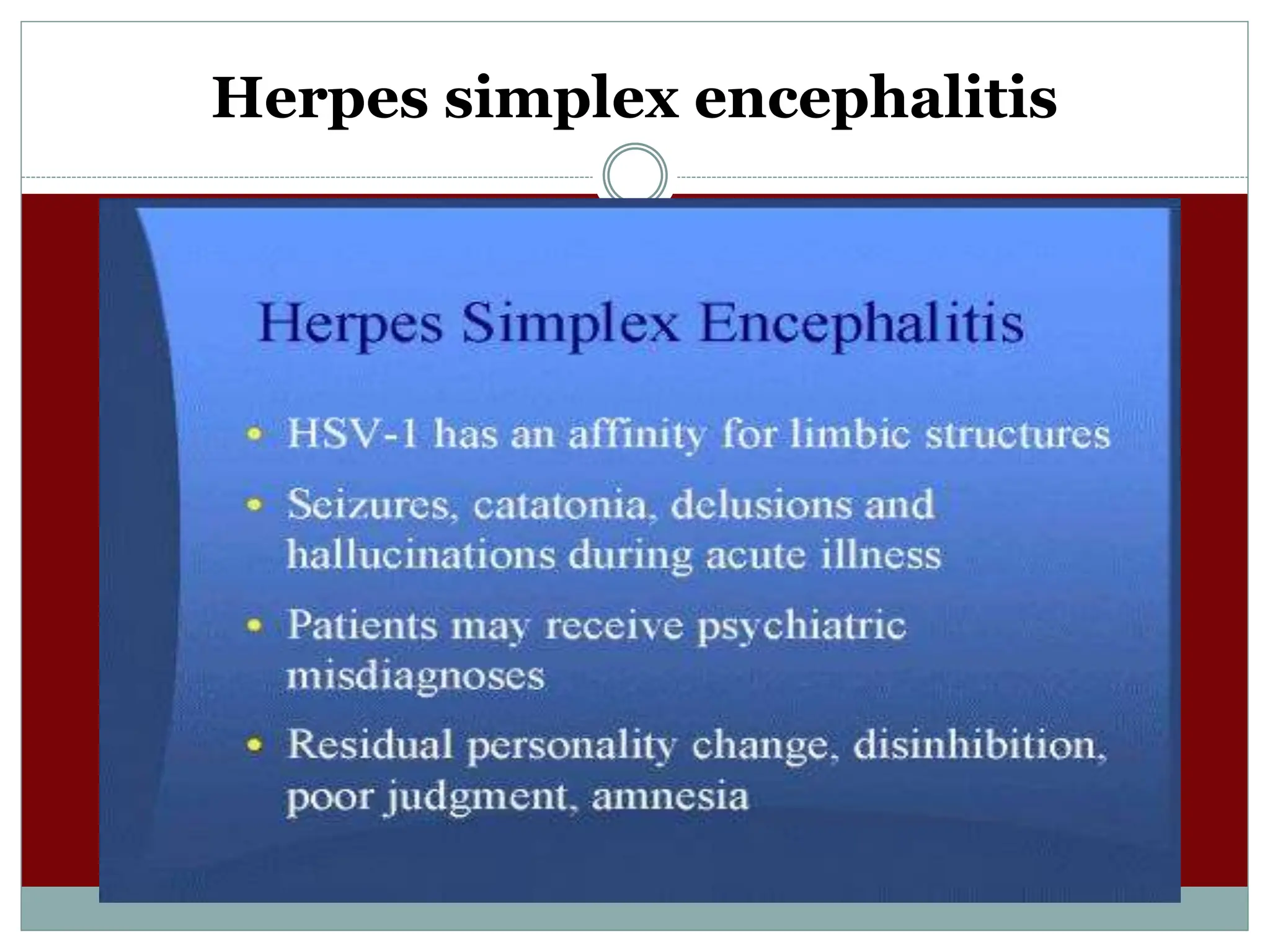
Herpes simplex encephalitis
The LS in psychosurgery
 Stereotactic operations on the amygdaloid nuclei:
decreased emotional excitability
 OCD: cingulotomy, anterior cingulotomy, and limbic
leucotomy may be effective
 Pain: cingulotomy
 Epilepsy:TLE
 Tourette: disconnection of the anterior cingulate from
the thalamus results in improvement of symptoms
References
 Kaplan and saddock’s comprehensinve textbook of
psychiatry 9th ed (2009), lippincott w&w
 Lishman, organic psychiatry
 Snell’s clinical neuroanatomy for medical students
 Ganong’s review of physiology,Lange
 Internet
Thank you

limbicsystem.pptThe limbic system is a group of interconnected brain structures that help regulate your emotions and behavior. The structure
  • 1.
  • 2.
    Scheme of presentation Introduction  Anatomy  Physiology  Applied aspects
  • 3.
    Case of ArthurShawcross
  • 4.
    What is limbicsystem?  It includes structures forming a border between hypothalamus and cerebral cortex.  It is simply functional anatomic system of interconnected cortical and subcortical structures.
  • 5.
    Parts of limbicsystem Parts mostly listed are  Limbic cortex—the cingulate and the parahippocampal gyri  The hippocampal formation– the dentate gyrus, the hippocampus, the subicular complex.  The amygdala  The septal area  The hypothalamus, the related thalamic(ant) and cortical areas  Other parts included are--- insula, entorhinal cortex, nucleus accumbens No unanimity exists on brain structures that constitute the LS
  • 6.
    History of conceptof the limbic system 1  Paul Broca– coined the term limbic(Le Grand Lobe Limbique)-- to include curved rim of cortex including cingulate and parahippocampal gyrus which was different from the rest of the cerebral mantle(appeared paler)(Broca’s cortex/lobe). This cortex later shown to be composed of only three layers– labelled allocortex to distinguish it from the six layered eucortex that make up most of the cerebral mantle
  • 7.
    History of conceptof the limbic system 2  James Papez(1937)– postulated these cortical regions(the cingulate gyrus and the parahippocampal gyrus ) are linked to hippocampus, mamillary body and anterior thalamus in circuit that mediated emotional behaviour(Papez circuit)  Emotions tend to go round and round in this circuit
  • 8.
    History of conceptof the LS 3  Heinrich Kluver and Paul Bucy(1939)—by removing temporal lobes in monkeys they found that amygdala of temporal lobe has role in taming and other basic instincts– fighting, fleeing, feeding and sex  Kluver Bucy syndrome
  • 9.
    History of conceptof the LS 4  Paul Maclean(1952)--- coined the term limbic system to describe broca’s lobe and related subcortical nuclei as the neural substitute for emotion
  • 10.
    History of conceptof limbic system 5  Originally term limbic system encompassed only Broca’s cortex and Papez’s circuitry and later amygdala is included  Further, the functions of amygdala and hippocampal system proved to have more to do with attention and formation of specific memories than with emotions
  • 11.
    The Cingulate gyrus Located dorsal to corpus callosum  Includes several cortical regions that are heavily interconnected with the association areas of the cerebral cortex  Posteriorly, it becomes continuous (via cingulate bundle of fibres in the white matter) with the parahippocapal gyrus. )
  • 12.
    The Parahippocampal gyrus Located in medial temporal lobe  Lies between the hippocampal fissure and the collateral sulcus  Continuous with the hippocampus along with the medial edge of the temporal lobe )
  • 13.
    The Dentate gyrus Narrow notched band of gray matter  Lies between fimbria of the hippocampus and the parahippocampal gyrus  Anteriorly– contunued into the uncus  Posteriorly– continuous with indusium griseum )
  • 14.
    The hippocampus  Curvedelevation of gray matter  Extends throughout the entire lenghth of the floor of the inferior horn of the lateral ventricle  Expanded anterior end --- pes hippocampus  Terminates posteriorly– beneath the splenium of corpus callosum  Alveus– thin layer of white matter beneath the convex ventricular surface  Fimbria– bundle formed by nerve fibres originated in hippocampus--- becomes continuous with the crus of fornix – passes anteriorly and inferiorly--- coloumn of fornix pass through hypothalamus into the mamillary bodies
  • 15.
    The Subicular complex Includes pre, para, and the subicular parts  The transition region between the hippocampus and parahippocampal gyrus )
  • 16.
    The amygdala  Locatedin medial temporal lobe  Just anterior to the hippocampal formation  It is fused with the tip of the tail of the caudate nucleus  Stria terminalis emerges from its post aspect  It– is a group of nuclei larger basolater, smaller centromedial  Centromedial amygdala appears to be part of a larger structure that is continuous through the sublenticular innominate with bed nucleus of stria terminalis(extended amygdala)
  • 17.
    The septal area Gray matter structure located immediately above the anterior commissure
  • 18.
    The insula  Medialcortical gyrus located between the amygdala and the frontal lobe )
  • 19.
    The uncus  Formedby the amygdala and the rostral hippocampus
  • 20.
    The entorhinal cortex Located in the anterior part of the parahippocampal gyrus, on medial surface of temporal lobe  Transition zone between hippocampus and temporal neocortex
  • 21.
    The hypothalamus, thethalamus and cortical areas  The lateral and medial mamillary nuclei receive hippocampal input through fornix and project to the anterior nuclei of hypothlamus
  • 28.
    Histology of thelimbic system 1  Cortical structure of parahippocampal gyrus is six layered. As the cortex is traced into the hippocampus,there is gradual trasnition from a six to a three layered arrangement  The hippocampus has-- outer molecular, middle pyramidal and inner polymorphic layer. It is divided into three distinct fields– CA1, CA2 and CA3 (CA=Cornu Ammonis) --Molecular layer-- consist of nerve fibres and scattered small neurons --Pyramidal layer-- consist of many large pyramid shaped neurons ---Polymorphic layer-- is similar to the polymorphic layer of the cortex seen else where
  • 29.
    Histology of limbicsystem 2  The dentate gyrus comprises three layers– outer acellular molecular, middle granular and inner polymorphic layer. Pyramidal layer is replaced by the granular layer ---Granular layer is composed of densely arranged rounded or oval neurons that give rise to axons that terminate upon the dendrites of the pyramidal cells in hippocampus  Basolateral nuclei of amygdala– have connectivity and some other anatomical characteristics similar to cortical region
  • 30.
    Histology of limbicsystem 3  John Allman and Giacomo Rizzolatti identified the limbic spindle cells and mirror cells the undergrid prosocial mentation  Spindle cells(Von Economo)–20 times more in humans than apes--- concentrated in ant cingulate gyrus, prefrontal cortex, the insula- -- central to governance of social emotion and moral judgement
  • 31.
    Histology of limbicsystem 4  Mirror cells– more developed in humans than in primates--- reside in insula, ant cingualte—  - mediate empathy– the experience of feeling the emotions of another
  • 32.
    Connections of thelimbic system 1  The major structures of limbic system are interconnected with each other and with other components of nervous system in various ways.  In generel, it is area of intimate processing between hypothalamus and cortical information processing  The connecting pathways of limbic system are– the alveus, the fimbriae, the fornix, the mamillothalamic tract, and the stria terminalis
  • 33.
    Connections of limbicsystem 2  Entorhinal cortex funnesl highly processed cortical information to the hippocampal formation and dentate gyrus  The layers of dentate gyrus connected each other and finally project to the hippocampus  The fields CA3 and CA1 of hippocampus are connected each other and finally project to subicular complex
  • 34.
    Connections of limbicsystem 3  Basolateral nuclei of amygdala directly and reciprocally connected with the temporal, insular and prefrontal cortices---- n shares bidirectional connctions with the medial dorsal thalamic nuclei  Medial amygdaloid nucleus has reciprocal connections with endocrine portion of hypothalamus  Lateral part of extended amygdala connected with brainstem and lateral hypothalamus and receives cortical limbic region and the basolateral amygdaloid complex
  • 35.
    Connections of theLS 4  The septal area reciprocally connected with the hippocampus, the amygdala, and the hypothalamus and projects to numerous structures in the brainstem  Posterior nuclei of hypothalamus shares reciprocal connections with extended amygdala  LS also interacts with components of the basal ganglial system. Thus functions of basal ganglia extens beyond the regulation of motor activities  Limbic system recieves inputs from the smell receptors in the nose
  • 36.
    Functions of thelimbic system 1  The Ls is involved in behaviour required for self- preservation and the preservation of species  control over instinctual behaviour regulated by hypothalamus and brainstem  Critical in emotions such as fear  Plays a role is sexual behaviour  Has special role in memory
  • 37.
    Functions of limbicsystem(ant, post cingulate) 2  Ant cingulate -- for integrating affective and motor behaviour– stimulation of the anterior cingulate triggers autonomic nervous system  Excessive stimulation leads to amplification of emotions and motor responses and may lead to anxiety, tics, impulsivity, and OCD. Inhibition leads to akinetic mutism  Post cingulate is important for visual spatial and memory functions
  • 38.
    Functions of limbicsystem(amygdala vs adrenal gland)3  Anatomy and physiology of the adrenal gland are reflected in the anatomy and physiology of the amygdala circuit and hippocampal circuit  Adrenaline secreted by the adrenal core is processed by the amygdala system  Cortisone secreted by adrenal cortex is processed by the hippocampal formation
  • 39.
    Functions of limbicsystem (functional divisions) 4  Rostral limbic system—amygdala, septum, orbitofrontal cortex, anterior insula, and anterior cingulate --important for emotions  Caudal system– hippocampus, posterior parahippocampal cortex and posterior cingulate -- important for memory and visual spatial functions
  • 40.
    The functions oflimbic system(neurotransmitters) 5  Neurotransmitter system in limbic system include– dopamine, serotonin, noradrenergic, and cholinergic systems
  • 41.
    The LS (amygdala)in emotions 1  In generel, amygdala assign emotional significance to sensory experiences  Ls directs the hypothalamus to express the motor and endocrine components of emotional states
  • 42.
    The LS (amygdala)in emotions 2  Emotional experiences and expressions per se are accompanied and even initiated by body responses (change in heart and respiratory rate and blood pressure). The responses waned with repitition as they become familiar(habituation)  The amygdala was shown to be important to processing these experiences.(selective activation of amygdala=framing effect)
  • 43.
    The LS(amygdala) inemotions 3  The body responses help a person to attain via the amygdala, a certain kind of memory and that emotions is due to a challenge to the pattern of that memory, not the body responses themselves  Fear is not an expression of an experience per se, but of a memory based anticipation of pain that may be realistic and imagined
  • 44.
    The LS (hippocampus)in memory 1  Hippocampus is concerned with recent memory converting it to long term memory– memory of the remote past events before the lesion developed is unaffected.  Anterograde amnesia is present  Hippocampal circuit places bounds, boundaries on experience and behaviour
  • 45.
    The LS (hippocamppus)in memory 2  The hippocampus is important to an organism’s ability to reset an internal co-ordinate system. This process is critical to navigation and episodic memory  While the amygdala is processing what is novel during habituation, the hippocampus is processing the context within which habituation is happening: the hippocampus is processing what is already familiar  The co-ordinates are constructed by attending to what is not, at the moment, the focus of navigating our world. Eg: to walk through a door we must process the walls so as not to bump into them
  • 46.
    The LS (hippocampus)in memory 3  In damage to hippocampus– the memory of what is happening to the patient personally fails to become familiar
  • 47.
    The LS(hippocampus) inmotivation and attidude 1  The hippocampal circuit brings together emotion and motivation ---The emotion—the processing of familiarty ---The Motivation– the processing of readiness to engage the world in practical manner  Attitudes (emotions plus motivation) are dispositional states that embody the experience of the individual
  • 48.
    The LS(hippocampus) inmotivation and attitude 2  Freud’s project for a scientific psychology developed a theory of motivation based on memory rather than on drive. Freud noted that motivation are the prospective aspects of memories  Papez simply stated that the circuit could account for attitudes without saying how
  • 49.
    The LS insexual behaviour  Directly involved in elements of sexual functioning  Stimulation of various sites of the limbic system have elicited penile erection.  Hippocampus– genital tumescence, regulation of release of gonadotropins.  Amagdala– in oral and then in genital benaviour  Olfactory sense is strongly involved in both feeding and mating  Those areas activated by emotions of fear and anxiety are notably quiescent when the woman experience an orgasm
  • 50.
    The LS inviolence behaviour  The fear is processed in amygdala – stimulation of it elicits defensive and aggressive responses  Other parts involved are– hypothalamus and septal area  The prefrontal cortex allows humans to exercise some control over their resposes  Aggressive behaviour have been noted individual with damage to the medial temporal lobe and with developing brain tumor in the limbic system  Frontal lobe injury commonest type in infancy and early childhood have lifelong consequences  Case of serial killer Arthur Shawcross
  • 51.
    The LS inpositive mental health(ant cingulate and insula) 1  Both the limbic anterior cingulate and insula appears to be active in the positive emotions of humor, trust and empathy  The prosocial biological activity of the anterior cingulate cortex and insula was highest in individiuals with highest level of social awareness--- the biological differences for positive mental health
  • 52.
    The LS(ant cingulategyrus) in positive mental health 2  Anterior cingulate gyrus links valence and memory to create attachment  Along with the hippocampus, the anterior cingulate is the brain region most responsible for making the past meaningful  Anterior cingulate fMRI images light up when a lover gazes at a pictures of a partner’s face or when a new mother hear her infant’s cry
  • 53.
    The LD(insula) inpositive mental health 3  Helps to bring visceral feelings into consciousness  The pain in one’s heart of grief , the warmth in one’s heart of love, and the tightness in one’s gut from fear all make their way into consciousness through the insula
  • 54.
    The LS inpositive mental health(hippocampus and amygdala) 4  fMRI studies of kundalini yoga practitioners demonstrates-- the meditation activates the activity of the hippocampus and right lateral amygdala which in turn leads to parasympathetic stimulation and sensation of deep peacefulness
  • 55.
    The LS inpositive mental health(frontal lobe) 5  Frontal lobe connectivity to the limbic system underscores its executive function which includes the ability to delay gratification, comprehend symbolic language, and most important, to establish temporal sequencing  Frontal lobes through their connection to the amygdala, hippocampus and other limbic structures encode emotional learning quite distinct from both conventional conditioning and declarative memory
  • 56.
    The LS inschizophrenia 1  Because of its role in controlling emotions, the LS has been hypothesized to be involved in pathophysiology of schizophrenia  Limbic activation is diminished  Abnormally increased limbic activation time(threat related fascial emotions of anger and fear)  Antipsychotics block limbic receptors to dopamine as well as receptors of the extrapyramidal system
  • 57.
    The LS inschizophrenia 2  Neuropathology findings—decrease in size of regions including the amygdala the hippocampus and parahippocmapal gyrus  Hippocampus is not only smaller, but is functionally abnormal as indicated by disturbances in glutamate transmission  Disorganisaion of neurons within the hippocampus has also been reported
  • 58.
    The LS inBPAD  Hyperactivity and hyperfunction of some limbic and para limbic areas---including amygdala and ventrial striation as well as in the cerebellum
  • 59.
    The LS isanxiety and OCD  In addition to receiving noradrenergic and serotonergic innervation the LS contains highest concentration of GABA A receptors  Increased activity of the septohippocampal pathway—leads to anxiety  Cingulate gyrus has been particulary implicated in pathophysiology of OCD
  • 60.
    The LS indementia Involved in  Alzheimers disease  Limbic encephalitis  Wernick/Korsakoff  Anoxic encephalopathy  HSV encephalitis  Post traumatic amnesia  Strokes involving PCA or thalamoperforators  ACOM aneursyms
  • 61.
    The LS inAlzhiemers  Gross– medial temporal lobe atrophy and hippocampal atrophy most common  Plaques and tangles most frequently present in hippocampal and entorhinal cortex
  • 62.
    Limbic encephalopathy  Usuallydue to metastatic ca of lung  Marked disturbance of memory for recent events  Affective disturbance– severe anxiety and depression  Pathology– combination of degeneration and inflammation on the medial temporal lobe structures— the hippocampus, uncus, amygdaloid nucleus, dentate gyrus, insular and posterior orbital cortex  Where memory failure is predominat feature the possibity of limbic encephalopathy should be considered
  • 63.
    The LS inWernicke and Korsakoff  Caused by B1 deficiency  Changes involve periventricular areas: medial thalamus, hypothalamus, mamillary bodies, PAG, reticular formation  Lesions show petechial hemorrhages, edema, myelin loss, and reactive gliosis. Neurons generally preserved.
  • 64.
    The LS inepilepsy n hippocampal sclerosis  Hippocampal cell loss can be considered a cause and consequence of repeated seizures  Hippocampal sclerosis—seen in 47—70% of all TLE
  • 65.
    Limbic epilepsy  Limbicepilepsy can originate in the amygdala, hippocampus, entorhinal cortex, cingulate or orbital frontal cortex  Pts classically describe fear, déjà vu, jamais vu, elementary and complex visual hallucinations, illusions, forced thinking, or emotional distress.
  • 66.
    Kluver Bucy syndrome Bilateral removal of temporal lobe– amygdala, para amygdala area  Features– no evidence of fear or anger, unable to appreciate object visually, increased appetite, increased sexual activity- indscriminatly seek partnership with male, female animals
  • 67.
  • 68.
    The LS inpsychosurgery  Stereotactic operations on the amygdaloid nuclei: decreased emotional excitability  OCD: cingulotomy, anterior cingulotomy, and limbic leucotomy may be effective  Pain: cingulotomy  Epilepsy:TLE  Tourette: disconnection of the anterior cingulate from the thalamus results in improvement of symptoms
  • 69.
    References  Kaplan andsaddock’s comprehensinve textbook of psychiatry 9th ed (2009), lippincott w&w  Lishman, organic psychiatry  Snell’s clinical neuroanatomy for medical students  Ganong’s review of physiology,Lange  Internet
  • 70.