Presentation on Surge Arresters
2
Surge Arresters and Recent Developments
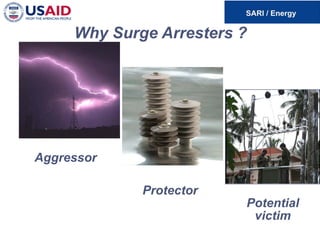
Why Surge Arresters ?
Aggressor
Protector
Potential
victim
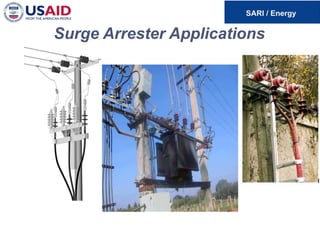
Surge Arrester Applications
Definition as per IEEE standards
As per IEEE standards, Surge
/ Lightning Arrester is
“ a protective device for limiting
surge voltages on the equipment by
diverting surge current and
returning the device to its original
status. It is capable of repeating
these functions as specified”
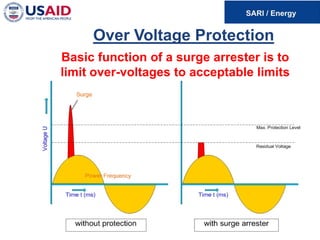
Over Voltage Protection
Basic function of a surge arrester is to
limit over-voltages to acceptable limits
Causes for over-voltage / Surges
in a system
Main causes for over-voltages in electrical
system :
1. Lightning over-voltages ( micro seconds )
2. Switching over-voltages ( milli seconds )
3. Temporary Over-voltages ( Seconds )
Over-voltages & electrical system
Electrical equipments like transformers,
motors are designed to withstand pre-
determined values of impulse voltages.
Higher levels & multiple strikes of impulse
voltages cause the insulation to break down
thus creating chaos in the system.
Over-voltages in electrical system
Protection of electrical devises are made
possible by connecting protective devises -
Surge Arresters in parallel.
These devises should have variable
resistance as a function of the voltage
magnitude to divert over-voltage to ground.
Gapless Zinc Oxide Surge Arresters are
the latest protective devises used to keep
the system voltages well within limits.
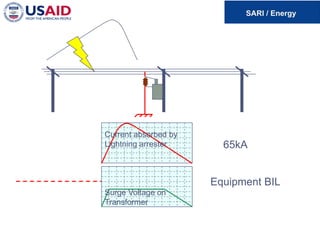
Current absorbed by
Lightning arrester
Surge Voltage on
Transformer
65kA
Equipment BIL
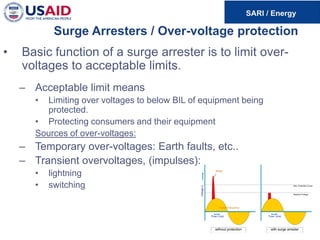
Surge Arresters / Over-voltage protection
• Basic function of a surge arrester is to limit over-
voltages to acceptable limits.
– Acceptable limit means
• Limiting over voltages to below BIL of equipment being
protected.
• Protecting consumers and their equipment
Sources of over-voltages:
– Temporary over-voltages: Earth faults, etc..
– Transient overvoltages, (impulses):
• lightning
• switching
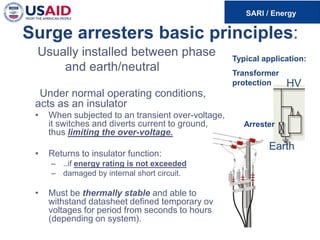
Surge arresters basic principles:
Usually installed between phase
and earth/neutral
Under normal operating conditions,
acts as an insulator
• When subjected to an transient over-voltage,
it switches and diverts current to ground,
thus limiting the over-voltage.
• Returns to insulator function:
– ..if energy rating is not exceeded
– damaged by internal short circuit.
• Must be thermally stable and able to
withstand datasheet defined temporary over-
voltages for period from seconds to hours,
(depending on system).
Typical application:
Transformer
protection
Earth
Arrester
HV
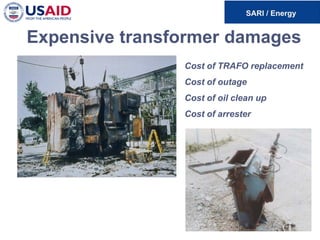
Expensive transformer damages
Cost of TRAFO replacement
Cost of outage
Cost of oil clean up
Cost of arrester
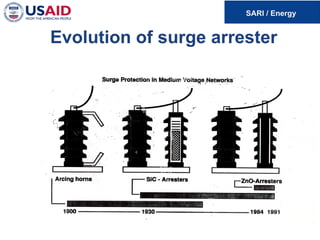
Evolution of surge arrester
Arcing Horns
Basic arcing horns are:
Simplest of Surge Arresters.
Can be provided with all equipments with
bushings.
Difficult to maintain spacing / setting.
Difficult to monitor
SiC Arresters
Silicon Carbide Gapped arresters, assembled
with SiC resistors and plate spark gaps:
Creates short circuit to earth when the
voltage rises due to the spark gaps.
Series connection of SiC resistors limits
the follow current from power supply - arcs
disappear across gaps when next current
zero occurs
Difficult to maintain gaps and monitor
Metal Oxide Arresters
Zinc Oxide Gapless arresters, assembled by
stacking ZnO blocks and placing same in
insulating housings:
Extremely non-linear characteristics and so
do not require any spark gaps.
Current starts to flow through arrester
before the over voltage reaches the peak
value.
Reduces the over voltage faster than the
sparked gap arrester.
TWO SIGNIFICANT DEVELOPMENTS
Following two significant fundamental
developments occurred in the arrester
technology:
SiC resistors and plate spark gaps were
replaced by Metal oxide resistors without
plate gaps.
Housings of the arresters made of
porcelain were replaced with new ones
made of polymer material.
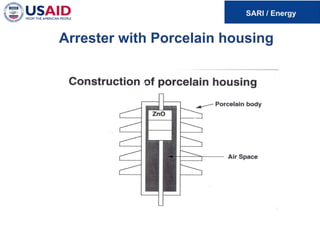
Arrester with Porcelain housing
Arrester Classification
Arresters can be classified based on
following:
Based on type of housing
a) Porcelain Housed Arresters
b) Polymeric Housed Arresters
Based on Energy Handling
Distribution class
Station class I to IV
Surge Arrester Major Components
The major components of LA’s are:
• Outer housing - porcelain or polymeric.
• ZnO Blocks.
• Springs to keep blocks in place.
• Spacers / Heat sinks
• Pressure Relief vents
• End caps for preventing moisture entry.
• Terminals for connecting to line & earth.
• Mounting clamps
Outer Housing
Main functions are:
• Provide the contained space in which the
ZnO Blocks are assembled.
• Ensure heat transfer from the blocks to
outside atmosphere.
• Have necessary parameters to ensure
withstand of electrical system properties.
• Prevent tracking and flashover.
Zinc Oxide Blocks
HEART of the Surge Arrester:
• Must remain as a non-conducting path
during the normal operating voltage &
ensure only over-voltages are conducted
to earth.
• Minimum leakage current & have good heat
dissipation.
• Quick response - absorb incoming surges
without time delay.
• Maintain good thermal stability for long life.
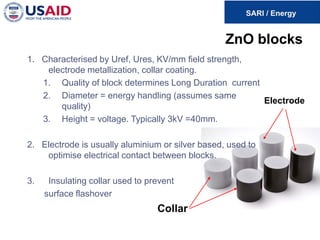
ZnO blocks
Electrode
Collar
1. Characterised by Uref, Ures, KV/mm field strength,
electrode metallization, collar coating.
1. Quality of block determines Long Duration current
2. Diameter = energy handling (assumes same
quality)
3. Height = voltage. Typically 3kV =40mm.
2. Electrode is usually aluminium or silver based, used to
optimise electrical contact between blocks.
3. Insulating collar used to prevent
surface flashover
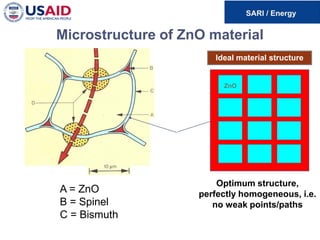
Microstructure of ZnO material
Ideal material structure
ZnO
ZnO
A = ZnO
B = Spinel
C = Bismuth
Optimum structure,
perfectly homogeneous, i.e.
no weak points/paths
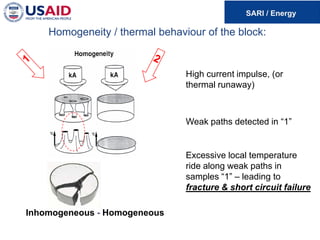
Homogeneity / thermal behaviour of the block:
Inhomogeneous - Homogeneous
High current impulse, (or
thermal runaway)
Weak paths detected in “1”
Excessive local temperature
ride along weak paths in
samples “1” – leading to
fracture & short circuit failure
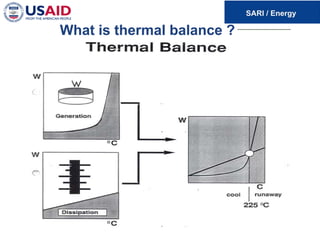
What is thermal balance ?
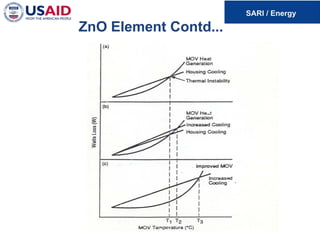
ZnO Element Contd...
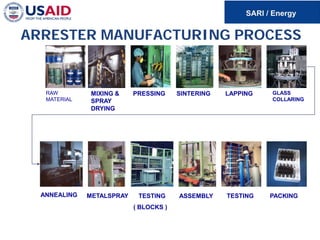
ARRESTER MANUFACTURING PROCESS
RAW
MATERIAL
MIXING &
SPRAY
DRYING
PRESSING SINTERING LAPPING GLASS
COLLARING
ANNEALING METALSPRAY TESTING
( BLOCKS )
ASSEMBLY TESTING PACKING
Ultimate test of varistors and arrester:
Independent type testing,
IEC 60099-4 Surge Arrester Type Testing
• Insulation withstand tests
• Residual voltage tests
• Long duration current withstand test
• Operating duty test
• Power frequency voltage versus time curve
• Short circuit (pressure relief) test
• Partial discharge test
Latest edition of IEC 60099-4 released 2006
Insulation withstand test
Insulation withstand test of the arrester
housing:
Arrester housing should be able to withstand the
lightning impulse protection level of arrester
multiplied by 1.3
Design feature: Flash over distance of the housing
Samples tested: Arrester housing with insulating
core.
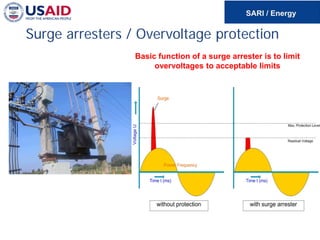
Surge arresters / Overvoltage protection
Basic function of a surge arrester is to limit
overvoltages to acceptable limits
Residual Voltage test
Residual voltage testing of pro-rated test
samples:
The purpose of the measurement of residual
voltage is to obtian the maximum voltages for a
given design for all specified currents and
waveforms.
Design feature: Related to disc specification
Samples tested: Prorated arrester samples.
Residual voltage determines protection level of
arrester when subjected to certain wave forms.
Its output also sets the limits for reference
voltage routine testing in the factory.
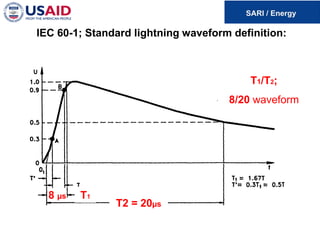
IEC 60-1; Standard lightning waveform definition:
T1/T2;
8/20 waveform
8 µs T1
T2 = 20µs
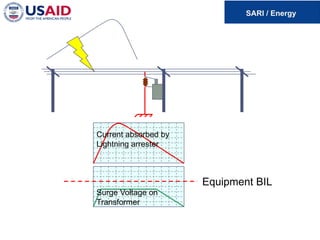
Current absorbed by
Lightning arrester
Surge Voltage on
Transformer
Equipment BIL
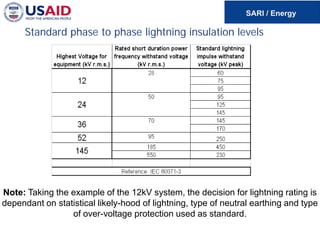
Standard phase to phase lightning insulation levels
Note: Taking the example of the 12kV system, the decision for lightning rating is
dependant on statistical likely-hood of lightning, type of neutral earthing and type
of over-voltage protection used as standard.
Residual voltage drop
In order to ensure no loss of residual voltage the surge
arrester should be mounted directly on the transformer.
If it is not then quite a dramatic increase in effective residual
voltage will occur. The actual loss will depend on the size of the
impulse in kA and the frequency of the wave form.
For example if the arrester is 4m from the transformer and the
incoming impulse is 5kA on a 8/20 then the rise in residual voltage
will be 5kV. If the impulse is 20kA then the loss will be 20kV.
If the incoming wave is 4/10 then the rise will be 10kV on a 5kA
impulse
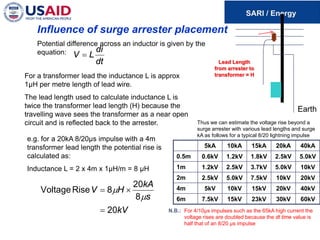
Influence of surge arrester placement
Potential difference across an inductor is given by the
equation:
For a transformer lead the inductance L is approx
1μH per metre length of lead wire.
The lead length used to calculate inductance L is
twice the transformer lead length (H) because the
travelling wave sees the transformer as a near open
circuit and is reflected back to the arrester.
e.g. for a 20kA 8/20μs impulse with a 4m
transformer lead length the potential rise is
calculated as:
Inductance L = 2 x 4m x 1μH/m = 8 μH
kV
s
kA
H
V
20
8
20
8
Rise
Voltage
=
×
=
µ
µ
dt
di
L
V =
Lead Length
from arrester to
transformer = H
Earth
Thus we can estimate the voltage rise beyond a
surge arrester with various lead lengths and surge
kA as follows for a typical 8/20 lightning impulse
5kA 10kA 15kA 20kA 40kA
0.5m 0.6kV 1.2kV 1.8kV 2.5kV 5.0kV
1m 1.2kV 2.5kV 3.7kV 5.0kV 10kV
2m 2.5kV 5.0kV 7.5kV 10kV 20kV
4m 5kV 10kV 15kV 20kV 40kV
6m 7.5kV 15kV 23kV 30kV 60kV
N.B.: For 4/10μs impulses such as the 65kA high current the
voltage rises are doubled because the dt time value is
half that of an 8/20 μs impulse
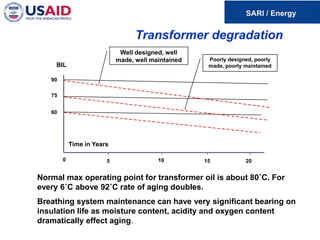
Transformer degradation
Well designed, well
made, well maintained Poorly designed, poorly
made, poorly maintained
Time in Years
BIL
90
75
60
0 5 10 15 20
Normal max operating point for transformer oil is about 80˚C. For
every 6˚C above 92˚C rate of aging doubles.
Breathing system maintenance can have very significant bearing on
insulation life as moisture content, acidity and oxygen content
dramatically effect aging.
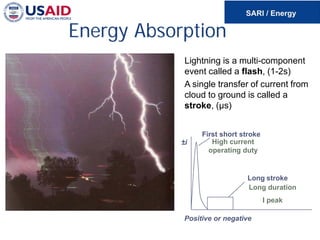
Energy Absorption
Lightning is a multi-component
event called a flash, (1-2s)
A single transfer of current from
cloud to ground is called a
stroke, (µs)
Positive or negative
Long stroke
First short stroke
±i High current
operating duty
Long duration
I peak
Long duration current withstand
Test to confirm that arrester can withstand rated long
duration line discharge duty.
The purpose of the measurement of LD test is to verify the
arrester ability to withstand multiple long duration impulses, i.e.
Switching / multipulse induced overvoltages while energised at
power frequency voltage.
Design feature: Energy handling, thermal stability.
Samples tested: Prorated arrester samples.
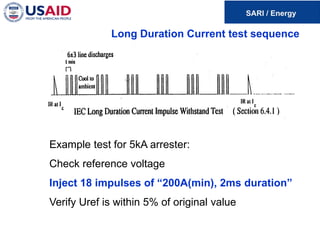
Long Duration Current test sequence
Example test for 5kA arrester:
Check reference voltage
Inject 18 impulses of “200A(min), 2ms duration”
Verify Uref is within 5% of original value
Operating duty test
Test to confirm that arrester can withstand a combination of stresses
that an arrester is faced with in service while energised at power
frequency voltage.
The main requirement to pass this test is that the arrester is able to
cool down in between impulses while under power frequency voltage,
i.e. Thermal run away does not occur.
Design feature: Impulse stability, energy handling,
thermal stability.
Samples tested: Prorated arrester samples.
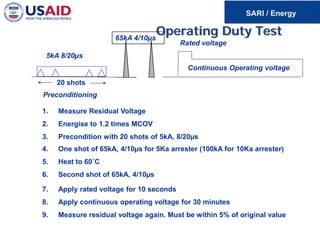
Operating Duty Test
20 shots
Preconditioning
5kA 8/20µs
Rated voltage
Continuous Operating voltage
65kA 4/10µs
1. Measure Residual Voltage
2. Energise to 1.2 times MCOV
3. Precondition with 20 shots of 5kA, 8/20µs
4. One shot of 65kA, 4/10µs for 5Ka arrester (100kA for 10Ka arrester)
5. Heat to 60˚C
6. Second shot of 65kA, 4/10µs
7. Apply rated voltage for 10 seconds
8. Apply continuous operating voltage for 30 minutes
9. Measure residual voltage again. Must be within 5% of original value
Revision of Standard
IEC 60099-4,
2006
finally caught up
with
State-of-the-Art
Surge Arrester
Technology
New Requirements
Moisture Ingress Test;
Weather Ageing Tests;
(Tracking & Erosion Performance
of Housing)
Short Circuit Tests
(Test procedure still informative but commonly accepted with
distribution type arresters, more realistic failure simulation)
Routine testing: PD < 10pC,
Aging addressed.
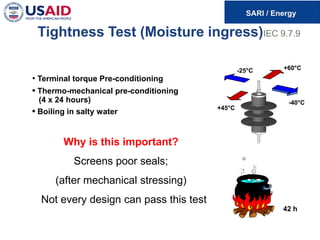
Tightness Test (Moisture ingress)IEC 9.7.9
• Terminal torque Pre-conditioning
• Thermo-mechanical pre-conditioning
(4 x 24 hours)
• Boiling in salty water
Why is this important?
Screens poor seals;
(after mechanical stressing)
Not every design can pass this test
-25°C +60°C
+45°C
-40°C
42 h
Moisture Ingress Test
• Mechanical changes to be reported
• Increase of power loss < 20%
• Partial discharges not exceeding 10pC
• Change of residual voltage @
nom. discharge current not exceeding 5%
• No breakdown visible in voltage and current
oscillograms
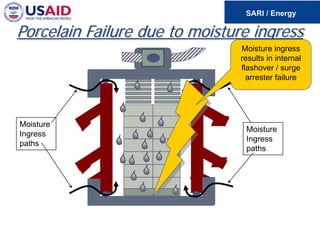
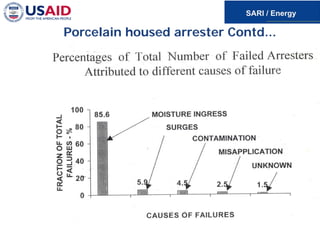
Porcelain Failure due to moisture ingress
Moisture
Ingress
paths
Moisture
Ingress
paths
Moisture ingress
results in internal
flashover / surge
arrester failure
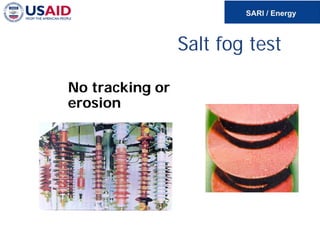
No tracking or
erosion
Salt fog test
• No tracking
• No erosion through entire
thickness of external coating
• No puncturing of sheds and housing
• Decrease of reference voltage should
not exceed 5%
• Partial discharges should not exceed
10 pC
Product materials testing
Tracking and Erosion Resistance, TERT.
• TERT is used a measure of the tracking and erosion resistance
of materials.
• It is a good measure used to rank materials relative
performance, at the screening stage. Though this ranking may
not always reflect exact ranking in the field, it is considered a
good screening test.
Two tert tests;
-Step test: Voltage is increased each hour and contaminant rate
increased periodically
-Constant Voltage test: Voltage and contaminant flow rate maintained
for set time
In either test method, the material must be
non-tracking with eventual failure by erosion
only. Flame failure is not allowed.
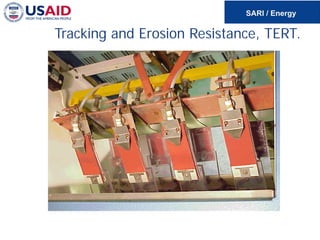
Tracking and Erosion Resistance, TERT.
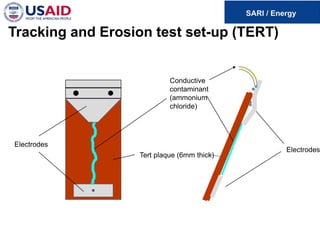
Tracking and Erosion test set-up (TERT)
Conductive
contaminant
(ammonium
chloride)
Electrodes
Electrodes
Tert plaque (6mm thick)
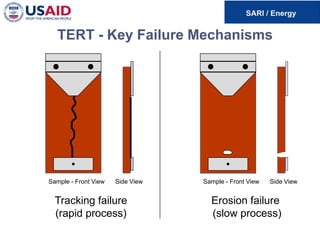
TERT - Key Failure Mechanisms
Tracking failure
(rapid process)
Erosion failure
(slow process)
Sample - Front View Side View Sample - Front View Side View
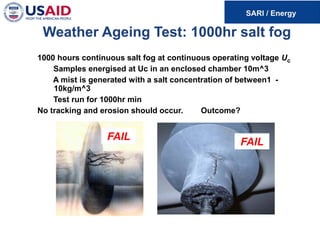
1000 hours continuous salt fog at continuous operating voltage Uc
Samples energised at Uc in an enclosed chamber 10m^3
A mist is generated with a salt concentration of between1 -
10kg/m^3
Test run for 1000hr min
No tracking and erosion should occur. Outcome?
FAIL
FAIL
Weather Ageing Test: 1000hr salt fog
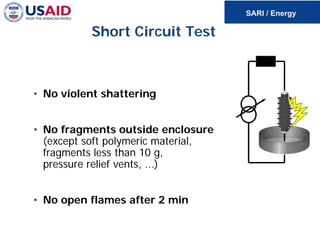
Short Circuit Test
• No violent shattering
• No fragments outside enclosure
(except soft polymeric material,
fragments less than 10 g,
pressure relief vents, ...)
• No open flames after 2 min
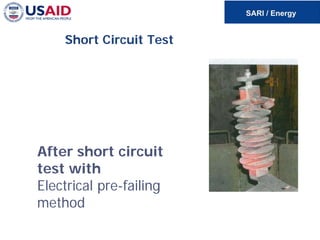
After short circuit
test with
Electrical pre-failing
method
Short Circuit Test
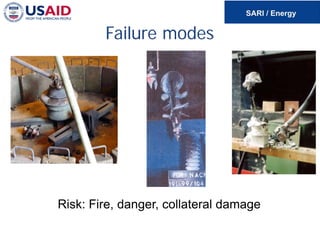
Failure modes
Risk: Fire, danger, collateral damage
Specific Advantages of Polymeric
Housing
• No internal air space, no chance of moisture ingress.
• Vandal proof.
• Non-explosive failure mode.
• High thermal conductivity. Rapid heat dissipation.
• Low weight and small size.
• Suitable for pollution environment.
• Resistant to transport damage and careless handling.
• Stud, pedestal or bracket mounted.
• Good for abnormal service conditions like enhanced external
insulation where operation is under high or low temperature or
altitudes over 1000m etc
• Easy to install.
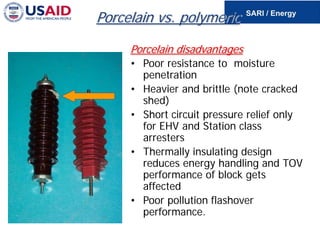
Porcelain vs. polymeric
Porcelain disadvantages
• Poor resistance to moisture
penetration
• Heavier and brittle (note cracked
shed)
• Short circuit pressure relief only
for EHV and Station class
arresters
• Thermally insulating design
reduces energy handling and TOV
performance of block gets
affected
• Poor pollution flashover
performance.
Porcelain housed arrester Contd...
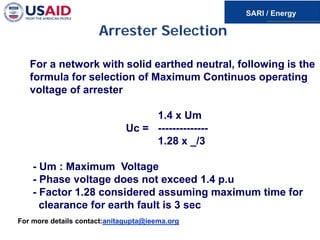
Arrester Selection
For a network with solid earthed neutral, following is the
formula for selection of Maximum Continuos operating
voltage of arrester
1.4 x Um
Uc = --------------
1.28 x _/3
- Um : Maximum Voltage
- Phase voltage does not exceed 1.4 p.u
- Factor 1.28 considered assuming maximum time for
clearance for earth fault is 3 sec
For more details contact:anitagupta@ieema.org

Surge_Arrester_HIGH POWER LED FLOOD LIGHT Project presentationPresentation.pdf

  • 1.
  • 2.
    2 Surge Arresters andRecent Developments
  • 3.
    Why Surge Arresters? Aggressor Protector Potential victim
  • 4.
  • 5.
    Definition as perIEEE standards As per IEEE standards, Surge / Lightning Arrester is “ a protective device for limiting surge voltages on the equipment by diverting surge current and returning the device to its original status. It is capable of repeating these functions as specified”
  • 6.
    Over Voltage Protection Basicfunction of a surge arrester is to limit over-voltages to acceptable limits
  • 7.
    Causes for over-voltage/ Surges in a system Main causes for over-voltages in electrical system : 1. Lightning over-voltages ( micro seconds ) 2. Switching over-voltages ( milli seconds ) 3. Temporary Over-voltages ( Seconds )
  • 8.
    Over-voltages & electricalsystem Electrical equipments like transformers, motors are designed to withstand pre- determined values of impulse voltages. Higher levels & multiple strikes of impulse voltages cause the insulation to break down thus creating chaos in the system.
  • 9.
    Over-voltages in electricalsystem Protection of electrical devises are made possible by connecting protective devises - Surge Arresters in parallel. These devises should have variable resistance as a function of the voltage magnitude to divert over-voltage to ground. Gapless Zinc Oxide Surge Arresters are the latest protective devises used to keep the system voltages well within limits.
  • 10.
    Current absorbed by Lightningarrester Surge Voltage on Transformer 65kA Equipment BIL
  • 11.
    Surge Arresters /Over-voltage protection • Basic function of a surge arrester is to limit over- voltages to acceptable limits. – Acceptable limit means • Limiting over voltages to below BIL of equipment being protected. • Protecting consumers and their equipment Sources of over-voltages: – Temporary over-voltages: Earth faults, etc.. – Transient overvoltages, (impulses): • lightning • switching
  • 12.
    Surge arresters basicprinciples: Usually installed between phase and earth/neutral Under normal operating conditions, acts as an insulator • When subjected to an transient over-voltage, it switches and diverts current to ground, thus limiting the over-voltage. • Returns to insulator function: – ..if energy rating is not exceeded – damaged by internal short circuit. • Must be thermally stable and able to withstand datasheet defined temporary over- voltages for period from seconds to hours, (depending on system). Typical application: Transformer protection Earth Arrester HV
  • 13.
    Expensive transformer damages Costof TRAFO replacement Cost of outage Cost of oil clean up Cost of arrester
  • 14.
  • 15.
    Arcing Horns Basic arcinghorns are: Simplest of Surge Arresters. Can be provided with all equipments with bushings. Difficult to maintain spacing / setting. Difficult to monitor
  • 16.
    SiC Arresters Silicon CarbideGapped arresters, assembled with SiC resistors and plate spark gaps: Creates short circuit to earth when the voltage rises due to the spark gaps. Series connection of SiC resistors limits the follow current from power supply - arcs disappear across gaps when next current zero occurs Difficult to maintain gaps and monitor
  • 17.
    Metal Oxide Arresters ZincOxide Gapless arresters, assembled by stacking ZnO blocks and placing same in insulating housings: Extremely non-linear characteristics and so do not require any spark gaps. Current starts to flow through arrester before the over voltage reaches the peak value. Reduces the over voltage faster than the sparked gap arrester.
  • 18.
    TWO SIGNIFICANT DEVELOPMENTS Followingtwo significant fundamental developments occurred in the arrester technology: SiC resistors and plate spark gaps were replaced by Metal oxide resistors without plate gaps. Housings of the arresters made of porcelain were replaced with new ones made of polymer material.
  • 19.
  • 20.
    Arrester Classification Arresters canbe classified based on following: Based on type of housing a) Porcelain Housed Arresters b) Polymeric Housed Arresters Based on Energy Handling Distribution class Station class I to IV
  • 21.
    Surge Arrester MajorComponents The major components of LA’s are: • Outer housing - porcelain or polymeric. • ZnO Blocks. • Springs to keep blocks in place. • Spacers / Heat sinks • Pressure Relief vents • End caps for preventing moisture entry. • Terminals for connecting to line & earth. • Mounting clamps
  • 22.
    Outer Housing Main functionsare: • Provide the contained space in which the ZnO Blocks are assembled. • Ensure heat transfer from the blocks to outside atmosphere. • Have necessary parameters to ensure withstand of electrical system properties. • Prevent tracking and flashover.
  • 23.
    Zinc Oxide Blocks HEARTof the Surge Arrester: • Must remain as a non-conducting path during the normal operating voltage & ensure only over-voltages are conducted to earth. • Minimum leakage current & have good heat dissipation. • Quick response - absorb incoming surges without time delay. • Maintain good thermal stability for long life.
  • 24.
    ZnO blocks Electrode Collar 1. Characterisedby Uref, Ures, KV/mm field strength, electrode metallization, collar coating. 1. Quality of block determines Long Duration current 2. Diameter = energy handling (assumes same quality) 3. Height = voltage. Typically 3kV =40mm. 2. Electrode is usually aluminium or silver based, used to optimise electrical contact between blocks. 3. Insulating collar used to prevent surface flashover
  • 25.
    Microstructure of ZnOmaterial Ideal material structure ZnO ZnO A = ZnO B = Spinel C = Bismuth Optimum structure, perfectly homogeneous, i.e. no weak points/paths
  • 26.
    Homogeneity / thermalbehaviour of the block: Inhomogeneous - Homogeneous High current impulse, (or thermal runaway) Weak paths detected in “1” Excessive local temperature ride along weak paths in samples “1” – leading to fracture & short circuit failure
  • 27.
    What is thermalbalance ?
  • 28.
  • 29.
    ARRESTER MANUFACTURING PROCESS RAW MATERIAL MIXING& SPRAY DRYING PRESSING SINTERING LAPPING GLASS COLLARING ANNEALING METALSPRAY TESTING ( BLOCKS ) ASSEMBLY TESTING PACKING
  • 30.
    Ultimate test ofvaristors and arrester: Independent type testing, IEC 60099-4 Surge Arrester Type Testing • Insulation withstand tests • Residual voltage tests • Long duration current withstand test • Operating duty test • Power frequency voltage versus time curve • Short circuit (pressure relief) test • Partial discharge test Latest edition of IEC 60099-4 released 2006
  • 31.
    Insulation withstand test Insulationwithstand test of the arrester housing: Arrester housing should be able to withstand the lightning impulse protection level of arrester multiplied by 1.3 Design feature: Flash over distance of the housing Samples tested: Arrester housing with insulating core.
  • 32.
    Surge arresters /Overvoltage protection Basic function of a surge arrester is to limit overvoltages to acceptable limits
  • 33.
    Residual Voltage test Residualvoltage testing of pro-rated test samples: The purpose of the measurement of residual voltage is to obtian the maximum voltages for a given design for all specified currents and waveforms. Design feature: Related to disc specification Samples tested: Prorated arrester samples. Residual voltage determines protection level of arrester when subjected to certain wave forms. Its output also sets the limits for reference voltage routine testing in the factory.
  • 34.
    IEC 60-1; Standardlightning waveform definition: T1/T2; 8/20 waveform 8 µs T1 T2 = 20µs
  • 35.
    Current absorbed by Lightningarrester Surge Voltage on Transformer Equipment BIL
  • 36.
    Standard phase tophase lightning insulation levels Note: Taking the example of the 12kV system, the decision for lightning rating is dependant on statistical likely-hood of lightning, type of neutral earthing and type of over-voltage protection used as standard.
  • 37.
    Residual voltage drop Inorder to ensure no loss of residual voltage the surge arrester should be mounted directly on the transformer. If it is not then quite a dramatic increase in effective residual voltage will occur. The actual loss will depend on the size of the impulse in kA and the frequency of the wave form. For example if the arrester is 4m from the transformer and the incoming impulse is 5kA on a 8/20 then the rise in residual voltage will be 5kV. If the impulse is 20kA then the loss will be 20kV. If the incoming wave is 4/10 then the rise will be 10kV on a 5kA impulse
  • 38.
    Influence of surgearrester placement Potential difference across an inductor is given by the equation: For a transformer lead the inductance L is approx 1μH per metre length of lead wire. The lead length used to calculate inductance L is twice the transformer lead length (H) because the travelling wave sees the transformer as a near open circuit and is reflected back to the arrester. e.g. for a 20kA 8/20μs impulse with a 4m transformer lead length the potential rise is calculated as: Inductance L = 2 x 4m x 1μH/m = 8 μH kV s kA H V 20 8 20 8 Rise Voltage = × = µ µ dt di L V = Lead Length from arrester to transformer = H Earth Thus we can estimate the voltage rise beyond a surge arrester with various lead lengths and surge kA as follows for a typical 8/20 lightning impulse 5kA 10kA 15kA 20kA 40kA 0.5m 0.6kV 1.2kV 1.8kV 2.5kV 5.0kV 1m 1.2kV 2.5kV 3.7kV 5.0kV 10kV 2m 2.5kV 5.0kV 7.5kV 10kV 20kV 4m 5kV 10kV 15kV 20kV 40kV 6m 7.5kV 15kV 23kV 30kV 60kV N.B.: For 4/10μs impulses such as the 65kA high current the voltage rises are doubled because the dt time value is half that of an 8/20 μs impulse
  • 39.
    Transformer degradation Well designed,well made, well maintained Poorly designed, poorly made, poorly maintained Time in Years BIL 90 75 60 0 5 10 15 20 Normal max operating point for transformer oil is about 80˚C. For every 6˚C above 92˚C rate of aging doubles. Breathing system maintenance can have very significant bearing on insulation life as moisture content, acidity and oxygen content dramatically effect aging.
  • 40.
    Energy Absorption Lightning isa multi-component event called a flash, (1-2s) A single transfer of current from cloud to ground is called a stroke, (µs) Positive or negative Long stroke First short stroke ±i High current operating duty Long duration I peak
  • 41.
    Long duration currentwithstand Test to confirm that arrester can withstand rated long duration line discharge duty. The purpose of the measurement of LD test is to verify the arrester ability to withstand multiple long duration impulses, i.e. Switching / multipulse induced overvoltages while energised at power frequency voltage. Design feature: Energy handling, thermal stability. Samples tested: Prorated arrester samples.
  • 42.
    Long Duration Currenttest sequence Example test for 5kA arrester: Check reference voltage Inject 18 impulses of “200A(min), 2ms duration” Verify Uref is within 5% of original value
  • 43.
    Operating duty test Testto confirm that arrester can withstand a combination of stresses that an arrester is faced with in service while energised at power frequency voltage. The main requirement to pass this test is that the arrester is able to cool down in between impulses while under power frequency voltage, i.e. Thermal run away does not occur. Design feature: Impulse stability, energy handling, thermal stability. Samples tested: Prorated arrester samples.
  • 44.
    Operating Duty Test 20shots Preconditioning 5kA 8/20µs Rated voltage Continuous Operating voltage 65kA 4/10µs 1. Measure Residual Voltage 2. Energise to 1.2 times MCOV 3. Precondition with 20 shots of 5kA, 8/20µs 4. One shot of 65kA, 4/10µs for 5Ka arrester (100kA for 10Ka arrester) 5. Heat to 60˚C 6. Second shot of 65kA, 4/10µs 7. Apply rated voltage for 10 seconds 8. Apply continuous operating voltage for 30 minutes 9. Measure residual voltage again. Must be within 5% of original value
  • 45.
    Revision of Standard IEC60099-4, 2006 finally caught up with State-of-the-Art Surge Arrester Technology
  • 46.
    New Requirements Moisture IngressTest; Weather Ageing Tests; (Tracking & Erosion Performance of Housing) Short Circuit Tests (Test procedure still informative but commonly accepted with distribution type arresters, more realistic failure simulation) Routine testing: PD < 10pC, Aging addressed.
  • 47.
    Tightness Test (Moistureingress)IEC 9.7.9 • Terminal torque Pre-conditioning • Thermo-mechanical pre-conditioning (4 x 24 hours) • Boiling in salty water Why is this important? Screens poor seals; (after mechanical stressing) Not every design can pass this test -25°C +60°C +45°C -40°C 42 h
  • 48.
    Moisture Ingress Test •Mechanical changes to be reported • Increase of power loss < 20% • Partial discharges not exceeding 10pC • Change of residual voltage @ nom. discharge current not exceeding 5% • No breakdown visible in voltage and current oscillograms
  • 49.
    Porcelain Failure dueto moisture ingress Moisture Ingress paths Moisture Ingress paths Moisture ingress results in internal flashover / surge arrester failure
  • 50.
  • 51.
    • No tracking •No erosion through entire thickness of external coating • No puncturing of sheds and housing • Decrease of reference voltage should not exceed 5% • Partial discharges should not exceed 10 pC Product materials testing
  • 52.
    Tracking and ErosionResistance, TERT. • TERT is used a measure of the tracking and erosion resistance of materials. • It is a good measure used to rank materials relative performance, at the screening stage. Though this ranking may not always reflect exact ranking in the field, it is considered a good screening test. Two tert tests; -Step test: Voltage is increased each hour and contaminant rate increased periodically -Constant Voltage test: Voltage and contaminant flow rate maintained for set time In either test method, the material must be non-tracking with eventual failure by erosion only. Flame failure is not allowed.
  • 53.
    Tracking and ErosionResistance, TERT.
  • 54.
    Tracking and Erosiontest set-up (TERT) Conductive contaminant (ammonium chloride) Electrodes Electrodes Tert plaque (6mm thick)
  • 55.
    TERT - KeyFailure Mechanisms Tracking failure (rapid process) Erosion failure (slow process) Sample - Front View Side View Sample - Front View Side View
  • 56.
    1000 hours continuoussalt fog at continuous operating voltage Uc Samples energised at Uc in an enclosed chamber 10m^3 A mist is generated with a salt concentration of between1 - 10kg/m^3 Test run for 1000hr min No tracking and erosion should occur. Outcome? FAIL FAIL Weather Ageing Test: 1000hr salt fog
  • 57.
    Short Circuit Test •No violent shattering • No fragments outside enclosure (except soft polymeric material, fragments less than 10 g, pressure relief vents, ...) • No open flames after 2 min
  • 58.
    After short circuit testwith Electrical pre-failing method Short Circuit Test
  • 59.
    Failure modes Risk: Fire,danger, collateral damage
  • 60.
    Specific Advantages ofPolymeric Housing • No internal air space, no chance of moisture ingress. • Vandal proof. • Non-explosive failure mode. • High thermal conductivity. Rapid heat dissipation. • Low weight and small size. • Suitable for pollution environment. • Resistant to transport damage and careless handling. • Stud, pedestal or bracket mounted. • Good for abnormal service conditions like enhanced external insulation where operation is under high or low temperature or altitudes over 1000m etc • Easy to install.
  • 61.
    Porcelain vs. polymeric Porcelaindisadvantages • Poor resistance to moisture penetration • Heavier and brittle (note cracked shed) • Short circuit pressure relief only for EHV and Station class arresters • Thermally insulating design reduces energy handling and TOV performance of block gets affected • Poor pollution flashover performance.
  • 62.
  • 63.
    Arrester Selection For anetwork with solid earthed neutral, following is the formula for selection of Maximum Continuos operating voltage of arrester 1.4 x Um Uc = -------------- 1.28 x _/3 - Um : Maximum Voltage - Phase voltage does not exceed 1.4 p.u - Factor 1.28 considered assuming maximum time for clearance for earth fault is 3 sec For more details contact:anitagupta@ieema.org