LIGHT TREES
BHAVYA R WARRIER
S7 CSE
12133012
1
CONTENTS
 Introduction
 Literature survey
 Methodology
 Results & discussions
 Conclusion
 Future scope
 References
2
INTRODUCTION
3
 The concept of light tree is
introduced in a wavelength
routed optical network
 Employs wavelength division
multiplexing(WDM)
 Point to point multipoint
 Enables single hop
communication
 Increases network throughput 4
PHYSICAL TOPOLOGIES
 First generation
• Copper based or microwave technology
• Eg: Ethernet
 Second generation
• Optical fibers for data transmission
• Switching is performed in electronic
domain Eg: FDDI
 Third generation
• Optical fibers are used
• Eg: WDM
5
LITERATURE SURVEY
6
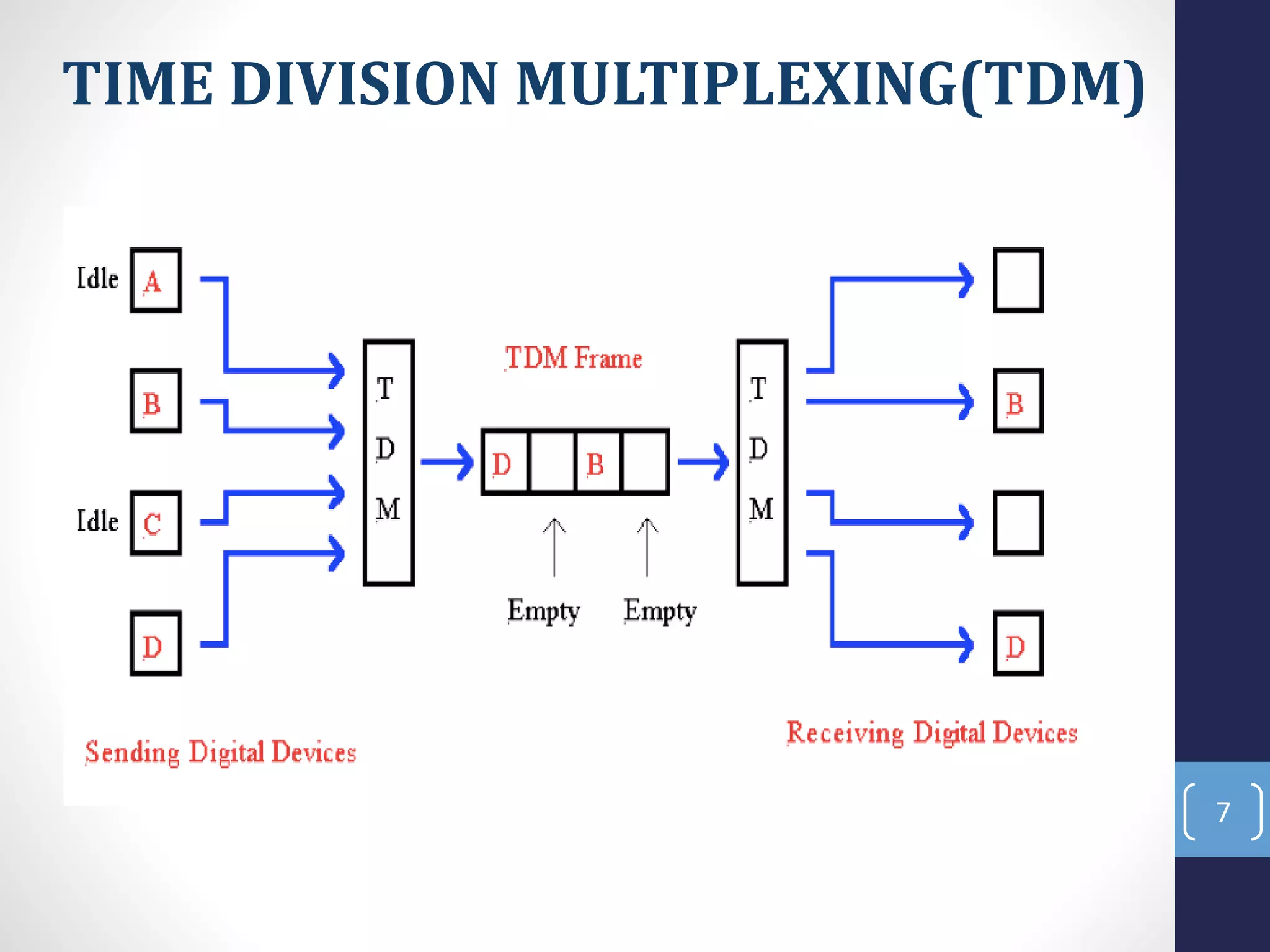
TIME DIVISION MULTIPLEXING(TDM)
7
 It is a method of transmitting
and receiving signals in a single
common path
 Multiple channels can be
combined time wise
 Transmitted over single fiber
using one wavelength
 Uses a single channel which is
accessed by many devices
 Speed is less 8
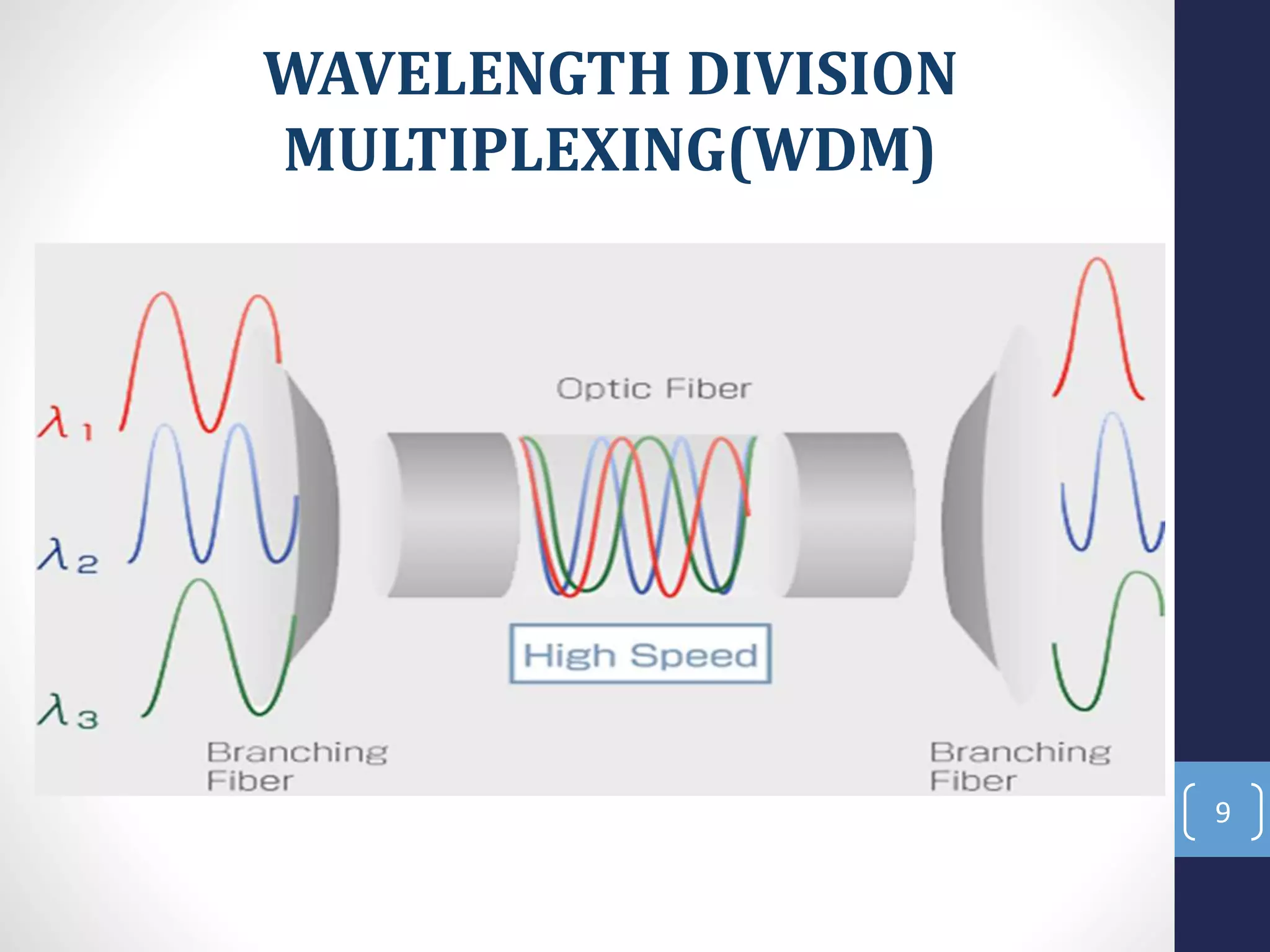
WAVELENGTH DIVISION
MULTIPLEXING(WDM)
9
 Multiple time multiplexed channels
can be transmitted over a single
fiber using one wavelength
 Can deal with very high frequencies
of light
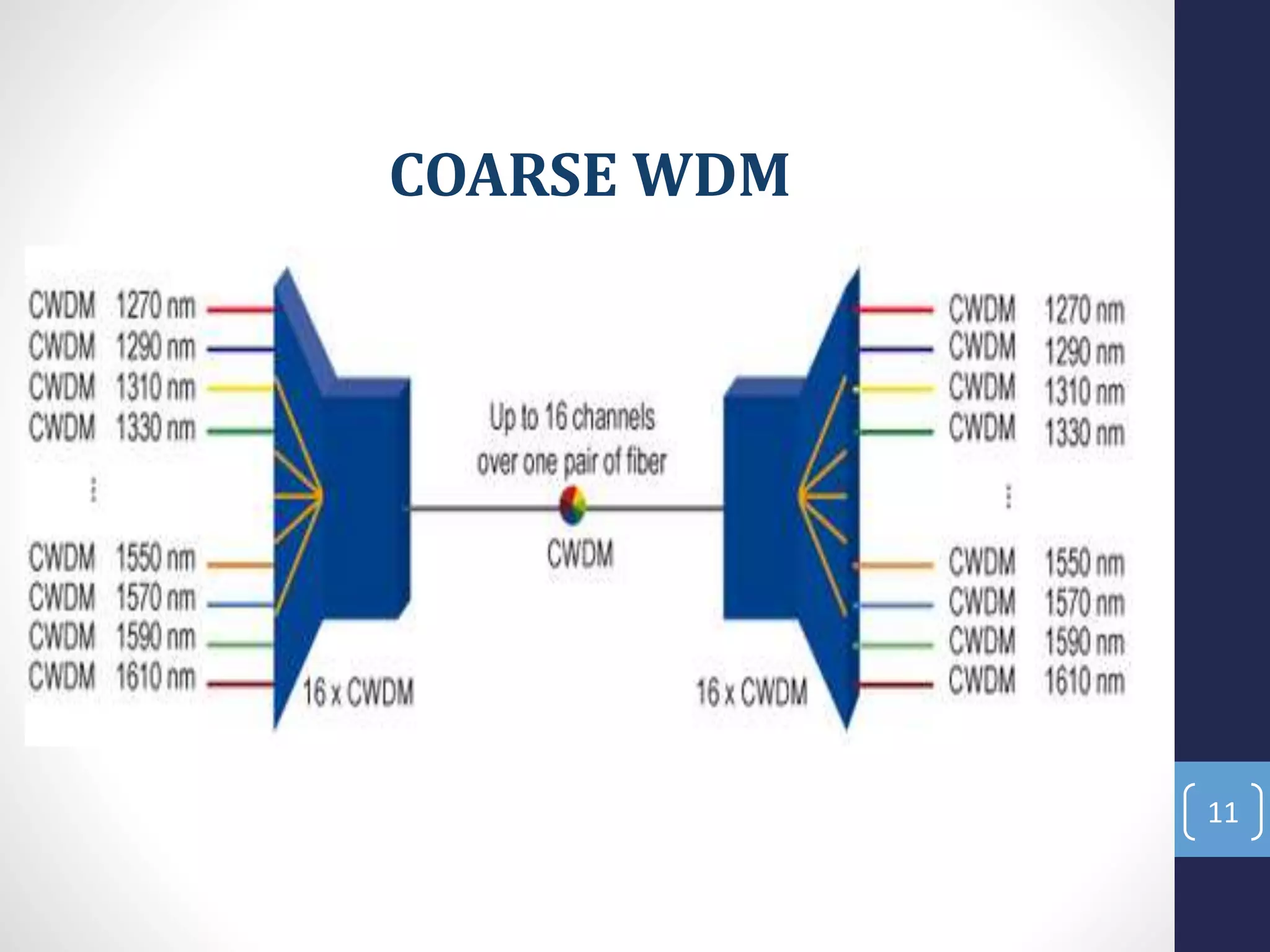
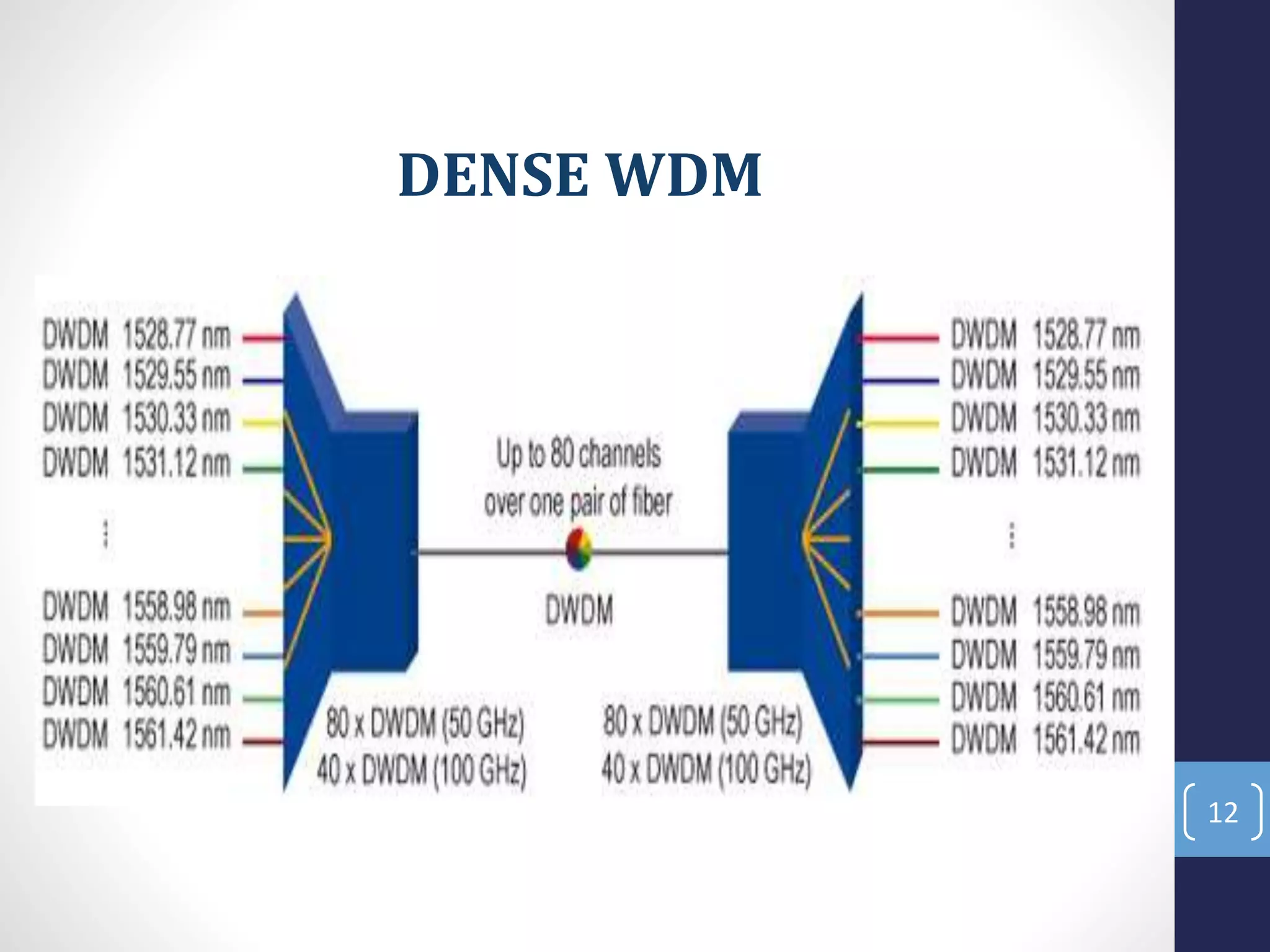
 Two types of WDM
• Coarse WDM
• Dense WDM
10
COARSE WDM
11
DENSE WDM
12
METHODOLOGY
13
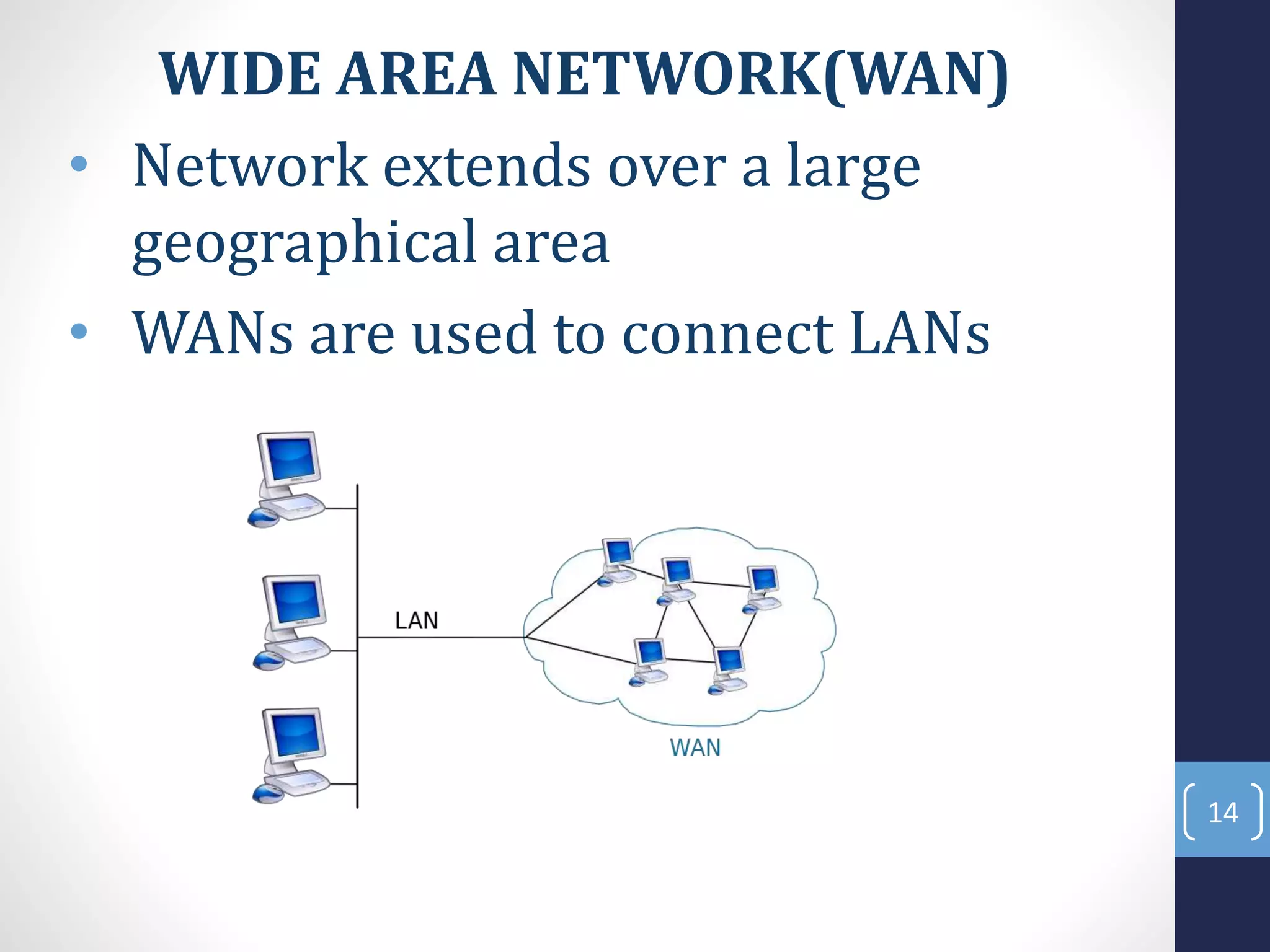
WIDE AREA NETWORK(WAN)
• Network extends over a large
geographical area
• WANs are used to connect LANs
14
LIGHT PATH
• It is an all optical channel
• Used to carry circuit switched
traffic
• It may span multiple fiber links
• Can create logical(or virtual)
neighbours out of nodes that may
be geographically far apart from
each other
15
• The major objective of light path
communication is to reduce the
number of hops a packet has to
traverse
• Under light path communication,
the network employs an equal no.
of transmitters and receivers
• Each light path operates on a point-
to-point basis
16
TRANSMISSION TYPES
There are three types of
transmissions used in light trees:
 Unicast traffic
 Broadcast traffic
 Multicast traffic
17
UNICAST TRAFFIC
18
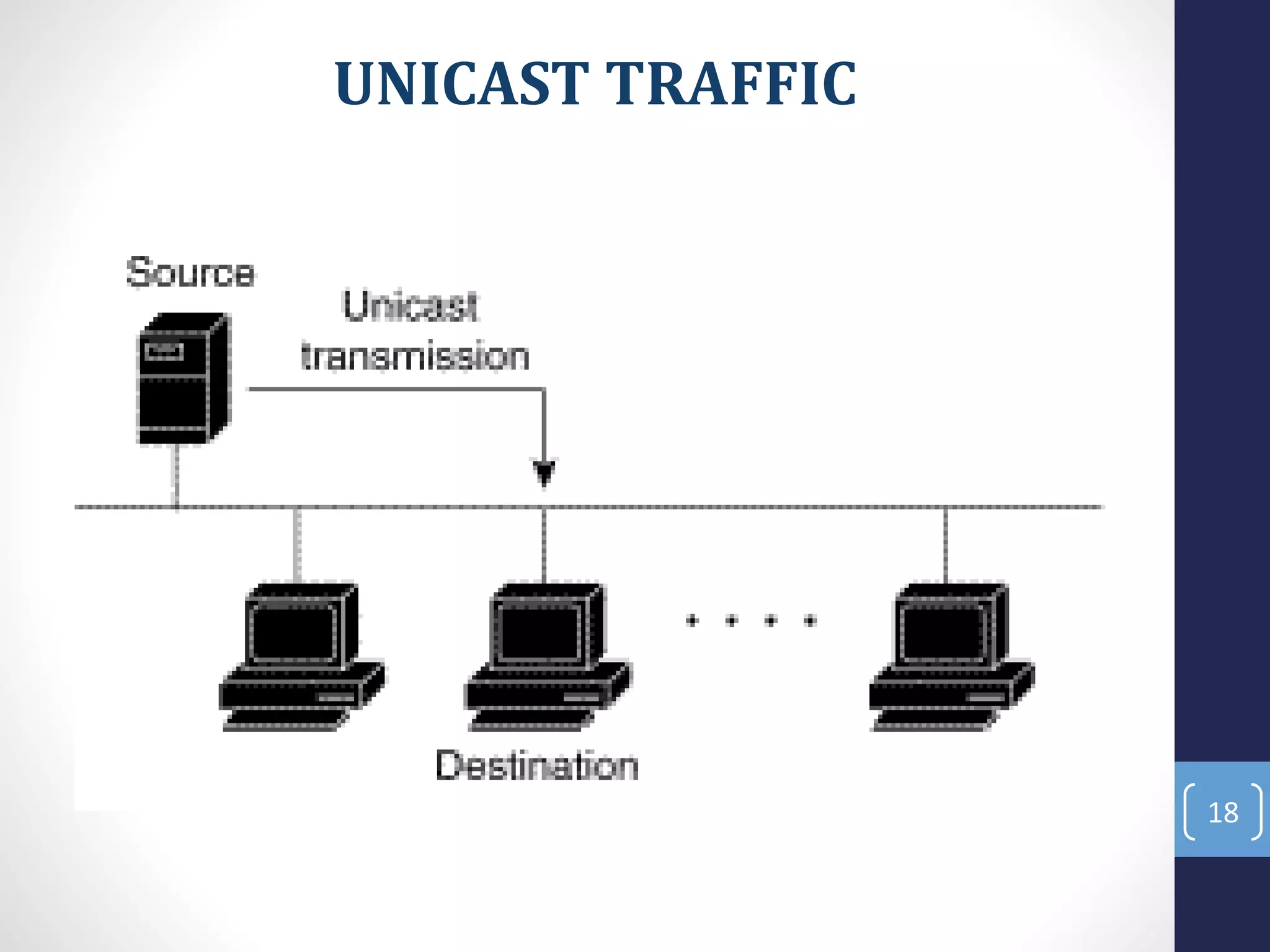
 Unicast traffic is sent from a single
source to a single destination IP
address
 It is appropriate for many
client/server applications such as
database applications
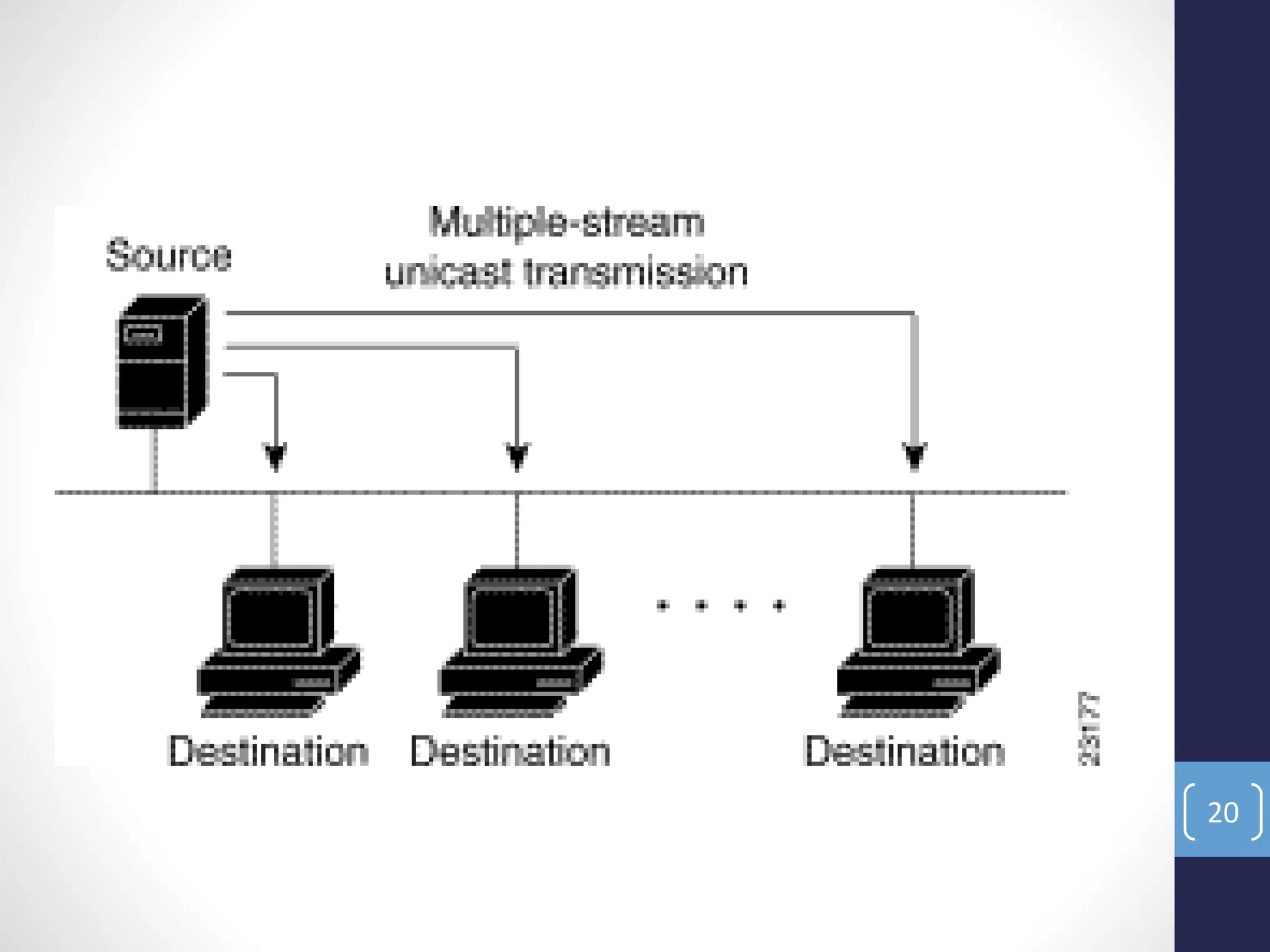
 There is also mutistream unicast
traffic
19
20
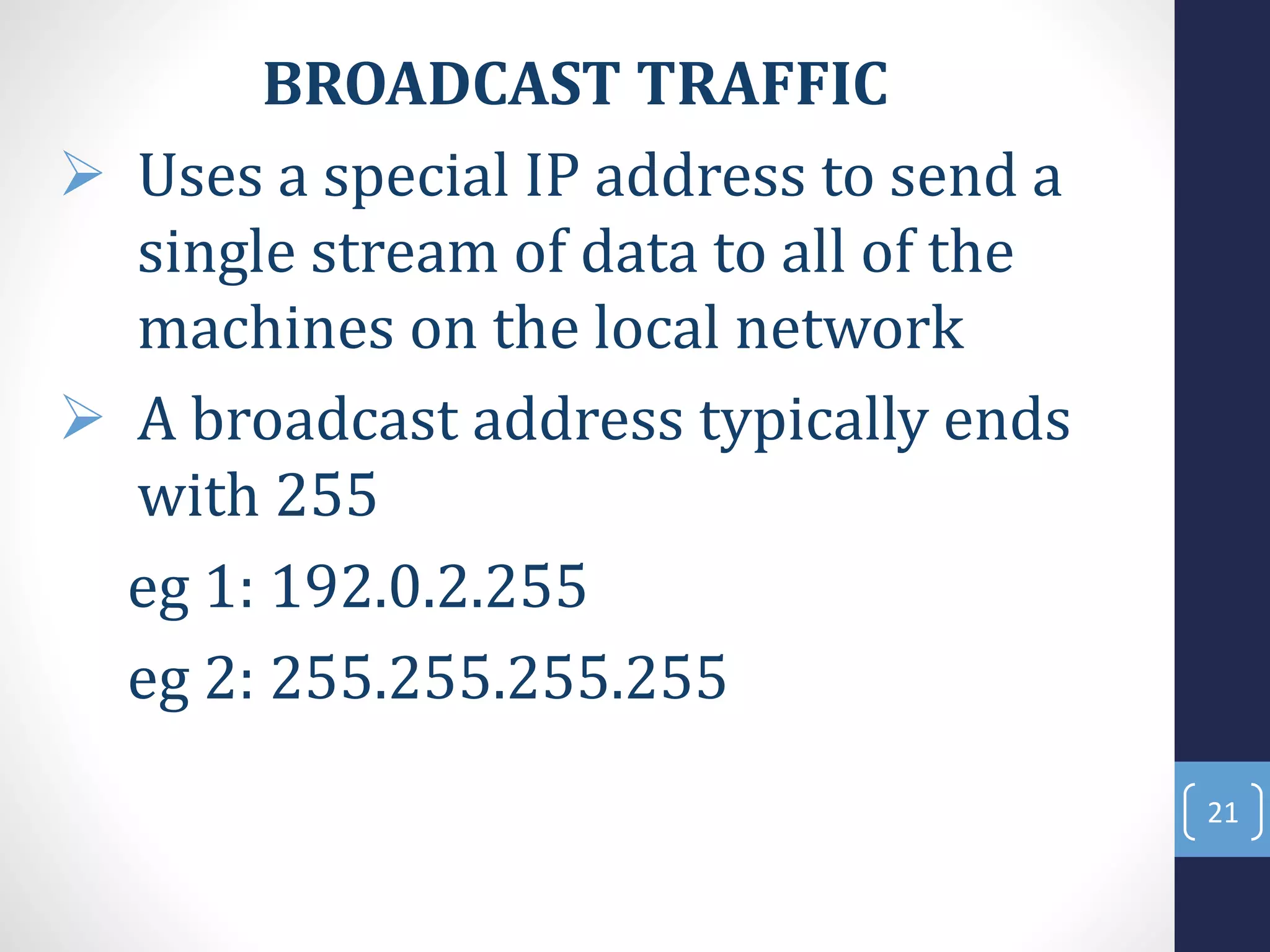
BROADCAST TRAFFIC
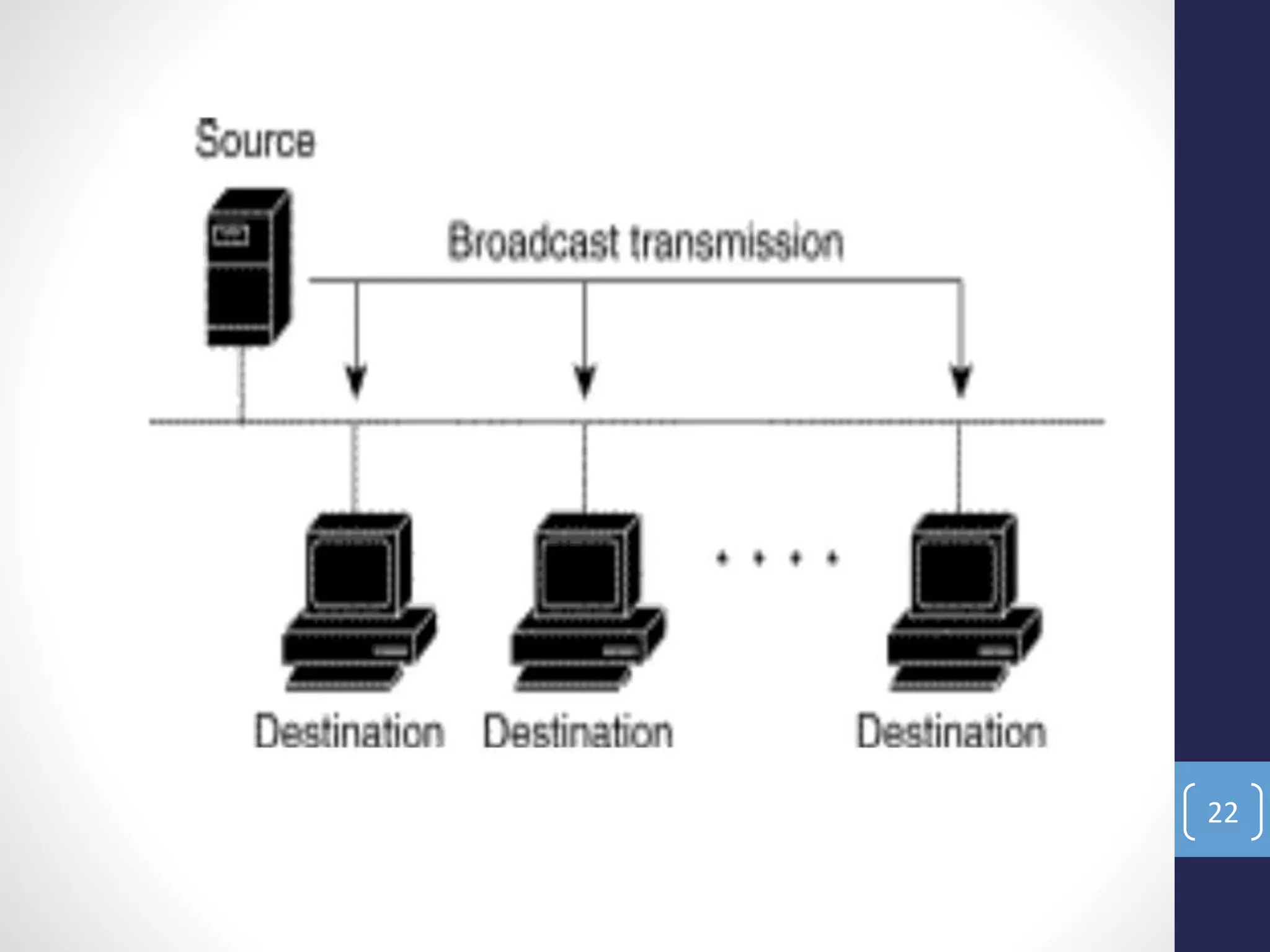
 Uses a special IP address to send a
single stream of data to all of the
machines on the local network
 A broadcast address typically ends
with 255
eg 1: 192.0.2.255
eg 2: 255.255.255.255
21
22
 Broadcast transmissions are
limited to network level services
such as address resolution
 Cannot be used for applications
like video streaming
23
MULTICAST TRAFFIC
24
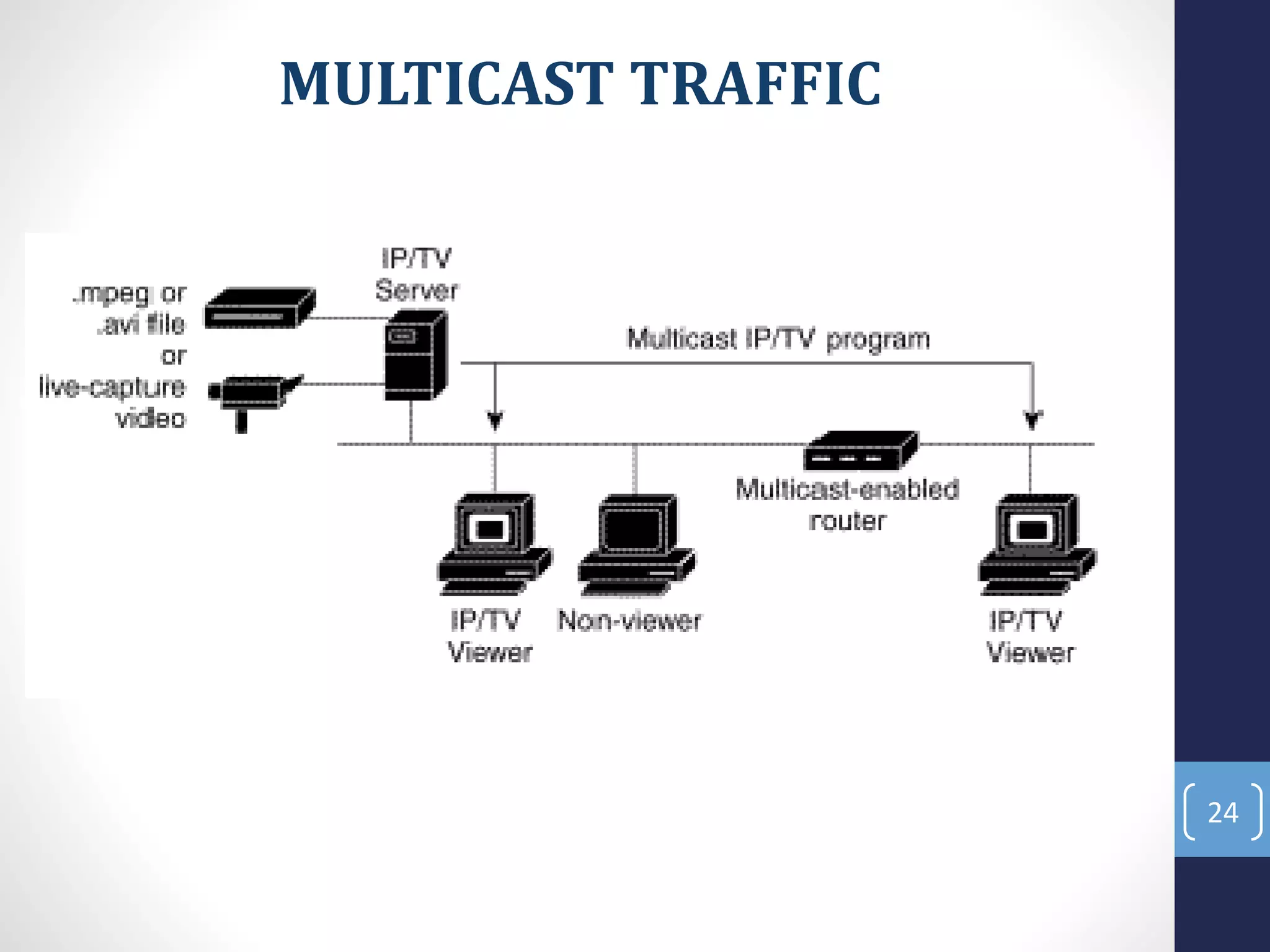
 When a data stream is sent , the
recipients of the data can decide
whether or not to receive data
 If the user wants the data, the user’s
machine receives the data else it
ignores
 That is the user can choose whether
to receive the data
25
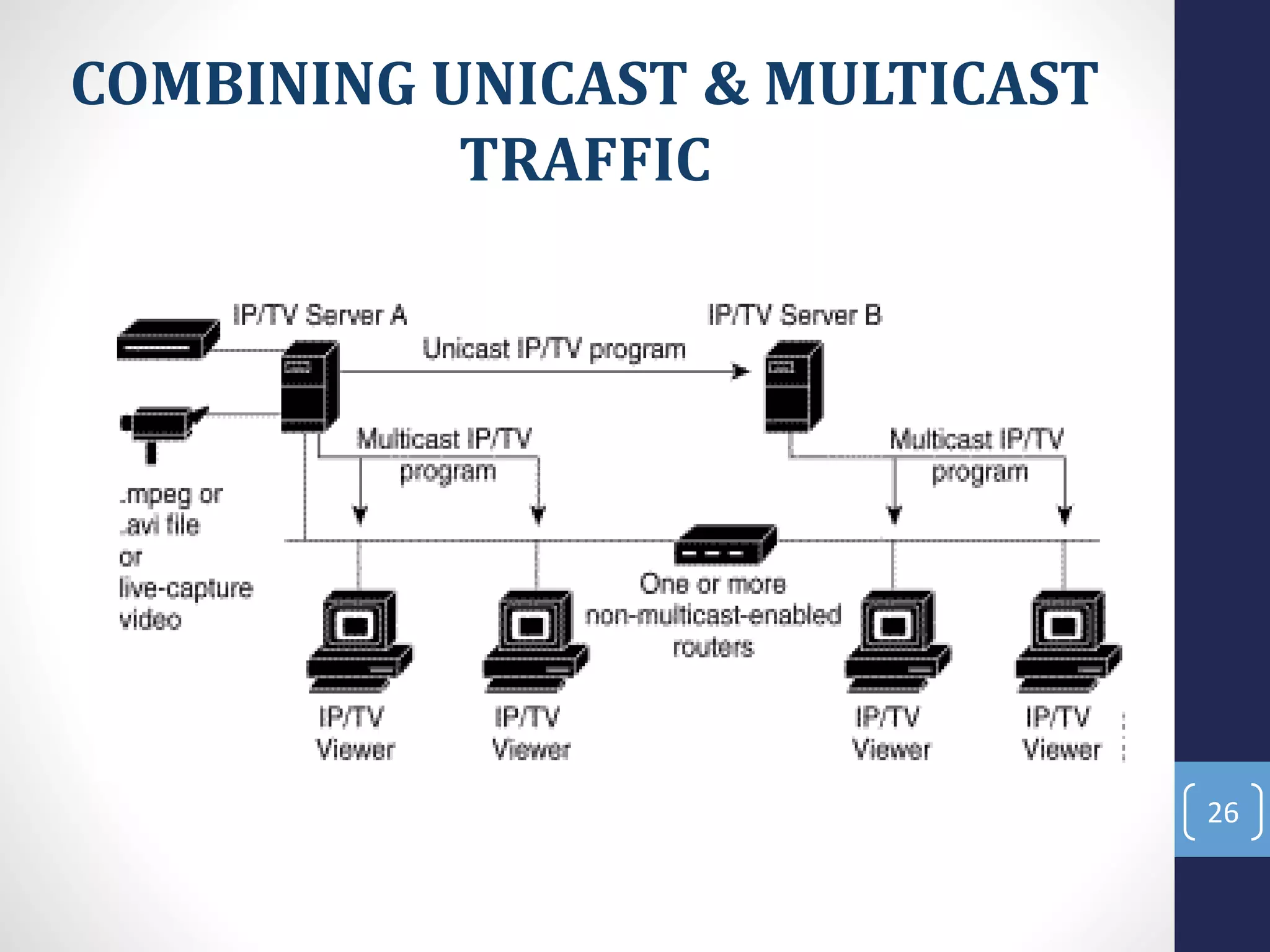
COMBINING UNICAST & MULTICAST
TRAFFIC
26
 Combination is used when routers
in a network are not capable of
handling multicast traffic
 IP/TV can use unicast
transmissions to send multimedia
content across the non-multicast
enabled router
 Small casting
27
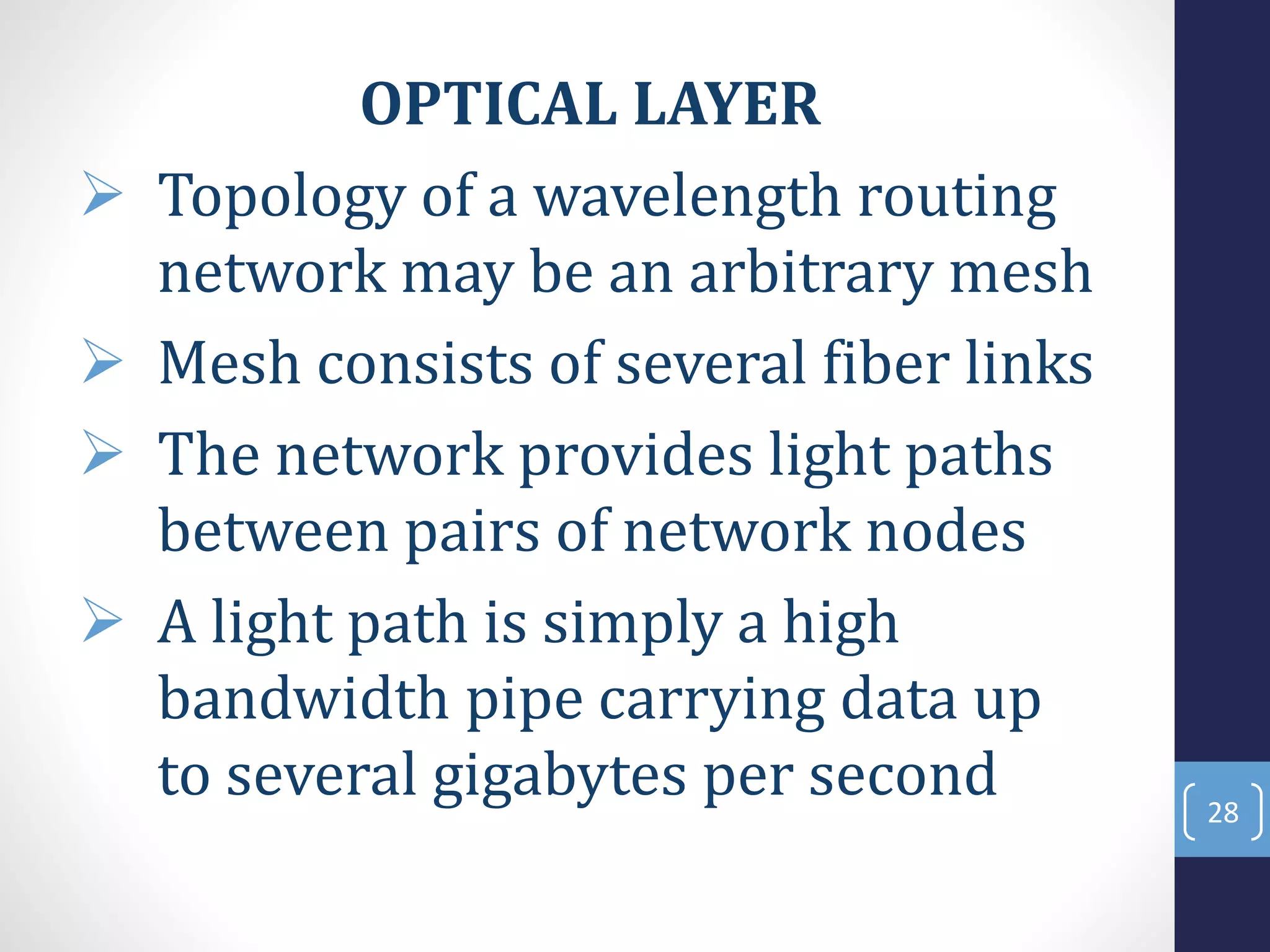
OPTICAL LAYER
 Topology of a wavelength routing
network may be an arbitrary mesh
 Mesh consists of several fiber links
 The network provides light paths
between pairs of network nodes
 A light path is simply a high
bandwidth pipe carrying data up
to several gigabytes per second 28
FEATURES OF OPTICAL LAYER
• Transparency
• Wavelength reuse
• Reliability
• Virtual topology
• Circuit switching
29
RESULTS & DISCUSSIONS
30
ADVANTAGES OF LIGHT TREES
• Data security
• Ease of installation
• Eliminating spark hazards
• High bandwidth over long distances
31
DISADVANTAGES OF LIGHT TREES
• Price
• Fragility
• Opaqueness
• Requires special skills
32
APPLICATIONS OF LIGHT TREES
• Teleconferencing
• Videoconferencing
• Internet news distribution
• Internet television
33
CONCLUSION
34
 WDM WAN based on light trees is
capable of supporting broadcasting
and multicasting over a wide area
network
 employ a minimum number of
opto-electronic devices
 provide a very high bandwidth
optical layer
 efficiently routes unicast, broadcast
and multicast packet-switch traffic 35
FUTURE SCOPE
36
 In the near future WANs will be
based on WDM optical networks
 In addition to unicast services, it
will provide broadcast and
multicast services
37
REFERENCES
38
[1] Laxman H. Sahasrabudhe and Biswanth
mikhergee, Light trees: Optical Multicasting For
Improved Performance in Wavelength-Routed
networks, IEEE Communication Magazine
February,1999,pp.67-73
[2] Biswanth Mukhergee, Dhritiman Banergee,
S.Ramamurthy And Amarnath Mukhergee, The
Principles for Designing a wide-area WDM
Optical Network, IEEE/ACM
Trans.Networking,VOL.4,NO.5,October1996,pp.68
4-96.
[3] Laxman H. Sahasrabudhe, Light trees: An
Optical Layer for Tomorrows IP
Networks, http://www.usdavis.edu
39
[4] Rajiv Ramaswami and kumara N. Sivarajan
Optical Networks. Pp.333-336
[5]
www.ieng.com/univercd/cc/td/doc/product/soft
ware
[6] http://imedea.uib-
csic.es/~salvador/coms_optiques/addicional/ibm
/ch10/10-03.html
40
THANK YOU…
41

Light trees

  • 1.
    LIGHT TREES BHAVYA RWARRIER S7 CSE 12133012 1
  • 2.
    CONTENTS  Introduction  Literaturesurvey  Methodology  Results & discussions  Conclusion  Future scope  References 2
  • 3.
  • 4.
     The conceptof light tree is introduced in a wavelength routed optical network  Employs wavelength division multiplexing(WDM)  Point to point multipoint  Enables single hop communication  Increases network throughput 4
  • 5.
    PHYSICAL TOPOLOGIES  Firstgeneration • Copper based or microwave technology • Eg: Ethernet  Second generation • Optical fibers for data transmission • Switching is performed in electronic domain Eg: FDDI  Third generation • Optical fibers are used • Eg: WDM 5
  • 6.
  • 7.
  • 8.
     It isa method of transmitting and receiving signals in a single common path  Multiple channels can be combined time wise  Transmitted over single fiber using one wavelength  Uses a single channel which is accessed by many devices  Speed is less 8
  • 9.
  • 10.
     Multiple timemultiplexed channels can be transmitted over a single fiber using one wavelength  Can deal with very high frequencies of light  Two types of WDM • Coarse WDM • Dense WDM 10
  • 11.
  • 12.
  • 13.
  • 14.
    WIDE AREA NETWORK(WAN) •Network extends over a large geographical area • WANs are used to connect LANs 14
  • 15.
    LIGHT PATH • Itis an all optical channel • Used to carry circuit switched traffic • It may span multiple fiber links • Can create logical(or virtual) neighbours out of nodes that may be geographically far apart from each other 15
  • 16.
    • The majorobjective of light path communication is to reduce the number of hops a packet has to traverse • Under light path communication, the network employs an equal no. of transmitters and receivers • Each light path operates on a point- to-point basis 16
  • 17.
    TRANSMISSION TYPES There arethree types of transmissions used in light trees:  Unicast traffic  Broadcast traffic  Multicast traffic 17
  • 18.
  • 19.
     Unicast trafficis sent from a single source to a single destination IP address  It is appropriate for many client/server applications such as database applications  There is also mutistream unicast traffic 19
  • 20.
  • 21.
    BROADCAST TRAFFIC  Usesa special IP address to send a single stream of data to all of the machines on the local network  A broadcast address typically ends with 255 eg 1: 192.0.2.255 eg 2: 255.255.255.255 21
  • 22.
  • 23.
     Broadcast transmissionsare limited to network level services such as address resolution  Cannot be used for applications like video streaming 23
  • 24.
  • 25.
     When adata stream is sent , the recipients of the data can decide whether or not to receive data  If the user wants the data, the user’s machine receives the data else it ignores  That is the user can choose whether to receive the data 25
  • 26.
    COMBINING UNICAST &MULTICAST TRAFFIC 26
  • 27.
     Combination isused when routers in a network are not capable of handling multicast traffic  IP/TV can use unicast transmissions to send multimedia content across the non-multicast enabled router  Small casting 27
  • 28.
    OPTICAL LAYER  Topologyof a wavelength routing network may be an arbitrary mesh  Mesh consists of several fiber links  The network provides light paths between pairs of network nodes  A light path is simply a high bandwidth pipe carrying data up to several gigabytes per second 28
  • 29.
    FEATURES OF OPTICALLAYER • Transparency • Wavelength reuse • Reliability • Virtual topology • Circuit switching 29
  • 30.
  • 31.
    ADVANTAGES OF LIGHTTREES • Data security • Ease of installation • Eliminating spark hazards • High bandwidth over long distances 31
  • 32.
    DISADVANTAGES OF LIGHTTREES • Price • Fragility • Opaqueness • Requires special skills 32
  • 33.
    APPLICATIONS OF LIGHTTREES • Teleconferencing • Videoconferencing • Internet news distribution • Internet television 33
  • 34.
  • 35.
     WDM WANbased on light trees is capable of supporting broadcasting and multicasting over a wide area network  employ a minimum number of opto-electronic devices  provide a very high bandwidth optical layer  efficiently routes unicast, broadcast and multicast packet-switch traffic 35
  • 36.
  • 37.
     In thenear future WANs will be based on WDM optical networks  In addition to unicast services, it will provide broadcast and multicast services 37
  • 38.
  • 39.
    [1] Laxman H.Sahasrabudhe and Biswanth mikhergee, Light trees: Optical Multicasting For Improved Performance in Wavelength-Routed networks, IEEE Communication Magazine February,1999,pp.67-73 [2] Biswanth Mukhergee, Dhritiman Banergee, S.Ramamurthy And Amarnath Mukhergee, The Principles for Designing a wide-area WDM Optical Network, IEEE/ACM Trans.Networking,VOL.4,NO.5,October1996,pp.68 4-96. [3] Laxman H. Sahasrabudhe, Light trees: An Optical Layer for Tomorrows IP Networks, http://www.usdavis.edu 39
  • 40.
    [4] Rajiv Ramaswamiand kumara N. Sivarajan Optical Networks. Pp.333-336 [5] www.ieng.com/univercd/cc/td/doc/product/soft ware [6] http://imedea.uib- csic.es/~salvador/coms_optiques/addicional/ibm /ch10/10-03.html 40
  • 41.