Shree Sant Gajanan Maharaj College of Engineering,
Shegaon – 444203
(2019 - 20)
1
SEMINAR ON
ā€œ LIGHT TREES ā€
Presented By :
Mr. Prashant Chaudhari
Final Year C.S.E
Roll no. : 66
Group no. : G 19
Seminar Guide :
Prof. M. G. Ingle
CONTENTS
• Introduction
• Physical Topologies
• WDM and its types
• Comparisons of CWDM and DWDM
• Light Path
• Light Tree
• Multicast Switch Architecture of Light Tree
• Optical Layer
• Unicast, Broadcast & Multicast Traffic
• Applications
• Advantages and Disadvantages
• Conclusion
• References
2
INTRODUCTION
• The concept of light tree is introduced in a wavelength routed
optical network
• Employs wavelength division multiplexing(WDM)
• Point to point multipoint
• Enables single hop communication
• Increases network throughput
3
PHYSICAL TOPOLOGIES
• First generation
Copper based or microwave technology
Eg: Ethernet
• Second generation
Optical fiber for data transmission
Switching is performed in electronic domain
Eg: FDDI
• Third generation
Optical fiber are used for both transmission & switching
Eg: WDM
4
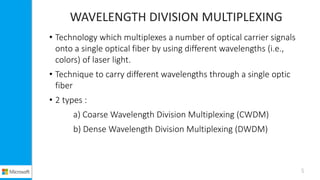
WAVELENGTH DIVISION MULTIPLEXING
• Technology which multiplexes a number of optical carrier signals
onto a single optical fiber by using different wavelengths (i.e.,
colors) of laser light.
• Technique to carry different wavelengths through a single optic
fiber
• 2 types :
a) Coarse Wavelength Division Multiplexing (CWDM)
b) Dense Wavelength Division Multiplexing (DWDM)
5
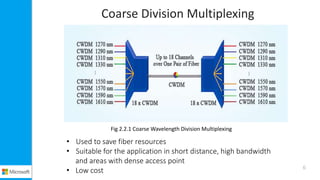
Coarse Division Multiplexing
• Used to save fiber resources
• Suitable for the application in short distance, high bandwidth
and areas with dense access point
• Low cost
Fig 2.2.1 Coarse Wavelength Division Multiplexing
6
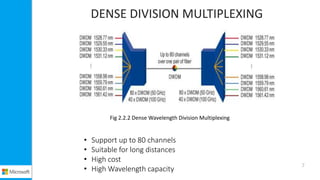
DENSE DIVISION MULTIPLEXING
• Support up to 80 channels
• Suitable for long distances
• High cost
• High Wavelength capacity
Fig 2.2.2 Dense Wavelength Division Multiplexing
7
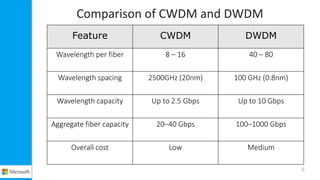
Comparison of CWDM and DWDM
Feature CWDM DWDM
Wavelength per fiber 8 – 16 40 – 80
Wavelength spacing 2500GHz (20nm) 100 GHz (0.8nm)
Wavelength capacity Up to 2.5 Gbps Up to 10 Gbps
Aggregate fiber capacity 20–40 Gbps 100–1000 Gbps
Overall cost Low Medium
8
LIGHT PATH
• It is an all optical channel
• Used to carry circuit switched traffic
• It may span multiple fiber links
• Can create logical(or virtual) neighbours out of nodes that may be
geographically far apart from each other
• The major objective of light path communication is to reduce the
number of hops a packet has to traverse
• Under light path communication, the network employs an equal
no. of transmitters and receivers
• Each light path operates on a point-to-point basis
9
LIGHT TREES
• Light tree as a point to multipoint extension of light path
• A point to point multipoint all optical channel
• Multicasting applications
• Single-hop communication
• Increases network throughput
10
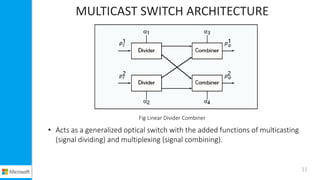
MULTICAST SWITCH ARCHITECTURE
Fig Linear Divider Combiner
• Acts as a generalized optical switch with the added functions of multicasting
(signal dividing) and multiplexing (signal combining).
11
OPTICAL LAYER
• Topology of a wavelength routing network may be an arbitrary
mesh
• Mesh consists of several fiber links
• The network provides light paths between pairs of network nodes
• A light path is simply a high bandwidth pipe carrying data up to
several gigabytes per second
12
FEATURES OF OPTICAL LAYER
• Transparency
• Wavelength reuse
• Reliability
• Virtual topology
• Circuit switching
13
TRANSMISSION TYPES IN LIGHT TREE
• There are three types of transmissions used in light trees:
1. Unicast traffic
2. Broadcast traffic
3. Multicast traffic
14
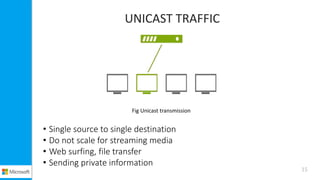
UNICAST TRAFFIC
• Single source to single destination
• Do not scale for streaming media
• Web surfing, file transfer
• Sending private information
Fig Unicast transmission
15
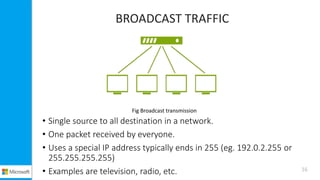
BROADCAST TRAFFIC
• Single source to all destination in a network.
• One packet received by everyone.
• Uses a special IP address typically ends in 255 (eg. 192.0.2.255 or
255.255.255.255)
• Examples are television, radio, etc.
Fig Broadcast transmission
16
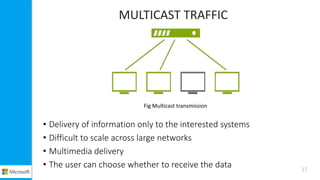
MULTICAST TRAFFIC
• Delivery of information only to the interested systems
• Difficult to scale across large networks
• Multimedia delivery
• The user can choose whether to receive the data
Fig Multicast transmission
17
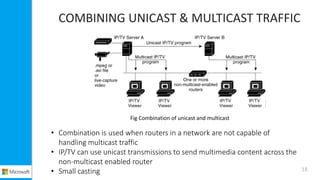
COMBINING UNICAST & MULTICAST TRAFFIC
Fig Combination of unicast and multicast
• Combination is used when routers in a network are not capable of
handling multicast traffic
• IP/TV can use unicast transmissions to send multimedia content across the
non-multicast enabled router
• Small casting 18
ADVANTAGES OF LIGHT TREES
• Data security
• Ease of installation
• Eliminating spark hazards
• High bandwidth over long distances
19
DISADVANTAGES OF LIGHT TREES
• Price
• Fragility
• Opaqueness
• Requires special skills
20
APPLICATIONS OF LIGHT TREES
• Teleconferencing
• Videoconferencing
• Internet news distribution
• Internet television
21
CONCLUSION
• WDM WAN based on light trees is capable of supporting broadcasting and
multicasting over a wide area network
• Employ a minimum number of opto-electronic devices
• Provide a very high bandwidth optical layer
• Efficiently routes unicast, broadcast and multicast packet-switch traffic
• Enable single hop count
• Maximizes the throughput
22
REFERENCES
1) R. Lin, M. Zukerman, G. Shen and W. Zhong, "Design of light-tree based optical inter-
datacenter networks," in IEEE/OSA Journal of Optical Communications and Networking,
vol. 5, no. 12, pp. 1443-1455, Dec. 2013.
2) B. Mukherjee,ā€ Optical Communication Networksā€, New York:McGraw-Hill, 1997.
3) I. Chlamtac, A. Ganz, G. Karmi, "Lightpath communications: An approach to
highbandwidth optical WAN's", IEEE Trans. Commun., vol. 40, pp. 1171-1182, July
1992.
4) L. H. Sahasrabuddhe, B. Mukherjee, ā€œLight-trees: Exploiting optical multicasting to
improve the performance of unicast and broadcast traffic in wavelength-routed optical
networksā€, Aug. 1998.
5) R. M. Krishnaswamy, and K. N. Sivarajan, ā€œDesign of Logical Topologies: A Linear
Formulation for Wavelength-Routed Optical Networks with No Wavelength Changers,ā€
IEEE/ACM Trans. Networking, vol. 9, no. 2, Apr. 2001, pp. 186-198.
6) L. H. Sahasrabuddhe and B. Mukherjee, ā€œLight-Trees: Optical Multicasting for Improved
Performance in Wavelength-Routed Networks,ā€ IEEE Commun. Mag., Feb. 2009, pp. 67-
731790.
7) https://koovik.com/en/2018/09/21/iptv-broadcast-multicast-unicast-streaming/
23
THANK YOU !
24

Light Trees ppt

  • 1.
    Shree Sant GajananMaharaj College of Engineering, Shegaon – 444203 (2019 - 20) 1 SEMINAR ON ā€œ LIGHT TREES ā€ Presented By : Mr. Prashant Chaudhari Final Year C.S.E Roll no. : 66 Group no. : G 19 Seminar Guide : Prof. M. G. Ingle
  • 2.
    CONTENTS • Introduction • PhysicalTopologies • WDM and its types • Comparisons of CWDM and DWDM • Light Path • Light Tree • Multicast Switch Architecture of Light Tree • Optical Layer • Unicast, Broadcast & Multicast Traffic • Applications • Advantages and Disadvantages • Conclusion • References 2
  • 3.
    INTRODUCTION • The conceptof light tree is introduced in a wavelength routed optical network • Employs wavelength division multiplexing(WDM) • Point to point multipoint • Enables single hop communication • Increases network throughput 3
  • 4.
    PHYSICAL TOPOLOGIES • Firstgeneration Copper based or microwave technology Eg: Ethernet • Second generation Optical fiber for data transmission Switching is performed in electronic domain Eg: FDDI • Third generation Optical fiber are used for both transmission & switching Eg: WDM 4
  • 5.
    WAVELENGTH DIVISION MULTIPLEXING •Technology which multiplexes a number of optical carrier signals onto a single optical fiber by using different wavelengths (i.e., colors) of laser light. • Technique to carry different wavelengths through a single optic fiber • 2 types : a) Coarse Wavelength Division Multiplexing (CWDM) b) Dense Wavelength Division Multiplexing (DWDM) 5
  • 6.
    Coarse Division Multiplexing •Used to save fiber resources • Suitable for the application in short distance, high bandwidth and areas with dense access point • Low cost Fig 2.2.1 Coarse Wavelength Division Multiplexing 6
  • 7.
    DENSE DIVISION MULTIPLEXING •Support up to 80 channels • Suitable for long distances • High cost • High Wavelength capacity Fig 2.2.2 Dense Wavelength Division Multiplexing 7
  • 8.
    Comparison of CWDMand DWDM Feature CWDM DWDM Wavelength per fiber 8 – 16 40 – 80 Wavelength spacing 2500GHz (20nm) 100 GHz (0.8nm) Wavelength capacity Up to 2.5 Gbps Up to 10 Gbps Aggregate fiber capacity 20–40 Gbps 100–1000 Gbps Overall cost Low Medium 8
  • 9.
    LIGHT PATH • Itis an all optical channel • Used to carry circuit switched traffic • It may span multiple fiber links • Can create logical(or virtual) neighbours out of nodes that may be geographically far apart from each other • The major objective of light path communication is to reduce the number of hops a packet has to traverse • Under light path communication, the network employs an equal no. of transmitters and receivers • Each light path operates on a point-to-point basis 9
  • 10.
    LIGHT TREES • Lighttree as a point to multipoint extension of light path • A point to point multipoint all optical channel • Multicasting applications • Single-hop communication • Increases network throughput 10
  • 11.
    MULTICAST SWITCH ARCHITECTURE FigLinear Divider Combiner • Acts as a generalized optical switch with the added functions of multicasting (signal dividing) and multiplexing (signal combining). 11
  • 12.
    OPTICAL LAYER • Topologyof a wavelength routing network may be an arbitrary mesh • Mesh consists of several fiber links • The network provides light paths between pairs of network nodes • A light path is simply a high bandwidth pipe carrying data up to several gigabytes per second 12
  • 13.
    FEATURES OF OPTICALLAYER • Transparency • Wavelength reuse • Reliability • Virtual topology • Circuit switching 13
  • 14.
    TRANSMISSION TYPES INLIGHT TREE • There are three types of transmissions used in light trees: 1. Unicast traffic 2. Broadcast traffic 3. Multicast traffic 14
  • 15.
    UNICAST TRAFFIC • Singlesource to single destination • Do not scale for streaming media • Web surfing, file transfer • Sending private information Fig Unicast transmission 15
  • 16.
    BROADCAST TRAFFIC • Singlesource to all destination in a network. • One packet received by everyone. • Uses a special IP address typically ends in 255 (eg. 192.0.2.255 or 255.255.255.255) • Examples are television, radio, etc. Fig Broadcast transmission 16
  • 17.
    MULTICAST TRAFFIC • Deliveryof information only to the interested systems • Difficult to scale across large networks • Multimedia delivery • The user can choose whether to receive the data Fig Multicast transmission 17
  • 18.
    COMBINING UNICAST &MULTICAST TRAFFIC Fig Combination of unicast and multicast • Combination is used when routers in a network are not capable of handling multicast traffic • IP/TV can use unicast transmissions to send multimedia content across the non-multicast enabled router • Small casting 18
  • 19.
    ADVANTAGES OF LIGHTTREES • Data security • Ease of installation • Eliminating spark hazards • High bandwidth over long distances 19
  • 20.
    DISADVANTAGES OF LIGHTTREES • Price • Fragility • Opaqueness • Requires special skills 20
  • 21.
    APPLICATIONS OF LIGHTTREES • Teleconferencing • Videoconferencing • Internet news distribution • Internet television 21
  • 22.
    CONCLUSION • WDM WANbased on light trees is capable of supporting broadcasting and multicasting over a wide area network • Employ a minimum number of opto-electronic devices • Provide a very high bandwidth optical layer • Efficiently routes unicast, broadcast and multicast packet-switch traffic • Enable single hop count • Maximizes the throughput 22
  • 23.
    REFERENCES 1) R. Lin,M. Zukerman, G. Shen and W. Zhong, "Design of light-tree based optical inter- datacenter networks," in IEEE/OSA Journal of Optical Communications and Networking, vol. 5, no. 12, pp. 1443-1455, Dec. 2013. 2) B. Mukherjee,ā€ Optical Communication Networksā€, New York:McGraw-Hill, 1997. 3) I. Chlamtac, A. Ganz, G. Karmi, "Lightpath communications: An approach to highbandwidth optical WAN's", IEEE Trans. Commun., vol. 40, pp. 1171-1182, July 1992. 4) L. H. Sahasrabuddhe, B. Mukherjee, ā€œLight-trees: Exploiting optical multicasting to improve the performance of unicast and broadcast traffic in wavelength-routed optical networksā€, Aug. 1998. 5) R. M. Krishnaswamy, and K. N. Sivarajan, ā€œDesign of Logical Topologies: A Linear Formulation for Wavelength-Routed Optical Networks with No Wavelength Changers,ā€ IEEE/ACM Trans. Networking, vol. 9, no. 2, Apr. 2001, pp. 186-198. 6) L. H. Sahasrabuddhe and B. Mukherjee, ā€œLight-Trees: Optical Multicasting for Improved Performance in Wavelength-Routed Networks,ā€ IEEE Commun. Mag., Feb. 2009, pp. 67- 731790. 7) https://koovik.com/en/2018/09/21/iptv-broadcast-multicast-unicast-streaming/ 23
  • 24.