LIGHT EMITTING DIODE
GROUP MEMBERS:
ATIQ-UR-REHMAN AWAIS ATHER WALEED
TOPICS:
 HISTORY
 WORKING
1.DIRECT COMBINATION
2.INDIRECT COMBINATION
 APPLICATIONS
 ADVANTAGES
 DISADVANTAGES
HISTORY:
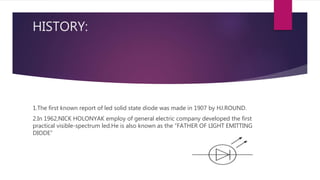
1.The first known report of led solid state diode was made in 1907 by HJ.ROUND.
2.In 1962,NICK HOLONYAK employ of general electric company developed the first
practical visible-spectrum led.He is also known as the “FATHER OF LIGHT EMITTING
DIODE”
WORKING:
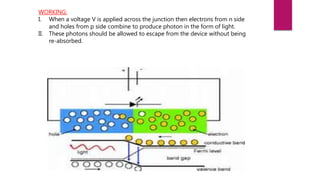
I. When a voltage V is applied across the junction then electrons from n side
and holes from p side combine to produce photon in the form of light.
II. These photons should be allowed to escape from the device without being
re-absorbed.
 DIRECT GAP:
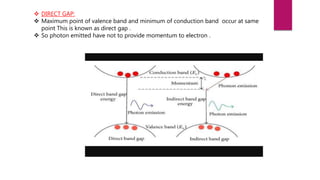
 Maximum point of valence band and minimum of conduction band occur at same
point This is known as direct gap .
 So photon emitted have not to provide momentum to electron .
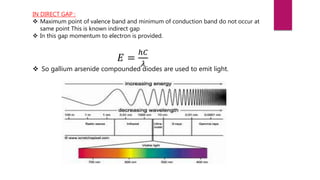
IN DIRECT GAP :
 Maximum point of valence band and minimum of conduction band do not occur at
same point This is known indirect gap
 In this gap momentum to electron is provided.
𝐸 =
ℎ𝐶
𝜆
 So gallium arsenide compounded diodes are used to emit light.
APPLICATIONS:
DEVICES,MEDICAL applications,clothing,toys
Remote control
Lighting
Indicators, signs
Traffic signals
Swimming pool lighting
ADVANTAGES
 LED produce more light per watt than normal bulbs; useful for energy saving
devices.
 Led lights up very quickly and achieve full brightness in microseconds.
 Led’s can have a relatively long useful life.
 Led’s being solid state components are difficult to damage with external source.
DISADVANTAGES
 LED are currently more expensive
 LED must be supplied correct voltage otherwise a little more voltage will burn the
LED
 LED performance depend upon the environment temperature, increase in temp
effect the life of LED

Light emitting diode presentation

  • 1.
    LIGHT EMITTING DIODE GROUPMEMBERS: ATIQ-UR-REHMAN AWAIS ATHER WALEED
  • 2.
    TOPICS:  HISTORY  WORKING 1.DIRECTCOMBINATION 2.INDIRECT COMBINATION  APPLICATIONS  ADVANTAGES  DISADVANTAGES
  • 3.
    HISTORY: 1.The first knownreport of led solid state diode was made in 1907 by HJ.ROUND. 2.In 1962,NICK HOLONYAK employ of general electric company developed the first practical visible-spectrum led.He is also known as the “FATHER OF LIGHT EMITTING DIODE”
  • 4.
    WORKING: I. When avoltage V is applied across the junction then electrons from n side and holes from p side combine to produce photon in the form of light. II. These photons should be allowed to escape from the device without being re-absorbed.
  • 5.
     DIRECT GAP: Maximum point of valence band and minimum of conduction band occur at same point This is known as direct gap .  So photon emitted have not to provide momentum to electron .
  • 6.
    IN DIRECT GAP:  Maximum point of valence band and minimum of conduction band do not occur at same point This is known indirect gap  In this gap momentum to electron is provided. 𝐸 = ℎ𝐶 𝜆  So gallium arsenide compounded diodes are used to emit light.
  • 7.
  • 8.
    ADVANTAGES  LED producemore light per watt than normal bulbs; useful for energy saving devices.  Led lights up very quickly and achieve full brightness in microseconds.  Led’s can have a relatively long useful life.  Led’s being solid state components are difficult to damage with external source.
  • 9.
    DISADVANTAGES  LED arecurrently more expensive  LED must be supplied correct voltage otherwise a little more voltage will burn the LED  LED performance depend upon the environment temperature, increase in temp effect the life of LED