Li-Fi Technology
Wi-Fi
 Wi-Fi is a technology that allows electronic devices to connect to a
wireless LAN (WLAN) network.
 It mainly uses the 2.4 gigahertz UHF and 5 gigahertz SHF ISM radio
bands.
 Wi-Fi compatible devices can connect to the Internet via a WLAN
network and a wireless access point. Such an access point has a range
of about 20 meters (66 feet) indoors and a greater range outdoors.
 The Wi-Fi Alliance defines Wi-Fi as any "wireless local area network"
(WLAN) product based on the IEEE 802.11 standards
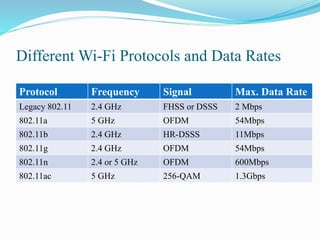
Different Wi-Fi Protocols and Data Rates
Protocol Frequency Signal Max. Data Rate
Legacy 802.11 2.4 GHz FHSS or DSSS 2 Mbps
802.11a 5 GHz OFDM 54Mbps
802.11b 2.4 GHz HR-DSSS 11Mbps
802.11g 2.4 GHz OFDM 54Mbps
802.11n 2.4 or 5 GHz OFDM 600Mbps
802.11ac 5 GHz 256-QAM 1.3Gbps
History Of Li-Fi
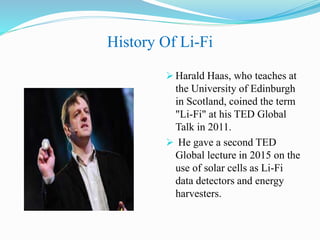
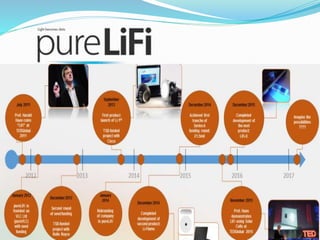
 Harald Haas, who teaches at
the University of Edinburgh
in Scotland, coined the term
"Li-Fi" at his TED Global
Talk in 2011.
 He gave a second TED
Global lecture in 2015 on the
use of solar cells as Li-Fi
data detectors and energy
harvesters.
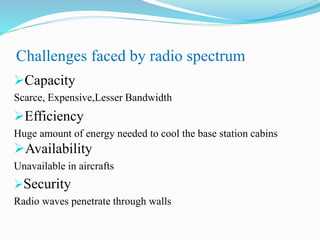
Challenges faced by radio spectrum
Capacity
Scarce, Expensive,Lesser Bandwidth
Efficiency
Huge amount of energy needed to cool the base station cabins
Availability
Unavailable in aircrafts
Security
Radio waves penetrate through walls
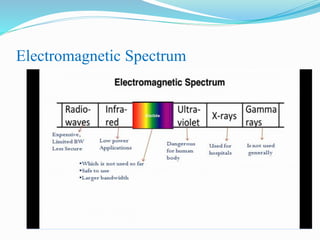
Electromagnetic Spectrum
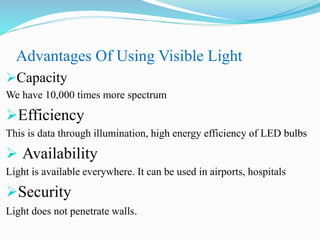
Advantages Of Using Visible Light
Capacity
We have 10,000 times more spectrum
Efficiency
This is data through illumination, high energy efficiency of LED bulbs
 Availability
Light is available everywhere. It can be used in airports, hospitals
Security
Light does not penetrate walls.
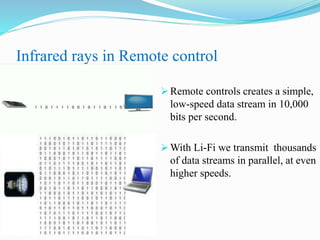
Infrared rays in Remote control
 Remote controls creates a simple,
low-speed data stream in 10,000
bits per second.
 With Li-Fi we transmit thousands
of data streams in parallel, at even
higher speeds.
Working Of Li-Fi
Operational procedure is very simple, if the led is on, you transmit a
digital 1,if its off you transmit a digital 0.
The LEDs can be switched on and off very quickly, which gives nice
opportunities for transmitting data.
Hence all that is required is some LEDs and a controller that code
data into those LEDs.
We have to just vary the rate at which the LED’s flicker depending
upon the data we want to encode .
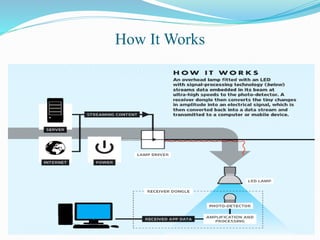
How It Works
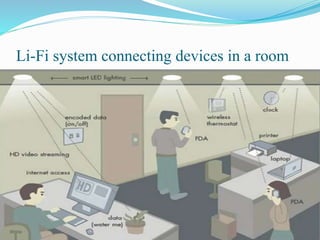
Li-Fi system connecting devices in a room
Modulation Techniques
On-off keying
• On-off keying (OOK) denotes the simplest form of amplitude-shift
keying (ASK) modulation
• Presence of a carrier for a specific duration represents a binary one
• Absence of carrier for the same duration represents a binary zero
• It is analogous to unipolar encoding line code.
• It is very easy to generate and decode
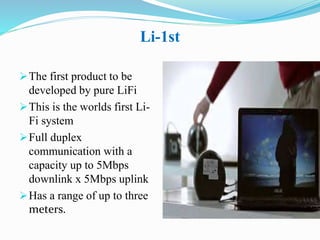
Li-1st
The first product to be
developed by pure LiFi
This is the worlds first Li-
Fi system
Full duplex
communication with a
capacity up to 5Mbps
downlink x 5Mbps uplink
Has a range of up to three
meters.
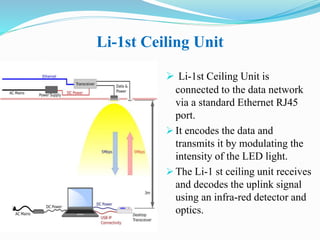
Li-1st Ceiling Unit
 Li-1st Ceiling Unit is
connected to the data network
via a standard Ethernet RJ45
port.
 It encodes the data and
transmits it by modulating the
intensity of the LED light.
 The Li-1 st ceiling unit receives
and decodes the uplink signal
using an infra-red detector and
optics.
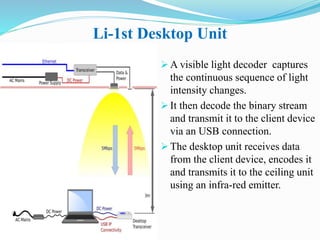
Li-1st Desktop Unit
 A visible light decoder captures
the continuous sequence of light
intensity changes.
 It then decode the binary stream
and transmit it to the client device
via an USB connection.
 The desktop unit receives data
from the client device, encodes it
and transmits it to the ceiling unit
using an infra-red emitter.
Li-Flame
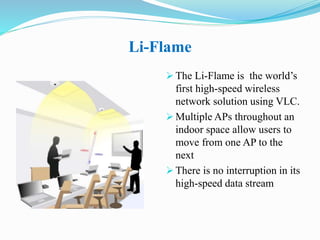
 The Li-Flame is the world’s
first high-speed wireless
network solution using VLC.
 Multiple APs throughout an
indoor space allow users to
move from one AP to the
next
 There is no interruption in its
high-speed data stream
Li Flame Ceiling Unit
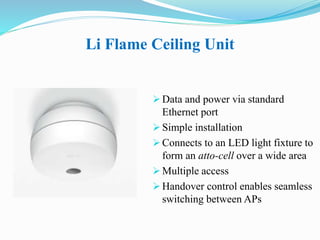
 Data and power via standard
Ethernet port
 Simple installation
 Connects to an LED light fixture to
form an atto-cell over a wide area
 Multiple access
 Handover control enables seamless
switching between APs
Li Flame Desktop Unit
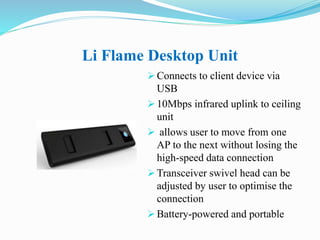
 Connects to client device via
USB
 10Mbps infrared uplink to ceiling
unit
 allows user to move from one
AP to the next without losing the
high-speed data connection
 Transceiver swivel head can be
adjusted by user to optimise the
connection
 Battery-powered and portable
Solar Li-Fi
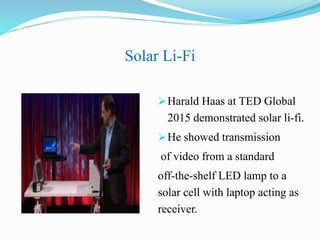
Harald Haas at TED Global
2015 demonstrated solar li-fi.
He showed transmission
of video from a standard
off-the-shelf LED lamp to a
solar cell with laptop acting as
receiver.
Solar Li-Fi
 The point is to use existing infrastructure like solar panel and
LEDs to close the digital divide and to connect billions of
devices to internet .
 The Li-Fi prototype relies on solar energy to power Internet
connections
 An LED light source paired with a solar panel becomes a
fully functional transmitter and receiver system for high
speed, secure data transfer
 It is possible to use solar cells on the roof of a hut to act as a
broadband receiver from a laser station on a close by hill.
Applications
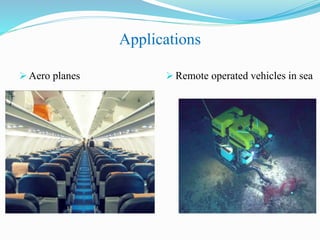
 Aero planes  Remote operated vehicles in sea
Applications
 Petro chemical plants  Traffic control
Applications
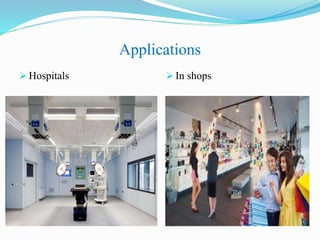
 Hospitals  In shops
Limitations 0f Li-Fi
 Light does not penetrate walls so signal contained to one area.
 For ideal speeds line of sight is required.
 A major challenge facing Li-Fi is how the receiving device
will transmit back to transmitter.
 Interferences from external light sources like sun light, normal
bulbs, and opaque materials in the path of transmission will
cause interruption in the communication
Conclusion
 So, all we would need to do is to fit a small microchip to every
potential illumination device.
 This would then combine two basic functionalities: illumination
and wireless data transmission
 This could solve the four essential problems that face us in wireless
communication these days
 In the future data for laptops, smartphones could be transmitted
through the light in a room.
videos
 https://www.ted.com/talks/harald_haas_wireless_dat
a_from_every_light_bulb?language=en
 https://www.ted.com/talks/harald_haas_a_breakthro
ugh_new_kind_of_wireless_internet?language=en

Li Fi technology

  • 1.
  • 2.
    Wi-Fi  Wi-Fi isa technology that allows electronic devices to connect to a wireless LAN (WLAN) network.  It mainly uses the 2.4 gigahertz UHF and 5 gigahertz SHF ISM radio bands.  Wi-Fi compatible devices can connect to the Internet via a WLAN network and a wireless access point. Such an access point has a range of about 20 meters (66 feet) indoors and a greater range outdoors.  The Wi-Fi Alliance defines Wi-Fi as any "wireless local area network" (WLAN) product based on the IEEE 802.11 standards
  • 3.
    Different Wi-Fi Protocolsand Data Rates Protocol Frequency Signal Max. Data Rate Legacy 802.11 2.4 GHz FHSS or DSSS 2 Mbps 802.11a 5 GHz OFDM 54Mbps 802.11b 2.4 GHz HR-DSSS 11Mbps 802.11g 2.4 GHz OFDM 54Mbps 802.11n 2.4 or 5 GHz OFDM 600Mbps 802.11ac 5 GHz 256-QAM 1.3Gbps
  • 4.
    History Of Li-Fi Harald Haas, who teaches at the University of Edinburgh in Scotland, coined the term "Li-Fi" at his TED Global Talk in 2011.  He gave a second TED Global lecture in 2015 on the use of solar cells as Li-Fi data detectors and energy harvesters.
  • 5.
    Challenges faced byradio spectrum Capacity Scarce, Expensive,Lesser Bandwidth Efficiency Huge amount of energy needed to cool the base station cabins Availability Unavailable in aircrafts Security Radio waves penetrate through walls
  • 6.
  • 7.
    Advantages Of UsingVisible Light Capacity We have 10,000 times more spectrum Efficiency This is data through illumination, high energy efficiency of LED bulbs  Availability Light is available everywhere. It can be used in airports, hospitals Security Light does not penetrate walls.
  • 8.
    Infrared rays inRemote control  Remote controls creates a simple, low-speed data stream in 10,000 bits per second.  With Li-Fi we transmit thousands of data streams in parallel, at even higher speeds.
  • 9.
    Working Of Li-Fi Operationalprocedure is very simple, if the led is on, you transmit a digital 1,if its off you transmit a digital 0. The LEDs can be switched on and off very quickly, which gives nice opportunities for transmitting data. Hence all that is required is some LEDs and a controller that code data into those LEDs. We have to just vary the rate at which the LED’s flicker depending upon the data we want to encode .
  • 10.
  • 11.
    Li-Fi system connectingdevices in a room
  • 12.
    Modulation Techniques On-off keying •On-off keying (OOK) denotes the simplest form of amplitude-shift keying (ASK) modulation • Presence of a carrier for a specific duration represents a binary one • Absence of carrier for the same duration represents a binary zero • It is analogous to unipolar encoding line code. • It is very easy to generate and decode
  • 14.
    Li-1st The first productto be developed by pure LiFi This is the worlds first Li- Fi system Full duplex communication with a capacity up to 5Mbps downlink x 5Mbps uplink Has a range of up to three meters.
  • 15.
    Li-1st Ceiling Unit Li-1st Ceiling Unit is connected to the data network via a standard Ethernet RJ45 port.  It encodes the data and transmits it by modulating the intensity of the LED light.  The Li-1 st ceiling unit receives and decodes the uplink signal using an infra-red detector and optics.
  • 16.
    Li-1st Desktop Unit A visible light decoder captures the continuous sequence of light intensity changes.  It then decode the binary stream and transmit it to the client device via an USB connection.  The desktop unit receives data from the client device, encodes it and transmits it to the ceiling unit using an infra-red emitter.
  • 17.
    Li-Flame  The Li-Flameis the world’s first high-speed wireless network solution using VLC.  Multiple APs throughout an indoor space allow users to move from one AP to the next  There is no interruption in its high-speed data stream
  • 18.
    Li Flame CeilingUnit  Data and power via standard Ethernet port  Simple installation  Connects to an LED light fixture to form an atto-cell over a wide area  Multiple access  Handover control enables seamless switching between APs
  • 19.
    Li Flame DesktopUnit  Connects to client device via USB  10Mbps infrared uplink to ceiling unit  allows user to move from one AP to the next without losing the high-speed data connection  Transceiver swivel head can be adjusted by user to optimise the connection  Battery-powered and portable
  • 20.
    Solar Li-Fi Harald Haasat TED Global 2015 demonstrated solar li-fi. He showed transmission of video from a standard off-the-shelf LED lamp to a solar cell with laptop acting as receiver.
  • 21.
    Solar Li-Fi  Thepoint is to use existing infrastructure like solar panel and LEDs to close the digital divide and to connect billions of devices to internet .  The Li-Fi prototype relies on solar energy to power Internet connections  An LED light source paired with a solar panel becomes a fully functional transmitter and receiver system for high speed, secure data transfer  It is possible to use solar cells on the roof of a hut to act as a broadband receiver from a laser station on a close by hill.
  • 22.
    Applications  Aero planes Remote operated vehicles in sea
  • 23.
    Applications  Petro chemicalplants  Traffic control
  • 24.
  • 25.
    Limitations 0f Li-Fi Light does not penetrate walls so signal contained to one area.  For ideal speeds line of sight is required.  A major challenge facing Li-Fi is how the receiving device will transmit back to transmitter.  Interferences from external light sources like sun light, normal bulbs, and opaque materials in the path of transmission will cause interruption in the communication
  • 26.
    Conclusion  So, allwe would need to do is to fit a small microchip to every potential illumination device.  This would then combine two basic functionalities: illumination and wireless data transmission  This could solve the four essential problems that face us in wireless communication these days  In the future data for laptops, smartphones could be transmitted through the light in a room.
  • 27.