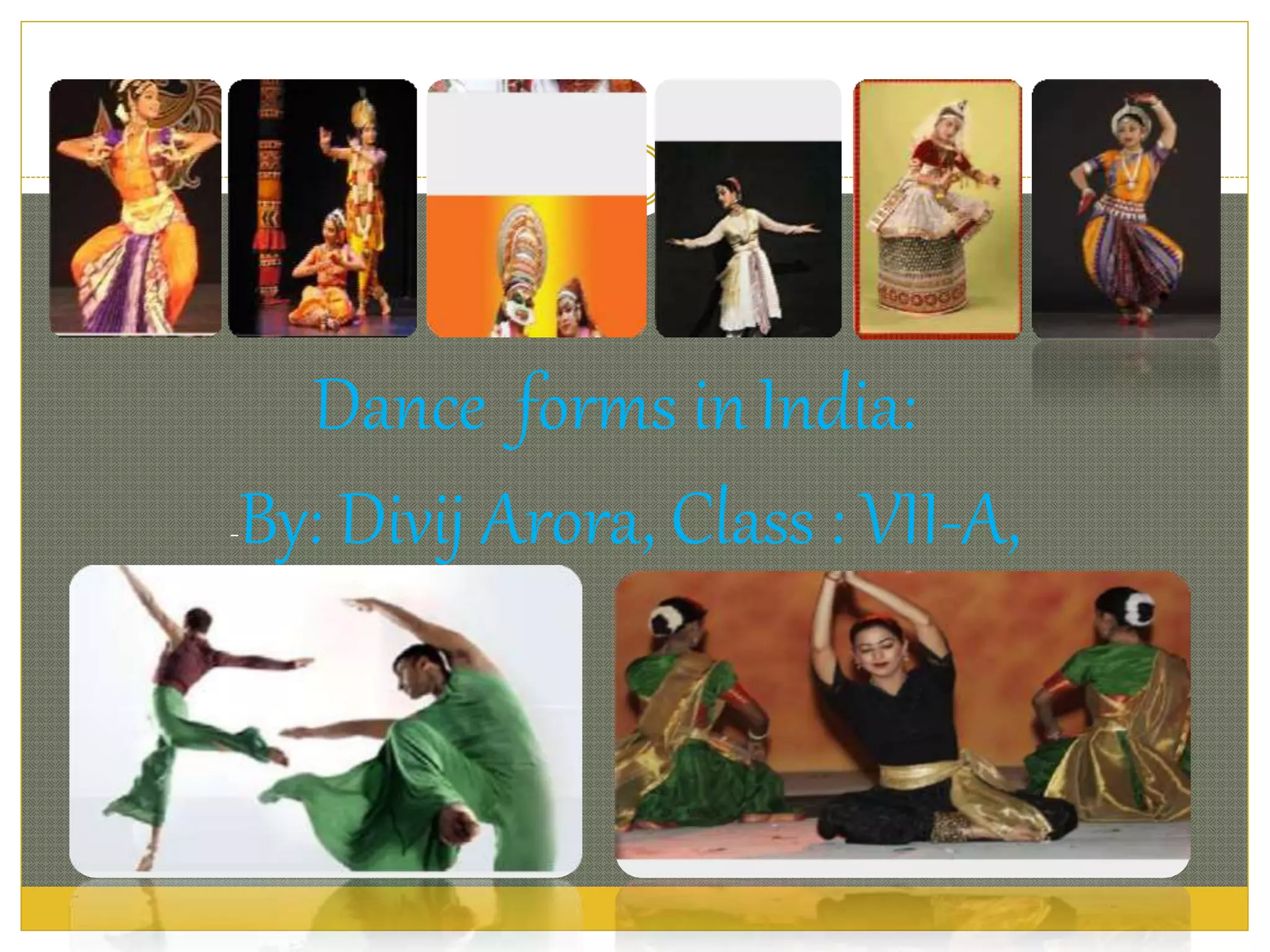
Dance forms inIndia:
-By: Divij Arora, Class : VII-A,
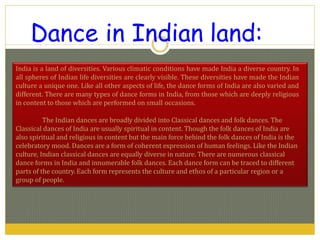
India is a land of diversities. Various climatic conditions have made India a diverse country. In
all spheres of Indian life diversities are clearly visible. These diversities have made the Indian
culture a unique one. Like all other aspects of life, the dance forms of India are also varied and
different. There are many types of dance forms in India, from those which are deeply religious
in content to those which are performed on small occasions.
The Indian dances are broadly divided into Classical dances and folk dances. The
Classical dances of India are usually spiritual in content. Though the folk dances of India are
also spiritual and religious in content but the main force behind the folk dances of India is the
celebratory mood. Dances are a form of coherent expression of human feelings. Like the Indian
culture, Indian classical dances are equally diverse in nature. There are numerous classical
dance forms in India and innumerable folk dances. Each dance form can be traced to different
parts of the country. Each form represents the culture and ethos of a particular region or a
group of people.
Dance in Indian land:
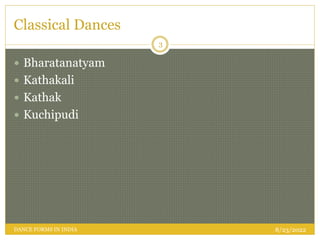
Classical Dances
 Bharatanatyam
 Kathakali
 Kathak
 Kuchipudi
8/23/2022
3
DANCE FORMS IN INDIA
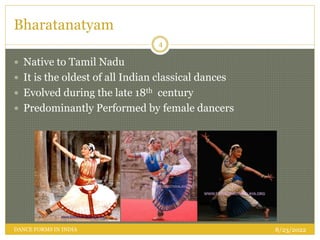
Bharatanatyam
 Native to Tamil Nadu
 It is the oldest of all Indian classical dances
 Evolved during the late 18th century
 Predominantly Performed by female dancers
8/23/2022
4
DANCE FORMS IN INDIA
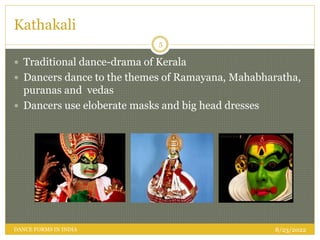
Kathakali
 Traditional dance-drama of Kerala
 Dancers dance to the themes of Ramayana, Mahabharatha,
puranas and vedas
 Dancers use eloberate masks and big head dresses
8/23/2022
5
DANCE FORMS IN INDIA
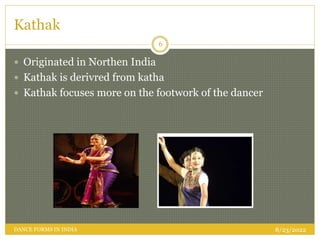
Kathak
 Originated in Northen India
 Kathak is derivred from katha
 Kathak focuses more on the footwork of the dancer
8/23/2022
6
DANCE FORMS IN INDIA
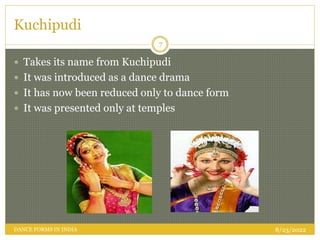
Kuchipudi
 Takes its name from Kuchipudi
 It was introduced as a dance drama
 It has now been reduced only to dance form
 It was presented only at temples
8/23/2022
7
DANCE FORMS IN INDIA
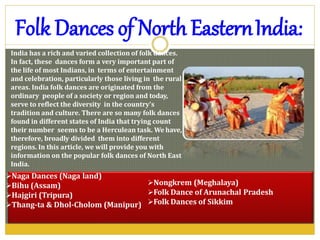
Folk Dances of North EasternIndia:
Naga Dances (Naga land)
Bihu (Assam)
Hajgiri (Tripura)
Thang-ta & Dhol-Cholom (Manipur)
India has a rich and varied collection of folk dances.
In fact, these dances form a very important part of
the life of most Indians, in terms of entertainment
and celebration, particularly those living in the rural
areas. India folk dances are originated from the
ordinary people of a society or region and today,
serve to reflect the diversity in the country's
tradition and culture. There are so many folk dances
found in different states of India that trying count
their number seems to be a Herculean task. We have,
therefore, broadly divided them into different
regions. In this article, we will provide you with
information on the popular folk dances of North East
India.
Nongkrem (Meghalaya)
Folk Dance of Arunachal Pradesh
Folk Dances of Sikkim
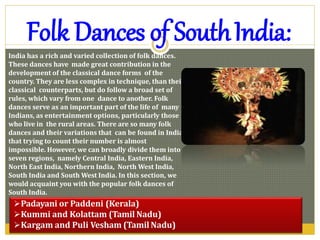
Folk Dances of SouthIndia:
India has a rich and varied collection of folk dances.
These dances have made great contribution in the
development of the classical dance forms of the
country. They are less complex in technique, than their
classical counterparts, but do follow a broad set of
rules, which vary from one dance to another. Folk
dances serve as an important part of the life of many
Indians, as entertainment options, particularly those
who live in the rural areas. There are so many folk
dances and their variations that can be found in India
that trying to count their number is almost
impossible. However, we can broadly divide them into
seven regions, namely Central India, Eastern India,
North East India, Northern India, North West India,
South India and South West India. In this section, we
would acquaint you with the popular folk dances of
South India.
Padayani or Paddeni (Kerala)
Kummi and Kolattam (Tamil Nadu)
Kargam and Puli Vesham (Tamil Nadu)
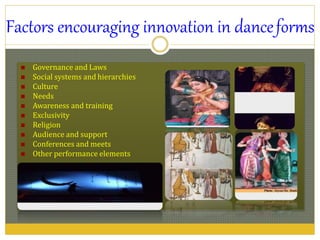
Factors encouraging innovation in danceforms
 Governance and Laws
 Social systems and hierarchies
 Culture
 Needs
 Awareness and training
 Exclusivity
 Religion
 Audience and support
 Conferences and meets
 Other performance elements
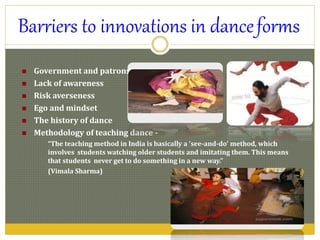
Barriers to innovations in danceforms
 Government and patrons
 Lack of awareness
 Risk averseness
 Ego and mindset
 The history of dance
 Methodology of teaching dance -
“The teaching method in India is basically a 'see-and-do' method, which
involves students watching older students and imitating them. This means
that students never get to do something in a new way.”
(Vimala Sharma)
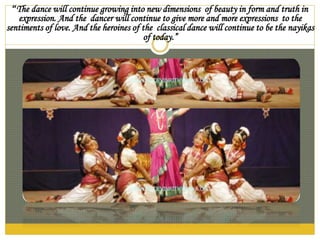
“The dance will continue growing into new dimensions of beauty in form and truth in
expression. And the dancer will continue to give more and more expressions to the
sentiments of love. And the heroines of the classical dance will continue to be the nayikas
of today.”
8/23/2022
13
DANCE FORMS IN INDIA

Dance-Forms.pptx

  • 1.
    Dance forms inIndia: -By:Divij Arora, Class : VII-A,
  • 2.
    India is aland of diversities. Various climatic conditions have made India a diverse country. In all spheres of Indian life diversities are clearly visible. These diversities have made the Indian culture a unique one. Like all other aspects of life, the dance forms of India are also varied and different. There are many types of dance forms in India, from those which are deeply religious in content to those which are performed on small occasions. The Indian dances are broadly divided into Classical dances and folk dances. The Classical dances of India are usually spiritual in content. Though the folk dances of India are also spiritual and religious in content but the main force behind the folk dances of India is the celebratory mood. Dances are a form of coherent expression of human feelings. Like the Indian culture, Indian classical dances are equally diverse in nature. There are numerous classical dance forms in India and innumerable folk dances. Each dance form can be traced to different parts of the country. Each form represents the culture and ethos of a particular region or a group of people. Dance in Indian land:
  • 3.
    Classical Dances  Bharatanatyam Kathakali  Kathak  Kuchipudi 8/23/2022 3 DANCE FORMS IN INDIA
  • 4.
    Bharatanatyam  Native toTamil Nadu  It is the oldest of all Indian classical dances  Evolved during the late 18th century  Predominantly Performed by female dancers 8/23/2022 4 DANCE FORMS IN INDIA
  • 5.
    Kathakali  Traditional dance-dramaof Kerala  Dancers dance to the themes of Ramayana, Mahabharatha, puranas and vedas  Dancers use eloberate masks and big head dresses 8/23/2022 5 DANCE FORMS IN INDIA
  • 6.
    Kathak  Originated inNorthen India  Kathak is derivred from katha  Kathak focuses more on the footwork of the dancer 8/23/2022 6 DANCE FORMS IN INDIA
  • 7.
    Kuchipudi  Takes itsname from Kuchipudi  It was introduced as a dance drama  It has now been reduced only to dance form  It was presented only at temples 8/23/2022 7 DANCE FORMS IN INDIA
  • 8.
    Folk Dances ofNorth EasternIndia: Naga Dances (Naga land) Bihu (Assam) Hajgiri (Tripura) Thang-ta & Dhol-Cholom (Manipur) India has a rich and varied collection of folk dances. In fact, these dances form a very important part of the life of most Indians, in terms of entertainment and celebration, particularly those living in the rural areas. India folk dances are originated from the ordinary people of a society or region and today, serve to reflect the diversity in the country's tradition and culture. There are so many folk dances found in different states of India that trying count their number seems to be a Herculean task. We have, therefore, broadly divided them into different regions. In this article, we will provide you with information on the popular folk dances of North East India. Nongkrem (Meghalaya) Folk Dance of Arunachal Pradesh Folk Dances of Sikkim
  • 9.
    Folk Dances ofSouthIndia: India has a rich and varied collection of folk dances. These dances have made great contribution in the development of the classical dance forms of the country. They are less complex in technique, than their classical counterparts, but do follow a broad set of rules, which vary from one dance to another. Folk dances serve as an important part of the life of many Indians, as entertainment options, particularly those who live in the rural areas. There are so many folk dances and their variations that can be found in India that trying to count their number is almost impossible. However, we can broadly divide them into seven regions, namely Central India, Eastern India, North East India, Northern India, North West India, South India and South West India. In this section, we would acquaint you with the popular folk dances of South India. Padayani or Paddeni (Kerala) Kummi and Kolattam (Tamil Nadu) Kargam and Puli Vesham (Tamil Nadu)
  • 10.
    Factors encouraging innovationin danceforms  Governance and Laws  Social systems and hierarchies  Culture  Needs  Awareness and training  Exclusivity  Religion  Audience and support  Conferences and meets  Other performance elements
  • 11.
    Barriers to innovationsin danceforms  Government and patrons  Lack of awareness  Risk averseness  Ego and mindset  The history of dance  Methodology of teaching dance - “The teaching method in India is basically a 'see-and-do' method, which involves students watching older students and imitating them. This means that students never get to do something in a new way.” (Vimala Sharma)
  • 12.
    “The dance willcontinue growing into new dimensions of beauty in form and truth in expression. And the dancer will continue to give more and more expressions to the sentiments of love. And the heroines of the classical dance will continue to be the nayikas of today.”
  • 13.