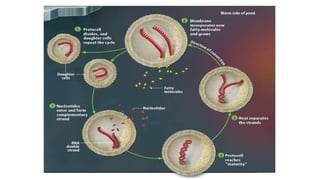
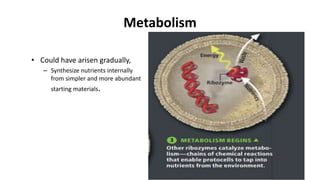
The earliest forms of life on Earth were likely simple protocells consisting of fatty acid membranes enclosing genetic molecules like RNA. These protocells could grow and divide by incorporating new fatty acids and duplicating their genetic material with heat from nearby hot rocks. Over time, as RNA randomly mutated and some sequences gained the ability to self-replicate more efficiently, the earliest forms of evolution and metabolism began to emerge. Eventually, proteins were produced that proved more effective as catalysts than RNA, and DNA arose as the primary genetic material due to its stability, marking the transition from an 'RNA world' to a DNA-based biology as we know it today.