#NYKLondon
Life as a
Brandwatch Analyst
Maximising Data with Storytelling
Tips & Tricks to quickly discover insights
Adam Brons-Smith | Senior Data Analyst
#NYKLondon
Adam Brons-Smith | Senior Data Analyst at Brandwatch
1. Previous roles in Digital Agencies, E-Commerce &
Consultancy
2. Never been to Brighton before joining Brandwatch
3. You can find me on Twitter - @ABronsSmith
Who Am I?
#NYKLondon
1. How to use Brandwatch Analytics to discover insights
2. How to maximise your data with strong story telling
What’s Coming?
#NYKLondon
A good story can speak to an unfamiliar audience
A great story will hold their interest & incite action
Essentials for Storytelling: Empathy, Motivation & Content
When numbers only tell you so
much
#NYKLondon
Brandwatch
Storytelling:
The How?
#NYKLondon
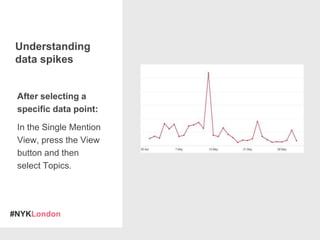
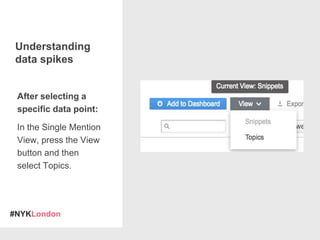
Understanding
data spikes
After selecting a
specific data point:
In the Single Mention
View, press the View
button and then
select Topics.
#NYKLondon
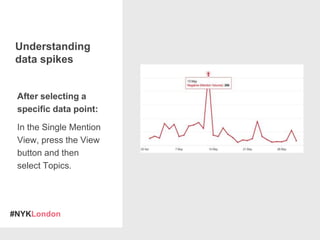
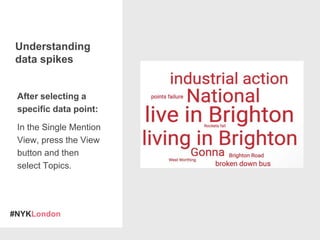
Understanding
data spikes
After selecting a
specific data point:
In the Single Mention
View, press the View
button and then
select Topics.
#NYKLondon
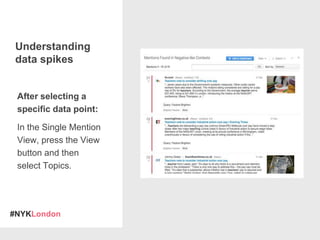
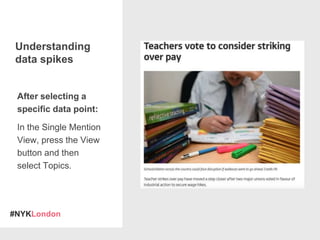
Understanding
data spikes
After selecting a
specific data point:
In the Single Mention
View, press the View
button and then
select Topics.
#NYKLondon
Understanding
data spikes
After selecting a
specific data point:
In the Single Mention
View, press the View
button and then
select Topics.
#NYKLondon
After selecting a
specific data point:
In the Single Mention
View, press the View
button and then
select Topics.
Understanding
data spikes
#NYKLondon
After selecting a
specific data point:
In the Single Mention
View, press the View
button and then
select Topics.
Understanding
data spikes
#NYKLondon
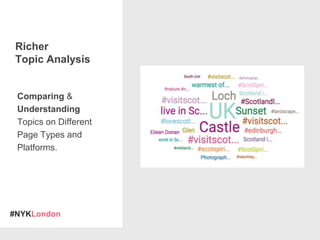
Comparing &
Understanding
Topics on Different
Page Types and
Platforms.
Richer
Topic Analysis
#NYKLondon
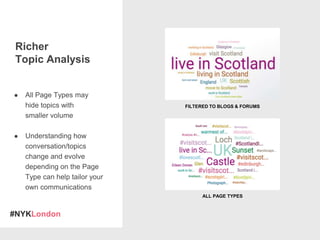
Richer
Topic Analysis
● All Page Types may
hide topics with
smaller volume
● Understanding how
conversation/topics
change and evolve
depending on the Page
Type can help tailor your
own communications
ALL PAGE TYPES
FILTERED TO BLOGS & FORUMS
#NYKLondon
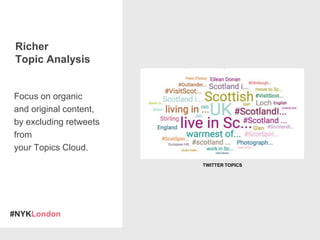
Focus on organic
and original content,
by excluding retweets
from
your Topics Cloud.
Richer
Topic Analysis
TWITTER TOPICS
#NYKLondon
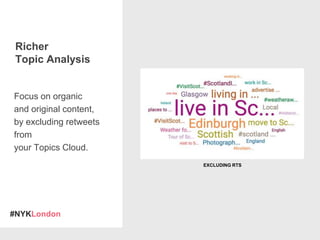
Focus on organic
and original content,
by excluding retweets
from
your Topics Cloud.
Richer
Topic Analysis
EXCLUDING RTS
#NYKLondon
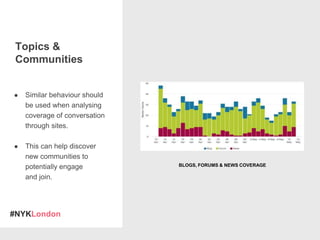
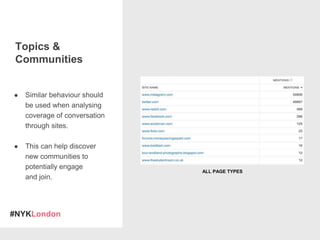
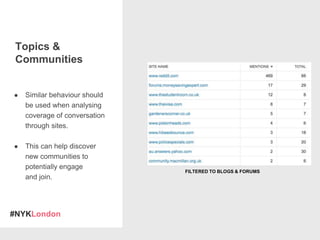
Topics &
Communities
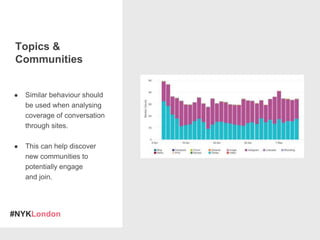
● Similar behaviour should
be used when analysing
coverage of conversation
through sites.
● This can help discover
new communities to
potentially engage
and join.
#NYKLondon
Topics &
Communities
● Similar behaviour should
be used when analysing
coverage of conversation
through sites.
● This can help discover
new communities to
potentially engage
and join.
BLOGS, FORUMS & NEWS COVERAGE
#NYKLondon
Topics &
Communities
● Similar behaviour should
be used when analysing
coverage of conversation
through sites.
● This can help discover
new communities to
potentially engage
and join.
ALL PAGE TYPES
#NYKLondon
Topics &
Communities
● Similar behaviour should
be used when analysing
coverage of conversation
through sites.
● This can help discover
new communities to
potentially engage
and join.
FILTERED TO BLOGS & FORUMS
#NYKLondon
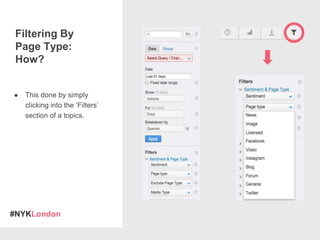
Filtering By
Page Type:
How?
● This done by simply
clicking into the ‘Filters’
section of a topics.
#NYKLondon
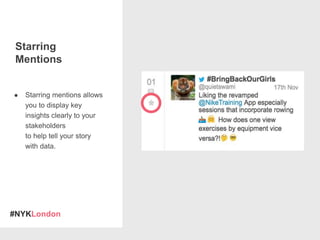
Starring
Mentions
● Starring mentions allows
you to display key
insights clearly to your
stakeholders
to help tell your story
with data.
#NYKLondon
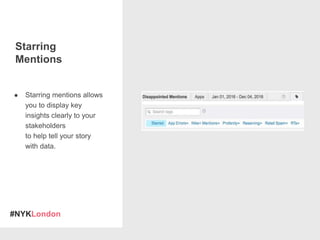
Starring
Mentions
● Starring mentions allows
you to display key
insights clearly to your
stakeholders
to help tell your story
with data.
#NYKLondon
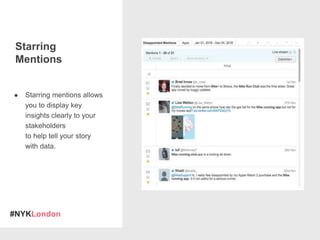
Starring
Mentions
● Starring mentions allows
you to display key
insights clearly to your
stakeholders
to help tell your story
with data.
#NYKLondon
Maximise
Your Data with
Story Telling
#NYKLondon
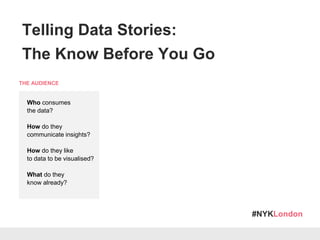
Telling Data Stories:
The Know Before You Go
Who consumes
the data?
How do they
communicate insights?
How do they like
to data to be visualised?
What do they
know already?
THE AUDIENCE
Establish a
business question
Research question
What are we/
they trying to achieve?
Narrative purpose
THE OBJECTIVE
Link information
to strategy
What?
So what?
(The Why)
Now what?
(The Action)
THE STORY
#NYKLondon
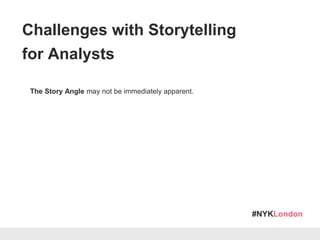
The Story Angle may not be immediately apparent.
New & Unfamiliar Data:
Data exploration must come first! Don’t confuse analysis with communication
Ongoing Analysis:
Actionable insight (in some cases) may only become apparent in the near future
Lack of organisational context:
Do you know enough about your client/end-user to translate your data-set
into actions?
Challenges with Storytelling
for Analysts
#NYKLondon
Telling Stories
with Brandwatch
#NYKLondon
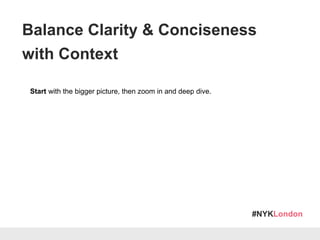
Start with the bigger picture, then zoom in and deep dive.
Reveal datasets at several levels of detail where appropriate
Avoid tangents, unnecessary information and stay focused on the goals/objectives
Dedicate time to deeper insights than answer clear business/briefing questions?
Balance Clarity & Conciseness
with Context
#NYKLondon
Clearly label your charts, for easier interpretation of data. Hold your audience’s
attention, without them having to think about what they are seeing in your
report/dashboard.
Annotate your reports with language that resonates with your audience’s level of
skill and familiarity with social listening tools. Identify the purpose of your
components & their implications.
Closely Integrate Data &
Written Description
#NYKLondon
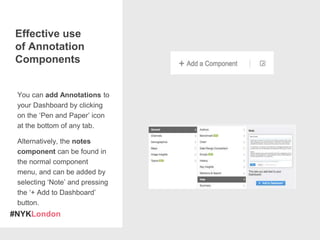
You can add Annotations to
your Dashboard by clicking
on the ‘Pen and Paper’ icon
at the bottom of any tab.
Alternatively, the notes
component can be found in
the normal component
menu, and can be added by
selecting ‘Note’ and pressing
the ‘+ Add to Dashboard’
button.
Effective use
of Annotation
Components
#NYKLondonAnnotation Example
Introduction to the
Data Segmentation
included
in Dashboard
[link
text](http://www.ab.co
m)
For hyperlinks to
resources & further
assistance
**bold text**
*italic text*
You can use asterix’s to bold
or italic your text. This can
help raise awareness to
insights or
recommendations you have
discovered
Contact information for
feedback, further
reporting and clarification
if required.
#NYKLondon
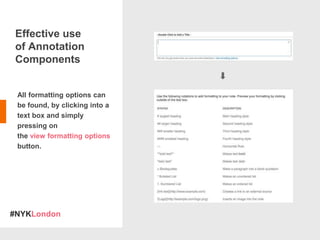
All formatting options can
be found, by clicking into a
text box and simply
pressing on
the view formatting options
button.
Effective use
of Annotation
Components
#NYKLondon
Guide the end-user/client through your thought process. Why have these
components been selected and positioned like they have? Does it help you with your
overall data story?.
Be prepared to answer important questions about your setup, which may be
prompted by the data that is being displayed.
Encourage your audience to compare the data and raise questions on their own
points of analysis for a higher level of engagement.
Effective Dashboard Usage
for Communications
#NYKLondon
Thank you.
Any questions?

Life As a Brandwatch Analyst

  • 1.
    #NYKLondon Life as a BrandwatchAnalyst Maximising Data with Storytelling Tips & Tricks to quickly discover insights Adam Brons-Smith | Senior Data Analyst
  • 2.
    #NYKLondon Adam Brons-Smith |Senior Data Analyst at Brandwatch 1. Previous roles in Digital Agencies, E-Commerce & Consultancy 2. Never been to Brighton before joining Brandwatch 3. You can find me on Twitter - @ABronsSmith Who Am I?
  • 3.
    #NYKLondon 1. How touse Brandwatch Analytics to discover insights 2. How to maximise your data with strong story telling What’s Coming?
  • 4.
    #NYKLondon A good storycan speak to an unfamiliar audience A great story will hold their interest & incite action Essentials for Storytelling: Empathy, Motivation & Content When numbers only tell you so much
  • 5.
  • 6.
    #NYKLondon Understanding data spikes After selectinga specific data point: In the Single Mention View, press the View button and then select Topics.
  • 7.
    #NYKLondon Understanding data spikes After selectinga specific data point: In the Single Mention View, press the View button and then select Topics.
  • 8.
    #NYKLondon Understanding data spikes After selectinga specific data point: In the Single Mention View, press the View button and then select Topics.
  • 9.
    #NYKLondon Understanding data spikes After selectinga specific data point: In the Single Mention View, press the View button and then select Topics.
  • 10.
    #NYKLondon After selecting a specificdata point: In the Single Mention View, press the View button and then select Topics. Understanding data spikes
  • 11.
    #NYKLondon After selecting a specificdata point: In the Single Mention View, press the View button and then select Topics. Understanding data spikes
  • 12.
    #NYKLondon Comparing & Understanding Topics onDifferent Page Types and Platforms. Richer Topic Analysis
  • 13.
    #NYKLondon Richer Topic Analysis ● AllPage Types may hide topics with smaller volume ● Understanding how conversation/topics change and evolve depending on the Page Type can help tailor your own communications ALL PAGE TYPES FILTERED TO BLOGS & FORUMS
  • 14.
    #NYKLondon Focus on organic andoriginal content, by excluding retweets from your Topics Cloud. Richer Topic Analysis TWITTER TOPICS
  • 15.
    #NYKLondon Focus on organic andoriginal content, by excluding retweets from your Topics Cloud. Richer Topic Analysis EXCLUDING RTS
  • 16.
    #NYKLondon Topics & Communities ● Similarbehaviour should be used when analysing coverage of conversation through sites. ● This can help discover new communities to potentially engage and join.
  • 17.
    #NYKLondon Topics & Communities ● Similarbehaviour should be used when analysing coverage of conversation through sites. ● This can help discover new communities to potentially engage and join. BLOGS, FORUMS & NEWS COVERAGE
  • 18.
    #NYKLondon Topics & Communities ● Similarbehaviour should be used when analysing coverage of conversation through sites. ● This can help discover new communities to potentially engage and join. ALL PAGE TYPES
  • 19.
    #NYKLondon Topics & Communities ● Similarbehaviour should be used when analysing coverage of conversation through sites. ● This can help discover new communities to potentially engage and join. FILTERED TO BLOGS & FORUMS
  • 20.
    #NYKLondon Filtering By Page Type: How? ●This done by simply clicking into the ‘Filters’ section of a topics.
  • 21.
    #NYKLondon Starring Mentions ● Starring mentionsallows you to display key insights clearly to your stakeholders to help tell your story with data.
  • 22.
    #NYKLondon Starring Mentions ● Starring mentionsallows you to display key insights clearly to your stakeholders to help tell your story with data.
  • 23.
    #NYKLondon Starring Mentions ● Starring mentionsallows you to display key insights clearly to your stakeholders to help tell your story with data.
  • 24.
  • 25.
    #NYKLondon Telling Data Stories: TheKnow Before You Go Who consumes the data? How do they communicate insights? How do they like to data to be visualised? What do they know already? THE AUDIENCE Establish a business question Research question What are we/ they trying to achieve? Narrative purpose THE OBJECTIVE Link information to strategy What? So what? (The Why) Now what? (The Action) THE STORY
  • 26.
    #NYKLondon The Story Anglemay not be immediately apparent. New & Unfamiliar Data: Data exploration must come first! Don’t confuse analysis with communication Ongoing Analysis: Actionable insight (in some cases) may only become apparent in the near future Lack of organisational context: Do you know enough about your client/end-user to translate your data-set into actions? Challenges with Storytelling for Analysts
  • 27.
  • 28.
    #NYKLondon Start with thebigger picture, then zoom in and deep dive. Reveal datasets at several levels of detail where appropriate Avoid tangents, unnecessary information and stay focused on the goals/objectives Dedicate time to deeper insights than answer clear business/briefing questions? Balance Clarity & Conciseness with Context
  • 29.
    #NYKLondon Clearly label yourcharts, for easier interpretation of data. Hold your audience’s attention, without them having to think about what they are seeing in your report/dashboard. Annotate your reports with language that resonates with your audience’s level of skill and familiarity with social listening tools. Identify the purpose of your components & their implications. Closely Integrate Data & Written Description
  • 30.
    #NYKLondon You can addAnnotations to your Dashboard by clicking on the ‘Pen and Paper’ icon at the bottom of any tab. Alternatively, the notes component can be found in the normal component menu, and can be added by selecting ‘Note’ and pressing the ‘+ Add to Dashboard’ button. Effective use of Annotation Components
  • 31.
    #NYKLondonAnnotation Example Introduction tothe Data Segmentation included in Dashboard [link text](http://www.ab.co m) For hyperlinks to resources & further assistance **bold text** *italic text* You can use asterix’s to bold or italic your text. This can help raise awareness to insights or recommendations you have discovered Contact information for feedback, further reporting and clarification if required.
  • 32.
    #NYKLondon All formatting optionscan be found, by clicking into a text box and simply pressing on the view formatting options button. Effective use of Annotation Components
  • 33.
    #NYKLondon Guide the end-user/clientthrough your thought process. Why have these components been selected and positioned like they have? Does it help you with your overall data story?. Be prepared to answer important questions about your setup, which may be prompted by the data that is being displayed. Encourage your audience to compare the data and raise questions on their own points of analysis for a higher level of engagement. Effective Dashboard Usage for Communications
  • 34.