Emotional Intelligence
How the BBC taps into audience emotions to drive business strategy
Photo by Bernard Hermant on Unsplash
Hello,
I’m Tara.
throwback
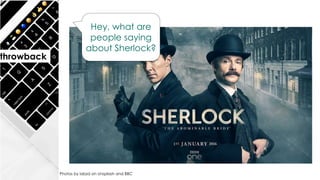
Hey, what are
people saying
about Sherlock?
Photos by iabzd on Unsplash and BBC
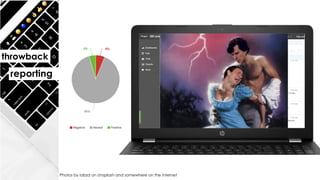
throwback
reporting
Photos by iabzd on Unsplash and somewhere on the internet
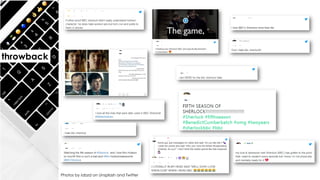
throwback
Photos by iabzd on Unsplash and Twitter
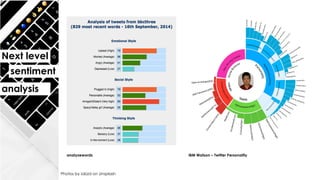
IBM Watson – Twitter Personalityanalyzewords
Next level
Photos by iabzd on Unsplash
sentiment
analysis
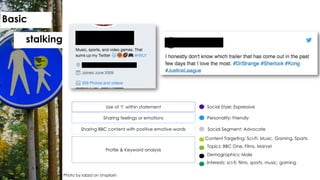
Social Style: ExpressiveUse of ‘I’ within statement
Personality: FriendlySharing feelings or emotions
Content Targeting: Sci-Fi, Music, Gaming, Sports`
Sharing BBC content with positive emotive words
Topics: BBC One, Films, Marvel`
Demographics: Male`
Profile & Keyword analysis
Interests: sci-fi, films, sports, music, gaming`
Social Segment: Advocate
Photo by iabzd on Unsplash
Basic
stalking
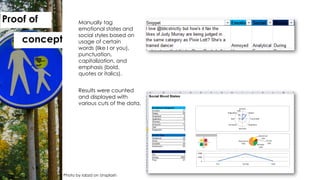
Manually tag
emotional states and
social styles based on
usage of certain
words (like I or you),
punctuation,
capitalization, and
emphasis (bold,
quotes or italics).
Results were counted
and displayed with
various cuts of the data.
Photo by iabzd on Unsplash
Proof of
concept
Photo by iabzd on Unsplash
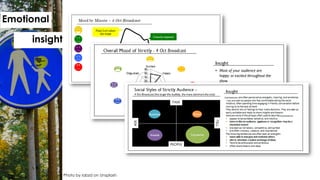
Emotional
insight
Expresessives
Expresessives
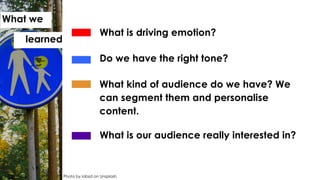
What is driving emotion?
Do we have the right tone?
What kind of audience do we have? We
can segment them and personalise
content.
What is our audience really interested in?
Photo by iabzd on Unsplash
What we
learned
Photo by Lidya Nada on Unsplash
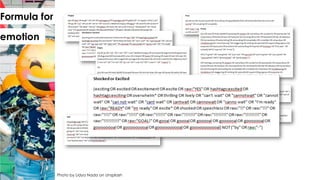
Formula for
emotion
Photo by Lidya Nada on Unsplash
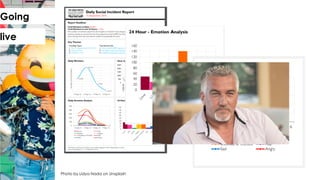
Going
live
Photo by Lidya Nada on Unsplash
Going
live
Photo by rawpixel on Unsplash
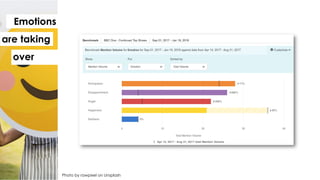
Emotions
are taking
over
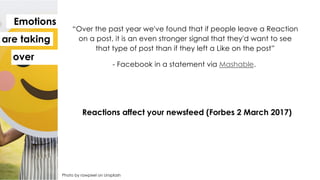
“Over the past year we've found that if people leave a Reaction
on a post, it is an even stronger signal that they'd want to see
that type of post than if they left a Like on the post”
- Facebook in a statement via Mashable.
Reactions affect your newsfeed (Forbes 2 March 2017)
Photo by rawpixel on Unsplash
Emotions
are taking
over
2,823 emojis in the Unicode standard as of June 2018
– according to emojipedia
There’s a thing called emojipedia
Photo by rawpixel on Unsplash
Emotions
are taking
over
Photo by Lidya Nada on Unsplash
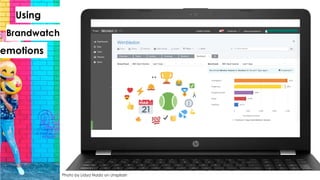
Using
Brandwatch
emotions
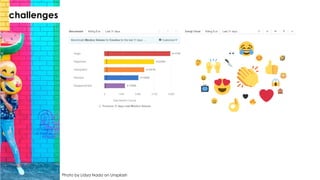
• Not inferring too much
• Not crossing the line with emotionally vulnerable
people
• (mis)understanding sarcasm
• Some people use extreme terminology that
doesn’t always match up to how they feel
• Subject/verb agreement is tricky
• Automated formulas aren’t 100%
• Not putting numbers for the sake of numbers –
making the data meaningful
Photo by Lidya Nada on Unsplash
challenges
taraclark.davanzati@bbc.co.uk
1 9
Photo by rawpixel on Unsplash

Emotional Intelligence

  • 1.
    Emotional Intelligence How theBBC taps into audience emotions to drive business strategy Photo by Bernard Hermant on Unsplash
  • 2.
  • 3.
    throwback Hey, what are peoplesaying about Sherlock? Photos by iabzd on Unsplash and BBC
  • 4.
    throwback reporting Photos by iabzdon Unsplash and somewhere on the internet
  • 5.
    throwback Photos by iabzdon Unsplash and Twitter
  • 6.
    IBM Watson –Twitter Personalityanalyzewords Next level Photos by iabzd on Unsplash sentiment analysis
  • 7.
    Social Style: ExpressiveUseof ‘I’ within statement Personality: FriendlySharing feelings or emotions Content Targeting: Sci-Fi, Music, Gaming, Sports` Sharing BBC content with positive emotive words Topics: BBC One, Films, Marvel` Demographics: Male` Profile & Keyword analysis Interests: sci-fi, films, sports, music, gaming` Social Segment: Advocate Photo by iabzd on Unsplash Basic stalking
  • 8.
    Manually tag emotional statesand social styles based on usage of certain words (like I or you), punctuation, capitalization, and emphasis (bold, quotes or italics). Results were counted and displayed with various cuts of the data. Photo by iabzd on Unsplash Proof of concept
  • 9.
    Photo by iabzdon Unsplash Emotional insight Expresessives Expresessives
  • 10.
    What is drivingemotion? Do we have the right tone? What kind of audience do we have? We can segment them and personalise content. What is our audience really interested in? Photo by iabzd on Unsplash What we learned
  • 11.
    Photo by LidyaNada on Unsplash Formula for emotion
  • 12.
    Photo by LidyaNada on Unsplash Going live
  • 13.
    Photo by LidyaNada on Unsplash Going live
  • 14.
    Photo by rawpixelon Unsplash Emotions are taking over “Over the past year we've found that if people leave a Reaction on a post, it is an even stronger signal that they'd want to see that type of post than if they left a Like on the post” - Facebook in a statement via Mashable. Reactions affect your newsfeed (Forbes 2 March 2017)
  • 15.
    Photo by rawpixelon Unsplash Emotions are taking over 2,823 emojis in the Unicode standard as of June 2018 – according to emojipedia There’s a thing called emojipedia
  • 16.
    Photo by rawpixelon Unsplash Emotions are taking over
  • 17.
    Photo by LidyaNada on Unsplash Using Brandwatch emotions
  • 18.
    • Not inferringtoo much • Not crossing the line with emotionally vulnerable people • (mis)understanding sarcasm • Some people use extreme terminology that doesn’t always match up to how they feel • Subject/verb agreement is tricky • Automated formulas aren’t 100% • Not putting numbers for the sake of numbers – making the data meaningful Photo by Lidya Nada on Unsplash challenges
  • 19.