Teaching Data
Information Literacy
Sarah J. Wright
Life Sciences Librarian for
Research, Cornell University
What I’ll talk
about
Data Information Literacy
IMLS-funded Data Information Literacy
research project
needs identified
approaches
lessons learned
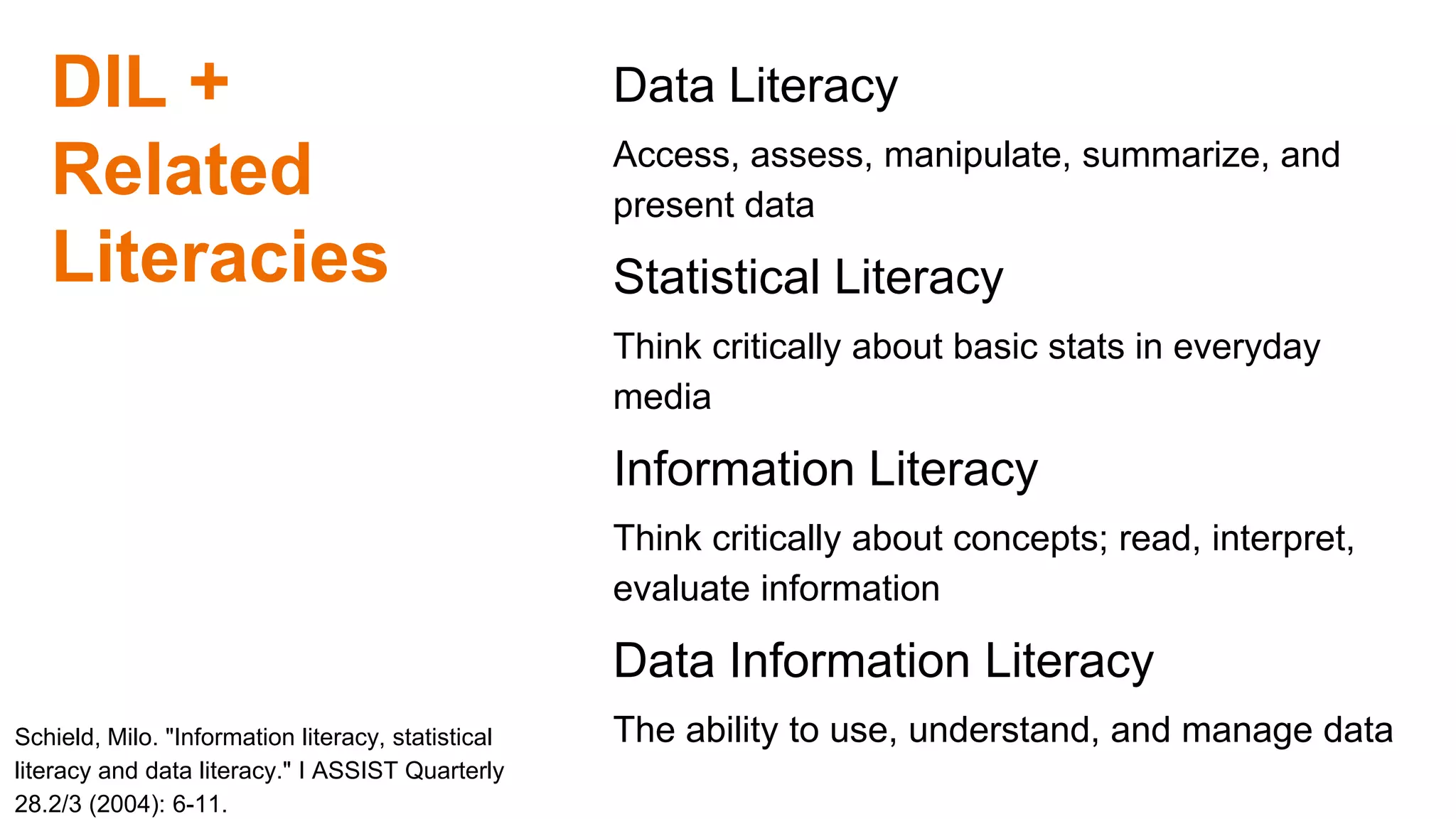
DIL +
Related
Literacies
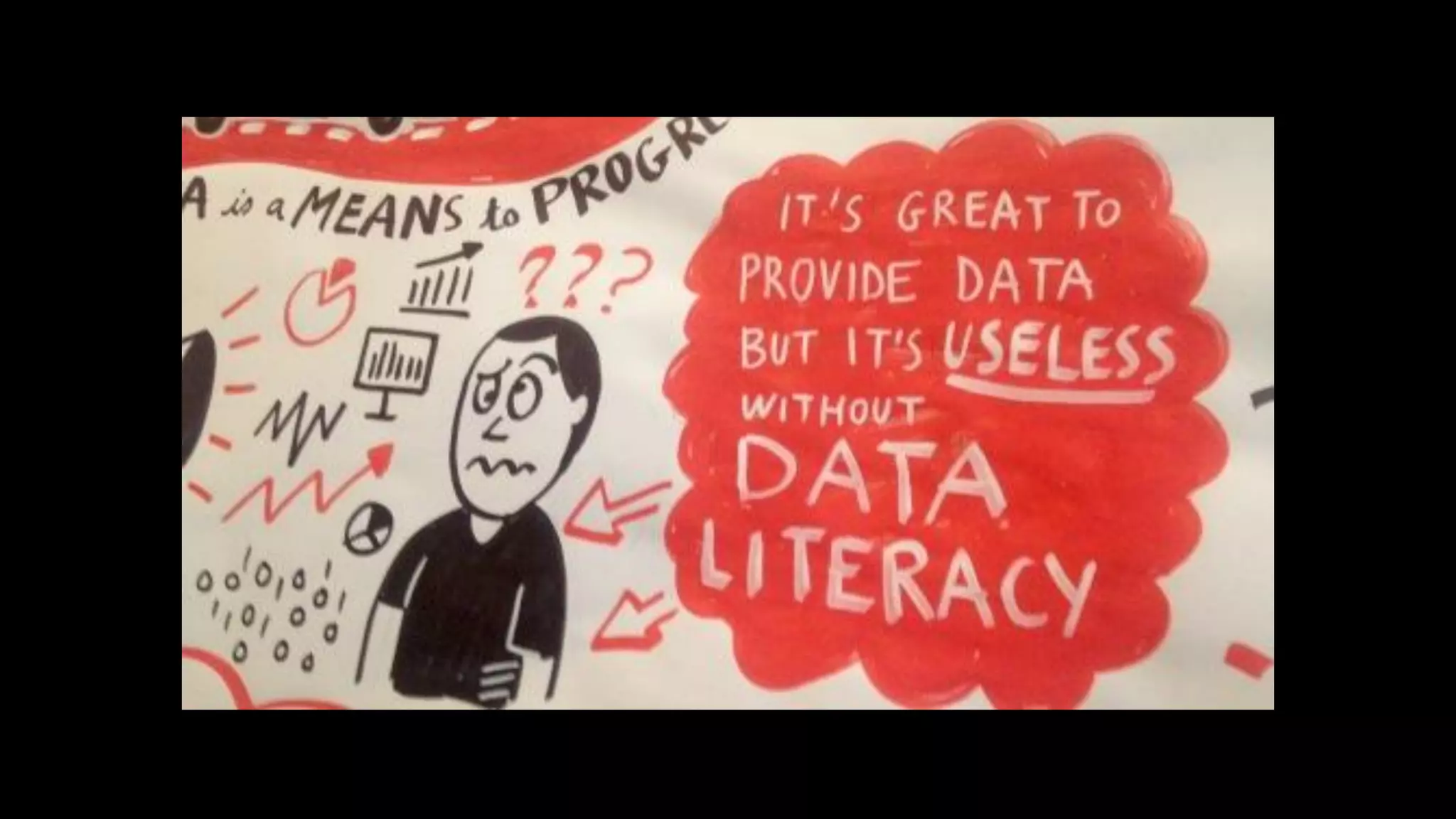
Data Literacy
Access, assess, manipulate, summarize, and
present data
Statistical Literacy
Think critically about basic stats in everyday
media
Information Literacy
Think critically about concepts; read, interpret,
evaluate information
Data Information Literacy
The ability to use, understand, and manage dataSchield, Milo. "Information literacy, statistical
literacy and data literacy." I ASSIST Quarterly
28.2/3 (2004): 6-11.
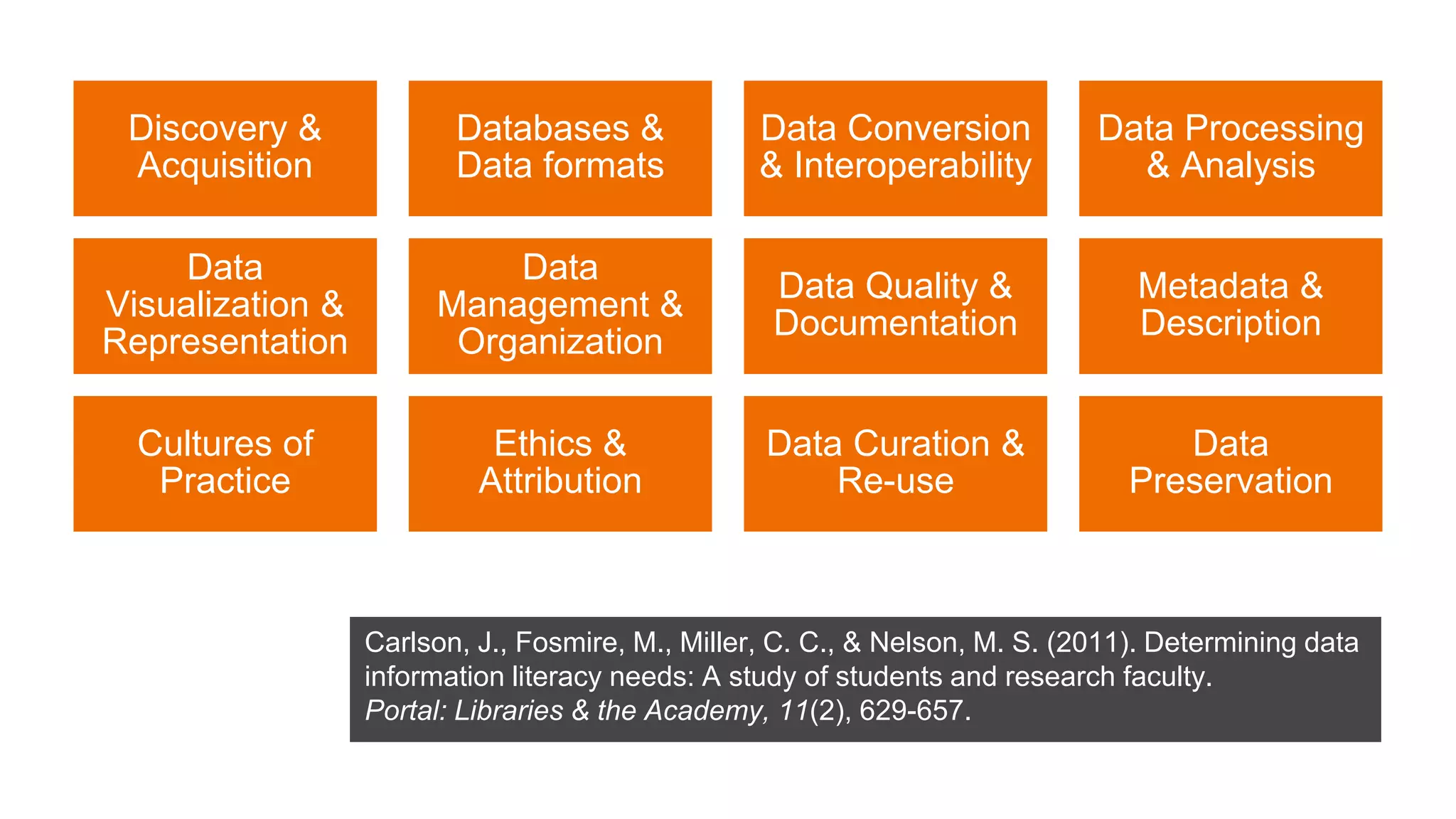
Discovery &
Acquisition
Databases &
Data formats
Data Conversion
& Interoperability
Data Processing
& Analysis
Data
Visualization &
Representation
Data
Management &
Organization
Data Quality &
Documentation
Metadata &
Description
Cultures of
Practice
Ethics &
Attribution
Data Curation &
Re-use
Data
Preservation
Carlson, J., Fosmire, M., Miller, C. C., & Nelson, M. S. (2011). Determining data
information literacy needs: A study of students and research faculty.
Portal: Libraries & the Academy, 11(2), 629-657.
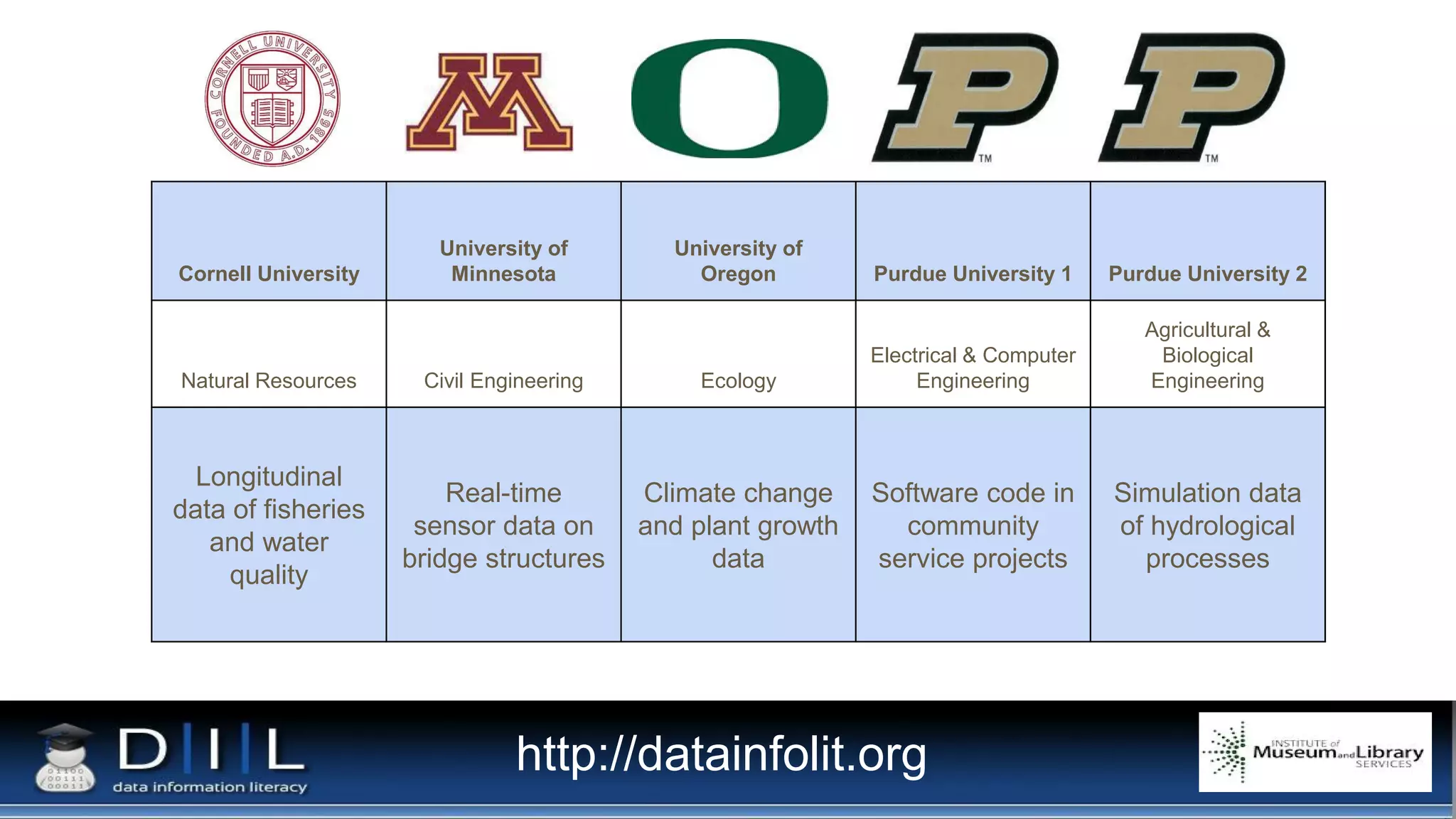
Cornell University
University of
Minnesota
University of
Oregon Purdue University 1 Purdue University 2
Natural Resources Civil Engineering Ecology
Electrical & Computer
Engineering
Agricultural &
Biological
Engineering
Longitudinal
data of fisheries
and water
quality
Real-time
sensor data on
bridge structures
Climate change
and plant growth
data
Software code in
community
service projects
Simulation data
of hydrological
processes
http://datainfolit.org
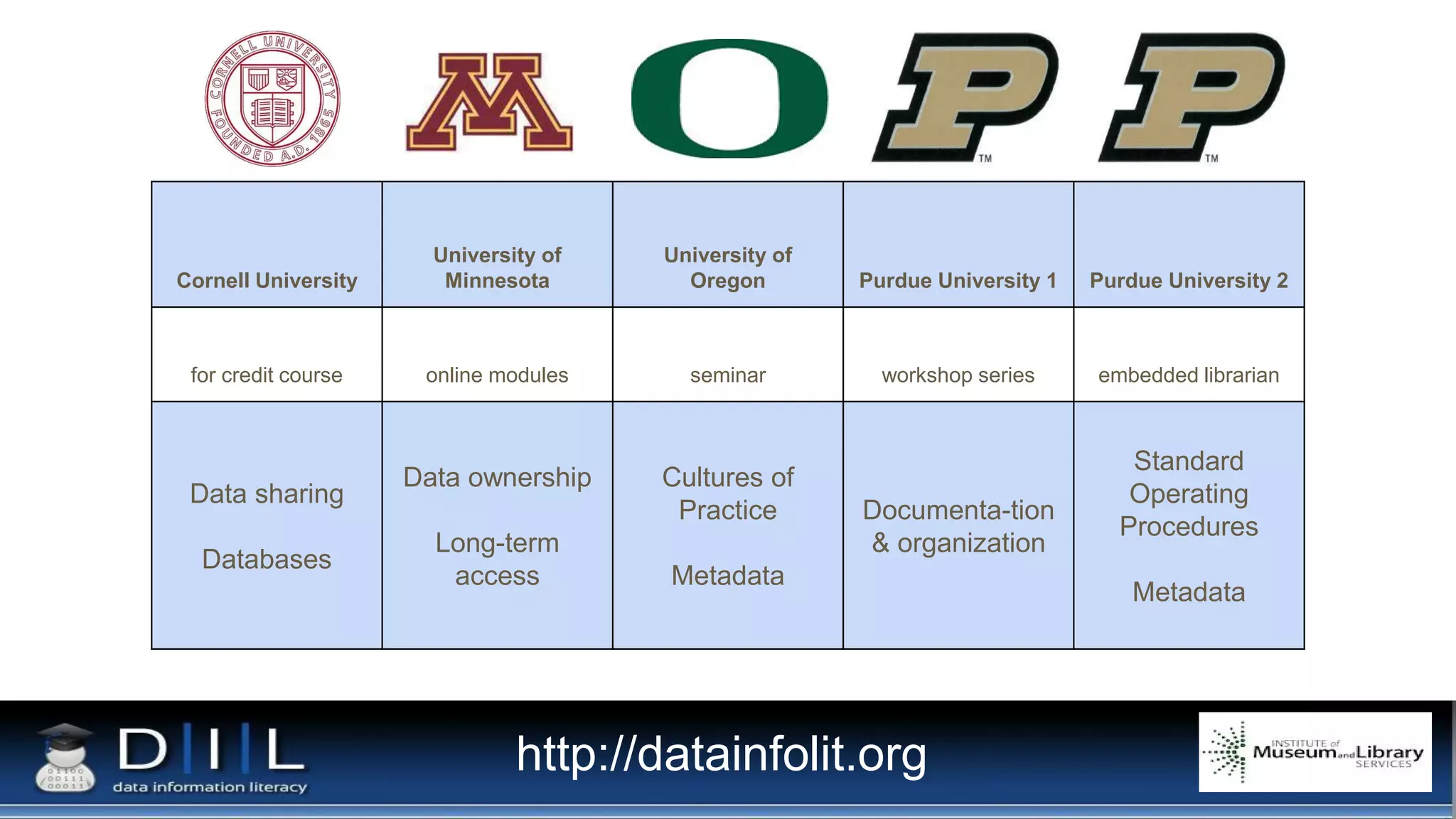
Cornell University
University of
Minnesota
University of
Oregon Purdue University 1 Purdue University 2
for credit course online modules seminar workshop series embedded librarian
Data sharing
Databases
Data ownership
Long-term
access
Cultures of
Practice
Metadata
Documenta-tion
& organization
Standard
Operating
Procedures
Metadata
http://datainfolit.org
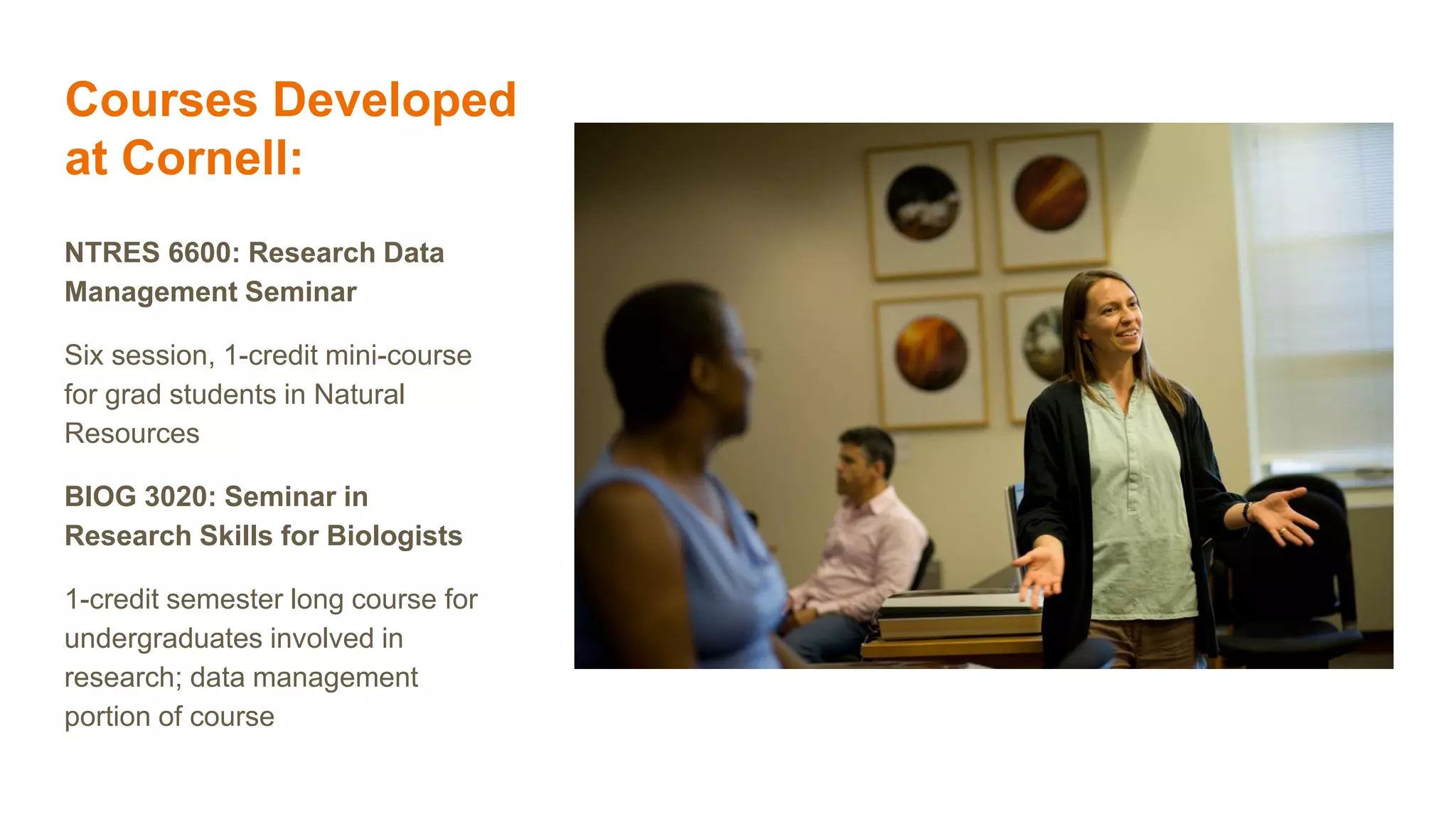
Courses Developed
at Cornell:
NTRES 6600: Research Data
Management Seminar
Six session, 1-credit mini-course
for grad students in Natural
Resources
BIOG 3020: Seminar in
Research Skills for Biologists
1-credit semester long course for
undergraduates involved in
research; data management
portion of course
Lessons Learned
• The competencies were almost universally considered
important by students and faculty interviewed.
• Students were considered lacking in these competencies.
• Faculty assumed that students have or should have
acquired the competencies earlier.
• Lack of formal training for students working with data.
http://www.slideshare.net/asist_org/rdap-15-lessons-learned-from-the-data-information-literacy-project
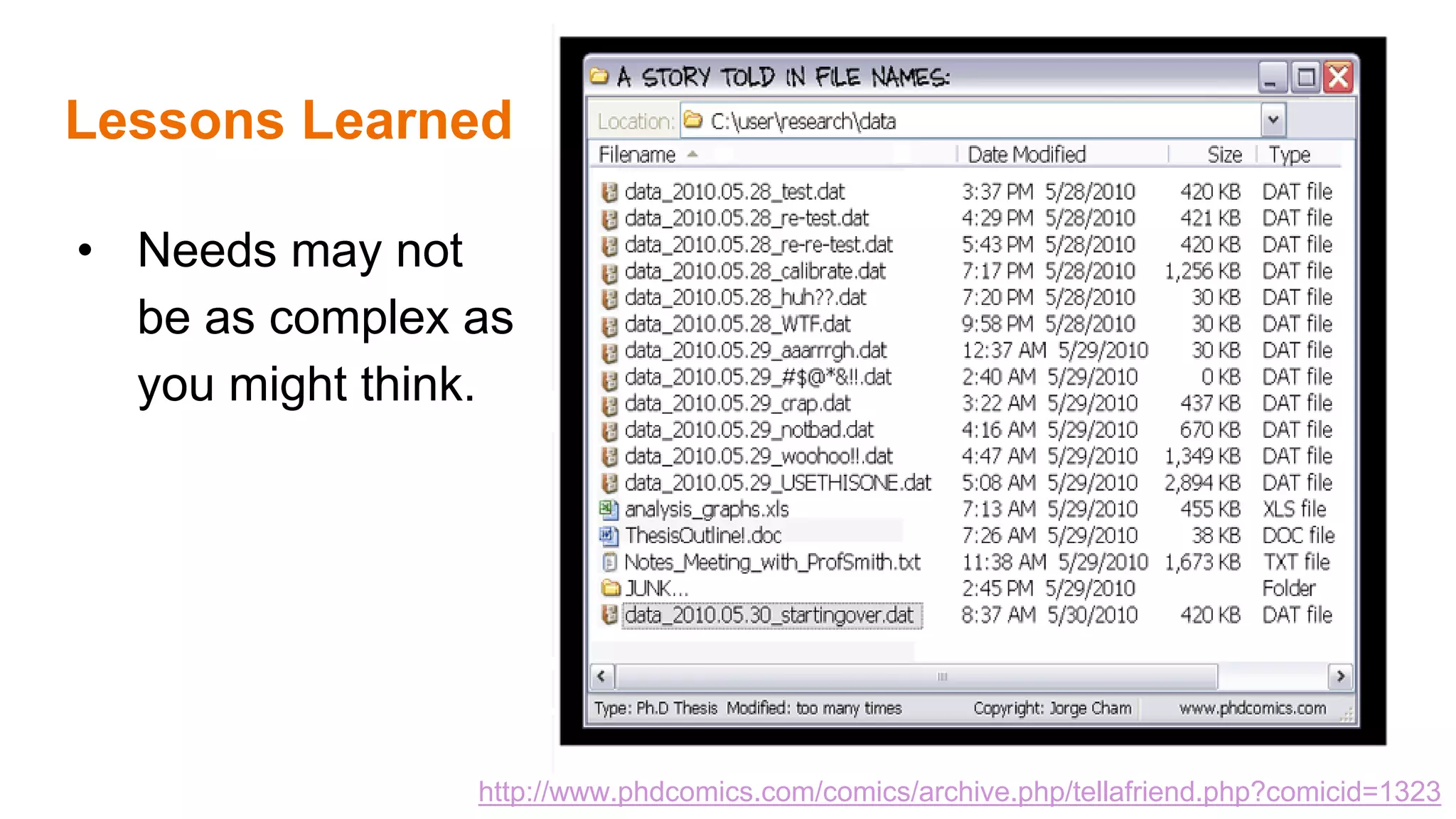
PhD comics, http://www.phdcomics.com/comics.php?f=1323
http://www.phdcomics.com/comics/archive.php/tellafriend.php?comicid=1323
Lessons Learned
• Needs may not
be as complex as
you might think.
Lessons Learned
• Learning is largely self-directed through “trial and error.”
• Training often at point of need, often in the context of the
immediate issue.
• Faculty were often unsure of best practices or how to
approach the competencies themselves.
http://www.slideshare.net/asist_org/rdap-15-lessons-learned-from-the-data-information-literacy-project
DIL Resources
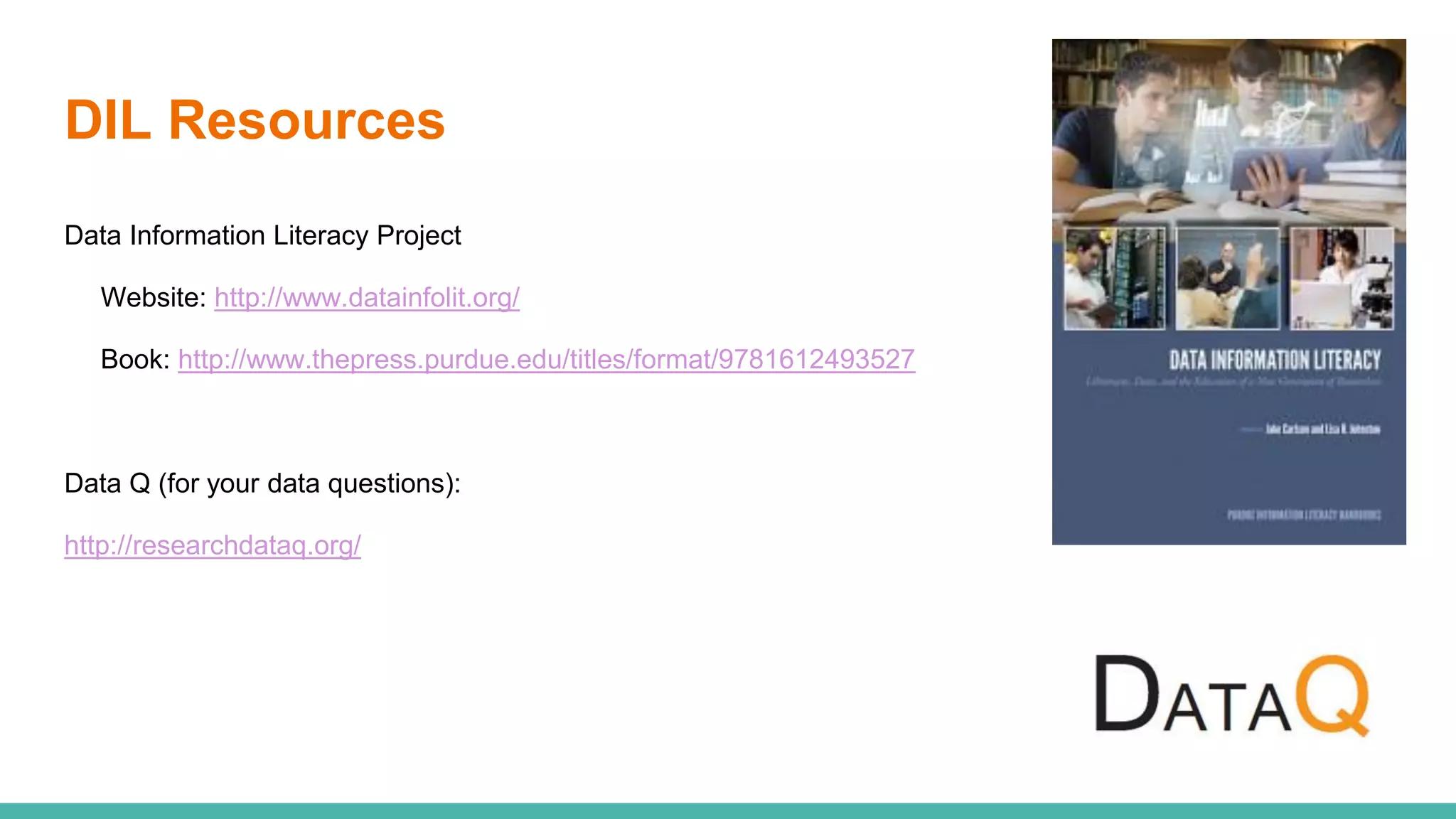
Data Information Literacy Project
Website: http://www.datainfolit.org/
Book: http://www.thepress.purdue.edu/titles/format/9781612493527
Data Q (for your data questions):
http://researchdataq.org/
Contact Information
SARAH J. WRIGHT
Life Sciences Librarian for Research
Cornell University
sjw256@cornell.edu
Digital Social
Science Lab
- connecting academia
with data literacy
Christian Lauersen
Copenhagen University Library
Email: cula@kb.dk
Twitter: @clauersen
Library Connect Webinar Dec 8th 2016
Research Data Literacy and The Library
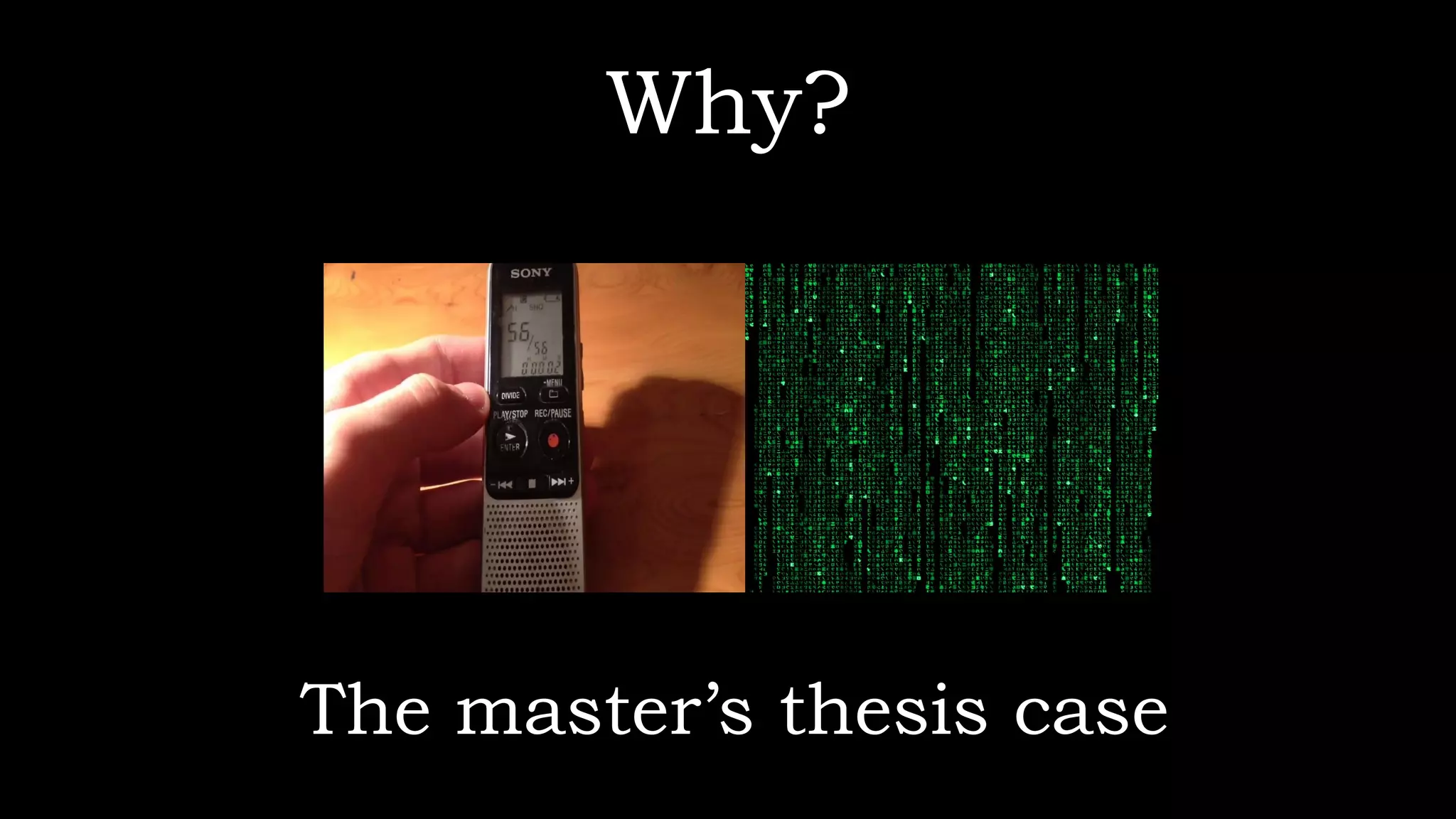
Why?
The master’s thesis case
Kub kort
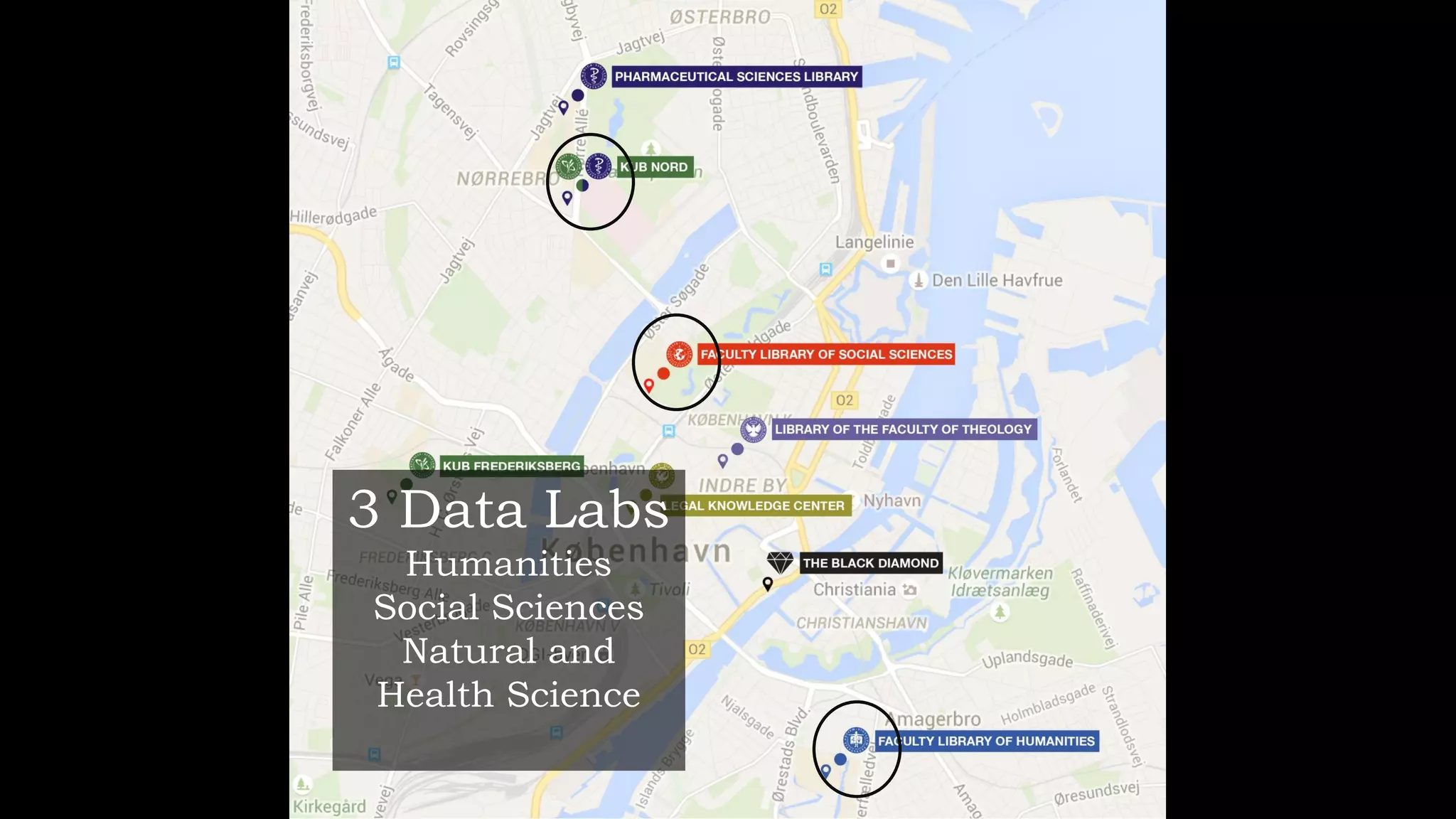
Hvorfor?3 Data Labs
Humanities
Social Sciences
Natural and
Health Science
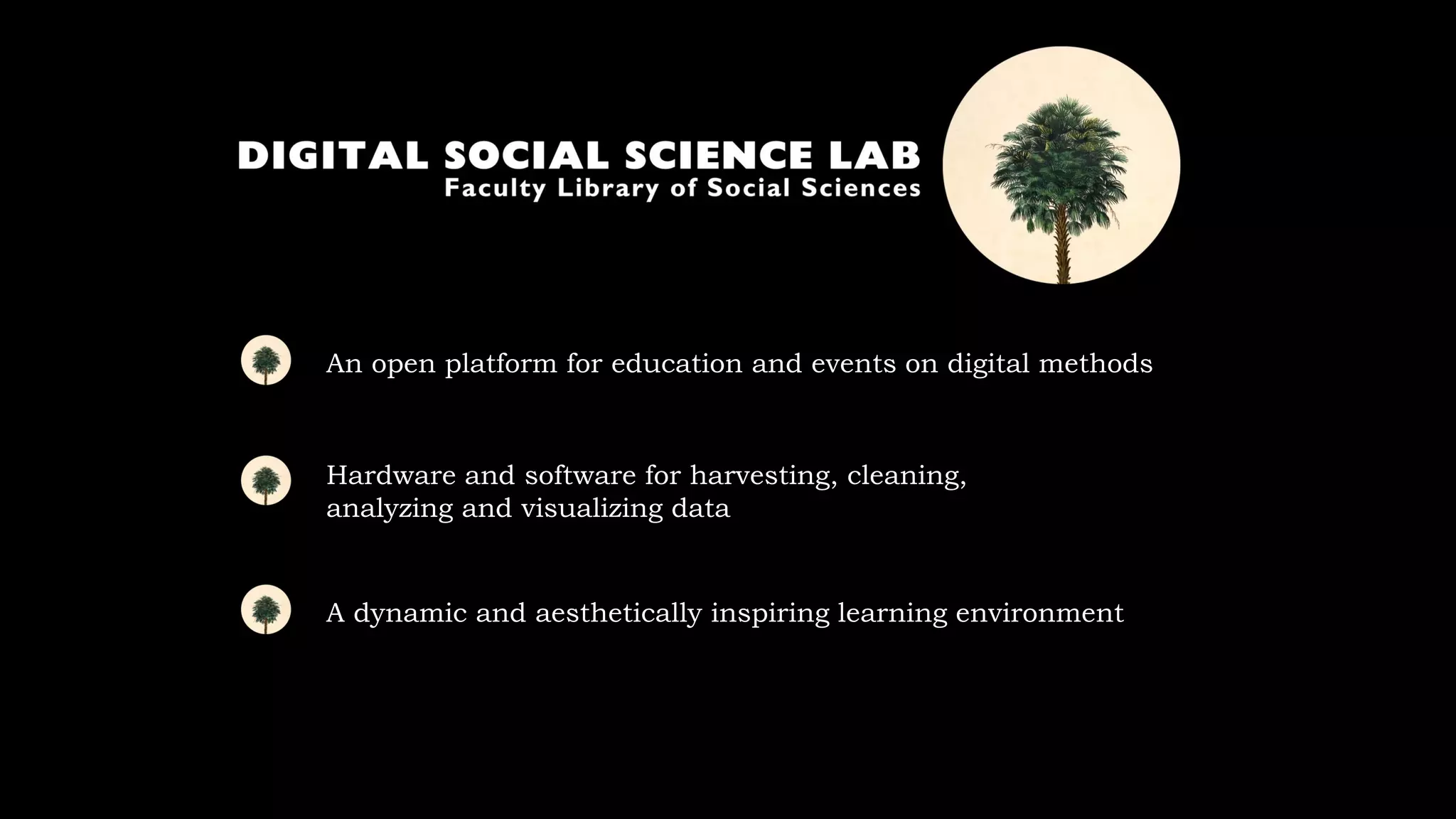
An open platform for education and events on digital methods
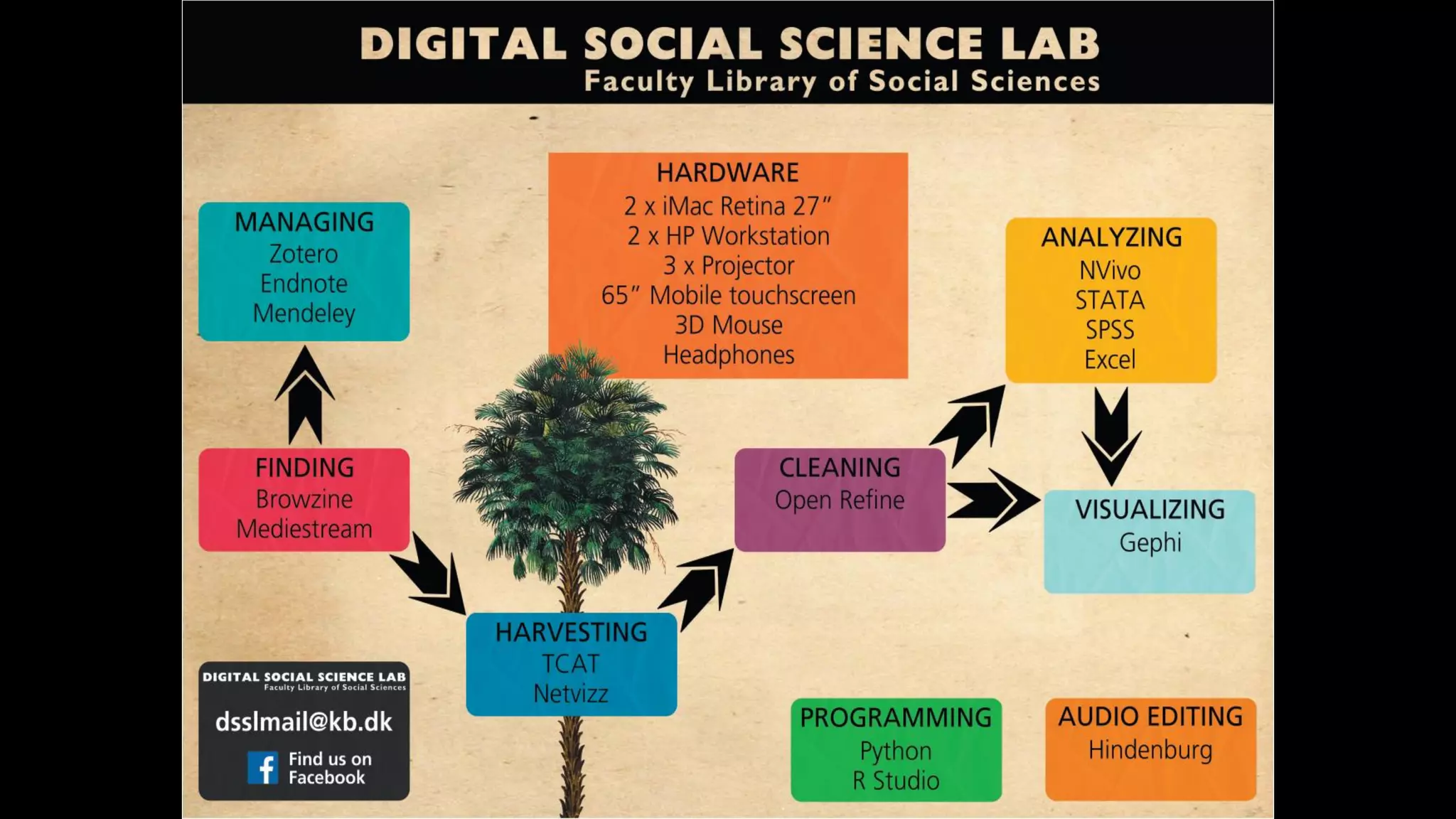
Hardware and software for harvesting, cleaning,
analyzing and visualizing data
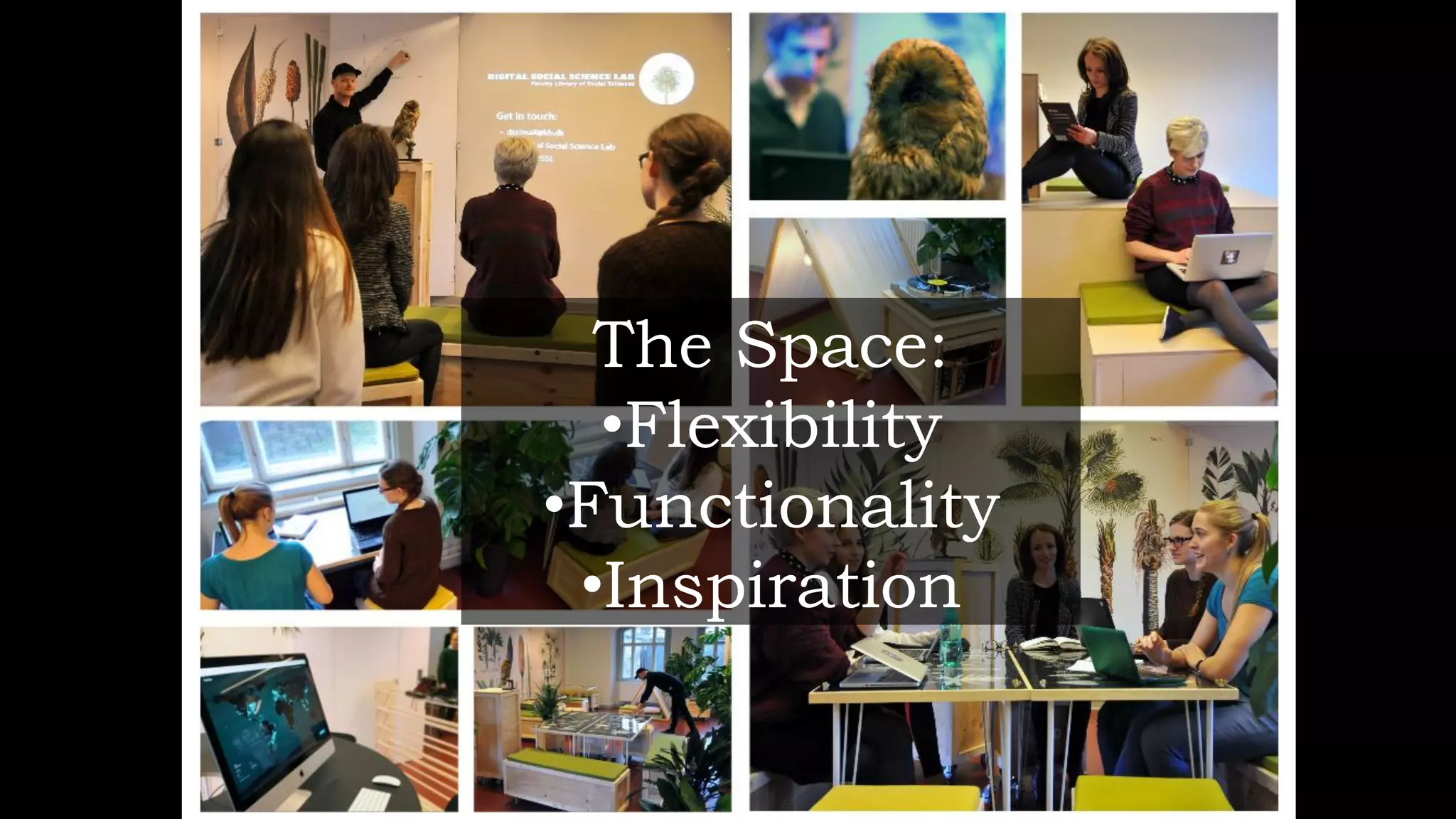
A dynamic and aesthetically inspiring learning environment
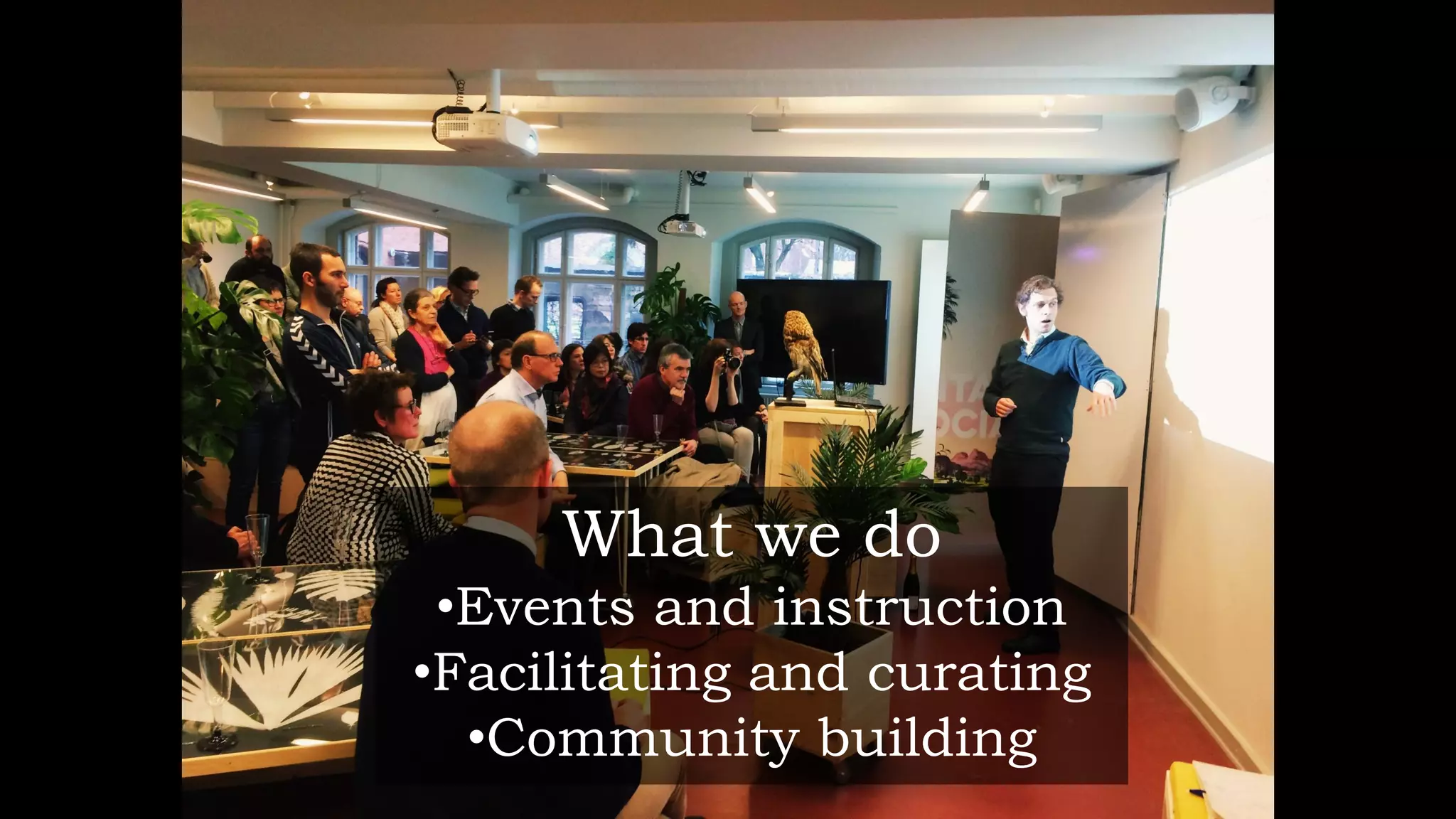
What we do
•Events and instruction
•Facilitating and curating
•Community building
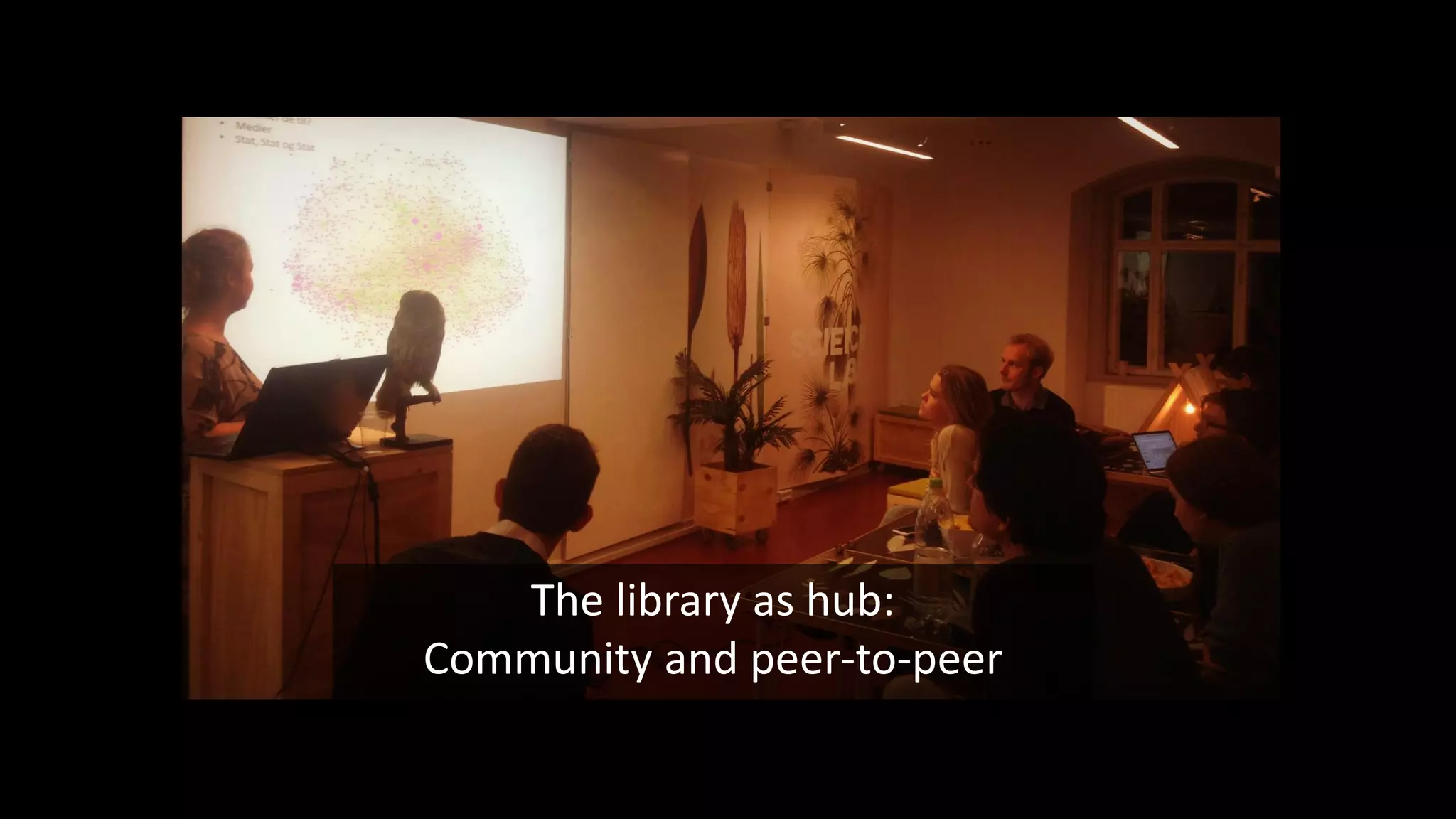
The library as hub:
Community and peer-to-peer
The Space:
•Flexibility
•Functionality
•Inspiration
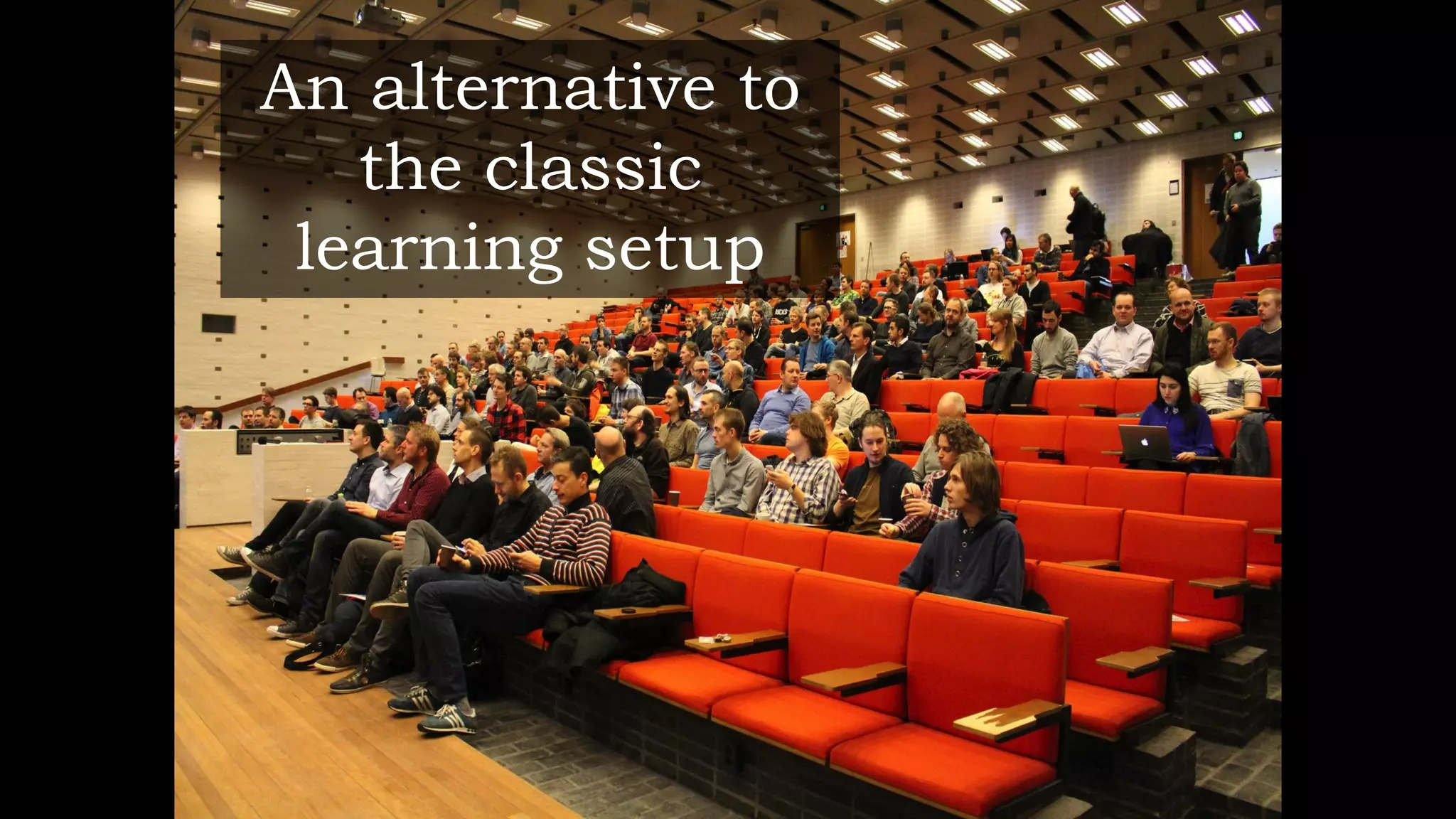
An alternative to
the classic
learning setup
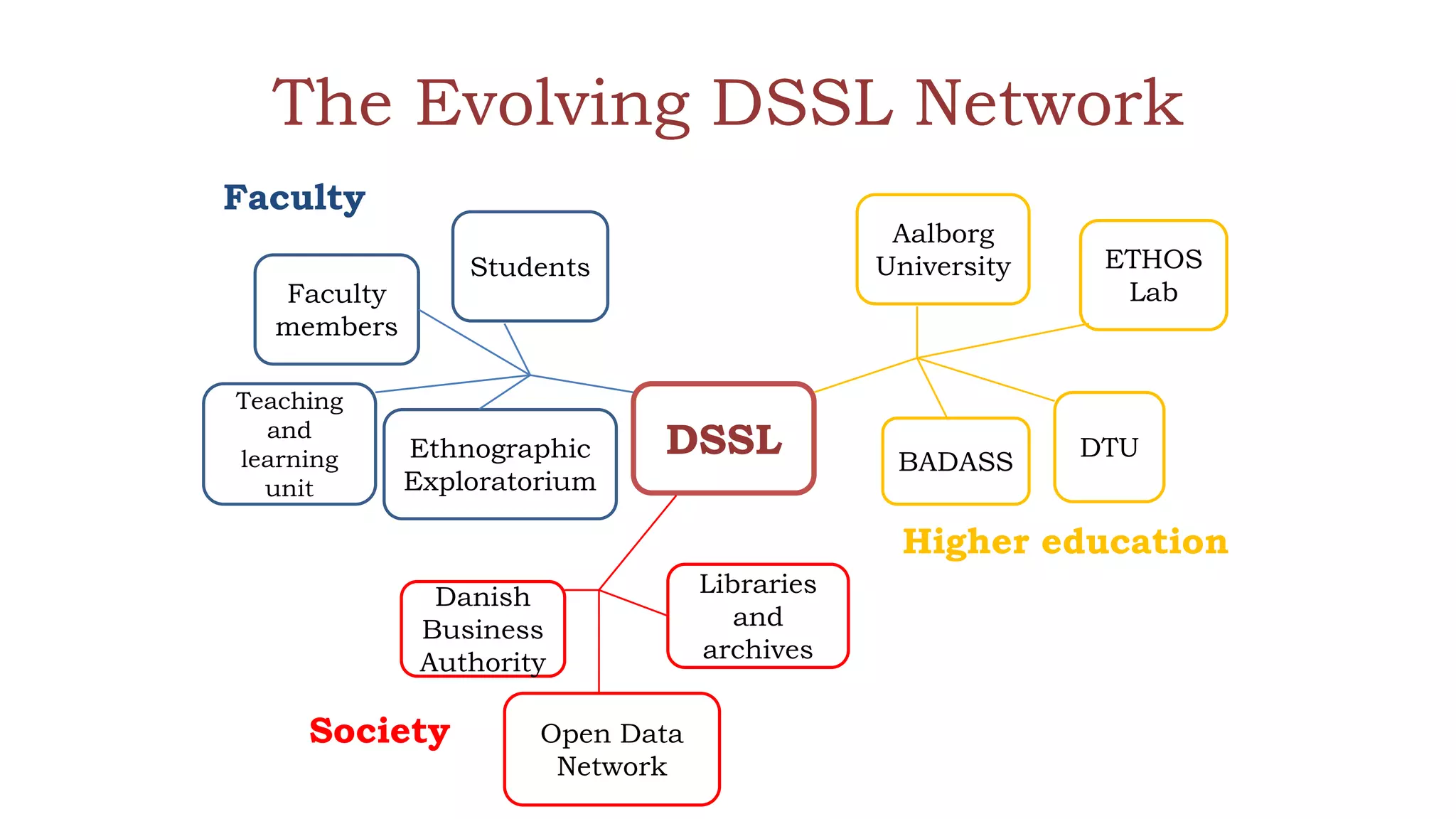
The Evolving DSSL Network
DSSL
Aalborg
University
DTU
Faculty
members
Students
Ethnographic
Exploratorium
ETHOS
Lab
Teaching
and
learning
unit
Faculty
BADASS
Higher education
Danish
Business
Authority
Open Data
Network
Libraries
and
archives
Society
Hvad er Digital Social Science Lab?
• Et fysisk rum til understøttelse af
forskning, uddannelse og læring
• Relevant software og hardware +
vejledning og support
• En platform for digitale metoder og
værktøjer indenfor samfundsvidenskaben
Key to impact?
Stakeholders
Ownership
Collaboration
Challenges in the process
• ”Is this a library task?”
• ”On the expense of what?”
• How do we get the relevant skills?
• How do we talk about this project?
• How do we position ourselves toward the local
research and educational environment?
What we’ve learned
• It’s not enough to provide access to software
and hardware
• Skill development is a long process and has
to be in context of need and resources
• The facilitating role is a good way to create
value
• Network is key
• The Library is a very strong platform for
bringing people together within academia
• Library support of data literacy might not fit
with all subjects
Digital Social Science Lab
http://kub.kb.dk/DSSL
Christian Lauersen
Mail: cula@kb.dk
Twitter: @clauersen
The Library Lab
https://christianlauersen.net
Thanks for
listening
| 29
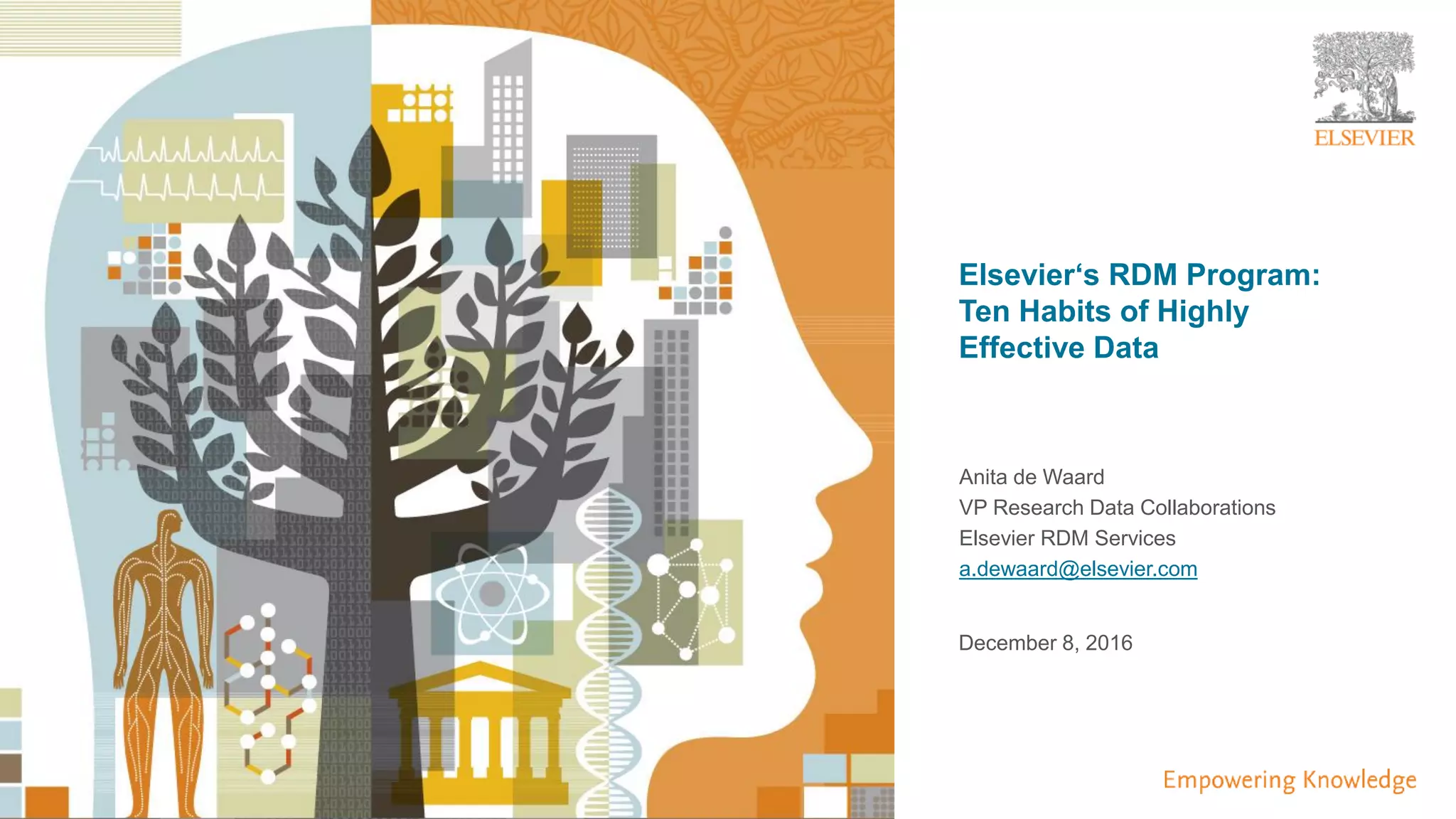
Elsevier‘s RDM Program:
Ten Habits of Highly
Effective Data
Anita de Waard
VP Research Data Collaborations
Elsevier RDM Services
a.dewaard@elsevier.com
December 8, 2016
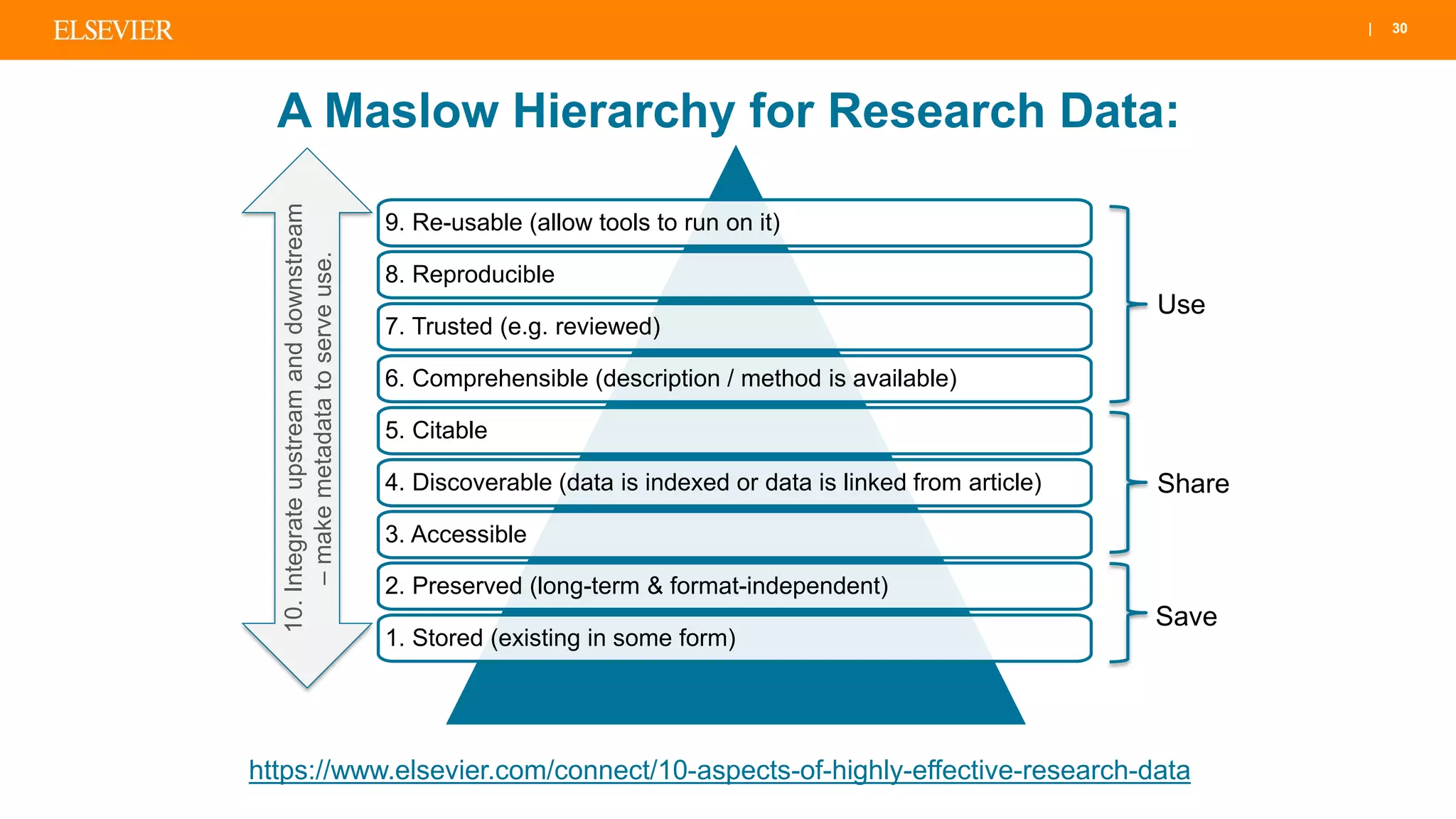
| 30
https://www.elsevier.com/connect/10-aspects-of-highly-effective-research-data
10.Integrateupstreamanddownstream
–makemetadatatoserveuse.
Save
Share
Use
9. Re-usable (allow tools to run on it)
8. Reproducible
7. Trusted (e.g. reviewed)
6. Comprehensible (description / method is available)
5. Citable
4. Discoverable (data is indexed or data is linked from article)
3. Accessible
1. Stored (existing in some form)
2. Preserved (long-term & format-independent)
A Maslow Hierarchy for Research Data:
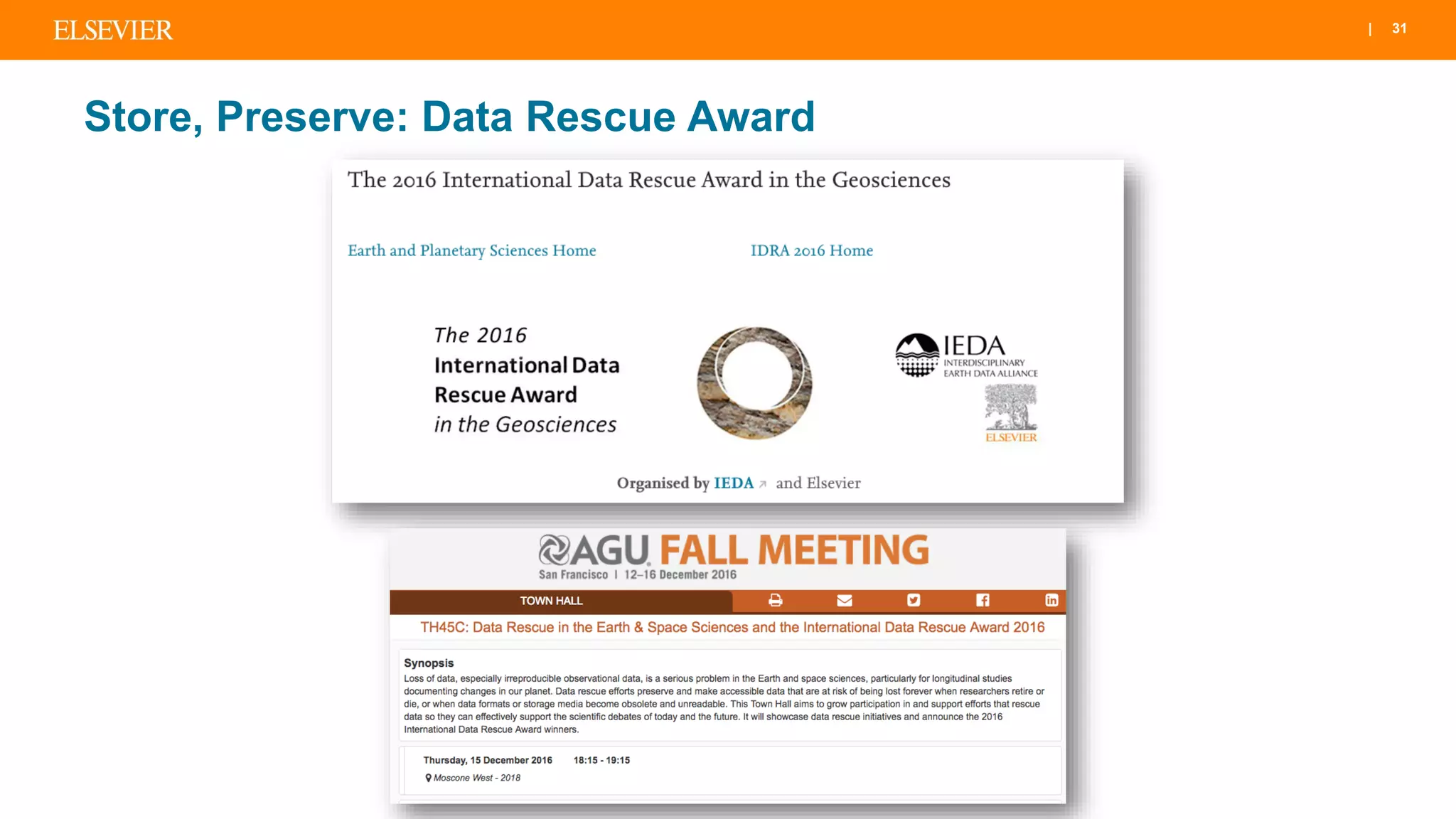
| 31
Store, Preserve: Data Rescue Award
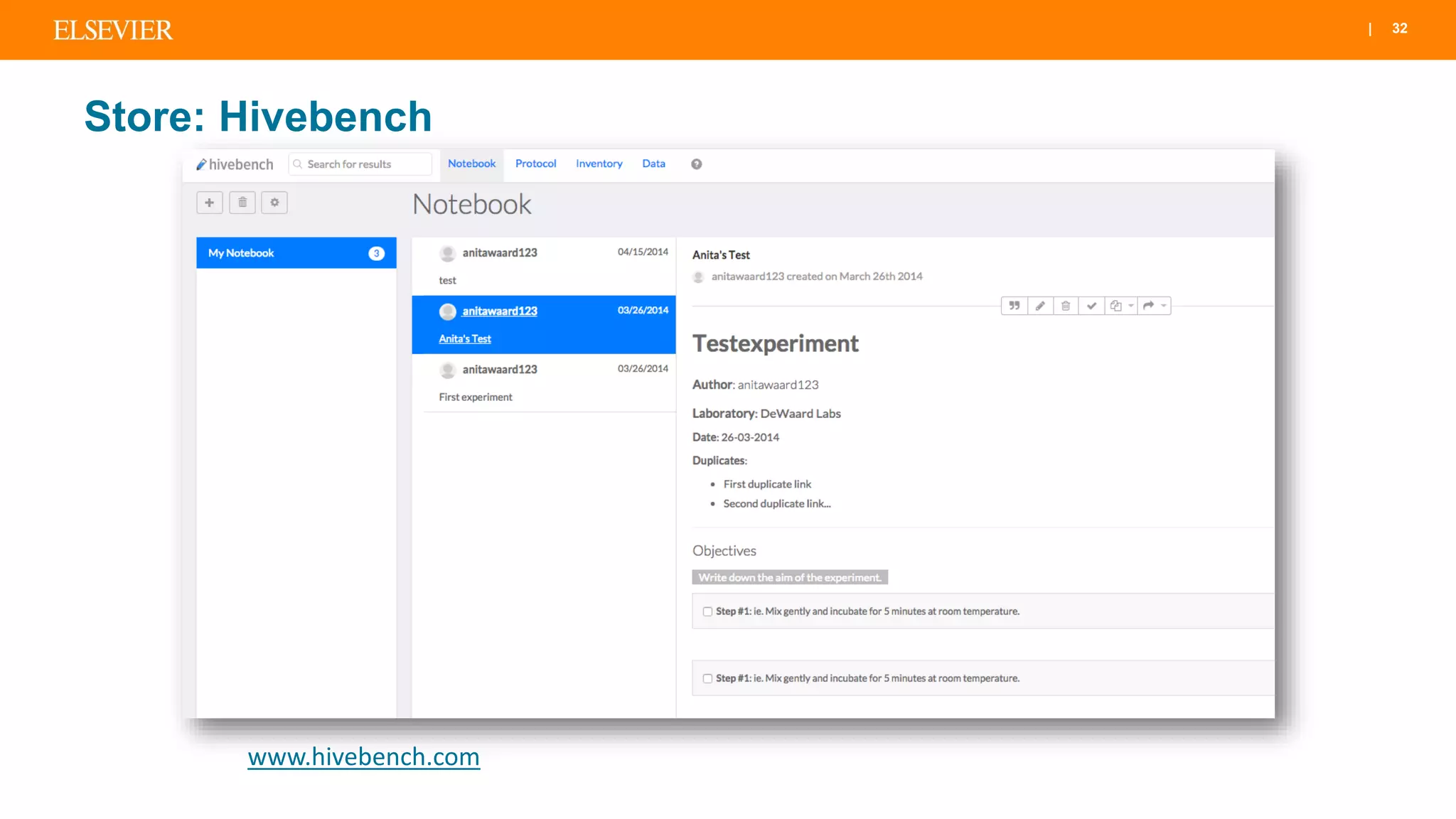
| 32
Store: Hivebench
www.hivebench.com
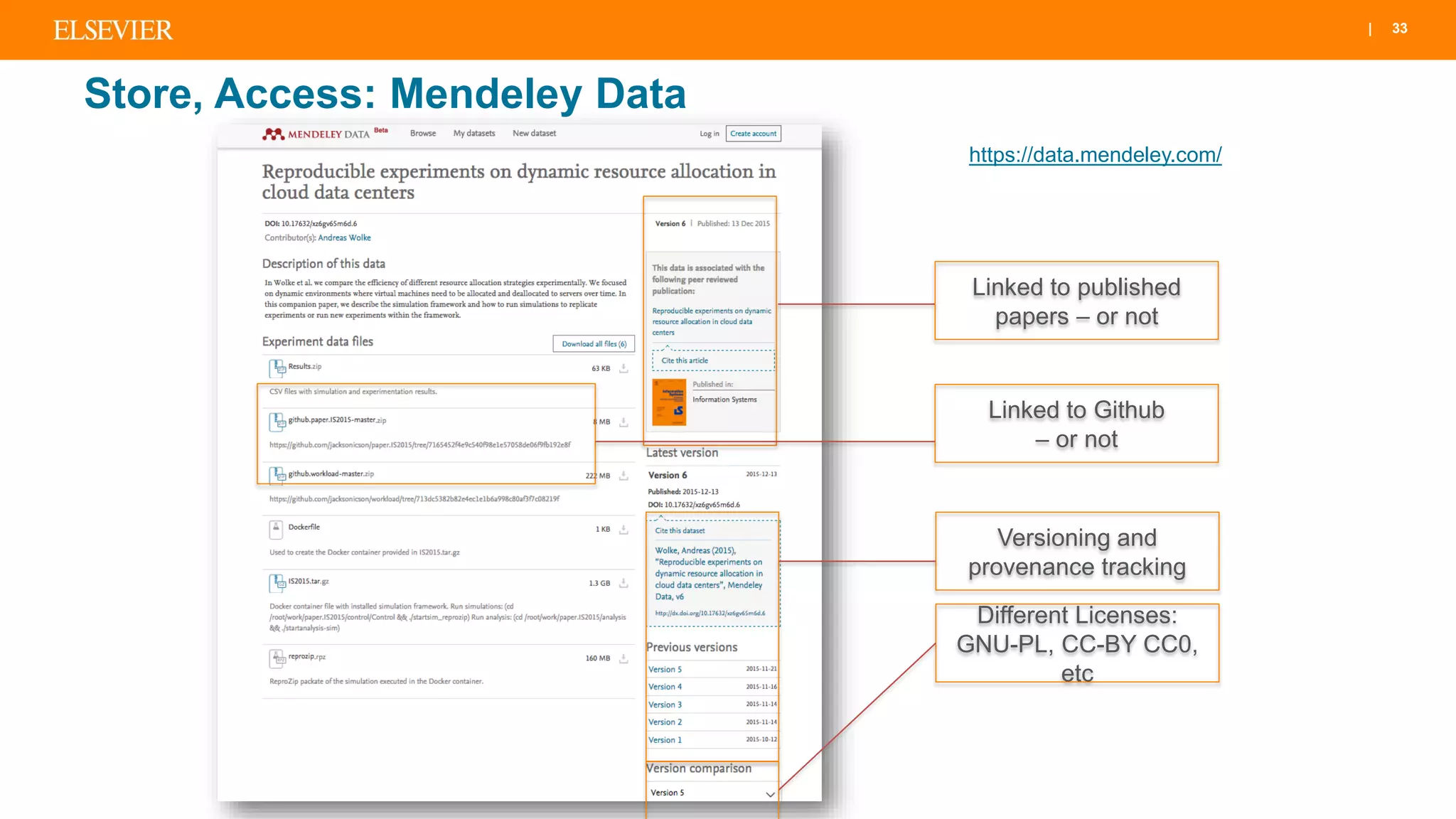
| 33
https://data.mendeley.com/
Linked to published
papers – or not
Linked to Github
– or not
Versioning and
provenance tracking
Store, Access: Mendeley Data
Different Licenses:
GNU-PL, CC-BY CC0,
etc
| 34
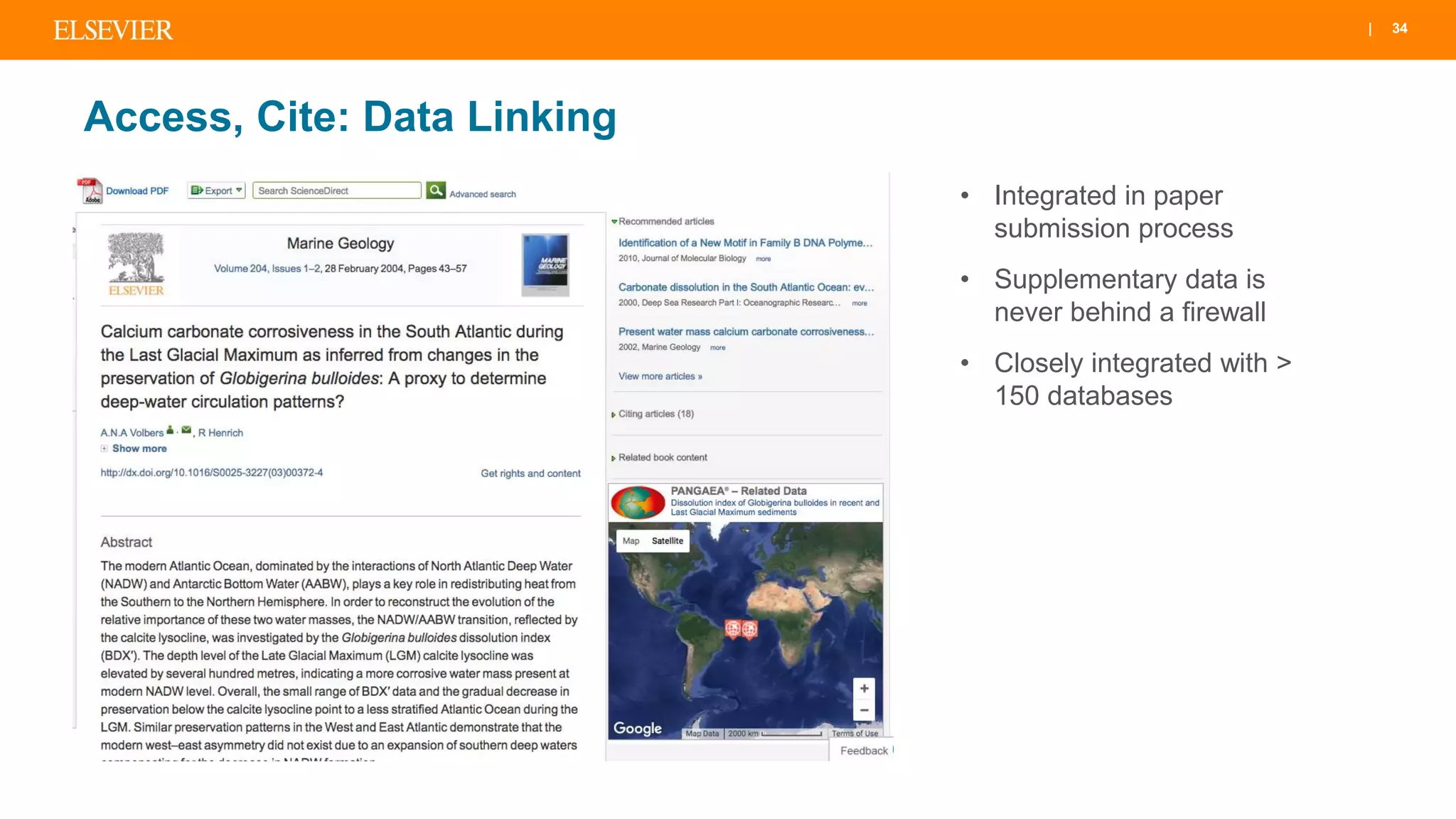
Access, Cite: Data Linking
• Integrated in paper
submission process
• Supplementary data is
never behind a firewall
• Closely integrated with >
150 databases
| 35
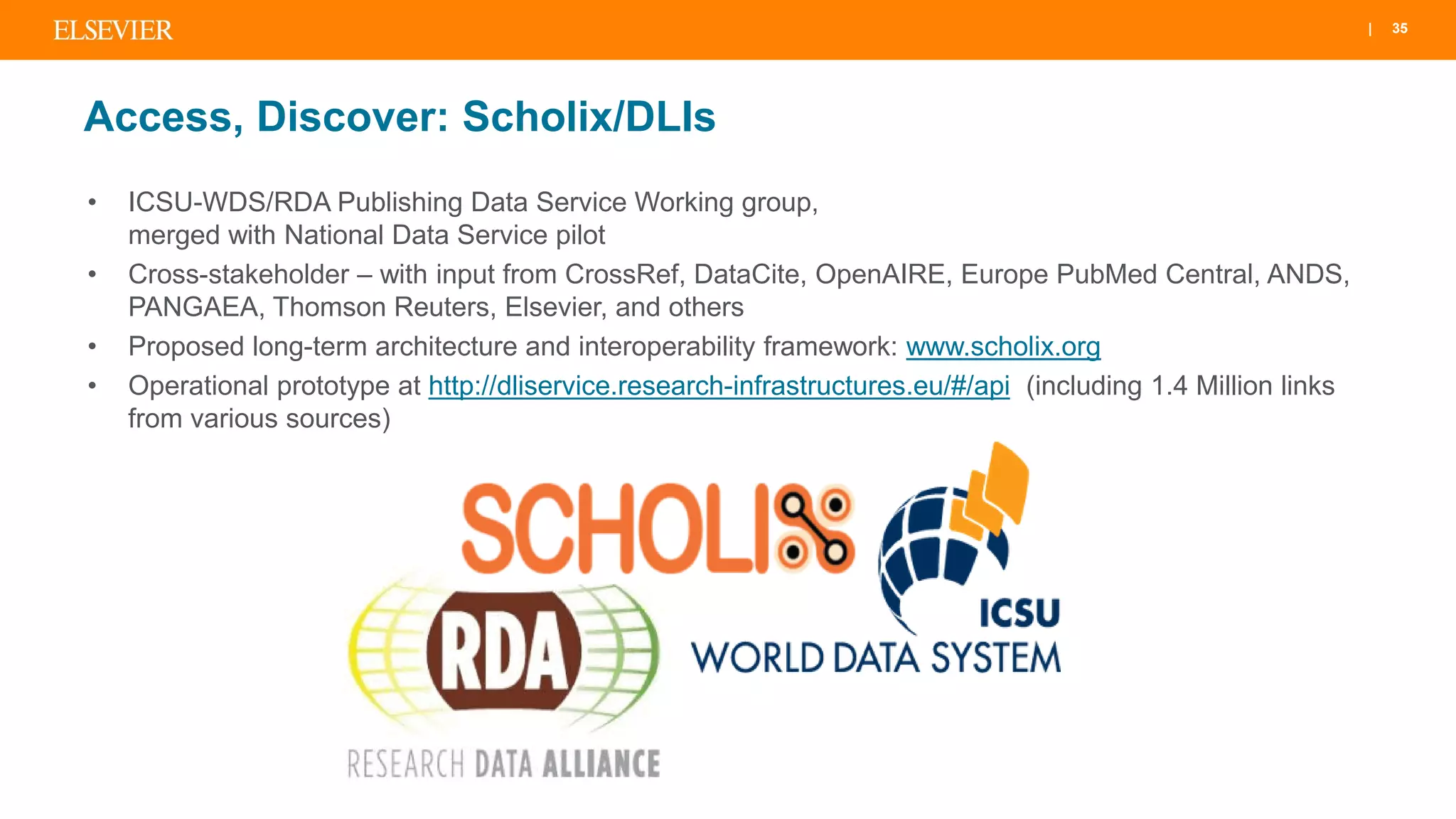
Access, Discover: Scholix/DLIs
• ICSU-WDS/RDA Publishing Data Service Working group,
merged with National Data Service pilot
• Cross-stakeholder – with input from CrossRef, DataCite, OpenAIRE, Europe PubMed Central, ANDS,
PANGAEA, Thomson Reuters, Elsevier, and others
• Proposed long-term architecture and interoperability framework: www.scholix.org
• Operational prototype at http://dliservice.research-infrastructures.eu/#/api (including 1.4 Million links
from various sources)
| 36
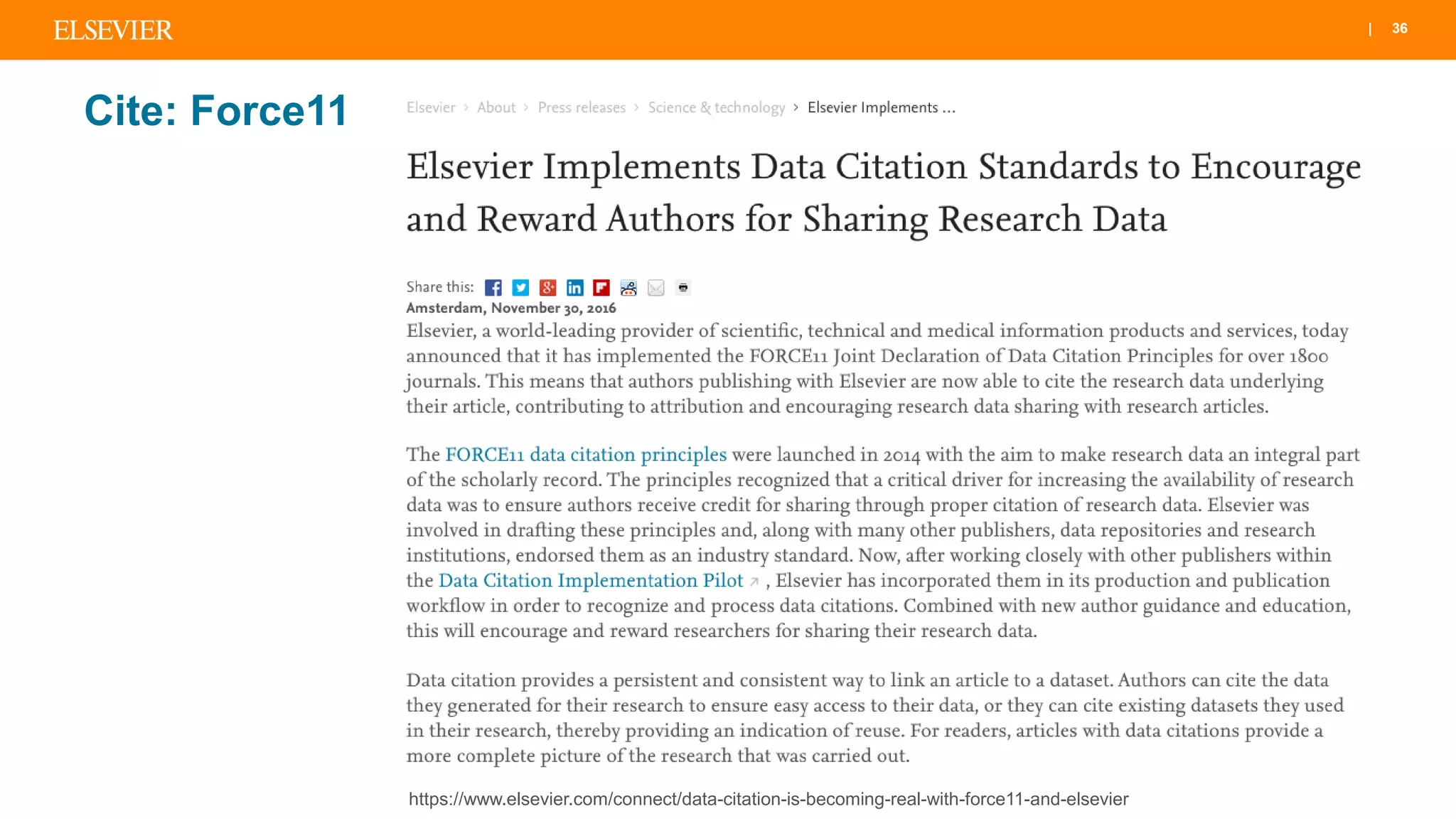
Cite: Force11
https://www.elsevier.com/connect/data-citation-is-becoming-real-with-force11-and-elsevier
| 37
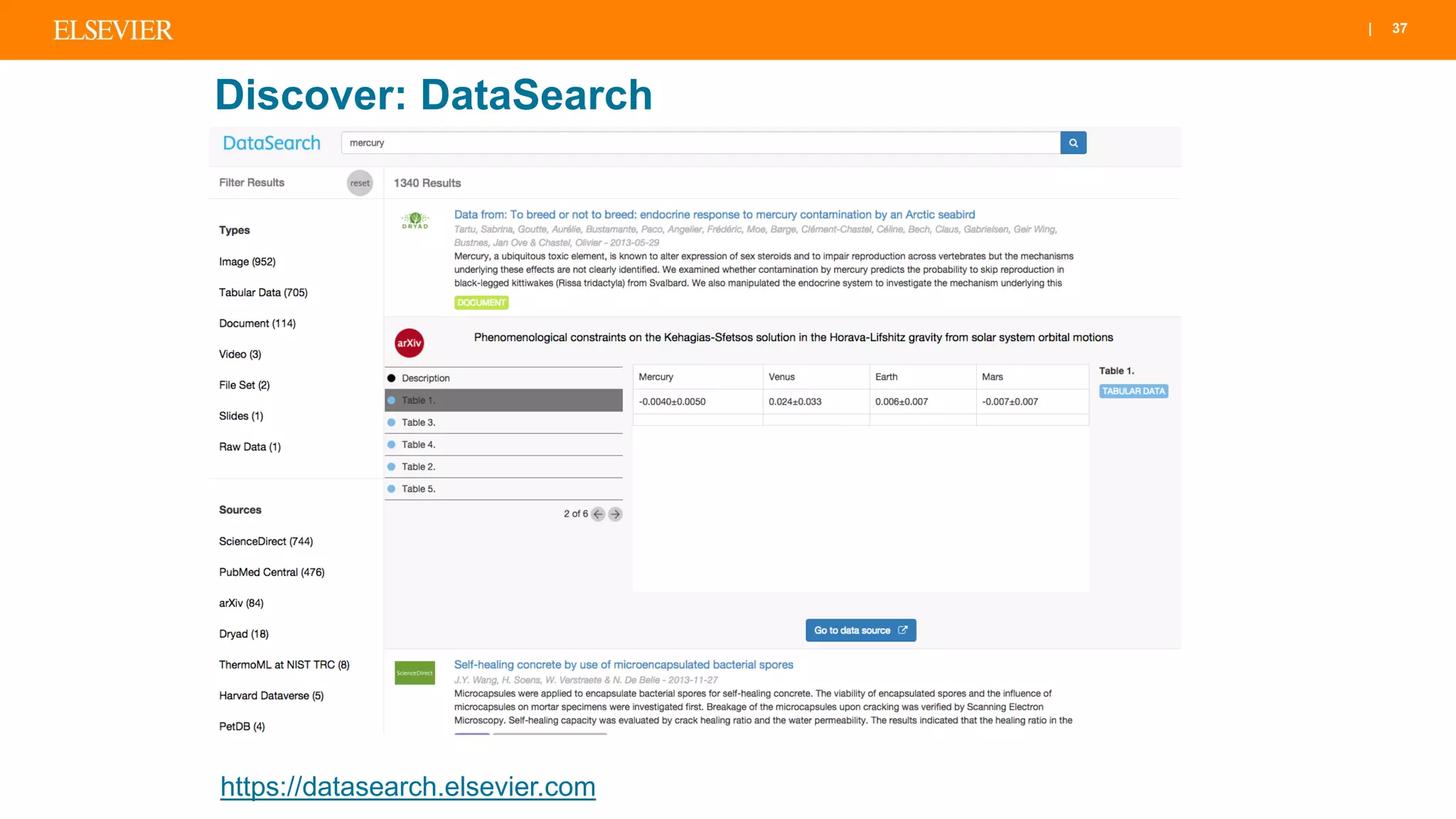
Discover: DataSearch
https://datasearch.elsevier.com
| 38
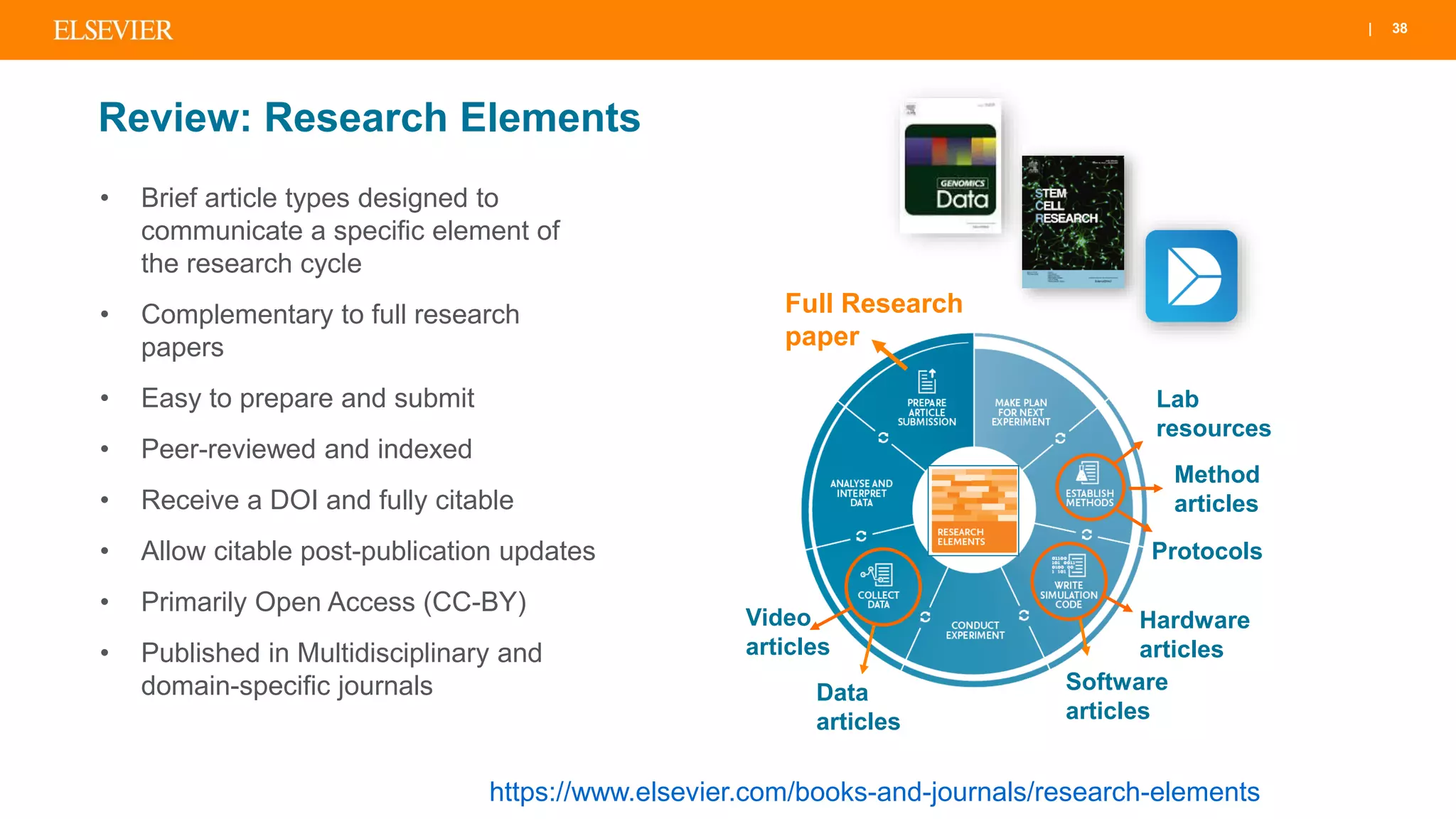
Data
articles
Software
articles
Method
articles
Protocols
Video
articles
Hardware
articles
Lab
resources
Full Research
paper
• Brief article types designed to
communicate a specific element of
the research cycle
• Complementary to full research
papers
• Easy to prepare and submit
• Peer-reviewed and indexed
• Receive a DOI and fully citable
• Allow citable post-publication updates
• Primarily Open Access (CC-BY)
• Published in Multidisciplinary and
domain-specific journals
https://www.elsevier.com/books-and-journals/research-elements
Review: Research Elements
| 39
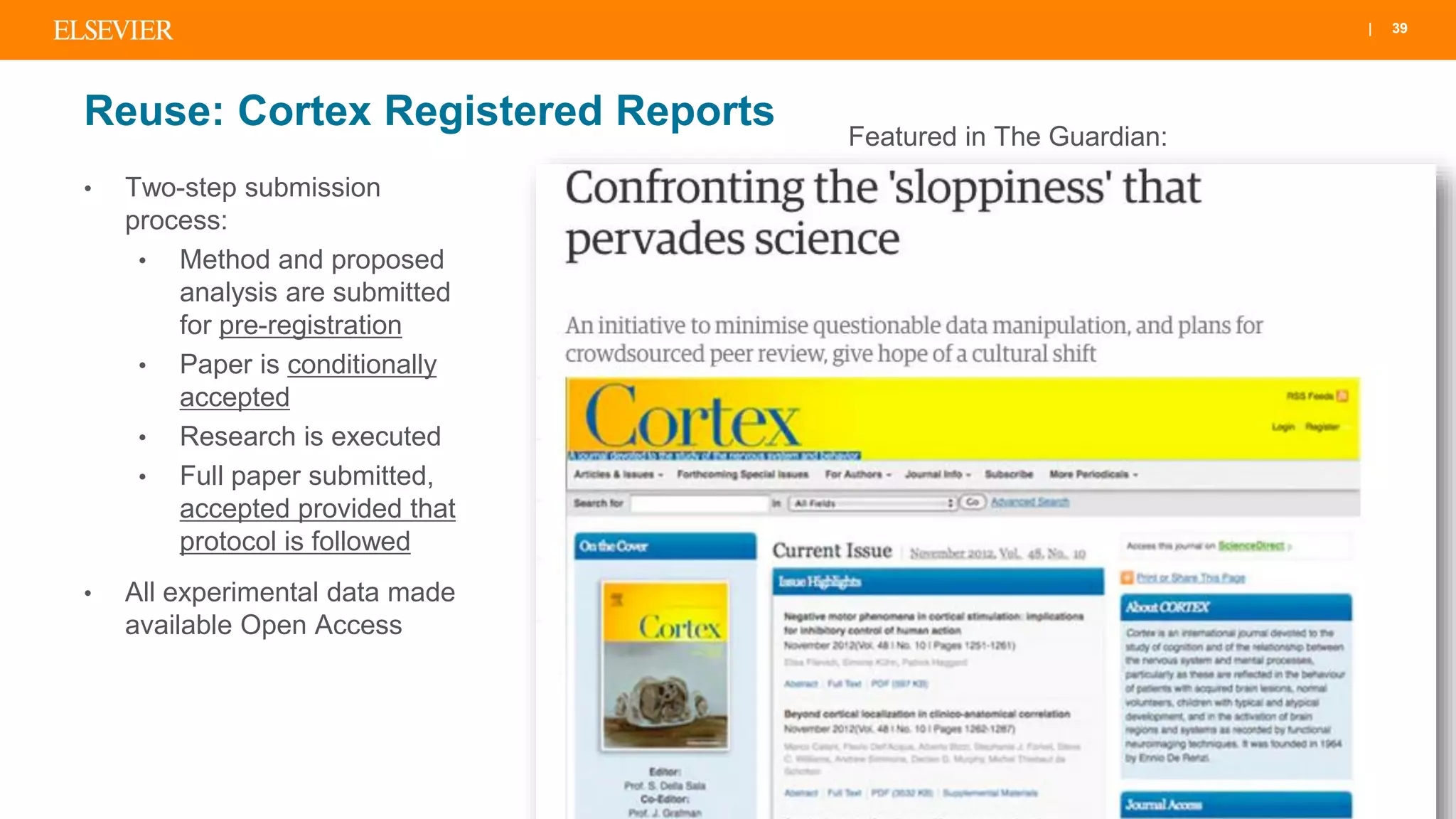
Reuse: Cortex Registered Reports
39
• Two-step submission
process:
• Method and proposed
analysis are submitted
for pre-registration
• Paper is conditionally
accepted
• Research is executed
• Full paper submitted,
accepted provided that
protocol is followed
• All experimental data made
available Open Access
Featured in The Guardian:
| 40
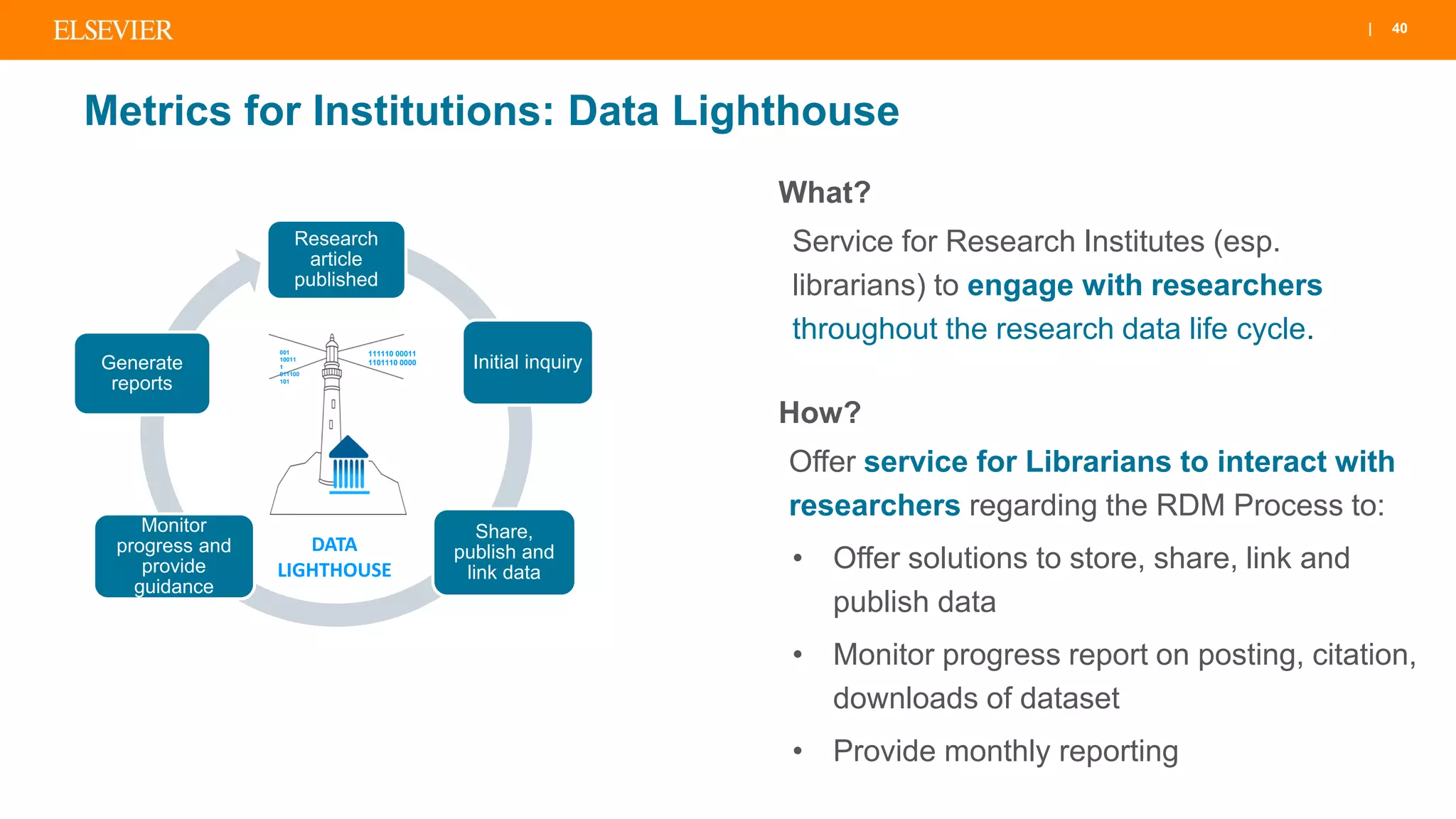
Research
article
published
Initial inquiry
Share,
publish and
link data
Monitor
progress and
provide
guidance
Generate
reports
111110 00011
1101110 0000
001
10011
1
011100
101
Metrics for Institutions: Data Lighthouse
What?
Service for Research Institutes (esp.
librarians) to engage with researchers
throughout the research data life cycle.
How?
Offer service for Librarians to interact with
researchers regarding the RDM Process to:
• Offer solutions to store, share, link and
publish data
• Monitor progress report on posting, citation,
downloads of dataset
• Provide monthly reporting
DATA
LIGHTHOUSE
| 41
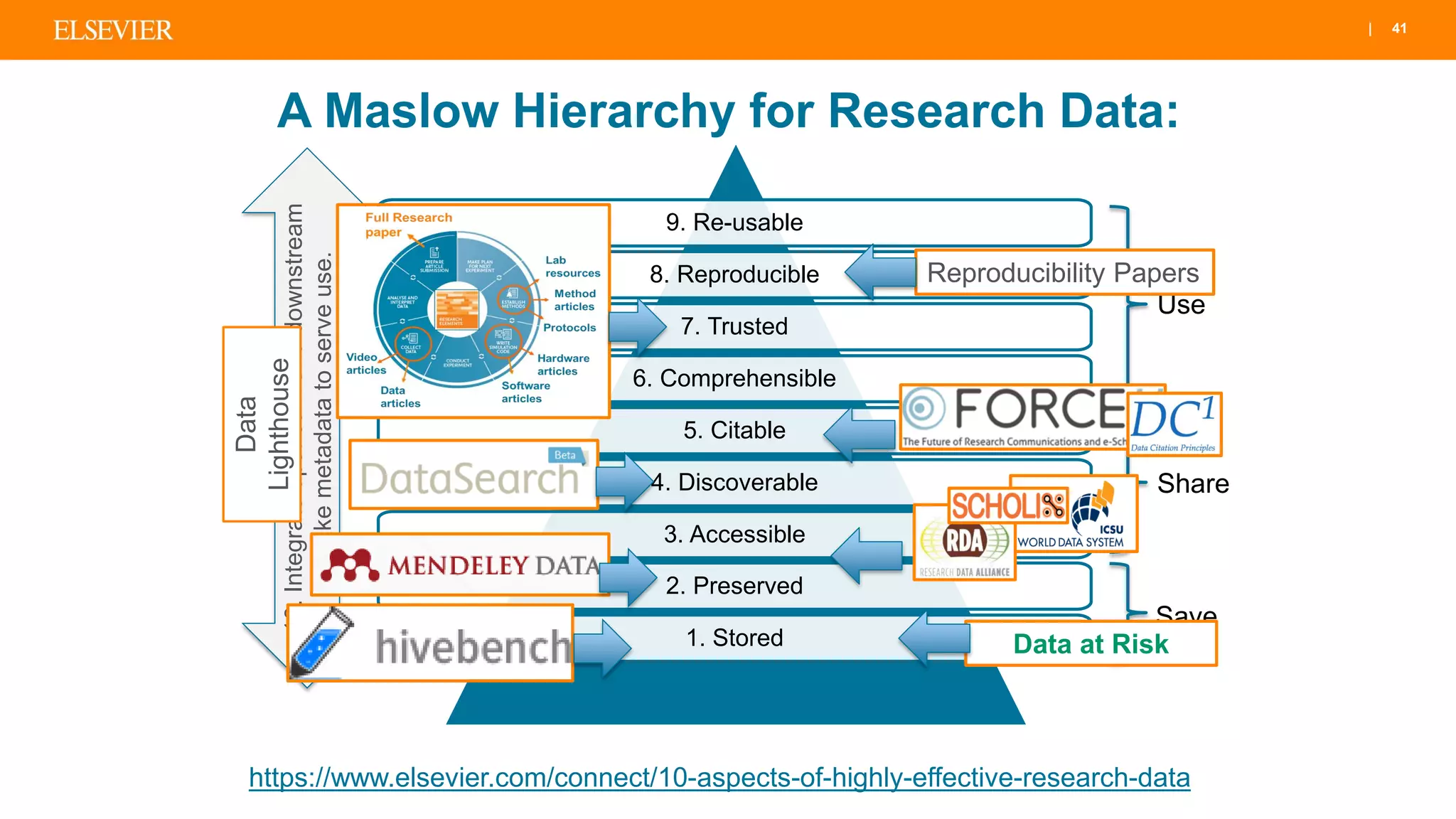
10.Integrateupstreamanddownstream
–makemetadatatoserveuse.
Save
Share
Use
9. Re-usable
8. Reproducible
7. Trusted
6. Comprehensible
5. Citable
4. Discoverable
3. Accessible
1. Stored
2. Preserved
https://www.elsevier.com/connect/10-aspects-of-highly-effective-research-data
A Maslow Hierarchy for Research Data:
Data at Risk
Reproducibility Papers
Data
Lighthouse
Slides | Research data literacy and the library

Slides | Research data literacy and the library

  • 2.
    Teaching Data Information Literacy SarahJ. Wright Life Sciences Librarian for Research, Cornell University
  • 3.
    What I’ll talk about DataInformation Literacy IMLS-funded Data Information Literacy research project needs identified approaches lessons learned
  • 4.
    DIL + Related Literacies Data Literacy Access,assess, manipulate, summarize, and present data Statistical Literacy Think critically about basic stats in everyday media Information Literacy Think critically about concepts; read, interpret, evaluate information Data Information Literacy The ability to use, understand, and manage dataSchield, Milo. "Information literacy, statistical literacy and data literacy." I ASSIST Quarterly 28.2/3 (2004): 6-11.
  • 5.
    Discovery & Acquisition Databases & Dataformats Data Conversion & Interoperability Data Processing & Analysis Data Visualization & Representation Data Management & Organization Data Quality & Documentation Metadata & Description Cultures of Practice Ethics & Attribution Data Curation & Re-use Data Preservation Carlson, J., Fosmire, M., Miller, C. C., & Nelson, M. S. (2011). Determining data information literacy needs: A study of students and research faculty. Portal: Libraries & the Academy, 11(2), 629-657.
  • 6.
    Cornell University University of Minnesota Universityof Oregon Purdue University 1 Purdue University 2 Natural Resources Civil Engineering Ecology Electrical & Computer Engineering Agricultural & Biological Engineering Longitudinal data of fisheries and water quality Real-time sensor data on bridge structures Climate change and plant growth data Software code in community service projects Simulation data of hydrological processes http://datainfolit.org
  • 7.
    Cornell University University of Minnesota Universityof Oregon Purdue University 1 Purdue University 2 for credit course online modules seminar workshop series embedded librarian Data sharing Databases Data ownership Long-term access Cultures of Practice Metadata Documenta-tion & organization Standard Operating Procedures Metadata http://datainfolit.org
  • 8.
    Courses Developed at Cornell: NTRES6600: Research Data Management Seminar Six session, 1-credit mini-course for grad students in Natural Resources BIOG 3020: Seminar in Research Skills for Biologists 1-credit semester long course for undergraduates involved in research; data management portion of course
  • 9.
    Lessons Learned • Thecompetencies were almost universally considered important by students and faculty interviewed. • Students were considered lacking in these competencies. • Faculty assumed that students have or should have acquired the competencies earlier. • Lack of formal training for students working with data. http://www.slideshare.net/asist_org/rdap-15-lessons-learned-from-the-data-information-literacy-project
  • 10.
  • 11.
    Lessons Learned • Learningis largely self-directed through “trial and error.” • Training often at point of need, often in the context of the immediate issue. • Faculty were often unsure of best practices or how to approach the competencies themselves. http://www.slideshare.net/asist_org/rdap-15-lessons-learned-from-the-data-information-literacy-project
  • 12.
    DIL Resources Data InformationLiteracy Project Website: http://www.datainfolit.org/ Book: http://www.thepress.purdue.edu/titles/format/9781612493527 Data Q (for your data questions): http://researchdataq.org/
  • 13.
    Contact Information SARAH J.WRIGHT Life Sciences Librarian for Research Cornell University sjw256@cornell.edu
  • 14.
    Digital Social Science Lab -connecting academia with data literacy Christian Lauersen Copenhagen University Library Email: cula@kb.dk Twitter: @clauersen Library Connect Webinar Dec 8th 2016 Research Data Literacy and The Library
  • 15.
  • 17.
    Kub kort Hvorfor?3 DataLabs Humanities Social Sciences Natural and Health Science
  • 18.
    An open platformfor education and events on digital methods Hardware and software for harvesting, cleaning, analyzing and visualizing data A dynamic and aesthetically inspiring learning environment
  • 19.
    What we do •Eventsand instruction •Facilitating and curating •Community building
  • 21.
    The library ashub: Community and peer-to-peer
  • 22.
  • 23.
    An alternative to theclassic learning setup
  • 24.
    The Evolving DSSLNetwork DSSL Aalborg University DTU Faculty members Students Ethnographic Exploratorium ETHOS Lab Teaching and learning unit Faculty BADASS Higher education Danish Business Authority Open Data Network Libraries and archives Society
  • 25.
    Hvad er DigitalSocial Science Lab? • Et fysisk rum til understøttelse af forskning, uddannelse og læring • Relevant software og hardware + vejledning og support • En platform for digitale metoder og værktøjer indenfor samfundsvidenskaben Key to impact? Stakeholders Ownership Collaboration
  • 26.
    Challenges in theprocess • ”Is this a library task?” • ”On the expense of what?” • How do we get the relevant skills? • How do we talk about this project? • How do we position ourselves toward the local research and educational environment?
  • 27.
    What we’ve learned •It’s not enough to provide access to software and hardware • Skill development is a long process and has to be in context of need and resources • The facilitating role is a good way to create value • Network is key • The Library is a very strong platform for bringing people together within academia • Library support of data literacy might not fit with all subjects
  • 28.
    Digital Social ScienceLab http://kub.kb.dk/DSSL Christian Lauersen Mail: cula@kb.dk Twitter: @clauersen The Library Lab https://christianlauersen.net Thanks for listening
  • 29.
    | 29 Elsevier‘s RDMProgram: Ten Habits of Highly Effective Data Anita de Waard VP Research Data Collaborations Elsevier RDM Services a.dewaard@elsevier.com December 8, 2016
  • 30.
    | 30 https://www.elsevier.com/connect/10-aspects-of-highly-effective-research-data 10.Integrateupstreamanddownstream –makemetadatatoserveuse. Save Share Use 9. Re-usable(allow tools to run on it) 8. Reproducible 7. Trusted (e.g. reviewed) 6. Comprehensible (description / method is available) 5. Citable 4. Discoverable (data is indexed or data is linked from article) 3. Accessible 1. Stored (existing in some form) 2. Preserved (long-term & format-independent) A Maslow Hierarchy for Research Data:
  • 31.
    | 31 Store, Preserve:Data Rescue Award
  • 32.
  • 33.
    | 33 https://data.mendeley.com/ Linked topublished papers – or not Linked to Github – or not Versioning and provenance tracking Store, Access: Mendeley Data Different Licenses: GNU-PL, CC-BY CC0, etc
  • 34.
    | 34 Access, Cite:Data Linking • Integrated in paper submission process • Supplementary data is never behind a firewall • Closely integrated with > 150 databases
  • 35.
    | 35 Access, Discover:Scholix/DLIs • ICSU-WDS/RDA Publishing Data Service Working group, merged with National Data Service pilot • Cross-stakeholder – with input from CrossRef, DataCite, OpenAIRE, Europe PubMed Central, ANDS, PANGAEA, Thomson Reuters, Elsevier, and others • Proposed long-term architecture and interoperability framework: www.scholix.org • Operational prototype at http://dliservice.research-infrastructures.eu/#/api (including 1.4 Million links from various sources)
  • 36.
  • 37.
  • 38.
    | 38 Data articles Software articles Method articles Protocols Video articles Hardware articles Lab resources Full Research paper •Brief article types designed to communicate a specific element of the research cycle • Complementary to full research papers • Easy to prepare and submit • Peer-reviewed and indexed • Receive a DOI and fully citable • Allow citable post-publication updates • Primarily Open Access (CC-BY) • Published in Multidisciplinary and domain-specific journals https://www.elsevier.com/books-and-journals/research-elements Review: Research Elements
  • 39.
    | 39 Reuse: CortexRegistered Reports 39 • Two-step submission process: • Method and proposed analysis are submitted for pre-registration • Paper is conditionally accepted • Research is executed • Full paper submitted, accepted provided that protocol is followed • All experimental data made available Open Access Featured in The Guardian:
  • 40.
    | 40 Research article published Initial inquiry Share, publishand link data Monitor progress and provide guidance Generate reports 111110 00011 1101110 0000 001 10011 1 011100 101 Metrics for Institutions: Data Lighthouse What? Service for Research Institutes (esp. librarians) to engage with researchers throughout the research data life cycle. How? Offer service for Librarians to interact with researchers regarding the RDM Process to: • Offer solutions to store, share, link and publish data • Monitor progress report on posting, citation, downloads of dataset • Provide monthly reporting DATA LIGHTHOUSE
  • 41.
    | 41 10.Integrateupstreamanddownstream –makemetadatatoserveuse. Save Share Use 9. Re-usable 8.Reproducible 7. Trusted 6. Comprehensible 5. Citable 4. Discoverable 3. Accessible 1. Stored 2. Preserved https://www.elsevier.com/connect/10-aspects-of-highly-effective-research-data A Maslow Hierarchy for Research Data: Data at Risk Reproducibility Papers Data Lighthouse