R2DALT: THOUGHTS ABOUT
TEACHING DATA LITERACY
CONTENTS
• Research 2.0
• The changing view on data,
• Data literacy,
• The sequence of supporting researchers,
• RDM,
• Data curation,
• Contents and courses,
• Conclusion.
2
RESEARCH 2.0
• Data-intensive research
• Open Science
= Open Data
= Open Access to scholarly publications
Research 2.0 requires a high level of attention to
data management and data curation, data citation
and data quality (Vilar, & Zabukovec, 2019).
3
ABUNDANCE OF DATA
Source and consequence of
Information overload → data overload
4
NEW VIEWS ON DATA
With its perceived importance,
the views on data have changed.
• Is data something different from
information?
5
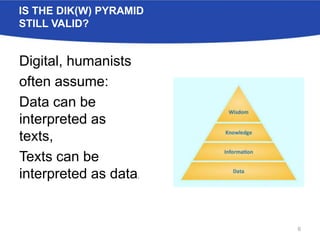
Digital, humanists
often assume:
Data can be
interpreted as
texts,
Texts can be
interpreted as data.
6
IS THE DIK(W) PYRAMID
STILL VALID?
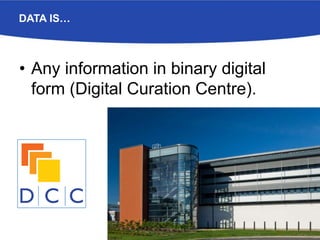
DATA IS…
• Any information in binary digital
form (Digital Curation Centre).
7
• Information literacy is related not only to
print, but data, images, etc. (CILIP, 2018).
← Documents, not born digital may
become digital at some point.
8
PRIMARY SOURCE DATA
• Humanities – unstructured data (from
archives and manuscripts),
• Social sciences – tabulated data (from
surveys, polls, census),
• Natural sciences – tabulated data (from
controlled studies) (Fontichiaro et al,
2017).
9
RESEARCH DATA
• More specific than ‘data’
= ‘data collected as part of a research
project’
• data collected for curation and
preservation, can become research data,
• research data is archived for curation and
preservation.
10
DATA LITERACY
= competences needed for any work with
research data (Schneider, 2013).
= the ability to process, sort and filter vast
quantities of information, for which
competences for searching, filtering,
processing, creation and synthesizing
information are needed (Koltay, 2015).
11
DATA LITERACY
• Is cognate to information literacy.
• Is compatible with the information literacy
focus of academic librarianship.
12
DATA LITERACY
• Focuses on data quality.
It involves elements of
• Statistical literacy,
• Numeracy,
• Data governance principles,
• Data science,
• and Open Data.
13
DATA LITERACY
Is relevant
• in the context of education and training (of
researchers, students, etc.)
• in the context of providing data services of
informational and/or technical nature (for
librarians and other providers, technical
staff, etc.)
14
DATA LITERACY
• Data literacy education’s main targets are
students.
• Librarians and teaching staff members
also should be data literate, but educating
the latter is a delicate issue.
15
FUNDAMENTAL TOPICS
• The concept of data,
• Critical thinking,
• Ethical issues,
• Research Data Management (RDM),
• Data quality
• Data citation
• Data visualization
• Metadata (Ridsdale et al., 2015).
16
OTHER IMPORTANT TOPICS
• Big data, little data, no data (Borgman,
2015).
• The existence of grey data (useful data,
produced by universities outside their
research realm, but not subjected to peer
review, similarly to grey literature
(Borgman, 2018).
17
INCLUDE FAIR PRINCIPLES
AND RDA
• Findable,
• Accessible,
• Interoperable,
• and Re-usable.
Mention the existence of Research Data
Alliance (https://rd-alliance.org/)
18
DATA GOVERNANCE
• Provides answers about the availability
and access possibilities, provenance,
trustworthiness and meaning.
Provenance as indicator of quality:
• Who generated it?
• Who funded the study where the data
come from?
• What was the research agenda?
(Koltay, 2016; Fontichiaro et al., 2017)
19
HOW TO TEACH DATA
LITERACY?
• Include mechanics related to research
data;
• Focus on practice;
• Use real world data, when appropriate
(Ridsdale et al. 2015).
20
THE SEQUENCE OF
SUPPORTING RESEARCHERS
1. Data literacy instruction,
2. Research Data Management,
3. Data curation,
4. Data preservation.
21
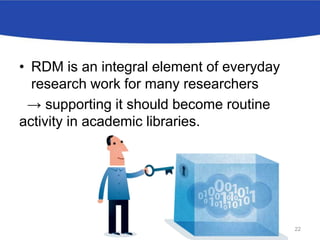
• RDM is an integral element of everyday
research work for many researchers
→ supporting it should become routine
activity in academic libraries.
22
RDM
• Academic libraries show varied levels of
readiness,
but they provide a wide array of
informational RDM services in many
countries =
• Informational services (with high
frequency),
• Technological/technical services (with
lower frequency).
23
INFORMATIONAL SERVICES
Consulting with staff and students
• On Data Management Plans,
• On metadata standards,
Providing
• reference support (for finding and citing)
datasets,
24
TECHNOLOGICAL SERVICES
• Creating or transforming metadata for
datasets,
• identifying datasets that could be
candidates for repositories,
• selecting and preparing datasets for
deposit,
• deaccessioning, or deselecting datasets.
25
DATA CURATION
Data curation is close to technological RDM
services
The encompassing work
and actions
taken by curators of a data repository
in order to provide meaningful and enduring
access to data (Johnston et al., 2018).
26
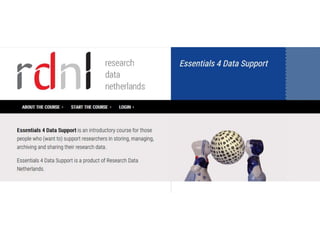
TARGET AUDIENCE
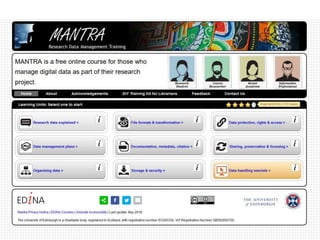
• Anyone wanting to support researchers in
storing, managing, archiving and sharing
research data
= a data supporter
= (data) librarians, IT staff and researchers
28
Acquiring the basic knowledge and skills
= essentials
that enable data supporters
to take the first steps towards supporting
researchers in storing, managing, archiving
and sharing their research data.
29
A DATA SUPPORTER
• Shows proactive attitude to improve data
services;
• Sees data and information services as part
of larger whole in which decisions are
made;
• Can handle questions efficiently and
knows when to address a dedicated
expert;
• Is cooperative.
30
UNDERSTANDS / KNOWS
• The structure of a data management
plans;
• The various ways to store, backup,
organize and document research data;
• Types of archives, data publication and
data citation;
• How to advise researchers in balancing
legislation and practice;
(Verbakel, & Grootveld, 2016).
31
32
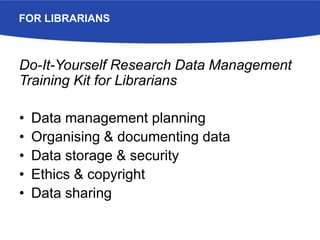
FOR LIBRARIANS
Do-It-Yourself Research Data Management
Training Kit for Librarians
• Data management planning
• Organising & documenting data
• Data storage & security
• Ethics & copyright
• Data sharing
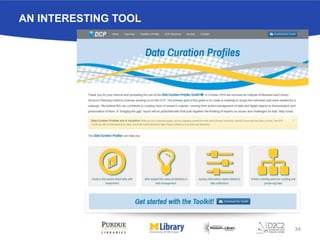
AN INTERESTING TOOL
34
DATA CURATION PROFILES
• Can be used to provide a foundational
base of information about a particular set
of data
• that may be curated by an academic
library or other institution (Carlson, 2010).
35
AN EXCERPT FROM A
PROFILE
Linguistics / Etymology
• Significant amount of data;
• Composed of videos, spreadsheets and a
finalized report captured in MS Word files;
• Lack the means of managing, curating and
sharing this data effectively.
36
GENERAL ADVISE
Ensure that researchers understand
• Libraries will be responsible stewards of
their information.
37
• They will not be taking ownership of the
material,
• Original owners will be able to access their
access content
• or take it out of library systems
• at any point and in-perpetuity
38
• Relieving researchers’ technical and
administrative burdens is a respectable
goal.
• Transcending this status by achieving true
collaboration with researchers, requires
focused and intensive work of library
managers, who must understand the
advantages of RDM
(Burton & Lyon, 2017, Koltay, 2019).
39
TELL TO ACADEMIC LIBRARIES
THAT THEY SHOULD…
• Fill gaps at all levels of professional skills
• Change librarians’ self-identification
• Gain an appreciation of technical and
socio-ethical issues related to research
data (Robinson & Bawden, 2017).
40
NOT ONLY FOR DATA
LIBRARIANS
• There is a clear need for teaching data
literacy to academic librarians (Koltay,
2017).
• At smaller institutions, there is a greater
need for diverse and generalized skills,
• Being data literate is a need for all future
academic librarians (Morrison & Weech,
2018).
41
LITERATURE
Borgman, C. L. (2015). Big data, little data, no data: Scholarship in the networked world. MIT press.
Borgman, C. L. (2018). Open Data, Grey Data, and Stewardship: Universities at the Privacy Frontier. Berkeley
Technology Law Journal, 3(2), 287-336.
Fontichiaro, K., Lennex, A., Hoff, T., Hovinga, K., & Oehrli, J. A. (Eds.). (2017). Data Literacy in the Real
World: Conversations & Case Studies. Michigan Publishing, University of Michigan Library.
Koltay, T. (2015). Data literacy: in search of a name and identity. Journal of Documentation, 71(2), 401–415.
Koltay, T. (2016). Data governance, data literacy and the management of data quality. IFLA Journal, 42
(4):303-312.
Koltay, T. (2017). Data literacy for researchers and data librarians. Journal of Librarianship and Information
Science, 49(1) 3–14.
Koltay, T. (2019). Accepted and emerging roles of academic libraries in supporting Research 2.0. Journal of
Academic Librarianship 45(2), 75-80.
Morrison, L. & Weech, T. (2018). Reading data: the missing literacy from LIS education. In: Lelde, Petrovska;
Baiba, Īvāne-Kronberga; Zane, Melde (eds.) The Power of Reading : Proceedings of the XXVI Bobcatsss
Symposium, Riga: University of Latvia, pp. 75-80.
Rice, R. (2014). Research Data MANTRA: A Labour of Love. Journal of eScience Librarianship 3(1): e1056.
Ridsdale Ch. et al. (2015). Strategies and best practices for data literacy education: Knowledge synthesis
report. Halifax, NS: Dalhousie University.
Robinson, L. and Bawden, D. (2017). 'The story of data': a socio-technical approach to education for the data
librarian role in the CityLIS library school at City, University of London. Library Management, 38 (6-7), 312-
322.
Schneider, R. (2013). Research data literacy. In Kurbanoglu, S. et al. (Eds.), Worldwide Commonalities and
Challenges in Information Literacy Research and Practice (pp. 134–140). Springer International.
Vilar, P., & Zabukovec, V. (2019). Research data management and research data literacy in Slovenian
science. Journal of Documentation, 75(1), 24-43,
42
Tibor Koltay
Professor
Eszterházy Károly
University
Email: koltay.tibor@uni-
eszterhazy.hu
Telephone: +36 7066687302
Twitter: @ktiborH

R2DaLT: thoughts about data literacy - Koltay

  • 1.
  • 2.
    CONTENTS • Research 2.0 •The changing view on data, • Data literacy, • The sequence of supporting researchers, • RDM, • Data curation, • Contents and courses, • Conclusion. 2
  • 3.
    RESEARCH 2.0 • Data-intensiveresearch • Open Science = Open Data = Open Access to scholarly publications Research 2.0 requires a high level of attention to data management and data curation, data citation and data quality (Vilar, & Zabukovec, 2019). 3
  • 4.
    ABUNDANCE OF DATA Sourceand consequence of Information overload → data overload 4
  • 5.
    NEW VIEWS ONDATA With its perceived importance, the views on data have changed. • Is data something different from information? 5
  • 6.
    Digital, humanists often assume: Datacan be interpreted as texts, Texts can be interpreted as data. 6 IS THE DIK(W) PYRAMID STILL VALID?
  • 7.
    DATA IS… • Anyinformation in binary digital form (Digital Curation Centre). 7
  • 8.
    • Information literacyis related not only to print, but data, images, etc. (CILIP, 2018). ← Documents, not born digital may become digital at some point. 8
  • 9.
    PRIMARY SOURCE DATA •Humanities – unstructured data (from archives and manuscripts), • Social sciences – tabulated data (from surveys, polls, census), • Natural sciences – tabulated data (from controlled studies) (Fontichiaro et al, 2017). 9
  • 10.
    RESEARCH DATA • Morespecific than ‘data’ = ‘data collected as part of a research project’ • data collected for curation and preservation, can become research data, • research data is archived for curation and preservation. 10
  • 11.
    DATA LITERACY = competencesneeded for any work with research data (Schneider, 2013). = the ability to process, sort and filter vast quantities of information, for which competences for searching, filtering, processing, creation and synthesizing information are needed (Koltay, 2015). 11
  • 12.
    DATA LITERACY • Iscognate to information literacy. • Is compatible with the information literacy focus of academic librarianship. 12
  • 13.
    DATA LITERACY • Focuseson data quality. It involves elements of • Statistical literacy, • Numeracy, • Data governance principles, • Data science, • and Open Data. 13
  • 14.
    DATA LITERACY Is relevant •in the context of education and training (of researchers, students, etc.) • in the context of providing data services of informational and/or technical nature (for librarians and other providers, technical staff, etc.) 14
  • 15.
    DATA LITERACY • Dataliteracy education’s main targets are students. • Librarians and teaching staff members also should be data literate, but educating the latter is a delicate issue. 15
  • 16.
    FUNDAMENTAL TOPICS • Theconcept of data, • Critical thinking, • Ethical issues, • Research Data Management (RDM), • Data quality • Data citation • Data visualization • Metadata (Ridsdale et al., 2015). 16
  • 17.
    OTHER IMPORTANT TOPICS •Big data, little data, no data (Borgman, 2015). • The existence of grey data (useful data, produced by universities outside their research realm, but not subjected to peer review, similarly to grey literature (Borgman, 2018). 17
  • 18.
    INCLUDE FAIR PRINCIPLES ANDRDA • Findable, • Accessible, • Interoperable, • and Re-usable. Mention the existence of Research Data Alliance (https://rd-alliance.org/) 18
  • 19.
    DATA GOVERNANCE • Providesanswers about the availability and access possibilities, provenance, trustworthiness and meaning. Provenance as indicator of quality: • Who generated it? • Who funded the study where the data come from? • What was the research agenda? (Koltay, 2016; Fontichiaro et al., 2017) 19
  • 20.
    HOW TO TEACHDATA LITERACY? • Include mechanics related to research data; • Focus on practice; • Use real world data, when appropriate (Ridsdale et al. 2015). 20
  • 21.
    THE SEQUENCE OF SUPPORTINGRESEARCHERS 1. Data literacy instruction, 2. Research Data Management, 3. Data curation, 4. Data preservation. 21
  • 22.
    • RDM isan integral element of everyday research work for many researchers → supporting it should become routine activity in academic libraries. 22
  • 23.
    RDM • Academic librariesshow varied levels of readiness, but they provide a wide array of informational RDM services in many countries = • Informational services (with high frequency), • Technological/technical services (with lower frequency). 23
  • 24.
    INFORMATIONAL SERVICES Consulting withstaff and students • On Data Management Plans, • On metadata standards, Providing • reference support (for finding and citing) datasets, 24
  • 25.
    TECHNOLOGICAL SERVICES • Creatingor transforming metadata for datasets, • identifying datasets that could be candidates for repositories, • selecting and preparing datasets for deposit, • deaccessioning, or deselecting datasets. 25
  • 26.
    DATA CURATION Data curationis close to technological RDM services The encompassing work and actions taken by curators of a data repository in order to provide meaningful and enduring access to data (Johnston et al., 2018). 26
  • 28.
    TARGET AUDIENCE • Anyonewanting to support researchers in storing, managing, archiving and sharing research data = a data supporter = (data) librarians, IT staff and researchers 28
  • 29.
    Acquiring the basicknowledge and skills = essentials that enable data supporters to take the first steps towards supporting researchers in storing, managing, archiving and sharing their research data. 29
  • 30.
    A DATA SUPPORTER •Shows proactive attitude to improve data services; • Sees data and information services as part of larger whole in which decisions are made; • Can handle questions efficiently and knows when to address a dedicated expert; • Is cooperative. 30
  • 31.
    UNDERSTANDS / KNOWS •The structure of a data management plans; • The various ways to store, backup, organize and document research data; • Types of archives, data publication and data citation; • How to advise researchers in balancing legislation and practice; (Verbakel, & Grootveld, 2016). 31
  • 32.
  • 33.
    FOR LIBRARIANS Do-It-Yourself ResearchData Management Training Kit for Librarians • Data management planning • Organising & documenting data • Data storage & security • Ethics & copyright • Data sharing
  • 34.
  • 35.
    DATA CURATION PROFILES •Can be used to provide a foundational base of information about a particular set of data • that may be curated by an academic library or other institution (Carlson, 2010). 35
  • 36.
    AN EXCERPT FROMA PROFILE Linguistics / Etymology • Significant amount of data; • Composed of videos, spreadsheets and a finalized report captured in MS Word files; • Lack the means of managing, curating and sharing this data effectively. 36
  • 37.
    GENERAL ADVISE Ensure thatresearchers understand • Libraries will be responsible stewards of their information. 37
  • 38.
    • They willnot be taking ownership of the material, • Original owners will be able to access their access content • or take it out of library systems • at any point and in-perpetuity 38
  • 39.
    • Relieving researchers’technical and administrative burdens is a respectable goal. • Transcending this status by achieving true collaboration with researchers, requires focused and intensive work of library managers, who must understand the advantages of RDM (Burton & Lyon, 2017, Koltay, 2019). 39
  • 40.
    TELL TO ACADEMICLIBRARIES THAT THEY SHOULD… • Fill gaps at all levels of professional skills • Change librarians’ self-identification • Gain an appreciation of technical and socio-ethical issues related to research data (Robinson & Bawden, 2017). 40
  • 41.
    NOT ONLY FORDATA LIBRARIANS • There is a clear need for teaching data literacy to academic librarians (Koltay, 2017). • At smaller institutions, there is a greater need for diverse and generalized skills, • Being data literate is a need for all future academic librarians (Morrison & Weech, 2018). 41
  • 42.
    LITERATURE Borgman, C. L.(2015). Big data, little data, no data: Scholarship in the networked world. MIT press. Borgman, C. L. (2018). Open Data, Grey Data, and Stewardship: Universities at the Privacy Frontier. Berkeley Technology Law Journal, 3(2), 287-336. Fontichiaro, K., Lennex, A., Hoff, T., Hovinga, K., & Oehrli, J. A. (Eds.). (2017). Data Literacy in the Real World: Conversations & Case Studies. Michigan Publishing, University of Michigan Library. Koltay, T. (2015). Data literacy: in search of a name and identity. Journal of Documentation, 71(2), 401–415. Koltay, T. (2016). Data governance, data literacy and the management of data quality. IFLA Journal, 42 (4):303-312. Koltay, T. (2017). Data literacy for researchers and data librarians. Journal of Librarianship and Information Science, 49(1) 3–14. Koltay, T. (2019). Accepted and emerging roles of academic libraries in supporting Research 2.0. Journal of Academic Librarianship 45(2), 75-80. Morrison, L. & Weech, T. (2018). Reading data: the missing literacy from LIS education. In: Lelde, Petrovska; Baiba, Īvāne-Kronberga; Zane, Melde (eds.) The Power of Reading : Proceedings of the XXVI Bobcatsss Symposium, Riga: University of Latvia, pp. 75-80. Rice, R. (2014). Research Data MANTRA: A Labour of Love. Journal of eScience Librarianship 3(1): e1056. Ridsdale Ch. et al. (2015). Strategies and best practices for data literacy education: Knowledge synthesis report. Halifax, NS: Dalhousie University. Robinson, L. and Bawden, D. (2017). 'The story of data': a socio-technical approach to education for the data librarian role in the CityLIS library school at City, University of London. Library Management, 38 (6-7), 312- 322. Schneider, R. (2013). Research data literacy. In Kurbanoglu, S. et al. (Eds.), Worldwide Commonalities and Challenges in Information Literacy Research and Practice (pp. 134–140). Springer International. Vilar, P., & Zabukovec, V. (2019). Research data management and research data literacy in Slovenian science. Journal of Documentation, 75(1), 24-43, 42
  • 43.
    Tibor Koltay Professor Eszterházy Károly University Email:koltay.tibor@uni- eszterhazy.hu Telephone: +36 7066687302 Twitter: @ktiborH

Editor's Notes

  • #44 By Barry Mangham [CC BY-SA 3.0 (https://creativecommons.org/licenses/by-sa/3.0) or GFDL (http://www.gnu.org/copyleft/fdl.html)], from Wikimedia Commons