IFLA Warsaw • 16 – 17August 2017
New Data, Same Skills:
Applying Core Principles to New Needs in Data Curation
Lynn Silipigni Connaway, PhD
Senior Research Scientist & Director of User Research, OCLC
connawal@oclc.org
@LynnConnaway
• Data curation involves different stakeholders
• Data governance & framework
• Critical factors in data governance
• Business objectives
• LIS objectives
• Data life-cycle
Data Curation
Data Curation & Roles
• Data management objects can be text, numbers,
images, video, audio, software, algorithms,
reports, models & other forms
• Data management = all activities that related to
maintaining, preserving, & adding value during
lifecycle of digital data
• Emphasis on adding value for reuse of data
ROLES OF DATA CURATORS
Lewis (2010) proposed possible areas for library
involvement with RDM
• Influence national data policy
• Lead on local (institutional) data policy
• Develop local data curation capacity
• Identify required data skills with LIS schools
• Bring data into UG research-based training
• Teach data literacy to postgraduate students
• Develop LIS workforce data confidence
• Provide researcher data advice
• Develop researcher data awareness
Roles and responsibilities of RDM librarians
• Provide researcher data advice
• Teach data literacy
• Develop researcher data awareness
• Support local data curation
• Embedded in R&D data flow & related to data life-cycle
• Includes
• R&D management & data utilization perspectives
(Koltay 2015, Hagen-MacIntosh 2016 and Carlson & Johnston 2016)
• Practical skills such as data analysis, description
& tools
Data Literacy
Successful librarians can strengthen or develop
present roles in the following areas:
• Assessment
• Education
• Curation
• Environment
Challenges
• Difficult to get engagement from senior managers who may
not see the importance of DRM
• Difficult to maintain levels of funding required to run services without
engagement from senior management
• Critical to include activities that link to university strategies &
funder policies (Bellanger et al., 2017)
• Maintain balance of services – do not skew towards those
researchers who speak the loudest
DATA REUSE
Key Barriers
• Low levels of user trust in information resources of every kind
(Yoon, 2016; Yoon, 2017; Carlson & Anderson, 2007)
• Current models, especially those emphasizing metadata quality
over primary data quality, may not be as effective as initially
expected
• Repositories are clearinghouses, not archives
• Preservation for reusability is not enough
Key Barriers
• Primary user groups are not known data creators but unknown data
reusers
• Approach effectively returns data librarianship to Ranganathan’s view:
information resources of all kinds are for use
• Research data are for reuse
• Every reuser his/her data
• Every dataset its reuser
• If data are not reused, then data curators must redouble their efforts to
connect data with actual reusers
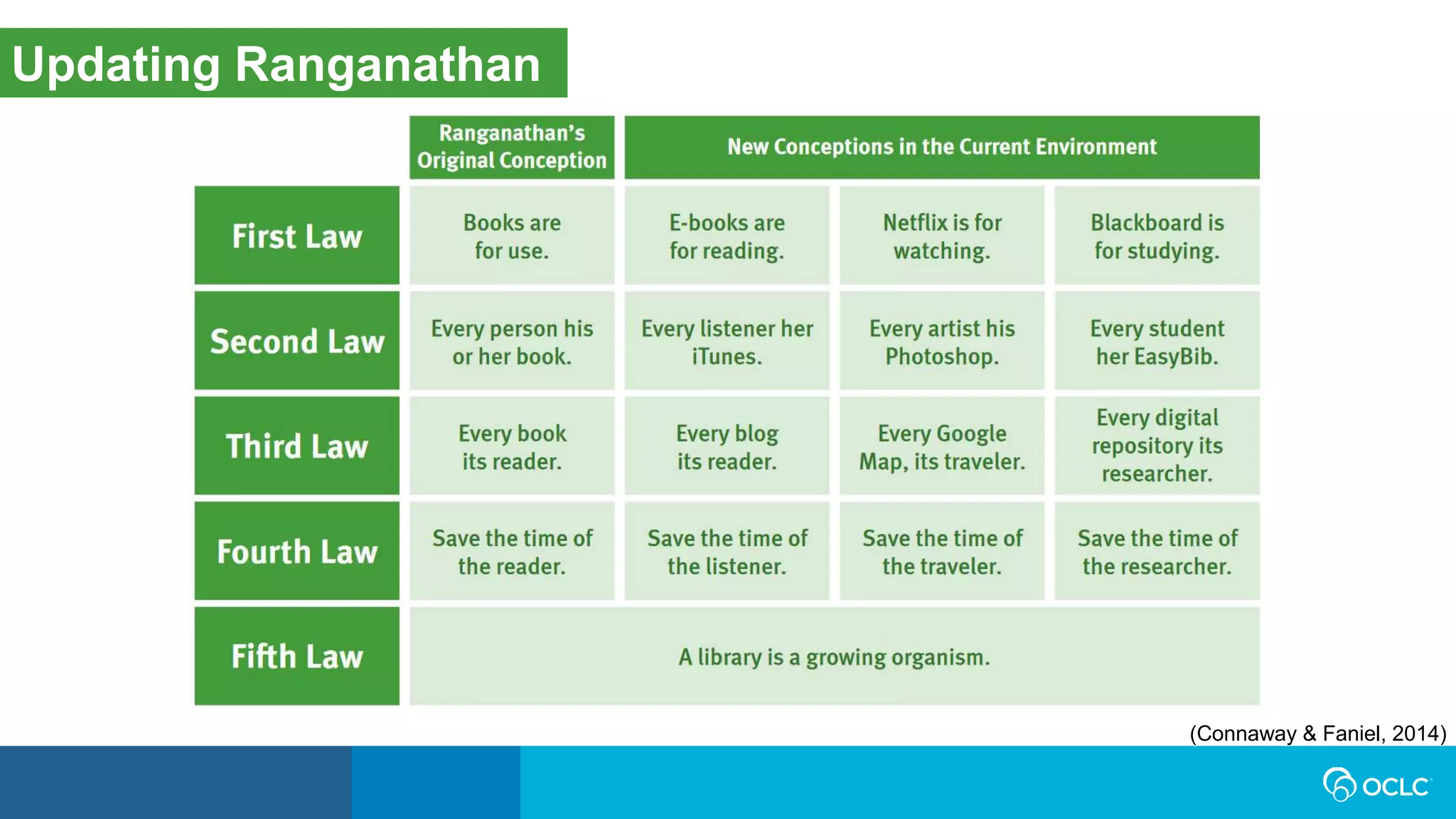
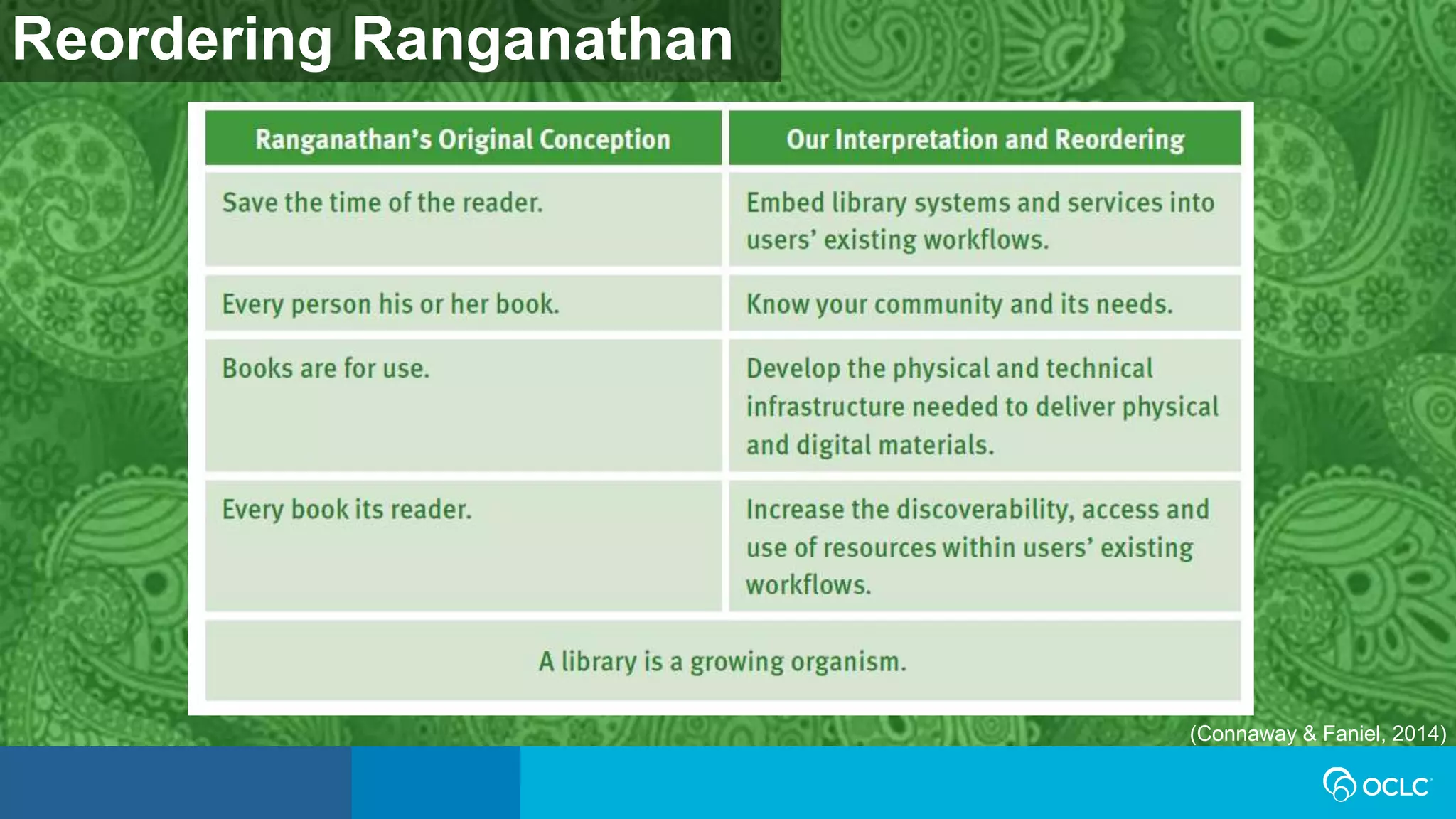
• Ranganathan’s third law: Find reusers for your data
(Connaway & Faniel, 2014)
Updating Ranganathan
Increase the discoverability, access and
use of resources within users’ existing
workflows.
(Connaway and Faniel, 2014, p. 74)
Updating Ranganathan
Reuser-centric Framework
• Integrate repository ingest into development of data reuse plans
• Build data literacy programs around an institutional repository
service
• Integrate data curation training into communities of practice
• Promote reuse from the beginning of research cycle
• Build research data models with
• designated reuses
• specific reuse communities in mind
TECHNOLOGY & TRAINING
EDUCATION & TRAINING
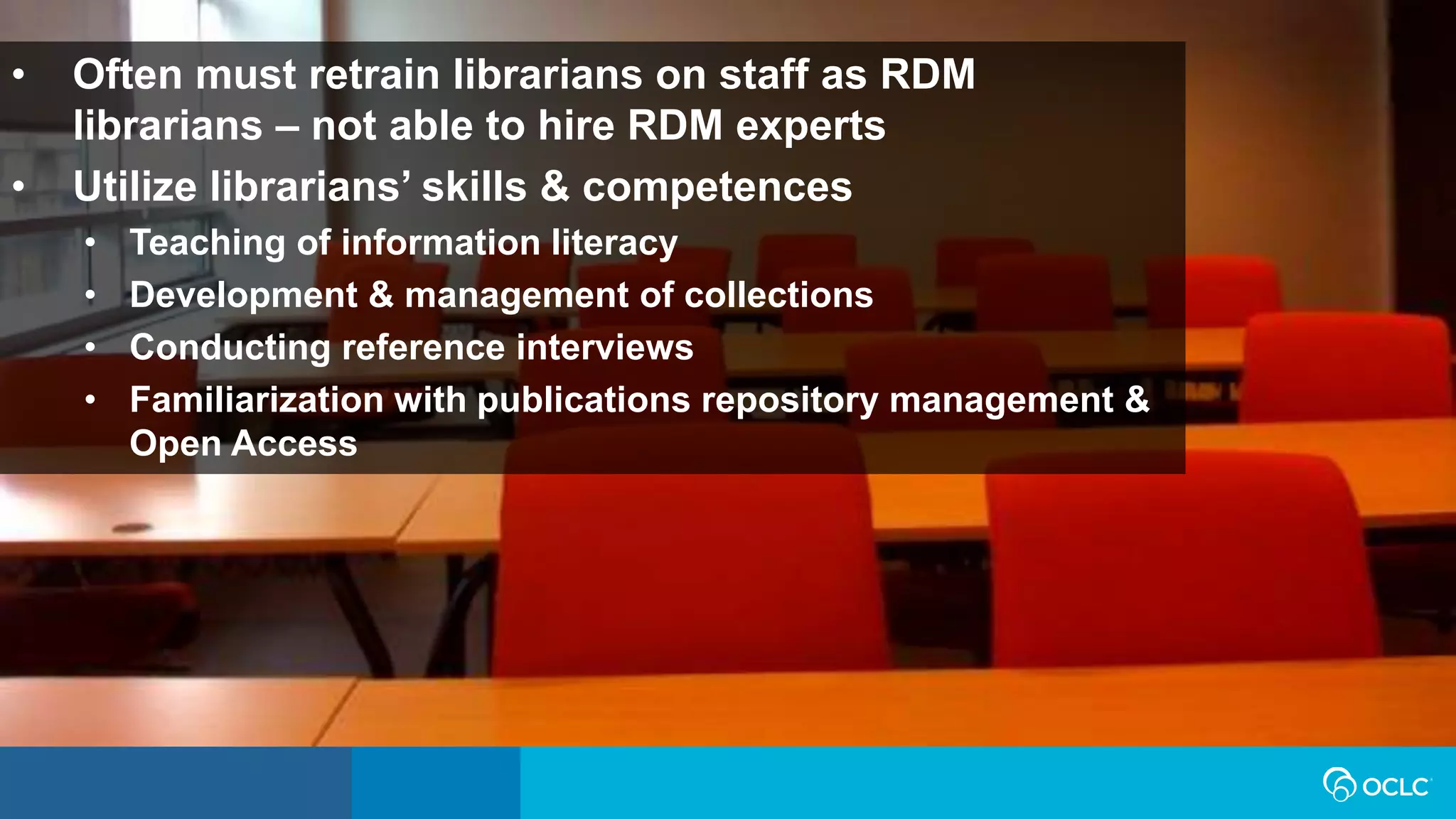
• Often must retrain librarians on staff as RDM
librarians – not able to hire RDM experts
• Utilize librarians’ skills & competences
• Teaching of information literacy
• Development & management of collections
• Conducting reference interviews
• Familiarization with publications repository management &
Open Access
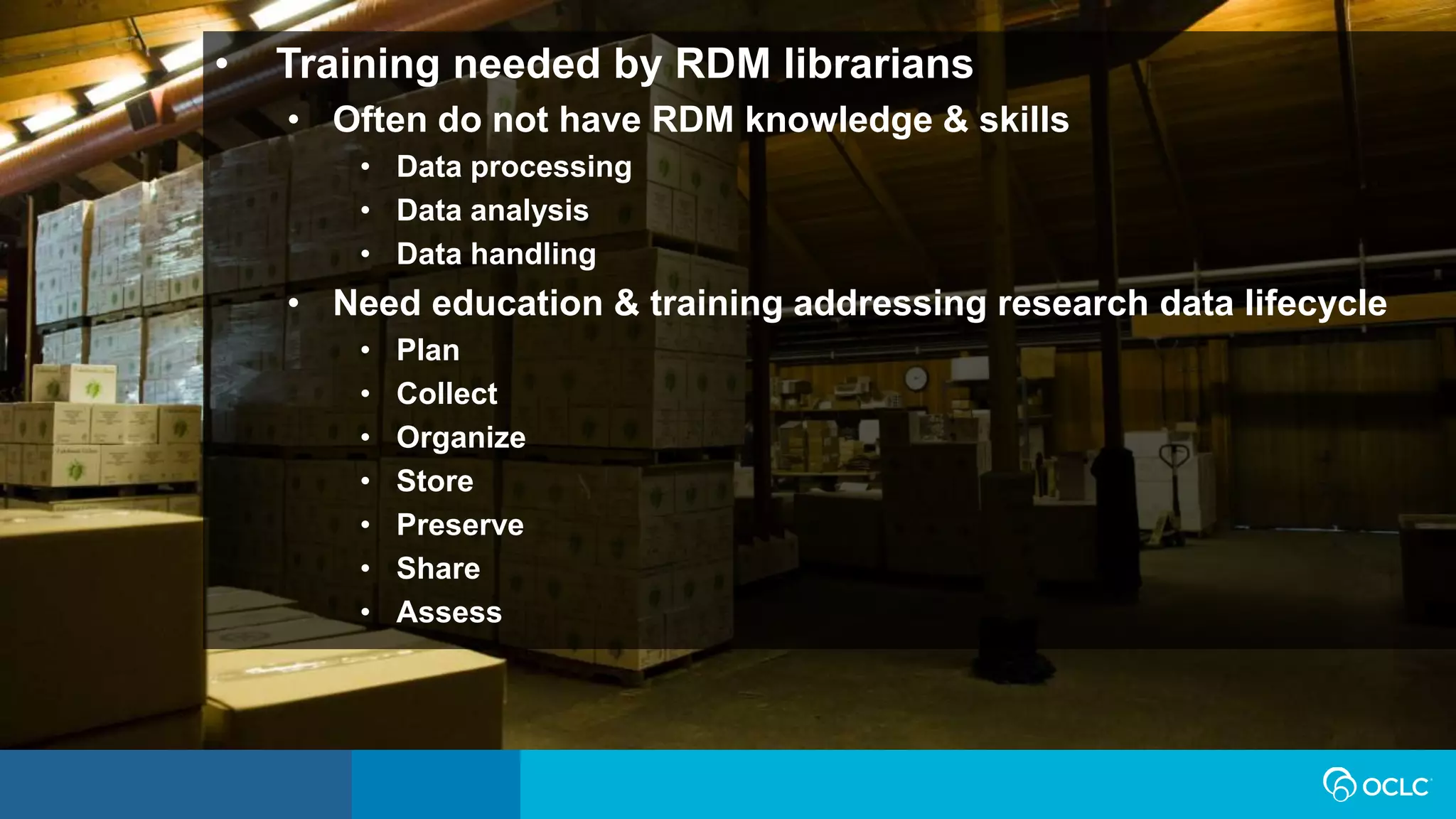
• Training needed by RDM librarians
• Often do not have RDM knowledge & skills
• Data processing
• Data analysis
• Data handling
• Need education & training addressing research data lifecycle
• Plan
• Collect
• Organize
• Store
• Preserve
• Share
• Assess
• Key areas for RDM librarian development
• Develop protocols & infrastructures for description, discovery,
retrieval, & citation of research data
• Simplify compliance regulations & articulate rationale
• Adapt archival practices for data “at rest”
• Assess & identify trustworthy repositories
• Review & propose institutional policies
• Apply data mining & analytics to demonstrate evidence of
faculty productivity, research impact, trends & rankings
REPOSITORY PLATFORMS
• Most platforms designed to work with common use cases
& do not fully address the needs of research data
• Data modelling requirements often complex & difficult to
represent in traditional folder hierarchies
• Diverse & sometimes proprietary file formats not always
supported
• Metadata presents a major obstacle
• Diversity across disciplines difficult to consolidate in single
system
CONCLUSIONS &
RECOMMENDATIONS
Conclusions
• Lack of policy, unclear responsibilities, mismatch in quality &
demand of staff’s data literacy, & lack of professional education
• Stakeholders not fully engaged in data curation
• Need framework to establish clear organizational structure &
division of responsibilities, & clarify relationships between
stakeholders
• More emphasis on data reutilization in the field of data curation
• Universities expected to demonstrate accountability
• Academic librarians can be critical players
• Librarians should be integral to the academy to leverage
its knowledge assets & empower its community
• Results will create relationships not only across
academy, but with public & private sectors
• Collaborative innovation & governance will strengthen
university’s research infrastructure
Conclusions
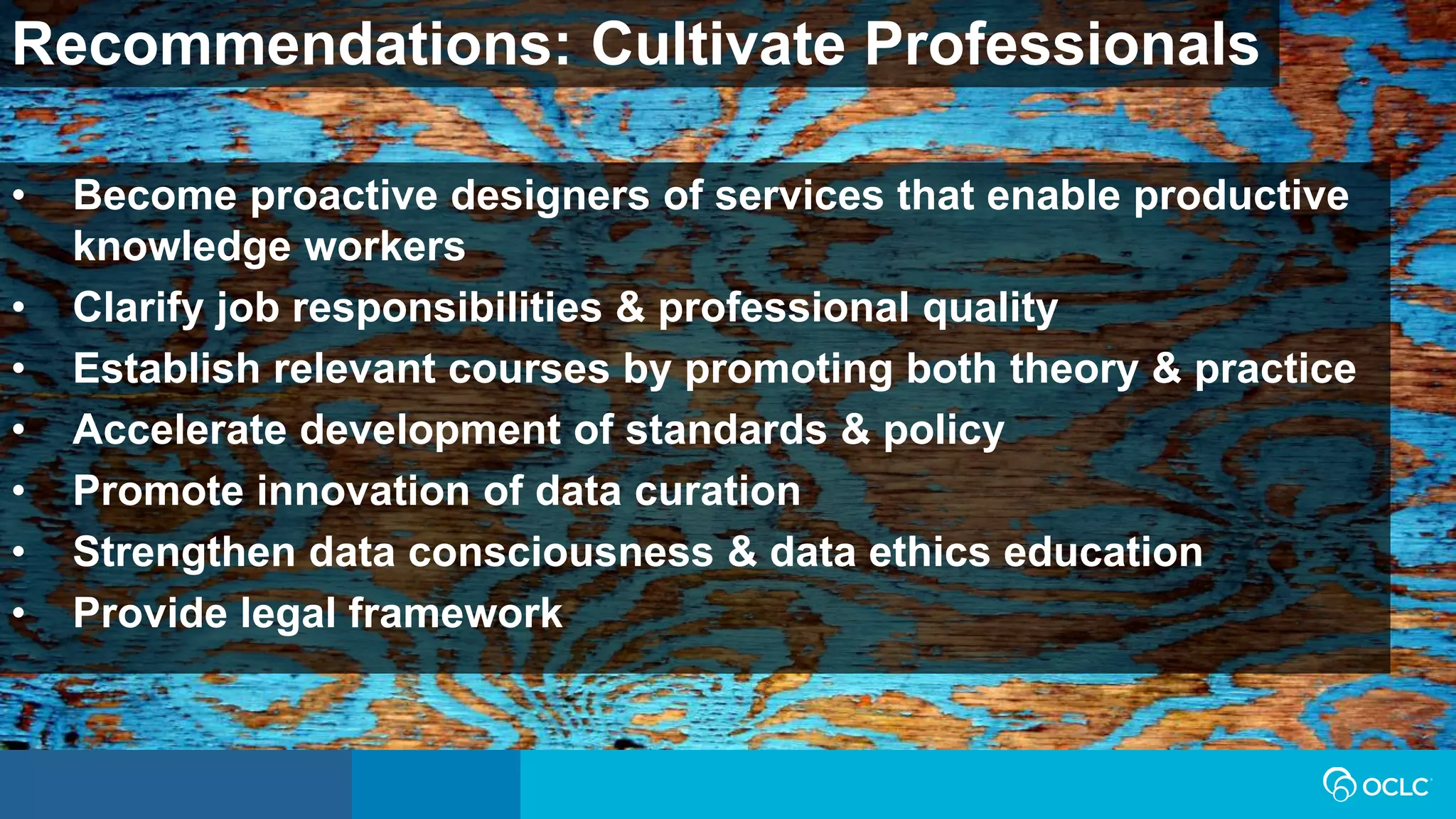
Recommendations: Cultivate Professionals
• Become proactive designers of services that enable productive
knowledge workers
• Clarify job responsibilities & professional quality
• Establish relevant courses by promoting both theory & practice
• Accelerate development of standards & policy
• Promote innovation of data curation
• Strengthen data consciousness & data ethics education
• Provide legal framework
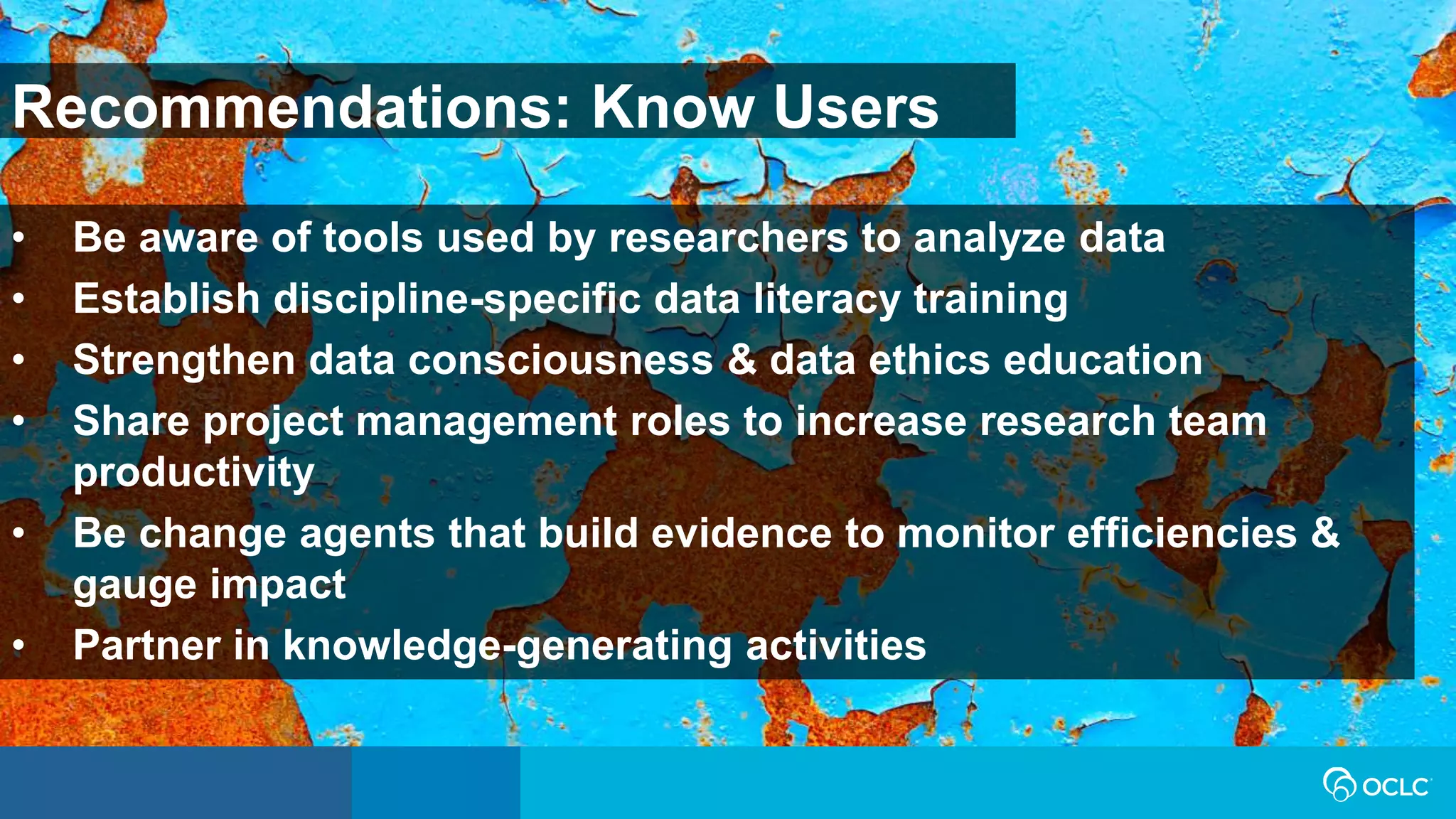
• Be aware of tools used by researchers to analyze data
• Establish discipline-specific data literacy training
• Strengthen data consciousness & data ethics education
• Share project management roles to increase research team
productivity
• Be change agents that build evidence to monitor efficiencies &
gauge impact
• Partner in knowledge-generating activities
Recommendations: Know Users
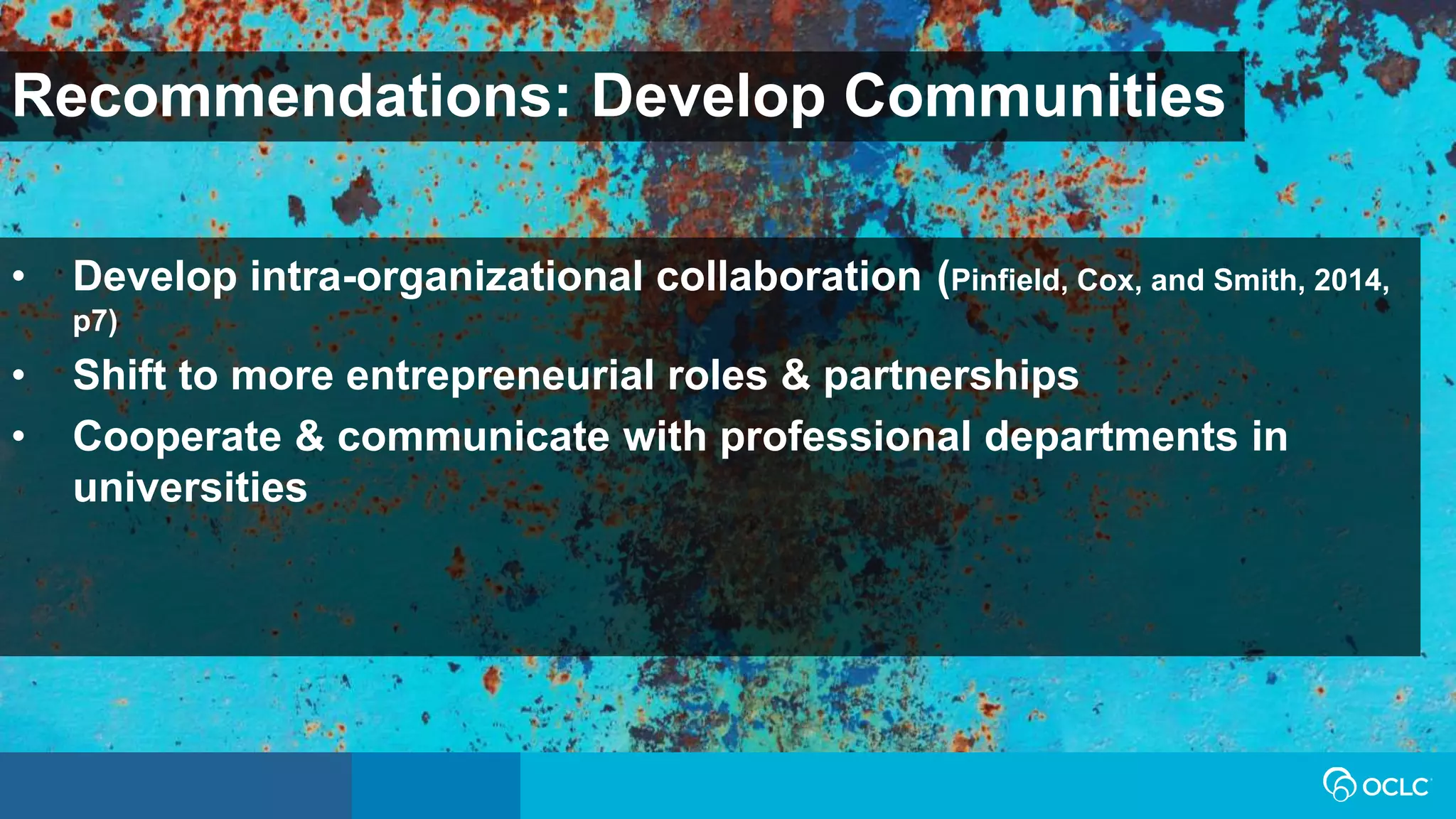
Recommendations: Develop Communities
• Develop intra-organizational collaboration (Pinfield, Cox, and Smith, 2014,
p7)
• Shift to more entrepreneurial roles & partnerships
• Cooperate & communicate with professional departments in
universities
Reordering Ranganathan
(Connaway & Faniel, 2014)
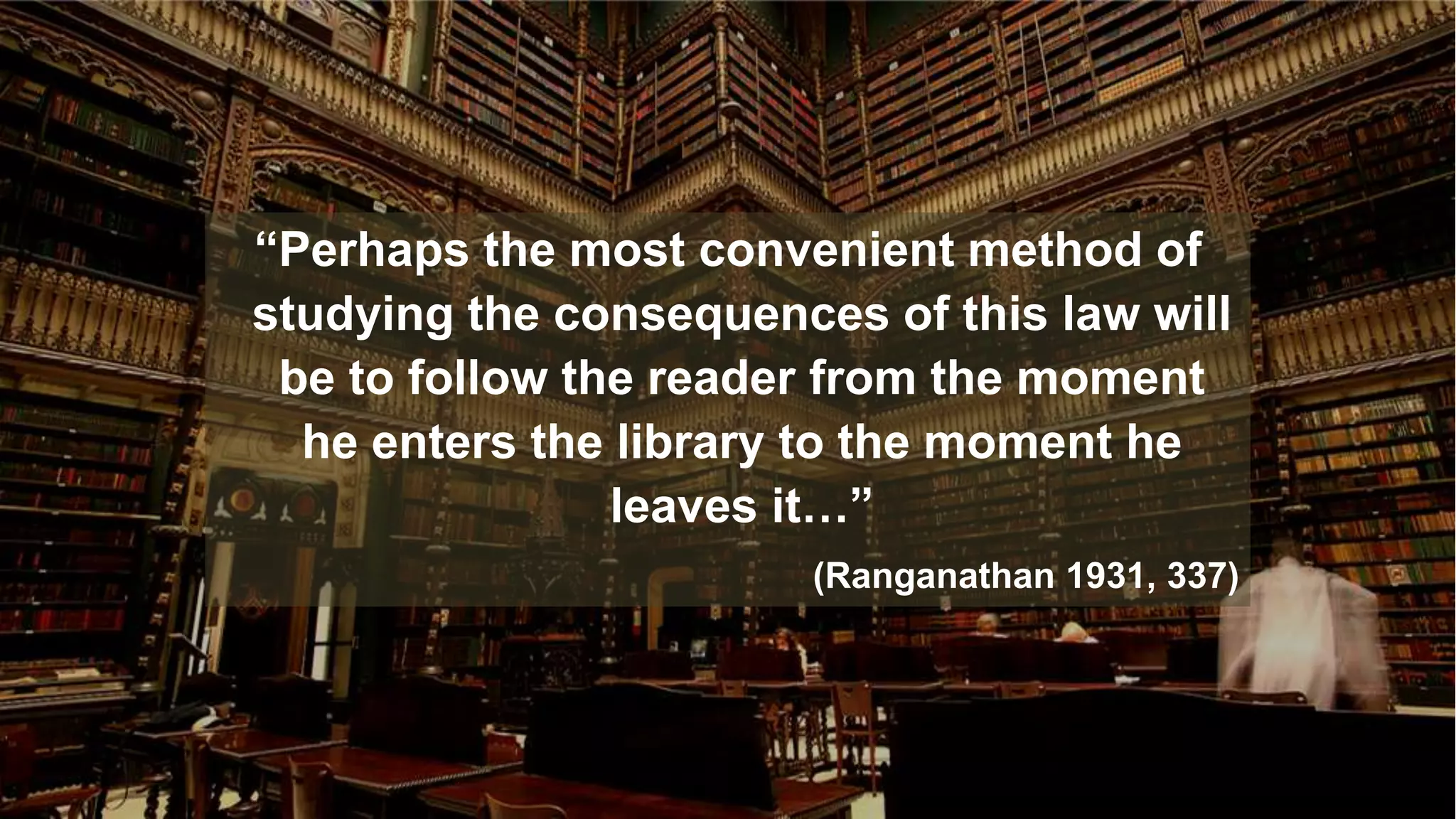
“Perhaps the most convenient method of
studying the consequences of this law will
be to follow the reader from the moment
he enters the library to the moment he
leaves it…”
(Ranganathan 1931, 337)
References
Bellanger, S., Higman, R., Imker, H., Jones, B., Lyon, L., Stokes, P., Teperek, M., Verdicchio, D.
(2017). Strategies for engaging senior leadership with RDM – IDCC discussion.
https://unlockingresearch.blog.lib.cam.ac.uk/?p=1435 (accessed 26th May 2017).
Carlson, J, Johnston, L.(2015). Data information literacy: Librarians, data, and the education of a
new generation of researchers. Purdue Information Literacy Handbooks. West Lafayette, Indiana:
Purdue University Press.
Carlson, S. & Anderson, B. (2007). What are data? The many kinds of data and their implications
for data re‐use. Journal of Computer‐Mediated Communication, 12(2), 635-651.
Connaway, Lynn Silipigni, and Ixchel M. Faniel. 2014. Reordering Ranganathan: Shifting user
behaviors, shifting priorities. Dublin, OH: OCLC Research.
http://www.oclc.org/content/dam/research/publications/library/2014/oclcresearch-reordering-
ranganathan-2014.pdf.
Hagen-McIntosh, J. (2016). Information and data literacy: The role of the library. Oakville, ON,
Canada Waretown, NJ, USA: Apple Academic Press.
References
Koltay, T. (2015). Data Literacy: In Search of a Name and Identity. Journal of Documentation, 71(2):
401–415.
Lewis, M.J. (2010) Libraries and the management of research data. In: McKnight, S, (ed.)
Envisioning Future Academic Library Services. Facet Publishing , London , pp. 145-168.
Pinfield, S., Cox, A.M., & Smith, J. (2014). Research data management and libraries: Relationships,
activities, drivers and influences. PLOS ONE.
https://doi.org/10.1371/journal.pone.0114734 (accessed 16th August 2017).
Yoon, A. (2016). Red flags in data: Learning from failed data reuse experiences. Proceedings of the
Association for Information Science and Technology, 53(1), 1-6.
Yoon, A. (2017). Data reusers & trust development. Journal of the Association for Information
Science and Technology, 68(4), 946-956.
Image Attributions
Slide 2: Image: https://www.flickr.com/photos/danielmennerich/11307423964 by Daniel Mennerich / CC BY-NC-ND
2.0
Slide 3: Image: https://www.flickr.com/photos/glassholic/14937736275 by Etienne / CC BY-NC-ND 2.0
Slide 5: Image: https://www.flickr.com/photos/tekkbabe859/22284423998/ by Vicki Timman / CC BY-ND 2.0
Slide 6: Image: https://www.flickr.com/photos/xmex/12699925114 by XoMEoX / CC BY 2.0
Slide 7: Image: https://www.flickr.com/photos/filterforge/8631518108 by Filter Forge / CC BY 2.0
Slide 8: Image: https://www.flickr.com/photos/tassieeye/8316658218/ by TassieEye / CC BY-NC-ND 2.0
Slide 9: Image: https://www.flickr.com/photos/thedimka/4913283926 by Dimka / CC BY 2.0
Slide 11: Image: https://www.flickr.com/photos/glassholic/18419160379 by Etienne / CC BY-NC-ND 2.0
Slide 12: Image: https://www.flickr.com/photos/60352852@N05/11026507975 by Stéphane Toumayan (ToumaŸ) /
CC BY-NC-ND 2.0
Slide 14: Image: https://www.flickr.com/photos/joaquinmurillo/7146686083 by JOAQUIN MURILLO / CC BY-NC-ND
2.0
Slide 15: Image: https://www.flickr.com/photos/your_teacher/1193129945 by Lynne Hand / CC BY-NC-ND 2.0
Slide 18: Image: https://www.flickr.com/photos/jakecaptive/2924964056/ by Jacob Bøtter / CC BY 2.0
Image Attributions
Slide 19: Image: https://www.flickr.com/photos/johnjoh/2609425747/ by star5112 / CC BY-SA 2.0
Slide 20: Image: https://www.flickr.com/photos/katzarella/3663583382/ by Gisella Klein / CC BY-NC 2.0
Slide 22: Image: https://www.flickr.com/photos/75487768@N04/12010562175/ by barnyz / CC BY-NC-ND 2.0
Slide 23: Image: https://www.flickr.com/photos/travelbusy/7951240982/ by Travelbusy.com / CC BY 2.0
Slide 25: Image: https://www.flickr.com/photos/arselectronica/35671263330/ by Ars Electronica / CC BY-NC-ND 2.0
Slide 28: Image: https://www.flickr.com/photos/andymag/12747836764 by Andy Maguire / CC BY 2.0
Slide 29: Image: https://www.flickr.com/photos/krisursachi/13744504423/ by Kris Ursachi / CC BY-NC-ND 2.0
Slide 30: Image: https://www.flickr.com/photos/anneliekeb/12224687966/ by Annelieke B / CC BY-SA 2.0
Slide 31: Image: https://www.flickr.com/photos/brentleimenstoll/8404903857/ by Brent Leimenstoll / CC BY 2.0
Slide 32: Image: https://www.flickr.com/photos/glassholic/33633807492 by Etienne / CC BY-NC-ND 2.0
Slide 34: Image: http://www.flickr.com/photos/mathieustruck/6551303327/ by Mathieu Bertrand Struck / CC BY-NC-
ND 2.0
ACKNOWLEDGEMENTS
I would like to thank Brittany Brannon and Erin M. Hood
for their assistance in preparing this presentation.
Questions &
Discussion
Lynn Silipigni Connaway, PhD
Senior Research Scientist & Director of User
Research
connawal@oclc.org
@LynnConnaway

New Data, Same Skills: Applying Core Principles to New Needs in Data Curation

  • 1.
    IFLA Warsaw •16 – 17August 2017 New Data, Same Skills: Applying Core Principles to New Needs in Data Curation Lynn Silipigni Connaway, PhD Senior Research Scientist & Director of User Research, OCLC connawal@oclc.org @LynnConnaway
  • 2.
    • Data curationinvolves different stakeholders • Data governance & framework • Critical factors in data governance • Business objectives • LIS objectives • Data life-cycle Data Curation
  • 3.
    Data Curation &Roles • Data management objects can be text, numbers, images, video, audio, software, algorithms, reports, models & other forms • Data management = all activities that related to maintaining, preserving, & adding value during lifecycle of digital data • Emphasis on adding value for reuse of data
  • 4.
    ROLES OF DATACURATORS
  • 5.
    Lewis (2010) proposedpossible areas for library involvement with RDM • Influence national data policy • Lead on local (institutional) data policy • Develop local data curation capacity • Identify required data skills with LIS schools • Bring data into UG research-based training • Teach data literacy to postgraduate students • Develop LIS workforce data confidence • Provide researcher data advice • Develop researcher data awareness
  • 6.
    Roles and responsibilitiesof RDM librarians • Provide researcher data advice • Teach data literacy • Develop researcher data awareness • Support local data curation
  • 7.
    • Embedded inR&D data flow & related to data life-cycle • Includes • R&D management & data utilization perspectives (Koltay 2015, Hagen-MacIntosh 2016 and Carlson & Johnston 2016) • Practical skills such as data analysis, description & tools Data Literacy
  • 8.
    Successful librarians canstrengthen or develop present roles in the following areas: • Assessment • Education • Curation • Environment
  • 9.
    Challenges • Difficult toget engagement from senior managers who may not see the importance of DRM • Difficult to maintain levels of funding required to run services without engagement from senior management • Critical to include activities that link to university strategies & funder policies (Bellanger et al., 2017) • Maintain balance of services – do not skew towards those researchers who speak the loudest
  • 10.
  • 11.
    Key Barriers • Lowlevels of user trust in information resources of every kind (Yoon, 2016; Yoon, 2017; Carlson & Anderson, 2007) • Current models, especially those emphasizing metadata quality over primary data quality, may not be as effective as initially expected • Repositories are clearinghouses, not archives • Preservation for reusability is not enough
  • 12.
    Key Barriers • Primaryuser groups are not known data creators but unknown data reusers • Approach effectively returns data librarianship to Ranganathan’s view: information resources of all kinds are for use • Research data are for reuse • Every reuser his/her data • Every dataset its reuser • If data are not reused, then data curators must redouble their efforts to connect data with actual reusers • Ranganathan’s third law: Find reusers for your data
  • 13.
    (Connaway & Faniel,2014) Updating Ranganathan
  • 14.
    Increase the discoverability,access and use of resources within users’ existing workflows. (Connaway and Faniel, 2014, p. 74) Updating Ranganathan
  • 15.
    Reuser-centric Framework • Integraterepository ingest into development of data reuse plans • Build data literacy programs around an institutional repository service • Integrate data curation training into communities of practice • Promote reuse from the beginning of research cycle • Build research data models with • designated reuses • specific reuse communities in mind
  • 16.
  • 17.
  • 18.
    • Often mustretrain librarians on staff as RDM librarians – not able to hire RDM experts • Utilize librarians’ skills & competences • Teaching of information literacy • Development & management of collections • Conducting reference interviews • Familiarization with publications repository management & Open Access
  • 19.
    • Training neededby RDM librarians • Often do not have RDM knowledge & skills • Data processing • Data analysis • Data handling • Need education & training addressing research data lifecycle • Plan • Collect • Organize • Store • Preserve • Share • Assess
  • 20.
    • Key areasfor RDM librarian development • Develop protocols & infrastructures for description, discovery, retrieval, & citation of research data • Simplify compliance regulations & articulate rationale • Adapt archival practices for data “at rest” • Assess & identify trustworthy repositories • Review & propose institutional policies • Apply data mining & analytics to demonstrate evidence of faculty productivity, research impact, trends & rankings
  • 21.
  • 22.
    • Most platformsdesigned to work with common use cases & do not fully address the needs of research data • Data modelling requirements often complex & difficult to represent in traditional folder hierarchies • Diverse & sometimes proprietary file formats not always supported • Metadata presents a major obstacle • Diversity across disciplines difficult to consolidate in single system
  • 23.
  • 24.
    Conclusions • Lack ofpolicy, unclear responsibilities, mismatch in quality & demand of staff’s data literacy, & lack of professional education • Stakeholders not fully engaged in data curation • Need framework to establish clear organizational structure & division of responsibilities, & clarify relationships between stakeholders • More emphasis on data reutilization in the field of data curation
  • 25.
    • Universities expectedto demonstrate accountability • Academic librarians can be critical players • Librarians should be integral to the academy to leverage its knowledge assets & empower its community • Results will create relationships not only across academy, but with public & private sectors • Collaborative innovation & governance will strengthen university’s research infrastructure Conclusions
  • 26.
    Recommendations: Cultivate Professionals •Become proactive designers of services that enable productive knowledge workers • Clarify job responsibilities & professional quality • Establish relevant courses by promoting both theory & practice • Accelerate development of standards & policy • Promote innovation of data curation • Strengthen data consciousness & data ethics education • Provide legal framework
  • 27.
    • Be awareof tools used by researchers to analyze data • Establish discipline-specific data literacy training • Strengthen data consciousness & data ethics education • Share project management roles to increase research team productivity • Be change agents that build evidence to monitor efficiencies & gauge impact • Partner in knowledge-generating activities Recommendations: Know Users
  • 28.
    Recommendations: Develop Communities •Develop intra-organizational collaboration (Pinfield, Cox, and Smith, 2014, p7) • Shift to more entrepreneurial roles & partnerships • Cooperate & communicate with professional departments in universities
  • 29.
  • 30.
    “Perhaps the mostconvenient method of studying the consequences of this law will be to follow the reader from the moment he enters the library to the moment he leaves it…” (Ranganathan 1931, 337)
  • 31.
    References Bellanger, S., Higman,R., Imker, H., Jones, B., Lyon, L., Stokes, P., Teperek, M., Verdicchio, D. (2017). Strategies for engaging senior leadership with RDM – IDCC discussion. https://unlockingresearch.blog.lib.cam.ac.uk/?p=1435 (accessed 26th May 2017). Carlson, J, Johnston, L.(2015). Data information literacy: Librarians, data, and the education of a new generation of researchers. Purdue Information Literacy Handbooks. West Lafayette, Indiana: Purdue University Press. Carlson, S. & Anderson, B. (2007). What are data? The many kinds of data and their implications for data re‐use. Journal of Computer‐Mediated Communication, 12(2), 635-651. Connaway, Lynn Silipigni, and Ixchel M. Faniel. 2014. Reordering Ranganathan: Shifting user behaviors, shifting priorities. Dublin, OH: OCLC Research. http://www.oclc.org/content/dam/research/publications/library/2014/oclcresearch-reordering- ranganathan-2014.pdf. Hagen-McIntosh, J. (2016). Information and data literacy: The role of the library. Oakville, ON, Canada Waretown, NJ, USA: Apple Academic Press.
  • 32.
    References Koltay, T. (2015).Data Literacy: In Search of a Name and Identity. Journal of Documentation, 71(2): 401–415. Lewis, M.J. (2010) Libraries and the management of research data. In: McKnight, S, (ed.) Envisioning Future Academic Library Services. Facet Publishing , London , pp. 145-168. Pinfield, S., Cox, A.M., & Smith, J. (2014). Research data management and libraries: Relationships, activities, drivers and influences. PLOS ONE. https://doi.org/10.1371/journal.pone.0114734 (accessed 16th August 2017). Yoon, A. (2016). Red flags in data: Learning from failed data reuse experiences. Proceedings of the Association for Information Science and Technology, 53(1), 1-6. Yoon, A. (2017). Data reusers & trust development. Journal of the Association for Information Science and Technology, 68(4), 946-956.
  • 33.
    Image Attributions Slide 2:Image: https://www.flickr.com/photos/danielmennerich/11307423964 by Daniel Mennerich / CC BY-NC-ND 2.0 Slide 3: Image: https://www.flickr.com/photos/glassholic/14937736275 by Etienne / CC BY-NC-ND 2.0 Slide 5: Image: https://www.flickr.com/photos/tekkbabe859/22284423998/ by Vicki Timman / CC BY-ND 2.0 Slide 6: Image: https://www.flickr.com/photos/xmex/12699925114 by XoMEoX / CC BY 2.0 Slide 7: Image: https://www.flickr.com/photos/filterforge/8631518108 by Filter Forge / CC BY 2.0 Slide 8: Image: https://www.flickr.com/photos/tassieeye/8316658218/ by TassieEye / CC BY-NC-ND 2.0 Slide 9: Image: https://www.flickr.com/photos/thedimka/4913283926 by Dimka / CC BY 2.0 Slide 11: Image: https://www.flickr.com/photos/glassholic/18419160379 by Etienne / CC BY-NC-ND 2.0 Slide 12: Image: https://www.flickr.com/photos/60352852@N05/11026507975 by Stéphane Toumayan (ToumaŸ) / CC BY-NC-ND 2.0 Slide 14: Image: https://www.flickr.com/photos/joaquinmurillo/7146686083 by JOAQUIN MURILLO / CC BY-NC-ND 2.0 Slide 15: Image: https://www.flickr.com/photos/your_teacher/1193129945 by Lynne Hand / CC BY-NC-ND 2.0 Slide 18: Image: https://www.flickr.com/photos/jakecaptive/2924964056/ by Jacob Bøtter / CC BY 2.0
  • 34.
    Image Attributions Slide 19:Image: https://www.flickr.com/photos/johnjoh/2609425747/ by star5112 / CC BY-SA 2.0 Slide 20: Image: https://www.flickr.com/photos/katzarella/3663583382/ by Gisella Klein / CC BY-NC 2.0 Slide 22: Image: https://www.flickr.com/photos/75487768@N04/12010562175/ by barnyz / CC BY-NC-ND 2.0 Slide 23: Image: https://www.flickr.com/photos/travelbusy/7951240982/ by Travelbusy.com / CC BY 2.0 Slide 25: Image: https://www.flickr.com/photos/arselectronica/35671263330/ by Ars Electronica / CC BY-NC-ND 2.0 Slide 28: Image: https://www.flickr.com/photos/andymag/12747836764 by Andy Maguire / CC BY 2.0 Slide 29: Image: https://www.flickr.com/photos/krisursachi/13744504423/ by Kris Ursachi / CC BY-NC-ND 2.0 Slide 30: Image: https://www.flickr.com/photos/anneliekeb/12224687966/ by Annelieke B / CC BY-SA 2.0 Slide 31: Image: https://www.flickr.com/photos/brentleimenstoll/8404903857/ by Brent Leimenstoll / CC BY 2.0 Slide 32: Image: https://www.flickr.com/photos/glassholic/33633807492 by Etienne / CC BY-NC-ND 2.0 Slide 34: Image: http://www.flickr.com/photos/mathieustruck/6551303327/ by Mathieu Bertrand Struck / CC BY-NC- ND 2.0
  • 35.
    ACKNOWLEDGEMENTS I would liketo thank Brittany Brannon and Erin M. Hood for their assistance in preparing this presentation.
  • 36.
    Questions & Discussion Lynn SilipigniConnaway, PhD Senior Research Scientist & Director of User Research connawal@oclc.org @LynnConnaway

Editor's Notes

  • #3 Image: https://www.flickr.com/photos/danielmennerich/11307423964 by Daniel Mennerich / CC BY-NC-ND 2.0 Data curation involves different stakeholders Data governance & framework: a set of activities including planning, supervision, and enforcement that governs the process and methodologies that are carried out to ensure and improve the quality of data. Critical factors in data governance Business objectives LIS objectives Data life-cycle, which consists of data acquisition data sharing, data reuse, and data appreciation
  • #4 Image: https://www.flickr.com/photos/glassholic/14937736275 by Etienne / CC BY-NC-ND 2.0 Digital Curation Center (DCC) defines data management as all activities that maintain, preserve, & add value during lifecycle of digital data
  • #6 Image: https://www.flickr.com/photos/tekkbabe859/22284423998/ by Vicki Timman / CC BY-ND 2.0 Lewis (2010) proposed nine possible areas for library involvement with RDM Influence national data policy (leading on institutional data policy or developing data confidence among library staff, will most likely rest with management or senior management,) Influence national data policy Lead on local (institutional) data policy Develop local data curation capacity Identify required data skills with LIS schools Bring data into UG research based training Teach data literacy to postgraduate students Develop LIS workforce data confidence Provide researcher data advice Develop researcher data awareness Lewis, M.J. (2010) Libraries and the management of research data. In: McKnight, S, (ed.) Envisioning Future Academic Library Services. Facet Publishing , London , pp. 145-168. 
  • #7 Image: https://www.flickr.com/photos/xmex/12699925114 by XoMEoX / CC BY 2.0 Main roles and responsibilities of RDM librarians (based on Kings College experience) Provide researcher data advice Web page design Equiries help desk DMP reviews Data interviews Teach data literacy RDM training workshops Presentations to faculty, doctoral training centres, and library staff Develop researcher data awareness Presentations to stakeholders Consultancy with stakeholders Surveys/mail-outs Support local data curation Participation in RDM System working group Oversee submission, ingest and publication of research datasets and metadata
  • #8 Image: https://www.flickr.com/photos/filterforge/8631518108 by Filter Forge / CC BY 2.0 Carlson, J, Johnston, L.(2015). Data Information Literacy: Librarians, Data, and the Education of a New Generation of Researchers. Purdue Information Literacy Handbooks. West Lafayette, Indiana: Purdue University Press.   Hagen-McIntosh, J. (2016). Information and Data Literacy: The Role of the Library. Oakville, ON, Canada Waretown, NJ, USA: Apple Academic Press.   Koltay, T. (2015). Data Literacy: In Search of a Name and Identity. Journal of Documentation, 71(2): 401–415.
  • #9 Image: https://www.flickr.com/photos/tassieeye/8316658218/ by TassieEye / CC BY-NC-ND 2.0 Successful librarians will strengthen or develop their present roles in the following ways: Assessment: by expanding from identifying customer needs to understanding researchers’ work Education: by shifting from skills training to advocacy and raising awareness of changing requirements and workflows for RDM Curation: by going beyond cataloging and preserving artifacts to designing infrastructures and implementation for digital preservation with secure storage, data records identifiers, and migration of records to new technical formats Environment designer: by changing from renovating places that house materials and study spaces, to creating environments for becoming life-long learners and citizen scientists.
  • #10 Image: https://www.flickr.com/photos/thedimka/4913283926 by Dimka / CC BY 2.0 By prioritizing needs of researchers, in particular the early career researchers who tend to engage, it can be harder to get engagement from senior managers who may not see the importance of these activities. Without engagement from senior management it is difficult to maintain the levels of funding required to run these services. This is particularly important as the more flexible approach to service development implied by researcher-led services (providing services in response to researchers’ suggestions and sometimes jointly with them) can be quite resource intensive and makes it harder to plan workloads. Thus, linking these activities back to university strategies, funder policies and how they mitigate the risks associated with RDM is critical (Bellanger et al., 2017). Danger that services will be skewed towards those researchers who speak the loudest. Those researchers need to be heard and have services provided for them but it also is important to consider whose voices are not being heard and what can be done to ensure that a broad range of researchers’ needs are being considered in service development. Bellanger, S., Higman, R., Imker, H., Jones, B., Lyon, L., Stokes, P., Teperek, M., Verdicchio, D. (2017). Strategies for engaging senior leadership with RDM – IDCC discussion. https://unlockingresearch.blog.lib.cam.ac.uk/?p=1435 (accessed 26th May 2017).
  • #12 Image: https://www.flickr.com/photos/glassholic/18419160379 by Etienne / CC BY-NC-ND 2.0 Key barriers to data reuse, data quality and user trust (From presenter, Frank Andreas Sposito) One common factor is correspondingly low levels of user trust in information resources of every kind (Yoon, 2016; Yoon, 2017; Carlson & Anderson, 2007) Current models of data curation, the roles and responsibilities of data curators, especially those that emphasize metadata quality over primary data quality, may not be as effective as initially expected. Repositories are not archives but rather clearinghouses. Preservation for reusability is not enough. Carlson, S. & Anderson, B. (2007). What are data? The many kinds of data and their implications for data re‐use. Journal of Computer‐Mediated Communication, 12(2), 635-651. Yoon, A. (2016). Red flags in data: Learning from failed data reuse experiences. Proceedings of the Association for Information Science and Technology, 53(1), 1-6. Yoon, A. (2017). Data reusers & trust development. Journal of the Association for Information Science and Technology, 68(4), 946-956.
  • #13 Image: https://www.flickr.com/photos/60352852@N05/11026507975 by Stéphane Toumayan (ToumaŸ) / CC BY-NC-ND 2.0 The primary user groups for data curators serving in academic libraries are not known data creators, often local faculty or students who produce data as part of their routine research output, but rather unknown data reusers who hope to leverage these outputs for new and often extended insights. This approach effectively returns data librarianship to the Ranganathanian view that information resources of all kinds are not for preservation but rather use. Research data are for reuse Every reuser their data Every dataset its reuser If data are not reused, then data curators must redouble their efforts to connect data with actual reusers, specifically focusing on Ranganathan’s third law: find reusers for your data.
  • #14 Connaway, Lynn Silipigni, and Ixchel M. Faniel. 2014. Reordering Ranganathan: Shifting user behaviors, shifting priorities. Dublin, OH: OCLC Research. http://www.oclc.org/content/dam/research/publications/library/2014/oclcresearch-reordering-ranganathan-2014.pdf. “Table I1. Ranganathan’s Five Laws: Original Vs. New Conceptions,” p. 4.
  • #15 Image: https://www.flickr.com/photos/joaquinmurillo/7146686083 by JOAQUIN MURILLO / CC BY-NC-ND 2.0 Connaway, Lynn Silipigni, and Ixchel M. Faniel. 2014. Reordering Ranganathan: Shifting user behaviors, shifting priorities. Dublin, OH: OCLC Research. http://www.oclc.org/content/dam/research/publications/library/2014/oclcresearch-reordering-ranganathan-2014.pdf.
  • #16 Image: https://www.flickr.com/photos/your_teacher/1193129945 by Lynne Hand / CC BY-NC-ND 2.0 Repository environments are ideal settings for development of data reuse plans, since reuse potential can be addressed at ingest. Build data literacy programs around an institutional repository service (at least) for educational purposes Integrate data curation training into communities of practice Promote reuse from the beginning of the research cycle Research data models Build research data models with designated reuses Build research data models with specific reuse communities in mind
  • #19 Image: https://www.flickr.com/photos/jakecaptive/2924964056/ by Jacob Bøtter / CC BY 2.0
  • #20 Image: https://www.flickr.com/photos/johnjoh/2609425747/ by star5112 / CC BY-SA 2.0 Training needed by RDM librarians Courses that address the research data lifecycle Plan Data management planning Collect File formats & software Organize File naming & organization Documentation & metadata Store Data storage, backup & security Managing sensitive data Selection & appraisal Preserve Data archiving & long-term preservation Legal and ethical responsibilities Share Data sharing, access & reuse Often not taught to RDM librarians (based on Kings College experience) Data processing or data analysis among the phases of the research lifecycle. Unlike MANTRA, the University of Edinburgh and Edina’s online RDM training course, don’t include data handling in RDM training.
  • #21 Image: https://www.flickr.com/photos/katzarella/3663583382/ by Gisella Klein / CC BY-NC 2.0 Key areas for RDM librarian development Develop protocols and infrastructures for the description discovery, retrieval, & citation of research data Simplify compliance regulations and articulate the rationale for sharing raw data & publications to advance e-science Adapt archival practices for data “at rest” including metadata creation, organization, and preservation Assess and identify trustworthy repositories managed by associations or government agencies Review and propose institutional policies to clarify intellectual property rights, compliance & regulations regarding research data Apply data mining and analytics to demonstrate evidence of faculty productivity, research impact, trends & rankings.
  • #23 Image: https://www.flickr.com/photos/75487768@N04/12010562175/ by barnyz / CC BY-NC-ND 2.0 Most repository platforms are designed to work with relatively common digital asset management use cases, which do not fully address the needs of research data. Data modelling requirements are often complex & difficult to represent in traditional folder hierarchies, while diverse and sometimes proprietary file formats are not always supported. Metadata presents a major obstacle; the diversity of standards and practices used across disciplines are difficult to consolidate in a single system.
  • #24 Image: https://www.flickr.com/photos/travelbusy/7951240982/ by Travelbusy.com / CC BY 2.0 Fedora is one repository platform Designed with this metadata complexity in mind Provides a set of features that support research data management in a flexible, extensible way. Supports linked data Allows administrators to use RDF to model datasets in a rich, accurate way. Enhanced with support for any file format, as well as support for large files Supports any metadata standard in both RDF and binary XML formats, which ensures that a broad range of research data can be described. These features provide a strong basis for research data management using Fedora as a repository platform Fedora also can be plugged into existing systems and services to provide a similar level of support within existing researcher workflows. The Open Science Framework is example of such an integration, allowing researchers to use OSF as a workbench while also storing and preserving their data in Fedora throughout the research lifecycle.
  • #25 Korea University Library
  • #26 Image: https://www.flickr.com/photos/arselectronica/35671263330/ by Ars Electronica / CC BY-NC-ND 2.0 Implemented and run a research guide system that automates most procedures of research data curation, including data collection, data management, data edit, data transport, data presentation, and data monitoring. Enhances the volume and timeliness of information distribution, while also filtering it for relevance and efficiency while also filtering it for relevance and efficiency
  • #27 Research guides provide 108,000 pieces of information including journals, books, reports, news articles, calls for papers, and videos from 22,000 information sources on 4 subjects: computer science, law, media and communication, and psychology. Each day, the guides automatically collect and update information from more than 21,000 sources. Has implications for libraries that are in search of a feasible model of research data curation. Libraries can use this or similar systems to collect and provide comprehensive research information with reasonable resources.
  • #29 Image: https://www.flickr.com/photos/andymag/12747836764 by Andy Maguire / CC BY 2.0 Lack of policy, unclear responsibilities, mismatch in quality and demand of staff’s data literacy, lack of professional education Stakeholders involved in the data governance framework are not fully related to the subject of data curation; The framework of data curation needs to establish a clear organizational structure and division of responsibilities, and clarify the synergistic relationship between different stakeholders; Data curation as a specific business data management, core roles, including data supervisors, data stewards and data custodians should be subdivided in post settings. Besides digital archiving and preservation, more emphasis should be on data reutilization in the field of data curation.
  • #30 Image: https://www.flickr.com/photos/krisursachi/13744504423/ by Kris Ursachi / CC BY-NC-ND 2.0 Conclusions Universities are increasingly expected to demonstrate accountability for investments in higher education, to preserve the mission of scholarship for social good, and to enable citizens to develop their intellect for improving life around them. Academic librarians are positioned to be critical players in addressing these demands, modeling the impact of increasing entrepreneurial leadership in higher education. Librarians will be integral to the academy to leverage its knowledge assets and empower its community to become effective change agents. The results will create not only relationships across the academy, but with public and private sectors of society to harness intellectual energy and talent in order to promote cultural & economic change. Learn how to work together in new ways and build collaborative governance. Doing so, librarians, researchers, faculty, students, and administrators for research, IT, and compliance, will strengthen the university’s research infrastructure.
  • #31 Image: https://www.flickr.com/photos/anneliekeb/12224687966/ by Annelieke B / CC BY-SA 2.0 Recommendations: Cultivate Professionals Become proactive designers of services that enable productive knowledge workers Need to make training more disciplinary specific Need to have a legal framework and skills to provide RDM services throughout the data lifecycle. Shift from servant/client relationships to more entrepreneurial roles and partnerships focused on designing and stewarding scholarship and research data as an important institutional asset.
  • #32 Image: https://www.flickr.com/photos/brentleimenstoll/8404903857/ by Brent Leimenstoll / CC BY 2.0 Recommendations: Know Users Be aware of the tools used by researchers to analyse their data Share project management roles to increase research team productivity Be change agents that build evidence to monitor efficiencies and gauge impact Partner in knowledge-generating activities bringing understanding of the information and data landscape and its tools for discovery & utilization
  • #33 Image: https://www.flickr.com/photos/glassholic/33633807492 by Etienne / CC BY-NC-ND 2.0 Recommendations: Develop Communities Intra-organisation collaboration across the university with other teams and services is essential (Pinfield, Cox, and Smith, 2014, p7) Pinfield, S., Cox, A.M., & Smith, J. (2014). Research data management and libraries: Relationships, activities, drivers and influences. PLOS ONE. https://doi.org/10.1371/journal.pone.0114734 (accessed 16th August 2017).
  • #34 Image from Connaway and Faniel 2014, 105 Connaway, Lynn Silipigni, and Ixchel M. Faniel. 2014. Reordering Ranganathan: Shifting user behaviors, shifting priorities. Dublin, OH: OCLC Research. http://www.oclc.org/content/dam/research/publications/library/2014/oclcresearch-reordering-ranganathan-2014.pdf.
  • #35 Image: http://www.flickr.com/photos/mathieustruck/6551303327/ by Mathieu Bertrand Struck / CC BY-NC-ND 2.0