STERILIZATION
Course Title: MICROBIOLOGY AND
MICROBIAL TECHNIQUES
Course Code: 21BTG2T421
What is Sterilization
• Sterilization is defined as the process
where all the living microorganisms,
including bacterial spores are killed.
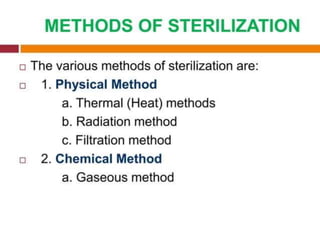
• Sterilization can be achieved by
physical, chemical and
physiochemical means. Chemicals
used as sterilizing agents are called
chemisterilants.
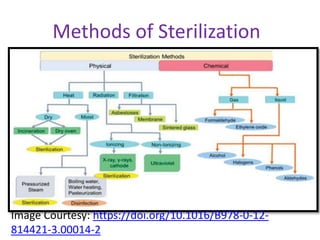
Methods of Sterilization
Image Courtesy: https://doi.org/10.1016/B978-0-12-
814421-3.00014-2
Working Principle of Filtration
Sterilization
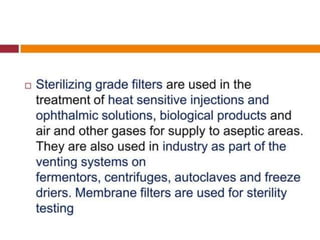
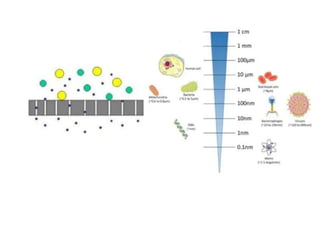
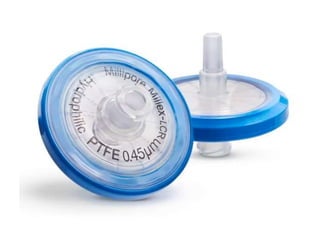
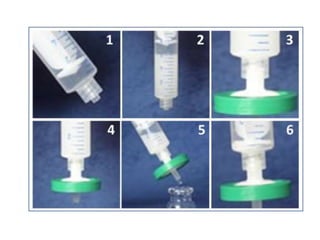
• Filters function by physically trapping particles that
are larger than the size of the pore and retaining
smaller particles by electrostatic attraction of
particles to the filter.
• Apart from porosity, various other aspects
influence the effectiveness of filtration. These
include:
Working Principle of Filtration
Sterilization
• The filter is charged with electricity.
• the electric charge carried by organisms nature of
the filtering fluid
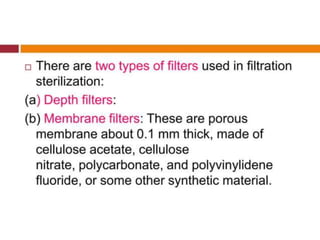
Depth Filters
• It is an elongated layer or mat that is made of
an array of random overlapping sheets of
paper, or even the borosilicate (glass) fibrous
material. The depth filter collects particles
inside the web of fibers within the structure.
• Applications of Depth Filters
• Sterilization of air filters in industrial processes
Air filtration Method
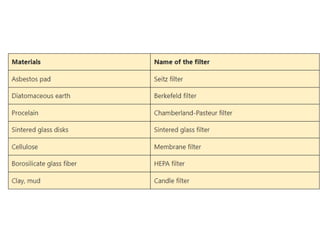
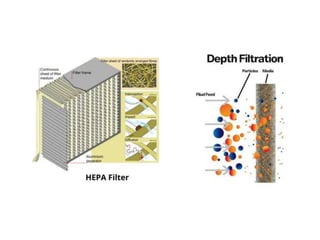
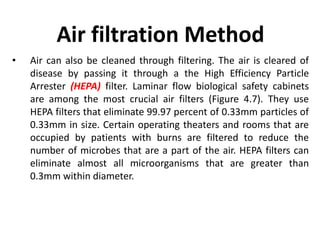
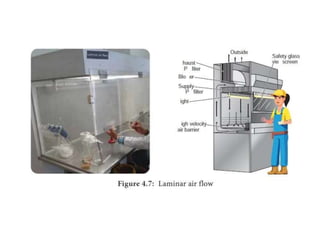
• Air can also be cleaned through filtering. The air is cleared of
disease by passing it through a the High Efficiency Particle
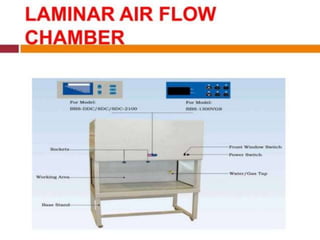
Arrester (HEPA) filter. Laminar flow biological safety cabinets
are among the most crucial air filters (Figure 4.7). They use
HEPA filters that eliminate 99.97 percent of 0.33mm particles of
0.33mm in size. Certain operating theaters and rooms that are
occupied by patients with burns are filtered to reduce the
number of microbes that are a part of the air. HEPA filters can
eliminate almost all microorganisms that are greater than
0.3mm within diameter.
Courtesy: Slideshare
Testing - Efficacy of Radiation Radiation control
indicator disc:
Special paper sticker which is yellow in colour, is
sticked on the articles. After proper sterilization
disc colour changes to red.
Chemical methods of Sterilization
Chemical Methods:
Action of chemical agents:
Protein coagulation
Disruption of cell membrane resulting in
exposure, damage/loss of contents
Removal of sulfhydryl group essential for
normal functioning of enzyme
Substate competition.
Commonly used chemical
Alcohol
Frequently used are Ethyl alcohol ,Isopropyl alcohol
These must be used at concentration 60-90%.
Isopropyl alcohol used in disinfection of clinical
thermometer.
Methyl alcohol is effective against fungal spores, treating
cabinets and incubators.
Methyl alcohol is also toxic and inflammable.
Aldehyde
Formaldehyde:
Having Bactericidal, sporicidal and has lethal effect on
viruses.
Used to preserve anatomical specimens, destroying
anthrax spores on hair and wool.
Glutaldehyde:
 Effective against Tubercle bacilli, fungi, viruses.
 Less toxic and irritant to eyes, skin
 Used to treat anaesthetic rubber, face masks, plastic
endotracheal tubes, metal instruments and polythene
tubing.
Dyes:
2 groups of dyes: 1.Aniline dye 2.Acridine dye
 Both are bacteriostatic in high dilution but are of low
bactericidal activity.
 Aniline dye is more active against gram +ve than

gram-ve organisms.
Some important dyes:
Proflavine Acriflavine Euflavine Aminacrine
These Impair the DNA complexes of the organisms
and thus kill or destroy the reproductive capacity of
the cell.
Halogens Iodine
Used as Skin disinfectant
Having Active bactericidal activity &moderate
action on spores.
Chlorine
Used to disinfect Water supplies, swimming pools
and food and dairy industries.
Along with hypochlorides are bactericidal. Also act
on viruses.
Phenols
 These are obtained from distillation of coal tar
between 170- 270°C.
Lethal effects are:
 Capacity to cause cell membrane damage, releasing
cell contents and causing lysis.
 Low concentration will precipitate proteins.
Gases:
Types of gases used for sterilization:
Ethylene oxide Formaldehyde gas
Beta propiolactone (BPL).
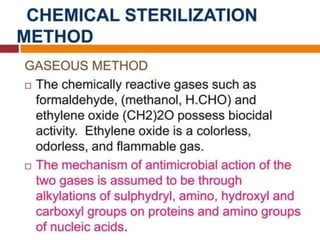
Ethylene oxide
Action is due to its alkylating the amino,
carboxyl, hydroxyl and sulphydryl groups
in protein molecules.
Also on DNA and RNA.
Items: heart-lung machines, respirators,
dental equipment, books, clothing.
Formaldehyde gas:
 This is widely employed for fumigation of OT and other rooms.
 Formaldehyde is produced by adding 150g of KMnO4 to
280ml of formalin for every 1000cu.ft of roomvolume, after
closing the windows and other outlets.
 After fumigation, the doors should be sealed and left unopened
for 48 hours.
Betapropiolactone:
 Product of ketane and formaldehyde with a boiling point of
163°C.
 Having rapid bactericidal activity but carcinogenic.
 Capable of killing all microorganisms and is very active
against viruses.
Metallic salts:
 Though all salts have a certain amount of germicidal action
depending on their concentration, salts of heavy metals
have a greater action.
Eg: salts of silver, copper and mercury
These are Protein coagulants and have capacity to combine
with free sulfhydryl group of cell enzymes.
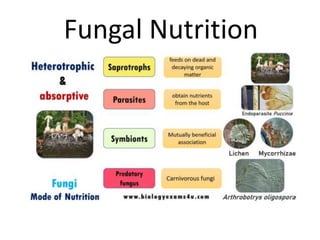
Occurrence of Fungi:
• The fungi are cosmopolitan in
distribution and occur in all possible
habitats.
• Due to absence of chlorophyll, they
depend on other for food, that is
why they may be saprophytes,
parasites or symbionts.
Occurrence of Fungi:
• Most of the fungi are terrestrial which grow in
soil, on dead and decaying organic material.
• Some grow on both plants and animals.
• They can grow on foods like jam, bread, fruits
etc.
• Some members are also found in water —
aquatic fungi. They are also present in the air.
Thus the fungi are universal in their distribution.
Vegetative Structure of
Fungi:
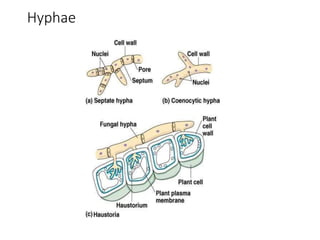
• Hyphae: The fungal thallus typically consists of
microscopic threads or filaments that branch in
all directions, spreading over or within the
substratum utilized for food. Each of these
filaments is known as a hypha (pl. hyphae; Gr.
hyphae = web). A hypha is made of a thin,
transparent, tubular wall filled or lined with a
layer of protoplasm varying in thickness.
Hyphae
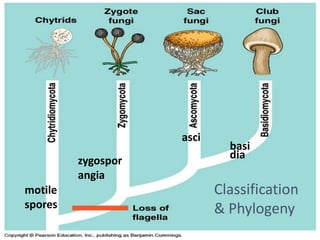
Classification
& Phylogeny
motile
spores
zygospor
angia
asci
basi
dia
5 Most Important Ecological Groups of
Fungi
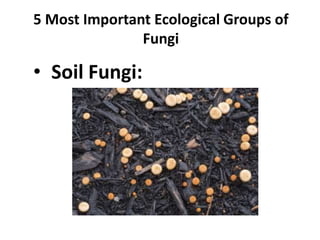
• Soil Fungi:
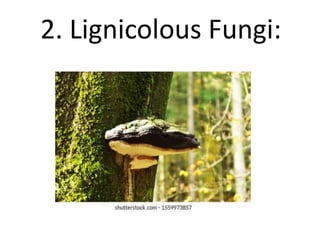
2. Lignicolous Fungi:
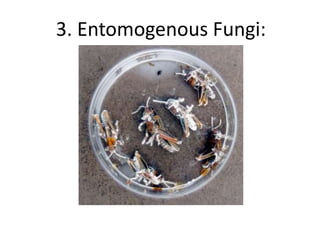
3. Entomogenous Fungi:
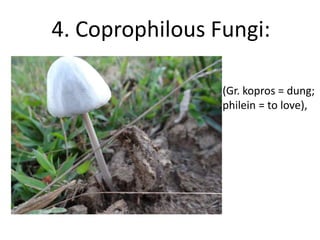
4. Coprophilous Fungi:
(Gr. kopros = dung;
philein = to love),
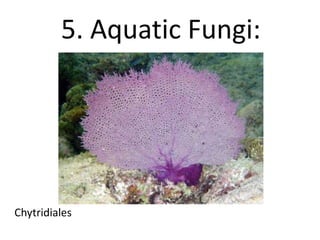
5. Aquatic Fungi:
Chytridiales
Fungal Nutrition
Sterilization.ppt
Sterilization.ppt
Sterilization.ppt

Sterilization.ppt

  • 1.
    STERILIZATION Course Title: MICROBIOLOGYAND MICROBIAL TECHNIQUES Course Code: 21BTG2T421
  • 2.
    What is Sterilization •Sterilization is defined as the process where all the living microorganisms, including bacterial spores are killed. • Sterilization can be achieved by physical, chemical and physiochemical means. Chemicals used as sterilizing agents are called chemisterilants.
  • 3.
    Methods of Sterilization ImageCourtesy: https://doi.org/10.1016/B978-0-12- 814421-3.00014-2
  • 13.
    Working Principle ofFiltration Sterilization • Filters function by physically trapping particles that are larger than the size of the pore and retaining smaller particles by electrostatic attraction of particles to the filter. • Apart from porosity, various other aspects influence the effectiveness of filtration. These include:
  • 14.
    Working Principle ofFiltration Sterilization • The filter is charged with electricity. • the electric charge carried by organisms nature of the filtering fluid
  • 15.
    Depth Filters • Itis an elongated layer or mat that is made of an array of random overlapping sheets of paper, or even the borosilicate (glass) fibrous material. The depth filter collects particles inside the web of fibers within the structure. • Applications of Depth Filters • Sterilization of air filters in industrial processes
  • 17.
    Air filtration Method •Air can also be cleaned through filtering. The air is cleared of disease by passing it through a the High Efficiency Particle Arrester (HEPA) filter. Laminar flow biological safety cabinets are among the most crucial air filters (Figure 4.7). They use HEPA filters that eliminate 99.97 percent of 0.33mm particles of 0.33mm in size. Certain operating theaters and rooms that are occupied by patients with burns are filtered to reduce the number of microbes that are a part of the air. HEPA filters can eliminate almost all microorganisms that are greater than 0.3mm within diameter.
  • 24.
  • 26.
    Testing - Efficacyof Radiation Radiation control indicator disc: Special paper sticker which is yellow in colour, is sticked on the articles. After proper sterilization disc colour changes to red.
  • 27.
    Chemical methods ofSterilization Chemical Methods: Action of chemical agents: Protein coagulation Disruption of cell membrane resulting in exposure, damage/loss of contents Removal of sulfhydryl group essential for normal functioning of enzyme Substate competition.
  • 28.
    Commonly used chemical Alcohol Frequentlyused are Ethyl alcohol ,Isopropyl alcohol These must be used at concentration 60-90%. Isopropyl alcohol used in disinfection of clinical thermometer. Methyl alcohol is effective against fungal spores, treating cabinets and incubators. Methyl alcohol is also toxic and inflammable. Aldehyde Formaldehyde: Having Bactericidal, sporicidal and has lethal effect on viruses. Used to preserve anatomical specimens, destroying anthrax spores on hair and wool.
  • 29.
    Glutaldehyde:  Effective againstTubercle bacilli, fungi, viruses.  Less toxic and irritant to eyes, skin  Used to treat anaesthetic rubber, face masks, plastic endotracheal tubes, metal instruments and polythene tubing. Dyes: 2 groups of dyes: 1.Aniline dye 2.Acridine dye  Both are bacteriostatic in high dilution but are of low bactericidal activity.  Aniline dye is more active against gram +ve than gram-ve organisms.
  • 30.
    Some important dyes: ProflavineAcriflavine Euflavine Aminacrine These Impair the DNA complexes of the organisms and thus kill or destroy the reproductive capacity of the cell. Halogens Iodine Used as Skin disinfectant Having Active bactericidal activity &moderate action on spores. Chlorine Used to disinfect Water supplies, swimming pools and food and dairy industries. Along with hypochlorides are bactericidal. Also act on viruses.
  • 31.
    Phenols  These areobtained from distillation of coal tar between 170- 270°C. Lethal effects are:  Capacity to cause cell membrane damage, releasing cell contents and causing lysis.  Low concentration will precipitate proteins. Gases: Types of gases used for sterilization: Ethylene oxide Formaldehyde gas Beta propiolactone (BPL).
  • 32.
    Ethylene oxide Action isdue to its alkylating the amino, carboxyl, hydroxyl and sulphydryl groups in protein molecules. Also on DNA and RNA. Items: heart-lung machines, respirators, dental equipment, books, clothing.
  • 33.
    Formaldehyde gas:  Thisis widely employed for fumigation of OT and other rooms.  Formaldehyde is produced by adding 150g of KMnO4 to 280ml of formalin for every 1000cu.ft of roomvolume, after closing the windows and other outlets.  After fumigation, the doors should be sealed and left unopened for 48 hours. Betapropiolactone:  Product of ketane and formaldehyde with a boiling point of 163°C.  Having rapid bactericidal activity but carcinogenic.  Capable of killing all microorganisms and is very active against viruses.
  • 34.
    Metallic salts:  Thoughall salts have a certain amount of germicidal action depending on their concentration, salts of heavy metals have a greater action. Eg: salts of silver, copper and mercury These are Protein coagulants and have capacity to combine with free sulfhydryl group of cell enzymes.
  • 39.
    Occurrence of Fungi: •The fungi are cosmopolitan in distribution and occur in all possible habitats. • Due to absence of chlorophyll, they depend on other for food, that is why they may be saprophytes, parasites or symbionts.
  • 40.
    Occurrence of Fungi: •Most of the fungi are terrestrial which grow in soil, on dead and decaying organic material. • Some grow on both plants and animals. • They can grow on foods like jam, bread, fruits etc. • Some members are also found in water — aquatic fungi. They are also present in the air. Thus the fungi are universal in their distribution.
  • 41.
    Vegetative Structure of Fungi: •Hyphae: The fungal thallus typically consists of microscopic threads or filaments that branch in all directions, spreading over or within the substratum utilized for food. Each of these filaments is known as a hypha (pl. hyphae; Gr. hyphae = web). A hypha is made of a thin, transparent, tubular wall filled or lined with a layer of protoplasm varying in thickness.
  • 42.
  • 43.
  • 44.
    5 Most ImportantEcological Groups of Fungi • Soil Fungi:
  • 45.
  • 46.
  • 47.
    4. Coprophilous Fungi: (Gr.kopros = dung; philein = to love),
  • 48.
  • 49.