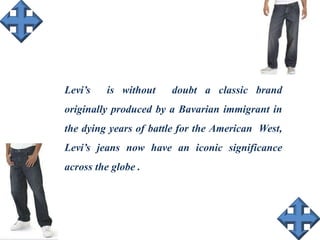
Levi’s is without doubt a classic brand
originally produced by a Bavarian immigrant in
the dying years of battle for the American West,
Levi’s jeans now have an iconic significance
across the globe .
In its September 2002 edition , the UK version of
Enquire magazine heralded Levi’s as the ultimate
clothing brand and a staple to the world wide
wardrobe:
The secret behind the
enduring magic and success of Levi’s has been its
ability to symbolize both ubiquity and uniqueness
simultaneously. Levi’s are both fashion and anti
fashion.
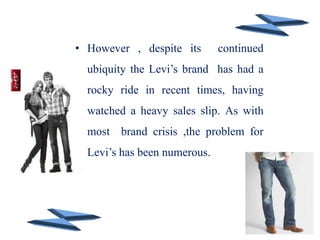
• However , despite its continued
ubiquity the Levi’s brand has had a
rocky ride in recent times, having
watched a heavy sales slip. As with
most brand crisis ,the problem for
Levi’s has been numerous.
• In the attempt to be sensitive to the various
fluctuations of taste among the denim
wearing public ,Levis has diversified brand
by creating a wide range of jeans styles .
Most significantly , it has branched out
beyond its traditional “red label” jeans
and introduced a new sub brand called ‘
Silvertab’.The company has also produced
a cheaper range of jeans with orange tags
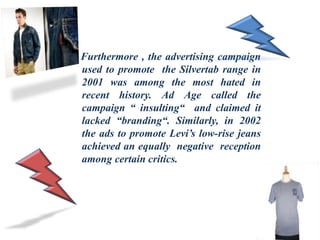
Furthermore , the advertising campaign
used to promote the Silvertab range in
2001 was among the most hated in
recent history. Ad Age called the
campaign “ insulting“ and claimed it
lacked “branding“. Similarly, in 2002
the ads to promote Levi’s low-rise jeans
achieved an equally negative reception
among certain critics.
In UK ,the start of the new millennium saw Levi’s
become engaged in a very public battle with Tesco’s
supermarket . Tesco’s claimed that consumer’s were
paying too much for their Levi’s and the supermarket
wanted to sell Levi in its own stores with a narrower
profit margin. Levi’s refused to sell its premium jeans
such as 501’s ,via the supermarket , and went to court
to stop imports from outside Europe.
The UK government joined in ,
attempting to persuade the European Union to allow
supermarkets like Tesco’s to import goods from
anywhere in the world. However , Levi’s insisted that
Tesco’s was missing the point ,confusing the cost of
making the jeans with the cost of marketing them.
• Despite all these unfortunate external factors ,
there is no escaping the fact that the real threat
to Levi’s brand is generated from Levi’s itself.
Now that it locked in an endless quest to appear
‘ innovative ‘ and ‘ youthful’ , by launching a
growing number of new styles . Levi’s is now
proving the law of diminishing returns. The
marketing expense continues to grow, while the
true brand value diminishes .
• In 2000, the company failed to make
the top 75 global brands by value
according to the Interbrand 2000
Brand Valuation Survey. The inclusion
of rival brands such as Gap and
Benetton only served to rub more salt
in Levi’s wounds.
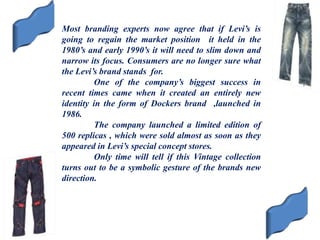
Most branding experts now agree that if Levi’s is
going to regain the market position it held in the
1980’s and early 1990’s it will need to slim down and
narrow its focus. Consumers are no longer sure what
the Levi’s brand stands for.
One of the company’s biggest success in
recent times came when it created an entirely new
identity in the form of Dockers brand ,launched in
1986.
The company launched a limited edition of
500 replicas , which were sold almost as soon as they
appeared in Levi’s special concept stores.
Only time will tell if this Vintage collection
turns out to be a symbolic gesture of the brands new
direction.
Intensify, don’t multiply
Focus on your strengths,
Don’t look down on your original brand
failure of levis

failure of levis

  • 2.
    Levi’s is withoutdoubt a classic brand originally produced by a Bavarian immigrant in the dying years of battle for the American West, Levi’s jeans now have an iconic significance across the globe .
  • 3.
    In its September2002 edition , the UK version of Enquire magazine heralded Levi’s as the ultimate clothing brand and a staple to the world wide wardrobe: The secret behind the enduring magic and success of Levi’s has been its ability to symbolize both ubiquity and uniqueness simultaneously. Levi’s are both fashion and anti fashion.
  • 4.
    • However ,despite its continued ubiquity the Levi’s brand has had a rocky ride in recent times, having watched a heavy sales slip. As with most brand crisis ,the problem for Levi’s has been numerous.
  • 5.
    • In theattempt to be sensitive to the various fluctuations of taste among the denim wearing public ,Levis has diversified brand by creating a wide range of jeans styles . Most significantly , it has branched out beyond its traditional “red label” jeans and introduced a new sub brand called ‘ Silvertab’.The company has also produced a cheaper range of jeans with orange tags
  • 6.
    Furthermore , theadvertising campaign used to promote the Silvertab range in 2001 was among the most hated in recent history. Ad Age called the campaign “ insulting“ and claimed it lacked “branding“. Similarly, in 2002 the ads to promote Levi’s low-rise jeans achieved an equally negative reception among certain critics.
  • 7.
    In UK ,thestart of the new millennium saw Levi’s become engaged in a very public battle with Tesco’s supermarket . Tesco’s claimed that consumer’s were paying too much for their Levi’s and the supermarket wanted to sell Levi in its own stores with a narrower profit margin. Levi’s refused to sell its premium jeans such as 501’s ,via the supermarket , and went to court to stop imports from outside Europe. The UK government joined in , attempting to persuade the European Union to allow supermarkets like Tesco’s to import goods from anywhere in the world. However , Levi’s insisted that Tesco’s was missing the point ,confusing the cost of making the jeans with the cost of marketing them.
  • 8.
    • Despite allthese unfortunate external factors , there is no escaping the fact that the real threat to Levi’s brand is generated from Levi’s itself. Now that it locked in an endless quest to appear ‘ innovative ‘ and ‘ youthful’ , by launching a growing number of new styles . Levi’s is now proving the law of diminishing returns. The marketing expense continues to grow, while the true brand value diminishes .
  • 9.
    • In 2000,the company failed to make the top 75 global brands by value according to the Interbrand 2000 Brand Valuation Survey. The inclusion of rival brands such as Gap and Benetton only served to rub more salt in Levi’s wounds.
  • 10.
    Most branding expertsnow agree that if Levi’s is going to regain the market position it held in the 1980’s and early 1990’s it will need to slim down and narrow its focus. Consumers are no longer sure what the Levi’s brand stands for. One of the company’s biggest success in recent times came when it created an entirely new identity in the form of Dockers brand ,launched in 1986. The company launched a limited edition of 500 replicas , which were sold almost as soon as they appeared in Levi’s special concept stores. Only time will tell if this Vintage collection turns out to be a symbolic gesture of the brands new direction.
  • 11.
    Intensify, don’t multiply Focuson your strengths, Don’t look down on your original brand