Introduction
•   Burberry is a global luxury brand with a distinctive British heritage,
    core outerwear base and one of the most recognized icons in the
    world. Burberry designs, sources and markets apparel and
    accessories, selling through a diversified network of retail, digital
    commerce, wholesale and licensing channels worldwide. The business
    is managed by channel, region and product, supported by corporate
    functions.
Case Study Synopsis
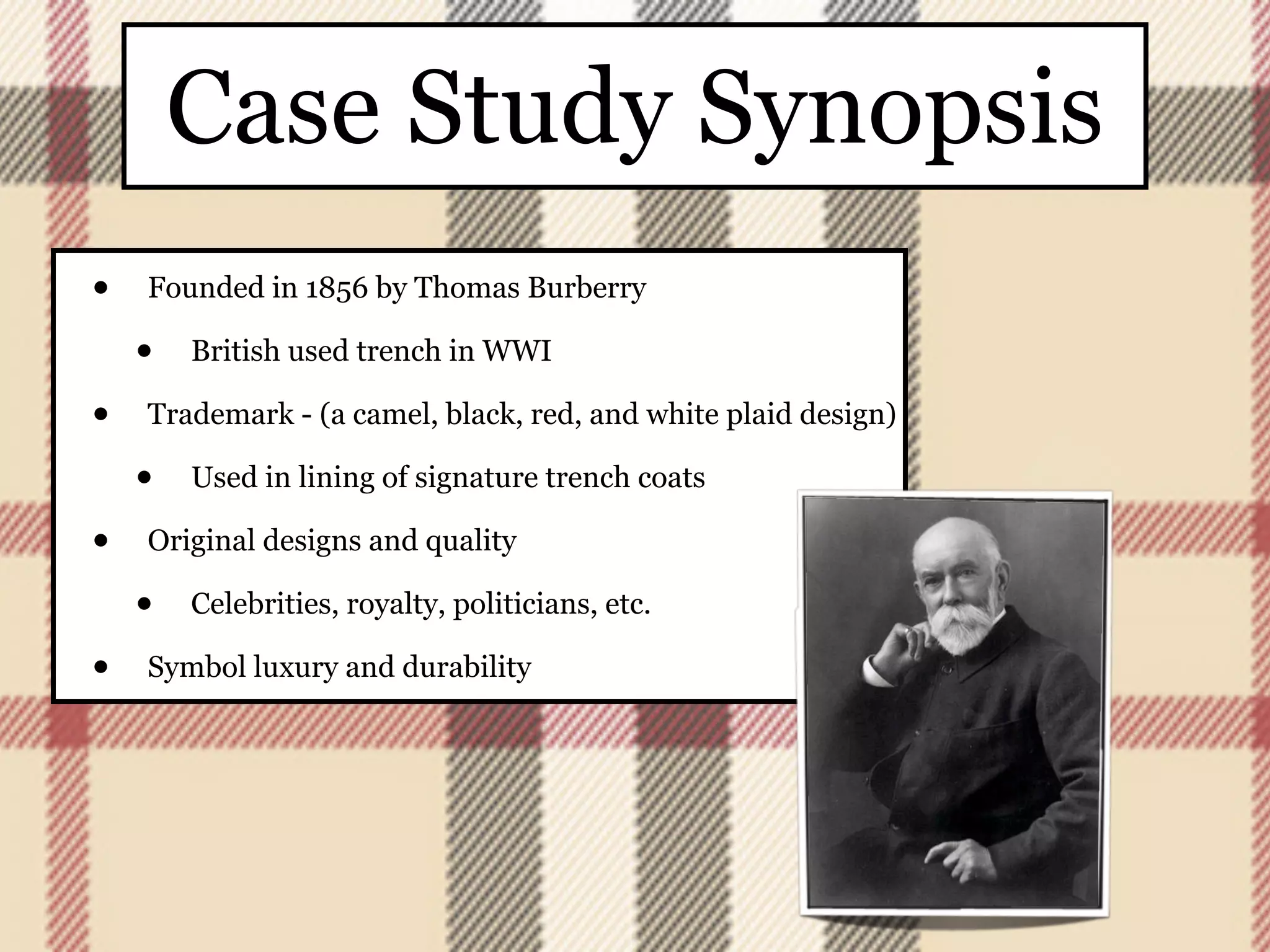
•   Founded in 1856 by Thomas Burberry

    •   British used trench in WWI

•   Trademark - (a camel, black, red, and white plaid design)

    •   Used in lining of signature trench coats

•   Original designs and quality

    •   Celebrities, royalty, politicians, etc.

•   Symbol luxury and durability
Case Study Synopsis
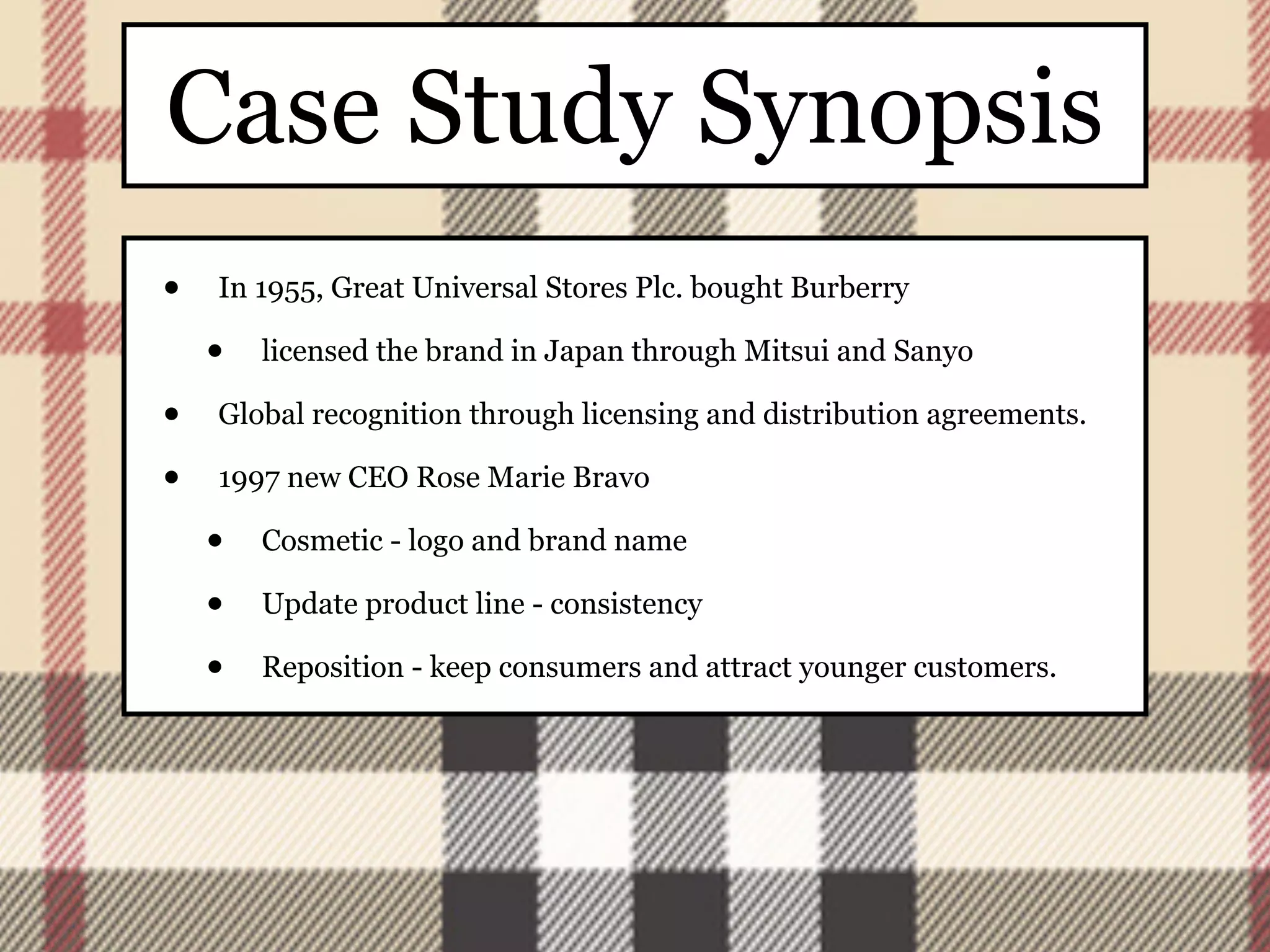
•   In 1955, Great Universal Stores Plc. bought Burberry

    •   licensed the brand in Japan through Mitsui and Sanyo

•   Global recognition through licensing and distribution agreements.

•   1997 new CEO Rose Marie Bravo

    •   Cosmetic - logo and brand name

    •   Update product line - consistency

    •   Reposition - keep consumers and attract younger customers.
Case Study Synopsis
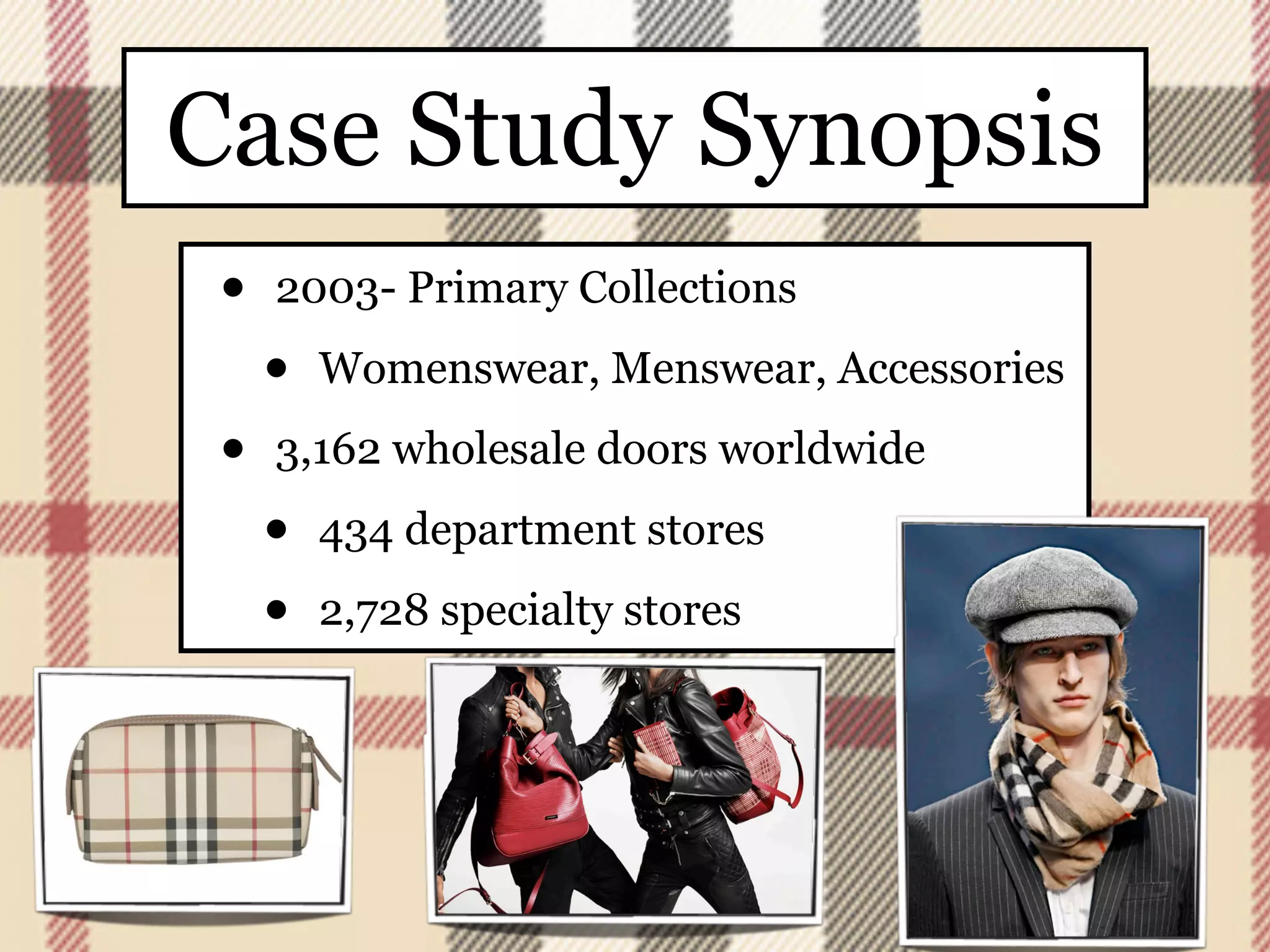
 •   2003- Primary Collections

     •   Womenswear, Menswear, Accessories

 •   3,162 wholesale doors worldwide

     •   434 department stores

     •   2,728 specialty stores
Case Synopsis
•   Biggest challenge

    •   Create a consistent brand image

    •   Risk losing brand and credibility

•   Prorsum - luxury line

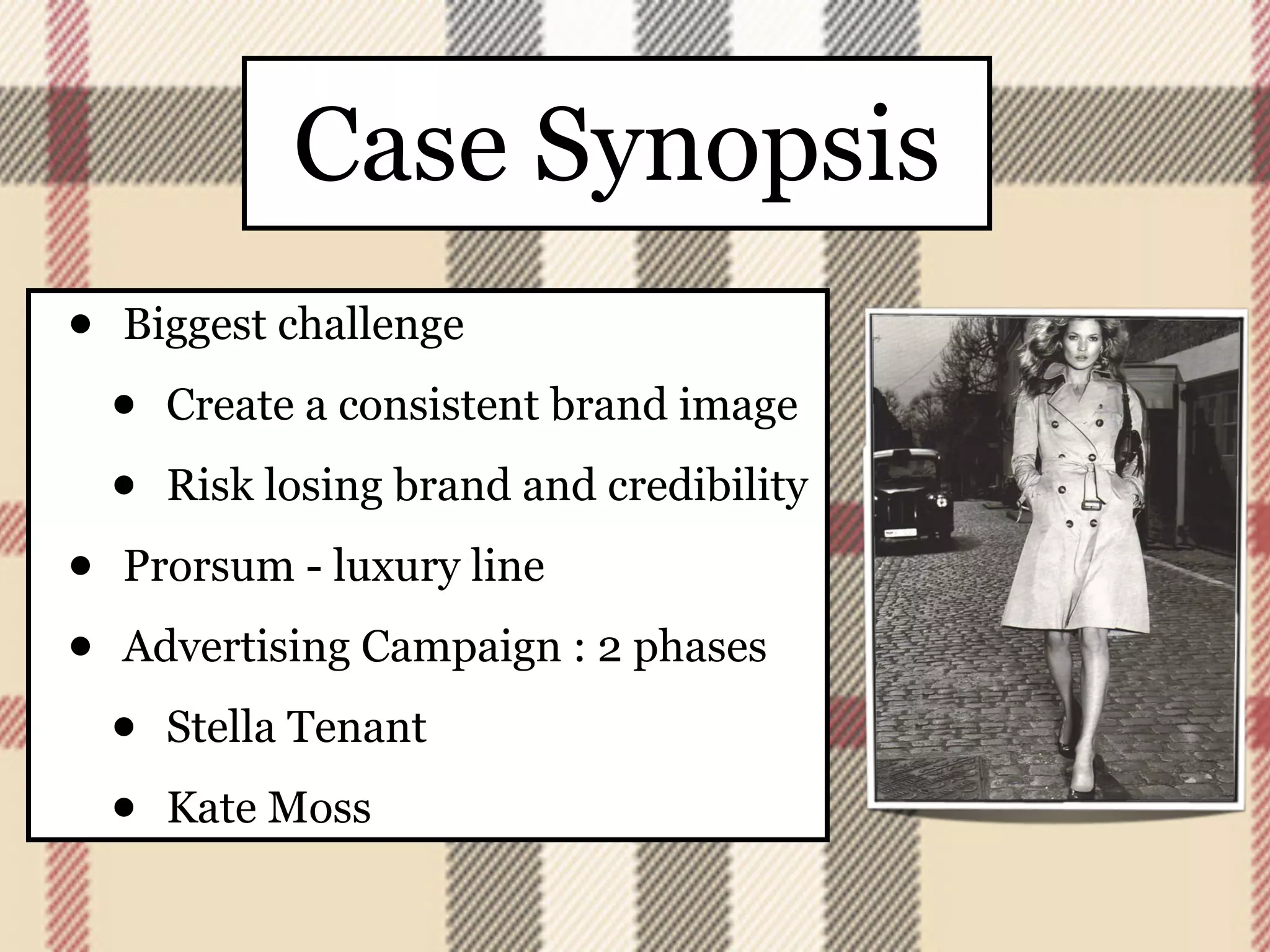
•   Advertising Campaign : 2 phases

    •   Stella Tenant

    •   Kate Moss
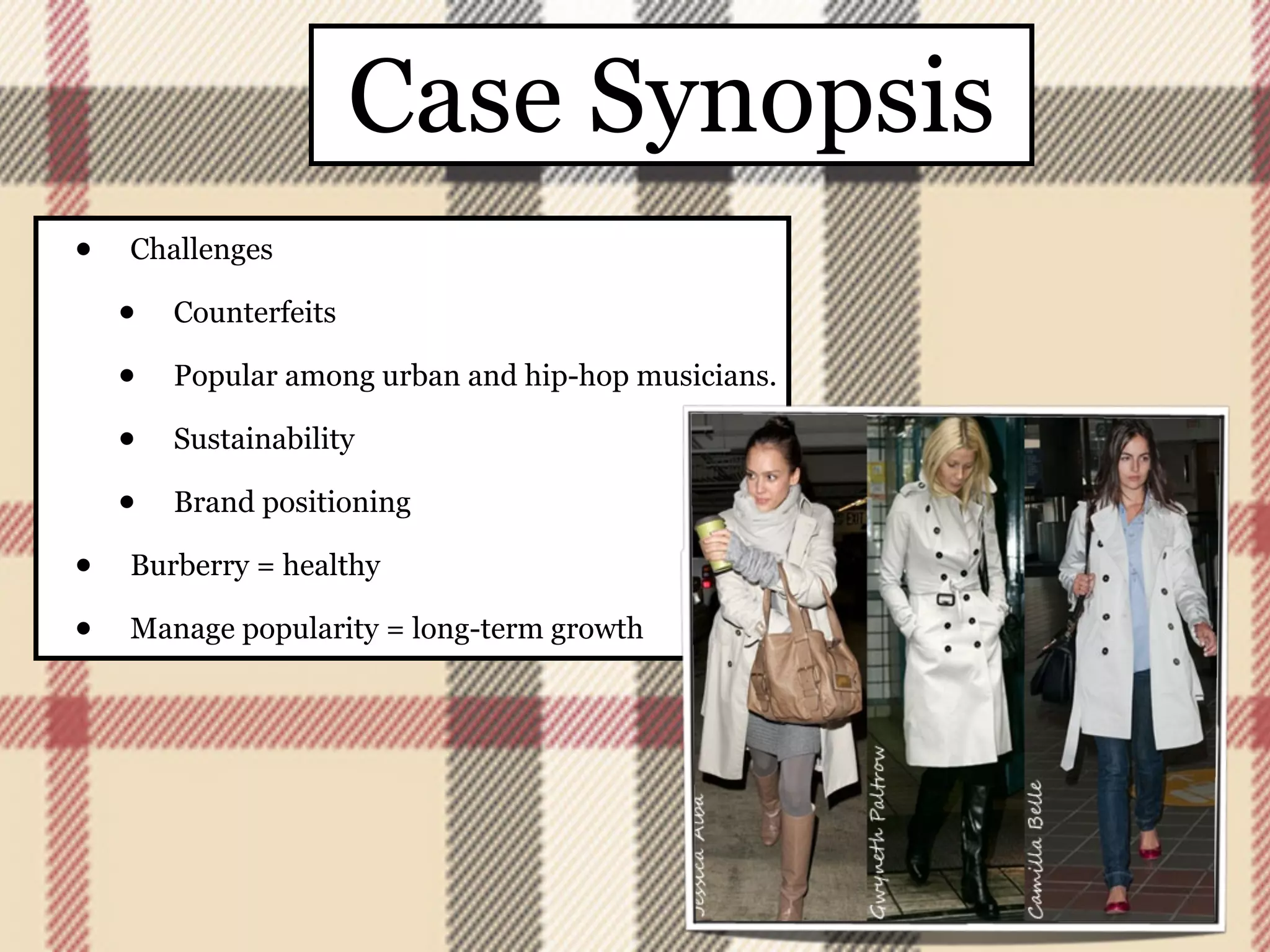
Case Synopsis
•   Challenges

    •   Counterfeits

    •   Popular among urban and hip-hop musicians.

    •   Sustainability

    •   Brand positioning

•   Burberry = healthy

•   Manage popularity = long-term growth
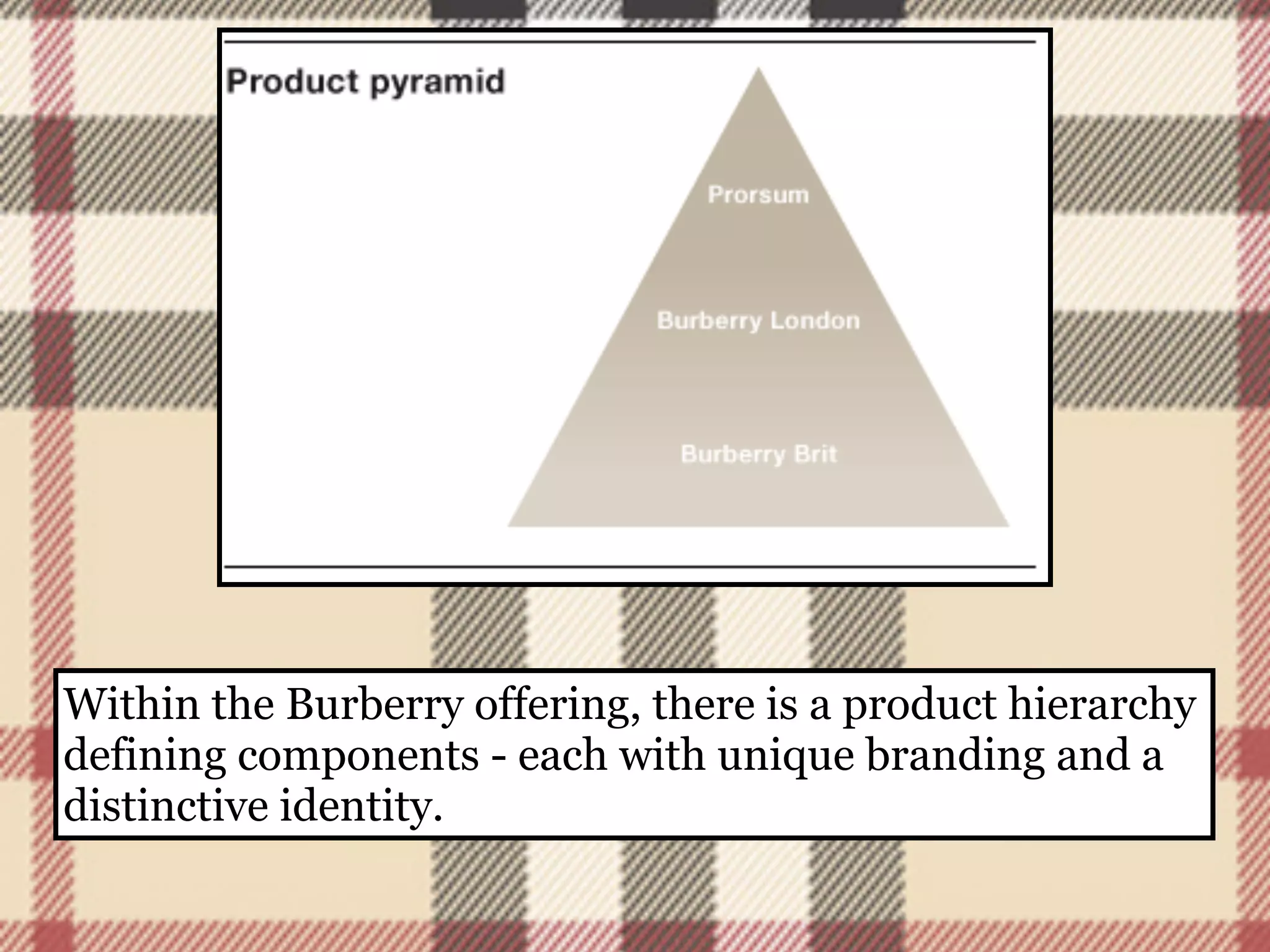
Within the Burberry offering, there is a product hierarchy
defining components - each with unique branding and a
distinctive identity.
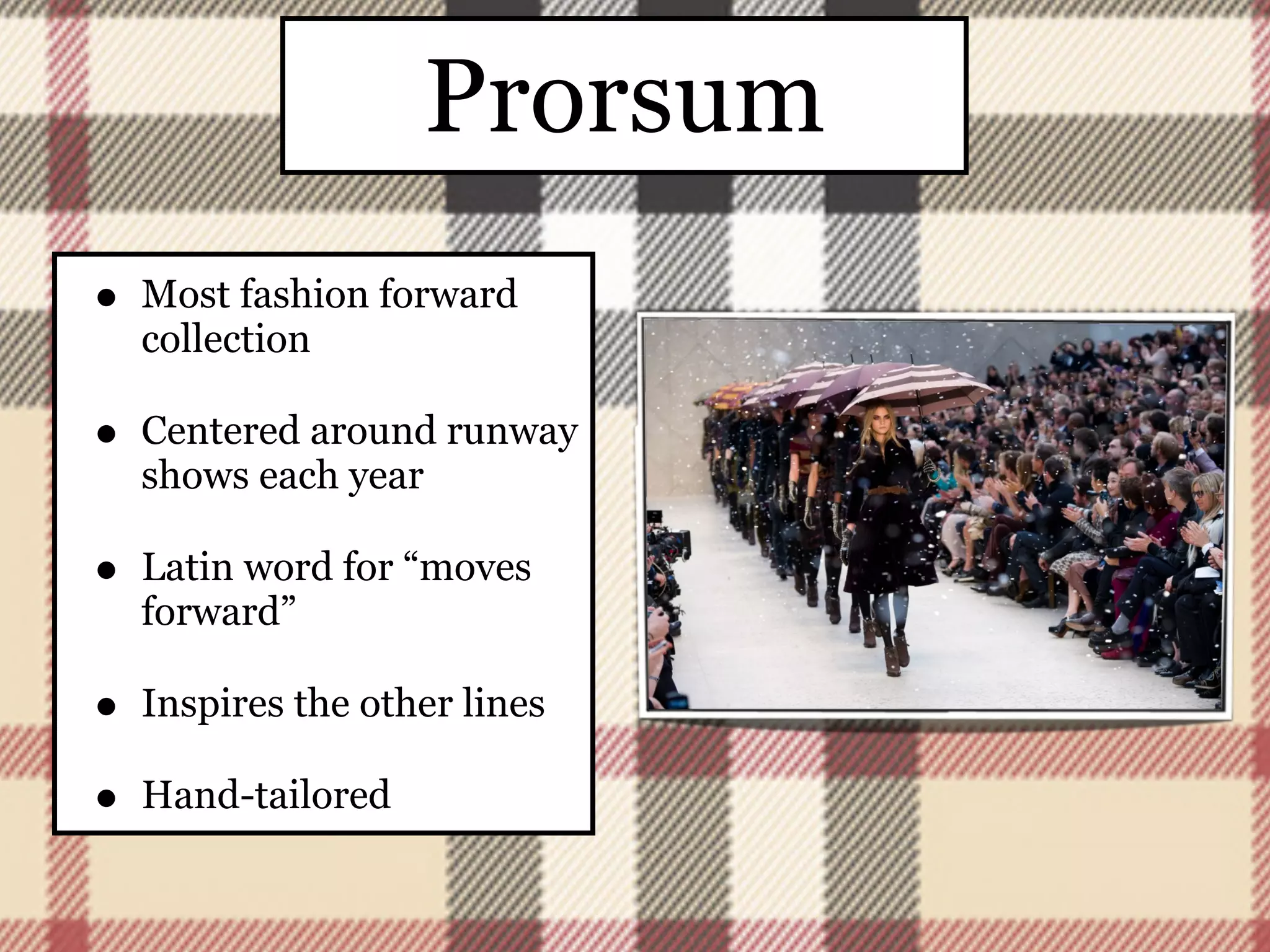
Prorsum
•   Most fashion forward
    collection

•   Centered around runway
    shows each year

•   Latin word for “moves
    forward”

•   Inspires the other lines

•   Hand-tailored
Runway Video
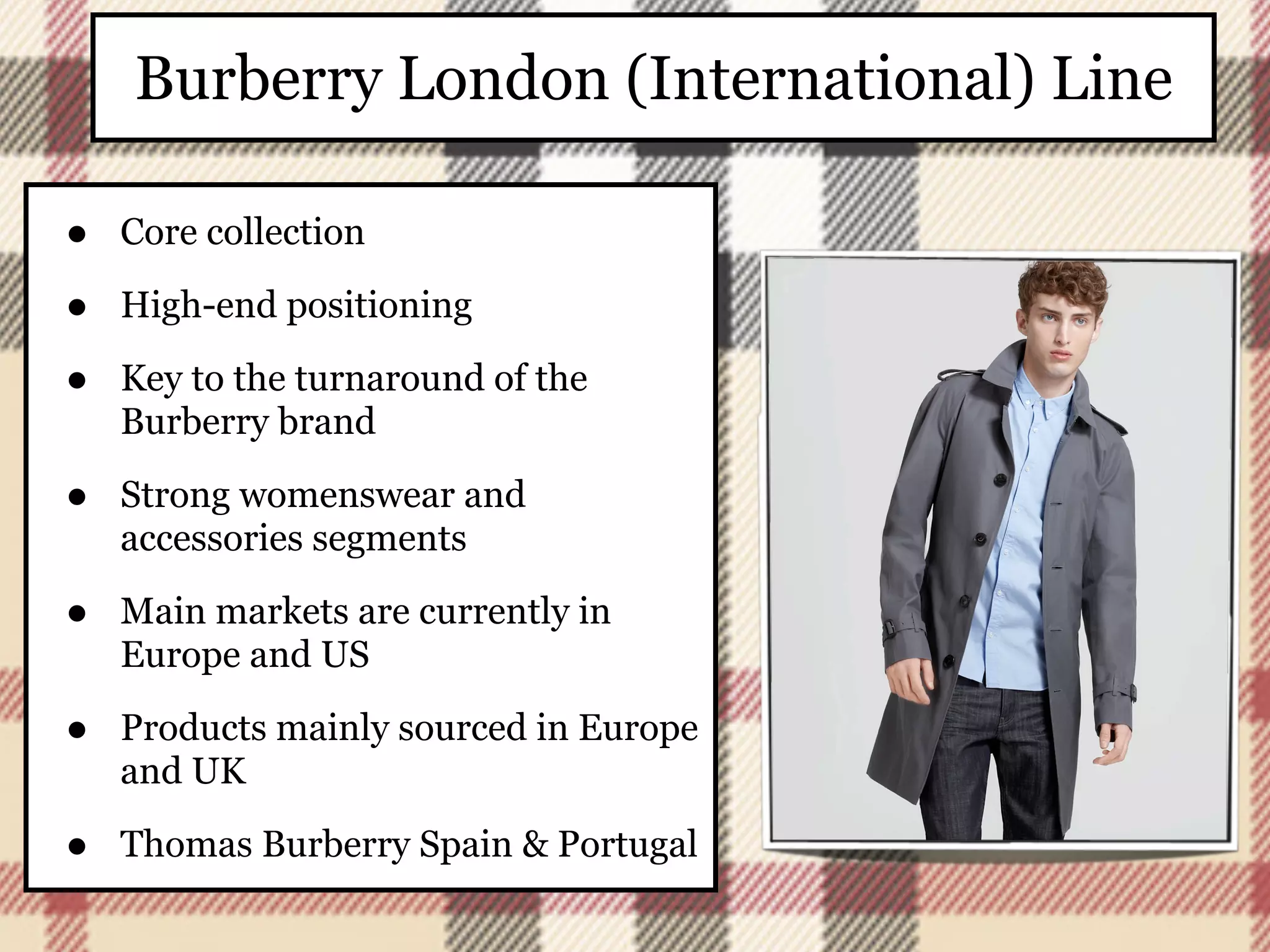
Burberry London (International) Line

•   Core collection

•   High-end positioning

•   Key to the turnaround of the
    Burberry brand

•   Strong womenswear and
    accessories segments

•   Main markets are currently in
    Europe and US

•   Products mainly sourced in Europe
    and UK

•   Thomas Burberry Spain & Portugal
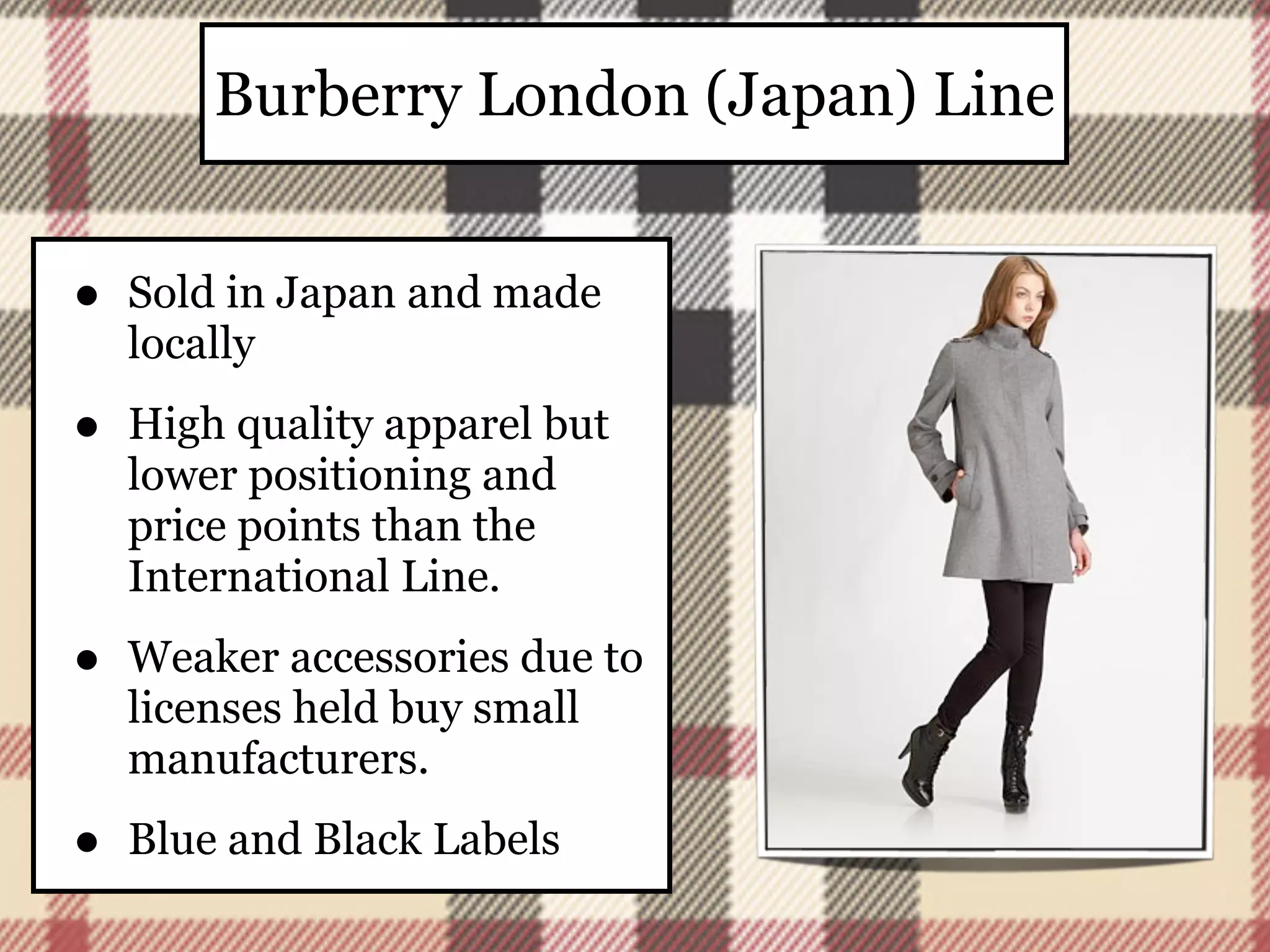
Burberry London (Japan) Line


•   Sold in Japan and made
    locally

•   High quality apparel but
    lower positioning and
    price points than the
    International Line.
•   Weaker accessories due to
    licenses held buy small
    manufacturers.

•   Blue and Black Labels
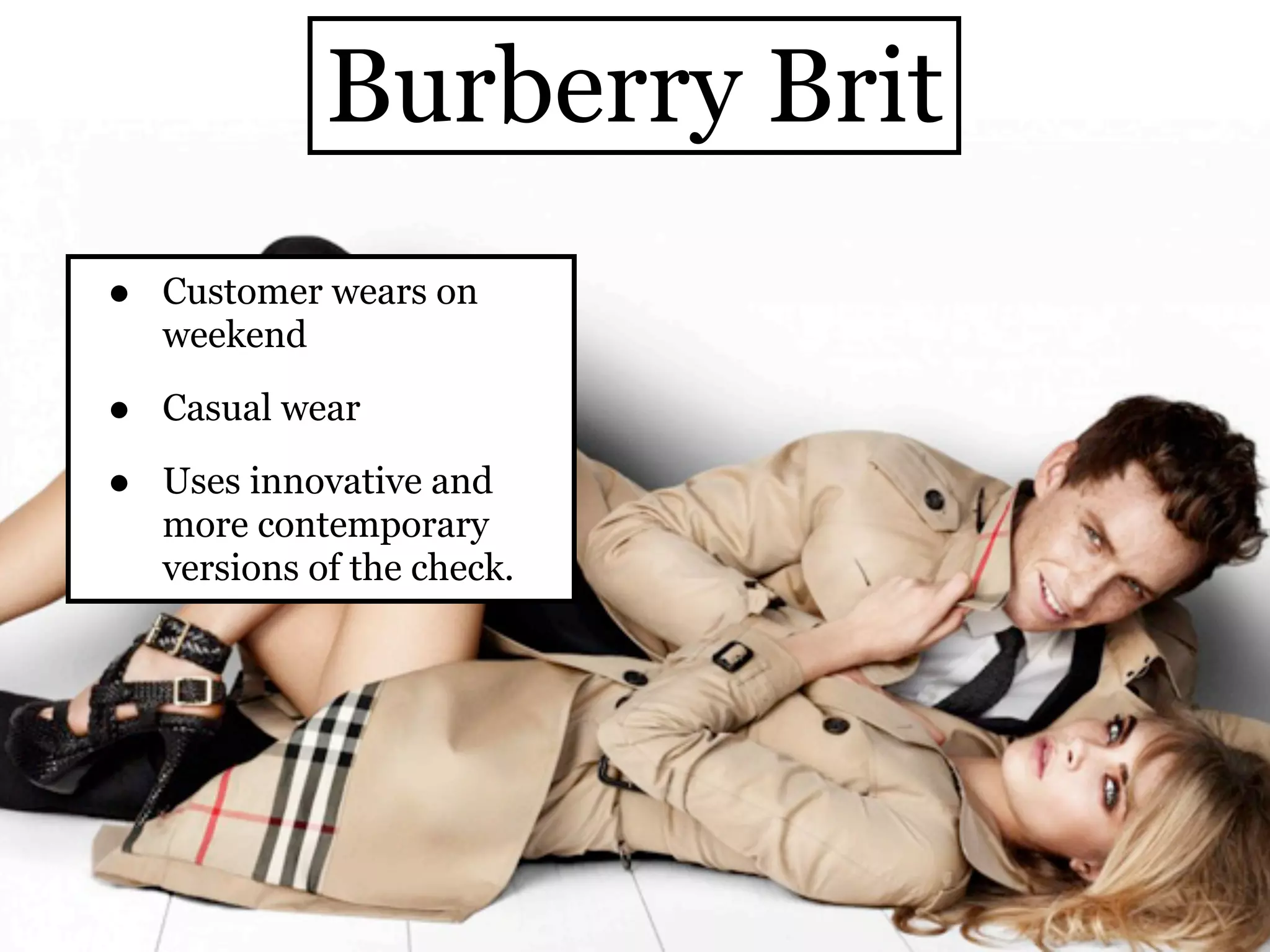
Burberry Brit
•   Customer wears on
    weekend

•   Casual wear

•   Uses innovative and
    more contemporary
    versions of the check.
Game
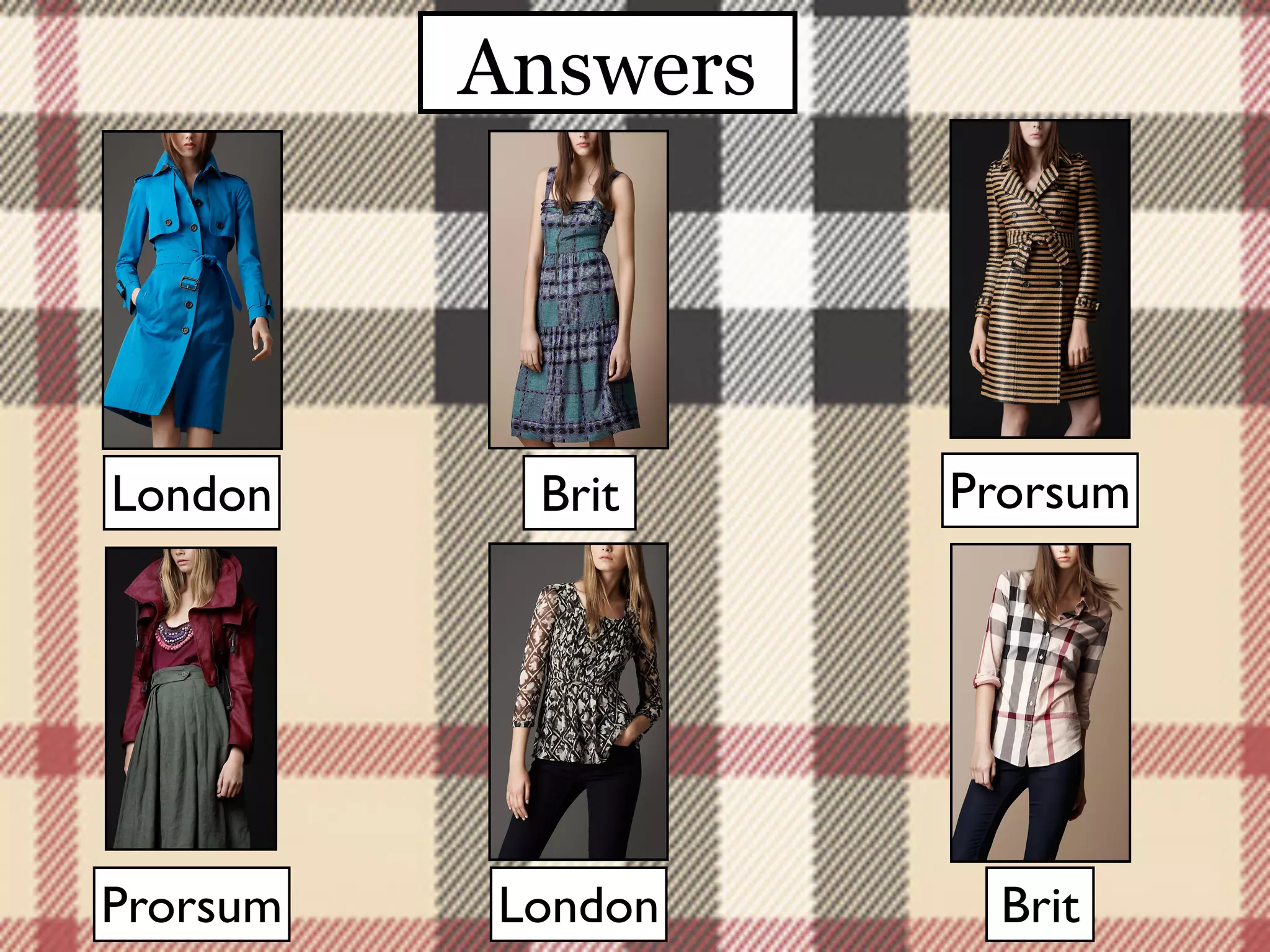
Answers


London     Brit     Prorsum


Prorsum   London     Brit
Burberry Brand
•   Defined by:
      • Authentic British heritage

      • Unique democratic positioning within the luxury arena.

      • Founding principles of quality, function and modern classic style,
        rooted in the integrity of its outerwear.

      • Globally recognized icon portfolio: the trench coat, trademark check
        and Prorsum horse logo.
Burberry Business
• Defined by:
 1 Design, marketing and retail-led strategies

 2 Digital focus and integration

 3 Channel diversity: retail, digital commerce, wholesale and licensing

 4 Multi-category competency: non-apparel, womenswear, menswear
   and children’s wear.

 5 Global reach and balance: across core regions and emerging markets
Culture
•   The culture is distinguished by:
     1 Core values: to protect, explore and inspire

     2 Democratic and meritocratic ethos

     3 Collaboration and connectedness

     4 Contributing to its communities, including through the Burberry
       Foundation.
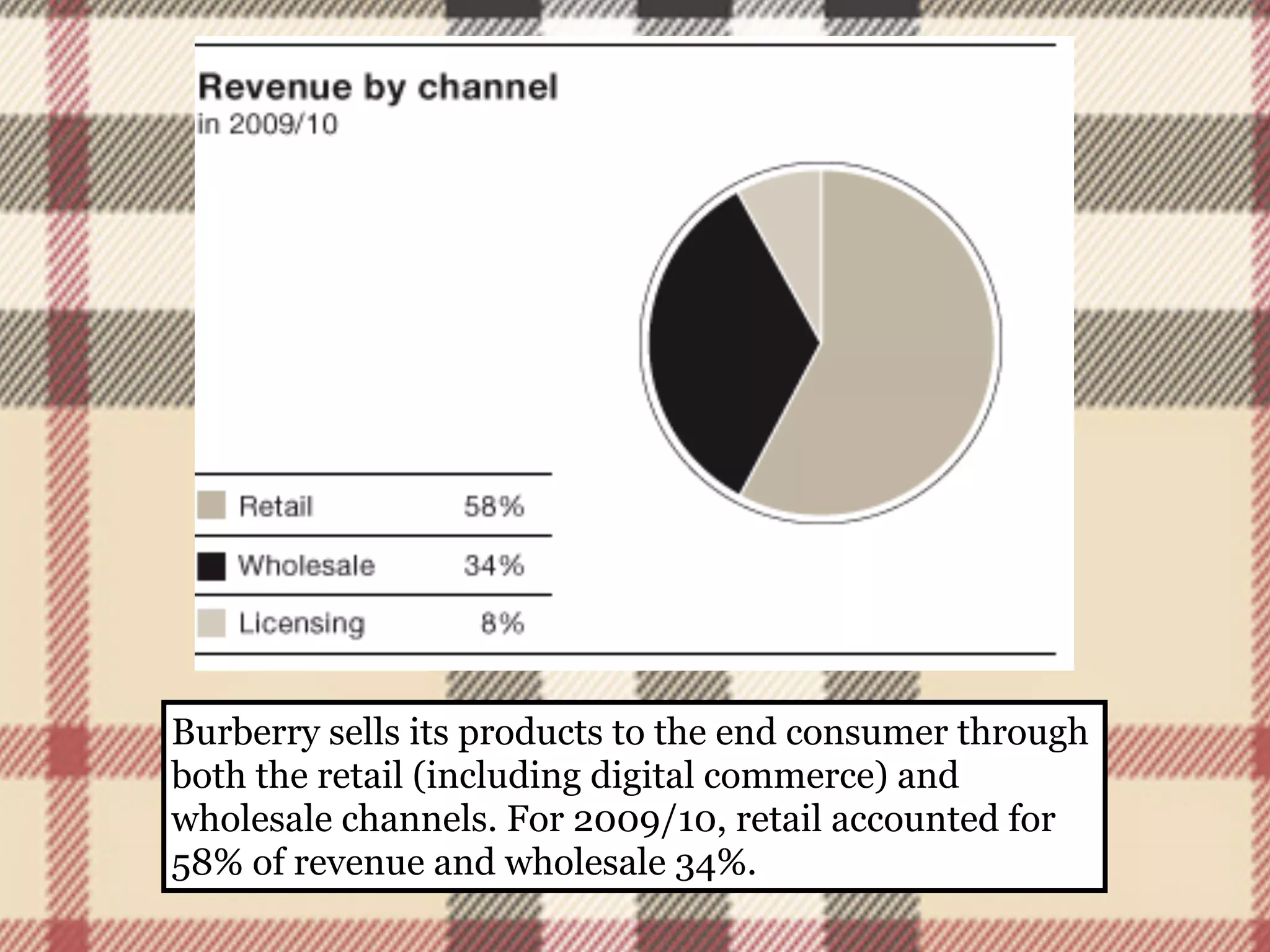
Burberry sells its products to the end consumer through
both the retail (including digital commerce) and
wholesale channels. For 2009/10, retail accounted for
58% of revenue and wholesale 34%.
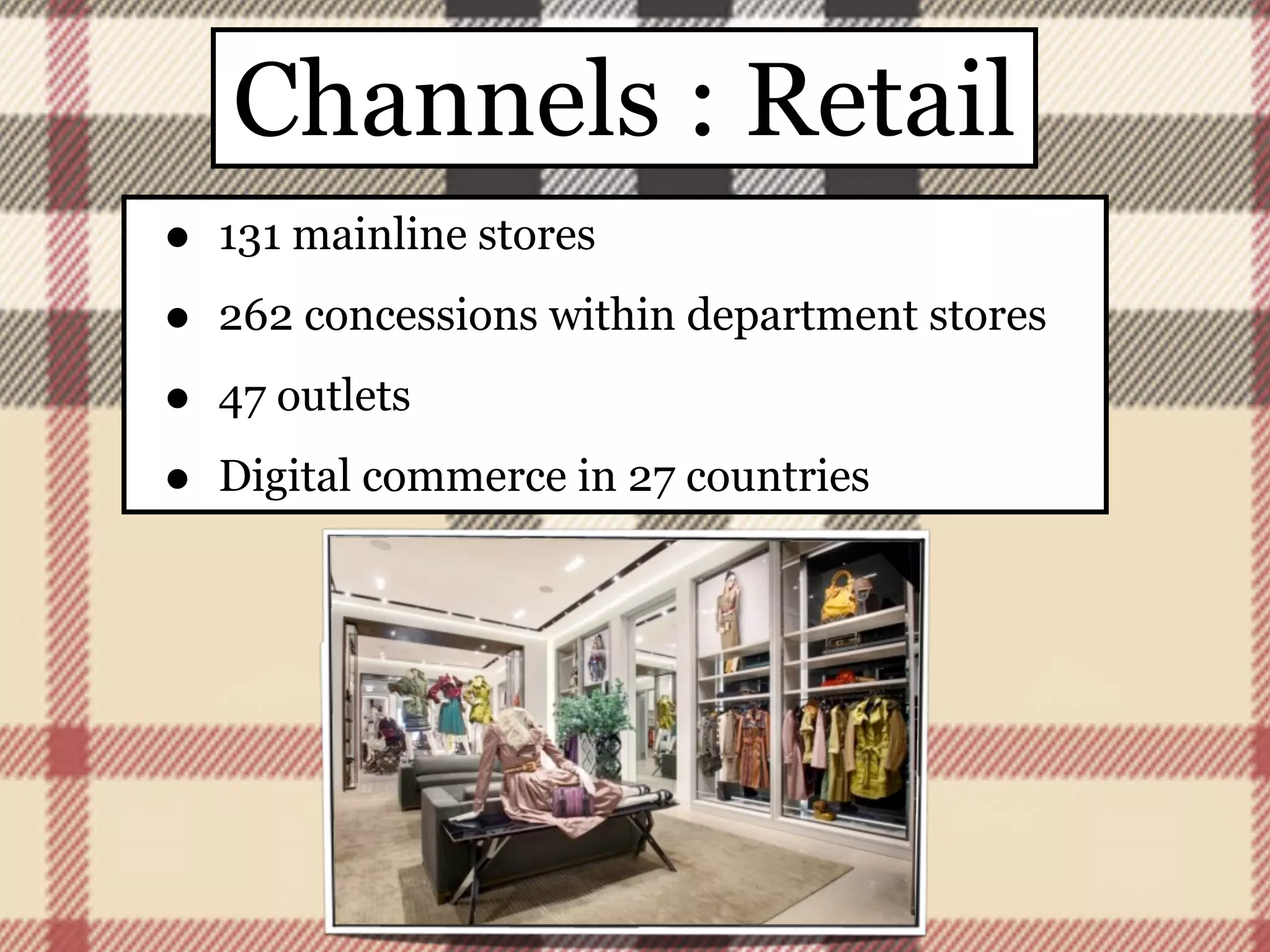
Channels : Retail
•   131 mainline stores

•   262 concessions within department stores

•   47 outlets

•   Digital commerce in 27 countries
Channels : Wholesale
•   Includes sales to prestige department stores
    and specialty retailers worldwide.

•   Sales to its franchisees who operate 97
    Burberry stores, mainly in Emerging Markets.
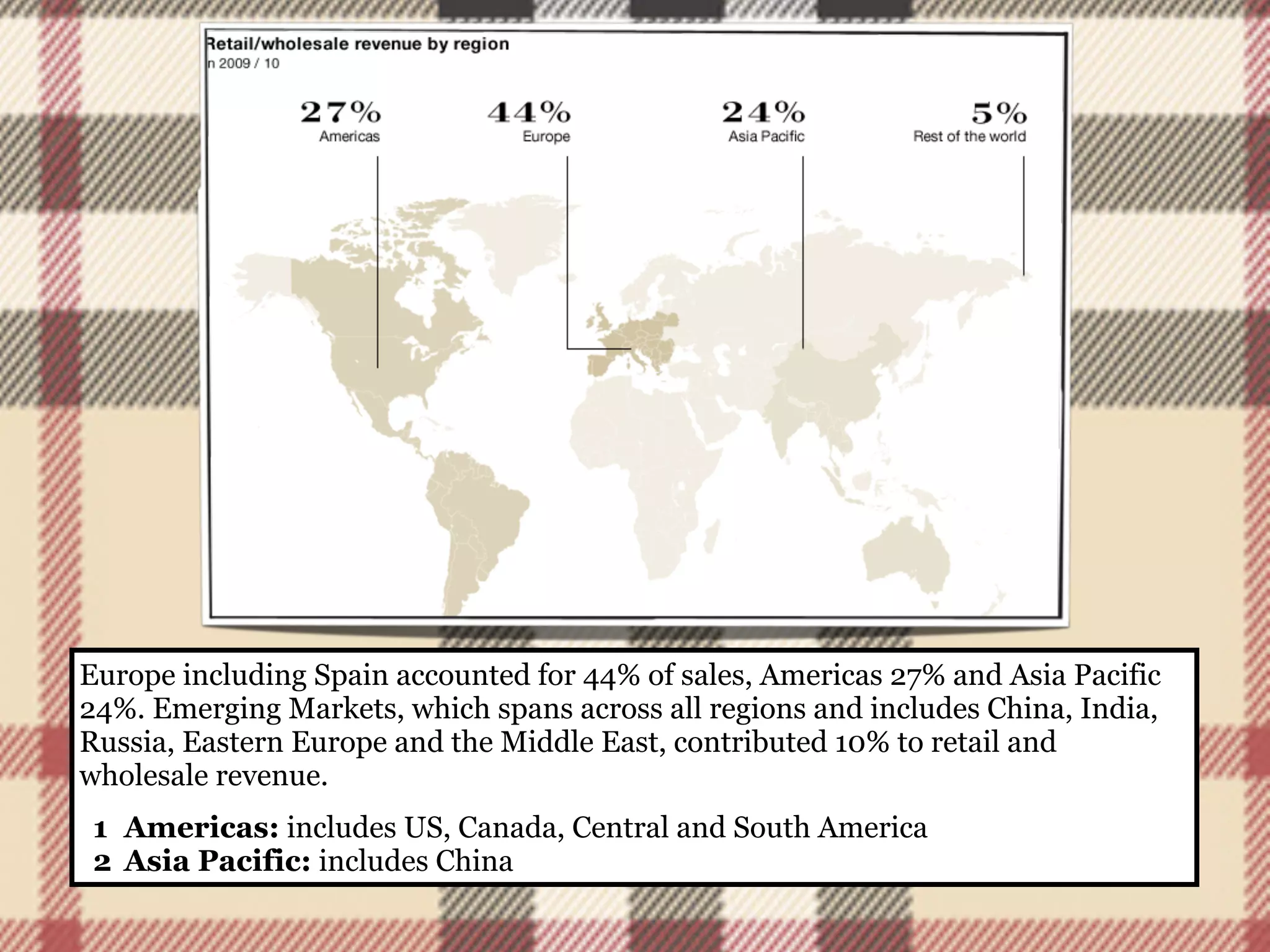
Europe including Spain accounted for 44% of sales, Americas 27% and Asia Pacific
24%. Emerging Markets, which spans across all regions and includes China, India,
Russia, Eastern Europe and the Middle East, contributed 10% to retail and
wholesale revenue.
 1 Americas: includes US, Canada, Central and South America
 2 Asia Pacific: includes China
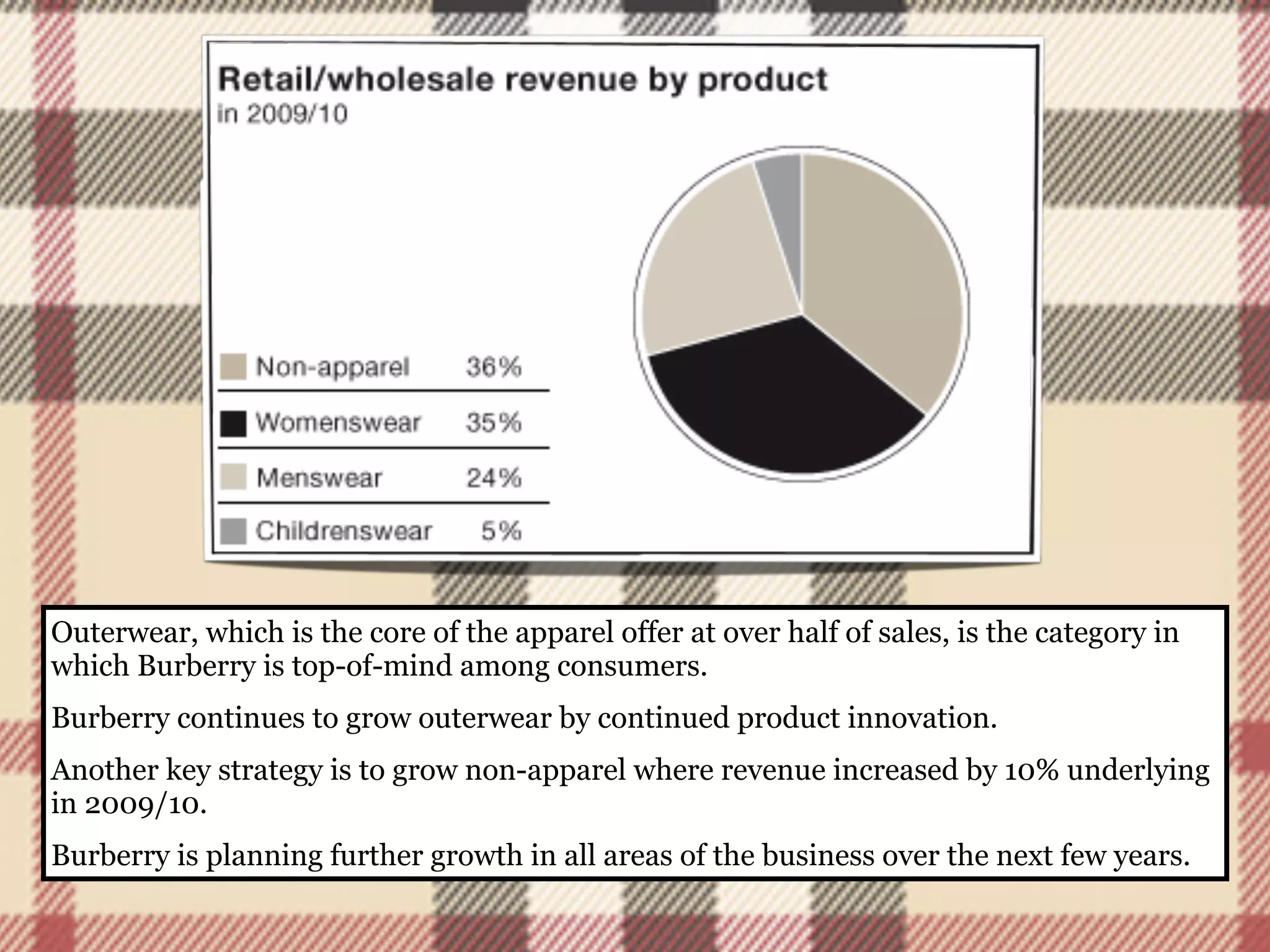
Outerwear, which is the core of the apparel offer at over half of sales, is the category in
which Burberry is top-of-mind among consumers.
Burberry continues to grow outerwear by continued product innovation.
Another key strategy is to grow non-apparel where revenue increased by 10% underlying
in 2009/10.
Burberry is planning further growth in all areas of the business over the next few years.
Channels: Licensing
•   Selective licensing agreements in Japan and globally,
    leveraging the local and technical expertise of its license
    partners.

•   Royalty income primarily received from Burberry’s
    licensees in Japan.

•   Its global licensees

      •   fragrance

      •   eyewear

      •   timepieces

      •   small menswear

      •   European children’s wear
Social & Environmental Achievements
              2010-2011
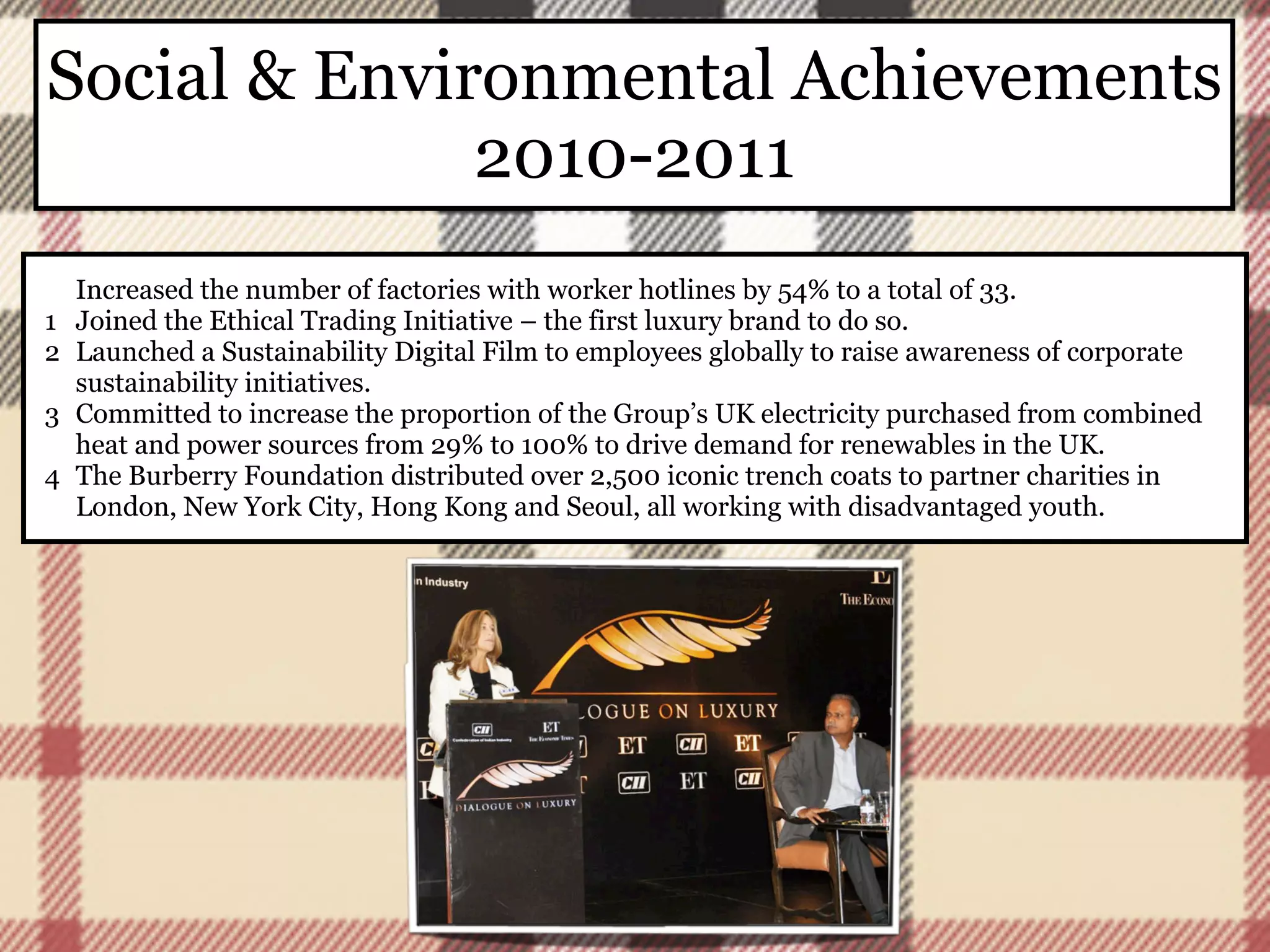
    Increased the number of factories with worker hotlines by 54% to a total of 33.
1   Joined the Ethical Trading Initiative – the first luxury brand to do so.
2   Launched a Sustainability Digital Film to employees globally to raise awareness of corporate
    sustainability initiatives.
3   Committed to increase the proportion of the Group’s UK electricity purchased from combined
    heat and power sources from 29% to 100% to drive demand for renewables in the UK.
4   The Burberry Foundation distributed over 2,500 iconic trench coats to partner charities in
    London, New York City, Hong Kong and Seoul, all working with disadvantaged youth.
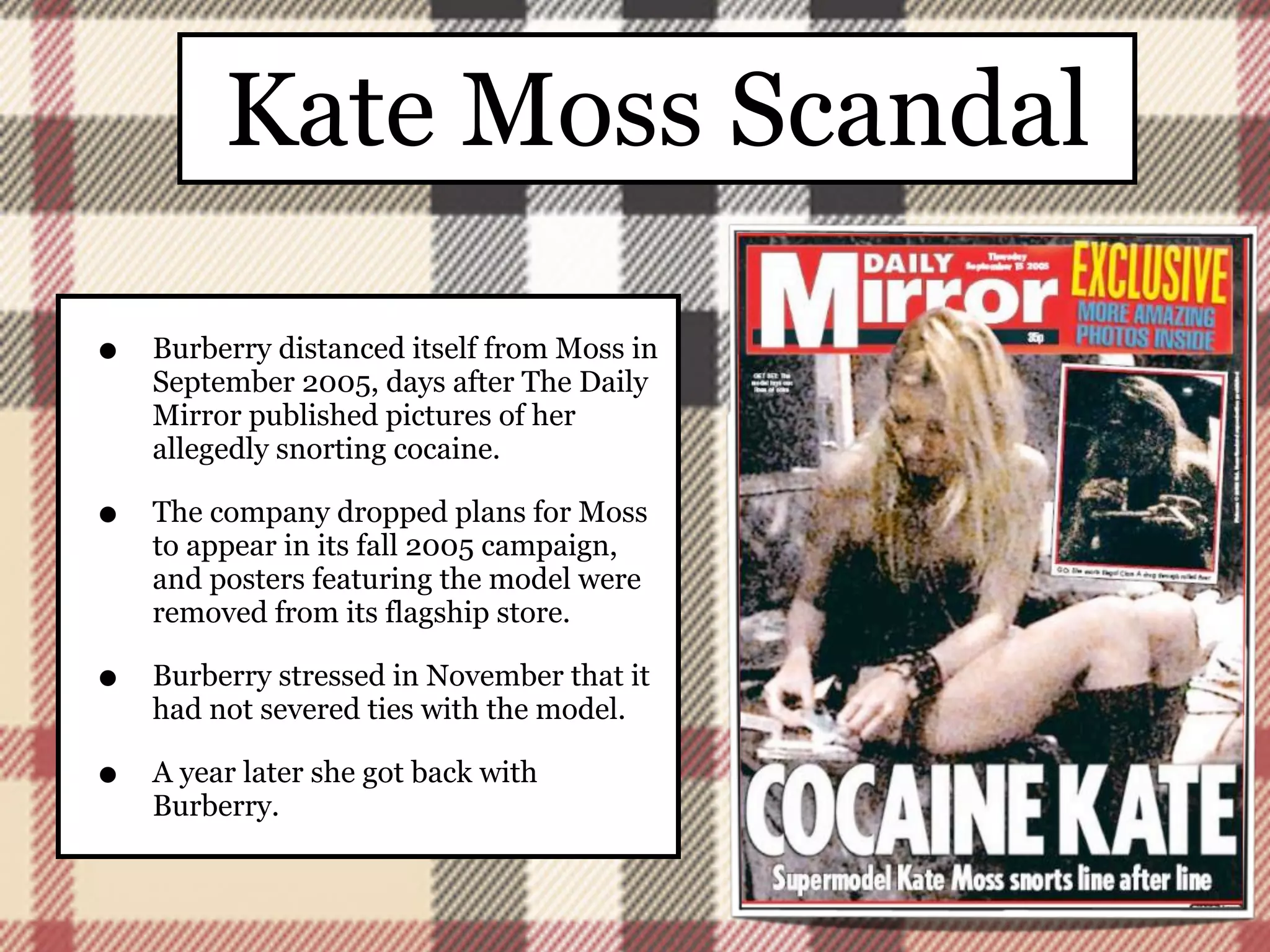
Kate Moss Scandal

•   Burberry distanced itself from Moss in
    September 2005, days after The Daily
    Mirror published pictures of her
    allegedly snorting cocaine.

•   The company dropped plans for Moss
    to appear in its fall 2005 campaign,
    and posters featuring the model were
    removed from its flagship store.

•   Burberry stressed in November that it
    had not severed ties with the model.

•   A year later she got back with
    Burberry.
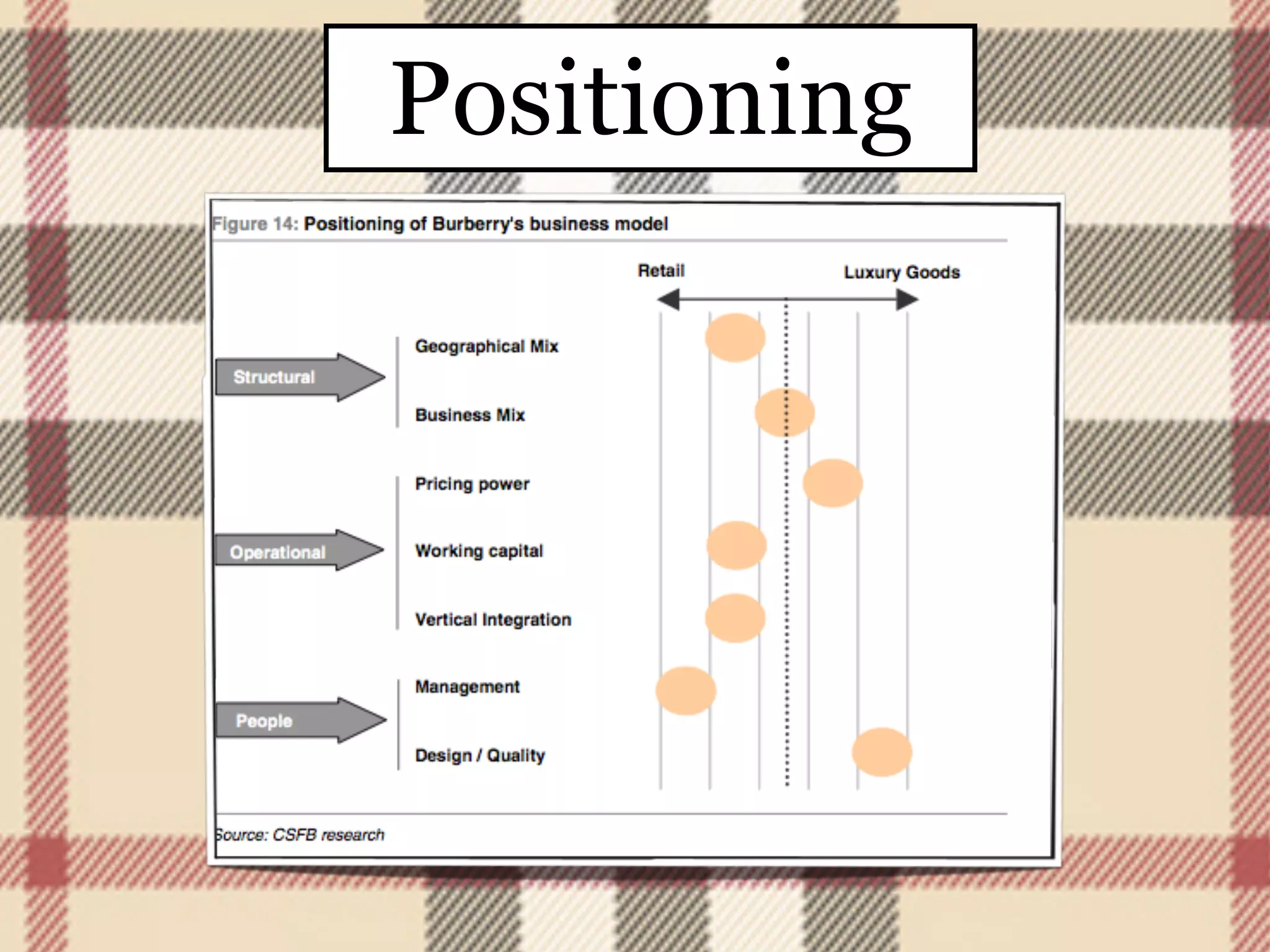
Positioning
Geographical Mix
• Under Retail
• Low transactional exposure
 • Outsourcing of productional activities
 • Allows production in various countries
     and currencies.
 •   Yen - Japan license
Vertical Integration
•   Under Retail

•   Recent acquisitions of licensees in Spain

•   Distributors in Korea and the Asia Pacific

•   Combined with ambitious retail extension

•   Not very integrated

•   Deliberately has limited production
    capabilities.
Business Mix

•   In the middle of luxury and retail.

•   Consists almost entirely of apparel and
    accessories.

•   Burberry’s business mix seems comparable to
    that of H&M, Hugo Boss and Inditex but also
    to that of Gucci and Hermès.
Pricing Power
•   Burberry sells premium products in a high-quality distribution network.

      •   This positioning is synonymous with higher prices and higher
          distribution costs.

•   The company has much lower transactional exchange exposure than luxury
    goods companies

      •   Therefore does not need to make up as much revenue in times of
          adverse exchange-rate movements.

•   Burberry has in the past increased fees due by its Japanese licensees, Sanyo
    Shokai and Mitsui & Co.
Design & Quality
•   High on Luxury goods category

•   Christopher Bailey worked at Donna Karan and
    Gucci.

•   Core heritage products

•   A high fashion range - Prorsum

•   high end product line - London
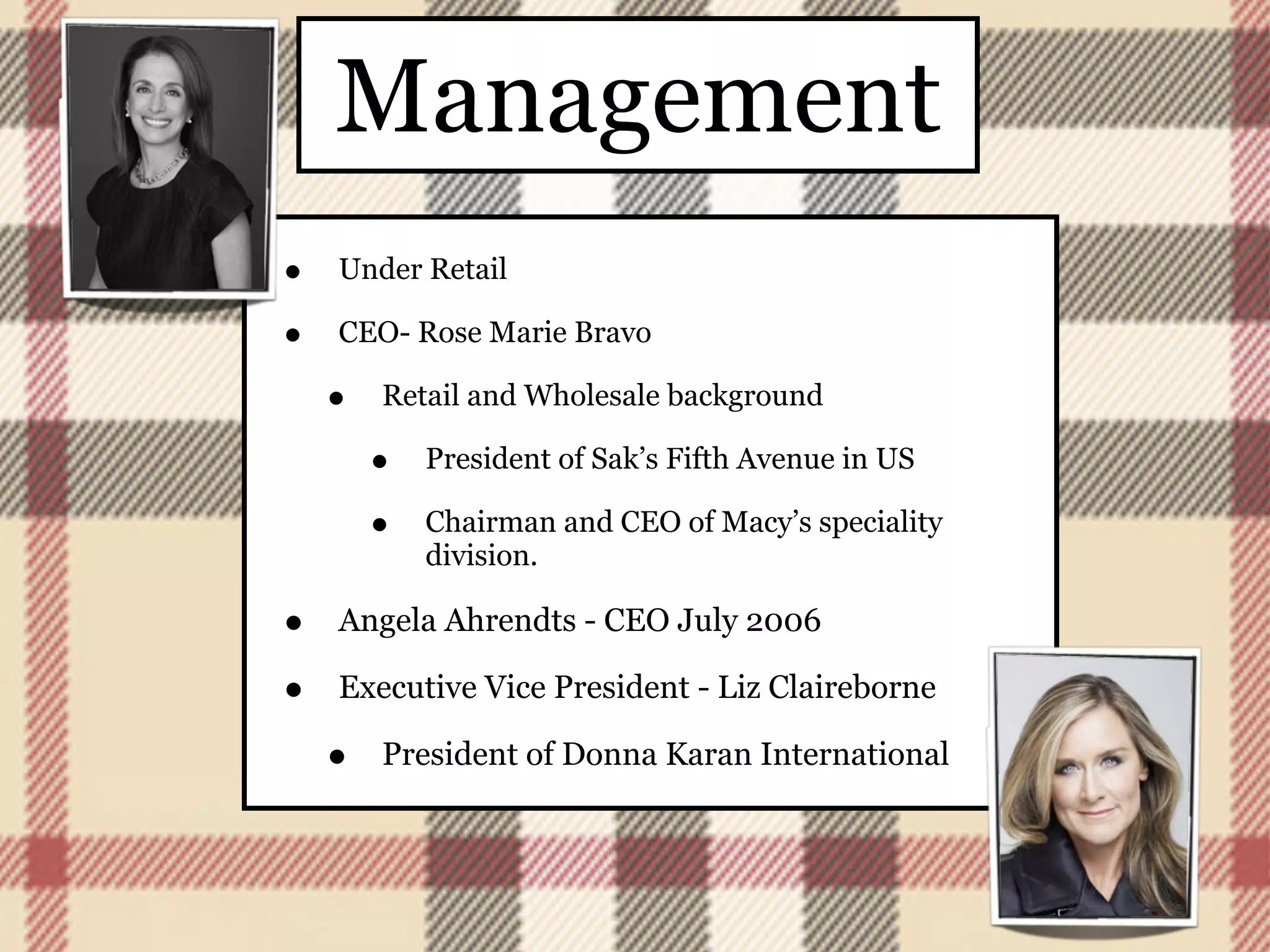
Management
•   Under Retail

•   CEO- Rose Marie Bravo

    •   Retail and Wholesale background

        •   President of Sak’s Fifth Avenue in US

        •   Chairman and CEO of Macy’s speciality
            division.

•   Angela Ahrendts - CEO July 2006

•   Executive Vice President - Liz Claireborne

    •   President of Donna Karan International
CEO Video:Angela Ahrendts
Strengths
•   Strong proven management team

•   Licensing growth delivers high return on capital

•   Heritage products

•   Flexibility in product sourcing

•   Lower transactional exchange exposure
Weaknesses
•   Low vertical integration reduces capture of
    margin and value from manufacturing.

•   Low gearing into Japanese upside.

•   Apparel segment - increased risk still accounts
    for most of company profits.
Opportunities
•   Retail network expansion

•   Widening of wholesale distribution

•   Extension of apparel offering

•   Further development accessories (Spain & Japan)

•   Increased distribution of Burberry London (Japan)
Threats
•   Conflicting interests of GUS and external Burberry
    shareholders.

•   Reliance on 3rd parties in Japan

•   Counterfeiting

•   Control over licensees and wholesale accounts

•   Company is mono-brand and trademark is core.
Conclusion
•   Explore opportunities

•   Demographic Studies

•   Know their threats

•   Relied on Licensing ---> Repositioning

•   New image -----> Success

•   Compete with some of the best luxury brands.

•   Sustainability
Any Questions?

Burberry final ppt

  • 2.
    Introduction • Burberry is a global luxury brand with a distinctive British heritage, core outerwear base and one of the most recognized icons in the world. Burberry designs, sources and markets apparel and accessories, selling through a diversified network of retail, digital commerce, wholesale and licensing channels worldwide. The business is managed by channel, region and product, supported by corporate functions.
  • 3.
    Case Study Synopsis • Founded in 1856 by Thomas Burberry • British used trench in WWI • Trademark - (a camel, black, red, and white plaid design) • Used in lining of signature trench coats • Original designs and quality • Celebrities, royalty, politicians, etc. • Symbol luxury and durability
  • 4.
    Case Study Synopsis • In 1955, Great Universal Stores Plc. bought Burberry • licensed the brand in Japan through Mitsui and Sanyo • Global recognition through licensing and distribution agreements. • 1997 new CEO Rose Marie Bravo • Cosmetic - logo and brand name • Update product line - consistency • Reposition - keep consumers and attract younger customers.
  • 5.
    Case Study Synopsis • 2003- Primary Collections • Womenswear, Menswear, Accessories • 3,162 wholesale doors worldwide • 434 department stores • 2,728 specialty stores
  • 6.
    Case Synopsis • Biggest challenge • Create a consistent brand image • Risk losing brand and credibility • Prorsum - luxury line • Advertising Campaign : 2 phases • Stella Tenant • Kate Moss
  • 7.
    Case Synopsis • Challenges • Counterfeits • Popular among urban and hip-hop musicians. • Sustainability • Brand positioning • Burberry = healthy • Manage popularity = long-term growth
  • 8.
    Within the Burberryoffering, there is a product hierarchy defining components - each with unique branding and a distinctive identity.
  • 9.
    Prorsum • Most fashion forward collection • Centered around runway shows each year • Latin word for “moves forward” • Inspires the other lines • Hand-tailored
  • 10.
  • 11.
    Burberry London (International)Line • Core collection • High-end positioning • Key to the turnaround of the Burberry brand • Strong womenswear and accessories segments • Main markets are currently in Europe and US • Products mainly sourced in Europe and UK • Thomas Burberry Spain & Portugal
  • 12.
    Burberry London (Japan)Line • Sold in Japan and made locally • High quality apparel but lower positioning and price points than the International Line. • Weaker accessories due to licenses held buy small manufacturers. • Blue and Black Labels
  • 13.
    Burberry Brit • Customer wears on weekend • Casual wear • Uses innovative and more contemporary versions of the check.
  • 14.
  • 15.
    Answers London Brit Prorsum Prorsum London Brit
  • 16.
    Burberry Brand • Defined by: • Authentic British heritage • Unique democratic positioning within the luxury arena. • Founding principles of quality, function and modern classic style, rooted in the integrity of its outerwear. • Globally recognized icon portfolio: the trench coat, trademark check and Prorsum horse logo.
  • 17.
    Burberry Business • Definedby: 1 Design, marketing and retail-led strategies 2 Digital focus and integration 3 Channel diversity: retail, digital commerce, wholesale and licensing 4 Multi-category competency: non-apparel, womenswear, menswear and children’s wear. 5 Global reach and balance: across core regions and emerging markets
  • 18.
    Culture • The culture is distinguished by: 1 Core values: to protect, explore and inspire 2 Democratic and meritocratic ethos 3 Collaboration and connectedness 4 Contributing to its communities, including through the Burberry Foundation.
  • 19.
    Burberry sells itsproducts to the end consumer through both the retail (including digital commerce) and wholesale channels. For 2009/10, retail accounted for 58% of revenue and wholesale 34%.
  • 20.
    Channels : Retail • 131 mainline stores • 262 concessions within department stores • 47 outlets • Digital commerce in 27 countries
  • 21.
    Channels : Wholesale • Includes sales to prestige department stores and specialty retailers worldwide. • Sales to its franchisees who operate 97 Burberry stores, mainly in Emerging Markets.
  • 22.
    Europe including Spainaccounted for 44% of sales, Americas 27% and Asia Pacific 24%. Emerging Markets, which spans across all regions and includes China, India, Russia, Eastern Europe and the Middle East, contributed 10% to retail and wholesale revenue. 1 Americas: includes US, Canada, Central and South America 2 Asia Pacific: includes China
  • 23.
    Outerwear, which isthe core of the apparel offer at over half of sales, is the category in which Burberry is top-of-mind among consumers. Burberry continues to grow outerwear by continued product innovation. Another key strategy is to grow non-apparel where revenue increased by 10% underlying in 2009/10. Burberry is planning further growth in all areas of the business over the next few years.
  • 24.
    Channels: Licensing • Selective licensing agreements in Japan and globally, leveraging the local and technical expertise of its license partners. • Royalty income primarily received from Burberry’s licensees in Japan. • Its global licensees • fragrance • eyewear • timepieces • small menswear • European children’s wear
  • 25.
    Social & EnvironmentalAchievements 2010-2011 Increased the number of factories with worker hotlines by 54% to a total of 33. 1 Joined the Ethical Trading Initiative – the first luxury brand to do so. 2 Launched a Sustainability Digital Film to employees globally to raise awareness of corporate sustainability initiatives. 3 Committed to increase the proportion of the Group’s UK electricity purchased from combined heat and power sources from 29% to 100% to drive demand for renewables in the UK. 4 The Burberry Foundation distributed over 2,500 iconic trench coats to partner charities in London, New York City, Hong Kong and Seoul, all working with disadvantaged youth.
  • 26.
    Kate Moss Scandal • Burberry distanced itself from Moss in September 2005, days after The Daily Mirror published pictures of her allegedly snorting cocaine. • The company dropped plans for Moss to appear in its fall 2005 campaign, and posters featuring the model were removed from its flagship store. • Burberry stressed in November that it had not severed ties with the model. • A year later she got back with Burberry.
  • 27.
  • 28.
    Geographical Mix • UnderRetail • Low transactional exposure • Outsourcing of productional activities • Allows production in various countries and currencies. • Yen - Japan license
  • 29.
    Vertical Integration • Under Retail • Recent acquisitions of licensees in Spain • Distributors in Korea and the Asia Pacific • Combined with ambitious retail extension • Not very integrated • Deliberately has limited production capabilities.
  • 30.
    Business Mix • In the middle of luxury and retail. • Consists almost entirely of apparel and accessories. • Burberry’s business mix seems comparable to that of H&M, Hugo Boss and Inditex but also to that of Gucci and Hermès.
  • 31.
    Pricing Power • Burberry sells premium products in a high-quality distribution network. • This positioning is synonymous with higher prices and higher distribution costs. • The company has much lower transactional exchange exposure than luxury goods companies • Therefore does not need to make up as much revenue in times of adverse exchange-rate movements. • Burberry has in the past increased fees due by its Japanese licensees, Sanyo Shokai and Mitsui & Co.
  • 32.
    Design & Quality • High on Luxury goods category • Christopher Bailey worked at Donna Karan and Gucci. • Core heritage products • A high fashion range - Prorsum • high end product line - London
  • 33.
    Management • Under Retail • CEO- Rose Marie Bravo • Retail and Wholesale background • President of Sak’s Fifth Avenue in US • Chairman and CEO of Macy’s speciality division. • Angela Ahrendts - CEO July 2006 • Executive Vice President - Liz Claireborne • President of Donna Karan International
  • 34.
  • 35.
    Strengths • Strong proven management team • Licensing growth delivers high return on capital • Heritage products • Flexibility in product sourcing • Lower transactional exchange exposure
  • 36.
    Weaknesses • Low vertical integration reduces capture of margin and value from manufacturing. • Low gearing into Japanese upside. • Apparel segment - increased risk still accounts for most of company profits.
  • 37.
    Opportunities • Retail network expansion • Widening of wholesale distribution • Extension of apparel offering • Further development accessories (Spain & Japan) • Increased distribution of Burberry London (Japan)
  • 38.
    Threats • Conflicting interests of GUS and external Burberry shareholders. • Reliance on 3rd parties in Japan • Counterfeiting • Control over licensees and wholesale accounts • Company is mono-brand and trademark is core.
  • 39.
    Conclusion • Explore opportunities • Demographic Studies • Know their threats • Relied on Licensing ---> Repositioning • New image -----> Success • Compete with some of the best luxury brands. • Sustainability
  • 40.