1
SKIM: Decision Behavior Specialists
Alex Zhu | Ariel Herrlich | February 2016
Leveraging Patient Support Programs in
Biologic-Biosimilar Competitive Landscape
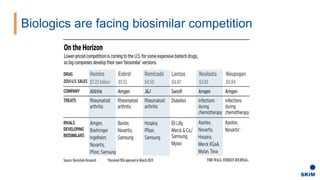
Biologics are facing biosimilar competition
2
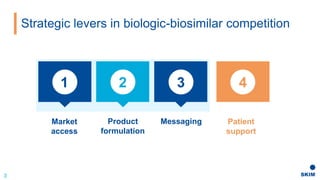
Strategic levers in biologic-biosimilar competition
3
Patient
support
Market
access
Product
formulation
Messaging
1 2 3 4
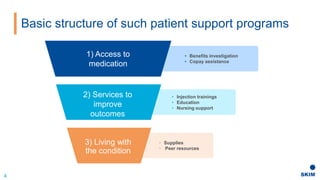
• Benefits investigation
• Copay assistance
• Injection trainings
• Education
• Nursing support
• Supplies
• Peer resources
Basic structure of such patient support programs
4
1) Access to
medication
2) Services to
improve
outcomes
3) Living with
the condition
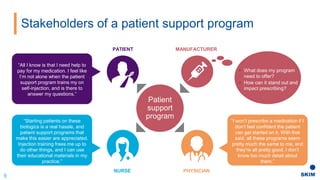
Stakeholders of a patient support program
5
Patient
support
program
“All I know is that I need help to
pay for my medication. I feel like
I’m not alone when the patient
support program trains my on
self-injection, and is there to
answer my questions.”
“Starting patients on these
biologics is a real hassle, and
patient support programs that
make this easier are appreciated.
Injection training frees me up to
do other things, and I can use
their educational materials in my
practice.”
• What does my program
need to offer?
• How can it stand out and
impact prescribing?
“I won’t prescribe a medication if I
don’t feel confident the patient
can get started on it. With that
said, all these programs seem
pretty much the same to me, and
they’re all pretty good. I don’t
know too much detail about
them.”
PATIENT MANUFACTURER
NURSE PHYSICIAN
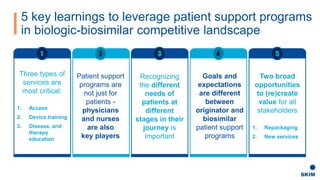
5 key learnings to leverage patient support programs
in biologic-biosimilar competitive landscape
1 2 3 4 5
Three types of
services are
most critical:
1. Access
2. Device training
3. Disease, and
therapy
education
Recognizing
the different
needs of
patients at
different
stages in their
journey is
important
Two broad
opportunities
to (re)create
value for all
stakeholders
1. Repackaging
2. New services
Goals and
expectations
are different
between
originator and
biosimilar
patient support
programs
Patient support
programs are
not just for
patients -
physicians
and nurses
are also
key players
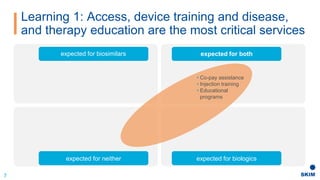
Learning 1: Access, device training and disease,
and therapy education are the most critical services
7
expected for biologics
expected for bothexpected for biosimilars
expected for neither
• Co-pay assistance
• Injection training
• Educational
programs
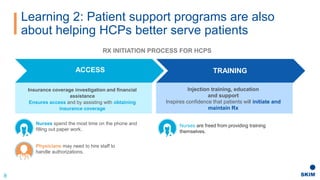
Learning 2: Patient support programs are also
about helping HCPs better serve patients
8
RX INITIATION PROCESS FOR HCPS
ACCESS TRAINING
Insurance coverage investigation and financial
assistance
Ensures access and by assisting with obtaining
insurance coverage
Injection training, education
and support
Inspires confidence that patients will initiate and
maintain Rx
Nurses spend the most time on the phone and
filling out paper work.
Physicians may need to hire staff to
handle authorizations.
Nurses are freed from providing training
themselves.
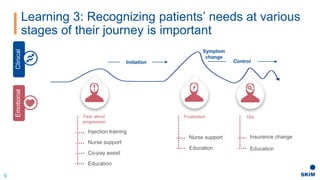
Learning 3: Recognizing patients’ needs at various
stages of their journey is important
9
Initiation Control
QoLFrustration
Symptom
change
Fear about
progression
Injection training
Nurse support
Co-pay assist
Education
Nurse support
Education
Insurance change
Education
EmotionalClinical
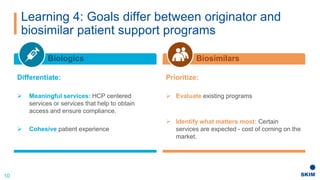
Learning 4: Goals differ between originator and
biosimilar patient support programs
10
Biologics Biosimilars
Differentiate:
 Meaningful services: HCP centered
services or services that help to obtain
access and ensure compliance.
 Cohesive patient experience
Prioritize:
 Evaluate existing programs
 Identify what matters most: Certain
services are expected - cost of coming on the
market.
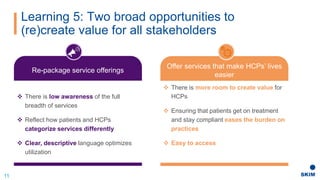
 There is low awareness of the full
breadth of services
 Reflect how patients and HCPs
categorize services differently
 Clear, descriptive language optimizes
utilization
 There is more room to create value for
HCPs
 Ensuring that patients get on treatment
and stay compliant eases the burden on
practices
 Easy to access
Learning 5: Two broad opportunities to
(re)create value for all stakeholders
11
Re-package service offerings
Offer services that make HCPs’ lives
easier
12
Framework and considerations
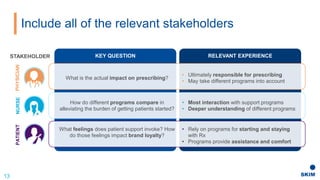
Include all of the relevant stakeholders
13
What is the actual impact on prescribing?
• Ultimately responsible for prescribing
• May take different programs into account
How do different programs compare in
alleviating the burden of getting patients started?
• Most interaction with support programs
• Deeper understanding of different programs
What feelings does patient support invoke? How
do those feelings impact brand loyalty?
• Rely on programs for starting and staying
with Rx
• Programs provide assistance and comfort
KEY QUESTION RELEVANT EXPERIENCE
PATIENTNURSEPHYSICIAN
STAKEHOLDER
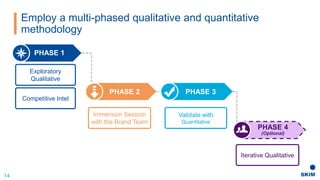
Employ a multi-phased qualitative and quantitative
methodology
14
PHASE 1
PHASE 2 PHASE 3
PHASE 4
(Optional)
Exploratory
Qualitative
Immersion Session
with the Brand Team
Validate with
Quantitative
Iterative Qualitative
Competitive Intel
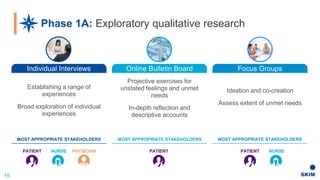
Phase 1A: Exploratory qualitative research
15
Individual Interviews Online Bulletin Board Focus Groups
Establishing a range of
experiences
Broad exploration of individual
experiences
Projective exercises for
unstated feelings and unmet
needs
In-depth reflection and
descriptive accounts
Ideation and co-creation
Assess extent of unmet needs
MOST APPROPRIATE STAKEHOLDERS MOST APPROPRIATE STAKEHOLDERS
PATIENT NURSE PHYSICIAN PATIENT NURSEPATIENT
MOST APPROPRIATE STAKEHOLDERS
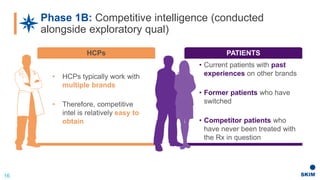
Phase 1B: Competitive intelligence (conducted
alongside exploratory qual)
16
• HCPs typically work with
multiple brands
• Therefore, competitive
intel is relatively easy to
obtain
• Current patients with past
experiences on other brands
• Former patients who have
switched
• Competitor patients who
have never been treated with
the Rx in question
HCPs PATIENTS
Phase 2: Immersion session with Brand team
17
• Discuss the qualitative outcomes deemed relevant
• Identify relevant service offering packages
• Align the outcomes of the quantification phase with brand team needs and
expectations
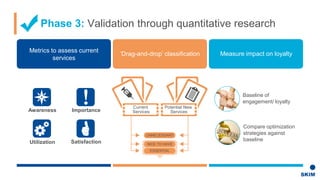
Phase 3: Validation through quantitative research
Metrics to assess current
services
‘Drag-and-drop’ classification Measure impact on loyalty
Current
Services
Potential New
Services
UNNECESSARY
NICE TO HAVE
ESSENTIAL
Awareness Importance
SatisfactionUtilization
Baseline of
engagement/ loyalty
Compare optimization
strategies against
baseline
Contact
19
skimgroup.com
SKIM: Decision Behavior Specialists
Alex Xiaogung Zhu
Manager
Based in New York
Ariel Herrlich
Analyst
Based in New York

Leveraging Patient Support Programs in Biologic-Biosimilar Competitive Landscape

  • 1.
    1 SKIM: Decision BehaviorSpecialists Alex Zhu | Ariel Herrlich | February 2016 Leveraging Patient Support Programs in Biologic-Biosimilar Competitive Landscape
  • 2.
    Biologics are facingbiosimilar competition 2
  • 3.
    Strategic levers inbiologic-biosimilar competition 3 Patient support Market access Product formulation Messaging 1 2 3 4
  • 4.
    • Benefits investigation •Copay assistance • Injection trainings • Education • Nursing support • Supplies • Peer resources Basic structure of such patient support programs 4 1) Access to medication 2) Services to improve outcomes 3) Living with the condition
  • 5.
    Stakeholders of apatient support program 5 Patient support program “All I know is that I need help to pay for my medication. I feel like I’m not alone when the patient support program trains my on self-injection, and is there to answer my questions.” “Starting patients on these biologics is a real hassle, and patient support programs that make this easier are appreciated. Injection training frees me up to do other things, and I can use their educational materials in my practice.” • What does my program need to offer? • How can it stand out and impact prescribing? “I won’t prescribe a medication if I don’t feel confident the patient can get started on it. With that said, all these programs seem pretty much the same to me, and they’re all pretty good. I don’t know too much detail about them.” PATIENT MANUFACTURER NURSE PHYSICIAN
  • 6.
    5 key learningsto leverage patient support programs in biologic-biosimilar competitive landscape 1 2 3 4 5 Three types of services are most critical: 1. Access 2. Device training 3. Disease, and therapy education Recognizing the different needs of patients at different stages in their journey is important Two broad opportunities to (re)create value for all stakeholders 1. Repackaging 2. New services Goals and expectations are different between originator and biosimilar patient support programs Patient support programs are not just for patients - physicians and nurses are also key players
  • 7.
    Learning 1: Access,device training and disease, and therapy education are the most critical services 7 expected for biologics expected for bothexpected for biosimilars expected for neither • Co-pay assistance • Injection training • Educational programs
  • 8.
    Learning 2: Patientsupport programs are also about helping HCPs better serve patients 8 RX INITIATION PROCESS FOR HCPS ACCESS TRAINING Insurance coverage investigation and financial assistance Ensures access and by assisting with obtaining insurance coverage Injection training, education and support Inspires confidence that patients will initiate and maintain Rx Nurses spend the most time on the phone and filling out paper work. Physicians may need to hire staff to handle authorizations. Nurses are freed from providing training themselves.
  • 9.
    Learning 3: Recognizingpatients’ needs at various stages of their journey is important 9 Initiation Control QoLFrustration Symptom change Fear about progression Injection training Nurse support Co-pay assist Education Nurse support Education Insurance change Education EmotionalClinical
  • 10.
    Learning 4: Goalsdiffer between originator and biosimilar patient support programs 10 Biologics Biosimilars Differentiate:  Meaningful services: HCP centered services or services that help to obtain access and ensure compliance.  Cohesive patient experience Prioritize:  Evaluate existing programs  Identify what matters most: Certain services are expected - cost of coming on the market.
  • 11.
     There islow awareness of the full breadth of services  Reflect how patients and HCPs categorize services differently  Clear, descriptive language optimizes utilization  There is more room to create value for HCPs  Ensuring that patients get on treatment and stay compliant eases the burden on practices  Easy to access Learning 5: Two broad opportunities to (re)create value for all stakeholders 11 Re-package service offerings Offer services that make HCPs’ lives easier
  • 12.
  • 13.
    Include all ofthe relevant stakeholders 13 What is the actual impact on prescribing? • Ultimately responsible for prescribing • May take different programs into account How do different programs compare in alleviating the burden of getting patients started? • Most interaction with support programs • Deeper understanding of different programs What feelings does patient support invoke? How do those feelings impact brand loyalty? • Rely on programs for starting and staying with Rx • Programs provide assistance and comfort KEY QUESTION RELEVANT EXPERIENCE PATIENTNURSEPHYSICIAN STAKEHOLDER
  • 14.
    Employ a multi-phasedqualitative and quantitative methodology 14 PHASE 1 PHASE 2 PHASE 3 PHASE 4 (Optional) Exploratory Qualitative Immersion Session with the Brand Team Validate with Quantitative Iterative Qualitative Competitive Intel
  • 15.
    Phase 1A: Exploratoryqualitative research 15 Individual Interviews Online Bulletin Board Focus Groups Establishing a range of experiences Broad exploration of individual experiences Projective exercises for unstated feelings and unmet needs In-depth reflection and descriptive accounts Ideation and co-creation Assess extent of unmet needs MOST APPROPRIATE STAKEHOLDERS MOST APPROPRIATE STAKEHOLDERS PATIENT NURSE PHYSICIAN PATIENT NURSEPATIENT MOST APPROPRIATE STAKEHOLDERS
  • 16.
    Phase 1B: Competitiveintelligence (conducted alongside exploratory qual) 16 • HCPs typically work with multiple brands • Therefore, competitive intel is relatively easy to obtain • Current patients with past experiences on other brands • Former patients who have switched • Competitor patients who have never been treated with the Rx in question HCPs PATIENTS
  • 17.
    Phase 2: Immersionsession with Brand team 17 • Discuss the qualitative outcomes deemed relevant • Identify relevant service offering packages • Align the outcomes of the quantification phase with brand team needs and expectations
  • 18.
    Phase 3: Validationthrough quantitative research Metrics to assess current services ‘Drag-and-drop’ classification Measure impact on loyalty Current Services Potential New Services UNNECESSARY NICE TO HAVE ESSENTIAL Awareness Importance SatisfactionUtilization Baseline of engagement/ loyalty Compare optimization strategies against baseline
  • 19.
    Contact 19 skimgroup.com SKIM: Decision BehaviorSpecialists Alex Xiaogung Zhu Manager Based in New York Ariel Herrlich Analyst Based in New York