Challenges in healthcare
Forces of change
• Debt crises
• Globalization
• Demographic and epidemiological pressures

• Advances in communication technologies
• Declining R&D productivity
• Healthcare reforms

Old environment (1980-2000)
• Economic stability
• Focus on top 10 markets
• 6.0%-6.9% of global population 65+
• Print, television, websites
• Blockbuster business model
• Treatments for chronic conditions
• Total number of prescriptions and unit
sales

Adapted from PWC; changing context in which pharmaceutical companies operate

New environment (2011-2020+)
• Economic volatility
• Focus on key mature and growth markets
• 7.6%-9.4% of global population 65+
• Obesity epidemic
• Social media & internet make better
informed patients

• Treatments for rare/acute diseases
• Products marketed to healthcare payers
• Value-based purchasing (using outcomes)
Helix Innovation, 2013
What do they all have in common?

+
New
Technologies

Connecting
people
http://youtu.be/XzYzfD_bAGI
What do you notice?
Do you see applications in your own organization?
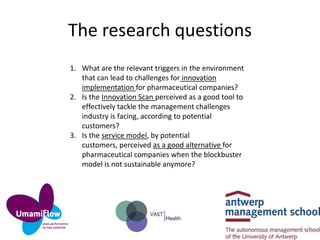
The research questions
1. What are the relevant triggers in the environment
that can lead to challenges for innovation
implementation for pharmaceutical companies?
2. Is the Innovation Scan perceived as a good tool to
effectively tackle the management challenges
industry is facing, according to potential
customers?
3. Is the service model, by potential
customers, perceived as a good alternative for
pharmaceutical companies when the blockbuster
model is not sustainable anymore?
The parties involved in research
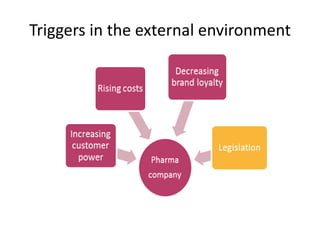
Triggers in the external environment
Current challenges in pharma
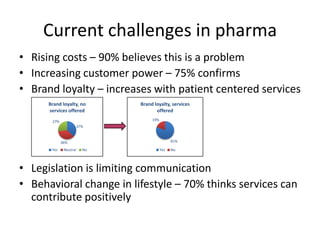
• Rising costs – 90% believes this is a problem
• Increasing customer power – 75% confirms
• Brand loyalty – increases with patient centered services
Brand loyalty, no
services offered

Brand loyalty, services
offered
19%

27%
37%

81%

36%
Yes

Neutral

No

Yes

No

• Legislation is limiting communication
• Behavioral change in lifestyle – 70% thinks services can
contribute positively
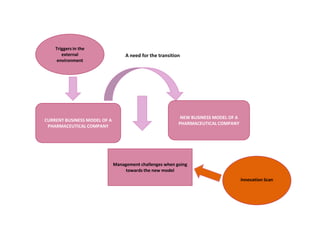
Triggers in the
external
environment

CURRENT BUSINESS MODEL OF A
PHARMACEUTICAL COMPANY

A need for the transition

NEW BUSINESS MODEL OF A
PHARMACEUTICAL COMPANY

Management challenges when going
towards the new model
Innovation Scan
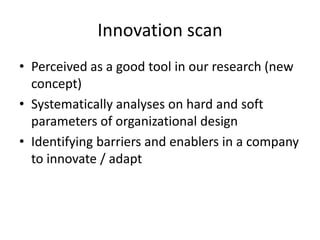
Innovation scan
• Perceived as a good tool in our research (new
concept)
• Systematically analyses on hard and soft
parameters of organizational design
• Identifying barriers and enablers in a company
to innovate / adapt
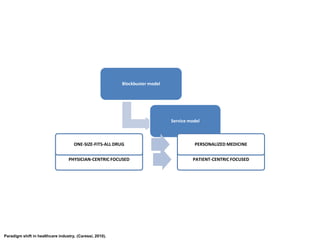
Blockbuster model

Service model

ONE-SIZE-FITS-ALL DRUG

PERSONALIZED MEDICINE

PHYSICIAN-CENTRIC FOCUSED

PATIENT-CENTRIC FOCUSED

Paradigm shift in healthcare industry, (Caressi, 2010).
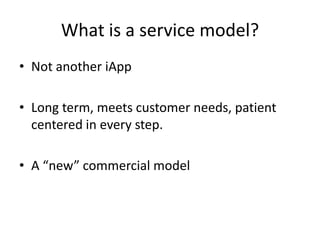
What is a service model?
• Not another iApp
• Long term, meets customer needs, patient
centered in every step.
• A “new” commercial model
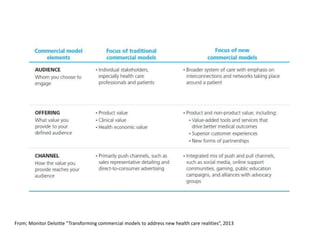
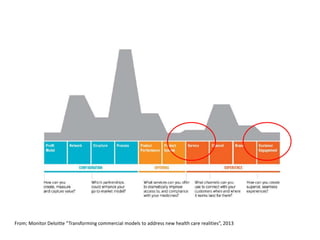
From; Monitor Deloitte “Transforming commercial models to address new health care realities”, 2013
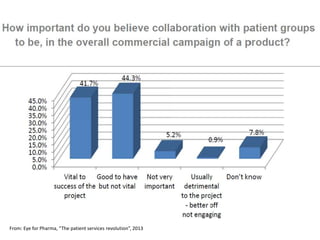
From: Eye for Pharma, “The patient services revolution”, 2013
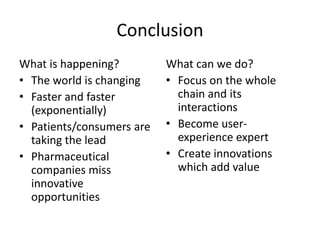
Conclusion
What is happening?
• The world is changing
• Faster and faster
(exponentially)
• Patients/consumers are
taking the lead
• Pharmaceutical
companies miss
innovative
opportunities

What can we do?
• Focus on the whole
chain and its
interactions
• Become userexperience expert
• Create innovations
which add value
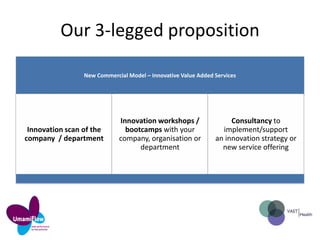
Our 3-legged proposition
New Commercial Model – Innovative Value Added Services

Innovation scan of the
company / department

Innovation workshops /
bootcamps with your
company, organisation or
department

Consultancy to
implement/support
an innovation strategy or
new service offering
Our partners, networks &
methodologies

Adding value and patient-centric services and innovation in pharma

  • 2.
  • 3.
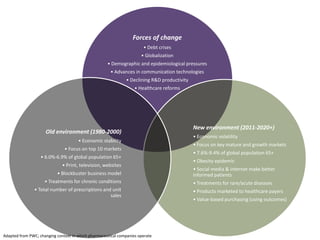
    Forces of change •Debt crises • Globalization • Demographic and epidemiological pressures • Advances in communication technologies • Declining R&D productivity • Healthcare reforms Old environment (1980-2000) • Economic stability • Focus on top 10 markets • 6.0%-6.9% of global population 65+ • Print, television, websites • Blockbuster business model • Treatments for chronic conditions • Total number of prescriptions and unit sales Adapted from PWC; changing context in which pharmaceutical companies operate New environment (2011-2020+) • Economic volatility • Focus on key mature and growth markets • 7.6%-9.4% of global population 65+ • Obesity epidemic • Social media & internet make better informed patients • Treatments for rare/acute diseases • Products marketed to healthcare payers • Value-based purchasing (using outcomes)
  • 4.
  • 5.
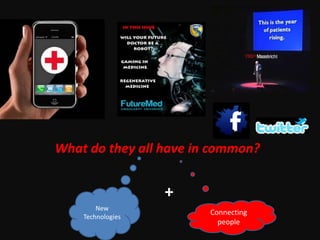
    What do theyall have in common? + New Technologies Connecting people
  • 6.
    http://youtu.be/XzYzfD_bAGI What do younotice? Do you see applications in your own organization?
  • 8.
    The research questions 1.What are the relevant triggers in the environment that can lead to challenges for innovation implementation for pharmaceutical companies? 2. Is the Innovation Scan perceived as a good tool to effectively tackle the management challenges industry is facing, according to potential customers? 3. Is the service model, by potential customers, perceived as a good alternative for pharmaceutical companies when the blockbuster model is not sustainable anymore?
  • 9.
  • 10.
    Triggers in theexternal environment
  • 11.
    Current challenges inpharma • Rising costs – 90% believes this is a problem • Increasing customer power – 75% confirms • Brand loyalty – increases with patient centered services Brand loyalty, no services offered Brand loyalty, services offered 19% 27% 37% 81% 36% Yes Neutral No Yes No • Legislation is limiting communication • Behavioral change in lifestyle – 70% thinks services can contribute positively
  • 12.
    Triggers in the external environment CURRENTBUSINESS MODEL OF A PHARMACEUTICAL COMPANY A need for the transition NEW BUSINESS MODEL OF A PHARMACEUTICAL COMPANY Management challenges when going towards the new model Innovation Scan
  • 13.
    Innovation scan • Perceivedas a good tool in our research (new concept) • Systematically analyses on hard and soft parameters of organizational design • Identifying barriers and enablers in a company to innovate / adapt
  • 14.
    Blockbuster model Service model ONE-SIZE-FITS-ALLDRUG PERSONALIZED MEDICINE PHYSICIAN-CENTRIC FOCUSED PATIENT-CENTRIC FOCUSED Paradigm shift in healthcare industry, (Caressi, 2010).
  • 15.
    What is aservice model? • Not another iApp • Long term, meets customer needs, patient centered in every step. • A “new” commercial model
  • 16.
    From; Monitor Deloitte“Transforming commercial models to address new health care realities”, 2013
  • 17.
    From; Monitor Deloitte“Transforming commercial models to address new health care realities”, 2013
  • 18.
    From: Eye forPharma, “The patient services revolution”, 2013
  • 19.
    Conclusion What is happening? •The world is changing • Faster and faster (exponentially) • Patients/consumers are taking the lead • Pharmaceutical companies miss innovative opportunities What can we do? • Focus on the whole chain and its interactions • Become userexperience expert • Create innovations which add value
  • 20.
    Our 3-legged proposition NewCommercial Model – Innovative Value Added Services Innovation scan of the company / department Innovation workshops / bootcamps with your company, organisation or department Consultancy to implement/support an innovation strategy or new service offering
  • 21.
    Our partners, networks& methodologies

Editor's Notes

  • #6 Social Media en Internet informeren consumenten en patiënten steeds meer en beter. Nieuwe technologieën zorgen voor toepassingen en mogelijkheden die we ons nooit voor mogelijk hebben gehouden.Zeer recent is er een artikel gepubliceerd met de titel “Real-world experience with colorectal cancer chemotherapies: patient web forum analysis”Patient web forums provide a unique opportunity for patients to spontaneously post their experiences and thoughts about diseases and treatments. This study explored the impact of colorectal cancer (CRC) treatments in patient web forums. Zowerdduseenanalysegemaakt van watechtbelangrijk is voorpatienten, waarmakenzezichmeestezorgenom, welkebehoefteleefter en welkeemotieoverheerster. Supported by BMS. (uitprinten en uitdelen).
  • #11 From the introductionyoucanimaginethat these external triggers are leadingtopressures on the pharmacuetical company toinnovate. We triedtoquantify the sizeandurgency of these challenges.Challenges (barriers to implement innovation/service model):Patients -> customers. Pharma can give more insight in disease and think in non-medical ways to incorporate the patient’s voice in their strategy. Reimbursement constrains (outcome, adherence/compliance): combi service and product modelPost-patent strategy (extra services) especially for chronic diseases: proactive development!Pressure patient orgs. Not use as excuse for resistance to change. Fill gap between PC and POs.Biggest challenge of all: multi-stakeholders (read: people) and internal change…Oplossingen: patient-centered approach, more outcomes, adherence, personalized approach + step by step approach, wise change management, communication, external bridging/coaching
  • #12 Kostendruk en toenemende verwachtingen van consumenten worden door de meesten gevoeld als belangrijke uitdagingen.Brandloyalty kan grotendeels beinvloed worden door implementatie van relevante services.We denken dat de beperking voor communicatiee met patiententotal is, terwijl wanneer je geen reklame-uitingen doet kan het prima.
  • #20 Triangle of performance innovation and creativity: to perform in these changing times, you need to be an adaptive organization / unit. Getting to results = provide health = via pills but also via services/prevention/adherence/compliance/better outcomes/personalized medicine/information… To be adaptive requires individuals, teams and the organization to be creative in a sustainable way (needs to be accepted in the culture -> leaders need to create the environment/context for creativity to thrive). That is real innovation: the process to continuously capture the good ideas , integrate them strategically in an early development stage , and implement.
  • #21 Scan generatesinsights in organisationalarchitectureConnect patient organizations (PO) with pharma (PC) (workshops). Out of interviews: big need for PO = information. Link Insight. Big need for PC = trust. Voorbeeld pharmacy met health café/bib. Include VOC early in the development process. FB PO: replace egosystem by ecosystem…Build patient pathway (value-added steps) -> that determines stakeholder management -> that determines actionsThe product development process consists of seven phases: understanding the customer needs, idea generation or design, product concept, prototype development, final design and pilot production, commercialization and product maintenance and extension (Cornell University, 2013) ~offer