Lets Look at WebQuests   Angie Simmons School of Education Unitec
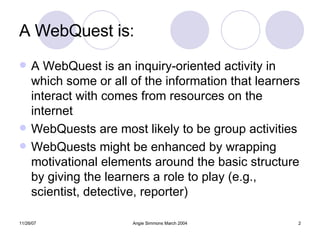
A WebQuest is: A WebQuest is an inquiry-oriented activity in which some or all of the information that learners interact with comes from resources on the internet  WebQuests are most likely to be group activities WebQuests might be enhanced by wrapping motivational elements around the basic structure by giving the learners a role to play (e.g., scientist, detective, reporter)
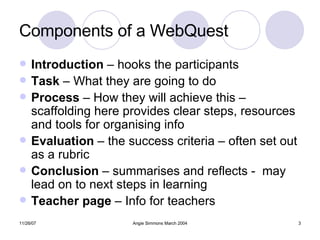
Components of a WebQuest Introduction  – hooks the participants Task  – What they are going to do Process  – How they will achieve this – scaffolding here provides clear steps, resources and tools for organising info Evaluation  – the success criteria – often set out as a rubric Conclusion  – summarises and reflects -  may lead on to next steps in learning Teacher page  – Info for teachers
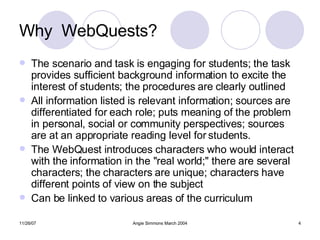
Why  WebQuests? The scenario and task is engaging for students; the task provides sufficient background information to excite the interest of students; the procedures are clearly outlined  All information listed is relevant information; sources are differentiated for each role; puts meaning of the problem in personal, social or community perspectives; sources are at an appropriate reading level for students.  The WebQuest introduces characters who would interact with the information in the "real world;" there are several characters; the characters are unique; characters have different points of view on the subject  Can be linked to various areas of the curriculum
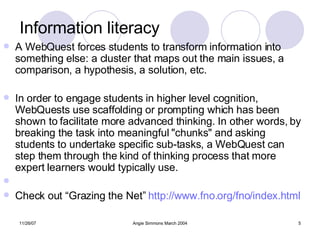
Information literacy A WebQuest forces students to transform information into something else: a cluster that maps out the main issues, a comparison, a hypothesis, a solution, etc.  In order to engage students in higher level cognition, WebQuests use scaffolding or prompting which has been shown to facilitate more advanced thinking. In other words, by breaking the task into meaningful "chunks" and asking students to undertake specific sub-tasks, a WebQuest can step them through the kind of thinking process that more expert learners would typically use. Check out “Grazing the Net”  http:// www.fno.org/fno/index.html
Let’s look at some WebQuests http://www.webquest.org http://www.bestwebquests.com/ http://studenthome.nku.edu/~webquest/gabbard/ http://webquest.sdsu.edu/materials.htm http://www.kn.pacbell.com/wired/fil/index.html http:// www.kn.pacbell.com/wired/China/ChinaQuest.html#Group http://www.tki.org.nz/e/search/results.php?2%3Aelem=DC.Type&2%3Aval=ICT%20Learning%20Experience;&2%3Avalop=OR&xsl_lang=en&xsl_path=/search/results_e.php http://projects.edtech.sandi.net/staffdev/buildingblocks/p-index.htm http://www.catawba.k12.nc.us/techtrac/plus/hildebran/ www.freewebs.com/blanchfield/webquest/ [email_address]
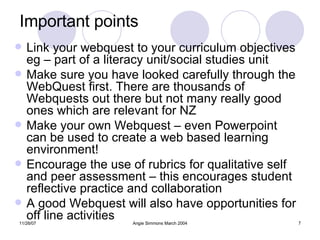
Important points Link your webquest to your curriculum objectives eg – part of a literacy unit/social studies unit Make sure you have looked carefully through the WebQuest first. There are thousands of Webquests out there but not many really good ones which are relevant for NZ  Make your own Webquest – even Powerpoint can be used to create a web based learning environment! Encourage the use of rubrics for qualitative self and peer assessment – this encourages student reflective practice and collaboration A good Webquest will also have opportunities for off line activities

Lets Look At Webquests

  • 1.
    Lets Look atWebQuests Angie Simmons School of Education Unitec
  • 2.
    A WebQuest is:A WebQuest is an inquiry-oriented activity in which some or all of the information that learners interact with comes from resources on the internet WebQuests are most likely to be group activities WebQuests might be enhanced by wrapping motivational elements around the basic structure by giving the learners a role to play (e.g., scientist, detective, reporter)
  • 3.
    Components of aWebQuest Introduction – hooks the participants Task – What they are going to do Process – How they will achieve this – scaffolding here provides clear steps, resources and tools for organising info Evaluation – the success criteria – often set out as a rubric Conclusion – summarises and reflects - may lead on to next steps in learning Teacher page – Info for teachers
  • 4.
    Why WebQuests?The scenario and task is engaging for students; the task provides sufficient background information to excite the interest of students; the procedures are clearly outlined All information listed is relevant information; sources are differentiated for each role; puts meaning of the problem in personal, social or community perspectives; sources are at an appropriate reading level for students. The WebQuest introduces characters who would interact with the information in the "real world;" there are several characters; the characters are unique; characters have different points of view on the subject Can be linked to various areas of the curriculum
  • 5.
    Information literacy AWebQuest forces students to transform information into something else: a cluster that maps out the main issues, a comparison, a hypothesis, a solution, etc. In order to engage students in higher level cognition, WebQuests use scaffolding or prompting which has been shown to facilitate more advanced thinking. In other words, by breaking the task into meaningful "chunks" and asking students to undertake specific sub-tasks, a WebQuest can step them through the kind of thinking process that more expert learners would typically use. Check out “Grazing the Net” http:// www.fno.org/fno/index.html
  • 6.
    Let’s look atsome WebQuests http://www.webquest.org http://www.bestwebquests.com/ http://studenthome.nku.edu/~webquest/gabbard/ http://webquest.sdsu.edu/materials.htm http://www.kn.pacbell.com/wired/fil/index.html http:// www.kn.pacbell.com/wired/China/ChinaQuest.html#Group http://www.tki.org.nz/e/search/results.php?2%3Aelem=DC.Type&2%3Aval=ICT%20Learning%20Experience;&2%3Avalop=OR&xsl_lang=en&xsl_path=/search/results_e.php http://projects.edtech.sandi.net/staffdev/buildingblocks/p-index.htm http://www.catawba.k12.nc.us/techtrac/plus/hildebran/ www.freewebs.com/blanchfield/webquest/ [email_address]
  • 7.
    Important points Linkyour webquest to your curriculum objectives eg – part of a literacy unit/social studies unit Make sure you have looked carefully through the WebQuest first. There are thousands of Webquests out there but not many really good ones which are relevant for NZ Make your own Webquest – even Powerpoint can be used to create a web based learning environment! Encourage the use of rubrics for qualitative self and peer assessment – this encourages student reflective practice and collaboration A good Webquest will also have opportunities for off line activities