 Where do you teach?
 What lever are your students?
 How many students in your classroom?
How do you plan your lessons?
When do you plan your lessons?
How much time do spend planning?
Why do you plan lessons?
Why don’t you plan lessons
Effective lessons
are
ones that lead students
towards clear
objectives.
Diana M. Salcedo
Gist Volume IV November
2010 Bogota Colombia
 Ask yourself: What do I want students to be
able to do at the end of the lesson?”
 Think Observable – what do you want to see
them doing?
 Think Specific
 For example……
 Types of Objectives
 Language Skills
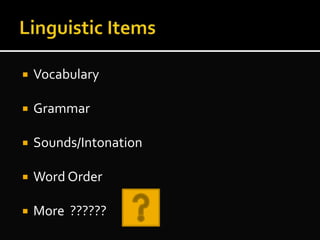
 Linguistic Items
 The Learning Process
SW
BAT
’s
 What are the skills we teach in the language
classroom?
 Identify a primary skill to focus on
 Choose a secondary skill to develop in post
activities
 Skill:
Reading
Language Item:
 Regular PastTenseVerbs
Learning Process:
 Identify, Use, Personalize
Skill?
Language Item?
Learning process?
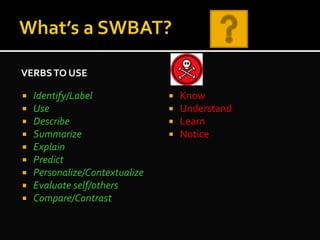
VERBSTO USE
 Identify/Label
 Use
 Describe
 Summarize
 Explain
 Predict
 Personalize/Contextualize
 Evaluate self/others
 Compare/Contrast
 Know
 Understand
 Learn
 Notice
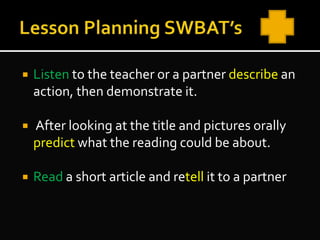
 Listen to the teacher or a partner describe an
action, then demonstrate it.
 After looking at the title and pictures orally
predict what the reading could be about.
 Read a short article and retell it to a partner
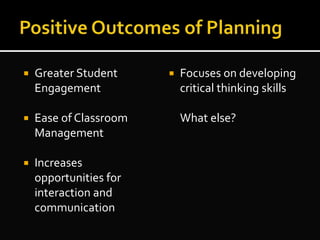
 Greater Student
Engagement
 Ease of Classroom
Management
 Increases
opportunities for
interaction and
communication
 Focuses on developing
critical thinking skills
What else?
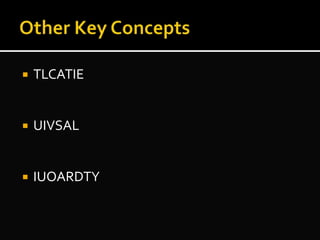
 TLCATIE
 UIVSAL
 IUOARDTY
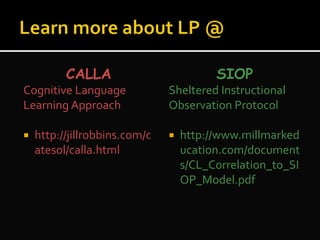
CALLA
Cognitive Language
Learning Approach
 http://jillrobbins.com/c
atesol/calla.html
SIOP
Sheltered Instructional
Observation Protocol
 http://www.millmarked
ucation.com/document
s/CL_Correlation_to_SI
OP_Model.pdf
https://docs.google.com/leaf?id=1aEcL1T00syR
sAvcXa4D68mzxhDFm9sV2t3BRTXv-
z9R9IghvtRhf5qrpirz_&hl=en&authkey=CNq
n4-wJ
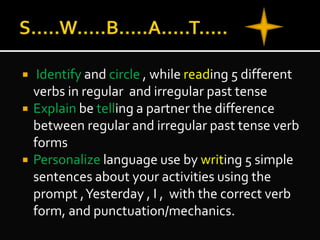
 Identify and circle , while reading 5 different
verbs in regular and irregular past tense
 Explain be telling a partner the difference
between regular and irregular past tense verb
forms
 Personalize language use by writing 5 simple
sentences about your activities using the
prompt ,Yesterday , I , with the correct verb
form, and punctuation/mechanics.
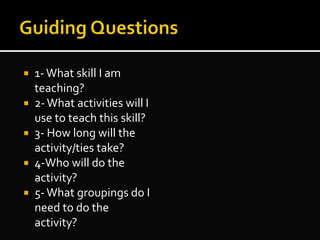
 1-What skill I am
teaching?
 2-What activities will I
use to teach this skill?
 3- How long will the
activity/ties take?
 4-Who will do the
activity?
 5-What groupings do I
need to do the
activity?
 Vocabulary
 Grammar
 Sounds/Intonation
 Word Order
 More ??????
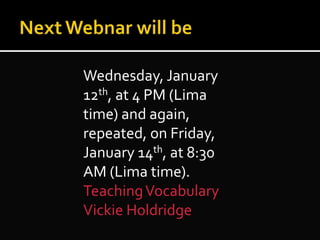
Wednesday, January
12th, at 4 PM (Lima
time) and again,
repeated, on Friday,
January 14th, at 8:30
AM (Lima time).
TeachingVocabulary
Vickie Holdridge

LessonPlanning2

  • 2.
     Where doyou teach?  What lever are your students?  How many students in your classroom?
  • 3.
    How do youplan your lessons? When do you plan your lessons? How much time do spend planning? Why do you plan lessons? Why don’t you plan lessons
  • 4.
    Effective lessons are ones thatlead students towards clear objectives. Diana M. Salcedo Gist Volume IV November 2010 Bogota Colombia
  • 5.
     Ask yourself:What do I want students to be able to do at the end of the lesson?”  Think Observable – what do you want to see them doing?  Think Specific  For example……
  • 6.
     Types ofObjectives  Language Skills  Linguistic Items  The Learning Process SW BAT ’s
  • 7.
     What arethe skills we teach in the language classroom?  Identify a primary skill to focus on  Choose a secondary skill to develop in post activities
  • 9.
     Skill: Reading Language Item: Regular PastTenseVerbs Learning Process:  Identify, Use, Personalize
  • 10.
  • 11.
    VERBSTO USE  Identify/Label Use  Describe  Summarize  Explain  Predict  Personalize/Contextualize  Evaluate self/others  Compare/Contrast  Know  Understand  Learn  Notice
  • 12.
     Listen tothe teacher or a partner describe an action, then demonstrate it.  After looking at the title and pictures orally predict what the reading could be about.  Read a short article and retell it to a partner
  • 13.
     Greater Student Engagement Ease of Classroom Management  Increases opportunities for interaction and communication  Focuses on developing critical thinking skills What else?
  • 14.
  • 15.
    CALLA Cognitive Language Learning Approach http://jillrobbins.com/c atesol/calla.html SIOP Sheltered Instructional Observation Protocol  http://www.millmarked ucation.com/document s/CL_Correlation_to_SI OP_Model.pdf
  • 16.
  • 17.
     Identify andcircle , while reading 5 different verbs in regular and irregular past tense  Explain be telling a partner the difference between regular and irregular past tense verb forms  Personalize language use by writing 5 simple sentences about your activities using the prompt ,Yesterday , I , with the correct verb form, and punctuation/mechanics.
  • 18.
     1-What skillI am teaching?  2-What activities will I use to teach this skill?  3- How long will the activity/ties take?  4-Who will do the activity?  5-What groupings do I need to do the activity?
  • 19.
     Vocabulary  Grammar Sounds/Intonation  Word Order  More ??????
  • 20.
    Wednesday, January 12th, at4 PM (Lima time) and again, repeated, on Friday, January 14th, at 8:30 AM (Lima time). TeachingVocabulary Vickie Holdridge