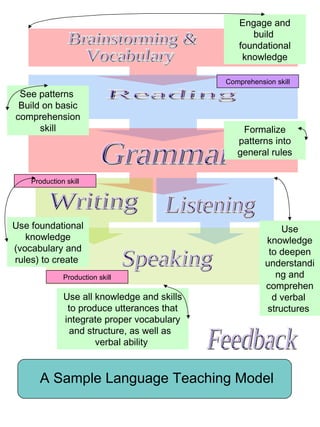
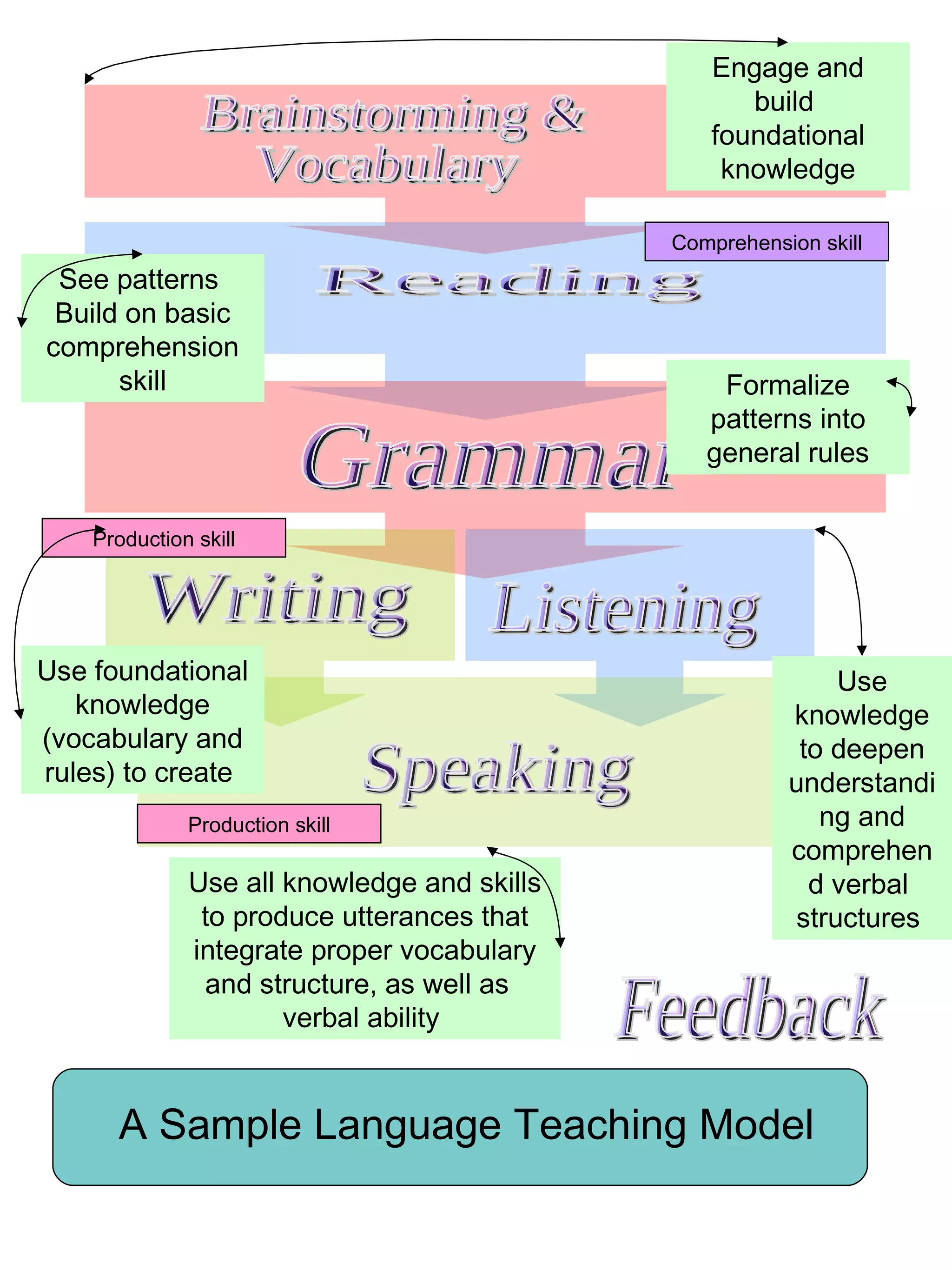
Brainstorming & Vocabulary Reading Grammar  Writing Listening Speaking Engage and build  foundational knowledge See patterns  Build on basic comprehension skill Formalize patterns into general rules Use foundational knowledge (vocabulary and rules) to create  Use knowledge to deepen understanding and comprehend verbal  structures  Use all knowledge and skills to produce utterances that integrate proper vocabulary and structure, as well as  verbal ability  Production skill Production skill Comprehension skill A Sample Language Teaching Model Feedback
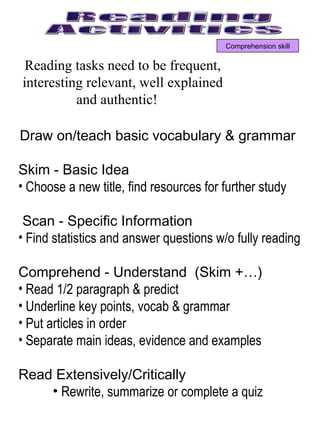
Reading  Activities Comprehension skill Reading tasks need to be frequent, interesting relevant, well explained and authentic!  Draw on/teach basic vocabulary & grammar   Skim -  Basic Idea Choose a new title, find resources for further study Scan -  Specific Information   Find statistics and answer questions w/o fully reading Comprehend -  Understand  (Skim +…) Read 1/2 paragraph & predict Underline key points, vocab & grammar  Put articles in order  Separate main ideas, evidence and examples Read Extensively/Critically Rewrite, summarize or complete a quiz
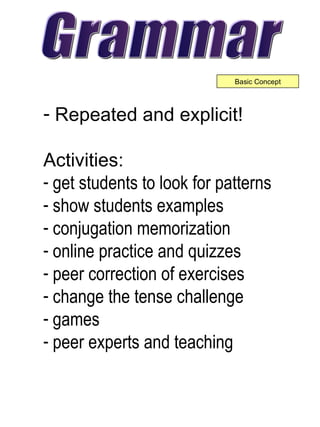
Grammar Repeated and explicit! Activities: get students to look for patterns show students examples conjugation memorization  online practice and quizzes peer correction of exercises change the tense challenge games  peer experts and teaching   Basic Concept
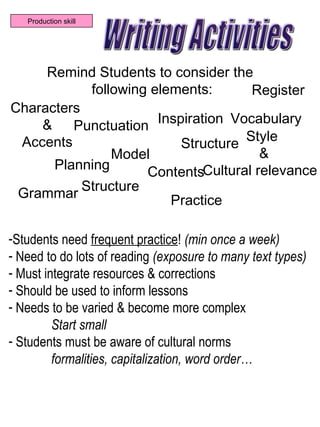
Writing Activities Remind Students to consider the  following elements: Register Grammar Vocabulary Practice Planning   Characters  & Accents Contents Structure Structure Model Inspiration   Style  & Cultural relevance   Punctuation Production skill Students need  frequent practice !  (min once a week) Need to do lots of reading  (exposure to many text types) Must integrate resources & corrections Should be used to inform lessons  Needs to be varied & become more complex Start small Students must be aware of cultural norms  formalities, capitalization, word order…
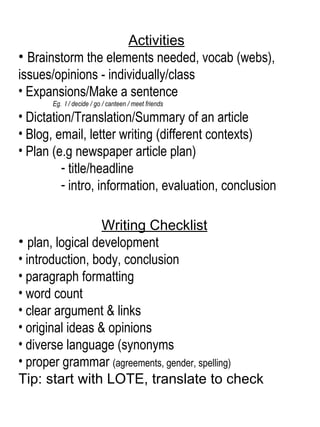
Activities Brainstorm the elements needed, vocab (webs),  issues/opinions - individually/class Expansions/Make a sentence Eg.  I / decide / go / canteen / meet friends Dictation/Translation/Summary of an article  Blog, email, letter writing (different contexts) Plan (e.g newspaper article plan) title/headline intro, information, evaluation, conclusion   Writing Checklist   plan, logical development introduction, body, conclusion  paragraph formatting  word count  clear argument & links original ideas & opinions  diverse language (synonyms proper grammar  (agreements, gender, spelling) Tip: start with LOTE, translate to check
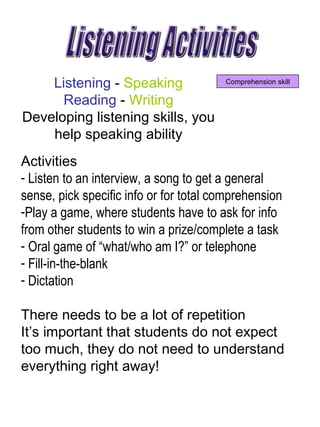
Listening Activities Comprehension skill Listening  -  Speaking  Reading  -  Writing  Developing listening skills, you  help speaking ability  Activities  Listen to an interview, a song to get a general sense, pick specific info or for total comprehension Play a game, where students have to ask for info from other students to win a prize/complete a task Oral game of “what/who am I?” or telephone Fill-in-the-blank Dictation   There needs to be a lot of repetition  It’s important that students do not expect too much, they do not need to understand everything right away!
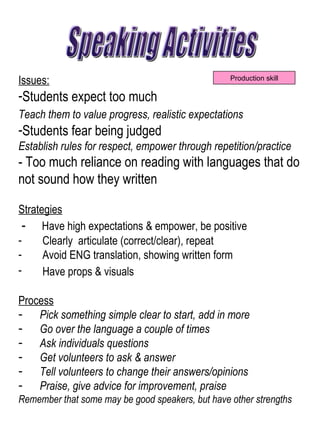
Speaking Activities Issues:   Students expect too much  Teach them to value progress, realistic expectations   Students fear being judged  Establish rules for respect, empower through repetition/practice - Too much reliance on reading with languages that do not sound how they written Strategies -  Have high expectations & empower, be positive Clearly  articulate (correct/clear), repeat Avoid ENG translation, showing written form Have props & visuals   Process Pick something simple clear to start, add in more  Go over the language a couple of times  Ask individuals questions  Get volunteers to ask & answer Tell volunteers to change their answers/opinions  Praise, give advice for improvement, praise  Remember that some may be good speakers, but have other strengths Production skill
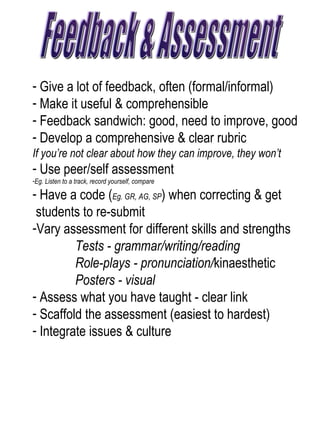
Feedback & Assessment Give a lot of feedback, often (formal/informal) Make it useful & comprehensible  Feedback sandwich: good, need to improve, good Develop a comprehensive & clear rubric  If you’re not clear about how they can improve, they won’t Use peer/self assessment  Eg. Listen to a track, record yourself, compare Have a code ( Eg. GR, AG, SP ) when correcting & get  students to re-submit  Vary assessment for different skills and strengths  Tests - grammar/writing/reading  Role-plays - pronunciation/ kinaesthetic Posters - visual  Assess what you have taught - clear link Scaffold the assessment (easiest to hardest) Integrate issues & culture
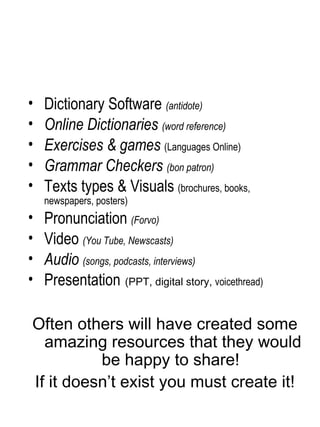
Dictionary Software  (antidote) Online Dictionaries  (word reference) Exercises & games  (Languages Online) Grammar Checkers  (bon patron) Texts types & Visuals  (brochures, books, newspapers, posters) Pronunciation  (Forvo) Video  (You Tube, Newscasts) Audio  (songs, podcasts, interviews) Presentation   (PPT, digital story,  voicethread) Often others will have created some amazing resources that they would be happy to share!  If it doesn’t exist you must create it!

Teaching models lote

  • 1.
    Brainstorming & VocabularyReading Grammar Writing Listening Speaking Engage and build foundational knowledge See patterns Build on basic comprehension skill Formalize patterns into general rules Use foundational knowledge (vocabulary and rules) to create Use knowledge to deepen understanding and comprehend verbal structures Use all knowledge and skills to produce utterances that integrate proper vocabulary and structure, as well as verbal ability Production skill Production skill Comprehension skill A Sample Language Teaching Model Feedback
  • 2.
    Reading ActivitiesComprehension skill Reading tasks need to be frequent, interesting relevant, well explained and authentic! Draw on/teach basic vocabulary & grammar Skim - Basic Idea Choose a new title, find resources for further study Scan - Specific Information Find statistics and answer questions w/o fully reading Comprehend - Understand (Skim +…) Read 1/2 paragraph & predict Underline key points, vocab & grammar Put articles in order Separate main ideas, evidence and examples Read Extensively/Critically Rewrite, summarize or complete a quiz
  • 3.
    Grammar Repeated andexplicit! Activities: get students to look for patterns show students examples conjugation memorization online practice and quizzes peer correction of exercises change the tense challenge games peer experts and teaching Basic Concept
  • 4.
    Writing Activities RemindStudents to consider the following elements: Register Grammar Vocabulary Practice Planning Characters & Accents Contents Structure Structure Model Inspiration Style & Cultural relevance Punctuation Production skill Students need frequent practice ! (min once a week) Need to do lots of reading (exposure to many text types) Must integrate resources & corrections Should be used to inform lessons Needs to be varied & become more complex Start small Students must be aware of cultural norms formalities, capitalization, word order…
  • 5.
    Activities Brainstorm theelements needed, vocab (webs), issues/opinions - individually/class Expansions/Make a sentence Eg. I / decide / go / canteen / meet friends Dictation/Translation/Summary of an article Blog, email, letter writing (different contexts) Plan (e.g newspaper article plan) title/headline intro, information, evaluation, conclusion Writing Checklist plan, logical development introduction, body, conclusion paragraph formatting word count clear argument & links original ideas & opinions diverse language (synonyms proper grammar (agreements, gender, spelling) Tip: start with LOTE, translate to check
  • 6.
    Listening Activities Comprehensionskill Listening - Speaking Reading - Writing Developing listening skills, you help speaking ability Activities Listen to an interview, a song to get a general sense, pick specific info or for total comprehension Play a game, where students have to ask for info from other students to win a prize/complete a task Oral game of “what/who am I?” or telephone Fill-in-the-blank Dictation There needs to be a lot of repetition It’s important that students do not expect too much, they do not need to understand everything right away!
  • 7.
    Speaking Activities Issues: Students expect too much Teach them to value progress, realistic expectations Students fear being judged Establish rules for respect, empower through repetition/practice - Too much reliance on reading with languages that do not sound how they written Strategies - Have high expectations & empower, be positive Clearly articulate (correct/clear), repeat Avoid ENG translation, showing written form Have props & visuals Process Pick something simple clear to start, add in more Go over the language a couple of times Ask individuals questions Get volunteers to ask & answer Tell volunteers to change their answers/opinions Praise, give advice for improvement, praise Remember that some may be good speakers, but have other strengths Production skill
  • 8.
    Feedback & AssessmentGive a lot of feedback, often (formal/informal) Make it useful & comprehensible Feedback sandwich: good, need to improve, good Develop a comprehensive & clear rubric If you’re not clear about how they can improve, they won’t Use peer/self assessment Eg. Listen to a track, record yourself, compare Have a code ( Eg. GR, AG, SP ) when correcting & get students to re-submit Vary assessment for different skills and strengths Tests - grammar/writing/reading Role-plays - pronunciation/ kinaesthetic Posters - visual Assess what you have taught - clear link Scaffold the assessment (easiest to hardest) Integrate issues & culture
  • 9.
    Dictionary Software (antidote) Online Dictionaries (word reference) Exercises & games (Languages Online) Grammar Checkers (bon patron) Texts types & Visuals (brochures, books, newspapers, posters) Pronunciation (Forvo) Video (You Tube, Newscasts) Audio (songs, podcasts, interviews) Presentation (PPT, digital story, voicethread) Often others will have created some amazing resources that they would be happy to share! If it doesn’t exist you must create it!