Exercise and fitness
Benefits to physical health What are they??? More energy Strengthens muscles and bones Enhances immune system Look good    feel good?
Benefits you don’t see Nervous system Improve reaction time Handle more weight Circulatory system Heart gets stronger, pumps blood more efficiently Respiratory system  Greater lung capacity
 
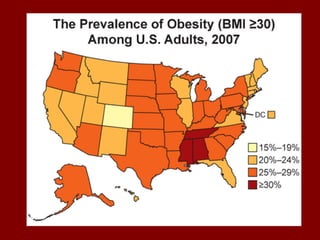
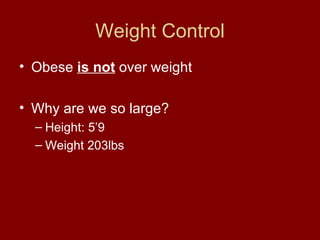
Weight Control Obese  is not  over weight Why are we so large? Height: 5’9 Weight 203lbs
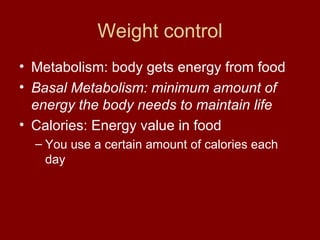
Weight control Metabolism: body gets energy from food Basal Metabolism: minimum amount of energy the body needs to maintain life  Calories: Energy value in food You use a certain amount of calories each day
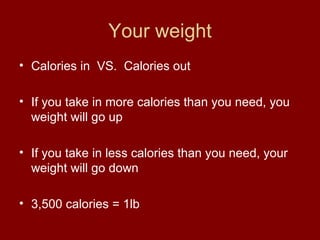
Your weight Calories in  VS.  Calories out If you take in more calories than you need, you weight will go up If you take in less calories than you need, your weight will go down  3,500 calories = 1lb
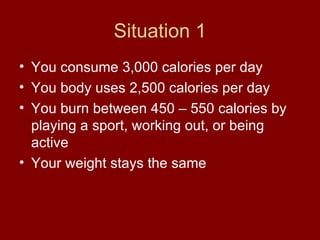
Situation 1 You consume 3,000 calories per day You body uses 2,500 calories per day You burn between 450 – 550 calories by playing a sport, working out, or being active  Your weight stays the same
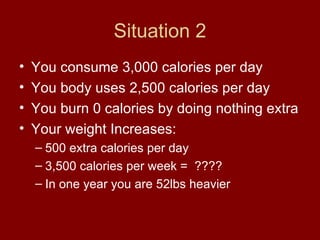
Situation 2 You consume 3,000 calories per day You body uses 2,500 calories per day You burn 0 calories by doing nothing extra Your weight Increases: 500 extra calories per day 3,500 calories per week =  ???? In one year you are 52lbs heavier
The Result
Mental benefits  Reduces stress  Endorphins  Pride and accomplishment
Social benefits You can do more stuff: hiking, biking, swimming, playing sports Develop friendships Gym rats Look good     feel good
Types of Exercise
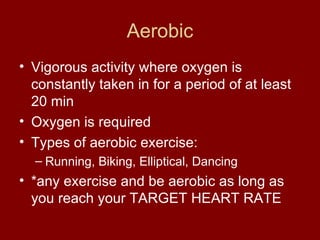
Aerobic Vigorous activity where oxygen is constantly taken in for a period of at least 20 min Oxygen is required  Types of aerobic exercise: Running, Biking, Elliptical, Dancing *any exercise and be aerobic as long as you reach your TARGET HEART RATE
Heart rates Resting heart rate Count the number of times your heart beats over a period of 15 second.  Multiply that number by 4 The product is your resting heart rate Maximum heart rate: 220 minus your age
Anaerobic  3 types: Isometric: NO MOVEMENT Muscle meets weight with equal force Isotonic: Muscle contraction and repeated movement What you do at the gym: curls, squats, shoulder press Isokinetic: Resistance through a full range of motion
Homework FOLLOW THE STEPS AND FIND YOUR TAGRET HEART RATE
Step 1 Find your resting heart rate Sit relaxed for about 10 mins Take your pulse rate for 30 seconds Multiply times 2 The answer is your resting heart rate
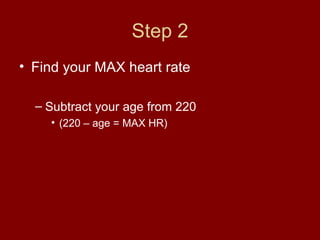
Step 2 Find your MAX heart rate Subtract your age from 220 (220 – age = MAX HR)
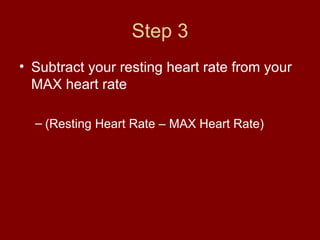
Step 3 Subtract your resting heart rate from your MAX heart rate (Resting Heart Rate – MAX Heart Rate)
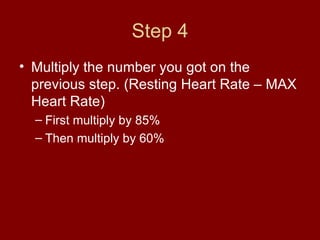
Step 4 Multiply the number you got on the previous step. (Resting Heart Rate – MAX Heart Rate) First multiply by 85% Then multiply by 60%
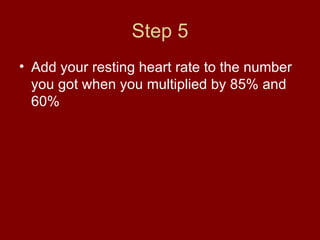
Step 5 Add your resting heart rate to the number you got when you multiplied by 85% and 60%
ANSWER Your answer is a range Ex:  130 - 155

Lesson2 exercise

  • 1.
  • 2.
    Benefits to physicalhealth What are they??? More energy Strengthens muscles and bones Enhances immune system Look good  feel good?
  • 3.
    Benefits you don’tsee Nervous system Improve reaction time Handle more weight Circulatory system Heart gets stronger, pumps blood more efficiently Respiratory system Greater lung capacity
  • 4.
  • 5.
    Weight Control Obese is not over weight Why are we so large? Height: 5’9 Weight 203lbs
  • 6.
    Weight control Metabolism:body gets energy from food Basal Metabolism: minimum amount of energy the body needs to maintain life Calories: Energy value in food You use a certain amount of calories each day
  • 7.
    Your weight Caloriesin VS. Calories out If you take in more calories than you need, you weight will go up If you take in less calories than you need, your weight will go down 3,500 calories = 1lb
  • 8.
    Situation 1 Youconsume 3,000 calories per day You body uses 2,500 calories per day You burn between 450 – 550 calories by playing a sport, working out, or being active Your weight stays the same
  • 9.
    Situation 2 Youconsume 3,000 calories per day You body uses 2,500 calories per day You burn 0 calories by doing nothing extra Your weight Increases: 500 extra calories per day 3,500 calories per week = ???? In one year you are 52lbs heavier
  • 10.
  • 11.
    Mental benefits Reduces stress Endorphins Pride and accomplishment
  • 12.
    Social benefits Youcan do more stuff: hiking, biking, swimming, playing sports Develop friendships Gym rats Look good  feel good
  • 13.
  • 14.
    Aerobic Vigorous activitywhere oxygen is constantly taken in for a period of at least 20 min Oxygen is required Types of aerobic exercise: Running, Biking, Elliptical, Dancing *any exercise and be aerobic as long as you reach your TARGET HEART RATE
  • 15.
    Heart rates Restingheart rate Count the number of times your heart beats over a period of 15 second. Multiply that number by 4 The product is your resting heart rate Maximum heart rate: 220 minus your age
  • 16.
    Anaerobic 3types: Isometric: NO MOVEMENT Muscle meets weight with equal force Isotonic: Muscle contraction and repeated movement What you do at the gym: curls, squats, shoulder press Isokinetic: Resistance through a full range of motion
  • 17.
    Homework FOLLOW THESTEPS AND FIND YOUR TAGRET HEART RATE
  • 18.
    Step 1 Findyour resting heart rate Sit relaxed for about 10 mins Take your pulse rate for 30 seconds Multiply times 2 The answer is your resting heart rate
  • 19.
    Step 2 Findyour MAX heart rate Subtract your age from 220 (220 – age = MAX HR)
  • 20.
    Step 3 Subtractyour resting heart rate from your MAX heart rate (Resting Heart Rate – MAX Heart Rate)
  • 21.
    Step 4 Multiplythe number you got on the previous step. (Resting Heart Rate – MAX Heart Rate) First multiply by 85% Then multiply by 60%
  • 22.
    Step 5 Addyour resting heart rate to the number you got when you multiplied by 85% and 60%
  • 23.
    ANSWER Your answeris a range Ex: 130 - 155