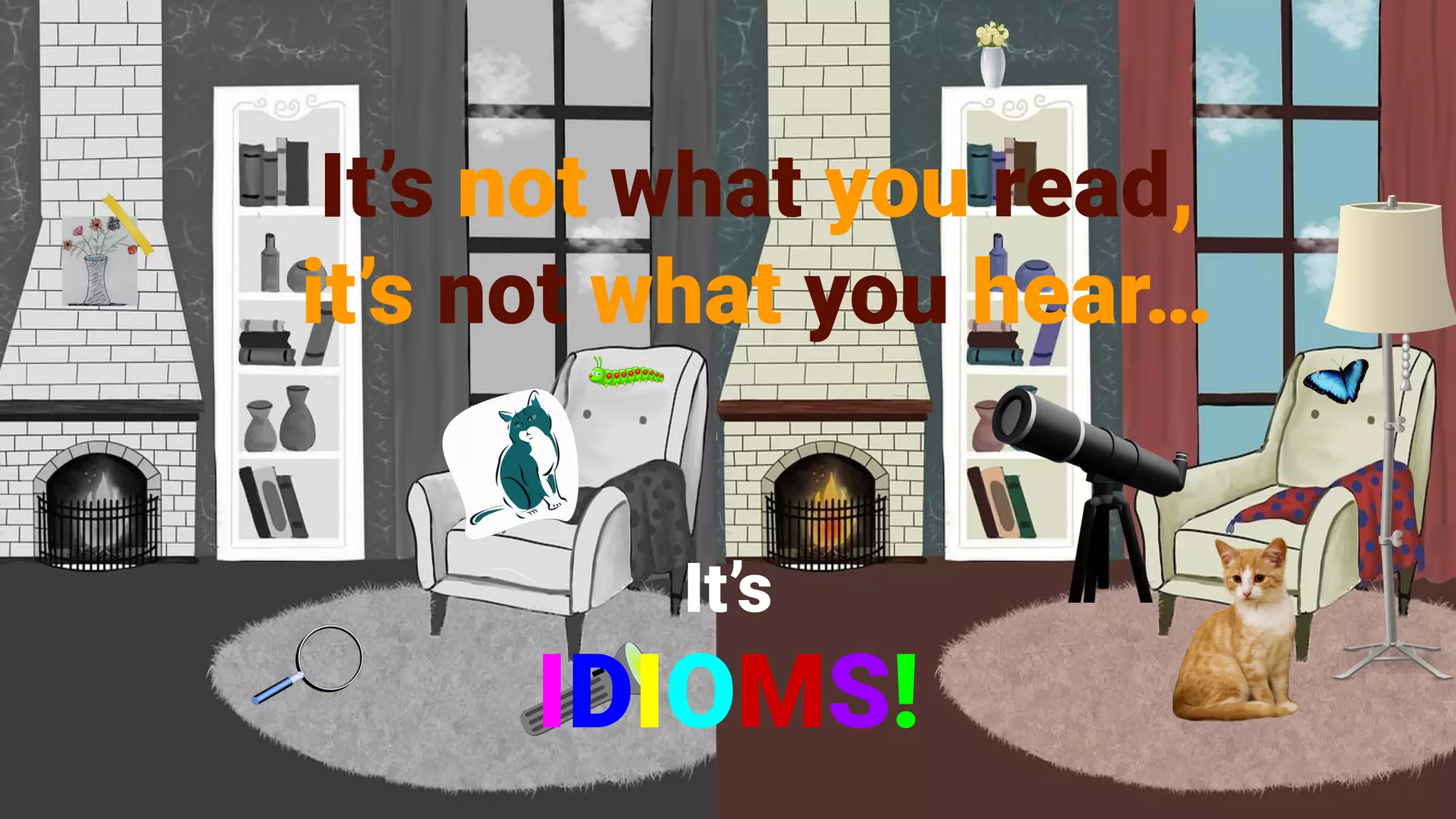
It’s not what you read,
it’s not what you hear…
It’s
IDIOMS!
Are you ready to ace your exam?
What does “ace” mean?
Are you ready to ace your exam?
What does “ace” mean?
-to “ace” something means to get an “A” or a very high grade.
This type of language or expression is a figurative language.
Click the silver
play button to
watch a video.
Guide Questions:
a) What have you learned in the
video about idioms?
b) What is the underlying purpose of
idioms?
c) Is the usage of idioms significant
in our day-to-day conversations?
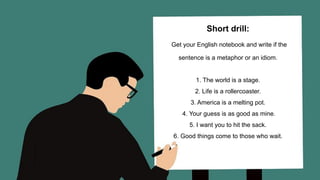
Short drill:
Get your English notebook and write if the
sentence is a metaphor or an idiom.
1. The world is a stage.
2. Life is a rollercoaster.
3. America is a melting pot.
4. Your guess is as good as mine.
5. I want you to hit the sack.
6. Good things come to those who wait.
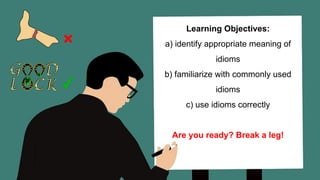
Learning Objectives:
a) identify appropriate meaning of
idioms
b) familiarize with commonly used
idioms
c) use idioms correctly
Are you ready? Break a leg!
Click the owl toy
to answer an
activity.
IDIOMS
Idioms are expressions whose meanings are
different from the words that make them.
Understanding an idiom requires some other
knowledge than knowing the words used. Idioms
normally cannot be modified or the words within
them changed.
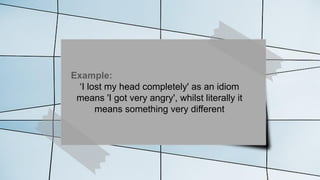
Example:
‘I lost my head completely' as an idiom
means 'I got very angry', whilst literally it
means something very different
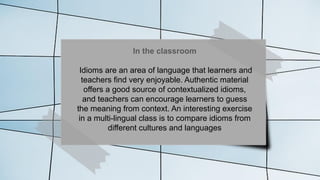
In the classroom
Idioms are an area of language that learners and
teachers find very enjoyable. Authentic material
offers a good source of contextualized idioms,
and teachers can encourage learners to guess
the meaning from context. An interesting exercise
in a multi-lingual class is to compare idioms from
different cultures and languages
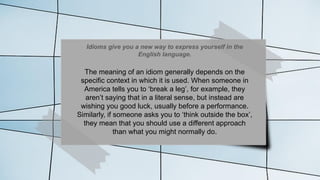
Idioms give you a new way to express yourself in the
English language.
The meaning of an idiom generally depends on the
specific context in which it is used. When someone in
America tells you to ‘break a leg’, for example, they
aren’t saying that in a literal sense, but instead are
wishing you good luck, usually before a performance.
Similarly, if someone asks you to ‘think outside the box’,
they mean that you should use a different approach
than what you might normally do.
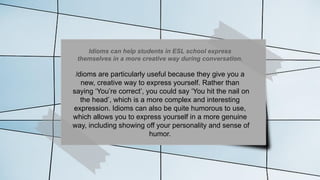
Idioms can help students in ESL school express
themselves in a more creative way during conversation.
Idioms are particularly useful because they give you a
new, creative way to express yourself. Rather than
saying ‘You’re correct’, you could say ‘You hit the nail on
the head’, which is a more complex and interesting
expression. Idioms can also be quite humorous to use,
which allows you to express yourself in a more genuine
way, including showing off your personality and sense of
humor.
Learning about idioms can help enrich what you learn in
your ESL lessons
Native speakers often use idioms more than someone who
is new to the language, simply because they are more
familiar with them and know the context in which they
should be used. Therefore, when you use an idiom, you
sound more like a native speaker
It also helps if you think of English as if it were a soup –
the basics may be good, but you need a little extra
flavor to take it to the next level. Idioms, in that sense,
are the spice that you can add to your English skills as
you progress through your ESL lessons. Understanding
the basics of English is a good start, but idioms can
help you explore the language in a deeper, more
meaningful way
Click
me!
Group Work/Question and Answer
The team will have 5 members each. Each team will
need a ¼ illustration board, some chalk, and an eraser.
They will listen to an audio media where the speaker
mentions idioms. Every time the speaker mentions an
idiom, the team will write it down and write the correct
meaning of it after a dash (-). The teacher will then
count the number of points to know the winner at the
end of the audio.
Assignment: Create a short story according to your own
genre. It may be a conversational type of story or just a
narration. Put five (5) or more idioms on your story.
Read it in front of the class tomorrow.
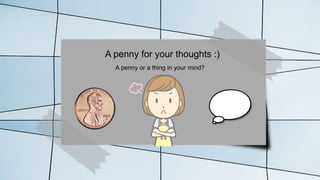
A penny for your thoughts :)
A penny or a thing in your mind?
Idioms.pdf

Idioms.pdf

  • 1.
    It’s not whatyou read, it’s not what you hear… It’s IDIOMS!
  • 2.
    Are you readyto ace your exam?
  • 3.
    Are you readyto ace your exam? What does “ace” mean?
  • 4.
    Are you readyto ace your exam? What does “ace” mean? -to “ace” something means to get an “A” or a very high grade. This type of language or expression is a figurative language.
  • 5.
    Click the silver playbutton to watch a video.
  • 6.
    Guide Questions: a) Whathave you learned in the video about idioms? b) What is the underlying purpose of idioms? c) Is the usage of idioms significant in our day-to-day conversations?
  • 7.
    Short drill: Get yourEnglish notebook and write if the sentence is a metaphor or an idiom. 1. The world is a stage. 2. Life is a rollercoaster. 3. America is a melting pot. 4. Your guess is as good as mine. 5. I want you to hit the sack. 6. Good things come to those who wait.
  • 8.
    Learning Objectives: a) identifyappropriate meaning of idioms b) familiarize with commonly used idioms c) use idioms correctly Are you ready? Break a leg!
  • 9.
    Click the owltoy to answer an activity.
  • 10.
    IDIOMS Idioms are expressionswhose meanings are different from the words that make them. Understanding an idiom requires some other knowledge than knowing the words used. Idioms normally cannot be modified or the words within them changed.
  • 11.
    Example: ‘I lost myhead completely' as an idiom means 'I got very angry', whilst literally it means something very different
  • 12.
    In the classroom Idiomsare an area of language that learners and teachers find very enjoyable. Authentic material offers a good source of contextualized idioms, and teachers can encourage learners to guess the meaning from context. An interesting exercise in a multi-lingual class is to compare idioms from different cultures and languages
  • 13.
    Idioms give youa new way to express yourself in the English language. The meaning of an idiom generally depends on the specific context in which it is used. When someone in America tells you to ‘break a leg’, for example, they aren’t saying that in a literal sense, but instead are wishing you good luck, usually before a performance. Similarly, if someone asks you to ‘think outside the box’, they mean that you should use a different approach than what you might normally do.
  • 14.
    Idioms can helpstudents in ESL school express themselves in a more creative way during conversation. Idioms are particularly useful because they give you a new, creative way to express yourself. Rather than saying ‘You’re correct’, you could say ‘You hit the nail on the head’, which is a more complex and interesting expression. Idioms can also be quite humorous to use, which allows you to express yourself in a more genuine way, including showing off your personality and sense of humor.
  • 15.
    Learning about idiomscan help enrich what you learn in your ESL lessons Native speakers often use idioms more than someone who is new to the language, simply because they are more familiar with them and know the context in which they should be used. Therefore, when you use an idiom, you sound more like a native speaker
  • 16.
    It also helpsif you think of English as if it were a soup – the basics may be good, but you need a little extra flavor to take it to the next level. Idioms, in that sense, are the spice that you can add to your English skills as you progress through your ESL lessons. Understanding the basics of English is a good start, but idioms can help you explore the language in a deeper, more meaningful way
  • 17.
  • 18.
    Group Work/Question andAnswer The team will have 5 members each. Each team will need a ¼ illustration board, some chalk, and an eraser. They will listen to an audio media where the speaker mentions idioms. Every time the speaker mentions an idiom, the team will write it down and write the correct meaning of it after a dash (-). The teacher will then count the number of points to know the winner at the end of the audio.
  • 19.
    Assignment: Create ashort story according to your own genre. It may be a conversational type of story or just a narration. Put five (5) or more idioms on your story. Read it in front of the class tomorrow.
  • 20.
    A penny foryour thoughts :) A penny or a thing in your mind?