GRADE LEVEL
9
QUARTER/
DOMAIN
3rd Quarter
Classroom
Observation Tool 1
February 17,
2023
DETAILED LESSON PLAN
I. OBJECTIVES
A. Content Standards The learner demonstrates understanding of key concepts of parallelograms and triangle similarity.
B. Performance
Standards
The learner s able to investigate, analyze, and solve problems involving parallelograms and triangle
similarity through appropriate and accurate representation.
C. Learning
Competencies/
Objectives
The learners should be able to;
The learner identifies quadrilaterals that are parallelograms. (M9GE-IIIa-1)
Learning Targets:
a. recall the definition of quadrilaterals and its types;
b. determines the conditions that guarantee a quadrilateral is a parallelogram; and
c. identify quadrilateral that are parallelogram
II. CONTENT Parallelogram
III. LEARNING
RESOURCES
A. References Mathematics 9: Quarter 3 – Module 1: Parallelograms
1. Teacher’s Guide
Pages
2.Learner’s Materials
Pages
Mathematics 9: Quarter 3 – Module 1: Parallelograms
3.Textbook Pages
4.Additional Materials
from Learning
Resource (LR) Portal
Holt Science and Technology-Biology Science Book
Science and Technology: Earth Science
B. Other Learning
Resources
Powerpoint Presentation, Math 9 Module, Worksheets
IV. PROCEDURES Teacher’s Activity Student’s Activity
A. Preliminaries Prayer
Checking of Attendance
 Pause for a prayer.
 Respond to the teacher’s greetings and
checking of attendance
 Listen to the teacher’s class rules
B. Reviewing
Previous Lesson or
Presenting the New
Lesson
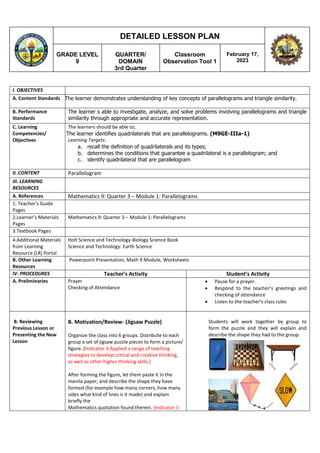
B. Motivation/Review- (Jigsaw Puzzle)
Organize the class into 6 groups. Distribute to each
group a set of jigsaw puzzle pieces to form a picture/
figure. (Indicator 3:Applied a range of teaching
strategies to develop critical and creative thinking,
as well as other higher thinking skills.)
After forming the figure, let them paste it in the
manila paper, and describe the shape they have
formed (for example how many corners, how many
sides what kind of lines is it made) and explain
briefly the
Mathematics quotation found therein. (Indicator 1:
Students will work together by group to
form the puzzle and they will explain and
describe the shape they had to the group.
GRADE LEVEL
9
QUARTER/
DOMAIN
3rd Quarter
Classroom
Observation Tool 1
February 17,
2023
DETAILED LESSON PLAN
applies knowledge of content within and across
curriculum teaching areas).
Rubrics/ Criteria:
Content - 3 pts
Alertness 2 pts
Total 5 pts
Guide Questions:
1. How many sides the shape has?
2. How many angles it has?
3. How many corners it has?
4. What do you call a polygon with 4 sides?
5. Explain your Mathematical Quotation
C. LESSON PROPER
I. Activity The teacher will have a mystery bag with
quadrilaterals inside.
Each group will choose their representative, who
will be the one to pick the quadrilateral that will fit
to the property given to them.
(Indicator 4: Manages classroom structure to engage
learners, individually or in groups, in meaningful
exploration, discovery and hands-on activities within
range of physical learning environment.)
Ask the student: What have you noticed among the
descriptions presented each group? What is
common therein? Look around you. Do you see
shapes in this room that could be called
quadrilaterals?
Giving examples of quadrilateral in the real world.
(Indicator 2: Used range of teaching strategies that
enhance learner achievement in literacy and
numeracy skills.)
Guide Questions:
Q1. How many sides and corners it has?
Q2. What is common with the 6 shapes you had?
Q3. Give some examples which you can find those
shapes?
Q4. Where can we use such shapes in the real world?
GRADE LEVEL
9
QUARTER/
DOMAIN
3rd Quarter
Classroom
Observation Tool 1
February 17,
2023
DETAILED LESSON PLAN
II. Abstraction The group will choose one representative and
pick the shape and describe it.
* This activity will cater the learner/s will
learning disability because they are given a
chance to use their different senses.
(Indicator 6:Uses differentiated appropriate
learning experiences to address learner’s
gender, needs, strengths, interests and
experiences,.)
(Indicator 8: Selected, developed, organized
and used appropriate teaching and learning
resources including ICT, to address learning
goals.)
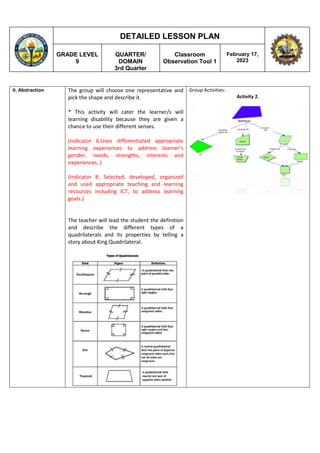
The teacher will lead the student the definition
and describe the different types of a
quadrilaterals and its properties by telling a
story about King Quadrilateral.
Group Activities:
Activity 2.
GRADE LEVEL
9
QUARTER/
DOMAIN
3rd Quarter
Classroom
Observation Tool 1
February 17,
2023
DETAILED LESSON PLAN
III. Analysis Is it a Fact or Bluff?)- Group Activity
With the same group, the group will decide whether
each statement is a fact or bluff. Students will be
given fact or bluff card.
1. A quadrilateral is a parallelogram
2. A trapezoid is a quadrilateral
3. A square is a parallelogram.
4. A kite is a trapezoid
5. A square is a rectangle
1. bluff
2. fact
3. fact
4. bluff
5. fact
IV. Application Draw a scenario in which all the quadrilaterals are
present. (10 minutes)
Rubrics/ Criteria:
Creativity 5 pts
Relevance to the topic 3 pts
Cleanliness 2 pts
TOTAL 10 pts
Let the students present their output and discuss
what they have learned.
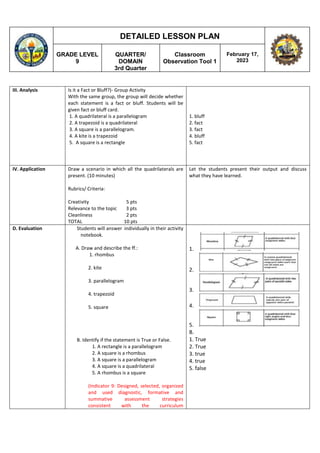
D. Evaluation Students will answer individually in their activity
notebook.
A. Draw and describe the ff.:
1. rhombus
2. kite
3. parallelogram
4. trapezoid
5. square
B. Identify if the statement is True or False.
1. A rectangle is a parallelogram
2. A square is a rhombus
3. A square is a parallelogram
4. A square is a quadrilateral
5. A rhombus is a square
(Indicator 9: Designed, selected, organized
and used diagnostic, formative and
summative assessment strategies
consistent with the curriculum
1.
2.
3.
4.
5.
B.
1. True
2. True
3. true
4. true
5. false
GRADE LEVEL
9
QUARTER/
DOMAIN
3rd Quarter
Classroom
Observation Tool 1
February 17,
2023
DETAILED LESSON PLAN
requirement.)
V. Assignment On your group, make a short jingle of what you
have learned. The jingle will be presented on
Monday. The jingle should not be more than 2
minutes.
Criteria:
Creativity 3 pts
Originality 3 pts
Content 5 pts
Choreography 4 pts
Total 15 pts
(Indicator 7: Planned, managed and
implemented developmentally
sequence teaching and learning
process to meet the curriculum
requirements and varied teaching
context.)
V. REMARKS
VI. REFLECTION
A. No. of Learners who Earned 80% on the Formative Assessment
B. No. of Learners who Require Additional Activities for Remediation
C. Did the Remedial Lessons Work? No. of Learners who Have Caught Up with the Lesson
D. No. of Learners who Continue to Require Remediation
E. Which of Teaching Strategies Worked Well? Why did these Work?
F. What Difficulties did I Encounter which My Principal or Supervisor can Help Me Solve?
G. What Innovative or Localized Materials did I Use/Discover which I Wish to Share with Other Teachers?
Prepared by: Checked and Observed by:
XY-ZA B. MERQUITA JOY MOVIMAR S. SASUMAN
Teacher III MT I, Subject Group Head

Lesson Plan for Quadrilateral.docx

  • 1.
    GRADE LEVEL 9 QUARTER/ DOMAIN 3rd Quarter Classroom ObservationTool 1 February 17, 2023 DETAILED LESSON PLAN I. OBJECTIVES A. Content Standards The learner demonstrates understanding of key concepts of parallelograms and triangle similarity. B. Performance Standards The learner s able to investigate, analyze, and solve problems involving parallelograms and triangle similarity through appropriate and accurate representation. C. Learning Competencies/ Objectives The learners should be able to; The learner identifies quadrilaterals that are parallelograms. (M9GE-IIIa-1) Learning Targets: a. recall the definition of quadrilaterals and its types; b. determines the conditions that guarantee a quadrilateral is a parallelogram; and c. identify quadrilateral that are parallelogram II. CONTENT Parallelogram III. LEARNING RESOURCES A. References Mathematics 9: Quarter 3 – Module 1: Parallelograms 1. Teacher’s Guide Pages 2.Learner’s Materials Pages Mathematics 9: Quarter 3 – Module 1: Parallelograms 3.Textbook Pages 4.Additional Materials from Learning Resource (LR) Portal Holt Science and Technology-Biology Science Book Science and Technology: Earth Science B. Other Learning Resources Powerpoint Presentation, Math 9 Module, Worksheets IV. PROCEDURES Teacher’s Activity Student’s Activity A. Preliminaries Prayer Checking of Attendance  Pause for a prayer.  Respond to the teacher’s greetings and checking of attendance  Listen to the teacher’s class rules B. Reviewing Previous Lesson or Presenting the New Lesson B. Motivation/Review- (Jigsaw Puzzle) Organize the class into 6 groups. Distribute to each group a set of jigsaw puzzle pieces to form a picture/ figure. (Indicator 3:Applied a range of teaching strategies to develop critical and creative thinking, as well as other higher thinking skills.) After forming the figure, let them paste it in the manila paper, and describe the shape they have formed (for example how many corners, how many sides what kind of lines is it made) and explain briefly the Mathematics quotation found therein. (Indicator 1: Students will work together by group to form the puzzle and they will explain and describe the shape they had to the group.
  • 2.
    GRADE LEVEL 9 QUARTER/ DOMAIN 3rd Quarter Classroom ObservationTool 1 February 17, 2023 DETAILED LESSON PLAN applies knowledge of content within and across curriculum teaching areas). Rubrics/ Criteria: Content - 3 pts Alertness 2 pts Total 5 pts Guide Questions: 1. How many sides the shape has? 2. How many angles it has? 3. How many corners it has? 4. What do you call a polygon with 4 sides? 5. Explain your Mathematical Quotation C. LESSON PROPER I. Activity The teacher will have a mystery bag with quadrilaterals inside. Each group will choose their representative, who will be the one to pick the quadrilateral that will fit to the property given to them. (Indicator 4: Manages classroom structure to engage learners, individually or in groups, in meaningful exploration, discovery and hands-on activities within range of physical learning environment.) Ask the student: What have you noticed among the descriptions presented each group? What is common therein? Look around you. Do you see shapes in this room that could be called quadrilaterals? Giving examples of quadrilateral in the real world. (Indicator 2: Used range of teaching strategies that enhance learner achievement in literacy and numeracy skills.) Guide Questions: Q1. How many sides and corners it has? Q2. What is common with the 6 shapes you had? Q3. Give some examples which you can find those shapes? Q4. Where can we use such shapes in the real world?
  • 3.
    GRADE LEVEL 9 QUARTER/ DOMAIN 3rd Quarter Classroom ObservationTool 1 February 17, 2023 DETAILED LESSON PLAN II. Abstraction The group will choose one representative and pick the shape and describe it. * This activity will cater the learner/s will learning disability because they are given a chance to use their different senses. (Indicator 6:Uses differentiated appropriate learning experiences to address learner’s gender, needs, strengths, interests and experiences,.) (Indicator 8: Selected, developed, organized and used appropriate teaching and learning resources including ICT, to address learning goals.) The teacher will lead the student the definition and describe the different types of a quadrilaterals and its properties by telling a story about King Quadrilateral. Group Activities: Activity 2.
  • 4.
    GRADE LEVEL 9 QUARTER/ DOMAIN 3rd Quarter Classroom ObservationTool 1 February 17, 2023 DETAILED LESSON PLAN III. Analysis Is it a Fact or Bluff?)- Group Activity With the same group, the group will decide whether each statement is a fact or bluff. Students will be given fact or bluff card. 1. A quadrilateral is a parallelogram 2. A trapezoid is a quadrilateral 3. A square is a parallelogram. 4. A kite is a trapezoid 5. A square is a rectangle 1. bluff 2. fact 3. fact 4. bluff 5. fact IV. Application Draw a scenario in which all the quadrilaterals are present. (10 minutes) Rubrics/ Criteria: Creativity 5 pts Relevance to the topic 3 pts Cleanliness 2 pts TOTAL 10 pts Let the students present their output and discuss what they have learned. D. Evaluation Students will answer individually in their activity notebook. A. Draw and describe the ff.: 1. rhombus 2. kite 3. parallelogram 4. trapezoid 5. square B. Identify if the statement is True or False. 1. A rectangle is a parallelogram 2. A square is a rhombus 3. A square is a parallelogram 4. A square is a quadrilateral 5. A rhombus is a square (Indicator 9: Designed, selected, organized and used diagnostic, formative and summative assessment strategies consistent with the curriculum 1. 2. 3. 4. 5. B. 1. True 2. True 3. true 4. true 5. false
  • 5.
    GRADE LEVEL 9 QUARTER/ DOMAIN 3rd Quarter Classroom ObservationTool 1 February 17, 2023 DETAILED LESSON PLAN requirement.) V. Assignment On your group, make a short jingle of what you have learned. The jingle will be presented on Monday. The jingle should not be more than 2 minutes. Criteria: Creativity 3 pts Originality 3 pts Content 5 pts Choreography 4 pts Total 15 pts (Indicator 7: Planned, managed and implemented developmentally sequence teaching and learning process to meet the curriculum requirements and varied teaching context.) V. REMARKS VI. REFLECTION A. No. of Learners who Earned 80% on the Formative Assessment B. No. of Learners who Require Additional Activities for Remediation C. Did the Remedial Lessons Work? No. of Learners who Have Caught Up with the Lesson D. No. of Learners who Continue to Require Remediation E. Which of Teaching Strategies Worked Well? Why did these Work? F. What Difficulties did I Encounter which My Principal or Supervisor can Help Me Solve? G. What Innovative or Localized Materials did I Use/Discover which I Wish to Share with Other Teachers? Prepared by: Checked and Observed by: XY-ZA B. MERQUITA JOY MOVIMAR S. SASUMAN Teacher III MT I, Subject Group Head