LESSON PLAN
PLANT CELL AND ANIMAL CELL
Name : Putu Diah Kirana Purnama Dewi
NIM : 1713041013
Class : IIIA
Subject : Telaah Kurikulum
BIOLOGY DEPARTMENT
MATHEMATICS AND SCIENCE FACULTY
GANESHA UNIVERSITY OF EDUCATION
SINGARAJA
2018
LESSON PLAN
School : SMA Negeri 2 Denpasar
Subject : Biology
Grade/Semester : XI / 1
Topic : Plant Cell and Animal Cell
Sub Topic : 1. Characteristic of plant cell and animal cell.
2. The body structure of plant cell and animal cell.
3. The function of plant cell and animal cell structure.
4. Difference plant cell and animal cell based on the
characteristics.
Time Allocation : 2 x 45 minutes
A. CORE COMPETENCY
CC 1 : Respect and appreciate the teachings of their religion.
CC 2 : Respect and appreciate the honest behavior, discipline, responsibility, caring
(tolerance, mutual aid), polite, and confident, in interacting effectively with the
social and natural environment within reach of the association and its existence.
CC 3 : Understanding knowledge (factual, conceptual and procedural) based on
curiosity about science, technology, art, culture, phenomena and events looking
eyes.
CC 4 : Attempting to process and present in the realm of concrete (using, parse,
compose, modify, and create) and abstract domains (reading, counting, drawing,
and making up) in accordance with the learned in school and other sources in
the same viewpoint.
B. BASIC COMPETENCY AND INDICATORS OF COMPETENCE
ACHIEVEMENT
Basic Competency Indicators of Competence Achievement
1.1. Understand the structure
and function of the cell’s
chemical component as
the basic unit in life.
1.1.1. Mention the characteristics of plant cell and
animal cell.
1.1.2. Identify the body structure of plant cell and
animal cell.
1.1.3. Identify the function of plant cell and animal
cell structure.
1.1.4. Difference plant cell and animal cell based on
the characteristics.
C. LEARNING OBJECTIVES
After the process of observing, asking, collecting information / trying and
communicating, students are able to:
1. Mention the characteristics of plant cell and animal cell.
2. Identify the body structure of plant cell and animal cell.
3. Identify the function of plant cell and animal cell structure.
4. Difference plant cell and animal cell based on the characteristics.
D. LEARNING MATERIALS
Cells is the structural and functional unit of all living organisms and is sometimes called
the “building block of life”. It is known as the building block of life because all the
organisms are made up of cells. The small structures present within the cell to perform
different functions are known as organelles. The types of organelles and the number of
them differ according to the function performed by the cell.
The cell prepared by including all the organelles is known as the typical cell. In the
living world such cells do not exist. But cells with a certain number of organelles of the
typical cell can be found in living organisms. There are two types of cells, eukaryotic and
prokaryotic cells. In eukaryotic cells, there are plant cells and animal cells.
All animal cells are covered by a plasma membrane or a cell membrane. It is a live semi
permeable membrane as well as a selective permeable membrane. There is a centralized
nucleus in an animal cell. The cytoplasm is a gelatinous material. The outer covering of
the plant cell is the cell wall . It is made up of cellulose. Inner to the cell wall is the plasma
membrane. At the center of plant cell is a large vacuole. Generally there are no such
vacuoles in animal cells.
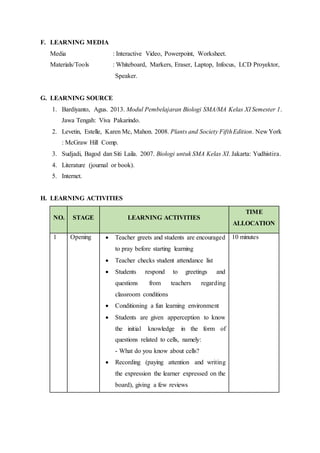
Animal cells as well as plant cells possess different organelles that perform different
functions. Most of the above organelles cannot be observed through the light microscope.
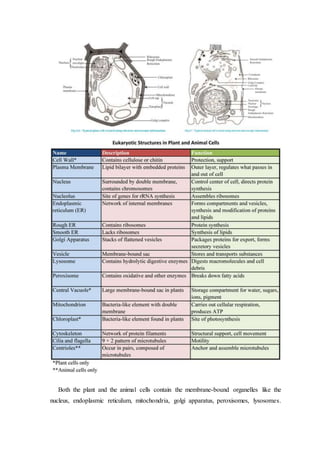
Therefore the electron microscope should be used. Below are the typical plant and animal
cells created based on electron microscopic information.
Both the plant and the animal cells contain the membrane-bound organelles like the
nucleus, endoplasmic reticulum, mitochondria, golgi apparatus, peroxisomes, lysosomes.
They also have similar membranes such as cytosol, and the cytoskeletal elements. The
function of all these organelles is said to be extremely similar lying between two classes
of cells. However, few differences do exist between them which are very much significant,
reflecting the difference in the function of each cell.
The plant cell can also be larger than the animal cell. The normal range of the animal
cell varies from about 10 – 30 micrometers and that of plant cell range between 10 – 100
micrometers. Beyond the size, the main differences between the structures of plants and
animal cells lie in some additional features that are found in the plant cells.
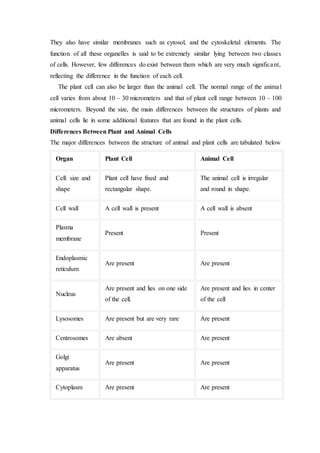
Differences Between Plant and Animal Cells
The major differences between the structure of animal and plant cells are tabulated below
Organ Plant Cell Animal Cell
Cell: size and
shape
Plant cell have fixed and
rectangular shape.
The animal cell is irregular
and round in shape.
Cell wall A cell wall is present A cell wall is absent
Plasma
membrane
Present Present
Endoplasmic
reticulum
Are present Are present
Nucleus
Are present and lies on one side
of the cell.
Are present and lies in center
of the cell
Lysosomes Are present but are very rare Are present
Centrosomes Are absent Are present
Golgi
apparatus
Are present Are present
Cytoplasm Are present Are present
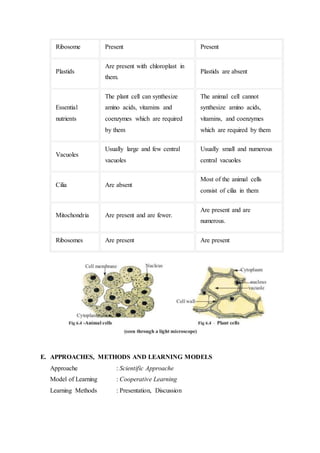
Ribosome Present Present
Plastids
Are present with chloroplast in
them.
Plastids are absent
Essential
nutrients
The plant cell can synthesize
amino acids, vitamins and
coenzymes which are required
by them
The animal cell cannot
synthesize amino acids,
vitamins, and coenzymes
which are required by them
Vacuoles
Usually large and few central
vacuoles
Usually small and numerous
central vacuoles
Cilia Are absent
Most of the animal cells
consist of cilia in them
Mitochondria Are present and are fewer.
Are present and are
numerous.
Ribosomes Are present Are present
E. APPROACHES, METHODS AND LEARNING MODELS
Approache : Scientific Approache
Model of Learning : Cooperative Learning
Learning Methods : Presentation, Discussion
F. LEARNING MEDIA
Media : Interactive Video, Powerpoint, Worksheet.
Materials/Tools : Whiteboard, Markers, Eraser, Laptop, Infocus, LCD Proyektor,
Speaker.
G. LEARNING SOURCE
1. Bardiyanto, Agus. 2013. Modul Pembelajaran Biologi SMA/MA Kelas XI Semester 1.
Jawa Tengah: Viva Pakarindo.
2. Levetin, Estelle, Karen Mc, Mahon. 2008. Plants and Society FifthEdition. New York
: McGraw Hill Comp.
3. Sudjadi, Bagod dan Siti Laila. 2007. Biologi untuk SMA Kelas XI. Jakarta: Yudhistira.
4. Literature (journal or book).
5. Internet.
H. LEARNING ACTIVITIES
NO. STAGE LEARNING ACTIVITIES
TIME
ALLOCATION
1 Opening  Teacher greets and students are encouraged
to pray before starting learning
 Teacher checks student attendance list
 Students respond to greetings and
questions from teachers regarding
classroom conditions
 Conditioning a fun learning environment
 Students are given apperception to know
the initial knowledge in the form of
questions related to cells, namely:
- What do you know about cells?
 Recording (paying attention and writing
the expression the learner expressed on the
board), giving a few reviews
10 minutes
 Motivate: teachers convey the role of cells
in everyday life
 Teacher conveys the learning objectives
and basic competencies to be achieved
 Delivering an outline of cells material
coverage
 Delivering learning methods and
assessment techniques to be used when
discussing cells material
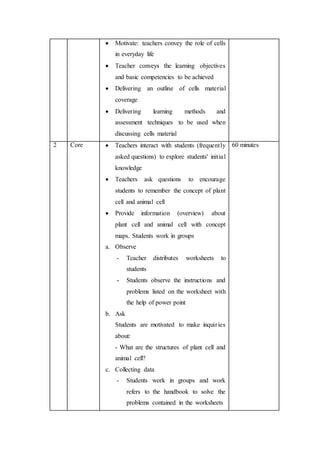
2 Core  Teachers interact with students (frequently
asked questions) to explore students' initial
knowledge
 Teachers ask questions to encourage
students to remember the concept of plant
cell and animal cell
 Provide information (overview) about
plant cell and animal cell with concept
maps. Students work in groups
a. Observe
- Teacher distributes worksheets to
students
- Students observe the instructions and
problems listed on the worksheet with
the help of power point
b. Ask
Students are motivated to make inquiries
about:
- What are the structures of plant cell and
animal cell?
c. Collecting data
- Students work in groups and work
refers to the handbook to solve the
problems contained in the worksheets
60 minutes
- Teachers facilitate students in
discussions
d. Associate
- Students process information that has
been obtained from the discussion and
literature review
- Students with the group write the
results of the discussion in the form of
simple reports
e. Communicate
- Teacher appoints several groups to
convey the results of the discussion
- Other students pay attention and
respond to answers from friends
- Teachers act as mediators, while
assessing the process of discussion
- Teacher explains the answers to the
concept questions
- The teacher provides an opportunity
for the student to ask the unknown
matter
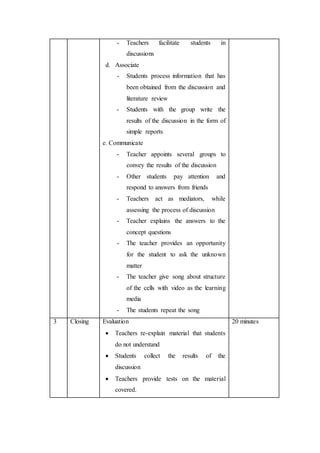
- The teacher give song about structure
of the cells with video as the learning
media
- The students repeat the song
3 Closing Evaluation
 Teachers re-explain material that students
do not understand
 Students collect the results of the
discussion
 Teachers provide tests on the material
covered.
20 minutes
 Teacher asks several students to give a
conclusion about the material that has been
learned
 The teacher closes the lesson with a closing
greeting
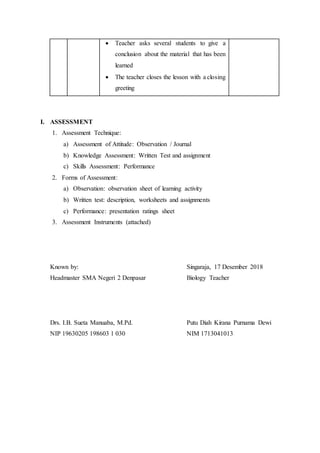
I. ASSESSMENT
1. Assessment Technique:
a) Assessment of Attitude: Observation / Journal
b) Knowledge Assessment: Written Test and assignment
c) Skills Assessment: Performance
2. Forms of Assessment:
a) Observation: observation sheet of learning activity
b) Written test: description, worksheets and assignments
c) Performance: presentation ratings sheet
3. Assessment Instruments (attached)
Known by: Singaraja, 17 Desember 2018
Headmaster SMA Negeri 2 Denpasar Biology Teacher
Drs. I.B. Sueta Manuaba, M.Pd. Putu Diah Kirana Purnama Dewi
NIP 19630205 198603 1 030 NIM 1713041013
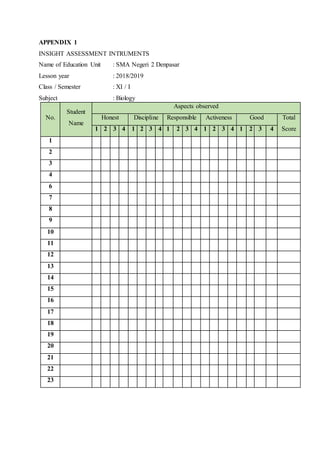
APPENDIX 1
INSIGHT ASSESSMENT INTRUMENTS
Name of Education Unit : SMA Negeri 2 Denpasar
Lesson year : 2018/2019
Class / Semester : XI / I
Subject : Biology
No.
Student
Name
Aspects observed
Honest Discipline Responsible Activeness Good Total
Score1 2 3 4 1 2 3 4 1 2 3 4 1 2 3 4 1 2 3 4
1
2
3
4
6
7
8
9
10
11
12
13
14
15
16
17
18
19
20
21
22
23
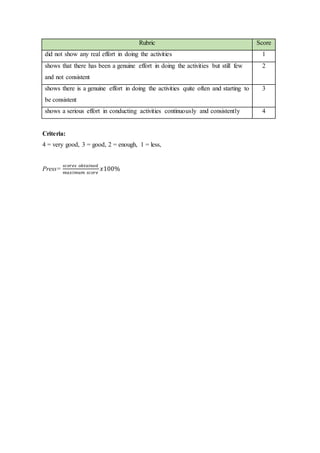
Rubric Score
did not show any real effort in doing the activities 1
shows that there has been a genuine effort in doing the activities but still few
and not consistent
2
shows there is a genuine effort in doing the activities quite often and starting to
be consistent
3
shows a serious effort in conducting activities continuously and consistently 4
Criteria:
4 = very good, 3 = good, 2 = enough, 1 = less,
Press=
𝑠𝑐𝑜𝑟𝑒𝑠 𝑜𝑏𝑡𝑎𝑖𝑛𝑒𝑑
𝑚𝑎𝑥𝑖𝑚𝑢𝑚 𝑠𝑐𝑜𝑟𝑒
𝑥100%
APPENDIX 2
STUDENT WORKSHEET
School : SMA Negeri 2 Denpasar
Subject : Biologi
Grade/Semester : XI / 1
Topic : Plant Cell and Animal Cell
Time Allocation : 20 minutes
BASIC COMPETITION :
1.1 Understand the structure and function of the cell’s chemical component as the basic
unit in life
INDICATORS :
1.1.1 Mention the characteristics of plant cell and animal cell
1.1.2 Identify the body structure of plant cell and animal cell
1.1.3 Identify the function of plant cell and animal cell structure
1.1.4 Difference plant cell and animal cell based on the characteristics
LEARNING OBJECTIVES :
1.1.1.1 Students are able to mention the characteristics of plant cell and animal cell
1.1.1.2 Students are able to identify the body structure of plant cell and animal cell
1.1.1.3 Students are able to identify the function of plant cell and animal cell structure
1.1.1.4 Students are able to difference plant cell and animal cell based on the characteristics
ACTIVITIES :
1. Make groups with 4-5 member in it!
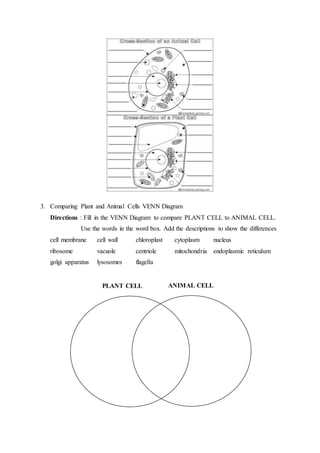
2. Observe picture of plant cell and animal cell and then fill the blank!
3. Comparing Plant and Animal Cells VENN Diagram
Directions : Fill in the VENN Diagram to compare PLANT CELL to ANIMAL CELL.
Use the words in the word box. Add the descriptions to show the differences
cell membrane cell wall chloroplast cytoplasm nucleus
ribosome vacuole centriole mitochondria endoplasmic reticulum
golgi apparatus lysosomes flagella
PLANT CELL ANIMAL CELL
4. Discussion it!
1. What is the cells?
Answer : ……………………………………………………..………………………
……………………………………………………………………………..
……………………………………………………………………………..
2. Mention 2 types of cells in eukaryotic cells!
Answer : ……………………………………………………………………………..
3. What is the difference between 2 types of cells that you mentioned before?
Answer : ……………………………………………………………………………..
4. Mentioned minimum 3 structure of the cells that you know and the function of that
structure!
Answer : ……………………………………………………………………………..
…….……………………………………………………………………….
……………………………………………………………………………..
……………………………………………………………………………..
.………………….…………………………………………………………
……………………………………………………………………………..
……………………………………………………………………………..
Conclude :
…..………………………………………………………………………………………
……………………………………………………………………………………………
……………………………………………………………………………………………
……………………………………………………………………………………………
……………………………………………………………………………………………
……………………………………………………………………………………………
……………………………………………………………………………………………
Member groups :
1.
2.
3.
4.
5.
Date Value Notes
APPENDIX 3
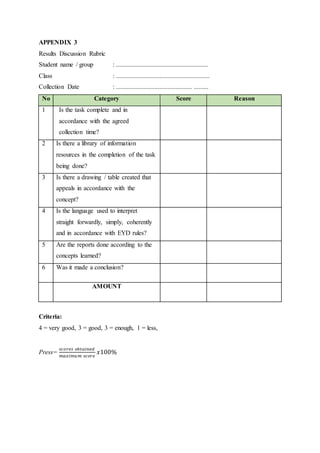
Results Discussion Rubric
Student name / group : .........................................................
Class : ..........................................................
Collection Date : ............................................... .........
No Category Score Reason
1 Is the task complete and in
accordance with the agreed
collection time?
2 Is there a library of information
resources in the completion of the task
being done?
3 Is there a drawing / table created that
appeals in accordance with the
concept?
4 Is the language used to interpret
straight forwardly, simply, coherently
and in accordance with EYD rules?
5 Are the reports done according to the
concepts learned?
6 Was it made a conclusion?
AMOUNT
Criteria:
4 = very good, 3 = good, 3 = enough, 1 = less,
Press=
𝑠𝑐𝑜𝑟𝑒𝑠 𝑜𝑏𝑡𝑎𝑖𝑛𝑒𝑑
𝑚𝑎𝑥𝑖𝑚𝑢𝑚 𝑠𝑐𝑜𝑟𝑒
𝑥100%
APPENDIX 4
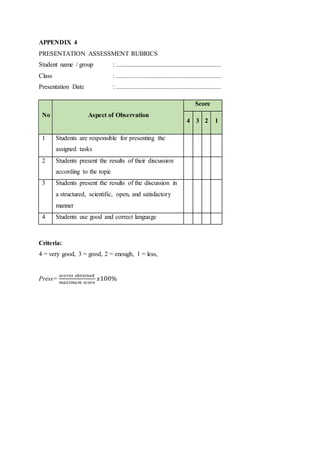
PRESENTATION ASSESSMENT RUBRICS
Student name / group : .................................................................
Class : .................................................................
Presentation Date : .................................................................
Criteria:
4 = very good, 3 = good, 2 = enough, 1 = less,
Press=
𝑠𝑐𝑜𝑟𝑒𝑠 𝑜𝑏𝑡𝑎𝑖𝑛𝑒𝑑
𝑚𝑎𝑥𝑖𝑚𝑢𝑚 𝑠𝑐𝑜𝑟𝑒
𝑥100%
No Aspect of Observation
Score
4 3 2 1
1 Students are responsible for presenting the
assigned tasks
2 Students present the results of their discussion
according to the topic
3 Students present the results of the discussion in
a structured, scientific, open, and satisfactory
manner
4 Students use good and correct language
Criteria:
4 = very good, 3 = good, 2 = enough, 1 = less,
Press=
𝑠𝑐𝑜𝑟𝑒𝑠 𝑜𝑏𝑡𝑎𝑖𝑛𝑒𝑑
𝑚𝑎𝑥𝑖𝑚𝑢𝑚 𝑠𝑐𝑜𝑟𝑒
𝑥100%
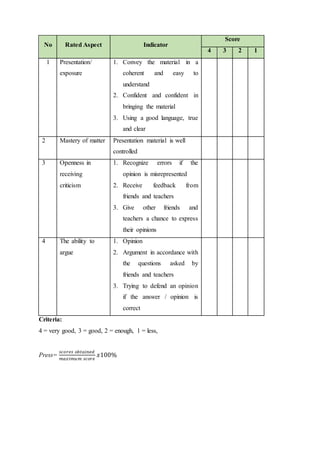
No Rated Aspect Indicator
Score
4 3 2 1
1 Presentation/
exposure
1. Convey the material in a
coherent and easy to
understand
2. Confident and confident in
bringing the material
3. Using a good language, true
and clear
2 Mastery of matter Presentation material is well
controlled
3 Openness in
receiving
criticism
1. Recognize errors if the
opinion is misrepresented
2. Receive feedback from
friends and teachers
3. Give other friends and
teachers a chance to express
their opinions
4 The ability to
argue
1. Opinion
2. Argument in accordance with
the questions asked by
friends and teachers
3. Trying to defend an opinion
if the answer / opinion is
correct
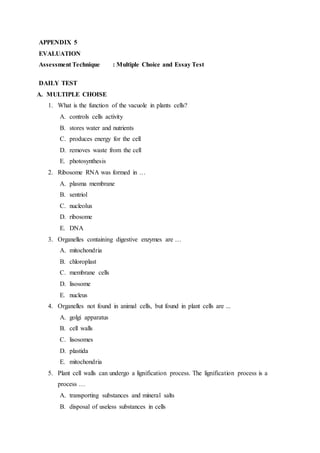
APPENDIX 5
EVALUATION
Assessment Technique : Multiple Choice and Essay Test
DAILY TEST
A. MULTIPLE CHOISE
1. What is the function of the vacuole in plants cells?
A. controls cells activity
B. stores water and nutrients
C. produces energy for the cell
D. removes waste from the cell
E. photosynthesis
2. Ribosome RNA was formed in …
A. plasma membrane
B. sentriol
C. nucleolus
D. ribosome
E. DNA
3. Organelles containing digestive enzymes are …
A. mitochondria
B. chloroplast
C. membrane cells
D. lisosome
E. nucleus
4. Organelles not found in animal cells, but found in plant cells are ...
A. golgi apparatus
B. cell walls
C. lisosomes
D. plastida
E. mitochondria
5. Plant cell walls can undergo a lignification process. The lignification process is a
process …
A. transporting substances and mineral salts
B. disposal of useless substances in cells
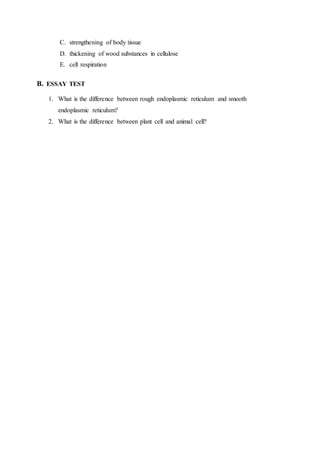
C. strengthening of body tissue
D. thickening of wood substances in cellulose
E. cell respiration
B. ESSAY TEST
1. What is the difference between rough endoplasmic reticulum and smooth
endoplasmic reticulum?
2. What is the difference between plant cell and animal cell?
APPENDIX 6
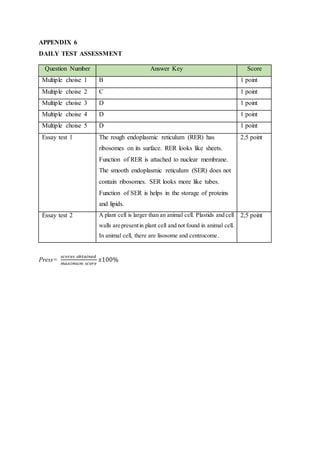
DAILY TEST ASSESSMENT
Question Number Answer Key Score
Multiple choise 1 B 1 point
Multiple choise 2 C 1 point
Multiple choise 3 D 1 point
Multiple choise 4 D 1 point
Multiple choise 5 D 1 point
Essay test 1 The rough endoplasmic reticulum (RER) has
ribosomes on its surface. RER looks like sheets.
Function of RER is attached to nuclear membrane.
The smooth endoplasmic reticulum (SER) does not
contain ribosomes. SER looks more like tubes.
Function of SER is helps in the storage of proteins
and lipids.
2,5 point
Essay test 2 A plant cell is larger than an animal cell. Plastids and cell
walls are presentin plant cell and not found in animal cell.
In animal cell, there are lisosome and centrocome.
2,5 point
Press=
𝑠𝑐𝑜𝑟𝑒𝑠 𝑜𝑏𝑡𝑎𝑖𝑛𝑒𝑑
𝑚𝑎𝑥𝑖𝑚𝑢𝑚 𝑠𝑐𝑜𝑟𝑒
𝑥100%

Lesson plan Biology

  • 1.
    LESSON PLAN PLANT CELLAND ANIMAL CELL Name : Putu Diah Kirana Purnama Dewi NIM : 1713041013 Class : IIIA Subject : Telaah Kurikulum BIOLOGY DEPARTMENT MATHEMATICS AND SCIENCE FACULTY GANESHA UNIVERSITY OF EDUCATION SINGARAJA 2018
  • 2.
    LESSON PLAN School :SMA Negeri 2 Denpasar Subject : Biology Grade/Semester : XI / 1 Topic : Plant Cell and Animal Cell Sub Topic : 1. Characteristic of plant cell and animal cell. 2. The body structure of plant cell and animal cell. 3. The function of plant cell and animal cell structure. 4. Difference plant cell and animal cell based on the characteristics. Time Allocation : 2 x 45 minutes A. CORE COMPETENCY CC 1 : Respect and appreciate the teachings of their religion. CC 2 : Respect and appreciate the honest behavior, discipline, responsibility, caring (tolerance, mutual aid), polite, and confident, in interacting effectively with the social and natural environment within reach of the association and its existence. CC 3 : Understanding knowledge (factual, conceptual and procedural) based on curiosity about science, technology, art, culture, phenomena and events looking eyes. CC 4 : Attempting to process and present in the realm of concrete (using, parse, compose, modify, and create) and abstract domains (reading, counting, drawing, and making up) in accordance with the learned in school and other sources in the same viewpoint. B. BASIC COMPETENCY AND INDICATORS OF COMPETENCE ACHIEVEMENT Basic Competency Indicators of Competence Achievement 1.1. Understand the structure and function of the cell’s chemical component as the basic unit in life. 1.1.1. Mention the characteristics of plant cell and animal cell. 1.1.2. Identify the body structure of plant cell and animal cell.
  • 3.
    1.1.3. Identify thefunction of plant cell and animal cell structure. 1.1.4. Difference plant cell and animal cell based on the characteristics. C. LEARNING OBJECTIVES After the process of observing, asking, collecting information / trying and communicating, students are able to: 1. Mention the characteristics of plant cell and animal cell. 2. Identify the body structure of plant cell and animal cell. 3. Identify the function of plant cell and animal cell structure. 4. Difference plant cell and animal cell based on the characteristics. D. LEARNING MATERIALS Cells is the structural and functional unit of all living organisms and is sometimes called the “building block of life”. It is known as the building block of life because all the organisms are made up of cells. The small structures present within the cell to perform different functions are known as organelles. The types of organelles and the number of them differ according to the function performed by the cell. The cell prepared by including all the organelles is known as the typical cell. In the living world such cells do not exist. But cells with a certain number of organelles of the typical cell can be found in living organisms. There are two types of cells, eukaryotic and prokaryotic cells. In eukaryotic cells, there are plant cells and animal cells. All animal cells are covered by a plasma membrane or a cell membrane. It is a live semi permeable membrane as well as a selective permeable membrane. There is a centralized nucleus in an animal cell. The cytoplasm is a gelatinous material. The outer covering of the plant cell is the cell wall . It is made up of cellulose. Inner to the cell wall is the plasma membrane. At the center of plant cell is a large vacuole. Generally there are no such vacuoles in animal cells. Animal cells as well as plant cells possess different organelles that perform different functions. Most of the above organelles cannot be observed through the light microscope. Therefore the electron microscope should be used. Below are the typical plant and animal cells created based on electron microscopic information.
  • 4.
    Both the plantand the animal cells contain the membrane-bound organelles like the nucleus, endoplasmic reticulum, mitochondria, golgi apparatus, peroxisomes, lysosomes.
  • 5.
    They also havesimilar membranes such as cytosol, and the cytoskeletal elements. The function of all these organelles is said to be extremely similar lying between two classes of cells. However, few differences do exist between them which are very much significant, reflecting the difference in the function of each cell. The plant cell can also be larger than the animal cell. The normal range of the animal cell varies from about 10 – 30 micrometers and that of plant cell range between 10 – 100 micrometers. Beyond the size, the main differences between the structures of plants and animal cells lie in some additional features that are found in the plant cells. Differences Between Plant and Animal Cells The major differences between the structure of animal and plant cells are tabulated below Organ Plant Cell Animal Cell Cell: size and shape Plant cell have fixed and rectangular shape. The animal cell is irregular and round in shape. Cell wall A cell wall is present A cell wall is absent Plasma membrane Present Present Endoplasmic reticulum Are present Are present Nucleus Are present and lies on one side of the cell. Are present and lies in center of the cell Lysosomes Are present but are very rare Are present Centrosomes Are absent Are present Golgi apparatus Are present Are present Cytoplasm Are present Are present
  • 6.
    Ribosome Present Present Plastids Arepresent with chloroplast in them. Plastids are absent Essential nutrients The plant cell can synthesize amino acids, vitamins and coenzymes which are required by them The animal cell cannot synthesize amino acids, vitamins, and coenzymes which are required by them Vacuoles Usually large and few central vacuoles Usually small and numerous central vacuoles Cilia Are absent Most of the animal cells consist of cilia in them Mitochondria Are present and are fewer. Are present and are numerous. Ribosomes Are present Are present E. APPROACHES, METHODS AND LEARNING MODELS Approache : Scientific Approache Model of Learning : Cooperative Learning Learning Methods : Presentation, Discussion
  • 7.
    F. LEARNING MEDIA Media: Interactive Video, Powerpoint, Worksheet. Materials/Tools : Whiteboard, Markers, Eraser, Laptop, Infocus, LCD Proyektor, Speaker. G. LEARNING SOURCE 1. Bardiyanto, Agus. 2013. Modul Pembelajaran Biologi SMA/MA Kelas XI Semester 1. Jawa Tengah: Viva Pakarindo. 2. Levetin, Estelle, Karen Mc, Mahon. 2008. Plants and Society FifthEdition. New York : McGraw Hill Comp. 3. Sudjadi, Bagod dan Siti Laila. 2007. Biologi untuk SMA Kelas XI. Jakarta: Yudhistira. 4. Literature (journal or book). 5. Internet. H. LEARNING ACTIVITIES NO. STAGE LEARNING ACTIVITIES TIME ALLOCATION 1 Opening  Teacher greets and students are encouraged to pray before starting learning  Teacher checks student attendance list  Students respond to greetings and questions from teachers regarding classroom conditions  Conditioning a fun learning environment  Students are given apperception to know the initial knowledge in the form of questions related to cells, namely: - What do you know about cells?  Recording (paying attention and writing the expression the learner expressed on the board), giving a few reviews 10 minutes
  • 8.
     Motivate: teachersconvey the role of cells in everyday life  Teacher conveys the learning objectives and basic competencies to be achieved  Delivering an outline of cells material coverage  Delivering learning methods and assessment techniques to be used when discussing cells material 2 Core  Teachers interact with students (frequently asked questions) to explore students' initial knowledge  Teachers ask questions to encourage students to remember the concept of plant cell and animal cell  Provide information (overview) about plant cell and animal cell with concept maps. Students work in groups a. Observe - Teacher distributes worksheets to students - Students observe the instructions and problems listed on the worksheet with the help of power point b. Ask Students are motivated to make inquiries about: - What are the structures of plant cell and animal cell? c. Collecting data - Students work in groups and work refers to the handbook to solve the problems contained in the worksheets 60 minutes
  • 9.
    - Teachers facilitatestudents in discussions d. Associate - Students process information that has been obtained from the discussion and literature review - Students with the group write the results of the discussion in the form of simple reports e. Communicate - Teacher appoints several groups to convey the results of the discussion - Other students pay attention and respond to answers from friends - Teachers act as mediators, while assessing the process of discussion - Teacher explains the answers to the concept questions - The teacher provides an opportunity for the student to ask the unknown matter - The teacher give song about structure of the cells with video as the learning media - The students repeat the song 3 Closing Evaluation  Teachers re-explain material that students do not understand  Students collect the results of the discussion  Teachers provide tests on the material covered. 20 minutes
  • 10.
     Teacher asksseveral students to give a conclusion about the material that has been learned  The teacher closes the lesson with a closing greeting I. ASSESSMENT 1. Assessment Technique: a) Assessment of Attitude: Observation / Journal b) Knowledge Assessment: Written Test and assignment c) Skills Assessment: Performance 2. Forms of Assessment: a) Observation: observation sheet of learning activity b) Written test: description, worksheets and assignments c) Performance: presentation ratings sheet 3. Assessment Instruments (attached) Known by: Singaraja, 17 Desember 2018 Headmaster SMA Negeri 2 Denpasar Biology Teacher Drs. I.B. Sueta Manuaba, M.Pd. Putu Diah Kirana Purnama Dewi NIP 19630205 198603 1 030 NIM 1713041013
  • 11.
    APPENDIX 1 INSIGHT ASSESSMENTINTRUMENTS Name of Education Unit : SMA Negeri 2 Denpasar Lesson year : 2018/2019 Class / Semester : XI / I Subject : Biology No. Student Name Aspects observed Honest Discipline Responsible Activeness Good Total Score1 2 3 4 1 2 3 4 1 2 3 4 1 2 3 4 1 2 3 4 1 2 3 4 6 7 8 9 10 11 12 13 14 15 16 17 18 19 20 21 22 23
  • 12.
    Rubric Score did notshow any real effort in doing the activities 1 shows that there has been a genuine effort in doing the activities but still few and not consistent 2 shows there is a genuine effort in doing the activities quite often and starting to be consistent 3 shows a serious effort in conducting activities continuously and consistently 4 Criteria: 4 = very good, 3 = good, 2 = enough, 1 = less, Press= 𝑠𝑐𝑜𝑟𝑒𝑠 𝑜𝑏𝑡𝑎𝑖𝑛𝑒𝑑 𝑚𝑎𝑥𝑖𝑚𝑢𝑚 𝑠𝑐𝑜𝑟𝑒 𝑥100%
  • 13.
    APPENDIX 2 STUDENT WORKSHEET School: SMA Negeri 2 Denpasar Subject : Biologi Grade/Semester : XI / 1 Topic : Plant Cell and Animal Cell Time Allocation : 20 minutes BASIC COMPETITION : 1.1 Understand the structure and function of the cell’s chemical component as the basic unit in life INDICATORS : 1.1.1 Mention the characteristics of plant cell and animal cell 1.1.2 Identify the body structure of plant cell and animal cell 1.1.3 Identify the function of plant cell and animal cell structure 1.1.4 Difference plant cell and animal cell based on the characteristics LEARNING OBJECTIVES : 1.1.1.1 Students are able to mention the characteristics of plant cell and animal cell 1.1.1.2 Students are able to identify the body structure of plant cell and animal cell 1.1.1.3 Students are able to identify the function of plant cell and animal cell structure 1.1.1.4 Students are able to difference plant cell and animal cell based on the characteristics ACTIVITIES : 1. Make groups with 4-5 member in it! 2. Observe picture of plant cell and animal cell and then fill the blank!
  • 14.
    3. Comparing Plantand Animal Cells VENN Diagram Directions : Fill in the VENN Diagram to compare PLANT CELL to ANIMAL CELL. Use the words in the word box. Add the descriptions to show the differences cell membrane cell wall chloroplast cytoplasm nucleus ribosome vacuole centriole mitochondria endoplasmic reticulum golgi apparatus lysosomes flagella PLANT CELL ANIMAL CELL
  • 15.
    4. Discussion it! 1.What is the cells? Answer : ……………………………………………………..……………………… …………………………………………………………………………….. …………………………………………………………………………….. 2. Mention 2 types of cells in eukaryotic cells! Answer : …………………………………………………………………………….. 3. What is the difference between 2 types of cells that you mentioned before? Answer : …………………………………………………………………………….. 4. Mentioned minimum 3 structure of the cells that you know and the function of that structure! Answer : …………………………………………………………………………….. …….………………………………………………………………………. …………………………………………………………………………….. …………………………………………………………………………….. .………………….………………………………………………………… …………………………………………………………………………….. …………………………………………………………………………….. Conclude : …..……………………………………………………………………………………… …………………………………………………………………………………………… …………………………………………………………………………………………… …………………………………………………………………………………………… …………………………………………………………………………………………… …………………………………………………………………………………………… …………………………………………………………………………………………… Member groups : 1. 2. 3. 4. 5. Date Value Notes
  • 16.
    APPENDIX 3 Results DiscussionRubric Student name / group : ......................................................... Class : .......................................................... Collection Date : ............................................... ......... No Category Score Reason 1 Is the task complete and in accordance with the agreed collection time? 2 Is there a library of information resources in the completion of the task being done? 3 Is there a drawing / table created that appeals in accordance with the concept? 4 Is the language used to interpret straight forwardly, simply, coherently and in accordance with EYD rules? 5 Are the reports done according to the concepts learned? 6 Was it made a conclusion? AMOUNT Criteria: 4 = very good, 3 = good, 3 = enough, 1 = less, Press= 𝑠𝑐𝑜𝑟𝑒𝑠 𝑜𝑏𝑡𝑎𝑖𝑛𝑒𝑑 𝑚𝑎𝑥𝑖𝑚𝑢𝑚 𝑠𝑐𝑜𝑟𝑒 𝑥100%
  • 17.
    APPENDIX 4 PRESENTATION ASSESSMENTRUBRICS Student name / group : ................................................................. Class : ................................................................. Presentation Date : ................................................................. Criteria: 4 = very good, 3 = good, 2 = enough, 1 = less, Press= 𝑠𝑐𝑜𝑟𝑒𝑠 𝑜𝑏𝑡𝑎𝑖𝑛𝑒𝑑 𝑚𝑎𝑥𝑖𝑚𝑢𝑚 𝑠𝑐𝑜𝑟𝑒 𝑥100% No Aspect of Observation Score 4 3 2 1 1 Students are responsible for presenting the assigned tasks 2 Students present the results of their discussion according to the topic 3 Students present the results of the discussion in a structured, scientific, open, and satisfactory manner 4 Students use good and correct language
  • 18.
    Criteria: 4 = verygood, 3 = good, 2 = enough, 1 = less, Press= 𝑠𝑐𝑜𝑟𝑒𝑠 𝑜𝑏𝑡𝑎𝑖𝑛𝑒𝑑 𝑚𝑎𝑥𝑖𝑚𝑢𝑚 𝑠𝑐𝑜𝑟𝑒 𝑥100% No Rated Aspect Indicator Score 4 3 2 1 1 Presentation/ exposure 1. Convey the material in a coherent and easy to understand 2. Confident and confident in bringing the material 3. Using a good language, true and clear 2 Mastery of matter Presentation material is well controlled 3 Openness in receiving criticism 1. Recognize errors if the opinion is misrepresented 2. Receive feedback from friends and teachers 3. Give other friends and teachers a chance to express their opinions 4 The ability to argue 1. Opinion 2. Argument in accordance with the questions asked by friends and teachers 3. Trying to defend an opinion if the answer / opinion is correct
  • 19.
    APPENDIX 5 EVALUATION Assessment Technique: Multiple Choice and Essay Test DAILY TEST A. MULTIPLE CHOISE 1. What is the function of the vacuole in plants cells? A. controls cells activity B. stores water and nutrients C. produces energy for the cell D. removes waste from the cell E. photosynthesis 2. Ribosome RNA was formed in … A. plasma membrane B. sentriol C. nucleolus D. ribosome E. DNA 3. Organelles containing digestive enzymes are … A. mitochondria B. chloroplast C. membrane cells D. lisosome E. nucleus 4. Organelles not found in animal cells, but found in plant cells are ... A. golgi apparatus B. cell walls C. lisosomes D. plastida E. mitochondria 5. Plant cell walls can undergo a lignification process. The lignification process is a process … A. transporting substances and mineral salts B. disposal of useless substances in cells
  • 20.
    C. strengthening ofbody tissue D. thickening of wood substances in cellulose E. cell respiration B. ESSAY TEST 1. What is the difference between rough endoplasmic reticulum and smooth endoplasmic reticulum? 2. What is the difference between plant cell and animal cell?
  • 21.
    APPENDIX 6 DAILY TESTASSESSMENT Question Number Answer Key Score Multiple choise 1 B 1 point Multiple choise 2 C 1 point Multiple choise 3 D 1 point Multiple choise 4 D 1 point Multiple choise 5 D 1 point Essay test 1 The rough endoplasmic reticulum (RER) has ribosomes on its surface. RER looks like sheets. Function of RER is attached to nuclear membrane. The smooth endoplasmic reticulum (SER) does not contain ribosomes. SER looks more like tubes. Function of SER is helps in the storage of proteins and lipids. 2,5 point Essay test 2 A plant cell is larger than an animal cell. Plastids and cell walls are presentin plant cell and not found in animal cell. In animal cell, there are lisosome and centrocome. 2,5 point Press= 𝑠𝑐𝑜𝑟𝑒𝑠 𝑜𝑏𝑡𝑎𝑖𝑛𝑒𝑑 𝑚𝑎𝑥𝑖𝑚𝑢𝑚 𝑠𝑐𝑜𝑟𝑒 𝑥100%