Homework due in! (1 x 15 and 1 x
45, at least!)
•Why do socialists support collectivism and how
have they done it? (15 marks)
•Why did Marx believe that capitalism was
doomed to collapse? (15 marks)
•Why did socialists believe in gradualism and
why has gradualism failed? (45 marks)
• To what extent have socialists favoured the
common ownership of wealth? (45 marks)
(Summer 2012)
Fundamentalist socialism
Marxist/communist
analysis;
•historical materialism
('base/superstructure';
scientific theory of
history/society);
•dialectical change (internal
contradictions in society;
historical inevitability);
•class analysis (class conflict as
These are the
main elements
of communism
and the
Marxist
analysis of
Socialism.
Fundamentalist socialism
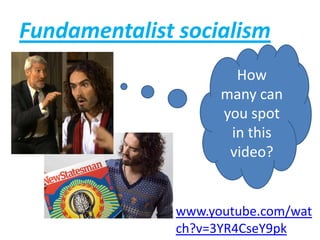
How
many can
you spot
in this
video?
www.youtube.com/wat
ch?v=3YR4CseY9pk
Fundamentalist socialism
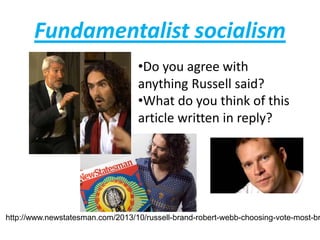
•Do you agree with
anything Russell said?
•What do you think of this
article written in reply?
http://www.newstatesman.com/2013/10/russell-brand-robert-webb-choosing-vote-most-br
Revisionist socialism
1.Revisionist Marxism (failure of Marx's predictions; resilience
of capitalism);
2.Ethical socialism (absence of theoretical 'baggage');
3.Keynesian social democracy (politics of social justice;
'humanise' capitalism; mixed economy; Keynesian economic
management; welfare state and redistributive mechanism;
Croslandism);
4.Social-democratic compromise (tension between equality and
efficiency; highlighted during recession of 1970s; 'collapse' of
traditional social democracy in the UK and elsewhere).
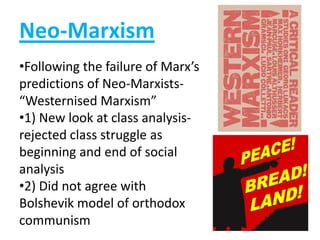
Neo-Marxism
•Following the failure of Marx’s
predictions of Neo-Marxists-
“Westernised Marxism”
•1) New look at class analysis-
rejected class struggle as
beginning and end of social
analysis
•2) Did not agree with
Bolshevik model of orthodox
communism
Revisionist Marxism (failure of Marx's
predictions; resilience of capitalism)
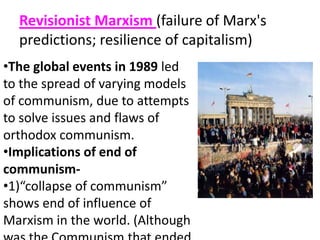
•The global events in 1989 led
to the spread of varying models
of communism, due to attempts
to solve issues and flaws of
orthodox communism.
•Implications of end of
communism-
•1)“collapse of communism”
shows end of influence of
Marxism in the world. (Although
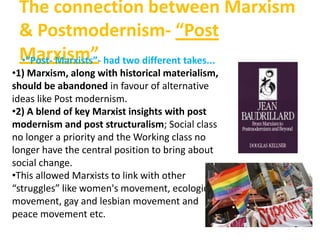
The connection between Marxism
& Postmodernism- “Post
Marxism”•“Post- Marxists”- had two different takes...
•1) Marxism, along with historical materialism,
should be abandoned in favour of alternative
ideas like Post modernism.
•2) A blend of key Marxist insights with post
modernism and post structuralism; Social class
no longer a priority and the Working class no
longer have the central position to bring about
social change.
•This allowed Marxists to link with other
“struggles” like women's movement, ecological
movement, gay and lesbian movement and
peace movement etc.
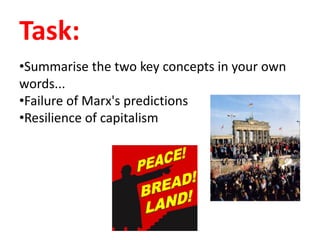
Task:
•Summarise the two key concepts in your own
words...
•Failure of Marx's predictions
•Resilience of capitalism
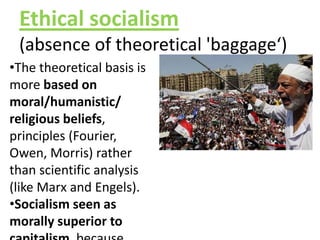
Ethical socialism
(absence of theoretical 'baggage‘)
•The theoretical basis is
more based on
moral/humanistic/
religious beliefs,
principles (Fourier,
Owen, Morris) rather
than scientific analysis
(like Marx and Engels).
•Socialism seen as
morally superior to
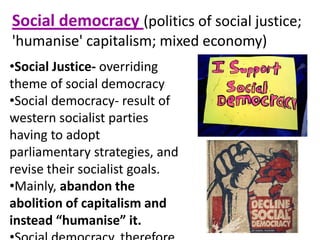
Social democracy (politics of social justice;
'humanise' capitalism; mixed economy)
•Social Justice- overriding
theme of social democracy
•Social democracy- result of
western socialist parties
having to adopt
parliamentary strategies, and
revise their socialist goals.
•Mainly, abandon the
abolition of capitalism and
instead “humanise” it.
Revisionist Socialism
•Revisionism: The revision or
reworking of a political theory
that departs from earlier
interpretations in an attempt
to present a “corrected” view
Revisionist Socialism
•Main aim of Socialism-
productive wealth should be
collectively owned. (priv
prop abolished, comm not
cap economy)
•Not all thought cap was
bad- Bernstein, Some
elements of cap had helped
redistribute and share
wealth- shareholders etc.
Keynesian social democracy (Keynesian
economic management; welfare state and
redistributive mechanism; Croslandism)
•This led to Social Democracy having 3 main objectives:
•“Mixed economy”- blend of private and public ownership that
stands between free-marketism and state collectivisation.
•“Economic management”- Capitalism needs to be regulated in
order to deliver sustainable growth. After 1945, most socialist
parties converted to Keynesianism. To control economy with full
employment.
•The “Welfare state”- the main way of reforming capitalism, it
acted as a redistributive mechanism to promote social equality
and eradicate poverty.
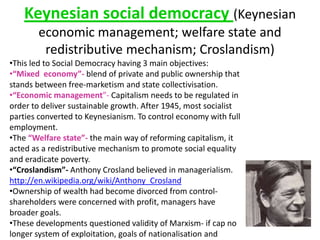
•“Croslandism”- Anthony Crosland believed in managerialism.
http://en.wikipedia.org/wiki/Anthony_Crosland
•Ownership of wealth had become divorced from control-
shareholders were concerned with profit, managers have
broader goals.
•These developments questioned validity of Marxism- if cap no
longer system of exploitation, goals of nationalisation and
Social-democratic compromise (tension between
equality and efficiency; highlighted during recession of 1970s;
'collapse' of traditional social democracy in the UK and
elsewhere)
•Keynesian social democracy was
unstable compromise between-
reliance on market to generate
wealth and also commitment to
social justice. (through a weak
notion of equality- distributive
equality). Conflict between
commitment to economic efficiency
and egalitarianism.
•Post 1945- No issue as boom

Lesson 7--russell-brand-and-revisionist-socialism

  • 1.
    Homework due in!(1 x 15 and 1 x 45, at least!) •Why do socialists support collectivism and how have they done it? (15 marks) •Why did Marx believe that capitalism was doomed to collapse? (15 marks) •Why did socialists believe in gradualism and why has gradualism failed? (45 marks) • To what extent have socialists favoured the common ownership of wealth? (45 marks) (Summer 2012)
  • 2.
    Fundamentalist socialism Marxist/communist analysis; •historical materialism ('base/superstructure'; scientifictheory of history/society); •dialectical change (internal contradictions in society; historical inevitability); •class analysis (class conflict as These are the main elements of communism and the Marxist analysis of Socialism.
  • 3.
    Fundamentalist socialism How many can youspot in this video? www.youtube.com/wat ch?v=3YR4CseY9pk
  • 4.
    Fundamentalist socialism •Do youagree with anything Russell said? •What do you think of this article written in reply? http://www.newstatesman.com/2013/10/russell-brand-robert-webb-choosing-vote-most-br
  • 5.
    Revisionist socialism 1.Revisionist Marxism(failure of Marx's predictions; resilience of capitalism); 2.Ethical socialism (absence of theoretical 'baggage'); 3.Keynesian social democracy (politics of social justice; 'humanise' capitalism; mixed economy; Keynesian economic management; welfare state and redistributive mechanism; Croslandism); 4.Social-democratic compromise (tension between equality and efficiency; highlighted during recession of 1970s; 'collapse' of traditional social democracy in the UK and elsewhere).
  • 6.
    Neo-Marxism •Following the failureof Marx’s predictions of Neo-Marxists- “Westernised Marxism” •1) New look at class analysis- rejected class struggle as beginning and end of social analysis •2) Did not agree with Bolshevik model of orthodox communism
  • 7.
    Revisionist Marxism (failureof Marx's predictions; resilience of capitalism) •The global events in 1989 led to the spread of varying models of communism, due to attempts to solve issues and flaws of orthodox communism. •Implications of end of communism- •1)“collapse of communism” shows end of influence of Marxism in the world. (Although
  • 8.
    The connection betweenMarxism & Postmodernism- “Post Marxism”•“Post- Marxists”- had two different takes... •1) Marxism, along with historical materialism, should be abandoned in favour of alternative ideas like Post modernism. •2) A blend of key Marxist insights with post modernism and post structuralism; Social class no longer a priority and the Working class no longer have the central position to bring about social change. •This allowed Marxists to link with other “struggles” like women's movement, ecological movement, gay and lesbian movement and peace movement etc.
  • 9.
    Task: •Summarise the twokey concepts in your own words... •Failure of Marx's predictions •Resilience of capitalism
  • 10.
    Ethical socialism (absence oftheoretical 'baggage‘) •The theoretical basis is more based on moral/humanistic/ religious beliefs, principles (Fourier, Owen, Morris) rather than scientific analysis (like Marx and Engels). •Socialism seen as morally superior to
  • 11.
    Social democracy (politicsof social justice; 'humanise' capitalism; mixed economy) •Social Justice- overriding theme of social democracy •Social democracy- result of western socialist parties having to adopt parliamentary strategies, and revise their socialist goals. •Mainly, abandon the abolition of capitalism and instead “humanise” it.
  • 12.
    Revisionist Socialism •Revisionism: Therevision or reworking of a political theory that departs from earlier interpretations in an attempt to present a “corrected” view
  • 13.
    Revisionist Socialism •Main aimof Socialism- productive wealth should be collectively owned. (priv prop abolished, comm not cap economy) •Not all thought cap was bad- Bernstein, Some elements of cap had helped redistribute and share wealth- shareholders etc.
  • 14.
    Keynesian social democracy(Keynesian economic management; welfare state and redistributive mechanism; Croslandism) •This led to Social Democracy having 3 main objectives: •“Mixed economy”- blend of private and public ownership that stands between free-marketism and state collectivisation. •“Economic management”- Capitalism needs to be regulated in order to deliver sustainable growth. After 1945, most socialist parties converted to Keynesianism. To control economy with full employment. •The “Welfare state”- the main way of reforming capitalism, it acted as a redistributive mechanism to promote social equality and eradicate poverty. •“Croslandism”- Anthony Crosland believed in managerialism. http://en.wikipedia.org/wiki/Anthony_Crosland •Ownership of wealth had become divorced from control- shareholders were concerned with profit, managers have broader goals. •These developments questioned validity of Marxism- if cap no longer system of exploitation, goals of nationalisation and
  • 15.
    Social-democratic compromise (tensionbetween equality and efficiency; highlighted during recession of 1970s; 'collapse' of traditional social democracy in the UK and elsewhere) •Keynesian social democracy was unstable compromise between- reliance on market to generate wealth and also commitment to social justice. (through a weak notion of equality- distributive equality). Conflict between commitment to economic efficiency and egalitarianism. •Post 1945- No issue as boom