PERFECT NUMBERS
ALAN S. ABERILLA
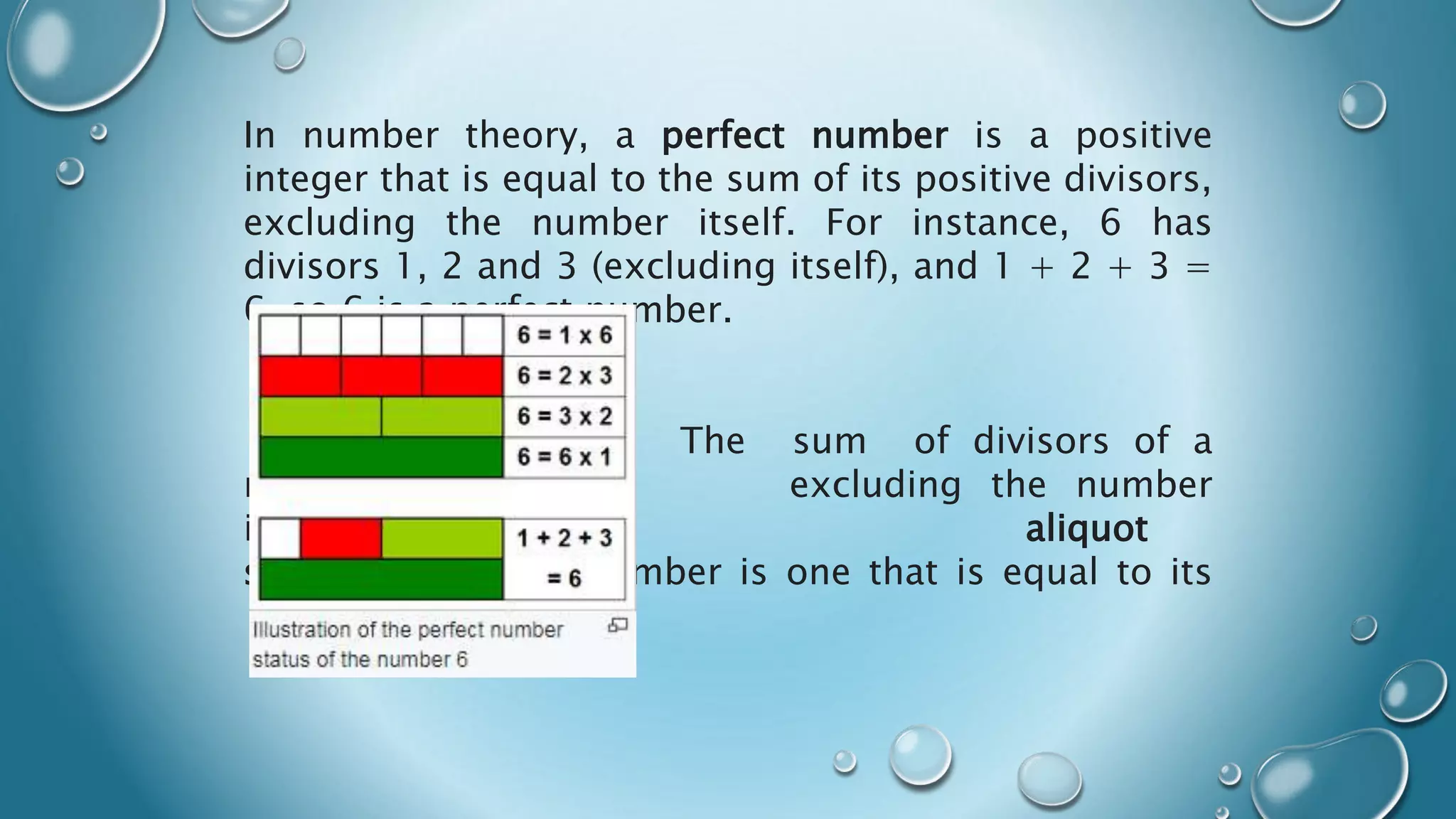
In number theory, a perfect number is a positive
integer that is equal to the sum of its positive divisors,
excluding the number itself. For instance, 6 has
divisors 1, 2 and 3 (excluding itself), and 1 + 2 + 3 =
6, so 6 is a perfect number.
The sum of divisors of a
number excluding the number
itself, is called aliquot
sum, so a perfect number is one that is equal to its
aliquot sum.
Equivalently, a perfect number is a number that is half
the the sum of all of its positive divisors including
itself; in symbols, σ1(n) = 2n where σ1 is the
sum-of-divisors function. For instance, 28 is perfect as 1
+ 2 + 4 + 7 + 14 + 28 = 56 = 2 × 28.
This definition is ancient, appearing as early as Euclid’s
Elements (VII.22) where it is called τέλειος
ἀριθμός (perfect, ideal, or complete number). Euclid also
proved a formation rule (IX.36) whereby is an even
perfect number whenever is a prime of the form for
prime - what is now called a Mersenne prime. Two
millennia later, Euler proved that all even perfect
numbers are of this form. This is known as the Euclid-
Euler Theorem.
ACTIVITY 5:
1. Make an illustration a perfect number 28.
2. Give the aliquot sum of 496
Use short bond paper (handwritten or
computerized) – utilize the folder of assignment
1
Lesson 6   perfect numbers

Lesson 6 perfect numbers

  • 1.
  • 2.
    In number theory,a perfect number is a positive integer that is equal to the sum of its positive divisors, excluding the number itself. For instance, 6 has divisors 1, 2 and 3 (excluding itself), and 1 + 2 + 3 = 6, so 6 is a perfect number. The sum of divisors of a number excluding the number itself, is called aliquot sum, so a perfect number is one that is equal to its aliquot sum.
  • 3.
    Equivalently, a perfectnumber is a number that is half the the sum of all of its positive divisors including itself; in symbols, σ1(n) = 2n where σ1 is the sum-of-divisors function. For instance, 28 is perfect as 1 + 2 + 4 + 7 + 14 + 28 = 56 = 2 × 28. This definition is ancient, appearing as early as Euclid’s Elements (VII.22) where it is called τέλειος ἀριθμός (perfect, ideal, or complete number). Euclid also proved a formation rule (IX.36) whereby is an even perfect number whenever is a prime of the form for prime - what is now called a Mersenne prime. Two millennia later, Euler proved that all even perfect numbers are of this form. This is known as the Euclid- Euler Theorem.
  • 4.
    ACTIVITY 5: 1. Makean illustration a perfect number 28. 2. Give the aliquot sum of 496 Use short bond paper (handwritten or computerized) – utilize the folder of assignment 1