 You will be assigned one of the incidents that occurred
 in the 1920s and you will needfollowing number
    Each incident will need at least the to create a performance
    of people for it to work:
 that will demonstrate exactlyyou have written
  You need to make sure what happened in that
 incidentneeds 4/5 people
    Vilna =
  down what happened in each of those
  incidents = 5/6 people
    Upper Silesia
 Eg two people can represent two countries having a
  dispute Islands = 3 people
     Aaland

 Anothera balanced analysis of stepsLON in
   Write= 5/6 people as the League who the in/doesn’t
     Corfu can act
  step in to sort the dispute out they did a
   the 1920s – do you think
     Bulgaria = 4
 You may also want another person to do the
  commentary job?the scene? classthey could
   good/bad over Or the best about the good
     Any who are not involved need to teach
  do inthe didhealth, transport and social problems
   work the for refugees, working
   conditions,
               situation?
 Disarmament


 The Locarno Treaty


 The other successful treaties of the 1920s
Starter:
  As a group rank the 4 aims of the League in order of
  success during the 1920s – you need to justify your
  answers
Aims:

   1. To promote international co-operation, peace and security by
   accepting an obligation not to go to war

   2. To promote open, just and honorable relations between nations

   3. To lay out a system of international law

   4. To maintain, or help to modify, treaties between nations
 Discuss what you think were the weaknesses of the
 League of Nations from what you have read so far
 about its structure, leadership and restraints when
 handling problems.
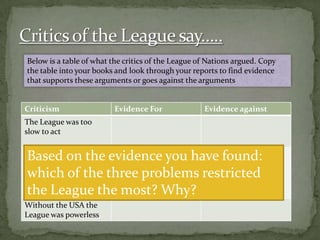
Below is a table of what the critics of the League of Nations argued. Copy
the table into your books and look through your reports to find evidence
that supports these arguments or goes against the arguments


Criticism                Evidence For               Evidence against
The League was too
slow to act


Based on the evidence you have found:
Members would only
act on their own
which of the three problems restricted
interests, not the
Leagues
the League the most? Why?
Without the USA the
League was powerless
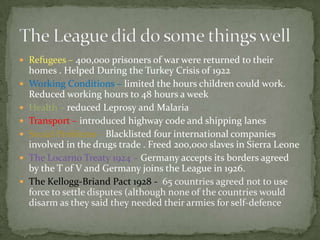
 Refugees – 400,000 prisoners of war were returned to their
    homes . Helped During the Turkey Crisis of 1922
   Working Conditions – limited the hours children could work.
    Reduced working hours to 48 hours a week
   Health – reduced Leprosy and Malaria
   Transport – introduced highway code and shipping lanes
   Social Problems – Blacklisted four international companies
    involved in the drugs trade . Freed 200,000 slaves in Sierra Leone
   The Locarno Treaty 1924 – Germany accepts its borders agreed
    by the T of V and Germany joins the League in 1926.
   The Kellogg-Briand Pact 1928 - 65 countries agreed not to use
    force to settle disputes (although none of the countries would
    disarm as they said they needed their armies for self-defence
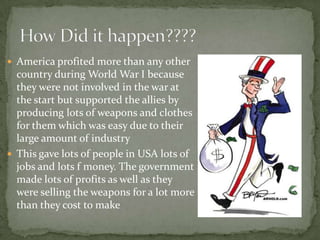
 America profited more than any other
  country during World War I because
  they were not involved in the war at
  the start but supported the allies by
  producing lots of weapons and clothes
  for them which was easy due to their
  large amount of industry
 This gave lots of people in USA lots of
  jobs and lots f money. The government
  made lots of profits as well as they
  were selling the weapons for a lot more
  than they cost to make
 With more money to spend people brought lots of
 luxury goods such as cars, radios, going to the cinema’s
 and invested on the stock market.

 President Hoover’s aim: “a chicken in every pot and two
 cars in every garage”.
 Companies borrow money to pay for equipment or
    staff etc
   Investors get a share of the profit the company
    makes
   ‘Shareholders’ can sell their shares on the stock
    market.
   This is based in Wall Street, New York
   Prices can change every day according to how well
    the company is doing.
   Prices can also change no matter how the company
    is doing this is called Speculation
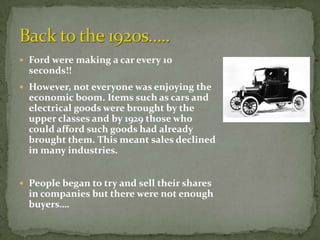
 Ford were making a car every 10
  seconds!!
 However, not everyone was enjoying the
  economic boom. Items such as cars and
  electrical goods were brought by the
  upper classes and by 1929 those who
  could afford such goods had already
  brought them. This meant sales declined
  in many industries.


 People began to try and sell their shares
  in companies but there were not enough
  buyers….
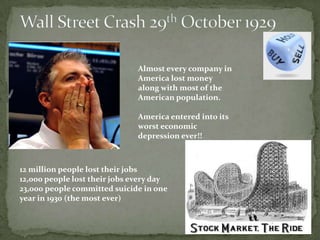
Almost every company in
                               America lost money
                               along with most of the
                               American population.

                               America entered into its
                               worst economic
                               depression ever!!


12 million people lost their jobs
12,000 people lost their jobs every day
23,000 people committed suicide in one
year in 1930 (the most ever)
 What effect the depression would have on the rest of
 the world?


 Think about how today’s depression affects lots of
 different countries


 What effect the depression would have on the League
 of Nation’ s effectiveness?
 Map image on page 35
 I have not worked since last year
 I will support anyone who can get the country back to
    work
   If we had our own empire we would have the resources
    we need to stop the depression affecting us
   Reparations have caused this mess
   The bank has closed we have lost everything
   We need tough leaders who will not be pushed around
    by the League or the USA
   We should ban all foreign goods, this will the jobs of
    our workers
 Go onto Google and type in Wall Street Crash ppt
 Open the second power point
 You need to investigate How the Wall Street Crash in
  the USA lead to Hitler coming into power in Germany

 The areas you need to cover:

1. Who were the people who suffered in Germany from the depression
and why
2. Why the government was held responsible
3. What Hitler and the Nazis did to take advantage of the situation
4. How they used propaganda to influence people
The Manchuria Crisis
you need to read the information on the crisis from the
textbooks and you need to produce a detailed timeline of the
important events that occurred

Who was to blame for the Leagues failure over Manchuria;
the Leagues structure or the individual members?
Justify your answer
   1920s Japan became a major power – large army, strong industry, growing empire

   1930s - Depression in the 1930s hits Japan badly as China and USA put trade tariffs on Japanese goods

   Japanese army leaders wanted to expand Japanese empire by force

   September 1931 Japan army throw all Chinese out of Manchuria

   February 1932 puppet government set up in Manchuria

   1932 – Japanese aeroplanes bomb Shanghai

   Japanese government tells Japanese army to withdraw but they are ignored – it is clear that the Japanese army is in control of
    Japanese foreign policy not the government

   China appeals to the League – Japan says it is settling a local difficulty and that China was in anarchy and this was needed to
    keep peace

   September 1932 the League decides Japan acted unlawfully and give Manchuria back to China

   February 1933 Japan announces they intend to invade more of China in Slef defence

   24th February the League votes against this action

   Japan leave the League on 27th March 1933

   The next week they invade Jehol

   The League doesn’t know what to do to stop them - many excuses made but the League did nothing to stop Japan

Lesson 6

  • 1.
     You willbe assigned one of the incidents that occurred in the 1920s and you will needfollowing number Each incident will need at least the to create a performance of people for it to work: that will demonstrate exactlyyou have written You need to make sure what happened in that incidentneeds 4/5 people Vilna = down what happened in each of those incidents = 5/6 people Upper Silesia  Eg two people can represent two countries having a dispute Islands = 3 people Aaland  Anothera balanced analysis of stepsLON in Write= 5/6 people as the League who the in/doesn’t Corfu can act step in to sort the dispute out they did a the 1920s – do you think Bulgaria = 4  You may also want another person to do the commentary job?the scene? classthey could good/bad over Or the best about the good Any who are not involved need to teach do inthe didhealth, transport and social problems work the for refugees, working conditions, situation?
  • 2.
     Disarmament  TheLocarno Treaty  The other successful treaties of the 1920s
  • 3.
    Starter: Asa group rank the 4 aims of the League in order of success during the 1920s – you need to justify your answers Aims: 1. To promote international co-operation, peace and security by accepting an obligation not to go to war 2. To promote open, just and honorable relations between nations 3. To lay out a system of international law 4. To maintain, or help to modify, treaties between nations
  • 4.
     Discuss whatyou think were the weaknesses of the League of Nations from what you have read so far about its structure, leadership and restraints when handling problems.
  • 5.
    Below is atable of what the critics of the League of Nations argued. Copy the table into your books and look through your reports to find evidence that supports these arguments or goes against the arguments Criticism Evidence For Evidence against The League was too slow to act Based on the evidence you have found: Members would only act on their own which of the three problems restricted interests, not the Leagues the League the most? Why? Without the USA the League was powerless
  • 6.
     Refugees –400,000 prisoners of war were returned to their homes . Helped During the Turkey Crisis of 1922  Working Conditions – limited the hours children could work. Reduced working hours to 48 hours a week  Health – reduced Leprosy and Malaria  Transport – introduced highway code and shipping lanes  Social Problems – Blacklisted four international companies involved in the drugs trade . Freed 200,000 slaves in Sierra Leone  The Locarno Treaty 1924 – Germany accepts its borders agreed by the T of V and Germany joins the League in 1926.  The Kellogg-Briand Pact 1928 - 65 countries agreed not to use force to settle disputes (although none of the countries would disarm as they said they needed their armies for self-defence
  • 8.
     America profitedmore than any other country during World War I because they were not involved in the war at the start but supported the allies by producing lots of weapons and clothes for them which was easy due to their large amount of industry  This gave lots of people in USA lots of jobs and lots f money. The government made lots of profits as well as they were selling the weapons for a lot more than they cost to make
  • 9.
     With moremoney to spend people brought lots of luxury goods such as cars, radios, going to the cinema’s and invested on the stock market.  President Hoover’s aim: “a chicken in every pot and two cars in every garage”.
  • 10.
     Companies borrowmoney to pay for equipment or staff etc  Investors get a share of the profit the company makes  ‘Shareholders’ can sell their shares on the stock market.  This is based in Wall Street, New York  Prices can change every day according to how well the company is doing.  Prices can also change no matter how the company is doing this is called Speculation
  • 11.
     Ford weremaking a car every 10 seconds!!  However, not everyone was enjoying the economic boom. Items such as cars and electrical goods were brought by the upper classes and by 1929 those who could afford such goods had already brought them. This meant sales declined in many industries.  People began to try and sell their shares in companies but there were not enough buyers….
  • 12.
    Almost every companyin America lost money along with most of the American population. America entered into its worst economic depression ever!! 12 million people lost their jobs 12,000 people lost their jobs every day 23,000 people committed suicide in one year in 1930 (the most ever)
  • 13.
     What effectthe depression would have on the rest of the world?  Think about how today’s depression affects lots of different countries  What effect the depression would have on the League of Nation’ s effectiveness?
  • 14.
     Map imageon page 35
  • 15.
     I havenot worked since last year  I will support anyone who can get the country back to work  If we had our own empire we would have the resources we need to stop the depression affecting us  Reparations have caused this mess  The bank has closed we have lost everything  We need tough leaders who will not be pushed around by the League or the USA  We should ban all foreign goods, this will the jobs of our workers
  • 16.
     Go ontoGoogle and type in Wall Street Crash ppt  Open the second power point  You need to investigate How the Wall Street Crash in the USA lead to Hitler coming into power in Germany  The areas you need to cover: 1. Who were the people who suffered in Germany from the depression and why 2. Why the government was held responsible 3. What Hitler and the Nazis did to take advantage of the situation 4. How they used propaganda to influence people
  • 17.
    The Manchuria Crisis youneed to read the information on the crisis from the textbooks and you need to produce a detailed timeline of the important events that occurred Who was to blame for the Leagues failure over Manchuria; the Leagues structure or the individual members? Justify your answer
  • 18.
    1920s Japan became a major power – large army, strong industry, growing empire  1930s - Depression in the 1930s hits Japan badly as China and USA put trade tariffs on Japanese goods  Japanese army leaders wanted to expand Japanese empire by force  September 1931 Japan army throw all Chinese out of Manchuria  February 1932 puppet government set up in Manchuria  1932 – Japanese aeroplanes bomb Shanghai  Japanese government tells Japanese army to withdraw but they are ignored – it is clear that the Japanese army is in control of Japanese foreign policy not the government  China appeals to the League – Japan says it is settling a local difficulty and that China was in anarchy and this was needed to keep peace  September 1932 the League decides Japan acted unlawfully and give Manchuria back to China  February 1933 Japan announces they intend to invade more of China in Slef defence  24th February the League votes against this action  Japan leave the League on 27th March 1933  The next week they invade Jehol  The League doesn’t know what to do to stop them - many excuses made but the League did nothing to stop Japan