Objectives:
Define outline;
Apply topicand sentence outline as techniques
in selecting and organizing information; and
Appreciate the importance of outlining in
selecting and organizing a text
Outline
• is anotherway of organizing
information. It organizes
materials hierarchically and
sequentially by classifying the
main topics, subtopics, and
supporting details.
6.
Outline
• is asnapshot of your paper
, capturing
the important points. It helps you to take
your paper from a clear introduction to a
logical conclusion, supported by your
research is essentially a guide to writing
your paper
, something like an of
assembly instructions.
7.
Outline
• is ageneral plan on what we are going
to write. You can compare making an
outline to drawing plans to build a
house. Before one begins build a house,
it is best to draw up plans to make sure
that a house is built in the way you want.
The same is true with writing an outline.
8.
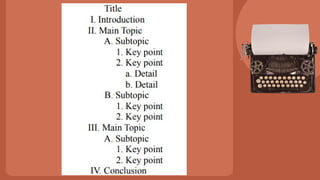
Structure
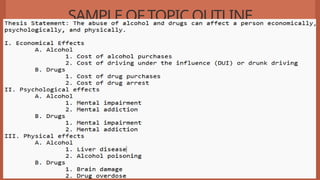
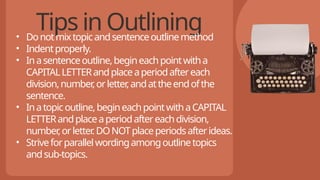
• Use “RomanNumerals” for the top-level,
‘capital letters’ in the alphabet for the
next level, ‘Arabic Numerals’ for the next
level, and then ‘lowercase letters’ for the
next level. Each numeral or letter is
followed by a period, and each item is
capitalized.
10.
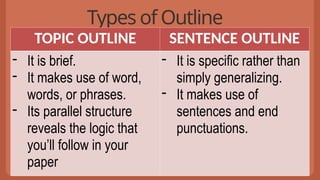
Types of Outline
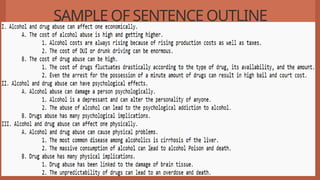
TOPICOUTLINE SENTENCE OUTLINE
- It is brief.
- It makes use of word,
words, or phrases.
- Its parallel structure
reveals the logic that
you’ll follow in your
paper
- It is specific rather than
simply generalizing.
- It makes use of
sentences and end
punctuations.
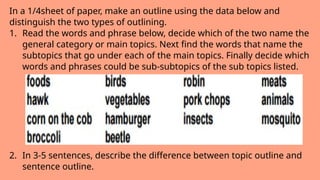
In a 1/4sheetof paper, make an outline using the data below and
distinguish the two types of outlining.
1. Read the words and phrase below, decide which of the two name the
general category or main topics. Next find the words that name the
subtopics that go under each of the main topics. Finally decide which
words and phrases could be sub-subtopics of the sub topics listed.
2. In 3-5 sentences, describe the difference between topic outline and
sentence outline.
#2 Miss Bitay:
1. The class will be divided into three (3) groups.
2. The teacher will randomly select a category.
3. For one (1) minute, each group will write as many objects as they can depending on the category (for example, name of fruits).
4. When the time is up, the teacher will cross check the list made by the groups. They will have to scratch off the list if it is also written by the other group.
#3 * ACTIVITY
* ANALYSIS
1. In doing the activity, what are the cues that helped you determine the answers?
2. How do we call the activity that you have engage with?
3. Then, the teacher will consolidate the answers of the students and lead them to the lesson.
ANSWER
1.D
2.B
3. C
#5 This is necessary to create clear statement or purpose, position, facts, examples, specific details, definitions,
explanations, justifications, or opposing viewpoints. It can be done through a
recognizable plan in relating sentences in paragraph. To secure this, there are
special words that can be used
#6 This is necessary to create clear statement or purpose, position, facts, examples, specific details, definitions,
explanations, justifications, or opposing viewpoints. It can be done through a
recognizable plan in relating sentences in paragraph. To secure this, there are
special words that can be used
#7 This is necessary to create clear statement or purpose, position, facts, examples, specific details, definitions,
explanations, justifications, or opposing viewpoints. It can be done through a
recognizable plan in relating sentences in paragraph. To secure this, there are
special words that can be used
#8 This is necessary to create clear statement or purpose, position, facts, examples, specific details, definitions,
explanations, justifications, or opposing viewpoints. It can be done through a
recognizable plan in relating sentences in paragraph. To secure this, there are
special words that can be used
#9 This is necessary to create clear statement or purpose, position, facts, examples, specific details, definitions,
explanations, justifications, or opposing viewpoints. It can be done through a
recognizable plan in relating sentences in paragraph. To secure this, there are
special words that can be used
#10 This is necessary to create clear statement or purpose, position, facts, examples, specific details, definitions,
explanations, justifications, or opposing viewpoints. It can be done through a
recognizable plan in relating sentences in paragraph. To secure this, there are
special words that can be used
#11 When sentences, ideas, and details fit together clearly, readers can follow along easily, and the writing is coherent. The ideas tie together smoothly and clearly.
#12 When sentences, ideas, and details fit together clearly, readers can follow along easily, and the writing is coherent. The ideas tie together smoothly and clearly.
#13 When sentences, ideas, and details fit together clearly, readers can follow along easily, and the writing is coherent. The ideas tie together smoothly and clearly.
#15 * In paragraph writing, cohesion is a characteristic that is manifested by a tight link among sentences. In other words, it is seen through the interrelatedness of the sentences.