Lesson # 2
Importance of
Quantitative
Research Across
Fields
Quantitative Research &
Anthropology
5 steps to follow in conducting true
experimental research with people:
1. You need at least 2 groups,
called the treatment group (or the
intervention group or the stimulus
group) and the control group.
Quantitative Research &
Anthropology
2. Individuals must be
randomly assigned,
either to the
intervention group or to
the control group.
Quantitative Research &
Anthropology
3. The groups are
measured on one or
more dependent
variables; this is called
the pre-test.
Quantitative Research &
Anthropology
4. The intervention
(the independent
variable is introduced).
Quantitative Research &
Anthropology
5. The dependent
variables are measured
again. This is the
posttest.
True Experiment in the Lab
• Often produce results that beg to be tested in
the natural world by anthropologists.
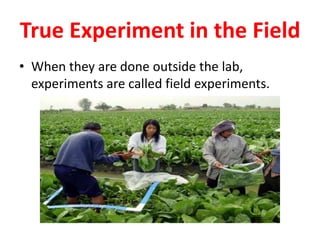
True Experiment in the Field
• When they are done outside the lab,
experiments are called field experiments.
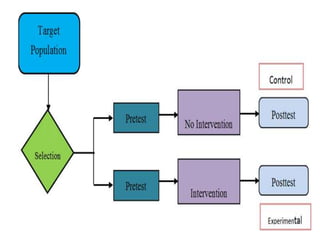
Quasi-Experiments
• Are most often use in evaluating a social
programs
• Students are measured before and after the
intervention to see whether their reading
scores improve.
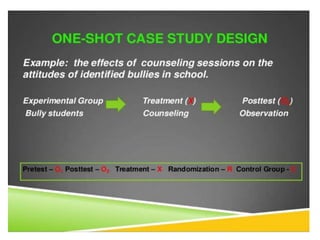
One-shot Case Study, or One-Group
Posttest Only Design
• A single group of individuals is
measured on some dependent
variable after an intervention has
taken place.
• The researcher evaluates the
experiment by interviewing people
and trying to assess the impact of
the intervention.
One-shot Case Study, or One-Group
Posttest Only Design
• Like all experimental designs, the goal is to
determine if the treatment had any effect on the
outcome.
• Without a comparison group, it is impossible to
determine if the outcome scores are any higher
than they would have been without the
treatment.
• And, without any pre-test scores, it is impossible
to determine if any change within the group
itself has taken place.
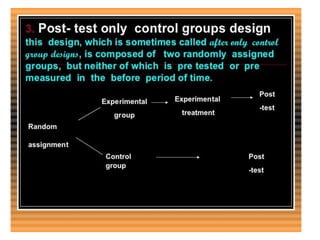
Two-Group Posttest Only Design
• You measure a series of variables
• This design is quite convincing.
• Lots of participants observation
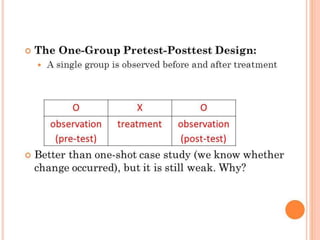
One-Group Pre-test-Posttest Design
• Some variables as measured (observed)then
the intervention takes place, and then the
variables are measured again.
• There is a significant difference on the pre-test
and posttest measurements.
Quantitative Research &
Communication
Quantitative Research &
Communication
• Researchers are often interested in
how an understanding of a
particular communication
phenomenon might be generalized
to a larger population.
• Ex. What communicative behaviours
are associated with different stages
in a romantic relationship?
Quantitative Research & Sports
Medicine
Quantitative Research & Sports
Medicine
• Example, in a quantitative
research conducted, the study
concluded that physical
activity affects effectively the
children’s weight control.
Quantitative Research &
Medical Education
Quantitative Research &
Medical Education
• Quantitative research in
medical education tends to be
predominantly observational
research based on surveys or
correlational studies.
Quantitative Research &
Medical Education
• Experimental research designs may
enhance the quality of medical
education. Said designs test
interventions like curriculum,
teaching-learning process, or
assessment with an experimental
group..
Quantitative Research &
the Behavioral Sciences
Quantitative Research &
the Behavioral Sciences
• Contemporary quantitative scholars
are interested in two types of
questions.
1. Questions of relationships and
2. Questions of differences
• Relationship questions tend to explore
how ne behavior exhibited by people is
related to other types of behavior.
• Questions of difference explore how
patterns of behavior or perceptions
might differ from one group or type
of person to another.
Quantitative Research in Education &
Psychology
• Mertens (220) says that dominant
paradigms that guided early
educational and psychological research
were positivism and post positivism.
• Positivism in based on the rationalistic,
empiricist philosophy that originated
with Aristotle et al.
Quantitative Research in Education &
Psychology
• The underlying assumptions of
positivism include the belief that
the social world can be studied in
the same way as the natural world,
that there is a method for studying
the social world that is value-free,
and that explanations of a causal
nature can be provided.
Quantitative Research & the
Social Sciences
Quantitative Research & the
Social Sciences
• The term “quantitative method”
refers to the adoption of the natural
science experiments as the model
for scientific research.
• The logic of such research is to:
1. Collect data using standardized
approaches on a range of
variables;
Quantitative Research & the
Social Sciences
2. Search for patterns of causal
relationships between these
variables; and
3. Test given theory by
confirming or denying precise
hypotheses.
Quantitative Research & the
Social Sciences
• Sample Survey and the experiment
are popular methods.
• People use social research to raise
children, reduce crime, improve
public health, sell products or just
understand one’s life ( Neuman,
2007).

Lesson 2-quanti (1)

  • 1.
    Lesson # 2 Importanceof Quantitative Research Across Fields
  • 2.
    Quantitative Research & Anthropology 5steps to follow in conducting true experimental research with people: 1. You need at least 2 groups, called the treatment group (or the intervention group or the stimulus group) and the control group.
  • 3.
    Quantitative Research & Anthropology 2.Individuals must be randomly assigned, either to the intervention group or to the control group.
  • 4.
    Quantitative Research & Anthropology 3.The groups are measured on one or more dependent variables; this is called the pre-test.
  • 5.
    Quantitative Research & Anthropology 4.The intervention (the independent variable is introduced).
  • 6.
    Quantitative Research & Anthropology 5.The dependent variables are measured again. This is the posttest.
  • 7.
    True Experiment inthe Lab • Often produce results that beg to be tested in the natural world by anthropologists.
  • 8.
    True Experiment inthe Field • When they are done outside the lab, experiments are called field experiments.
  • 10.
    Quasi-Experiments • Are mostoften use in evaluating a social programs • Students are measured before and after the intervention to see whether their reading scores improve.
  • 12.
    One-shot Case Study,or One-Group Posttest Only Design • A single group of individuals is measured on some dependent variable after an intervention has taken place. • The researcher evaluates the experiment by interviewing people and trying to assess the impact of the intervention.
  • 14.
    One-shot Case Study,or One-Group Posttest Only Design • Like all experimental designs, the goal is to determine if the treatment had any effect on the outcome. • Without a comparison group, it is impossible to determine if the outcome scores are any higher than they would have been without the treatment. • And, without any pre-test scores, it is impossible to determine if any change within the group itself has taken place.
  • 15.
    Two-Group Posttest OnlyDesign • You measure a series of variables • This design is quite convincing. • Lots of participants observation
  • 17.
    One-Group Pre-test-Posttest Design •Some variables as measured (observed)then the intervention takes place, and then the variables are measured again. • There is a significant difference on the pre-test and posttest measurements.
  • 19.
  • 20.
    Quantitative Research & Communication •Researchers are often interested in how an understanding of a particular communication phenomenon might be generalized to a larger population. • Ex. What communicative behaviours are associated with different stages in a romantic relationship?
  • 21.
    Quantitative Research &Sports Medicine
  • 22.
    Quantitative Research &Sports Medicine • Example, in a quantitative research conducted, the study concluded that physical activity affects effectively the children’s weight control.
  • 23.
  • 24.
    Quantitative Research & MedicalEducation • Quantitative research in medical education tends to be predominantly observational research based on surveys or correlational studies.
  • 25.
    Quantitative Research & MedicalEducation • Experimental research designs may enhance the quality of medical education. Said designs test interventions like curriculum, teaching-learning process, or assessment with an experimental group..
  • 26.
    Quantitative Research & theBehavioral Sciences
  • 27.
    Quantitative Research & theBehavioral Sciences • Contemporary quantitative scholars are interested in two types of questions. 1. Questions of relationships and 2. Questions of differences • Relationship questions tend to explore how ne behavior exhibited by people is related to other types of behavior.
  • 28.
    • Questions ofdifference explore how patterns of behavior or perceptions might differ from one group or type of person to another.
  • 29.
    Quantitative Research inEducation & Psychology • Mertens (220) says that dominant paradigms that guided early educational and psychological research were positivism and post positivism. • Positivism in based on the rationalistic, empiricist philosophy that originated with Aristotle et al.
  • 32.
    Quantitative Research inEducation & Psychology • The underlying assumptions of positivism include the belief that the social world can be studied in the same way as the natural world, that there is a method for studying the social world that is value-free, and that explanations of a causal nature can be provided.
  • 33.
    Quantitative Research &the Social Sciences
  • 34.
    Quantitative Research &the Social Sciences • The term “quantitative method” refers to the adoption of the natural science experiments as the model for scientific research. • The logic of such research is to: 1. Collect data using standardized approaches on a range of variables;
  • 35.
    Quantitative Research &the Social Sciences 2. Search for patterns of causal relationships between these variables; and 3. Test given theory by confirming or denying precise hypotheses.
  • 36.
    Quantitative Research &the Social Sciences • Sample Survey and the experiment are popular methods. • People use social research to raise children, reduce crime, improve public health, sell products or just understand one’s life ( Neuman, 2007).