








TALENT
ACQUISITION
Presented by
DR. RHEA LOWELLA S. FISER,RPsy,RPm,CSIOP
HR
FUNCTIONS/PLANNING
Lesson 2:
Talent Acquisition
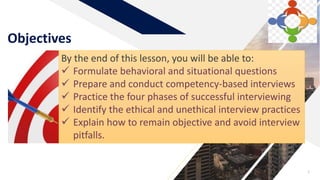
Objectives
3
By the end of this lesson, you will be able to:
 Formulate behavioral and situational questions
 Prepare and conduct competency-based interviews
 Practice the four phases of successful interviewing
 Identify the ethical and unethical interview practices
 Explain how to remain objective and avoid interview
pitfalls.
FR
Presented by: DR RHEA LOWELLA S. FISER 4
FR
TALENT ACQUSITION
Add a footer 5
FR
Add a footer 6
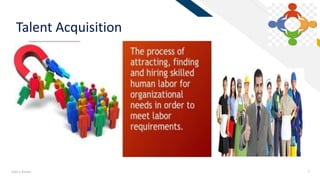
Talent Acquisition
FR
Talent Acquisition
Add a footer 7
FR
Talent Acquisition
Add a footer 8
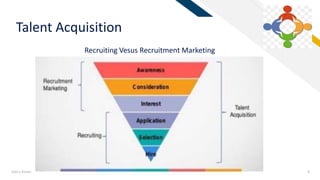
Recruiting Vesus Recruitment Marketing
FR
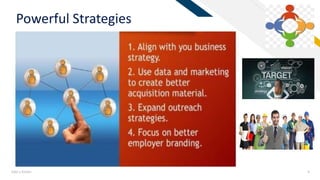
Powerful Strategies
Add a footer 9
FR
10
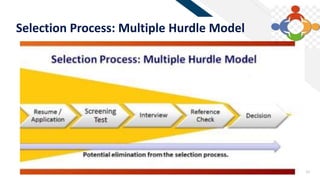
Selection Process: Multiple Hurdle Model
FR
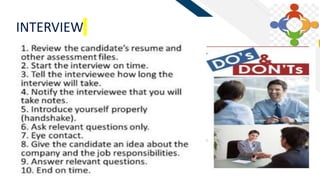
INTERVIEW
Add a footer 11
FR
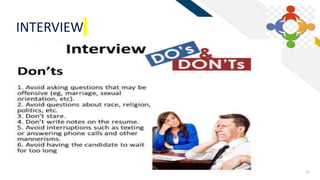
INTERVIEW
Add a footer 12
FR
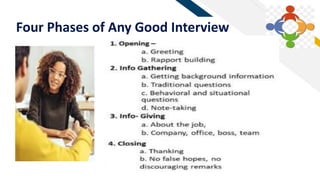
Four Phases of Any Good Interview
FR
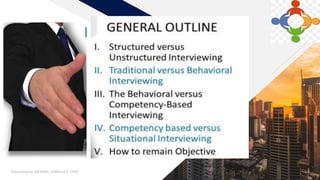
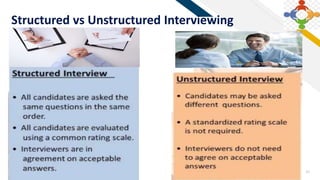
Structured vs Unstructured Interviewing
FR
Add a footer 15
Structured vs Unstructured Interviewing
FR
Add a footer 16
Behavioral vs Traditional Interviewing
FR
Add a footer 17
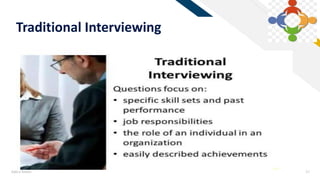
Traditional Interviewing
FR
Add a footer 18
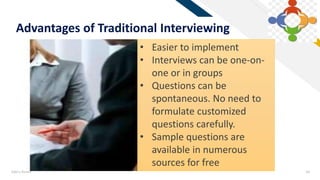
Advantages of Traditional Interviewing
• Easier to implement
• Interviews can be one-on-
one or in groups
• Questions can be
spontaneous. No need to
formulate customized
questions carefully.
• Sample questions are
available in numerous
sources for free
FR
Add a footer 19
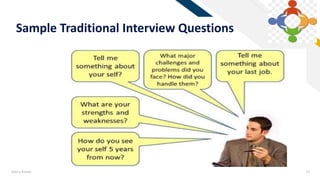
Sample Traditional Interview Questions
FR
Add a footer 20
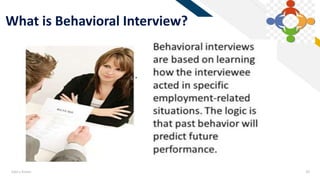
What is Behavioral Interview?
FR
Add a footer 21
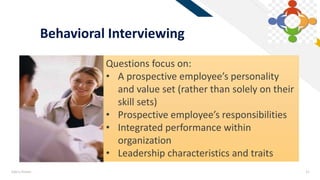
Behavioral Interviewing
Questions focus on:
• A prospective employee’s personality
and value set (rather than solely on their
skill sets)
• Prospective employee’s responsibilities
• Integrated performance within
organization
• Leadership characteristics and traits
FR
Add a footer 22
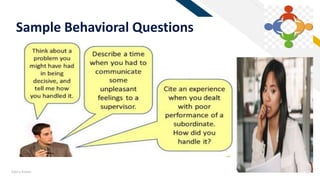
Sample Behavioral Questions
FR
Add a footer 23
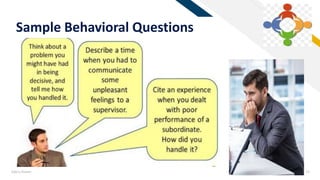
Sample Behavioral Questions
FR
Add a footer 24
Advantages of Behavioral Interviewing
 Provides a broad assessment of an
individual’s personality and skill set
 Results can be easily quantified
 Allow prospective employees to be more
relaxed during the interview process
 Hidden information more easily obtained
FR
Add a footer 25
Advantages of Behavioral Interviewing
 Less chance for a candidate to steer their
answers to what they think the
interviewer wants to hear
 Uncovers positive and negative
personality traits
 Better indication of how an individual
will fit in your organization
FR
Add a footer 26
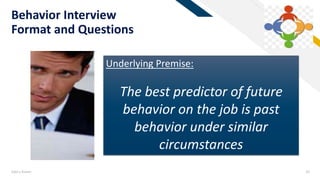
Behavior Interview
Format and Questions
Underlying Premise:
The best predictor of future
behavior on the job is past
behavior under similar
circumstances
FR
Add a footer 27
The Behavioral Vs Competency-
Based Interviewing Models
FR
Add a footer 28
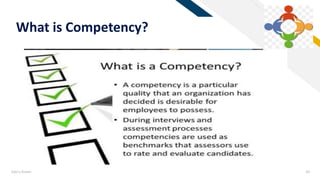
What is Competency?
FR
Add a footer 29
FR
Add a footer 30
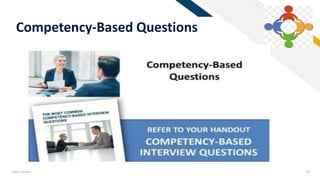
Competency-Based Questions
FR
Add a footer 31
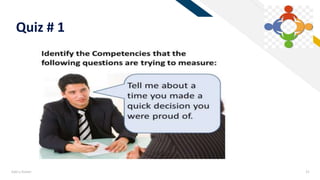
Quiz # 1
FR
Add a footer 32
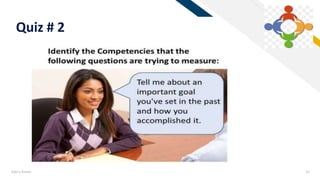
Quiz # 2
FR
Add a footer 33
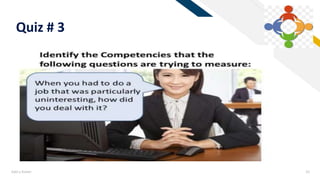
Quiz # 3
FR
Add a footer 34
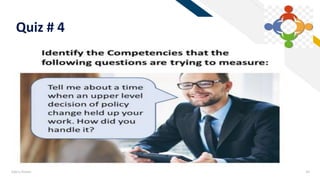
Quiz # 4
FR
Add a footer 35
Quiz # 5
FR
Add a footer 36
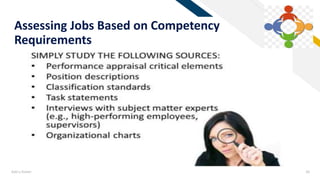
Assessing Jobs Based on Competency
Requirements
FR
Add a footer 37
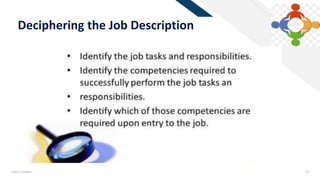
Deciphering the Job Description
FR
Add a footer 38
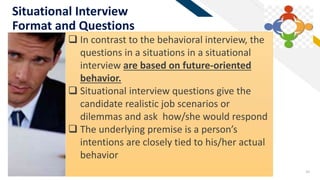
Situational Interview
Format and Questions
 In contrast to the behavioral interview, the
questions in a situations in a situational
interview are based on future-oriented
behavior.
 Situational interview questions give the
candidate realistic job scenarios or
dilemmas and ask how/she would respond
 The underlying premise is a person’s
intentions are closely tied to his/her actual
behavior
FR
39
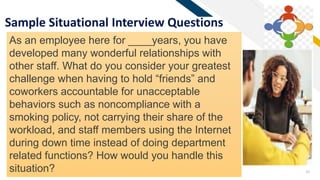
Sample Situational Interview Questions
As an employee here for ____years, you have
developed many wonderful relationships with
other staff. What do you consider your greatest
challenge when having to hold “friends” and
coworkers accountable for unacceptable
behaviors such as noncompliance with a
smoking policy, not carrying their share of the
workload, and staff members using the Internet
during down time instead of doing department
related functions? How would you handle this
situation?
FR
Add a footer 40
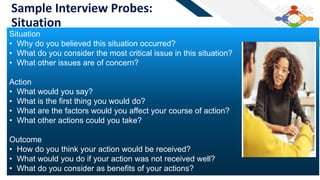
Sample Interview Probes:
Situation
Situation
• Why do you believed this situation occurred?
• What do you consider the most critical issue in this situation?
• What other issues are of concern?
Action
• What would you say?
• What is the first thing you would do?
• What are the factors would you affect your course of action?
• What other actions could you take?
Outcome
• How do you think your action would be received?
• What would you do if your action was not received well?
• What do you consider as benefits of your actions?
FR
Add a footer 41
FR
Add a footer 42
FR
Add a footer 43
FR
Add a footer 44
FR
Add a footer 45
FR
Add a footer 46
FR
Add a footer 47
FR
Add a footer 48
FR
Add a footer 49
FR
Add a footer 50
FR
Add a footer 51
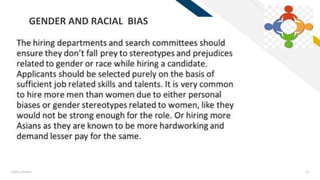
GENDER AND RACIAL BIAS
DR RHEA LOWELLA S. FISER
09951100143
rheasantillan@live.com
Thank You

Lesson 2 Talent Acquisition

  • 1.
    TALENT ACQUISITION Presented by DR. RHEALOWELLA S. FISER,RPsy,RPm,CSIOP
  • 2.
  • 3.
    Objectives 3 By the endof this lesson, you will be able to:  Formulate behavioral and situational questions  Prepare and conduct competency-based interviews  Practice the four phases of successful interviewing  Identify the ethical and unethical interview practices  Explain how to remain objective and avoid interview pitfalls.
  • 4.
    FR Presented by: DRRHEA LOWELLA S. FISER 4
  • 5.
  • 6.
    FR Add a footer6 Talent Acquisition
  • 7.
  • 8.
    FR Talent Acquisition Add afooter 8 Recruiting Vesus Recruitment Marketing
  • 9.
  • 10.
  • 11.
  • 12.
  • 13.
    FR Four Phases ofAny Good Interview
  • 14.
  • 15.
    FR Add a footer15 Structured vs Unstructured Interviewing
  • 16.
    FR Add a footer16 Behavioral vs Traditional Interviewing
  • 17.
    FR Add a footer17 Traditional Interviewing
  • 18.
    FR Add a footer18 Advantages of Traditional Interviewing • Easier to implement • Interviews can be one-on- one or in groups • Questions can be spontaneous. No need to formulate customized questions carefully. • Sample questions are available in numerous sources for free
  • 19.
    FR Add a footer19 Sample Traditional Interview Questions
  • 20.
    FR Add a footer20 What is Behavioral Interview?
  • 21.
    FR Add a footer21 Behavioral Interviewing Questions focus on: • A prospective employee’s personality and value set (rather than solely on their skill sets) • Prospective employee’s responsibilities • Integrated performance within organization • Leadership characteristics and traits
  • 22.
    FR Add a footer22 Sample Behavioral Questions
  • 23.
    FR Add a footer23 Sample Behavioral Questions
  • 24.
    FR Add a footer24 Advantages of Behavioral Interviewing  Provides a broad assessment of an individual’s personality and skill set  Results can be easily quantified  Allow prospective employees to be more relaxed during the interview process  Hidden information more easily obtained
  • 25.
    FR Add a footer25 Advantages of Behavioral Interviewing  Less chance for a candidate to steer their answers to what they think the interviewer wants to hear  Uncovers positive and negative personality traits  Better indication of how an individual will fit in your organization
  • 26.
    FR Add a footer26 Behavior Interview Format and Questions Underlying Premise: The best predictor of future behavior on the job is past behavior under similar circumstances
  • 27.
    FR Add a footer27 The Behavioral Vs Competency- Based Interviewing Models
  • 28.
    FR Add a footer28 What is Competency?
  • 29.
  • 30.
    FR Add a footer30 Competency-Based Questions
  • 31.
    FR Add a footer31 Quiz # 1
  • 32.
    FR Add a footer32 Quiz # 2
  • 33.
    FR Add a footer33 Quiz # 3
  • 34.
    FR Add a footer34 Quiz # 4
  • 35.
    FR Add a footer35 Quiz # 5
  • 36.
    FR Add a footer36 Assessing Jobs Based on Competency Requirements
  • 37.
    FR Add a footer37 Deciphering the Job Description
  • 38.
    FR Add a footer38 Situational Interview Format and Questions  In contrast to the behavioral interview, the questions in a situations in a situational interview are based on future-oriented behavior.  Situational interview questions give the candidate realistic job scenarios or dilemmas and ask how/she would respond  The underlying premise is a person’s intentions are closely tied to his/her actual behavior
  • 39.
    FR 39 Sample Situational InterviewQuestions As an employee here for ____years, you have developed many wonderful relationships with other staff. What do you consider your greatest challenge when having to hold “friends” and coworkers accountable for unacceptable behaviors such as noncompliance with a smoking policy, not carrying their share of the workload, and staff members using the Internet during down time instead of doing department related functions? How would you handle this situation?
  • 40.
    FR Add a footer40 Sample Interview Probes: Situation Situation • Why do you believed this situation occurred? • What do you consider the most critical issue in this situation? • What other issues are of concern? Action • What would you say? • What is the first thing you would do? • What are the factors would you affect your course of action? • What other actions could you take? Outcome • How do you think your action would be received? • What would you do if your action was not received well? • What do you consider as benefits of your actions?
  • 41.
  • 42.
  • 43.
  • 44.
  • 45.
  • 46.
  • 47.
  • 48.
  • 49.
  • 50.
  • 51.
    FR Add a footer51 GENDER AND RACIAL BIAS
  • 52.
    DR RHEA LOWELLAS. FISER 09951100143 rheasantillan@live.com Thank You