
Jens Martensson 2
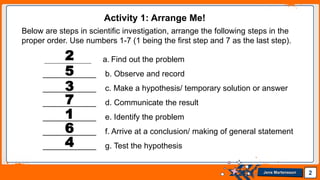
Activity 1: Arrange Me!
Below are steps in scientific investigation, arrange the following steps in the
proper order. Use numbers 1-7 (1 being the first step and 7 as the last step).
______________ a. Find out the problem
____________ b. Observe and record
____________ c. Make a hypothesis/ temporary solution or answer
____________ d. Communicate the result
____________ e. Identify the problem
____________ f. Arrive at a conclusion/ making of general statement
____________ g. Test the hypothesis
1
2
3
4
5
6
7
Jens Martensson 3
Jens Martensson
I. Identifying Problems
 The first step in scientific
investigations is to identify
a problem in a given
situation.
 This problem comes
when a researcher is
curious or interested about
something he/she has
observed in the
environment.
4
Jens Martensson
II. Making Observations
The process of science
starts with an
observation within the
surrounding of a
researcher.
In this step, the scientist
will research and make
observations regarding
the problem.
5
Jens Martensson
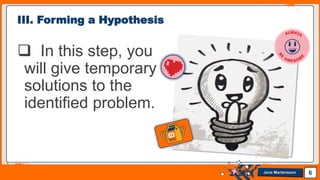
III. Forming a Hypothesis
 In this step, you
will give temporary
solutions to the
identified problem.
6
Jens Martensson
IV. Hypothesis
 The next scientific
step you are going to is
to test your hypothesis.
Some hypothesis may
be tested simply by
further observations or
take an elaborate and
tedious process as in
the experiment.
7
Jens Martensson
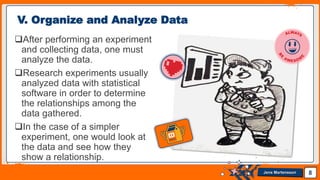
V. Organize and Analyze Data
After performing an experiment
and collecting data, one must
analyze the data.
Research experiments usually
analyzed data with statistical
software in order to determine
the relationships among the
data gathered.
In the case of a simpler
experiment, one would look at
the data and see how they
show a relationship.
8
Jens Martensson
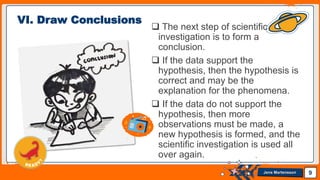
VI. Draw Conclusions
 The next step of scientific
investigation is to form a
conclusion.
 If the data support the
hypothesis, then the hypothesis is
correct and may be the
explanation for the phenomena.
 If the data do not support the
hypothesis, then more
observations must be made, a
new hypothesis is formed, and the
scientific investigation is used all
over again.
9
Jens Martensson
VII. Communicate Results
 When a conclusion is
drawn, the research can
be presented to others
to inform them of the
findings and receive
input about the validity
of the conclusion drawn
from the research.
10
Jens Martensson 11
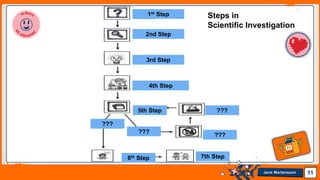
Steps in
Scientific Investigation
1st Step
2nd Step
3rd Step
4th Step
5th Step
???
???
???
???
6th Step 7th Step
Launch

Lesson 2 scientific method

  • 2.
    Jens Martensson 2 Activity1: Arrange Me! Below are steps in scientific investigation, arrange the following steps in the proper order. Use numbers 1-7 (1 being the first step and 7 as the last step). ______________ a. Find out the problem ____________ b. Observe and record ____________ c. Make a hypothesis/ temporary solution or answer ____________ d. Communicate the result ____________ e. Identify the problem ____________ f. Arrive at a conclusion/ making of general statement ____________ g. Test the hypothesis 1 2 3 4 5 6 7
  • 3.
  • 4.
    Jens Martensson I. IdentifyingProblems  The first step in scientific investigations is to identify a problem in a given situation.  This problem comes when a researcher is curious or interested about something he/she has observed in the environment. 4
  • 5.
    Jens Martensson II. MakingObservations The process of science starts with an observation within the surrounding of a researcher. In this step, the scientist will research and make observations regarding the problem. 5
  • 6.
    Jens Martensson III. Forminga Hypothesis  In this step, you will give temporary solutions to the identified problem. 6
  • 7.
    Jens Martensson IV. Hypothesis The next scientific step you are going to is to test your hypothesis. Some hypothesis may be tested simply by further observations or take an elaborate and tedious process as in the experiment. 7
  • 8.
    Jens Martensson V. Organizeand Analyze Data After performing an experiment and collecting data, one must analyze the data. Research experiments usually analyzed data with statistical software in order to determine the relationships among the data gathered. In the case of a simpler experiment, one would look at the data and see how they show a relationship. 8
  • 9.
    Jens Martensson VI. DrawConclusions  The next step of scientific investigation is to form a conclusion.  If the data support the hypothesis, then the hypothesis is correct and may be the explanation for the phenomena.  If the data do not support the hypothesis, then more observations must be made, a new hypothesis is formed, and the scientific investigation is used all over again. 9
  • 10.
    Jens Martensson VII. CommunicateResults  When a conclusion is drawn, the research can be presented to others to inform them of the findings and receive input about the validity of the conclusion drawn from the research. 10
  • 11.
    Jens Martensson 11 Stepsin Scientific Investigation 1st Step 2nd Step 3rd Step 4th Step 5th Step ??? ??? ??? ??? 6th Step 7th Step
  • 12.