Carrying Out an Investigation
in Science
Investigation Steps – Asking a
Question
1. Gather ideas
What could we investigate?
What could we measure or observe?
Investigation Steps : Asking a
Question
2.Ask yourself what are you trying to find out
You need a question to investigate....
How? What? When?
Investigation Steps: Choosing what to
change (making a fair test)
3. Plan what you will change
• What will you change? (only
ONE thing)
• what will you measure?
• what will you keep the same?
(The things which could change are called
variables)
Investigation Steps: Making a
Prediction
4. Make a prediction
(A Prediction is often known as a
Hypothesis)
• What do you think will happen to the
variable you are measuring or
observing........ when you change the
variable you are interested in.
Investigation Steps: Planning the
Enquiry
5. Plan the practical work
• How will you carry out the experiment? What
will you do?
• Design the experiment.
• List what you need.
• Describe how you will use the equipment.
Make a diagram if you want.
Investigation Steps: Collecting
Evidence
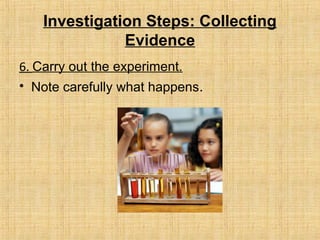
6. Carry out the experiment.
• Note carefully what happens.
Investigation Steps: Recording
and Presenting
7. Record the results
• Produce a table of results.
• The table includes the independent variable
(what you were changing) and the dependent
variable (what you were measuring).
• Use the results table to help
you construct a bar chart or
graph of your results.
Investigation Steps: Recording
and Presenting
8. Explain the results
Explain what your results show.
Decide whether your prediction was correct.
Make a conclusion about what you have
found out and explain it clearly.
Make a note of things you might change if you
were to do the enquiry again.
Report back to the rest of the class.
SO......How do I carry out an
Investigation in Science?
1. Gather ideas
2. Ask yourself what are
you trying to find out .
3. Plan what you will
change
4. Make a prediction
5. Plan the practical work
(Diagram)
6. Carry out the
experiment.
6. Record the results
7. Explain the results

Experiment planning 1

  • 1.
    Carrying Out anInvestigation in Science
  • 2.
    Investigation Steps –Asking a Question 1. Gather ideas What could we investigate? What could we measure or observe?
  • 3.
    Investigation Steps :Asking a Question 2.Ask yourself what are you trying to find out You need a question to investigate.... How? What? When?
  • 4.
    Investigation Steps: Choosingwhat to change (making a fair test) 3. Plan what you will change • What will you change? (only ONE thing) • what will you measure? • what will you keep the same? (The things which could change are called variables)
  • 5.
    Investigation Steps: Makinga Prediction 4. Make a prediction (A Prediction is often known as a Hypothesis) • What do you think will happen to the variable you are measuring or observing........ when you change the variable you are interested in.
  • 6.
    Investigation Steps: Planningthe Enquiry 5. Plan the practical work • How will you carry out the experiment? What will you do? • Design the experiment. • List what you need. • Describe how you will use the equipment. Make a diagram if you want.
  • 7.
    Investigation Steps: Collecting Evidence 6.Carry out the experiment. • Note carefully what happens.
  • 8.
    Investigation Steps: Recording andPresenting 7. Record the results • Produce a table of results. • The table includes the independent variable (what you were changing) and the dependent variable (what you were measuring). • Use the results table to help you construct a bar chart or graph of your results.
  • 9.
    Investigation Steps: Recording andPresenting 8. Explain the results Explain what your results show. Decide whether your prediction was correct. Make a conclusion about what you have found out and explain it clearly. Make a note of things you might change if you were to do the enquiry again. Report back to the rest of the class.
  • 10.
    SO......How do Icarry out an Investigation in Science? 1. Gather ideas 2. Ask yourself what are you trying to find out . 3. Plan what you will change 4. Make a prediction 5. Plan the practical work (Diagram) 6. Carry out the experiment. 6. Record the results 7. Explain the results