DATA
COMMUNICATION
This topic is to be covered in one week. The
mode of instruction is through
presentations online. The mode of
assessment is through CATs and class
practical and a full sitting
Examinations.Others resources like journals
are also provided, that include journals and
other textbooks are listed.
The learner is expected to differentiate
between analogue and digital signals
Data signal:
A data signal is a voltage level in the circuit which
represents the flow of data.
In data communication, there are 2 types of data
signals; Digital and Analog.
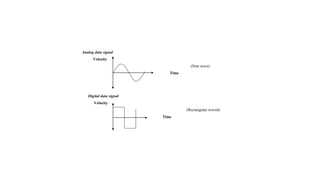
Analog data is made up of continuous waveforms,
while digital data is made up of a non-continuous
discrete waveform.
Analog data signal
Velocity
(Sine wave)
Time
Digital data signal
Velocity
(Rectangular waved)
Time
Signal modulation and demodulation:
This is the process of converting data signals to a form that can be transmitted over a
transmission medium.
E.g., a modem converts a digital signal to an analog signal, which can be transmitted over analog
telephone lines. This process is called modulation. A modem at the receiving end converts the
analog signal into a digital signal, a process known as demodulation.
Multiplexing and Demultiplexing:
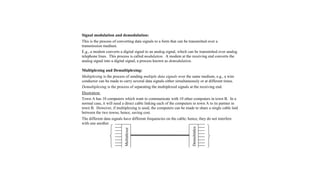
Multiplexing is the process of sending multiple data signals over the same medium, e.g., a wire
conductor can be made to carry several data signals either simultaneously or at different times.
Demultiplexing is the process of separating the multiplexed signals at the receiving end.
Illustration:
Town A has 10 computers which want to communicate with 10 other computers in town B. In a
normal case, it will need a direct cable linking each of the computers in town A to its partner in
town B. However, if multiplexing is used, the computers can be made to share a single cable laid
between the two towns, hence, saving cost.
The different data signals have different frequencies on the cable; hence, they do not interfere
with one another.
Multiplexer
Demultiplex
er
Frequency (f):
Frequency of a wave is the number of cycles made by the wave in 1 second. Frequency is
measured in units called Hertz (Hz); where 1 Hz is equivalent to 1 cycle/second.
Baud:
This is the unit to measure the speed of transmission. Generally, 1BAUD is 1bit/second.
Baud rate:
This is the rate at which data is transferred or transmitted. It is measured in Bits per second
(bps).
Band:
The rate of change of a signal on a transmission line.
Bandwidth:
A Bandwidth is the maximum amount of data that a transmission medium can carry at any one
time. E.g., a certain cable may have a bandwidth of 100 Mbps (Mega bits per second).
Guardband:
This is the range of frequency that is used to separate two channels.
Baseband signal:
This is a digital signal that is generated and applied to the transmission medium directly without
modulation.
Note. A baseband signal utilizes the full capacity of
the transmission medium; hence, at any one time,
only one signal can be sent. However, multiple
signals can be sent at different times, if they are
multiplexed.
Broadband transmission:
This is where an analog signal is sent over the
transmission medium using a particular frequency.
This means that, several data signals can be sent at
the same time through the same medium, but at
different frequencies so as to prevent them from
overlapping.
Attenuation:
Attenuation is the decrease in magnitude and energy
of a signal as it progressively moves along a
transmission medium.
If the signal is not boosted, it will totally be lost
along the way, and may never reach the destination.
Attenuation (or signal loss) is usually corrected by
placing signal amplifiers (also called repeater

Lesson 2

  • 1.
    DATA COMMUNICATION This topic isto be covered in one week. The mode of instruction is through presentations online. The mode of assessment is through CATs and class practical and a full sitting Examinations.Others resources like journals are also provided, that include journals and other textbooks are listed. The learner is expected to differentiate between analogue and digital signals
  • 2.
    Data signal: A datasignal is a voltage level in the circuit which represents the flow of data. In data communication, there are 2 types of data signals; Digital and Analog. Analog data is made up of continuous waveforms, while digital data is made up of a non-continuous discrete waveform.
  • 3.
    Analog data signal Velocity (Sinewave) Time Digital data signal Velocity (Rectangular waved) Time
  • 4.
    Signal modulation anddemodulation: This is the process of converting data signals to a form that can be transmitted over a transmission medium. E.g., a modem converts a digital signal to an analog signal, which can be transmitted over analog telephone lines. This process is called modulation. A modem at the receiving end converts the analog signal into a digital signal, a process known as demodulation. Multiplexing and Demultiplexing: Multiplexing is the process of sending multiple data signals over the same medium, e.g., a wire conductor can be made to carry several data signals either simultaneously or at different times. Demultiplexing is the process of separating the multiplexed signals at the receiving end. Illustration: Town A has 10 computers which want to communicate with 10 other computers in town B. In a normal case, it will need a direct cable linking each of the computers in town A to its partner in town B. However, if multiplexing is used, the computers can be made to share a single cable laid between the two towns, hence, saving cost. The different data signals have different frequencies on the cable; hence, they do not interfere with one another. Multiplexer Demultiplex er
  • 5.
    Frequency (f): Frequency ofa wave is the number of cycles made by the wave in 1 second. Frequency is measured in units called Hertz (Hz); where 1 Hz is equivalent to 1 cycle/second. Baud: This is the unit to measure the speed of transmission. Generally, 1BAUD is 1bit/second. Baud rate: This is the rate at which data is transferred or transmitted. It is measured in Bits per second (bps). Band: The rate of change of a signal on a transmission line. Bandwidth: A Bandwidth is the maximum amount of data that a transmission medium can carry at any one time. E.g., a certain cable may have a bandwidth of 100 Mbps (Mega bits per second). Guardband: This is the range of frequency that is used to separate two channels. Baseband signal: This is a digital signal that is generated and applied to the transmission medium directly without modulation.
  • 6.
    Note. A basebandsignal utilizes the full capacity of the transmission medium; hence, at any one time, only one signal can be sent. However, multiple signals can be sent at different times, if they are multiplexed. Broadband transmission: This is where an analog signal is sent over the transmission medium using a particular frequency. This means that, several data signals can be sent at the same time through the same medium, but at different frequencies so as to prevent them from overlapping. Attenuation: Attenuation is the decrease in magnitude and energy of a signal as it progressively moves along a transmission medium. If the signal is not boosted, it will totally be lost along the way, and may never reach the destination. Attenuation (or signal loss) is usually corrected by placing signal amplifiers (also called repeater