
Data Transmission


WILLIAM STALLINGS
DATA AND COMPUTER COMMUNICATIONS
Terminology (1)
   • Transmitter
   • Receiver
   • Medium
     • Guided medium
       • e.g. twisted pair, optical fiber
     • Unguided medium
       • e.g. air, water, vacuum
Terminology (2)
   • Direct link
     • No intermediate devices
   • Point-to-point
     • Direct link
     • Only 2 devices share link
   • Multi-point
     • More than two devices share the link
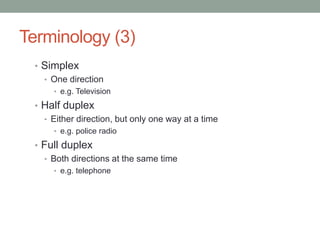
Terminology (3)
 • Simplex
   • One direction
      • e.g. Television

 • Half duplex
   • Either direction, but only one way at a time
      • e.g. police radio

 • Full duplex
   • Both directions at the same time
      • e.g. telephone
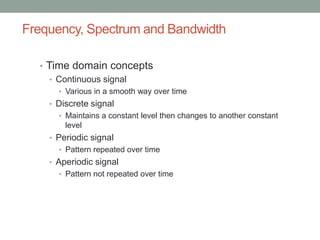
Frequency, Spectrum and Bandwidth

  • Time domain concepts
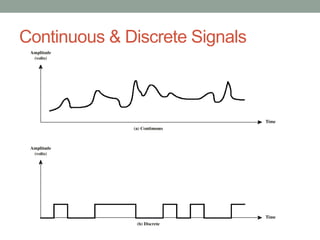
     • Continuous signal
      • Various in a smooth way over time
    • Discrete signal
      • Maintains a constant level then changes to another constant
        level
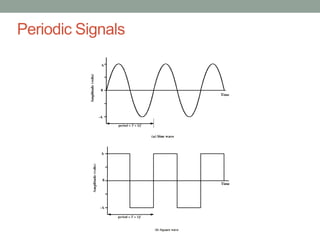
    • Periodic signal
      • Pattern repeated over time
    • Aperiodic signal
      • Pattern not repeated over time
Continuous & Discrete Signals
Periodic Signals
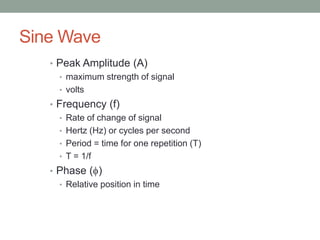
Sine Wave
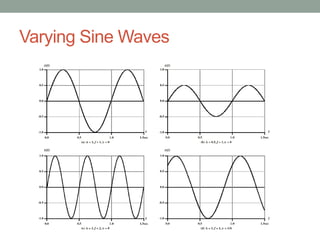
   • Peak Amplitude (A)
     • maximum strength of signal
     • volts
   • Frequency (f)
     • Rate of change of signal
     • Hertz (Hz) or cycles per second
     • Period = time for one repetition (T)
     • T = 1/f
   • Phase ( )
     • Relative position in time
Varying Sine Waves
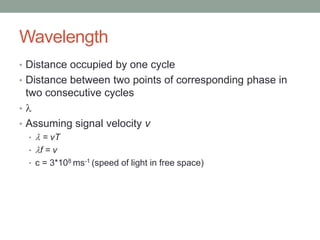
Wavelength
• Distance occupied by one cycle
• Distance between two points of corresponding phase in
    two consecutive cycles
•
• Assuming signal velocity v
  • = vT
  • f=v
  • c = 3*108 ms-1 (speed of light in free space)
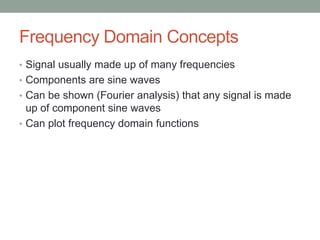
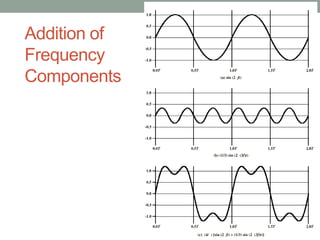
Frequency Domain Concepts
• Signal usually made up of many frequencies
• Components are sine waves
• Can be shown (Fourier analysis) that any signal is made
  up of component sine waves
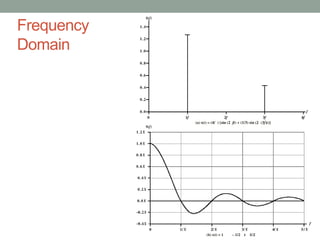
• Can plot frequency domain functions
Addition of
Frequency
Components
Frequency
Domain
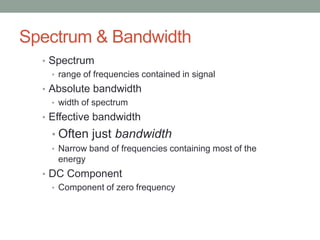
Spectrum & Bandwidth
  • Spectrum
    • range of frequencies contained in signal
  • Absolute bandwidth
    • width of spectrum
  • Effective bandwidth
    • Often just bandwidth
    • Narrow band of frequencies containing most of the
      energy
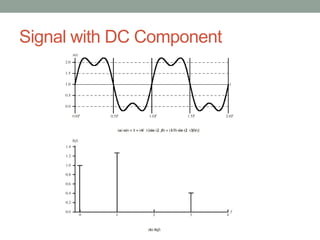
  • DC Component
    • Component of zero frequency
Signal with DC Component
Data Rate and Bandwidth
 • Any transmission system has a limited band of
   frequencies
 • This limits the data rate that can be carried
Analog and Digital Data Transmission
• Data
  • Entities that convey meaning
• Signals
  • Electric or electromagnetic representations of data
• Transmission
   • Communication of data by propagation and processing of signals
Data
• Analog
  • Continuous values within some interval
  • e.g. sound, video
• Digital
  • Discrete values
  • e.g. text, integers
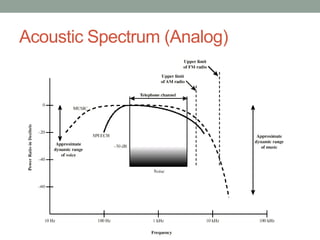
Acoustic Spectrum (Analog)
Signals
• Means by which data are propagated
• Analog
  • Continuously variable
  • Various media
    • wire, fiber optic, space
  • Speech bandwidth 100Hz to 7kHz
  • Telephone bandwidth 300Hz to 3400Hz
  • Video bandwidth 4MHz
• Digital
  • Use two DC components
Data and Signals
• Usually use digital signals for digital data and analog
  signals for analog data
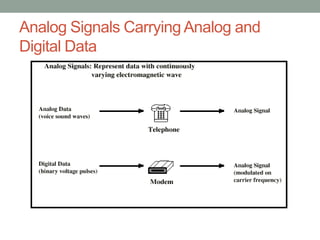
• Can use analog signal to carry digital data
  • Modem
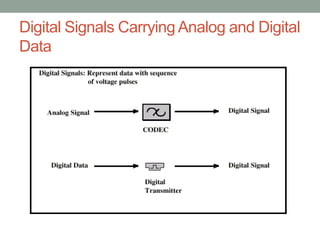
• Can use digital signal to carry analog data
  • Compact Disc audio
Analog Signals Carrying Analog and
Digital Data
Digital Signals Carrying Analog and Digital
Data
Analog Transmission
• Analog signal transmitted without regard to content
• May be analog or digital data
• Attenuated over distance
• Use amplifiers to boost signal
• Also amplifies noise
Digital Transmission
• Concerned with content
• Integrity endangered by noise, attenuation etc.
• Repeaters used
• Repeater receives signal
• Extracts bit pattern
• Retransmits
• Attenuation is overcome
• Noise is not amplified
Advantages of Digital Transmission
• Digital technology
  • Low cost LSI/VLSI technology
• Data integrity
  • Longer distances over lower quality lines
• Capacity utilization
  • High bandwidth links economical
  • High degree of multiplexing easier with digital techniques
• Security & Privacy
  • Encryption
• Integration
   • Can treat analog and digital data similarly
Transmission Impairments
• Signal received may differ from signal transmitted
• Analog - degradation of signal quality
• Digital - bit errors
• Caused by
  • Attenuation and attenuation distortion
  • Delay distortion
  • Noise
Attenuation
• Signal strength falls off with distance
• Depends on medium
• Received signal strength:
  • must be enough to be detected
  • must be sufficiently higher than noise to be received without error
• Attenuation is an increasing function of frequency
Delay Distortion
• Only in guided media
• Propagation velocity varies with frequency
Noise (1)
• Additional signals inserted between transmitter and
  receiver
• Thermal
  • Due to thermal agitation of electrons
  • Uniformly distributed
  • White noise
• Intermodulation
   • Signals that are the sum and difference of original frequencies
     sharing a medium
Noise (2)
• Crosstalk
  • A signal from one line is picked up by another
• Impulse
   • Irregular pulses or spikes
   • e.g. External electromagnetic interference
   • Short duration
   • High amplitude
Channel Capacity
• Data rate
  • In bits per second
  • Rate at which data can be communicated
• Bandwidth
  • In cycles per second of Hertz
  • Constrained by transmitter and medium
2.1.1 conceptos basicos de tx datos

2.1.1 conceptos basicos de tx datos

  • 1.
    Data Transmission WILLIAM STALLINGS DATAAND COMPUTER COMMUNICATIONS
  • 2.
    Terminology (1) • Transmitter • Receiver • Medium • Guided medium • e.g. twisted pair, optical fiber • Unguided medium • e.g. air, water, vacuum
  • 3.
    Terminology (2) • Direct link • No intermediate devices • Point-to-point • Direct link • Only 2 devices share link • Multi-point • More than two devices share the link
  • 4.
    Terminology (3) •Simplex • One direction • e.g. Television • Half duplex • Either direction, but only one way at a time • e.g. police radio • Full duplex • Both directions at the same time • e.g. telephone
  • 5.
    Frequency, Spectrum andBandwidth • Time domain concepts • Continuous signal • Various in a smooth way over time • Discrete signal • Maintains a constant level then changes to another constant level • Periodic signal • Pattern repeated over time • Aperiodic signal • Pattern not repeated over time
  • 6.
  • 7.
  • 8.
    Sine Wave • Peak Amplitude (A) • maximum strength of signal • volts • Frequency (f) • Rate of change of signal • Hertz (Hz) or cycles per second • Period = time for one repetition (T) • T = 1/f • Phase ( ) • Relative position in time
  • 9.
  • 10.
    Wavelength • Distance occupiedby one cycle • Distance between two points of corresponding phase in two consecutive cycles • • Assuming signal velocity v • = vT • f=v • c = 3*108 ms-1 (speed of light in free space)
  • 11.
    Frequency Domain Concepts •Signal usually made up of many frequencies • Components are sine waves • Can be shown (Fourier analysis) that any signal is made up of component sine waves • Can plot frequency domain functions
  • 12.
  • 13.
  • 14.
    Spectrum & Bandwidth • Spectrum • range of frequencies contained in signal • Absolute bandwidth • width of spectrum • Effective bandwidth • Often just bandwidth • Narrow band of frequencies containing most of the energy • DC Component • Component of zero frequency
  • 15.
    Signal with DCComponent
  • 16.
    Data Rate andBandwidth • Any transmission system has a limited band of frequencies • This limits the data rate that can be carried
  • 17.
    Analog and DigitalData Transmission • Data • Entities that convey meaning • Signals • Electric or electromagnetic representations of data • Transmission • Communication of data by propagation and processing of signals
  • 18.
    Data • Analog • Continuous values within some interval • e.g. sound, video • Digital • Discrete values • e.g. text, integers
  • 19.
  • 20.
    Signals • Means bywhich data are propagated • Analog • Continuously variable • Various media • wire, fiber optic, space • Speech bandwidth 100Hz to 7kHz • Telephone bandwidth 300Hz to 3400Hz • Video bandwidth 4MHz • Digital • Use two DC components
  • 21.
    Data and Signals •Usually use digital signals for digital data and analog signals for analog data • Can use analog signal to carry digital data • Modem • Can use digital signal to carry analog data • Compact Disc audio
  • 22.
    Analog Signals CarryingAnalog and Digital Data
  • 23.
    Digital Signals CarryingAnalog and Digital Data
  • 24.
    Analog Transmission • Analogsignal transmitted without regard to content • May be analog or digital data • Attenuated over distance • Use amplifiers to boost signal • Also amplifies noise
  • 25.
    Digital Transmission • Concernedwith content • Integrity endangered by noise, attenuation etc. • Repeaters used • Repeater receives signal • Extracts bit pattern • Retransmits • Attenuation is overcome • Noise is not amplified
  • 26.
    Advantages of DigitalTransmission • Digital technology • Low cost LSI/VLSI technology • Data integrity • Longer distances over lower quality lines • Capacity utilization • High bandwidth links economical • High degree of multiplexing easier with digital techniques • Security & Privacy • Encryption • Integration • Can treat analog and digital data similarly
  • 27.
    Transmission Impairments • Signalreceived may differ from signal transmitted • Analog - degradation of signal quality • Digital - bit errors • Caused by • Attenuation and attenuation distortion • Delay distortion • Noise
  • 28.
    Attenuation • Signal strengthfalls off with distance • Depends on medium • Received signal strength: • must be enough to be detected • must be sufficiently higher than noise to be received without error • Attenuation is an increasing function of frequency
  • 29.
    Delay Distortion • Onlyin guided media • Propagation velocity varies with frequency
  • 30.
    Noise (1) • Additionalsignals inserted between transmitter and receiver • Thermal • Due to thermal agitation of electrons • Uniformly distributed • White noise • Intermodulation • Signals that are the sum and difference of original frequencies sharing a medium
  • 31.
    Noise (2) • Crosstalk • A signal from one line is picked up by another • Impulse • Irregular pulses or spikes • e.g. External electromagnetic interference • Short duration • High amplitude
  • 32.
    Channel Capacity • Datarate • In bits per second • Rate at which data can be communicated • Bandwidth • In cycles per second of Hertz • Constrained by transmitter and medium