OBJECTIVES FOR
RIPTIDE
• To understand the processes through which meanings are
established through intertextuality
• To analyse how audiences respond to this aspect of media language
• To analyse the way meaning is created through micro elements
• To know the codes and conventions of music video and how genre develops over
time
• To explore the significance of challenging or subverting genre conventions
MEDIA LANGUAGE:
REPRESENTATION:
■ To analyse the way media constructs versions of reality
■ To explore how and why stereotypes can be used positively and
negatively
■ To analyse how media representations convey values, attitudes, and
beliefs about the world
■ How the audience are positioned by the music video
Van Zoonen: Feminist theory
Roland Barthes: Semiotics
David Gauntlett: Identity theory
Claude Levi-Strauss:
Structuralism
Tzvetan Todorov: Narratology
Andrew Goodwin: Genre theory
Steve Neal: Genre theory
STARTER
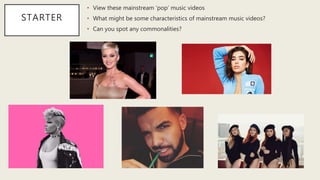
• View these mainstream ‘pop’ music videos
• What might be some characteristics of mainstream music videos?
• Can you spot any commonalities?
ANDREW GOODWIN
• A relationship between the lyrics and visuals (illustrating, amplifying or
contradicting the lyrics)
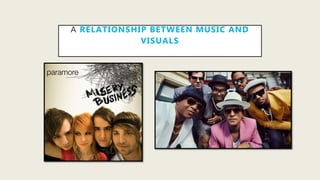
• A relationship between music and visuals
• Particular genres may have their own video style and iconography
• A demand from the record company for lots of close-ups of the main
artist
• Artist develops their own star iconography in and out of their videos
• Intertextual references
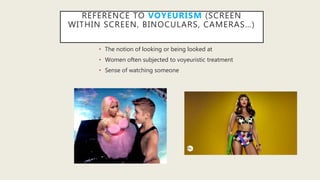
• Reference to voyeurism (screen within screen, binoculars, cameras…)
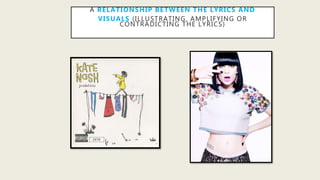
A RELATIONSHIP BETWEEN THE LYRICS AND
VISUALS (ILLUSTRATING, AMPLIFYING OR
CONTRADICTING THE LYRICS)
A RELATIONSHIP BETWEEN MUSIC AND
VISUALS
REFERENCE TO VOYEURISM (SCREEN
WITHIN SCREEN, BINOCULARS, CAMERAS…)
• The notion of looking or being looked at
• Women often subjected to voyeuristic treatment
• Sense of watching someone
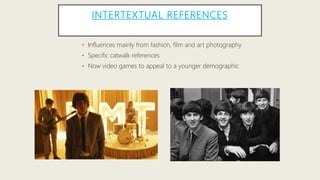
INTERTEXTUAL REFERENCES
• Influences mainly from fashion, film and art photography
• Specific catwalk references
• Now video games to appeal to a younger demographic
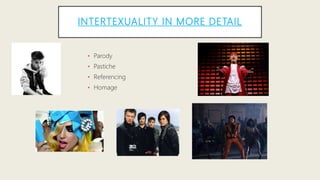
INTERTEXUALITY IN MORE DETAIL
• Parody
• Pastiche
• Referencing
• Homage
PASTICHE
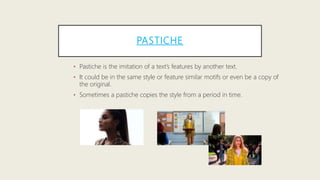
• Pastiche is the imitation of a text’s features by another text.
• It could be in the same style or feature similar motifs or even be a copy of
the original.
• Sometimes a pastiche copies the style from a period in time.
PARODY
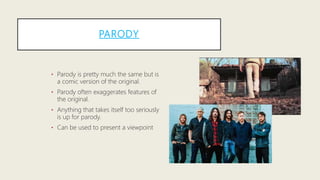
• Parody is pretty much the same but is
a comic version of the original.
• Parody often exaggerates features of
the original.
• Anything that takes itself too seriously
is up for parody.
• Can be used to present a viewpoint
HOMAGE
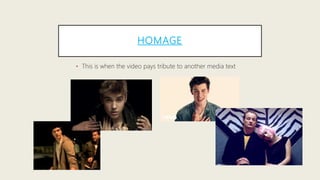
• This is when the video pays tribute to another media text
REFERENCING
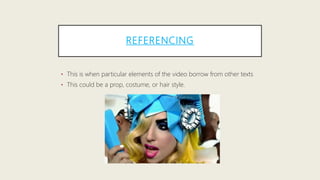
• This is when particular elements of the video borrow from other texts
• This could be a prop, costume, or hair style.
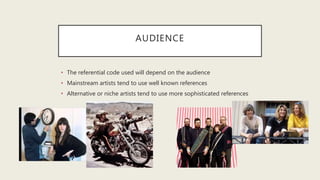
AUDIENCE
• The referential code used will depend on the audience
• Mainstream artists tend to use well known references
• Alternative or niche artists tend to use more sophisticated references

Lesson 11 music video conventions

  • 2.
    OBJECTIVES FOR RIPTIDE • Tounderstand the processes through which meanings are established through intertextuality • To analyse how audiences respond to this aspect of media language • To analyse the way meaning is created through micro elements • To know the codes and conventions of music video and how genre develops over time • To explore the significance of challenging or subverting genre conventions MEDIA LANGUAGE: REPRESENTATION: ■ To analyse the way media constructs versions of reality ■ To explore how and why stereotypes can be used positively and negatively ■ To analyse how media representations convey values, attitudes, and beliefs about the world ■ How the audience are positioned by the music video Van Zoonen: Feminist theory Roland Barthes: Semiotics David Gauntlett: Identity theory Claude Levi-Strauss: Structuralism Tzvetan Todorov: Narratology Andrew Goodwin: Genre theory Steve Neal: Genre theory
  • 3.
    STARTER • View thesemainstream ‘pop’ music videos • What might be some characteristics of mainstream music videos? • Can you spot any commonalities?
  • 4.
    ANDREW GOODWIN • Arelationship between the lyrics and visuals (illustrating, amplifying or contradicting the lyrics) • A relationship between music and visuals • Particular genres may have their own video style and iconography • A demand from the record company for lots of close-ups of the main artist • Artist develops their own star iconography in and out of their videos • Intertextual references • Reference to voyeurism (screen within screen, binoculars, cameras…)
  • 5.
    A RELATIONSHIP BETWEENTHE LYRICS AND VISUALS (ILLUSTRATING, AMPLIFYING OR CONTRADICTING THE LYRICS)
  • 6.
    A RELATIONSHIP BETWEENMUSIC AND VISUALS
  • 7.
    REFERENCE TO VOYEURISM(SCREEN WITHIN SCREEN, BINOCULARS, CAMERAS…) • The notion of looking or being looked at • Women often subjected to voyeuristic treatment • Sense of watching someone
  • 8.
    INTERTEXTUAL REFERENCES • Influencesmainly from fashion, film and art photography • Specific catwalk references • Now video games to appeal to a younger demographic
  • 9.
    INTERTEXUALITY IN MOREDETAIL • Parody • Pastiche • Referencing • Homage
  • 10.
    PASTICHE • Pastiche isthe imitation of a text’s features by another text. • It could be in the same style or feature similar motifs or even be a copy of the original. • Sometimes a pastiche copies the style from a period in time.
  • 11.
    PARODY • Parody ispretty much the same but is a comic version of the original. • Parody often exaggerates features of the original. • Anything that takes itself too seriously is up for parody. • Can be used to present a viewpoint
  • 12.
    HOMAGE • This iswhen the video pays tribute to another media text
  • 13.
    REFERENCING • This iswhen particular elements of the video borrow from other texts • This could be a prop, costume, or hair style.
  • 14.
    AUDIENCE • The referentialcode used will depend on the audience • Mainstream artists tend to use well known references • Alternative or niche artists tend to use more sophisticated references