Andrew Goodwin
Dancing in the Distraction Factory
(Routledge, 1992)
Key Ideas
1. Music videos demonstrate genre characteristics
2. There is a relationship between lyrics and visuals
3. There is a relationship between music and visuals
4. The demands of the record label will include the need for lots
of close ups of the artist and the artist may develop motifs
which recur across their work (a visual style).
5. There is frequently reference to notion of looking (screens
within screens, telescopes, etc) and particularly voyeuristic
treatment of the female body.
6. There is often intertextual reference (to films, tv programmes,
other music videos etc) which can contribute to the
postmodernism of music videos
Genre Characteristics
 In music videos you would expect to see certain things
happening that may relate to a particular genre.
 E.g In a Music Video for a girl band you would expect
to see a dance routine. Fifth Harmony- Worth It
 E.g In a Music Video for an RnB artist you would
expect to see at least one naked lady or a club scene
Jason Derulo- Want To Want Me
Relationship between Visuals and
Lyrics
 Videos will often have a relationship between what is
being seen in the video and what is being said.
 Eg Walk The Moon- Shut Up And Dance
 The Lyrics for the song are about a couple dancing
together and in the Video we see this played out on
screen.
Relationship between Music and
Visuals
 Often the visuals you see on screen will match the
music that you are hearing, an upbeat song might have
lots of colour and themes to enhance your mood,
whereas a slower tempo song might be more demure
and less in your face.
 Meghan Trainor- All About That Bass This song is your
typical stereotypical bubble gum pop complete with
bubble gum visuals to match, it clearly sets the tone
and genre of the track you are listening to.
Relationship Between Visuals and
The Song (Steve Archer)
 3 ways in which lyrics can work to support or promote a song.
 Illustration: Videos illustrate the meaning of the lyrics and the
genre, providing sometimes an over literal set of images.
Everything in the video is based on the source of the pop song.
 Amplification: The most persistent type of video adds value to
the song. Using a famous direct as an ‘artist’ is increasingly
common. Amplification works together with the song to retain a
link and enhance or develop the ideas.
 Disjuncture: Used to describe videos that work by ignoring the
original song and creating a whole new set of meanings. Usually
these types of videos do not make sense and use a lot of abstract
imagery.
Visual Style/Star Image
 The creation of character identities for stars provides a
point of identification from the audience which is
especially important when the lyrics lack depth.
 The construction of stars is central to the economics of the
music industry- only STARS guarantee sales and long
careers
 Star loyalty is a key ingredient- fans loyal to the star
 The audience knows its own tastes but the music industry
has long been able to work around this- the construction of
the stars is one of the ways that they do this
 The record industry is very dependent of stars- many
record companies rely on a few big stars (or just one) to
provide stability in sales
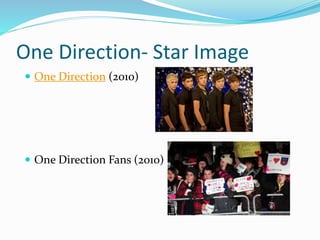
One Direction- Star Image
 One Direction (2010)
 One Direction Fans (2010)
One Direction- Star Image
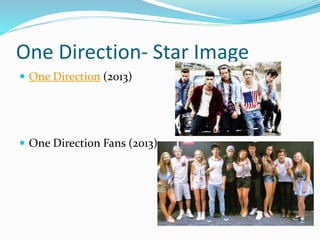
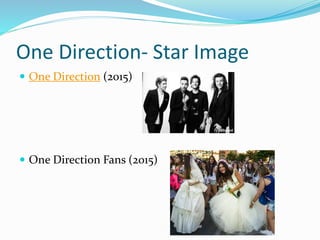
 One Direction (2013)
 One Direction Fans (2013)
One Direction- Star Image
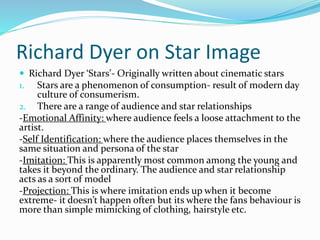
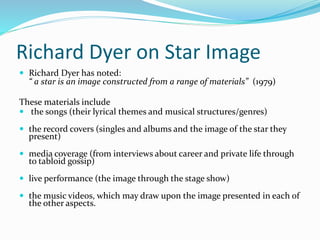
 One Direction (2015)
 One Direction Fans (2015)
Richard Dyer on Star Image
 Richard Dyer ‘Stars’- Originally written about cinematic stars
1. Stars are a phenomenon of consumption- result of modern day
culture of consumerism.
2. There are a range of audience and star relationships
-Emotional Affinity: where audience feels a loose attachment to the
artist.
-Self Identification: where the audience places themselves in the
same situation and persona of the star
-Imitation: This is apparently most common among the young and
takes it beyond the ordinary. The audience and star relationship
acts as a sort of model
-Projection: This is where imitation ends up when it become
extreme- it doesn’t happen often but its where the fans behaviour is
more than simple mimicking of clothing, hairstyle etc.
Richard Dyer on Star Image
 Richard Dyer has noted:
“ a star is an image constructed from a range of materials” (1979)
These materials include
 the songs (their lyrical themes and musical structures/genres)
 the record covers (singles and albums and the image of the star they
present)
 media coverage (from interviews about career and private life through
to tabloid gossip)
 live performance (the image through the stage show)
 the music videos, which may draw upon the image presented in each of
the other aspects.
Richard Dyer on Star Image
 Each video may also draw upon its predecessor both in
reinforcing the star’s existing image and in taking the
image on further, perhaps in new directions. Thus,
music videos will act as a showcase for the star’s talents
and play a significant part in the construction and
maintenance of their image.
Voyeurism
 This idea comes from Freud, and has been much
used in Media Studies, particularly in explaining
the gendered pleasures of cinema. Broadly it refers
to the idea of looking in order to gain sexual
pleasure. It has been argued that the male viewer’s
gaze at the screen is geared to notions of
voyeurism in that it is a powerful controlling gaze
at the objectified female on display. In music
promos the female on display has been a staple
element.
Voyeurism
 Goodwin argues that the female performer will
frequently be objectified in this fashion, often
through a combination of camerawork and editing
with fragmented body shots emphasising a
sexualised treatment of the star.
 In male performance videos too, the idea of
voyeuristic treatment of the female body is often
apparent with the use of dancers as adornments
flattering the male star ego.
Laura Mulvey: The Male Gaze
 Scopophilia = pleasure derived from looking or
watching
 The concept is linked to voyeurism
 Feminist theorist Laura Mulvey suggested that the
camera was usually gendered masculine, and thus
represented a “male gaze” objectifying feminine
subjects often with sexual overtones either as
virgin or whore.
 Calvin Harris & Disciples – How Deep is Your Love
The Male Body (Contrast)
 The idea becomes more complex when we see the male
body on display and we might raise questions about
how the female viewer is invited to respond.
 Equally, the apparently more powerful independent
female artists of recent years, from Madonna onwards,
have added to the complexity of the gaze by being at
once sexually provocative and apparently in control.
This offers interesting questions for discussion of the
range of audience experiences of music video and the
contradictory meanings they may evoke.
 Rita Ora Feat. Chris Brown- Body On Me
The Art of Looking
 The idea of voyeurism is also frequently evident in
music video through a system of screens within
screens- characters shown watching performers or
others on television, via webcams, as images on a video
camera screen or CCTV within the world of the
narrative.
 Skrillex and Diplo – What Do You Mean
Intertextuality
 The music video is often described as ‘postmodern’, a
slippery term which is sometimes used as a substitute
for intertextuality.
 Broadly, if we see music promos as frequently drawing
upon existing texts in order to spark recognition in the
audience, we have a working definition of
‘intertextuality’.
 Not all audiences will necessarily spot the reference
and this need not massively detract from their
pleasure in the text itself, but it is often argued that
greater pleasure will be derived by those who know the
reference and are somehow flattered by this.
Intertextuality
 It is perhaps not surprising that so many music
videos draw upon cinema as a starting point, since
their directors are often film school graduates
looking to move on eventually to the film industry
itself. Robbie Williams & Example
 Television is often a point of reference too.
Intertextuality and John Stewart
 visual reference in music video come from a range of sources, though the three
most frequent are perhaps cinema, fashion and art photography.
 Fashion sometimes takes the form of specific catwalk references and
sometimes even the use of supermodels. George Michael
 For the near future, John Stewart suspects that the influence of video games
will predominate for the younger audience with the more plasticised look of
characters emerging. Red Hot Chilli Peppers
 His description of the music video “incorporating, raiding and reconstructing”
is essentially the essence of intertextuality, using something with which the
audience may be familiar to generate both potentially nostalgic associations
and new meanings. It is perhaps more explicitly evident in the music video
than in any other media form, with the possible exception of advertising.
Homework Task.
 Using Goodwin’s Theory select a Music Video from
your chosen genre.
 Apply the 6 elements of the Theory to your video
 Complete a 600-800 word analysis on the video
 Please use ONLY Goodwin
Next Lesson
 Create 3 individual posts using your own selection of
videos for reference.
 Discuss Goodwin and the other theorists we have
looked at.
 Star Image
 Voyeurism
 Intertextuality

Goodwin’s Theory

  • 1.
    Andrew Goodwin Dancing inthe Distraction Factory (Routledge, 1992)
  • 2.
    Key Ideas 1. Musicvideos demonstrate genre characteristics 2. There is a relationship between lyrics and visuals 3. There is a relationship between music and visuals 4. The demands of the record label will include the need for lots of close ups of the artist and the artist may develop motifs which recur across their work (a visual style). 5. There is frequently reference to notion of looking (screens within screens, telescopes, etc) and particularly voyeuristic treatment of the female body. 6. There is often intertextual reference (to films, tv programmes, other music videos etc) which can contribute to the postmodernism of music videos
  • 3.
    Genre Characteristics  Inmusic videos you would expect to see certain things happening that may relate to a particular genre.  E.g In a Music Video for a girl band you would expect to see a dance routine. Fifth Harmony- Worth It  E.g In a Music Video for an RnB artist you would expect to see at least one naked lady or a club scene Jason Derulo- Want To Want Me
  • 4.
    Relationship between Visualsand Lyrics  Videos will often have a relationship between what is being seen in the video and what is being said.  Eg Walk The Moon- Shut Up And Dance  The Lyrics for the song are about a couple dancing together and in the Video we see this played out on screen.
  • 5.
    Relationship between Musicand Visuals  Often the visuals you see on screen will match the music that you are hearing, an upbeat song might have lots of colour and themes to enhance your mood, whereas a slower tempo song might be more demure and less in your face.  Meghan Trainor- All About That Bass This song is your typical stereotypical bubble gum pop complete with bubble gum visuals to match, it clearly sets the tone and genre of the track you are listening to.
  • 6.
    Relationship Between Visualsand The Song (Steve Archer)  3 ways in which lyrics can work to support or promote a song.  Illustration: Videos illustrate the meaning of the lyrics and the genre, providing sometimes an over literal set of images. Everything in the video is based on the source of the pop song.  Amplification: The most persistent type of video adds value to the song. Using a famous direct as an ‘artist’ is increasingly common. Amplification works together with the song to retain a link and enhance or develop the ideas.  Disjuncture: Used to describe videos that work by ignoring the original song and creating a whole new set of meanings. Usually these types of videos do not make sense and use a lot of abstract imagery.
  • 7.
    Visual Style/Star Image The creation of character identities for stars provides a point of identification from the audience which is especially important when the lyrics lack depth.  The construction of stars is central to the economics of the music industry- only STARS guarantee sales and long careers  Star loyalty is a key ingredient- fans loyal to the star  The audience knows its own tastes but the music industry has long been able to work around this- the construction of the stars is one of the ways that they do this  The record industry is very dependent of stars- many record companies rely on a few big stars (or just one) to provide stability in sales
  • 8.
    One Direction- StarImage  One Direction (2010)  One Direction Fans (2010)
  • 9.
    One Direction- StarImage  One Direction (2013)  One Direction Fans (2013)
  • 10.
    One Direction- StarImage  One Direction (2015)  One Direction Fans (2015)
  • 11.
    Richard Dyer onStar Image  Richard Dyer ‘Stars’- Originally written about cinematic stars 1. Stars are a phenomenon of consumption- result of modern day culture of consumerism. 2. There are a range of audience and star relationships -Emotional Affinity: where audience feels a loose attachment to the artist. -Self Identification: where the audience places themselves in the same situation and persona of the star -Imitation: This is apparently most common among the young and takes it beyond the ordinary. The audience and star relationship acts as a sort of model -Projection: This is where imitation ends up when it become extreme- it doesn’t happen often but its where the fans behaviour is more than simple mimicking of clothing, hairstyle etc.
  • 12.
    Richard Dyer onStar Image  Richard Dyer has noted: “ a star is an image constructed from a range of materials” (1979) These materials include  the songs (their lyrical themes and musical structures/genres)  the record covers (singles and albums and the image of the star they present)  media coverage (from interviews about career and private life through to tabloid gossip)  live performance (the image through the stage show)  the music videos, which may draw upon the image presented in each of the other aspects.
  • 13.
    Richard Dyer onStar Image  Each video may also draw upon its predecessor both in reinforcing the star’s existing image and in taking the image on further, perhaps in new directions. Thus, music videos will act as a showcase for the star’s talents and play a significant part in the construction and maintenance of their image.
  • 14.
    Voyeurism  This ideacomes from Freud, and has been much used in Media Studies, particularly in explaining the gendered pleasures of cinema. Broadly it refers to the idea of looking in order to gain sexual pleasure. It has been argued that the male viewer’s gaze at the screen is geared to notions of voyeurism in that it is a powerful controlling gaze at the objectified female on display. In music promos the female on display has been a staple element.
  • 15.
    Voyeurism  Goodwin arguesthat the female performer will frequently be objectified in this fashion, often through a combination of camerawork and editing with fragmented body shots emphasising a sexualised treatment of the star.  In male performance videos too, the idea of voyeuristic treatment of the female body is often apparent with the use of dancers as adornments flattering the male star ego.
  • 16.
    Laura Mulvey: TheMale Gaze  Scopophilia = pleasure derived from looking or watching  The concept is linked to voyeurism  Feminist theorist Laura Mulvey suggested that the camera was usually gendered masculine, and thus represented a “male gaze” objectifying feminine subjects often with sexual overtones either as virgin or whore.  Calvin Harris & Disciples – How Deep is Your Love
  • 17.
    The Male Body(Contrast)  The idea becomes more complex when we see the male body on display and we might raise questions about how the female viewer is invited to respond.  Equally, the apparently more powerful independent female artists of recent years, from Madonna onwards, have added to the complexity of the gaze by being at once sexually provocative and apparently in control. This offers interesting questions for discussion of the range of audience experiences of music video and the contradictory meanings they may evoke.  Rita Ora Feat. Chris Brown- Body On Me
  • 18.
    The Art ofLooking  The idea of voyeurism is also frequently evident in music video through a system of screens within screens- characters shown watching performers or others on television, via webcams, as images on a video camera screen or CCTV within the world of the narrative.  Skrillex and Diplo – What Do You Mean
  • 19.
    Intertextuality  The musicvideo is often described as ‘postmodern’, a slippery term which is sometimes used as a substitute for intertextuality.  Broadly, if we see music promos as frequently drawing upon existing texts in order to spark recognition in the audience, we have a working definition of ‘intertextuality’.  Not all audiences will necessarily spot the reference and this need not massively detract from their pleasure in the text itself, but it is often argued that greater pleasure will be derived by those who know the reference and are somehow flattered by this.
  • 20.
    Intertextuality  It isperhaps not surprising that so many music videos draw upon cinema as a starting point, since their directors are often film school graduates looking to move on eventually to the film industry itself. Robbie Williams & Example  Television is often a point of reference too.
  • 21.
    Intertextuality and JohnStewart  visual reference in music video come from a range of sources, though the three most frequent are perhaps cinema, fashion and art photography.  Fashion sometimes takes the form of specific catwalk references and sometimes even the use of supermodels. George Michael  For the near future, John Stewart suspects that the influence of video games will predominate for the younger audience with the more plasticised look of characters emerging. Red Hot Chilli Peppers  His description of the music video “incorporating, raiding and reconstructing” is essentially the essence of intertextuality, using something with which the audience may be familiar to generate both potentially nostalgic associations and new meanings. It is perhaps more explicitly evident in the music video than in any other media form, with the possible exception of advertising.
  • 22.
    Homework Task.  UsingGoodwin’s Theory select a Music Video from your chosen genre.  Apply the 6 elements of the Theory to your video  Complete a 600-800 word analysis on the video  Please use ONLY Goodwin
  • 23.
    Next Lesson  Create3 individual posts using your own selection of videos for reference.  Discuss Goodwin and the other theorists we have looked at.  Star Image  Voyeurism  Intertextuality