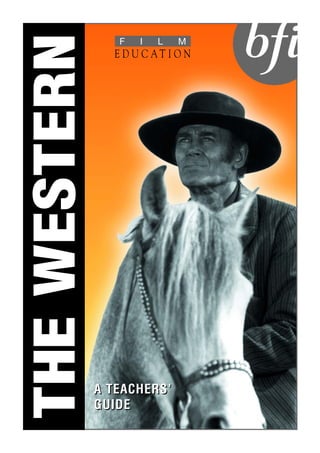
THE WESTERN 
F I L M 
E D U C AT I O N 
A TEACHERS’ 
GUIDE
An Introduction to 
The Western 
Teachers’ 
notes 
The Western is, perhaps, the prime means by which America 
interprets and represents its history to itself. Westerns are 
set within a certain period of American history, approximately 
1860-1900, in which America began to build the nation that it is 
today and to forge its identity. Many of the characters portrayed 
on film are men who really lived in that time, e.g. Wyatt Earp, Doc 
Holliday, General Custer. The Western is one of the oldest genres 
– since 1904 hardly a year has gone by without a Western film 
being made; there have been comic Westerns, musical Westerns 
and television Westerns. The study of Westerns enables us to 
examine issues about North America’s myths and legends; to look 
at how America thinks and feels about itself and its history; to 
explore how men and women fit into the community; and to look 
at those outside or on the edge of it. It investigates the building 
of a nation and its identity, patriotism, male friendship, honour 
and revenge, the triumph of good over evil. The popularity of any 
myth is rooted in its power to reflect and reproduce a society’s 
beliefs, values and fears in a palatable form. The myth of the 
Western tells its American audiences, and others, something 
about themselves and their society. 
Westerns often open with the scene of a lone rider sitting in the 
saddle of his dusty horse, travelling across the wide open plains 
towards a small frontier town with muddy streets and noisy 
saloons. He wears a worn wide-brimmed hat, a bandanna round 
his neck and a gun rests at his side in a well-worn holster. As he 
approaches the town we see the plains behind him rolling gently 
away towards deserts or mountain peaks. The scene is familiar to 
most Americans and to audiences of other nations. It presents a 
familiar setting within a context of social and moral meanings 
which are immediately understood. Stories of the Wild West 
include tales of glory and suffering, sacrifice, love and heroism, 
and have been a rich source for the growth and development of 
the myth. During this crucial period of settlement in which most 
Westerns are situated, major Indian wars were fought, cattle 
empires flourished and died, and some wagon trains reached 
their destinations. Part of the appeal of the Western is that it was 
a setting for romance and adventure and that many ways of life 
were available for people to start afresh or to reinvent themselves. 
Farmers, cowboys, cavalrymen, miners, Indian fighters, 
gamblers, gunfighters and railroad builders – all had their own 
elements of adventure, were contemporary with one another and 
had their own interests and values. This variety was a rich source 
for stories of conflicts between those interests and values. 
■ USING THIS TEACHING GUIDE 
This Guide will enable teachers and their students both to enjoy 
the Western as an exciting and popular film genre and to explore 
areas of Film and Media Studies syllabuses. The Guide provides 
background information on the Western as well as tasks and 
activities for students. Also included are synopses of significant 
Westerns and a bibliography. 
The Guide specifically focuses on Sergio Leone and the 
‘Spaghetti Western’, enabling students to look in detail at one 
type of Western and examine the influence of both a director 
(Sergio Leone) and a star (Clint Eastwood). 
It also offers ways in which the investigation of this genre could 
deliver other areas of the syllabuses and concept areas. 
Exploring a range of Western films, or extracts, can help Film and 
Media students investigate how meaning is made in film by 
asking them to analyse the features of a film’s form and style and 
to identify the techniques of storytelling specific to narrative 
film. Through the Western they can also consider the intended 
and actual response of audiences; look at representation; 
examine the codes and conventions within a particular genre, 
the historical development of a genre and the relationship of 
genre to media industries and audience. 
■ MEDIA AND FILM STUDIES LINKS 
At AS Level Media and Film Studies students will need to 
understand and work with the following: 
Narrative 
Students are asked to look at the overall structure of the film and 
the way in which the elements of the story are organised. The 
study of a specific sequence will include how narrative information 
is communicated. Westerns usually open with a set of very clear 
narrative ‘clues’, for example, look at The Searchers, The Quick 
and the Dead, The Outlaw Josey Wales. Students can be asked to 
look at the opening sequences of two or three Westerns and 
identify the film language, such as the establishing camera shot; 
the colour and the lighting; the mise en scène; and the music, 
which also gives information about the kind of story it is going to 
be. What are our expectations of this story? How do we know this 
man is the main character? What kind of a town or location is it? 
Is it hostile or friendly? How does the film language tell us this? 
The Western is also useful for demonstrating narrative structure 
as an example of classic Hollywood narrative. When students see 
a whole film they can be asked to examine how the initial 
situation or equilibrium is disturbed or disrupted and how the 
situation is re-established to produce a changed or amended 
equilibrium at the end. 
Genre 
Students should become familiar with the means by which a 
narrative film communicates meaning particularly through the 
use of signifying features or icons which an audience readily 
recognises. It is important to discuss genre in terms of how film 
is marketed to its audience. The Western makes a useful 
introduction to the iconography of particular genres. Students 
could be asked to list all the things (or icons) they expect to see 
in a Western and to discuss an audience’s expectation of this 
particular genre. They could then match what they see in film 
clips with the iconography on their own list and their own 
expectations. The opening sequences already referred to should 
be useful for this exercise. 
1
Teachers’ notes An Introduction to The Western 
2 
Mise en Scène and Cinematography 
These include setting, costume and make-up, expression and 
movement, lighting, framing and composition, off-screen space, 
camera position, colour, depth of focus and special effects. A 
short sequence, in which particular scenes could be freeze-framed, 
will allow students to identify close ups; the framing of 
the camera; the lighting of that particular scene; and to discuss 
why the film-maker has made these choices. Looking at interiors 
and exteriors from The Searchers and Unforgiven should 
encourage questions about the physical positioning of the 
characters, the groupings within the domestic context and the 
placing of the characters against the landscape. 
Editing 
Students need to be aware of how the film-maker organises time, 
both within a sequence and across sections of the narrative and 
how the organisation of space creates coherence for the 
spectator. Most Westerns follow a linear narrative; one of the 
ways the film-maker can heighten tension and add urgency is 
through editing shots together. For example, how is the chase by 
the Indians in Stagecoach made to seem so tense and dangerous? 
Students could be asked to look closely at how one scene cuts to 
another, so changing the pace. 
Sound 
Sound is a significant part of film language and includes the 
variety of ways in which aural elements – speech, music and 
noise – are used in relation to visuals, and help inform them. For 
example, the opening sequence of Once Upon a Time in the West 
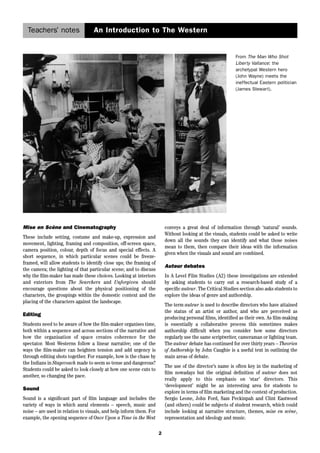
From The Man Who Shot 
Liberty Vallance: the 
archetypal Western hero 
(John Wayne) meets the 
ineffectual Eastern politician 
(James Stewart). 
conveys a great deal of information through ‘natural’ sounds. 
Without looking at the visuals, students could be asked to write 
down all the sounds they can identify and what those noises 
mean to them, then compare their ideas with the information 
given when the visuals and sound are combined. 
Auteur debates 
In A Level Film Studies (A2) these investigations are extended 
by asking students to carry out a research-based study of a 
specific auteur. The Critical Studies section also asks students to 
explore the ideas of genre and authorship. 
The term auteur is used to describe directors who have attained 
the status of an artist or author, and who are perceived as 
producing personal films, identified as their own. As film-making 
is essentially a collaborative process this sometimes makes 
authorship difficult when you consider how some directors 
regularly use the same scriptwriter, cameraman or lighting team. 
The auteur debate has continued for over thirty years – Theories 
of Authorship by John Caughie is a useful text in outlining the 
main areas of debate. 
The use of the director’s name is often key in the marketing of 
film nowadays but the original definition of auteur does not 
really apply to this emphasis on ‘star’ directors. This 
‘development’ might be an interesting area for students to 
explore in terms of film marketing and the context of production. 
Sergio Leone, John Ford, Sam Peckinpah and Clint Eastwood 
(and others) could be subjects of student research, which could 
include looking at narrative structure, themes, mise en scène, 
representation and ideology and music.
Teachers’ notes An Introduction to The Western 
3 
■ EXAM QUESTIONS 
A study of the Western could usefully help answer the following 
questions from past Film and Media examination papers: 
Narrative 
Q Analyse any two film or broadcast fiction texts which 
employ different narrative strategies. 
The Western can be used here as a classic Hollywood narrative 
text and contrasted with another kind of film narrative, e.g. The 
Searchers or The Outlaw Josey Wales with Pulp Fiction or Land 
and Freedom. 
Genre 
Q ‘Genre is a means by which an audience brings knowledge 
to a film; genre films provide frameworks in which the 
audience’s capacity to recognise certain story elements of plot, 
theme and image create the potential for great subtlety of 
meaning where the conventions may be stretched, played with 
or subverted’. How far would you agree with this view of genre? 
Refer to one or more genre films. 
Lone Star, Unforgiven, The Quick and the Dead are all Westerns 
which explore and subvert the generic conventions of the 
Western. Students could consider the audiences for these films 
as well as looking at the film-makers’ use of the conventions and 
iconography. 
Q How useful is the concept of genre to media producers and 
audiences? Discuss with reference to specific examples. 
The Western and how it is marketed could be explored here. 
Students should look at posters, trailers and other advertising 
material (web sites) in order to examine who the distributors are 
targeting and how. Stars associated with this genre are also 
useful marketing tools in reaching an audience. 
Q Outline the principal themes, conventions and 
iconography of any one genre of your choice, illustrating 
your answer with a range of examples. 
Three contrasting aspects of the Western could be considered 
through Lone Star, Unforgiven and The Searchers. 
Stars 
Q ‘Stars contribute more than potential box office appeal; 
they significantly determine meaning in the films in 
which they appear.’ Discuss this statement with reference to 
three films. 
Q Stars are often considered in partnerships, for example 
with a director or with another star. Explore what is 
revealing in a study of the work of a star in two partnerships. 
Clint Eastwood and John Wayne are two stars with which the 
Western is associated and their work with particular directors is 
significant. The Outlaw Josey Wales, Pale Rider, The Good, the 
Bad and the Ugly, The Searchers, Stagecoach, The Man Who 
Shot Liberty Valance offer useful texts through which to compare 
the relationship of a star persona to a particular director and 
genre. 
Q Hollywood stars are the direct or indirect reflection of the 
needs, drives and dreams of American society. Discuss 
this view of stars, making reference to one or more stars in at 
least two of their films. 
The Western as a myth and reflection of American society could 
be investigated looking particularly at the different 
representation of heroes through two or three films from 
different eras, e.g. High Noon, The Wild Bunch, Dances with 
Wolves. 
Auteur debates 
Q Auteur status is claimed today by Hollywood marketing 
hype for almost any director. What, in your opinion, are 
the characteristics which make a Hollywood auteur? In 
answering this question refer in detail to one or more directors 
and their work. 
Leone’s work could be a basis for this question as could an 
investigation of the work of John Ford, Sam Peckinpah and 
Clint Eastwood. It could also be interesting to discuss with your 
students whether Clint Eastwood is a star or an auteur, or 
combines qualities of both. 
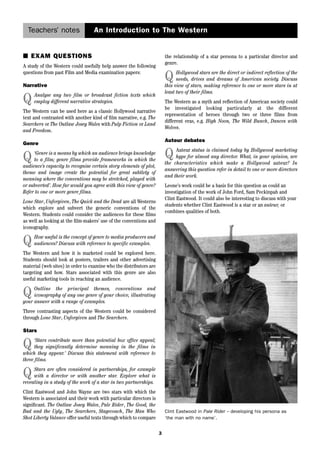
Clint Eastwood in Pale Rider – developing his persona as 
‘the man with no name’.
The Western – 
History and Myth 
It can be argued that the Western is the only genre that spans the 
history of narrative film-making from Edwin S. Porter’s The Great 
Train Robbery in 1903 to Ang Lee’s Ride with the Devil (1999). 
Geographically Westerns are set to the west of the Missouri/ 
Mississippi Rivers. They are sometimes set in Mexico. Historically, 
they are mainly set in the second half of the 19th Century (1860- 
1900). With the distinctive dress, props, situations and characters 
to add to this clearly recognisable genre it is not surprising that 
Westerns are often criticised for being far too formulaic. Certainly 
the Western can be identified by a range of elements which allow 
us the comfort of easy recognition, but this oversimplifies the 
complexities of Westerns which are constantly being redefined. 
Clint Eastwood, interviewed 
in Time Out in 1992 said: 
4 
Students’ 
notes 
Astagecoach hurtles across the vast landscape. Indians 
suddenly launch a savage attack. All seems lost until a bugle 
call signals the cavalry to the rescue! ‘The cavalry to the rescue’ 
has become part of common currency of English language and we 
recognise this description as an element of a typical Hollywood 
Western. 
One reason for the continued hold on audiences’ imaginations is 
the fascination with the ‘Lone Hero’, the ultimate Western 
archetype. No one knows where he came from or where he is 
going. He seeks no quarrel but is usually challenged and that 
challenge must be faced regardless of the consequences. He is 
almost always shown as heroic but the moral issues in his 
confrontations are not always completely clear. He is on the side 
of justice and order but also is intent on defending his honour or 
reputation. This rather simplified view of a Western’s morality is 
demonstrated in a classic Western directed by Fred Zinnemann 
called High Noon (1952) where Gary Cooper plays a marshal who 
has to face confrontation alone, abandoned by the townspeople 
and despite opposition from his new bride. After the gunfight the 
hero leaves town and his wife, more understanding now, leaves 
with him. This film, with the socially conscious allegory of the 
fearless individual standing up to the threat of oppression, was 
one of the most influential Westerns of the fifties. The theme of 
civic responsibility was explored again in a seventies Western – 
Clint Eastwood’s High Plains Drifter. 
T A S K 1 
■ The stagecoach, the vast landscape, the attacking 
native Americans all form part of what we call the 
iconography of the Western. These are the familiar 
‘signs’ that belong to this particular genre or type of 
film. (We would not expect to see a bus in a Western!) 
Make a list of as many other elements of iconography 
that you might expect to see in a Western, e.g. 
saloons, cattlemen, etc. 
T A S K 2 
■ A fearless individual 
standing up to and 
defeating oppressive 
forces is an appealing 
theme. Can you think 
of any other film 
genres where this 
happens? 
[The Western] is a genre 
in which you can 
analyse new subject 
matter and moralities; 
you can take it in 
different directions, 
otherwise it gets in a 
rut. And Hollywood’s 
silly a lot of the time; 
they follow a fad, and 
then some expert says a 
genre’s dead. But if they 
analysed it they’d see 
that every time they 
show certain Western 
movies from their 
library on TV, they get 
fabulous ratings. 
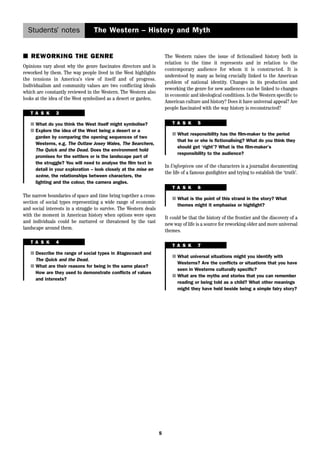
Will Kane (Gary Cooper) fighting for his life and honour in High Noon.
Students’ notes The Western – History and Myth 
5 
■ REWORKING THE GENRE 
Opinions vary about why the genre fascinates directors and is 
reworked by them. The way people lived in the West highlights 
the tensions in America’s view of itself and of progress. 
Individualism and community values are two conflicting ideals 
which are constantly reviewed in the Western. The Western also 
looks at the idea of the West symbolised as a desert or garden. 
T A S K 3 
■ What do you think the West itself might symbolise? 
■ Explore the idea of the West being a desert or a 
garden by comparing the opening sequences of two 
Westerns, e.g. The Outlaw Josey Wales, The Searchers, 
The Quick and the Dead. Does the environment hold 
promises for the settlers or is the landscape part of 
the struggle? You will need to analyse the film text in 
detail in your exploration – look closely at the mise en 
scène, the relationships between characters, the 
lighting and the colour, the camera angles. 
The narrow boundaries of space and time bring together a cross-section 
of social types representing a wide range of economic 
and social interests in a struggle to survive. The Western deals 
with the moment in American history when options were open 
and individuals could be nurtured or threatened by the vast 
landscape around them. 
T A S K 4 
■ Describe the range of social types in Stagecoach and 
The Quick and the Dead. 
■ What are their reasons for being in the same place? 
How are they used to demonstrate conflicts of values 
and interests? 
The Western raises the issue of fictionalised history both in 
relation to the time it represents and in relation to the 
contemporary audience for whom it is constructed. It is 
understood by many as being crucially linked to the American 
problem of national identity. Changes in its production and 
reworking the genre for new audiences can be linked to changes 
in economic and ideological conditions. Is the Western specific to 
American culture and history? Does it have universal appeal? Are 
people fascinated with the way history is reconstructed? 
T A S K 5 
■ What responsibility has the film-maker to the period 
that he or she is fictionalising? What do you think they 
should get ‘right’? What is the film-maker’s 
responsibility to the audience? 
In Unforgiven one of the characters is a journalist documenting 
the life of a famous gunfighter and trying to establish the ‘truth’. 
T A S K 6 
■ What is the point of this strand in the story? What 
themes might it emphasise or highlight? 
It could be that the history of the frontier and the discovery of a 
new way of life is a source for reworking older and more universal 
themes. 
T A S K 7 
■ What universal situations might you identify with 
Westerns? Are the conflicts or situations that you have 
seen in Westerns culturally specific? 
■ What are the myths and stories that you can remember 
reading or being told as a child? What other meanings 
might they have held beside being a simple fairy story?
John Ford and the archetypal 
Western? 
6 
Students’ 
notes 
John Ford, the director used to introduce himself by simply 
saying, ‘My name is John Ford. I make Westerns.’ Stagecoach 
(1939) remains for many people the prototype Western. With its 
tight dramatic construction and virtually non-stop action it 
seems in many ways more typical of Westerns generally than of 
Ford’s Westerns alone. Unusual for Ford is the simplicity of the 
film’s hero: a man on the run from the law, but undeniably good 
and heroic. More typical of Ford’s approach is the spirit of the 
film which offers the hope that the wrongfully outlawed hero and 
‘fallen woman’ heroine can start a new life in the Eden-like 
setting of a frontier farm, free from the censure of a hypocritical 
society. Stagecoach was Ford’s first film to be set in Monument 
Valley, the distinctive landscape which was to become Ford’s own 
preserve in the making of his Westerns and which was destined 
to become an icon of the American West. 
In Wagon Master (1950) Ford’s focus shifted from the individual 
to the vision of settlement of the west itself. The westward 
journey of a wagon train of settlers is seen as an epic quest, a trek 
to a promised land. In his films Ford developed a sense of the 
West’s historical realities, especially the history of injustices to 
Native Americans, the subject of Cheyenne Autumn (1964). At 
the same time, Ford’s nostalgia for the desert wilderness 
produces a hero as loner. 
In The Searchers (1956) John Wayne is Ethan Edwards, the 
champion of the family who turns his back on domestic life to 
become the nomadic loner. This film is considered by many to be 
Ford’s masterpiece. It was one of the most commercially 
successful Westerns of the fifties with Ford’s confident handling 
of complex material. There is slapstick, mythic landscapes with 
superbly striking settings, and character exploration. Unlike 
earlier Ford heroes, Ethan Edwards is not part of the westward 
march of civilisation. Rather like Scar, the Indian Chief who had 
‘defiled’ his niece, he represents the primitive forces that cannot 
survive beyond the desert and must be repressed before the 
foundations of civilisation can be properly laid and the desert be 
transformed into a garden. The film’s seriousness surprised many 
contemporary reviewers but was the culmination of Ford’s 
deepening sense of the paradoxes that his central characters 
contain from Stagecoach onwards. 
T A S K 1 
■ Look at the landscape in Stagecoach and list the 
‘typical’ elements. How does the film-maker convey the 
hostility of the environment? 
■ Take any sequence where the stagecoach is struggling 
to reach its destination. How does the film-maker 
emphasise the struggle and the urgency of the journey? 
Look closely at the mise en scéne, camera angles, 
music and editing. 
The characters in Stagecoach represent an almost perfect cross-section 
of Western types. We are introduced to the ‘proper’ 
heroine in the person of the cavalry officer’s pregnant wife; the 
‘fallen’ woman in the person of the banished saloon girl; the 
chivalrous Southern gambler; the big-hearted alcoholic doctor; 
the comic salesman; the bluff, jolly uncomplicated driver; the 
gruff, sterling, honest sheriff; the good outlaw seeking an honest 
start; all with the Seventh Cavalry and marauding Indians. 
T A S K 2 
■ What are the advantages for the story-teller in having 
all these types making a journey together? What might 
be the conflicts of interest? How might these conflicts 
carry the narrative forward? 
■ Can you think of any other genres in film, television 
and literature where groups of people from different 
backgrounds meet to make a journey, or are thrown 
together in a life-threatening situation? 
T A S K 3 
■ Look closely at the 
opening sequences of 
The Searchers. What 
contrasts can you find 
here, e.g. landscape 
and domestic setting? 
■ What are the 
paradoxes of the 
central characters, 
particularly the loner 
played by John Wayne? 
Look at his relationship 
with the adopted son 
of the family. 
■ What range of roles 
do the women play? 
Are they only 
symbolic, or are they 
important in pushing 
the narrative forward? 
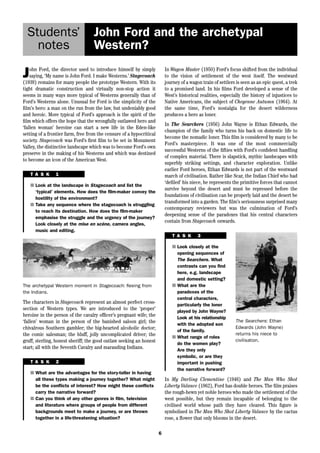
The Searchers: Ethan 
Edwards (John Wayne) 
returns his niece to 
civilisation. 
In My Darling Clementine (1946) and The Man Who Shot 
Liberty Valance (1962), Ford has double heroes. The film praises 
the rough-hewn yet noble heroes who made the settlement of the 
west possible, but they remain incapable of belonging to the 
civilised world whose path they have cleared. This figure is 
symbolised in The Man Who Shot Liberty Valance by the cactus 
rose, a flower that only blooms in the desert. 
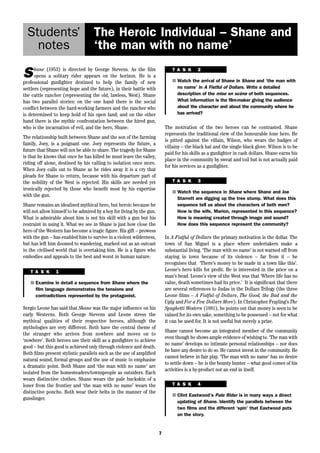
The archetypal Western moment in Stagecoach: fleeing from 
the Indians.
The Heroic Individual – Shane and 
‘the man with no name’ 
7 
Students’ 
notes 
Shane (1953) is directed by George Stevens. As the film 
opens a solitary rider appears on the horizon. He is a 
professional gunfighter destined to help the family of new 
settlers (representing hope and the future), in their battle with 
the cattle rancher (representing the old, lawless, West). Shane 
has two parallel stories: on the one hand there is the social 
conflict between the hard-working farmers and the rancher who 
is determined to keep hold of his open land; and on the other 
hand there is the mythic confrontation between the hired gun, 
who is the incarnation of evil, and the hero, Shane. 
The relationship built between Shane and the son of the farming 
family, Joey, is a poignant one. Joey represents the future, a 
future that Shane will not be able to share. The tragedy for Shane 
is that he knows that once he has killed he must leave the valley, 
riding off alone, destined by his calling to isolation once more. 
When Joey calls out to Shane as he rides away it is a cry that 
pleads for Shane to return, because with his departure part of 
the nobility of the West is rejected. His skills are needed yet 
ironically rejected by those who benefit most by his expertise 
with the gun. 
Shane remains an idealised mythical hero, but heroic because he 
will not allow himself to be admired by a boy for living by the gun. 
What is admirable about him is not his skill with a gun but his 
restraint in using it. What we see in Shane is just how close the 
hero of the Western has become a tragic figure. His gift – prowess 
with the gun – has enabled him to survive in a violent wilderness, 
but has left him doomed to wandering, marked out as an outcast 
in the civilised world that is overtaking him. He is a figure who 
embodies and appeals to the best and worst in human nature. 
In A Fistful of Dollars the primary motivation is the dollar. The 
town of San Miguel is a place where undertakers make a 
substantial living. ‘The man with no name’ is not warned off from 
staying in town because of its violence – far from it – he 
recognises that ‘There’s money to be made in a town like this’. 
Leone’s hero kills for profit. He is interested in the price on a 
man’s head. Leone’s view of the West was that ‘Where life has no 
value, death sometimes had its price.’ It is significant that there 
are several references to Judas in the Dollars Trilogy (the three 
Leone films – A Fistful of Dollars, The Good, the Bad and the 
Ugly and For a Few Dollars More). In Christopher Frayling’s The 
Spaghetti Western (1981), he points out that money is seen to be 
valued for its own sake, something to be possessed – not for what 
it can be used for. It is not useful but merely a prize. 
Shane cannot become an integrated member of the community 
even though he shows ample evidence of wishing to. ‘The man with 
no name’ develops no intimate personal relationships – nor does 
he have any desire to do so. He cannot invest in the community. He 
cannot believe in fair play. ‘The man with no name’ has no desire 
to settle down – he is the bounty hunter – what good comes of his 
activities is a by-product not an end in itself. 
T A S K 1 
■ Examine in detail a sequence from Shane where the 
film language demonstrates the tensions and 
contradictions represented by the protagonist. 
Sergio Leone has said that Shane was the major influence on his 
early Westerns. Both George Stevens and Leone stress the 
mythical qualities of their respective heroes, although the 
mythologies are very different. Both have the central theme of 
the stranger who arrives from nowhere and moves on to 
‘nowhere’. Both heroes use their skill as a gunfighter to achieve 
good – but this good is achieved only through violence and death. 
Both films present stylistic parallels such as the use of amplified 
natural sound, formal groups and the use of music to emphasise 
a dramatic point. Both Shane and ‘the man with no name’ are 
isolated from the homesteaders/townspeople as outsiders. Each 
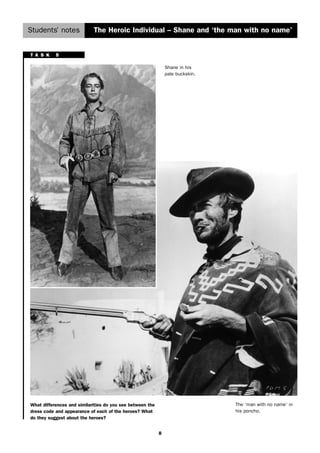
wears distinctive clothes. Shane wears the pale buckskin of a 
loner from the frontier and ‘the man with no name’ wears the 
distinctive poncho. Both wear their belts in the manner of the 
gunslinger. 
T A S K 2 
■ Watch the arrival of Shane in Shane and ‘the man with 
no name’ in A Fistful of Dollars. Write a detailed 
description of the mise en scène of both sequences. 
What information is the film-maker giving the audience 
about the character and about the community where he 
has arrived? 
The motivation of the two heroes can be contrasted. Shane 
represents the traditional view of the honourable lone hero. He 
is pitted against the villain, Wilson, who wears the badges of 
villainy – the black hat and the single black glove. Wilson is to be 
paid for his skills as a gunfighter in cash dollars. Shane earns his 
place in the community by sweat and toil but is not actually paid 
for his services as a gunfighter. 
T A S K 3 
■ Watch the sequence in Shane where Shane and Joe 
Starrett are digging up the tree stump. What does this 
sequence tell us about the characters of both men? 
How is the wife, Marion, represented in this sequence? 
How is meaning created through image and sound? 
How does this sequence represent the community? 
T A S K 4 
■ Clint Eastwood’s Pale Rider is in many ways a direct 
updating of Shane. Identify the parallels between the 
two films and the different ‘spin’ that Eastwood puts 
on the story.
Students’ notes The Heroic Individual – Shane and ‘the man with no name’ 
8 
Shane in his 
pale buckskin. 
The ‘man with no name’ in 
his poncho. 
T A S K 5 
What differences and similarities do you see between the 
dress code and appearance of each of the heroes? What 
do they suggest about the heroes?
9 
Students’ 
notes 
Reworking 
the Western 
■ SAM PECKINPAH 
Sam Peckinpah, an exciting director working in the sixties 
and seventies, chose to identify himself almost exclusively 
with the Western. In a sense, he begins where Ford ends, with the 
image of the ageing Western hero in Ride the High Country 
(1962) reduced, literally, to being a carnival attraction. The 
decline in the heroic image of the Western hero from Ride the 
High Country to Peckinpah’s most famous film, The Wild Bunch 
(1969) is rapid and extreme. No longer do we have a solitary man 
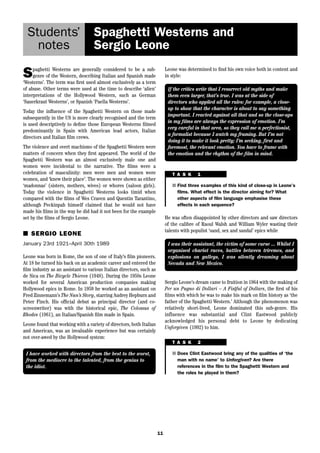
with a code of honour, but a killer who runs in a pack. The 
Western ‘hero’ who emerges from The Wild Bunch has come to 
resemble that other archetype of American films, the gangster. 
The violence of the Western, traditionally restrained by the 
hero’s gentlemanly code, is now allowed to run rampant. In this 
film it is the violence above all else which characterises the West. 
Moral confusion is everywhere. The U.S. Cavalry (the heroic 
rescuers in so many Westerns) is revealed as a mob of bungling 
fools, and children (so often symbols of innocence) are shown to 
be amoral. The mythology of the West is exploded and the 
concept of heroism is challenged. In Pat Garrett and Billy the 
Kid (1973), Peckinpah romanticises the character of the famed 
outlaw hero. He is seen as the personification of freedom and 
animal vitality in the face of an advancing corrupt civilisation: 
the last cowboy at the end of the frontier. In Junior Bonner 
(1972), a study of a contemporary rodeo performer, the defeat 
and death of the hero are a rebuke to society. 
■ THE QUICK AND THE DEAD 
It has been argued that the dominance of the male hero in the 
Western means that the women are instrumental in the action 
but not central to it and that their principal dramatic role is to 
be the voice of reason speaking out against violence. In mythical 
terms, women in Westerns often represent the ‘good’ and play an 
important part in civilising the frontier and establishing the 
community. In traditional Westerns women seem to have fallen 
into two types: the unsullied pioneer heroine, e.g. the virtuous 
wife, the rancher’s daughter, the schoolteacher; and then the 
saloon girl. There have been exceptional Westerns where there is 
a female hero, such as Johnny Guitar (1954), and where women 
are offered opportunities for greater freedom and power. 
Women’s changing roles in the Western may reflect their 
changing status in society. In the 1990s women as the central 
figures in Westerns were in fashion – in 1994 Bad Girls starred 
Madeleine Stowe, Mary Stuart Masterson, Andie McDowell and 
Drew Barrymore as four prostitutes who, after a killing, flee from 
town to town and became outlaws. In 1995 Sharon Stone starred 
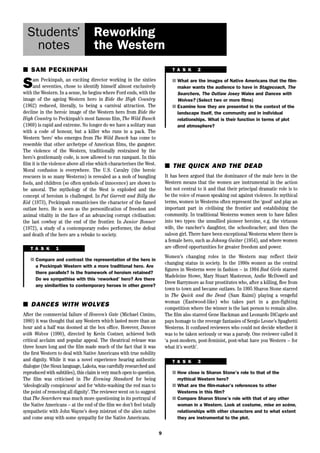
in The Quick and the Dead (Sam Raimi) playing a vengeful 
woman (Eastwood-like) who takes part in a gun-fighting 
competition where the winner is the last person to remain alive. 
The film also starred Gene Hackman and Leonardo DiCaprio and 
pays homage to the revenge fantasies of Sergio Leone’s Spaghetti 
Westerns. It confused reviewers who could not decide whether it 
was to be taken seriously or was a parody. One reviewer called it 
‘a post-modern, post-feminist, post-what have you Western – for 
what it’s worth’. 
T A S K 1 
■ Compare and contrast the representation of the hero in 
a Peckinpah Western with a more traditional hero. Are 
there parallels? Is the framework of heroism retained? 
Do we sympathise with this ‘reworked’ hero? Are there 
any similarities to contemporary heroes in other genre? 
■ DANCES WITH WOLVES 
After the commercial failure of Heaven’s Gate (Michael Cimino, 
1980) it was thought that any Western which lasted more than an 
hour and a half was doomed at the box office. However, Dances 
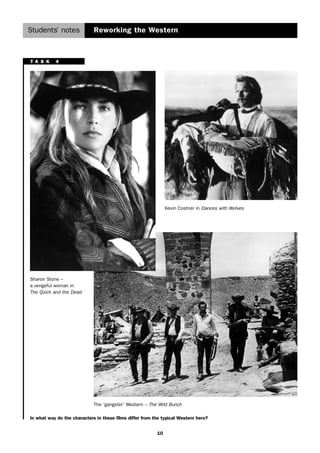
with Wolves (1990), directed by Kevin Costner, achieved both 
critical acclaim and popular appeal. The theatrical release was 
three hours long and the film made much of the fact that it was 
the first Western to deal with Native Americans with true nobility 
and dignity. While it was a novel experience hearing authentic 
dialogue (the Sioux language, Lakota, was carefully researched and 
reproduced with subtitles), this claim is very much open to question. 
The film was criticised in The Evening Standard for being 
‘ideologically conspicuous’ and for ‘white-washing the red man to 
the point of removing all dignity’. The reviewer went on to suggest 
that The Searchers was much more questioning in its portrayal of 
the Native Americans – at the end of the film we don’t feel totally 
sympathetic with John Wayne’s deep mistrust of the alien native 
and come away with some sympathy for the Native Americans. 
T A S K 2 
■ What are the images of Native Americans that the film-maker 
wants the audience to have in Stagecoach, The 
Searchers, The Outlaw Josey Wales and Dances with 
Wolves? (Select two or more films) 
■ Examine how they are presented in the context of the 
landscape itself, the community and in individual 
relationships. What is their function in terms of plot 
and atmosphere? 
T A S K 3 
■ How close is Sharon Stone’s role to that of the 
mythical Western hero? 
■ What are the film-maker’s references to other 
Westerns in this film? 
■ Compare Sharon Stone’s role with that of any other 
woman in a Western. Look at costume, mise en scène, 
relationships with other characters and to what extent 
they are instrumental to the plot.
Students’ notes 
Reworking the Western 
In what way do the characters in these films differ from the typical Western hero? 
10 
Sharon Stone – 
a vengeful woman in 
The Quick and the Dead 
Kevin Costner in Dances with Wolves 
The ‘gangster’ Western – The Wild Bunch 
T A S K 4
11 
Students’ 
notes 
Spaghetti Westerns and 
Sergio Leone 
Spaghetti Westerns are generally considered to be a sub-genre 
of the Western, describing Italian and Spanish made 
‘Westerns’. The term was first used almost exclusively as a term 
of abuse. Other terms were used at the time to describe ‘alien’ 
interpretations of the Hollywood Western, such as German 
‘Sauerkraut Westerns’, or Spanish ‘Paella Westerns’. 
Today the influence of the Spaghetti Western on those made 
subsequently in the US is more clearly recognised and the term 
is used descriptively to define those European Westerns filmed 
predominantly in Spain with American lead actors, Italian 
directors and Italian film crews. 
The violence and overt machismo of the Spaghetti Western were 
matters of concern when they first appeared. The world of the 
Spaghetti Western was an almost exclusively male one and 
women were incidental to the narrative. The films were a 
celebration of masculinity: men were men and women were 
women, and ‘knew their place’. The women were shown as either 
‘madonnas’ (sisters, mothers, wives) or whores (saloon girls). 
Today the violence in Spaghetti Westerns looks timid when 
compared with the films of Wes Craven and Quentin Tarantino, 
although Peckinpah himself claimed that he would not have 
made his films in the way he did had it not been for the example 
set by the films of Sergio Leone. 
■ SERGIO LEONE 
January 23rd 1921–April 30th 1989 
Leone was born in Rome, the son of one of Italy’s film pioneers. 
At 18 he turned his back on an academic career and entered the 
film industry as an assistant to various Italian directors, such as 
de Sica on The Bicycle Thieves (1948). During the 1950s Leone 
worked for several American production companies making 
Hollywood epics in Rome. In 1959 he worked as an assistant on 
Fred Zinnemann’s The Nun’s Story, starring Audrey Hepburn and 
Peter Finch. His official debut as principal director (and co-screenwriter) 
was with the historical epic, The Colossus of 
Rhodes (1961), an Italian/Spanish film made in Spain. 
Leone found that working with a variety of directors, both Italian 
and American, was an invaluable experience but was certainly 
not over-awed by the Hollywood system: 
Leone was determined to find his own voice both in content and 
in style: 
If the critics write that I resurrect old myths and make 
them even larger, that’s true. I was at the side of 
directors who applied all the rules: for example, a close-up 
to show that the character is about to say something 
important. I reacted against all that and so the close-ups 
in my films are always the expression of emotion. I’m 
very careful in that area, so they call me a perfectionist, 
a formalist because I watch my framing. But I’m not 
doing it to make it look pretty; I’m seeking, first and 
foremost, the relevant emotion. You have to frame with 
the emotion and the rhythm of the film in mind. 
T A S K 1 
■ Find three examples of this kind of close-up in Leone’s 
films. What effect is the director aiming for? What 
other aspects of film language emphasise these 
effects in each sequence? 
He was often disappointed by other directors and saw directors 
of the calibre of Raoul Walsh and William Wyler wasting their 
talents with populist ‘sand, sex and sandal’ epics while 
I have worked with directors from the best to the worst, 
from the mediocre to the talented, from the genius to 
the idiot. 
I was their assistant, the victim of some curse ... Whilst I 
organised chariot races, battles between triremes, and 
explosions on galleys, I was silently dreaming about 
Nevada and New Mexico. 
Sergio Leone’s dream came to fruition in 1964 with the making of 
Per un Pugno di Dollari – A Fistful of Dollars, the first of his 
films with which he was to make his mark on film history as ‘the 
father of the Spaghetti Western.’ Although the phenomenon was 
relatively short-lived, Leone dominated this sub-genre. His 
influence was substantial and Clint Eastwood publicly 
acknowledged his personal debt to Leone by dedicating 
Unforgiven (1992) to him. 
T A S K 2 
■ Does Clint Eastwood bring any of the qualities of ‘the 
man with no name’ to Unforgiven? Are there 
references in the film to the Spaghetti Western and 
the roles he played in them?
Students’ notes Spaghetti Westerns and Sergio Leone 
12 
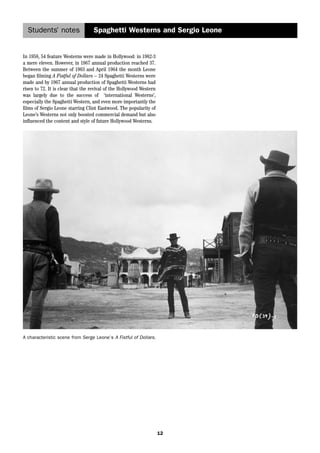
In 1958, 54 feature Westerns were made in Hollywood: in 1962-3 
a mere eleven. However, in 1967 annual production reached 37. 
Between the summer of 1963 and April 1964 the month Leone 
began filming A Fistful of Dollars – 24 Spaghetti Westerns were 
made and by 1967 annual production of Spaghetti Westerns had 
risen to 72. It is clear that the revival of the Hollywood Western 
was largely due to the success of ‘international Westerns’, 
especially the Spaghetti Western, and even more importantly the 
films of Sergio Leone starring Clint Eastwood. The popularity of 
Leone’s Westerns not only boosted commercial demand but also 
influenced the content and style of future Hollywood Westerns. 
A characteristic scene from Serge Leone’s A Fistful of Dollars.
13 
Students’ 
notes 
Sergio Leone: The Dollars Trilogy – 
Themes and Style 
■ A Fistful of Dollars (1964) 
■ For a Few Dollars More (1965) 
■ The Good, the Bad and the Ugly (1966) 
A Fistful of Dollars has been summed up disparagingly as a low-budget 
Western (the total budget was $200,000), based upon a 
Japanese film, pretending to be an American one, produced in 
Italy. It achieved, however, instant success in Italy and eventual 
international success. 
In this, the first of what was to become known as the Dollars 
Trilogy, Leone was to present his audiences with an alternative 
mythology of the West. His hero lives by his wits and is little 
concerned with ‘honour’. Leone viewed the American hero with 
a more objective, if not cynical eye: 
In my childhood America was like a religion. I dreamed 
of the wide, open paces. Of demi-gods upon the prairies. 
They were no longer the Americans of the West. I found 
them energetic, but also deceptive men who were 
materialistic, possessive, keen on earthly pleasures and 
goods. I could see nothing or almost nothing of the great 
prairies or of the demi-gods of my childhood. 
In an interview in 1973 Leone rejected Hollywood’s interpretation 
of the West as a place where the ‘whiter than white redresser of 
wrongs’ existed. He recognised the ‘real’ West as a 
world of violence, fear and instinct – a world of men. If 
you were ‘honourable’ like the heroes of the traditional 
Westerns – you would find yourself in the cemetery in no 
time at all. Life in the West was not pleasant or poetic. Up 
until the arrival of the railroads the law belonged to the 
most hard, the most cruel, the most cynical. 
T A S K 1 
■ Take one Spaghetti Western and two other Westerns, 
each from a different period, and trace the changes in 
the characterisation of the ‘hero’. What is retained 
from the traditional hero? What is lost? 
The outline narrative of A Fistful of Dollars was written in three 
weeks by Leone and two co-writers. The story was based heavily 
on Akira Kurosawa’s samurai film Yojimbo (1961). Both 
Kurosawa and Leone suggested that their main inspiration came 
from Hollywood films. Kurosawa said that Yojimbo was born out 
of a passion for the Hollywood Western, and in particular, George 
Steven’s Shane, a hugely popular film in Japan. 
T A S K 2 
‘Good Westerns are liked by everyone. Since humans are 
weak they want to see good people and great heroes. 
Westerns have been done over and over again and in the 
process a kind of grammar has evolved. I have learned 
from the grammar of the Westerns.’ 
KUROSAWA 
■ What does the ‘grammar of the Westerns’ mean, do 
you think? 
■ What would a Western have to have to attract a 
contemporary audience? Write a synopsis for a 
Western which would attract your peer group. Think 
about effects, casting, narrative. 
■ THEMES AND STYLE 
The Dollars Trilogy avoids sentimentality by combining black 
humour and brutality. In For a Few Dollars More Eastwood’s 
characterisation of ‘the man with no name’ became almost self-parody. 
In the complex game of the treasure hunt in The Good, 
the Bad and the Ugly much of the violence has almost a cartoon 
quality about it. Guns are fired from unexpected places: up 
sleeves, in a bath and from a boot. All the films include graphic 
close-ups of people eating voraciously. Less savoury functions are 
also featured. 
Ennio Morricone’s music plays a significant role in the films. 
Many of the characters have musical reference points. In The 
Good, the Bad and the Ugly each character has his own 
distinctive sound – a trill or a whine, sung whistled or played and 
taken from the opening bars of the main title theme. 
T A S K 3 
■ Take two of the Dollars Trilogy and note the musical 
reference points for the characters. 
Leone employs heavily amplified background noises to dramatic 
effect. Throughout the Dollars Trilogy there are long scenes 
where there is little or no dialogue but Leone emphasises the 
mechanics of loading, cocking and firing a rifle or pistol by 
electronically enhancing or simulating the sounds. This helps to 
increase the dramatic tension. For the opening sequence of The 
Good, the Bad and the Ugly amplified natural sounds are used to 
dramatic effect. 
T A S K 4 
■ Identify the sounds in the opening sequences of each 
of the Dollars Trilogy – the whistle of the wind, a dog 
howling ... what else? 
The real-life Americans he saw arriving to liberate Italy at the 
end of the Second World War ‘upset all my dreams’. Leone saw 
their weaknesses as well as their strengths:
Students’ notes Sergio Leone: The Dollars Trilogy – Themes and Style 
14 
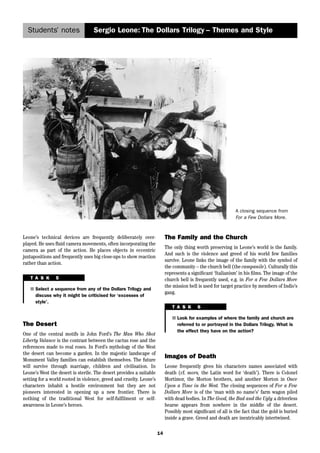
A closing sequence from 
For a Few Dollars More. 
Leone’s technical devices are frequently deliberately over-played. 
He uses fluid camera movements, often incorporating the 
camera as part of the action. He places objects in eccentric 
juxtapositions and frequently uses big close-ups to show reaction 
rather than action. 
T A S K 5 
■ Select a sequence from any of the Dollars Trilogy and 
discuss why it might be criticised for ‘excesses of 
style’. 
The Desert 
One of the central motifs in John Ford’s The Man Who Shot 
Liberty Valance is the contrast between the cactus rose and the 
references made to real roses. In Ford’s mythology of the West 
the desert can become a garden. In the majestic landscape of 
Monument Valley families can establish themselves. The future 
will survive through marriage, children and civilisation. In 
Leone’s West the desert is sterile. The desert provides a suitable 
setting for a world rooted in violence, greed and cruelty. Leone’s 
characters inhabit a hostile environment but they are not 
pioneers interested in opening up a new frontier. There is 
nothing of the traditional West for self-fulfilment or self-awareness 
in Leone’s heroes. 
The Family and the Church 
The only thing worth preserving in Leone’s world is the family. 
And such is the violence and greed of his world few families 
survive. Leone links the image of the family with the symbol of 
the community – the church bell (the campanile). Culturally this 
represents a significant ‘Italianism’ in his films. The image of the 
church bell is frequently used, e.g. in For a Few Dollars More 
the mission bell is used for target practice by members of Indio’s 
gang. 
T A S K 6 
■ Look for examples of where the family and church are 
referred to or portrayed in the Dollars Trilogy. What is 
the effect they have on the action? 
Images of Death 
Leone frequently gives his characters names associated with 
death (cf. mors, the Latin word for ‘death’). There is Colonel 
Mortimor, the Morton brothers, and another Morton in Once 
Upon a Time in the West. The closing sequences of For a Few 
Dollars More is of the ‘man with no name’s’ farm wagon piled 
with dead bodies. In The Good, the Bad and the Ugly a driverless 
hearse appears from nowhere in the middle of the desert. 
Possibly most significant of all is the fact that the gold is buried 
inside a grave. Greed and death are inextricably intertwined.
15 
Students’ 
notes 
Once Upon a Time 
in the West 
Once Upon a Time in the West is considered to be Leone’s most 
polished and also most optimistic Western. He wanted to 
portray America’s first frontier using the most worn out 
of stereotypes: the pushy whore, the romantic bandit, the 
avenger, the killer who is about to become a business 
man and the industrialist who uses the methods of the 
bandit,… 
and 
recount, through small characters, usual characters, 
taken from American traditions of fiction, the birth of a 
nation. Before they come onto the scene, these characters 
know themselves to be dying in every sense – physically 
and morally – victims of a new era which was advancing; 
the new, unpitying era of the economic boom. 
The main theme of Once Upon a Time in the West is the impact 
of technological developments on the Western frontier. Leone 
represents capitalism and advances in technology moving hand 
in hand. Linked with the theme of killing for money is the 
representation of the ruthless railroad tycoon. Perhaps one of 
the most telling lines in the film is when the tycoon is told that 
even when he is dead, ‘You’ll leave a slime behind you – two 
shiny rails.’ The film’s characters generally have no respect for 
the railroad. Only Jill McBain, travelling as a passenger, visiting 
the West for the first time seems relaxed and at ease on the train. 
She represents the advance of civilisation. 
In Once Upon a Time in the West Leone makes specific references 
to other Westerns: he includes scenes set in Monument Valley; the 
opening is a parody of High Noon; and there are parallel graveside 
scenes in Shane and visual references to Ford’s The Iron Horse. 
Timmy mimes the shooting of a partridge just as Joey mimes the 
shooting of a deer in Shane. There are many other visual echoes 
running through the film. Leone wanted Henry Fonda, playing the 
cruel villain, to have maximum impact. The hero of My Darling 
Clementine and Young Mr Lincoln becomes the steely-eyed killer 
and certainly achieved Leone’s aim. 
T A S K 1 
■ An audience would 
have expected Henry 
Fonda to play the hero 
with integrity and 
honour. What effect 
would it have on them 
to have him play the 
cold-hearted villain? 
How might it have 
emphasised any 
themes in the film? 
T A S K 2 
■ What kind of characters 
do we expect actors 
such as Harrison Ford, 
Tom Hanks and Meryl 
Streep to play? What 
meanings do they take 
to their films? What 
effect would it have on 
their audience to cast 
them against 
expectations? 
Themes of death in Leone’s Once Upon a Time in the West. 
The character of Jill McBain is central to an understanding of the 
film. If Leone’s world is essentially womanless, Once Upon a Time 
in the West is the exception that proves the rule. It is not that 
women are handled badly or indifferently in his films it is just that 
they hardly exist at all. Jill McBain is different. The scene where 
she strips off her city clothes to draw water from the well 
combines two essential motifs in the film. The ‘mother’ figure and 
the sense of hope for the future. Jill becomes the matriarch to the 
railroad gangs. Harmonica says, ‘It’s going to be a beautiful town, 
Sweetwater’, and it is Jill who will make it so. Within the one 
character lives a succession of Western stereotypes. She has been 
described as the adoring wife, a whore, a mother, a victim of rape 
and a matriarch. It is an irony that for all Leone’s supposed 
misogyny it is she who survives to give hope for the future. 
T A S K 3 
■ Choose a range of women, say five or six, from 
different Westerns and rank them in terms of how 
‘real’ they are. Some are stereotypes and symbols, 
others more heroic and full-blooded.
16 
Students’ 
notes 
Clint Eastwood 
as Star 
There are some actors who are associated with Westerns and 
with particular roles in them. The physical presence and 
characteristics of these actors have become part of the genre’s 
iconography, either accepted literally or worked into new 
patterns or used for fresh meanings. The well-known faces, with 
familiar plots and situations help to reinforce the sense of ritual, 
e.g. John Wayne is not associated with parts that require much 
inner turmoil, Henry Fonda is a key figure in Ford films such as 
My Darling Clementine and Gary Cooper is honest and upright, 
as in High Noon. If any of these are cast as criminals or outlaws 
there is the definite suggestion that there is something basically 
wrong with society. 
Clint Eastwood carefully refined his ‘man with no name’ persona, 
introduced with such dramatic effect in Leone’s films, 
culminating in his homage to Shane – the mystical preacher in 
Pale Rider (1985). Two of the most exciting Hollywood Westerns 
of the seventies were his High Plains Drifter (1973), a surreal 
extension of the genre, and The Outlaw Josey Wales. High 
Plains Drifter sees the hero consumed by revenge but in Josey 
Wales he is freed from revenge and made ‘human’ again. The 
screenplay quotes the classic line from Anthony Mann’s film The 
Naked Spur (1952): ‘Choosing a way to die, that’s easy; it’s 
choosing a way to live that’s the difficult thing to do.’ 
T A S K 1 
■ Which actors do you associate with the Western, and 
which qualities are associated with them? How do 
these qualities contribute to audience expectations 
and to the marketing of the film? 
Leone originally wanted Henry Fonda to play ‘the man with no 
name’ as an older character; his second choice was James Coburn. 
Both actors were too expensive and he tried, unsuccessfully, to 
cast various actors who were living in Europe. Clint Eastwood was, 
at the time, the co-star of the CBS TV Western series, Rawhide. 
Eastwood had joined the series in the winter of 1958, aged 28, as 
Rowdy Yates, the ‘ramrod’ of the cattle drivers. Eastwood was 
signed to play the ‘man with no name’ in the spring of 1964: his 
salary was $15,000. The film took a mere seven weeks to complete, 
after which Eastwood returned to Rawhide. After the death of Eric 
Fleming, who played the trail boss in Rawhide, Eastwood had solo 
billing until the series ended in 1966. 
Before casting Eastwood, Leone had watched an episode of 
Rawhide and thought that he was ‘a little sophisticated, a little 
light’ but ‘he was good at getting on a horse and had a way of 
walking with a tired resigned air’. Leone decided that he had to 
‘make him look more virile, harden him, ‘age’ him for the part – 
with that beard, that poncho which made him look broader, those 
cigars.’ Leone’s original vision of ‘the man with no name’ changed 
considerably when Eastwood took on the role. Leone saw that 
in real life Clint is slow, calm, rather like a cat. He does what 
he has to do, then sits down in a corner and goes to sleep 
immediately, until needed again. It was seeing him behave 
like this on the first day that helped me mould the character. 
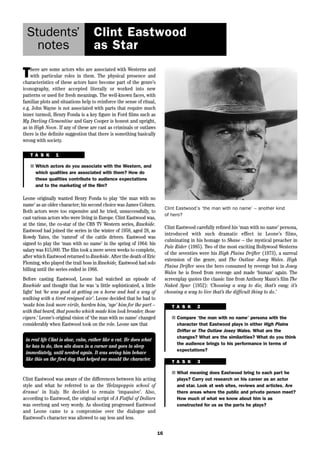
Clint Eastwood’s ‘the man with no name’ – another kind 
of hero? 
T A S K 2 
■ Compare ‘the man with no name’ persona with the 
character that Eastwood plays in either High Plains 
Drifter or The Outlaw Josey Wales. What are the 
changes? What are the similarities? What do you think 
the audience brings to his performance in terms of 
expectations? 
T A S K 3 
■ What meaning does Eastwood bring to each part he 
plays? Carry out research on his career as an actor 
and star. Look at web sites, reviews and articles. Are 
there areas where the public and private person meet? 
How much of what we know about him is as 
constructed for us as the parts he plays? 
Clint Eastwood was aware of the differences between his acting 
style and what he referred to as the ‘Helzapoppin school of 
drama‘ in Italy. He decided to remain ‘impassive’. Also, 
according to Eastwood, the original script of A Fistful of Dollars 
was overlong and very wordy. As shooting progressed Eastwood 
and Leone came to a compromise over the dialogue and 
Eastwood’s character was allowed to say less and less.
17 
Students’ 
notes 
The Western – synopses of 
selected films and bibliography 
■ SYNOPSES OF SELECTED FILMS 
Annie Get your Gun (US, 1950) 
Based on Irving Berlin’s 1946 musical, this tells the story of how 
‘sharp shootin’ straight talkin’’ Annie Oakley (Betty Hutton) wins 
her man (Howard Keel), a trick shot artist in Buffalo Bill’s 
travelling show. 
Bad Girls (US, 1994) 
Four prostitutes; a tough sharp-shooter (Madeline Stowe), a 
Southern gentlewoman (Andie MacDowell), an impoverished 
widow (Mary Stewart Masterson) and a young tomboy (Drew 
Barrymore), go on the run from the injustice and degradation of a 
life of virtual slavery in the Old West, but find they cannot escape 
a life that they were forced into. Directed by Jonathan Kaplan. 
Ballad of Little Jo, The (US, 1993) 
A fact-based feminist Western directed by Maggie Greenwald, 
this has as its central character a woman, Josephine, who, 
expelled from the safety of New York society in 1866 for an 
adulterous affair, travels West where she disguises herself as a 
man, Little Jo, and thrives in the testosterone-fuelled and brutal 
society of a frontier town. 
Calamity Jane (US, 1953) 
Doris Day plays a frontier tomboy who finds she has to choose 
between her femininity and her six-shooter when she falls in love 
with Wild Bill Hickok (Howard Keel), in this classic musical 
directed by David Butler. 
Dances with Wolves (US, 1990) 
Kevin Costner’s Oscar-winning Western sees him starring in and 
directing the story of a disillusioned Yankee soldier assigned to a 
remote, deserted outpost where he gradually gains the trust and 
friendship of the adjacent community of Sioux Indians. 
Remarkable as much for its epic sweep (it was Costner’s 
directorial debut) as for its historical accuracy: the Indian cast 
deliver subtitled Lakota dialogue. 
Duel in the Sun (US, 1946) 
A sustained emotional family melodrama. With a father brooding 
over his fallen empire as his two sons rival each other for a 
woman’s affections, it’s all bound to end in tears. Stars Gregory 
Peck, Lillian Gish and Jennifer Jones. Directed by King Vidor. 
Heaven’s Gate (US, 1980) 
Hugely ambitious and critically savaged on its release, Michael 
Cimino (The Deer Hunter) tells the story of two men – John Hurt 
and Kris Kristofferson – who, although ostensibly agents of the 
law, find themselves powerless in the face of the corruption and 
compromise that lies at the heart of the American Dream at the 
end of the 19th Century. 
High Noon (US, 1952) 
Oscar-winning film starring Gary Cooper and Grace Kelly, and 
directed by Fred Zinnemann. On the day of his retirement, small-town 
Sheriff Will Kane learns of the imminent arrival of a 
convicted murderer seeking revenge. As his community gradually 
abandons him to his fate, he comes face to face with what it 
means to be a man in the Old West. 
High Plains Drifter (US, 1972) 
A gothic Western in which Clint Eastwood reinforces and subverts 
his iconic status as the man (or ghost) who rides into the town of 
Lago to exact revenge on the entire population. Directed by Clint 
Eastwood, starring Verna Bloom, Mitchell Ryan and Jack Ging. 
Last Train from Gun Hill (US, 1959) 
Issues of duty, family and honour as Kirk Douglas’ sheriff, 
determined to bring to justice the man who raped and murdered 
his wife, comes into conflict with the rapist’s father and his own 
best friend, Anthony Quinn, who is equally determined to stop him. 
Lone Star (US, 1995) 
The mystery of a 40 year old murder intermixed with racial 
tensions in a Tex-Mex border town are central in this tale of a 
living, working, interrelating community. Directed by John 
Sayles, starring Matthew McConaughey, Frances McDormand 
and Kris Kristofferson. 
The Man Who Shot Liberty Valance (US, 1962) 
With passing of the Old West and the paving of the way for the 
development of a new civilisation, questions of chivalry, etiquette 
and the law rear their heads. Stars John Wayne, James Stewart, 
Vera Miles and Lee Marvin. Directed by John Ford. 
My Darling Clementine (US, 1946) 
Directed by John Ford and starring Henry Fonda as Wyatt Earp, 
provides perhaps the definitive version of the shoot-out at the OK 
Corral and the events that make it unavoidable, as well as 
touchingly depicting Earp’s civilisation from outlaw and loner to 
family man and sheriff. 
The Outlaw Josey Wales (US, 1976) 
Clint Eastwood directs and stars in this revenge western as a farmer 
who witnesses his family murdered at the hands of renegade 
confederate soldiers. He picks up a disparate ‘family’ of settlers and 
misfits on the way but gradually his thoughts return from killing to 
farming. Starring Chief Dan George, Sondra Locke and John Vernon. 
Pale Rider (US, 1985) 
Clint Eastwood again directs and stars as an anonymous, 
ambiguous stranger; this time a preacher more proficient with a 
gun than a bible, who rides out of the wilderness to deliver a poor 
community from the tyranny of an evil cattle baron, in a 
relatively traditional western. 
Pat Garrett and Billy the Kid (US, 1973) 
An elegy for, as well as a condemnation of, the values of the Old 
West from Sam Peckinpah: the story of the honourable,
Students’ notes 
The Western – synopses of selected films and bibliography 
18 
charismatic and inevitably tragic outlaw Billy (Kris Kristofferson) 
and James Coburn’s Garrett, the friend that is reluctantly 
pressed into the service of ‘civilising’ forces to arrest and then 
murder him. 
Posse (US, 1993) 
An all black Western about black cowboys. A refugee, Jessie Lee 
leads a band of deserters to a town where he has a score to settle. 
On his tail are sadistic Colonel Graham and his ‘Iron Brigade’. 
Ultimately a final confrontation ensues where all scores are 
inevitably settled. Stars Mario Van Peebles, Stephen Baldwin and 
Billy Zane. Directed by Mario Van Peebles. 
Quick and the Dead, The (US, 1995) 
Horror film director Sam Raimi’s affectionate, violent pastiche of 
(Spaghetti) Western conventions sees Sharon Stone’s woman 
with no name entering a quick-draw contest in the desert town 
of Redemption. Inevitably, the skeletons in various closets are 
exposed before the final showdown. 
Ride the High Country (US, 1961) 
Randolph Scott and Joel McCrea star as two friends, one 
transporting a shipment of gold across country, the other 
planning to steal it, both men trying to hold onto their self-respect 
and connection with their shared past in the face of old age and 
the passing of the Old West, in Sam Peckinpah’s second film. 
Ride with the Devil (US, 1999) 
Civil War epic directed by Ang Lee, told from the perspective of a 
group of young confederate volunteers. 
Shane (US, 1953) 
Centring on the understanding of the social processes of American 
History, the film is about a lone stranger rides out of the mountains 
to lend a hand to a pioneering farm family. Consequently, he 
becomes involved in their fight against a gang of brutal outlaws 
played out against an epic landscape. Directed by George Stevens 
and starring Alan Ladd, Jean Arthur and Van Heflin. 
The Searchers (US, 1956) 
Based on an Alan LeMay novel played out within another John 
Ford and John Wayne partnership. Wayne plays a civil war 
veteran, Ethan Edwards, a man dealing with the murder of his 
family by Indians. Edwards becomes a brutalised outsider who 
embarks on a five-year quest to find the sole survivor of the 
atrocity, his niece Debbie, daughter of his beloved sister-in-law. 
He becomes torn between his family loyalty and his hatred of 
what she has become. Stars Jeffrey Hunter, Vera Miles and 
Natalie Wood. 
Stagecoach (US, 1939) 
The first and arguably the most influential collaboration between 
John Ford and John Wayne – the imperilled stagecoach and its 
eclectic range of passengers becomes a microcosm of Western 
society. It made the Western landscape an essential part of film 
vocabulary. Stars Claire Trevor, John Carradine and George 
Bancroft. 
Tombstone (US, 1993) 
Entertaining, violent version of the Wyatt Earp myth, with Kurt 
Russell as Earp and Val Kilmer as the consumptive, murderous 
Doc Holliday, focusing on the way the crusading Earp is provoked 
into the final act of violence at the OK Corral. 
Unforgiven (US, 1992) 
Clint Eastwood won an Oscar directing and starring as William 
Munny, a killer-turned-farmer who is forced by circumstances to 
resume his violent ways to bring a vicious cowhand to justice. 
Also stars Gene Hackman and Morgan Freeman. 
Wild Bunch, The (US, 1969) 
Peckinpah presents a group of bounty hunters who pursue a band 
of outlaws into Mexico and become involved in Mexican 
Revolution. A violent portrayal of a group of brutal but noble 
outlaws and the passing of the Old West. Stars William Holden, 
Ernest Borgnine and Robert Ryan. Directed by Sam Peckinpah. 
Wyatt Earp (US, 1994) 
Lawrence Kasdan directs Kevin Costner in an epic, determinedly 
serious exploration of an important piece of Western mythology. 
The film is a biography of Earp, from his harsh childhood to the 
disintegration of his family in the aftermath of the OK Corral 
shooting, at every point trying to offer a complete, complex 
picture of ‘a deliberate’ man and the psychological traumas that 
motivated him. 
References 
Pym, J. ed. Time Out Guide: Edition 8 2000 Penguin, 1999 
Buscombe, E. ed. The BFI Companion to the Western Andre 
Deutsch, 1988 
■ BIBLIOGRAPHY 
BUSCOMBE, Edward The BFI Companion to the Western, 
Andre Deutsch, 1988 
BUSCOMBE, Edward Back in the Saddle Again, BFI 1998 
BUSCOMBE, Edward Stagecoach, BFI Film Classics 1992 
COUNTRYMAN, Edward and VON HEUSSEN-COUNTRYMAN, 
Evonne Shane, BFI Film Classics 
DRUMMOND, Philip High Noon, BFI Film Classics 1997 
FRAYLING, Christopher, Sergio Leone – Something to Do with 
Death, Faber, 2000 
FRAYLING, Christopher, Spaghetti Westerns, Routledge 1981 
KITSES, Jim and RICKMAN, Gregg, eds. The Western Reader, 
Limelight Editions 1998 
MILNER, Clyde A., O’CONNOR, Carol and SANDWEISS, Martha A 
The Oxford History of the American West, Oxford University 
Press, 1994 
Also see: Westerns: a selective bibliogragphy available from 
BFI Library and Information Services.
This Teachers’ Guide contains: an introduction to the Western genre; an 
outline of how teaching the Western can help deliver A Level and AS Level 
Film and Media Studies syllabuses; a series of students’ notes with 
questions to help explore the genre; and film synopses and a bibliography. 
ABOUT THE AUTHORS 
Richard Harvey is Chief Examiner for OCR A Level Media Studies and Chair of 
Examiners for GCSE Media Studies. He is also a teacher and writer on film and 
media studies. 
Jill Poppy is Head of Education at Film Education. 
AUTHOR’S ACKNOWLEDGEMENT 
Thanks are due to the following for their help with this resource: 
Nicky North, Mark Reid, Alpa Patel and Wendy Earle at the BFI, Matt Horgan at 
Film Education and Edward Buscombe. 
The British Film Institute offers you opportunities to experience, enjoy and discover more about the 
world of film and television. 
For more details of current bfi activities, please call the 24-hour bfi events line 0870 240 4050 
(national call rate applies) or visit www.bfi.org.uk 
British Film Institute 
21 Stephen Street 
London W1P 2LN 
F I L M 
E D U C AT I O N 
Film Education is a registered charity supported by the film industry in the UK. Its aims are to 
develop the use of film in the school curriculum and to facilitate the use of cinemas by schools. To 
this end it publishes a variety of free teaching materials, produces educational television 
programmes, organises screenings and runs a range of workshops, events and INSET. 
For further information please contact: 
Film Education 
Alhambra House 
27-31 Charing Cross Road 
London WC2H 0AU 
Telephone: 0171 976 2297 
Fax: 0171 839 5052 
Email: postbox@filmeducation.org 
Website: http://www.filmeducation.org 
Design: Amanda Hawkes

The western

  • 1.
    THE WESTERN FI L M E D U C AT I O N A TEACHERS’ GUIDE
  • 2.
    An Introduction to The Western Teachers’ notes The Western is, perhaps, the prime means by which America interprets and represents its history to itself. Westerns are set within a certain period of American history, approximately 1860-1900, in which America began to build the nation that it is today and to forge its identity. Many of the characters portrayed on film are men who really lived in that time, e.g. Wyatt Earp, Doc Holliday, General Custer. The Western is one of the oldest genres – since 1904 hardly a year has gone by without a Western film being made; there have been comic Westerns, musical Westerns and television Westerns. The study of Westerns enables us to examine issues about North America’s myths and legends; to look at how America thinks and feels about itself and its history; to explore how men and women fit into the community; and to look at those outside or on the edge of it. It investigates the building of a nation and its identity, patriotism, male friendship, honour and revenge, the triumph of good over evil. The popularity of any myth is rooted in its power to reflect and reproduce a society’s beliefs, values and fears in a palatable form. The myth of the Western tells its American audiences, and others, something about themselves and their society. Westerns often open with the scene of a lone rider sitting in the saddle of his dusty horse, travelling across the wide open plains towards a small frontier town with muddy streets and noisy saloons. He wears a worn wide-brimmed hat, a bandanna round his neck and a gun rests at his side in a well-worn holster. As he approaches the town we see the plains behind him rolling gently away towards deserts or mountain peaks. The scene is familiar to most Americans and to audiences of other nations. It presents a familiar setting within a context of social and moral meanings which are immediately understood. Stories of the Wild West include tales of glory and suffering, sacrifice, love and heroism, and have been a rich source for the growth and development of the myth. During this crucial period of settlement in which most Westerns are situated, major Indian wars were fought, cattle empires flourished and died, and some wagon trains reached their destinations. Part of the appeal of the Western is that it was a setting for romance and adventure and that many ways of life were available for people to start afresh or to reinvent themselves. Farmers, cowboys, cavalrymen, miners, Indian fighters, gamblers, gunfighters and railroad builders – all had their own elements of adventure, were contemporary with one another and had their own interests and values. This variety was a rich source for stories of conflicts between those interests and values. ■ USING THIS TEACHING GUIDE This Guide will enable teachers and their students both to enjoy the Western as an exciting and popular film genre and to explore areas of Film and Media Studies syllabuses. The Guide provides background information on the Western as well as tasks and activities for students. Also included are synopses of significant Westerns and a bibliography. The Guide specifically focuses on Sergio Leone and the ‘Spaghetti Western’, enabling students to look in detail at one type of Western and examine the influence of both a director (Sergio Leone) and a star (Clint Eastwood). It also offers ways in which the investigation of this genre could deliver other areas of the syllabuses and concept areas. Exploring a range of Western films, or extracts, can help Film and Media students investigate how meaning is made in film by asking them to analyse the features of a film’s form and style and to identify the techniques of storytelling specific to narrative film. Through the Western they can also consider the intended and actual response of audiences; look at representation; examine the codes and conventions within a particular genre, the historical development of a genre and the relationship of genre to media industries and audience. ■ MEDIA AND FILM STUDIES LINKS At AS Level Media and Film Studies students will need to understand and work with the following: Narrative Students are asked to look at the overall structure of the film and the way in which the elements of the story are organised. The study of a specific sequence will include how narrative information is communicated. Westerns usually open with a set of very clear narrative ‘clues’, for example, look at The Searchers, The Quick and the Dead, The Outlaw Josey Wales. Students can be asked to look at the opening sequences of two or three Westerns and identify the film language, such as the establishing camera shot; the colour and the lighting; the mise en scène; and the music, which also gives information about the kind of story it is going to be. What are our expectations of this story? How do we know this man is the main character? What kind of a town or location is it? Is it hostile or friendly? How does the film language tell us this? The Western is also useful for demonstrating narrative structure as an example of classic Hollywood narrative. When students see a whole film they can be asked to examine how the initial situation or equilibrium is disturbed or disrupted and how the situation is re-established to produce a changed or amended equilibrium at the end. Genre Students should become familiar with the means by which a narrative film communicates meaning particularly through the use of signifying features or icons which an audience readily recognises. It is important to discuss genre in terms of how film is marketed to its audience. The Western makes a useful introduction to the iconography of particular genres. Students could be asked to list all the things (or icons) they expect to see in a Western and to discuss an audience’s expectation of this particular genre. They could then match what they see in film clips with the iconography on their own list and their own expectations. The opening sequences already referred to should be useful for this exercise. 1
  • 3.
    Teachers’ notes AnIntroduction to The Western 2 Mise en Scène and Cinematography These include setting, costume and make-up, expression and movement, lighting, framing and composition, off-screen space, camera position, colour, depth of focus and special effects. A short sequence, in which particular scenes could be freeze-framed, will allow students to identify close ups; the framing of the camera; the lighting of that particular scene; and to discuss why the film-maker has made these choices. Looking at interiors and exteriors from The Searchers and Unforgiven should encourage questions about the physical positioning of the characters, the groupings within the domestic context and the placing of the characters against the landscape. Editing Students need to be aware of how the film-maker organises time, both within a sequence and across sections of the narrative and how the organisation of space creates coherence for the spectator. Most Westerns follow a linear narrative; one of the ways the film-maker can heighten tension and add urgency is through editing shots together. For example, how is the chase by the Indians in Stagecoach made to seem so tense and dangerous? Students could be asked to look closely at how one scene cuts to another, so changing the pace. Sound Sound is a significant part of film language and includes the variety of ways in which aural elements – speech, music and noise – are used in relation to visuals, and help inform them. For example, the opening sequence of Once Upon a Time in the West From The Man Who Shot Liberty Vallance: the archetypal Western hero (John Wayne) meets the ineffectual Eastern politician (James Stewart). conveys a great deal of information through ‘natural’ sounds. Without looking at the visuals, students could be asked to write down all the sounds they can identify and what those noises mean to them, then compare their ideas with the information given when the visuals and sound are combined. Auteur debates In A Level Film Studies (A2) these investigations are extended by asking students to carry out a research-based study of a specific auteur. The Critical Studies section also asks students to explore the ideas of genre and authorship. The term auteur is used to describe directors who have attained the status of an artist or author, and who are perceived as producing personal films, identified as their own. As film-making is essentially a collaborative process this sometimes makes authorship difficult when you consider how some directors regularly use the same scriptwriter, cameraman or lighting team. The auteur debate has continued for over thirty years – Theories of Authorship by John Caughie is a useful text in outlining the main areas of debate. The use of the director’s name is often key in the marketing of film nowadays but the original definition of auteur does not really apply to this emphasis on ‘star’ directors. This ‘development’ might be an interesting area for students to explore in terms of film marketing and the context of production. Sergio Leone, John Ford, Sam Peckinpah and Clint Eastwood (and others) could be subjects of student research, which could include looking at narrative structure, themes, mise en scène, representation and ideology and music.
  • 4.
    Teachers’ notes AnIntroduction to The Western 3 ■ EXAM QUESTIONS A study of the Western could usefully help answer the following questions from past Film and Media examination papers: Narrative Q Analyse any two film or broadcast fiction texts which employ different narrative strategies. The Western can be used here as a classic Hollywood narrative text and contrasted with another kind of film narrative, e.g. The Searchers or The Outlaw Josey Wales with Pulp Fiction or Land and Freedom. Genre Q ‘Genre is a means by which an audience brings knowledge to a film; genre films provide frameworks in which the audience’s capacity to recognise certain story elements of plot, theme and image create the potential for great subtlety of meaning where the conventions may be stretched, played with or subverted’. How far would you agree with this view of genre? Refer to one or more genre films. Lone Star, Unforgiven, The Quick and the Dead are all Westerns which explore and subvert the generic conventions of the Western. Students could consider the audiences for these films as well as looking at the film-makers’ use of the conventions and iconography. Q How useful is the concept of genre to media producers and audiences? Discuss with reference to specific examples. The Western and how it is marketed could be explored here. Students should look at posters, trailers and other advertising material (web sites) in order to examine who the distributors are targeting and how. Stars associated with this genre are also useful marketing tools in reaching an audience. Q Outline the principal themes, conventions and iconography of any one genre of your choice, illustrating your answer with a range of examples. Three contrasting aspects of the Western could be considered through Lone Star, Unforgiven and The Searchers. Stars Q ‘Stars contribute more than potential box office appeal; they significantly determine meaning in the films in which they appear.’ Discuss this statement with reference to three films. Q Stars are often considered in partnerships, for example with a director or with another star. Explore what is revealing in a study of the work of a star in two partnerships. Clint Eastwood and John Wayne are two stars with which the Western is associated and their work with particular directors is significant. The Outlaw Josey Wales, Pale Rider, The Good, the Bad and the Ugly, The Searchers, Stagecoach, The Man Who Shot Liberty Valance offer useful texts through which to compare the relationship of a star persona to a particular director and genre. Q Hollywood stars are the direct or indirect reflection of the needs, drives and dreams of American society. Discuss this view of stars, making reference to one or more stars in at least two of their films. The Western as a myth and reflection of American society could be investigated looking particularly at the different representation of heroes through two or three films from different eras, e.g. High Noon, The Wild Bunch, Dances with Wolves. Auteur debates Q Auteur status is claimed today by Hollywood marketing hype for almost any director. What, in your opinion, are the characteristics which make a Hollywood auteur? In answering this question refer in detail to one or more directors and their work. Leone’s work could be a basis for this question as could an investigation of the work of John Ford, Sam Peckinpah and Clint Eastwood. It could also be interesting to discuss with your students whether Clint Eastwood is a star or an auteur, or combines qualities of both. Clint Eastwood in Pale Rider – developing his persona as ‘the man with no name’.
  • 5.
    The Western – History and Myth It can be argued that the Western is the only genre that spans the history of narrative film-making from Edwin S. Porter’s The Great Train Robbery in 1903 to Ang Lee’s Ride with the Devil (1999). Geographically Westerns are set to the west of the Missouri/ Mississippi Rivers. They are sometimes set in Mexico. Historically, they are mainly set in the second half of the 19th Century (1860- 1900). With the distinctive dress, props, situations and characters to add to this clearly recognisable genre it is not surprising that Westerns are often criticised for being far too formulaic. Certainly the Western can be identified by a range of elements which allow us the comfort of easy recognition, but this oversimplifies the complexities of Westerns which are constantly being redefined. Clint Eastwood, interviewed in Time Out in 1992 said: 4 Students’ notes Astagecoach hurtles across the vast landscape. Indians suddenly launch a savage attack. All seems lost until a bugle call signals the cavalry to the rescue! ‘The cavalry to the rescue’ has become part of common currency of English language and we recognise this description as an element of a typical Hollywood Western. One reason for the continued hold on audiences’ imaginations is the fascination with the ‘Lone Hero’, the ultimate Western archetype. No one knows where he came from or where he is going. He seeks no quarrel but is usually challenged and that challenge must be faced regardless of the consequences. He is almost always shown as heroic but the moral issues in his confrontations are not always completely clear. He is on the side of justice and order but also is intent on defending his honour or reputation. This rather simplified view of a Western’s morality is demonstrated in a classic Western directed by Fred Zinnemann called High Noon (1952) where Gary Cooper plays a marshal who has to face confrontation alone, abandoned by the townspeople and despite opposition from his new bride. After the gunfight the hero leaves town and his wife, more understanding now, leaves with him. This film, with the socially conscious allegory of the fearless individual standing up to the threat of oppression, was one of the most influential Westerns of the fifties. The theme of civic responsibility was explored again in a seventies Western – Clint Eastwood’s High Plains Drifter. T A S K 1 ■ The stagecoach, the vast landscape, the attacking native Americans all form part of what we call the iconography of the Western. These are the familiar ‘signs’ that belong to this particular genre or type of film. (We would not expect to see a bus in a Western!) Make a list of as many other elements of iconography that you might expect to see in a Western, e.g. saloons, cattlemen, etc. T A S K 2 ■ A fearless individual standing up to and defeating oppressive forces is an appealing theme. Can you think of any other film genres where this happens? [The Western] is a genre in which you can analyse new subject matter and moralities; you can take it in different directions, otherwise it gets in a rut. And Hollywood’s silly a lot of the time; they follow a fad, and then some expert says a genre’s dead. But if they analysed it they’d see that every time they show certain Western movies from their library on TV, they get fabulous ratings. Will Kane (Gary Cooper) fighting for his life and honour in High Noon.
  • 6.
    Students’ notes TheWestern – History and Myth 5 ■ REWORKING THE GENRE Opinions vary about why the genre fascinates directors and is reworked by them. The way people lived in the West highlights the tensions in America’s view of itself and of progress. Individualism and community values are two conflicting ideals which are constantly reviewed in the Western. The Western also looks at the idea of the West symbolised as a desert or garden. T A S K 3 ■ What do you think the West itself might symbolise? ■ Explore the idea of the West being a desert or a garden by comparing the opening sequences of two Westerns, e.g. The Outlaw Josey Wales, The Searchers, The Quick and the Dead. Does the environment hold promises for the settlers or is the landscape part of the struggle? You will need to analyse the film text in detail in your exploration – look closely at the mise en scène, the relationships between characters, the lighting and the colour, the camera angles. The narrow boundaries of space and time bring together a cross-section of social types representing a wide range of economic and social interests in a struggle to survive. The Western deals with the moment in American history when options were open and individuals could be nurtured or threatened by the vast landscape around them. T A S K 4 ■ Describe the range of social types in Stagecoach and The Quick and the Dead. ■ What are their reasons for being in the same place? How are they used to demonstrate conflicts of values and interests? The Western raises the issue of fictionalised history both in relation to the time it represents and in relation to the contemporary audience for whom it is constructed. It is understood by many as being crucially linked to the American problem of national identity. Changes in its production and reworking the genre for new audiences can be linked to changes in economic and ideological conditions. Is the Western specific to American culture and history? Does it have universal appeal? Are people fascinated with the way history is reconstructed? T A S K 5 ■ What responsibility has the film-maker to the period that he or she is fictionalising? What do you think they should get ‘right’? What is the film-maker’s responsibility to the audience? In Unforgiven one of the characters is a journalist documenting the life of a famous gunfighter and trying to establish the ‘truth’. T A S K 6 ■ What is the point of this strand in the story? What themes might it emphasise or highlight? It could be that the history of the frontier and the discovery of a new way of life is a source for reworking older and more universal themes. T A S K 7 ■ What universal situations might you identify with Westerns? Are the conflicts or situations that you have seen in Westerns culturally specific? ■ What are the myths and stories that you can remember reading or being told as a child? What other meanings might they have held beside being a simple fairy story?
  • 7.
    John Ford andthe archetypal Western? 6 Students’ notes John Ford, the director used to introduce himself by simply saying, ‘My name is John Ford. I make Westerns.’ Stagecoach (1939) remains for many people the prototype Western. With its tight dramatic construction and virtually non-stop action it seems in many ways more typical of Westerns generally than of Ford’s Westerns alone. Unusual for Ford is the simplicity of the film’s hero: a man on the run from the law, but undeniably good and heroic. More typical of Ford’s approach is the spirit of the film which offers the hope that the wrongfully outlawed hero and ‘fallen woman’ heroine can start a new life in the Eden-like setting of a frontier farm, free from the censure of a hypocritical society. Stagecoach was Ford’s first film to be set in Monument Valley, the distinctive landscape which was to become Ford’s own preserve in the making of his Westerns and which was destined to become an icon of the American West. In Wagon Master (1950) Ford’s focus shifted from the individual to the vision of settlement of the west itself. The westward journey of a wagon train of settlers is seen as an epic quest, a trek to a promised land. In his films Ford developed a sense of the West’s historical realities, especially the history of injustices to Native Americans, the subject of Cheyenne Autumn (1964). At the same time, Ford’s nostalgia for the desert wilderness produces a hero as loner. In The Searchers (1956) John Wayne is Ethan Edwards, the champion of the family who turns his back on domestic life to become the nomadic loner. This film is considered by many to be Ford’s masterpiece. It was one of the most commercially successful Westerns of the fifties with Ford’s confident handling of complex material. There is slapstick, mythic landscapes with superbly striking settings, and character exploration. Unlike earlier Ford heroes, Ethan Edwards is not part of the westward march of civilisation. Rather like Scar, the Indian Chief who had ‘defiled’ his niece, he represents the primitive forces that cannot survive beyond the desert and must be repressed before the foundations of civilisation can be properly laid and the desert be transformed into a garden. The film’s seriousness surprised many contemporary reviewers but was the culmination of Ford’s deepening sense of the paradoxes that his central characters contain from Stagecoach onwards. T A S K 1 ■ Look at the landscape in Stagecoach and list the ‘typical’ elements. How does the film-maker convey the hostility of the environment? ■ Take any sequence where the stagecoach is struggling to reach its destination. How does the film-maker emphasise the struggle and the urgency of the journey? Look closely at the mise en scéne, camera angles, music and editing. The characters in Stagecoach represent an almost perfect cross-section of Western types. We are introduced to the ‘proper’ heroine in the person of the cavalry officer’s pregnant wife; the ‘fallen’ woman in the person of the banished saloon girl; the chivalrous Southern gambler; the big-hearted alcoholic doctor; the comic salesman; the bluff, jolly uncomplicated driver; the gruff, sterling, honest sheriff; the good outlaw seeking an honest start; all with the Seventh Cavalry and marauding Indians. T A S K 2 ■ What are the advantages for the story-teller in having all these types making a journey together? What might be the conflicts of interest? How might these conflicts carry the narrative forward? ■ Can you think of any other genres in film, television and literature where groups of people from different backgrounds meet to make a journey, or are thrown together in a life-threatening situation? T A S K 3 ■ Look closely at the opening sequences of The Searchers. What contrasts can you find here, e.g. landscape and domestic setting? ■ What are the paradoxes of the central characters, particularly the loner played by John Wayne? Look at his relationship with the adopted son of the family. ■ What range of roles do the women play? Are they only symbolic, or are they important in pushing the narrative forward? The Searchers: Ethan Edwards (John Wayne) returns his niece to civilisation. In My Darling Clementine (1946) and The Man Who Shot Liberty Valance (1962), Ford has double heroes. The film praises the rough-hewn yet noble heroes who made the settlement of the west possible, but they remain incapable of belonging to the civilised world whose path they have cleared. This figure is symbolised in The Man Who Shot Liberty Valance by the cactus rose, a flower that only blooms in the desert. The archetypal Western moment in Stagecoach: fleeing from the Indians.
  • 8.
    The Heroic Individual– Shane and ‘the man with no name’ 7 Students’ notes Shane (1953) is directed by George Stevens. As the film opens a solitary rider appears on the horizon. He is a professional gunfighter destined to help the family of new settlers (representing hope and the future), in their battle with the cattle rancher (representing the old, lawless, West). Shane has two parallel stories: on the one hand there is the social conflict between the hard-working farmers and the rancher who is determined to keep hold of his open land; and on the other hand there is the mythic confrontation between the hired gun, who is the incarnation of evil, and the hero, Shane. The relationship built between Shane and the son of the farming family, Joey, is a poignant one. Joey represents the future, a future that Shane will not be able to share. The tragedy for Shane is that he knows that once he has killed he must leave the valley, riding off alone, destined by his calling to isolation once more. When Joey calls out to Shane as he rides away it is a cry that pleads for Shane to return, because with his departure part of the nobility of the West is rejected. His skills are needed yet ironically rejected by those who benefit most by his expertise with the gun. Shane remains an idealised mythical hero, but heroic because he will not allow himself to be admired by a boy for living by the gun. What is admirable about him is not his skill with a gun but his restraint in using it. What we see in Shane is just how close the hero of the Western has become a tragic figure. His gift – prowess with the gun – has enabled him to survive in a violent wilderness, but has left him doomed to wandering, marked out as an outcast in the civilised world that is overtaking him. He is a figure who embodies and appeals to the best and worst in human nature. In A Fistful of Dollars the primary motivation is the dollar. The town of San Miguel is a place where undertakers make a substantial living. ‘The man with no name’ is not warned off from staying in town because of its violence – far from it – he recognises that ‘There’s money to be made in a town like this’. Leone’s hero kills for profit. He is interested in the price on a man’s head. Leone’s view of the West was that ‘Where life has no value, death sometimes had its price.’ It is significant that there are several references to Judas in the Dollars Trilogy (the three Leone films – A Fistful of Dollars, The Good, the Bad and the Ugly and For a Few Dollars More). In Christopher Frayling’s The Spaghetti Western (1981), he points out that money is seen to be valued for its own sake, something to be possessed – not for what it can be used for. It is not useful but merely a prize. Shane cannot become an integrated member of the community even though he shows ample evidence of wishing to. ‘The man with no name’ develops no intimate personal relationships – nor does he have any desire to do so. He cannot invest in the community. He cannot believe in fair play. ‘The man with no name’ has no desire to settle down – he is the bounty hunter – what good comes of his activities is a by-product not an end in itself. T A S K 1 ■ Examine in detail a sequence from Shane where the film language demonstrates the tensions and contradictions represented by the protagonist. Sergio Leone has said that Shane was the major influence on his early Westerns. Both George Stevens and Leone stress the mythical qualities of their respective heroes, although the mythologies are very different. Both have the central theme of the stranger who arrives from nowhere and moves on to ‘nowhere’. Both heroes use their skill as a gunfighter to achieve good – but this good is achieved only through violence and death. Both films present stylistic parallels such as the use of amplified natural sound, formal groups and the use of music to emphasise a dramatic point. Both Shane and ‘the man with no name’ are isolated from the homesteaders/townspeople as outsiders. Each wears distinctive clothes. Shane wears the pale buckskin of a loner from the frontier and ‘the man with no name’ wears the distinctive poncho. Both wear their belts in the manner of the gunslinger. T A S K 2 ■ Watch the arrival of Shane in Shane and ‘the man with no name’ in A Fistful of Dollars. Write a detailed description of the mise en scène of both sequences. What information is the film-maker giving the audience about the character and about the community where he has arrived? The motivation of the two heroes can be contrasted. Shane represents the traditional view of the honourable lone hero. He is pitted against the villain, Wilson, who wears the badges of villainy – the black hat and the single black glove. Wilson is to be paid for his skills as a gunfighter in cash dollars. Shane earns his place in the community by sweat and toil but is not actually paid for his services as a gunfighter. T A S K 3 ■ Watch the sequence in Shane where Shane and Joe Starrett are digging up the tree stump. What does this sequence tell us about the characters of both men? How is the wife, Marion, represented in this sequence? How is meaning created through image and sound? How does this sequence represent the community? T A S K 4 ■ Clint Eastwood’s Pale Rider is in many ways a direct updating of Shane. Identify the parallels between the two films and the different ‘spin’ that Eastwood puts on the story.
  • 9.
    Students’ notes TheHeroic Individual – Shane and ‘the man with no name’ 8 Shane in his pale buckskin. The ‘man with no name’ in his poncho. T A S K 5 What differences and similarities do you see between the dress code and appearance of each of the heroes? What do they suggest about the heroes?
  • 10.
    9 Students’ notes Reworking the Western ■ SAM PECKINPAH Sam Peckinpah, an exciting director working in the sixties and seventies, chose to identify himself almost exclusively with the Western. In a sense, he begins where Ford ends, with the image of the ageing Western hero in Ride the High Country (1962) reduced, literally, to being a carnival attraction. The decline in the heroic image of the Western hero from Ride the High Country to Peckinpah’s most famous film, The Wild Bunch (1969) is rapid and extreme. No longer do we have a solitary man with a code of honour, but a killer who runs in a pack. The Western ‘hero’ who emerges from The Wild Bunch has come to resemble that other archetype of American films, the gangster. The violence of the Western, traditionally restrained by the hero’s gentlemanly code, is now allowed to run rampant. In this film it is the violence above all else which characterises the West. Moral confusion is everywhere. The U.S. Cavalry (the heroic rescuers in so many Westerns) is revealed as a mob of bungling fools, and children (so often symbols of innocence) are shown to be amoral. The mythology of the West is exploded and the concept of heroism is challenged. In Pat Garrett and Billy the Kid (1973), Peckinpah romanticises the character of the famed outlaw hero. He is seen as the personification of freedom and animal vitality in the face of an advancing corrupt civilisation: the last cowboy at the end of the frontier. In Junior Bonner (1972), a study of a contemporary rodeo performer, the defeat and death of the hero are a rebuke to society. ■ THE QUICK AND THE DEAD It has been argued that the dominance of the male hero in the Western means that the women are instrumental in the action but not central to it and that their principal dramatic role is to be the voice of reason speaking out against violence. In mythical terms, women in Westerns often represent the ‘good’ and play an important part in civilising the frontier and establishing the community. In traditional Westerns women seem to have fallen into two types: the unsullied pioneer heroine, e.g. the virtuous wife, the rancher’s daughter, the schoolteacher; and then the saloon girl. There have been exceptional Westerns where there is a female hero, such as Johnny Guitar (1954), and where women are offered opportunities for greater freedom and power. Women’s changing roles in the Western may reflect their changing status in society. In the 1990s women as the central figures in Westerns were in fashion – in 1994 Bad Girls starred Madeleine Stowe, Mary Stuart Masterson, Andie McDowell and Drew Barrymore as four prostitutes who, after a killing, flee from town to town and became outlaws. In 1995 Sharon Stone starred in The Quick and the Dead (Sam Raimi) playing a vengeful woman (Eastwood-like) who takes part in a gun-fighting competition where the winner is the last person to remain alive. The film also starred Gene Hackman and Leonardo DiCaprio and pays homage to the revenge fantasies of Sergio Leone’s Spaghetti Westerns. It confused reviewers who could not decide whether it was to be taken seriously or was a parody. One reviewer called it ‘a post-modern, post-feminist, post-what have you Western – for what it’s worth’. T A S K 1 ■ Compare and contrast the representation of the hero in a Peckinpah Western with a more traditional hero. Are there parallels? Is the framework of heroism retained? Do we sympathise with this ‘reworked’ hero? Are there any similarities to contemporary heroes in other genre? ■ DANCES WITH WOLVES After the commercial failure of Heaven’s Gate (Michael Cimino, 1980) it was thought that any Western which lasted more than an hour and a half was doomed at the box office. However, Dances with Wolves (1990), directed by Kevin Costner, achieved both critical acclaim and popular appeal. The theatrical release was three hours long and the film made much of the fact that it was the first Western to deal with Native Americans with true nobility and dignity. While it was a novel experience hearing authentic dialogue (the Sioux language, Lakota, was carefully researched and reproduced with subtitles), this claim is very much open to question. The film was criticised in The Evening Standard for being ‘ideologically conspicuous’ and for ‘white-washing the red man to the point of removing all dignity’. The reviewer went on to suggest that The Searchers was much more questioning in its portrayal of the Native Americans – at the end of the film we don’t feel totally sympathetic with John Wayne’s deep mistrust of the alien native and come away with some sympathy for the Native Americans. T A S K 2 ■ What are the images of Native Americans that the film-maker wants the audience to have in Stagecoach, The Searchers, The Outlaw Josey Wales and Dances with Wolves? (Select two or more films) ■ Examine how they are presented in the context of the landscape itself, the community and in individual relationships. What is their function in terms of plot and atmosphere? T A S K 3 ■ How close is Sharon Stone’s role to that of the mythical Western hero? ■ What are the film-maker’s references to other Westerns in this film? ■ Compare Sharon Stone’s role with that of any other woman in a Western. Look at costume, mise en scène, relationships with other characters and to what extent they are instrumental to the plot.
  • 11.
    Students’ notes Reworkingthe Western In what way do the characters in these films differ from the typical Western hero? 10 Sharon Stone – a vengeful woman in The Quick and the Dead Kevin Costner in Dances with Wolves The ‘gangster’ Western – The Wild Bunch T A S K 4
  • 12.
    11 Students’ notes Spaghetti Westerns and Sergio Leone Spaghetti Westerns are generally considered to be a sub-genre of the Western, describing Italian and Spanish made ‘Westerns’. The term was first used almost exclusively as a term of abuse. Other terms were used at the time to describe ‘alien’ interpretations of the Hollywood Western, such as German ‘Sauerkraut Westerns’, or Spanish ‘Paella Westerns’. Today the influence of the Spaghetti Western on those made subsequently in the US is more clearly recognised and the term is used descriptively to define those European Westerns filmed predominantly in Spain with American lead actors, Italian directors and Italian film crews. The violence and overt machismo of the Spaghetti Western were matters of concern when they first appeared. The world of the Spaghetti Western was an almost exclusively male one and women were incidental to the narrative. The films were a celebration of masculinity: men were men and women were women, and ‘knew their place’. The women were shown as either ‘madonnas’ (sisters, mothers, wives) or whores (saloon girls). Today the violence in Spaghetti Westerns looks timid when compared with the films of Wes Craven and Quentin Tarantino, although Peckinpah himself claimed that he would not have made his films in the way he did had it not been for the example set by the films of Sergio Leone. ■ SERGIO LEONE January 23rd 1921–April 30th 1989 Leone was born in Rome, the son of one of Italy’s film pioneers. At 18 he turned his back on an academic career and entered the film industry as an assistant to various Italian directors, such as de Sica on The Bicycle Thieves (1948). During the 1950s Leone worked for several American production companies making Hollywood epics in Rome. In 1959 he worked as an assistant on Fred Zinnemann’s The Nun’s Story, starring Audrey Hepburn and Peter Finch. His official debut as principal director (and co-screenwriter) was with the historical epic, The Colossus of Rhodes (1961), an Italian/Spanish film made in Spain. Leone found that working with a variety of directors, both Italian and American, was an invaluable experience but was certainly not over-awed by the Hollywood system: Leone was determined to find his own voice both in content and in style: If the critics write that I resurrect old myths and make them even larger, that’s true. I was at the side of directors who applied all the rules: for example, a close-up to show that the character is about to say something important. I reacted against all that and so the close-ups in my films are always the expression of emotion. I’m very careful in that area, so they call me a perfectionist, a formalist because I watch my framing. But I’m not doing it to make it look pretty; I’m seeking, first and foremost, the relevant emotion. You have to frame with the emotion and the rhythm of the film in mind. T A S K 1 ■ Find three examples of this kind of close-up in Leone’s films. What effect is the director aiming for? What other aspects of film language emphasise these effects in each sequence? He was often disappointed by other directors and saw directors of the calibre of Raoul Walsh and William Wyler wasting their talents with populist ‘sand, sex and sandal’ epics while I have worked with directors from the best to the worst, from the mediocre to the talented, from the genius to the idiot. I was their assistant, the victim of some curse ... Whilst I organised chariot races, battles between triremes, and explosions on galleys, I was silently dreaming about Nevada and New Mexico. Sergio Leone’s dream came to fruition in 1964 with the making of Per un Pugno di Dollari – A Fistful of Dollars, the first of his films with which he was to make his mark on film history as ‘the father of the Spaghetti Western.’ Although the phenomenon was relatively short-lived, Leone dominated this sub-genre. His influence was substantial and Clint Eastwood publicly acknowledged his personal debt to Leone by dedicating Unforgiven (1992) to him. T A S K 2 ■ Does Clint Eastwood bring any of the qualities of ‘the man with no name’ to Unforgiven? Are there references in the film to the Spaghetti Western and the roles he played in them?
  • 13.
    Students’ notes SpaghettiWesterns and Sergio Leone 12 In 1958, 54 feature Westerns were made in Hollywood: in 1962-3 a mere eleven. However, in 1967 annual production reached 37. Between the summer of 1963 and April 1964 the month Leone began filming A Fistful of Dollars – 24 Spaghetti Westerns were made and by 1967 annual production of Spaghetti Westerns had risen to 72. It is clear that the revival of the Hollywood Western was largely due to the success of ‘international Westerns’, especially the Spaghetti Western, and even more importantly the films of Sergio Leone starring Clint Eastwood. The popularity of Leone’s Westerns not only boosted commercial demand but also influenced the content and style of future Hollywood Westerns. A characteristic scene from Serge Leone’s A Fistful of Dollars.
  • 14.
    13 Students’ notes Sergio Leone: The Dollars Trilogy – Themes and Style ■ A Fistful of Dollars (1964) ■ For a Few Dollars More (1965) ■ The Good, the Bad and the Ugly (1966) A Fistful of Dollars has been summed up disparagingly as a low-budget Western (the total budget was $200,000), based upon a Japanese film, pretending to be an American one, produced in Italy. It achieved, however, instant success in Italy and eventual international success. In this, the first of what was to become known as the Dollars Trilogy, Leone was to present his audiences with an alternative mythology of the West. His hero lives by his wits and is little concerned with ‘honour’. Leone viewed the American hero with a more objective, if not cynical eye: In my childhood America was like a religion. I dreamed of the wide, open paces. Of demi-gods upon the prairies. They were no longer the Americans of the West. I found them energetic, but also deceptive men who were materialistic, possessive, keen on earthly pleasures and goods. I could see nothing or almost nothing of the great prairies or of the demi-gods of my childhood. In an interview in 1973 Leone rejected Hollywood’s interpretation of the West as a place where the ‘whiter than white redresser of wrongs’ existed. He recognised the ‘real’ West as a world of violence, fear and instinct – a world of men. If you were ‘honourable’ like the heroes of the traditional Westerns – you would find yourself in the cemetery in no time at all. Life in the West was not pleasant or poetic. Up until the arrival of the railroads the law belonged to the most hard, the most cruel, the most cynical. T A S K 1 ■ Take one Spaghetti Western and two other Westerns, each from a different period, and trace the changes in the characterisation of the ‘hero’. What is retained from the traditional hero? What is lost? The outline narrative of A Fistful of Dollars was written in three weeks by Leone and two co-writers. The story was based heavily on Akira Kurosawa’s samurai film Yojimbo (1961). Both Kurosawa and Leone suggested that their main inspiration came from Hollywood films. Kurosawa said that Yojimbo was born out of a passion for the Hollywood Western, and in particular, George Steven’s Shane, a hugely popular film in Japan. T A S K 2 ‘Good Westerns are liked by everyone. Since humans are weak they want to see good people and great heroes. Westerns have been done over and over again and in the process a kind of grammar has evolved. I have learned from the grammar of the Westerns.’ KUROSAWA ■ What does the ‘grammar of the Westerns’ mean, do you think? ■ What would a Western have to have to attract a contemporary audience? Write a synopsis for a Western which would attract your peer group. Think about effects, casting, narrative. ■ THEMES AND STYLE The Dollars Trilogy avoids sentimentality by combining black humour and brutality. In For a Few Dollars More Eastwood’s characterisation of ‘the man with no name’ became almost self-parody. In the complex game of the treasure hunt in The Good, the Bad and the Ugly much of the violence has almost a cartoon quality about it. Guns are fired from unexpected places: up sleeves, in a bath and from a boot. All the films include graphic close-ups of people eating voraciously. Less savoury functions are also featured. Ennio Morricone’s music plays a significant role in the films. Many of the characters have musical reference points. In The Good, the Bad and the Ugly each character has his own distinctive sound – a trill or a whine, sung whistled or played and taken from the opening bars of the main title theme. T A S K 3 ■ Take two of the Dollars Trilogy and note the musical reference points for the characters. Leone employs heavily amplified background noises to dramatic effect. Throughout the Dollars Trilogy there are long scenes where there is little or no dialogue but Leone emphasises the mechanics of loading, cocking and firing a rifle or pistol by electronically enhancing or simulating the sounds. This helps to increase the dramatic tension. For the opening sequence of The Good, the Bad and the Ugly amplified natural sounds are used to dramatic effect. T A S K 4 ■ Identify the sounds in the opening sequences of each of the Dollars Trilogy – the whistle of the wind, a dog howling ... what else? The real-life Americans he saw arriving to liberate Italy at the end of the Second World War ‘upset all my dreams’. Leone saw their weaknesses as well as their strengths:
  • 15.
    Students’ notes SergioLeone: The Dollars Trilogy – Themes and Style 14 A closing sequence from For a Few Dollars More. Leone’s technical devices are frequently deliberately over-played. He uses fluid camera movements, often incorporating the camera as part of the action. He places objects in eccentric juxtapositions and frequently uses big close-ups to show reaction rather than action. T A S K 5 ■ Select a sequence from any of the Dollars Trilogy and discuss why it might be criticised for ‘excesses of style’. The Desert One of the central motifs in John Ford’s The Man Who Shot Liberty Valance is the contrast between the cactus rose and the references made to real roses. In Ford’s mythology of the West the desert can become a garden. In the majestic landscape of Monument Valley families can establish themselves. The future will survive through marriage, children and civilisation. In Leone’s West the desert is sterile. The desert provides a suitable setting for a world rooted in violence, greed and cruelty. Leone’s characters inhabit a hostile environment but they are not pioneers interested in opening up a new frontier. There is nothing of the traditional West for self-fulfilment or self-awareness in Leone’s heroes. The Family and the Church The only thing worth preserving in Leone’s world is the family. And such is the violence and greed of his world few families survive. Leone links the image of the family with the symbol of the community – the church bell (the campanile). Culturally this represents a significant ‘Italianism’ in his films. The image of the church bell is frequently used, e.g. in For a Few Dollars More the mission bell is used for target practice by members of Indio’s gang. T A S K 6 ■ Look for examples of where the family and church are referred to or portrayed in the Dollars Trilogy. What is the effect they have on the action? Images of Death Leone frequently gives his characters names associated with death (cf. mors, the Latin word for ‘death’). There is Colonel Mortimor, the Morton brothers, and another Morton in Once Upon a Time in the West. The closing sequences of For a Few Dollars More is of the ‘man with no name’s’ farm wagon piled with dead bodies. In The Good, the Bad and the Ugly a driverless hearse appears from nowhere in the middle of the desert. Possibly most significant of all is the fact that the gold is buried inside a grave. Greed and death are inextricably intertwined.
  • 16.
    15 Students’ notes Once Upon a Time in the West Once Upon a Time in the West is considered to be Leone’s most polished and also most optimistic Western. He wanted to portray America’s first frontier using the most worn out of stereotypes: the pushy whore, the romantic bandit, the avenger, the killer who is about to become a business man and the industrialist who uses the methods of the bandit,… and recount, through small characters, usual characters, taken from American traditions of fiction, the birth of a nation. Before they come onto the scene, these characters know themselves to be dying in every sense – physically and morally – victims of a new era which was advancing; the new, unpitying era of the economic boom. The main theme of Once Upon a Time in the West is the impact of technological developments on the Western frontier. Leone represents capitalism and advances in technology moving hand in hand. Linked with the theme of killing for money is the representation of the ruthless railroad tycoon. Perhaps one of the most telling lines in the film is when the tycoon is told that even when he is dead, ‘You’ll leave a slime behind you – two shiny rails.’ The film’s characters generally have no respect for the railroad. Only Jill McBain, travelling as a passenger, visiting the West for the first time seems relaxed and at ease on the train. She represents the advance of civilisation. In Once Upon a Time in the West Leone makes specific references to other Westerns: he includes scenes set in Monument Valley; the opening is a parody of High Noon; and there are parallel graveside scenes in Shane and visual references to Ford’s The Iron Horse. Timmy mimes the shooting of a partridge just as Joey mimes the shooting of a deer in Shane. There are many other visual echoes running through the film. Leone wanted Henry Fonda, playing the cruel villain, to have maximum impact. The hero of My Darling Clementine and Young Mr Lincoln becomes the steely-eyed killer and certainly achieved Leone’s aim. T A S K 1 ■ An audience would have expected Henry Fonda to play the hero with integrity and honour. What effect would it have on them to have him play the cold-hearted villain? How might it have emphasised any themes in the film? T A S K 2 ■ What kind of characters do we expect actors such as Harrison Ford, Tom Hanks and Meryl Streep to play? What meanings do they take to their films? What effect would it have on their audience to cast them against expectations? Themes of death in Leone’s Once Upon a Time in the West. The character of Jill McBain is central to an understanding of the film. If Leone’s world is essentially womanless, Once Upon a Time in the West is the exception that proves the rule. It is not that women are handled badly or indifferently in his films it is just that they hardly exist at all. Jill McBain is different. The scene where she strips off her city clothes to draw water from the well combines two essential motifs in the film. The ‘mother’ figure and the sense of hope for the future. Jill becomes the matriarch to the railroad gangs. Harmonica says, ‘It’s going to be a beautiful town, Sweetwater’, and it is Jill who will make it so. Within the one character lives a succession of Western stereotypes. She has been described as the adoring wife, a whore, a mother, a victim of rape and a matriarch. It is an irony that for all Leone’s supposed misogyny it is she who survives to give hope for the future. T A S K 3 ■ Choose a range of women, say five or six, from different Westerns and rank them in terms of how ‘real’ they are. Some are stereotypes and symbols, others more heroic and full-blooded.
  • 17.
    16 Students’ notes Clint Eastwood as Star There are some actors who are associated with Westerns and with particular roles in them. The physical presence and characteristics of these actors have become part of the genre’s iconography, either accepted literally or worked into new patterns or used for fresh meanings. The well-known faces, with familiar plots and situations help to reinforce the sense of ritual, e.g. John Wayne is not associated with parts that require much inner turmoil, Henry Fonda is a key figure in Ford films such as My Darling Clementine and Gary Cooper is honest and upright, as in High Noon. If any of these are cast as criminals or outlaws there is the definite suggestion that there is something basically wrong with society. Clint Eastwood carefully refined his ‘man with no name’ persona, introduced with such dramatic effect in Leone’s films, culminating in his homage to Shane – the mystical preacher in Pale Rider (1985). Two of the most exciting Hollywood Westerns of the seventies were his High Plains Drifter (1973), a surreal extension of the genre, and The Outlaw Josey Wales. High Plains Drifter sees the hero consumed by revenge but in Josey Wales he is freed from revenge and made ‘human’ again. The screenplay quotes the classic line from Anthony Mann’s film The Naked Spur (1952): ‘Choosing a way to die, that’s easy; it’s choosing a way to live that’s the difficult thing to do.’ T A S K 1 ■ Which actors do you associate with the Western, and which qualities are associated with them? How do these qualities contribute to audience expectations and to the marketing of the film? Leone originally wanted Henry Fonda to play ‘the man with no name’ as an older character; his second choice was James Coburn. Both actors were too expensive and he tried, unsuccessfully, to cast various actors who were living in Europe. Clint Eastwood was, at the time, the co-star of the CBS TV Western series, Rawhide. Eastwood had joined the series in the winter of 1958, aged 28, as Rowdy Yates, the ‘ramrod’ of the cattle drivers. Eastwood was signed to play the ‘man with no name’ in the spring of 1964: his salary was $15,000. The film took a mere seven weeks to complete, after which Eastwood returned to Rawhide. After the death of Eric Fleming, who played the trail boss in Rawhide, Eastwood had solo billing until the series ended in 1966. Before casting Eastwood, Leone had watched an episode of Rawhide and thought that he was ‘a little sophisticated, a little light’ but ‘he was good at getting on a horse and had a way of walking with a tired resigned air’. Leone decided that he had to ‘make him look more virile, harden him, ‘age’ him for the part – with that beard, that poncho which made him look broader, those cigars.’ Leone’s original vision of ‘the man with no name’ changed considerably when Eastwood took on the role. Leone saw that in real life Clint is slow, calm, rather like a cat. He does what he has to do, then sits down in a corner and goes to sleep immediately, until needed again. It was seeing him behave like this on the first day that helped me mould the character. Clint Eastwood’s ‘the man with no name’ – another kind of hero? T A S K 2 ■ Compare ‘the man with no name’ persona with the character that Eastwood plays in either High Plains Drifter or The Outlaw Josey Wales. What are the changes? What are the similarities? What do you think the audience brings to his performance in terms of expectations? T A S K 3 ■ What meaning does Eastwood bring to each part he plays? Carry out research on his career as an actor and star. Look at web sites, reviews and articles. Are there areas where the public and private person meet? How much of what we know about him is as constructed for us as the parts he plays? Clint Eastwood was aware of the differences between his acting style and what he referred to as the ‘Helzapoppin school of drama‘ in Italy. He decided to remain ‘impassive’. Also, according to Eastwood, the original script of A Fistful of Dollars was overlong and very wordy. As shooting progressed Eastwood and Leone came to a compromise over the dialogue and Eastwood’s character was allowed to say less and less.
  • 18.
    17 Students’ notes The Western – synopses of selected films and bibliography ■ SYNOPSES OF SELECTED FILMS Annie Get your Gun (US, 1950) Based on Irving Berlin’s 1946 musical, this tells the story of how ‘sharp shootin’ straight talkin’’ Annie Oakley (Betty Hutton) wins her man (Howard Keel), a trick shot artist in Buffalo Bill’s travelling show. Bad Girls (US, 1994) Four prostitutes; a tough sharp-shooter (Madeline Stowe), a Southern gentlewoman (Andie MacDowell), an impoverished widow (Mary Stewart Masterson) and a young tomboy (Drew Barrymore), go on the run from the injustice and degradation of a life of virtual slavery in the Old West, but find they cannot escape a life that they were forced into. Directed by Jonathan Kaplan. Ballad of Little Jo, The (US, 1993) A fact-based feminist Western directed by Maggie Greenwald, this has as its central character a woman, Josephine, who, expelled from the safety of New York society in 1866 for an adulterous affair, travels West where she disguises herself as a man, Little Jo, and thrives in the testosterone-fuelled and brutal society of a frontier town. Calamity Jane (US, 1953) Doris Day plays a frontier tomboy who finds she has to choose between her femininity and her six-shooter when she falls in love with Wild Bill Hickok (Howard Keel), in this classic musical directed by David Butler. Dances with Wolves (US, 1990) Kevin Costner’s Oscar-winning Western sees him starring in and directing the story of a disillusioned Yankee soldier assigned to a remote, deserted outpost where he gradually gains the trust and friendship of the adjacent community of Sioux Indians. Remarkable as much for its epic sweep (it was Costner’s directorial debut) as for its historical accuracy: the Indian cast deliver subtitled Lakota dialogue. Duel in the Sun (US, 1946) A sustained emotional family melodrama. With a father brooding over his fallen empire as his two sons rival each other for a woman’s affections, it’s all bound to end in tears. Stars Gregory Peck, Lillian Gish and Jennifer Jones. Directed by King Vidor. Heaven’s Gate (US, 1980) Hugely ambitious and critically savaged on its release, Michael Cimino (The Deer Hunter) tells the story of two men – John Hurt and Kris Kristofferson – who, although ostensibly agents of the law, find themselves powerless in the face of the corruption and compromise that lies at the heart of the American Dream at the end of the 19th Century. High Noon (US, 1952) Oscar-winning film starring Gary Cooper and Grace Kelly, and directed by Fred Zinnemann. On the day of his retirement, small-town Sheriff Will Kane learns of the imminent arrival of a convicted murderer seeking revenge. As his community gradually abandons him to his fate, he comes face to face with what it means to be a man in the Old West. High Plains Drifter (US, 1972) A gothic Western in which Clint Eastwood reinforces and subverts his iconic status as the man (or ghost) who rides into the town of Lago to exact revenge on the entire population. Directed by Clint Eastwood, starring Verna Bloom, Mitchell Ryan and Jack Ging. Last Train from Gun Hill (US, 1959) Issues of duty, family and honour as Kirk Douglas’ sheriff, determined to bring to justice the man who raped and murdered his wife, comes into conflict with the rapist’s father and his own best friend, Anthony Quinn, who is equally determined to stop him. Lone Star (US, 1995) The mystery of a 40 year old murder intermixed with racial tensions in a Tex-Mex border town are central in this tale of a living, working, interrelating community. Directed by John Sayles, starring Matthew McConaughey, Frances McDormand and Kris Kristofferson. The Man Who Shot Liberty Valance (US, 1962) With passing of the Old West and the paving of the way for the development of a new civilisation, questions of chivalry, etiquette and the law rear their heads. Stars John Wayne, James Stewart, Vera Miles and Lee Marvin. Directed by John Ford. My Darling Clementine (US, 1946) Directed by John Ford and starring Henry Fonda as Wyatt Earp, provides perhaps the definitive version of the shoot-out at the OK Corral and the events that make it unavoidable, as well as touchingly depicting Earp’s civilisation from outlaw and loner to family man and sheriff. The Outlaw Josey Wales (US, 1976) Clint Eastwood directs and stars in this revenge western as a farmer who witnesses his family murdered at the hands of renegade confederate soldiers. He picks up a disparate ‘family’ of settlers and misfits on the way but gradually his thoughts return from killing to farming. Starring Chief Dan George, Sondra Locke and John Vernon. Pale Rider (US, 1985) Clint Eastwood again directs and stars as an anonymous, ambiguous stranger; this time a preacher more proficient with a gun than a bible, who rides out of the wilderness to deliver a poor community from the tyranny of an evil cattle baron, in a relatively traditional western. Pat Garrett and Billy the Kid (US, 1973) An elegy for, as well as a condemnation of, the values of the Old West from Sam Peckinpah: the story of the honourable,
  • 19.
    Students’ notes TheWestern – synopses of selected films and bibliography 18 charismatic and inevitably tragic outlaw Billy (Kris Kristofferson) and James Coburn’s Garrett, the friend that is reluctantly pressed into the service of ‘civilising’ forces to arrest and then murder him. Posse (US, 1993) An all black Western about black cowboys. A refugee, Jessie Lee leads a band of deserters to a town where he has a score to settle. On his tail are sadistic Colonel Graham and his ‘Iron Brigade’. Ultimately a final confrontation ensues where all scores are inevitably settled. Stars Mario Van Peebles, Stephen Baldwin and Billy Zane. Directed by Mario Van Peebles. Quick and the Dead, The (US, 1995) Horror film director Sam Raimi’s affectionate, violent pastiche of (Spaghetti) Western conventions sees Sharon Stone’s woman with no name entering a quick-draw contest in the desert town of Redemption. Inevitably, the skeletons in various closets are exposed before the final showdown. Ride the High Country (US, 1961) Randolph Scott and Joel McCrea star as two friends, one transporting a shipment of gold across country, the other planning to steal it, both men trying to hold onto their self-respect and connection with their shared past in the face of old age and the passing of the Old West, in Sam Peckinpah’s second film. Ride with the Devil (US, 1999) Civil War epic directed by Ang Lee, told from the perspective of a group of young confederate volunteers. Shane (US, 1953) Centring on the understanding of the social processes of American History, the film is about a lone stranger rides out of the mountains to lend a hand to a pioneering farm family. Consequently, he becomes involved in their fight against a gang of brutal outlaws played out against an epic landscape. Directed by George Stevens and starring Alan Ladd, Jean Arthur and Van Heflin. The Searchers (US, 1956) Based on an Alan LeMay novel played out within another John Ford and John Wayne partnership. Wayne plays a civil war veteran, Ethan Edwards, a man dealing with the murder of his family by Indians. Edwards becomes a brutalised outsider who embarks on a five-year quest to find the sole survivor of the atrocity, his niece Debbie, daughter of his beloved sister-in-law. He becomes torn between his family loyalty and his hatred of what she has become. Stars Jeffrey Hunter, Vera Miles and Natalie Wood. Stagecoach (US, 1939) The first and arguably the most influential collaboration between John Ford and John Wayne – the imperilled stagecoach and its eclectic range of passengers becomes a microcosm of Western society. It made the Western landscape an essential part of film vocabulary. Stars Claire Trevor, John Carradine and George Bancroft. Tombstone (US, 1993) Entertaining, violent version of the Wyatt Earp myth, with Kurt Russell as Earp and Val Kilmer as the consumptive, murderous Doc Holliday, focusing on the way the crusading Earp is provoked into the final act of violence at the OK Corral. Unforgiven (US, 1992) Clint Eastwood won an Oscar directing and starring as William Munny, a killer-turned-farmer who is forced by circumstances to resume his violent ways to bring a vicious cowhand to justice. Also stars Gene Hackman and Morgan Freeman. Wild Bunch, The (US, 1969) Peckinpah presents a group of bounty hunters who pursue a band of outlaws into Mexico and become involved in Mexican Revolution. A violent portrayal of a group of brutal but noble outlaws and the passing of the Old West. Stars William Holden, Ernest Borgnine and Robert Ryan. Directed by Sam Peckinpah. Wyatt Earp (US, 1994) Lawrence Kasdan directs Kevin Costner in an epic, determinedly serious exploration of an important piece of Western mythology. The film is a biography of Earp, from his harsh childhood to the disintegration of his family in the aftermath of the OK Corral shooting, at every point trying to offer a complete, complex picture of ‘a deliberate’ man and the psychological traumas that motivated him. References Pym, J. ed. Time Out Guide: Edition 8 2000 Penguin, 1999 Buscombe, E. ed. The BFI Companion to the Western Andre Deutsch, 1988 ■ BIBLIOGRAPHY BUSCOMBE, Edward The BFI Companion to the Western, Andre Deutsch, 1988 BUSCOMBE, Edward Back in the Saddle Again, BFI 1998 BUSCOMBE, Edward Stagecoach, BFI Film Classics 1992 COUNTRYMAN, Edward and VON HEUSSEN-COUNTRYMAN, Evonne Shane, BFI Film Classics DRUMMOND, Philip High Noon, BFI Film Classics 1997 FRAYLING, Christopher, Sergio Leone – Something to Do with Death, Faber, 2000 FRAYLING, Christopher, Spaghetti Westerns, Routledge 1981 KITSES, Jim and RICKMAN, Gregg, eds. The Western Reader, Limelight Editions 1998 MILNER, Clyde A., O’CONNOR, Carol and SANDWEISS, Martha A The Oxford History of the American West, Oxford University Press, 1994 Also see: Westerns: a selective bibliogragphy available from BFI Library and Information Services.
  • 20.
    This Teachers’ Guidecontains: an introduction to the Western genre; an outline of how teaching the Western can help deliver A Level and AS Level Film and Media Studies syllabuses; a series of students’ notes with questions to help explore the genre; and film synopses and a bibliography. ABOUT THE AUTHORS Richard Harvey is Chief Examiner for OCR A Level Media Studies and Chair of Examiners for GCSE Media Studies. He is also a teacher and writer on film and media studies. Jill Poppy is Head of Education at Film Education. AUTHOR’S ACKNOWLEDGEMENT Thanks are due to the following for their help with this resource: Nicky North, Mark Reid, Alpa Patel and Wendy Earle at the BFI, Matt Horgan at Film Education and Edward Buscombe. The British Film Institute offers you opportunities to experience, enjoy and discover more about the world of film and television. For more details of current bfi activities, please call the 24-hour bfi events line 0870 240 4050 (national call rate applies) or visit www.bfi.org.uk British Film Institute 21 Stephen Street London W1P 2LN F I L M E D U C AT I O N Film Education is a registered charity supported by the film industry in the UK. Its aims are to develop the use of film in the school curriculum and to facilitate the use of cinemas by schools. To this end it publishes a variety of free teaching materials, produces educational television programmes, organises screenings and runs a range of workshops, events and INSET. For further information please contact: Film Education Alhambra House 27-31 Charing Cross Road London WC2H 0AU Telephone: 0171 976 2297 Fax: 0171 839 5052 Email: postbox@filmeducation.org Website: http://www.filmeducation.org Design: Amanda Hawkes