Android App Development
Lesson 1 - Introduction & App Structure
Prerequisities
These concepts should all be (VERY?!) familiar :
- Arrays of basic objects and types
- Use and characteristics of ArrayList
- Polymorphism.
- Overriding of methods (e.g. toString())
- Wrapper Classes - Integer, String, Double etc.
Android - Why ?
● Android (from Google) will be our platform of choice.
● Approaching 1 BILLION Android enabled devices
currently in the world (September 2014)
● Currently has 51% of the world’s smartphone market
share
● The types of devices (cars, fridges etc etc) are growing
all the time.
Android - History
● Originally started in 2005 and bought by Google in 2007.
● Google then started the OHA (Open Handset Alliance) with
the idea of standardizing mobile software platform across
vendors (Samsung, HTC, Motorola etc etc)
● Currently on version 4.4 (nickname ‘Kit Kat’), previous
4.1, 4.2 & 4.3 were nicknamed ‘Jelly Bean’
● Alphabetically ordered sweet treats!
The Basics
● We’ll be using Android as our platform of choice.
● Android apps are written in Java. So we need basic
Java installed :)! For this course we’ll use Java 8
(latest)
● We also need Android SDK (extra on top of Java)
● We’ll be using Android Studio as our development tool
of choice. Can also use Eclipse ADT (can be moved to
Android Studio later)
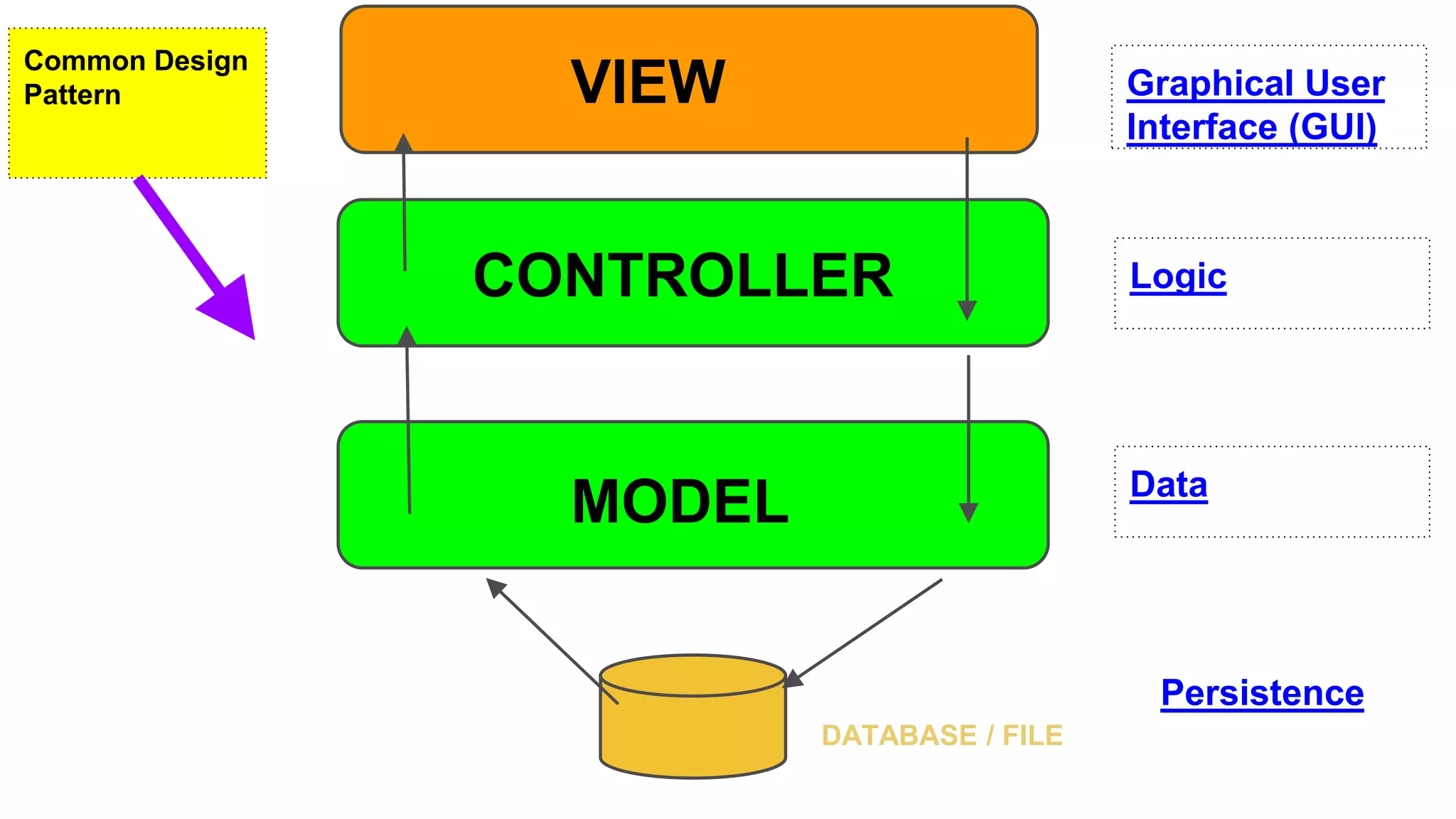
Logic
Data
Persistence
VIEW
CONTROLLER
MODEL
DATABASE / FILE
Graphical User
Interface (GUI)
Persistence
Common Design
Pattern
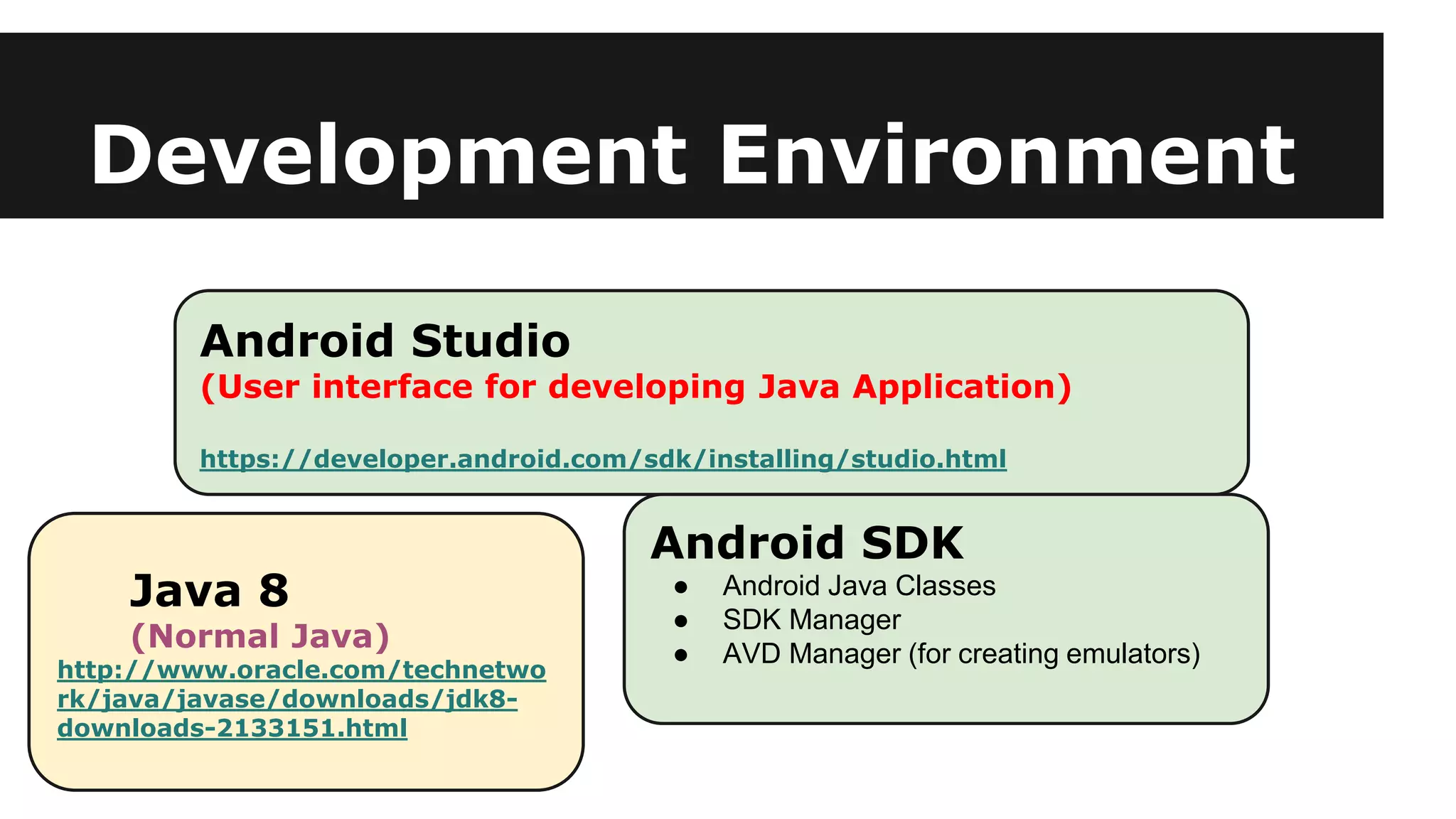
Development Environment
Android Studio
(User interface for developing Java Application)
https://developer.android.com/sdk/installing/studio.html
Java 8
(Normal Java)
http://www.oracle.com/technetwo
rk/java/javase/downloads/jdk8-
downloads-2133151.html
Android SDK
● Android Java Classes
● SDK Manager
● AVD Manager (for creating emulators)
Using Android Studio
● We could use Eclipse but it’s no longer in active
development.
● Android Studio is what Google are moving towards.
Currently at release candidaate level.
● When we create an App project in Android Studio or
Eclipse we see alot of stuff that “just gets created”.
So what are the basic key parts ?
...
Java Code
Manifest File
Resources (e.g.
Images)
Activites
● The basic building block of an app is an Activity.
● An Activity Java class that we write will ultimately
extend from android.app.Activity
● You can think of an Activity as a self-contained
“screen” of your app.
● Each Activity also has a corresponding layout file
(written in XML) - More later.
Resources
The very basic types of
resources you would
have would be :
● Images (different resolutions)
● Layout files for each Activity
(these are XML files)
● Strings, Styles and
Dimensions of components.
Activity Layouts
● Each Activity Java class has a corresponding layout
file (written in XML).
● Exists in the layout directory of resources.
● Can use the designer to generate this XML for us.
● Can also do it similar to how we did it in Swing, but
less popular in general (ViewGroups)
The Manifest File
● Every Android app must have an
AndroidManifest.xml file which is the “glue”
that brings everything together to form an app.
● It names the package for the Android
application
package="com.example.simon.myfirstapp"
● Also says which code files (including Java) are
behind each screen (Activity) in the app.
Start of the Manifest File
<application
android:allowBackup="true"
android:icon="@drawable/ic_launcher"
android:label="@string/app_name"
android:theme="@style/AppTheme" >
These are the icon, label and theme
of your app and are picked up from
the Resources (res directory)
@style automatically links to
res/values/styles.xml
@string automatically links to
res/values/strings.xml
@drawable
automatically links to
the relevant
res/drawable
directory
android:label
android:icon
The font, colour, style, spacing
(i.e. “The look”) of the app is
controlled by
android:style
(in this case AppTheme in style.xml)
This is where your Activity runs.
Here we see MainActivity.java
Activities in Manifest File
● Activities must also be defined in the manifest
file.
<activity
android:name=".MyActivity"
android:label="@string/app_name" >
<intent-filter>
<action android:name="android.intent.action.MAIN" />
<category android:name="android.intent.category.LAUNCHER" />
</intent-filter>
</activity>
Reference to the
Java file where the
Activity is
implemented.
What is <intent-filter> ?
● As previously mentioned each Activity is
capable of being launched as a “self-contained”
unit.
● An <intent-filter> defines where an Activity
can be launched from. (i.e. Where you “intend” it to
be launched from)
<intent-filter>
<action android:name="android.intent.action.MAIN" />
<category android:name="android.intent.category.LAUNCHER" />
</intent-filter>
<intent-filter>
The <action> element specifies that this is the "main" entry
point to the application. (Like main in regular Java)
The <category> element specifies that this activity should be
listed in the system's application launcher (to allow users to
launch this activity).
<intent-filter>
<action android:name="android.intent.action.MAIN" />
<category android:name="android.intent.category.LAUNCHER" />
</intent-filter>
A First Basic App
Key Parts of an Android App are :
Activity (Java) / Activity Layout (XML)
Manifest
Resource Directories
Next Week :
Activity Lifecycle & GUI Event Handling

Introduction & App Structure

  • 1.
    Android App Development Lesson1 - Introduction & App Structure
  • 2.
    Prerequisities These concepts shouldall be (VERY?!) familiar : - Arrays of basic objects and types - Use and characteristics of ArrayList - Polymorphism. - Overriding of methods (e.g. toString()) - Wrapper Classes - Integer, String, Double etc.
  • 3.
    Android - Why? ● Android (from Google) will be our platform of choice. ● Approaching 1 BILLION Android enabled devices currently in the world (September 2014) ● Currently has 51% of the world’s smartphone market share ● The types of devices (cars, fridges etc etc) are growing all the time.
  • 4.
    Android - History ●Originally started in 2005 and bought by Google in 2007. ● Google then started the OHA (Open Handset Alliance) with the idea of standardizing mobile software platform across vendors (Samsung, HTC, Motorola etc etc) ● Currently on version 4.4 (nickname ‘Kit Kat’), previous 4.1, 4.2 & 4.3 were nicknamed ‘Jelly Bean’ ● Alphabetically ordered sweet treats!
  • 5.
    The Basics ● We’llbe using Android as our platform of choice. ● Android apps are written in Java. So we need basic Java installed :)! For this course we’ll use Java 8 (latest) ● We also need Android SDK (extra on top of Java) ● We’ll be using Android Studio as our development tool of choice. Can also use Eclipse ADT (can be moved to Android Studio later)
  • 6.
    Logic Data Persistence VIEW CONTROLLER MODEL DATABASE / FILE GraphicalUser Interface (GUI) Persistence Common Design Pattern
  • 7.
    Development Environment Android Studio (Userinterface for developing Java Application) https://developer.android.com/sdk/installing/studio.html Java 8 (Normal Java) http://www.oracle.com/technetwo rk/java/javase/downloads/jdk8- downloads-2133151.html Android SDK ● Android Java Classes ● SDK Manager ● AVD Manager (for creating emulators)
  • 8.
    Using Android Studio ●We could use Eclipse but it’s no longer in active development. ● Android Studio is what Google are moving towards. Currently at release candidaate level. ● When we create an App project in Android Studio or Eclipse we see alot of stuff that “just gets created”. So what are the basic key parts ?
  • 9.
  • 10.
    Activites ● The basicbuilding block of an app is an Activity. ● An Activity Java class that we write will ultimately extend from android.app.Activity ● You can think of an Activity as a self-contained “screen” of your app. ● Each Activity also has a corresponding layout file (written in XML) - More later.
  • 11.
    Resources The very basictypes of resources you would have would be : ● Images (different resolutions) ● Layout files for each Activity (these are XML files) ● Strings, Styles and Dimensions of components.
  • 12.
    Activity Layouts ● EachActivity Java class has a corresponding layout file (written in XML). ● Exists in the layout directory of resources. ● Can use the designer to generate this XML for us. ● Can also do it similar to how we did it in Swing, but less popular in general (ViewGroups)
  • 13.
    The Manifest File ●Every Android app must have an AndroidManifest.xml file which is the “glue” that brings everything together to form an app. ● It names the package for the Android application package="com.example.simon.myfirstapp" ● Also says which code files (including Java) are behind each screen (Activity) in the app.
  • 14.
    Start of theManifest File <application android:allowBackup="true" android:icon="@drawable/ic_launcher" android:label="@string/app_name" android:theme="@style/AppTheme" > These are the icon, label and theme of your app and are picked up from the Resources (res directory) @style automatically links to res/values/styles.xml @string automatically links to res/values/strings.xml @drawable automatically links to the relevant res/drawable directory
  • 15.
    android:label android:icon The font, colour,style, spacing (i.e. “The look”) of the app is controlled by android:style (in this case AppTheme in style.xml) This is where your Activity runs. Here we see MainActivity.java
  • 16.
    Activities in ManifestFile ● Activities must also be defined in the manifest file. <activity android:name=".MyActivity" android:label="@string/app_name" > <intent-filter> <action android:name="android.intent.action.MAIN" /> <category android:name="android.intent.category.LAUNCHER" /> </intent-filter> </activity> Reference to the Java file where the Activity is implemented.
  • 17.
    What is <intent-filter>? ● As previously mentioned each Activity is capable of being launched as a “self-contained” unit. ● An <intent-filter> defines where an Activity can be launched from. (i.e. Where you “intend” it to be launched from) <intent-filter> <action android:name="android.intent.action.MAIN" /> <category android:name="android.intent.category.LAUNCHER" /> </intent-filter>
  • 18.
    <intent-filter> The <action> elementspecifies that this is the "main" entry point to the application. (Like main in regular Java) The <category> element specifies that this activity should be listed in the system's application launcher (to allow users to launch this activity). <intent-filter> <action android:name="android.intent.action.MAIN" /> <category android:name="android.intent.category.LAUNCHER" /> </intent-filter>
  • 19.
    A First BasicApp Key Parts of an Android App are : Activity (Java) / Activity Layout (XML) Manifest Resource Directories Next Week : Activity Lifecycle & GUI Event Handling