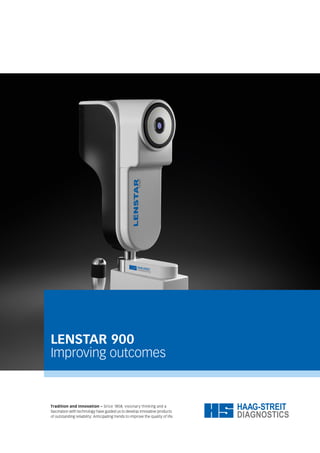
LENSTAR 900
Improving outcomes
Tradition and Innovation – Since 1858, visionary thinking and a
fascination with technology have guided us to develop innovative products
of outstanding reliability: Anticipating trends to improve the quality of life.
02 | 03 LENSTAR 900
Lenstar 900
Outstanding optic
measurement results
While the introduction of optical biometry revolutionized cataract surgery
in the late 1990s, Haag-Streit is writing the latest chapter in biometry
history with its Lenstar 900.
The Lenstar 900 provides highly accurate laser optic measurements for ev-
ery section of the eye − from the cornea to the retina − and is the first optical
biometer on the market that can measure the thickness of the crystalline
lens. With its integrated Hill-RBF, Olsen and Barrett formulas and the op-
tional IOL Toric Planner considering the posterior cornea, the Lenstar 900
provides the user with latest technology in IOL prediction for any patient.
Dual zone keratometry, with 32 measurement locations or topography
measurement with the optional T-Cone, provides reliable and precise mea-
surements for the K values, axis, and astigmatism that are essential to the
sophisticated planning of toric lenses2,3
. The Lenstar 900 offers the
optimal planning platform for superior refractive outcomes in cataract
surgery, both now and in the future.
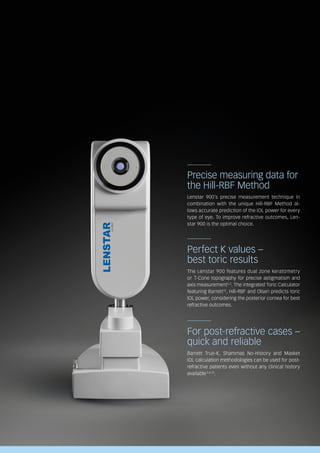
Precise measuring data for
the Hill-RBF Method
Lenstar 900’s precise measurement technique in
combination with the unique Hill-RBF Method al-
lows accurate prediction of the IOL power for every
type of eye. To improve refractive outcomes, Len-
star 900 is the optimal choice.
Perfect K values –
best toric results
The Lenstar 900 features dual zone keratometry
or T-Cone topography for precise astigmatism and
axis measurement2,3
. The integrated Toric Calculator
featuring Barrett12
, Hill-RBF and Olsen predicts toric
IOL power, considering the posterior cornea for best
refractive outcomes.
For post-refractive cases –
quick and reliable
Barrett True-K, Shammas No-History and Masket
IOL calculation methodologies can be used for post-
refractive patients even without any clinical history
available 5,6,13
.
04 | 05 EXPERT OPINION
Lenstar 900
an excellent choice for toric
and premium channel IOLs
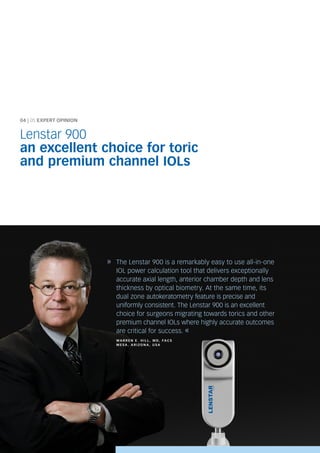
»	 The Lenstar 900 is a remarkably easy to use all-in-one 	
	 IOL power calculation tool that delivers exceptionally
	 accurate axial length, anterior chamber depth and lens
	 thickness by optical biometry. At the same time, its
	 dual zone autokeratometry feature is precise and
	 uniformly consistent. The Lenstar 900 is an excellent
	 choice for surgeons migrating towards torics and other
	 premium channel IOLs where highly accurate outcomes
	 are critical for success. «	
	 WA R R E N E . H I L L , M D , FA C S
	 M E S A , A R I Z O N A , U S A
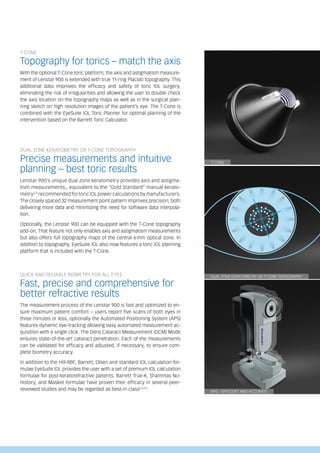
T-CONE
T-CONE
Topography for torics – match the axis
With the optional T-Cone toric platform, the axis and astigmatism measure-
ment of Lenstar 900 is extended with true 11-ring Placido topography. This
additional data improves the efficacy and safety of toric IOL surgery,
eliminating the risk of irregularities and allowing the user to double check
the axis location on the topography maps as well as in the surgical plan-
ning sketch on high resolution images of the patient’s eye. The T-Cone is
combined with the EyeSuite IOL Toric Planner for optimal planning of the
intervention based on the Barrett Toric Calculator.
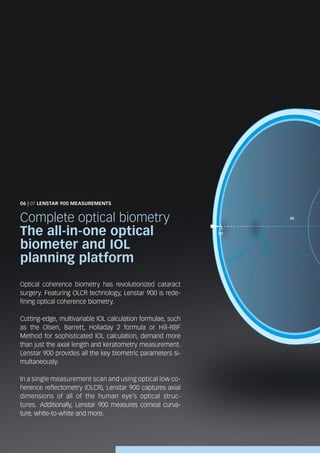
DUAL ZONE KERATOMETRY OR T-CONE TOPOGRAPHY
Precise measurements and intuitive
planning – best toric results
Lenstar 900’s unique dual zone keratometry provides axis and astigma-
tism measurements,, equivalent to the "Gold Standard" manual kerato-
metry2,3
recommended for toric IOL power calculations by manufacturers.
The closely spaced 32 measurement point pattern improves precision, both
delivering more data and minimizing the need for software data interpola-
tion.
Optionally, the Lenstar 900 can be equipped with the T-Cone topography
add-on. That feature not only enables axis and astigmatism measurements
but also offers full topography maps of the central 6 
mm optical zone. In
addition to topography, EyeSuite IOL also now features a toric IOL planning
platform that is included with the T-Cone.
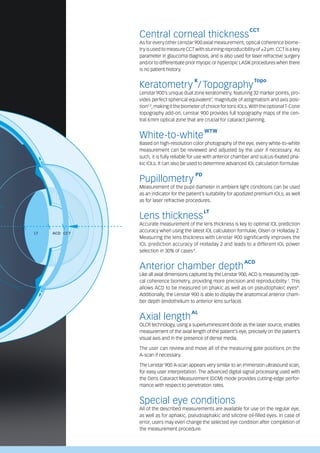
QUICK AND RELIABLE BIOMETRY FOR ALL EYES
Fast, precise and comprehensive for
better refractive results
The measurement process of the Lenstar 900 is fast and optimized to en-
sure maximum patient comfort – users report five scans of both eyes in
three minutes or less, optionally the Automated Positioning System (APS)
features dynamic eye-tracking allowing easy automated measurement ac-
quisition with a single click. The Dens Cataract Measurement (DCM) Mode
ensures state-of-the-art cataract penetration. Each of the measurements
can be validated for efficacy and adjusted, if necessary, to ensure com-
plete biometry accuracy.
In addition to the Hill-RBF, Barrett, Olsen and standard IOL calculation for-
mulae EyeSuite IOL provides the user with a set of premium IOL calculation
formulae for post-keratorefractive patients. Barrett True-K, Shammas No-
History, and Masket formulae have proven their efficacy in several peer-
reviewed studies and may be regarded as best-in-class5,6,13
. APS – EFFICIENT AND ACCURATE
DUAL ZONE KERATOMETRY OR T-CONE TOPOGRAPHY
06 | 07 LENSTAR 900 MEASUREMENTS
Complete optical biometry
The all-in-one optical
biometer and IOL
planning platform
Optical coherence biometry has revolutionized cataract
surgery. Featuring OLCR technology, Lenstar 900 is rede-
fining optical coherence biometry.
Cutting-edge, multivariable IOL calculation formulae, such
as the Olsen, Barrett, Holladay 2 formula or Hill-RBF
Method for sophisticated IOL calculation, demand more
than just the axial length and keratometry measurement.
Lenstar 900 provides all the key biometric parameters si-
multaneously.
In a single measurement scan and using optical low co-
herence reflectometry (OLCR), Lenstar 900 captures axial
dimensions of all of the human eye’s optical struc-
tures. Additionally, Lenstar 900 measures corneal curva-
ture, white-to-white and more.
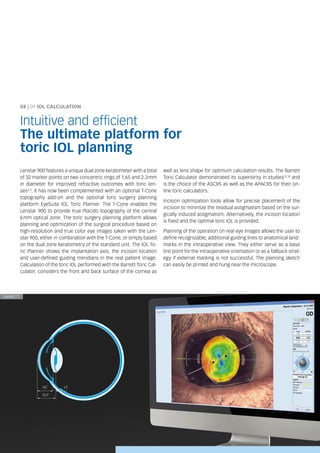
Central corneal thickness
CCT
As for every other Lenstar 900 axial measurement, optical coherence biome-
try is used to measure CCT with stunning reproducibility of ±2 μm. CCT is a key
parameter in glaucoma diagnosis, and is also used for laser refractive surgery
and/or to differentiate prior myopic or hyperopic LASIK procedures when there
is no patient history.
Keratometry
K
/ Topography
Topo
Lenstar 900’s unique dual zone keratometry, featuring 32 marker points, pro-
vides perfect spherical equivalent7
, magnitude of astigmatism and axis posi-
tion2,3
, making it the biometer of choice for toric IOLs. With the optional T-Cone
topography add-on, Lenstar 900 provides full topography maps of the cen-
tral 6 mm optical zone that are crucial for cataract planning.
White-to-white
WTW
Based on high-resolution color photography of the eye, every white-to-white
measurement can be reviewed and adjusted by the user if necessary. As
such, it is fully reliable for use with anterior chamber and sulcus-fixated pha-
kic IOLs. It can also be used to determine advanced IOL calculation formulae.
Pupillometry
PD
Measurement of the pupil diameter in ambient light conditions can be used
as an indicator for the patient’s suitability for apodized premium IOLs, as well
as for laser refractive procedures.
Lens thickness
LT
Accurate measurement of the lens thickness is key to optimal IOL prediction
accuracy when using the latest IOL calculation formulae, Olsen or Holladay 2.
Measuring the lens thickness with Lenstar 900 significantly improves the
IOL prediction accuracy of Holladay 2 and leads to a different IOL power
selection in 30% of cases4
.
Anterior chamber depth
ACD
Like all axial dimensions captured by the Lenstar 900, ACD is measured by opti-
cal coherence biometry, providing more precision and reproducibility 7
. This
allows ACD to be measured on phakic as well as on pseudophakic eyes8
.
Additionally, the Lenstar 900 is able to display the anatomical anterior cham-
ber depth (endothelium to anterior lens surface).
Axial length
AL
OLCR technology, using a superluminescent diode as the laser source, enables
measurement of the axial length of the patient’s eye, precisely on the patient’s
visual axis and in the presence of dense media.
The user can review and move all of the measuring gate positions on the
A-scan if necessary.
The Lenstar 900 A-scan appears very similar to an immersion ultrasound scan,
for easy user interpretation. The advanced digital signal processing used with
the Dens Cataract Measurement (DCM) mode provides cutting-edge perfor-
mance with respect to penetration rates.
Special eye conditions
All of the described measurements are available for use on the regular eye,
as well as for aphakic, pseudoaphakic and silicone oil-filled eyes. In case of
error, users may even change the selected eye condition after completion of
the measurement procedure.
08 | 09 IOL CALCULATION
Intuitive and efficient
The ultimate platform for
toric IOL planning
Lenstar 900 features a unique dual zone keratometer with a total
of 32 marker points on two concentric rings of 1.65 and 2.3 mm
in diameter for improved refractive outcomes with toric len-
ses2,3
. It has now been complemented with an optional T-Cone
topography add-on and the optional toric surgery planning
platform EyeSuite IOL Toric Planner. The T-Cone enables the
Lenstar 900 to provide true Placido topography of the central
6 
mm optical zone. The toric surgery planning platform allows
planning and optimization of the surgical procedure based on
high-resolution and true color eye images taken with the Len-
star 900, either in combination with the T-Cone, or simply based
on the dual zone keratometry of the standard unit. The IOL To-
ric Planner shows the implantation axis, the incision location
and user-defined guiding meridians in the real patient image.
Calculation of the toric IOL performed with the Barrett Toric Cal-
culator, considers the front and back surface of the cornea as
well as lens shape for optimum calculation results. The Barrett
Toric Calculator demonstrated its superiority in studies12,14
and
is the choice of the ASCRS as well as the APACRS for their on-
line toric calculators.
Incision optimization tools allow for precise placement of the
incision to minimize the residual astigmatism based on the sur-
gically induced astigmatism. Alternatively, the incision location
is fixed and the optimal toric IOL is provided.
Planning of the operation on real eye images allows the user to
define recognizable, additional guiding lines to anatomical land-
marks in the intraoperative view. They either serve as a base
line point for the intraoperative orientation or as a fallback strat-
egy if external marking is not successful. The planning sketch
can easily be printed and hung near the microscope.
AC LF
ELP
BARRETT
OLSEN
HILL-RBF METHOD
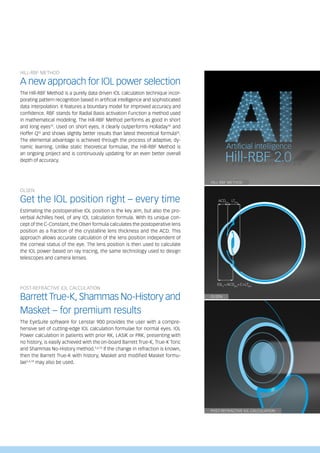
A new approach for IOL power selection
The Hill-RBF Method is a purely data driven IOL calculation technique incor-
porating pattern recognition based in artificial intelligence and sophisticated
data interpolation. It features a boundary model for improved accuracy and
confidence. RBF stands for Radial Basis activation Function a method used
in mathematical modeling. The Hill-RBF Method performs as good in short
and long eyes15
. Used on short eyes, it clearly outperforms Holladay16
and
Hoffer Q16
and shows slightly better results than latest theoretical formula16
.
The elemental advantage is achieved through the process of adaptive, dy-
namic learning. Unlike static theoretical formulae, the Hill-RBF Method is
an ongoing project and is continuously updating for an even better overall
depth of accuracy.
OLSEN
Get the IOL position right – every time
Estimating the postoperative IOL position is the key aim, but also the pro-
verbial Achilles heel, of any IOL calculation formula. With its unique con-
cept of the C-Constant, the Olsen formula calculates the postoperative lens
position as a fraction of the crystalline lens thickness and the ACD. This
approach allows accurate calculation of the lens position independent of
the corneal status of the eye. The lens position is then used to calculate
the IOL power based on ray tracing, the same technology used to design
telescopes and camera lenses.
POST-REFRACTIVE IOL CALCULATION
Barrett True-K, Shammas No-History and
Masket – for premium results
The EyeSuite software for Lenstar 900 provides the user with a compre-
hensive set of cutting-edge IOL calculation formulae for normal eyes. IOL
Power calculation in patients with prior RK, LASIK or PRK, presenting with
no history, is easily achieved with the on-board Barrett True-K, True-K Toric
and Shammas No-History method.5,6,13
If the change in refraction is known,
then the Barrett True-K with history, Masket and modified Masket formu-
lae5,6,13
may also be used.
IOLC
=ACDpre
+C×LTpre
ACDPre
LTPre
POST-REFRACTIVE IOL CALCULATION
HILL-RBF METHOD
The EyeSuite software is designed for optimal patient flow in busy
practices. Paired with Lenstar 900’s one scan – get all measure-
ments technology and the Automated Positioning System (APS)
biometry acquisition is fast.
Sophisticated capture and analysis algorithms − as well as the
possibility to review raw data of every parameter in detail to
ensure correct measurement − result in full transparency and
confidence that the biometry is accurate and precise.
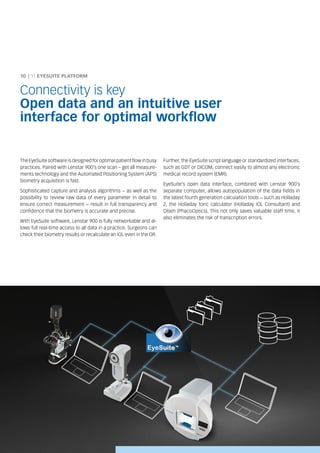
With EyeSuite software, Lenstar 900 is fully networkable and al-
lows full real-time access to all data in a practice. Surgeons can
check their biometry results or recalculate an IOL even in the OR.
10	| 11 EYESUITE PLATFORM
Connectivity is key
Open data and an intuitive user
interface for optimal workflow
Further, the EyeSuite script language or standardized interfaces,
such as GDT or DICOM, connect easily to almost any electronic
medical record system (EMR).
EyeSuite’s open data interface, combined with Lenstar 900’s
separate computer, allows autopopulation of the data fields in
the latest fourth generation calculation tools − such as Holladay
2, the Holladay toric calculator (Holladay IOL Consultant) and
Olsen (PhacoOptics). This not only saves valuable staff time, it
also eliminates the risk of transcription errors.
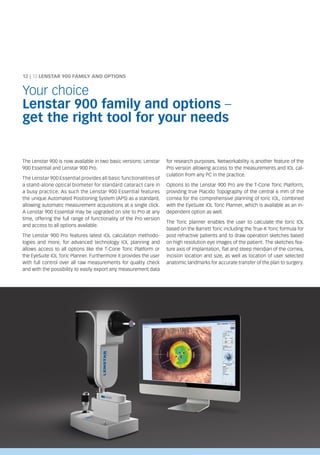
The Lenstar 900 is now available in two basic versions: Lenstar
900 Essential and Lenstar 900 Pro.
The Lenstar 900 Essential provides all basic functionalities of
a stand-alone optical biometer for standard cataract care in
a busy practice. As such the Lenstar 900 Essential features
the unique Automated Positioning System (APS) as a standard,
allowing automatic measurement acquisitions at a single click.
A Lenstar 900 Essential may be upgraded on site to Pro at any
time, offering the full range of functionality of the Pro version
and access to all options available.
The Lenstar 900 Pro features latest IOL calculation methodo-
logies and more, for advanced technology IOL planning and
allows access to all options like the T-Cone Toric Platform or
the EyeSuite IOL Toric Planner. Furthermore it provides the user
with full control over all raw measurements for quality check
and with the possibility to easily export any measurement data
for research purposes. Networkability is another feature of the
Pro version allowing access to the measurements and IOL cal-
culation from any PC in the practice.
Options to the Lenstar 900 Pro are the T-Cone Toric Platform,
providing true Placido Topography of the central 6 mm of the
cornea for the comprehensive planning of toric IOL, combined
with the EyeSuite IOL Toric Planner, which is available as an in-
dependent option as well.
The Toric planner enables the user to calculate the toric IOL
based on the Barrett Toric including the True-K Toric formula for
post refractive patients and to draw operation sketches based
on high resolution eye images of the patient. The sketches fea-
ture axis of implantation, flat and steep meridian of the cornea,
incision location and size, as well as location of user selected
anatomic landmarks for accurate transfer of the plan to surgery.
12 | 13 LENSTAR 900 FAMILY AND OPTIONS
Your choice
Lenstar 900 family and options –
get the right tool for your needs
Lenstar 900
Essential
Lenstar 900
Pro
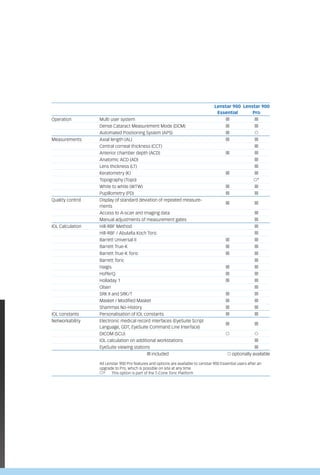
Operation Multi user system
Dense Cataract Measurement Mode (DCM)
Automated Positioning System (APS)
Measurements Axial length (AL)
Central corneal thickness (CCT)
Anterior chamber depth (ACD)
Anatomic ACD (AD)
Lens thickness (LT)
Keratometry (K)
Topography (Topo) *
White to white (WTW)
Pupillometry (PD)
Quality control Display of standard deviation of repeated measure-
ments
Access to A-scan and imaging data
Manual adjustments of measurement gates
IOL Calculation Hill-RBF Method
Hill-RBF / Abulafia Koch Toric
Barrett Universal II
Barrett True-K
Barrett True-K Toric
Barrett Toric
Haigis
HofferQ
Holladay 1
Olsen
SRK II and SRK/T
Masket / Modified Masket
Shammas No-History
IOL constants Personalisation of IOL constants
Networkability Electronic medical record interfaces (EyeSuite Script
Language, GDT, EyeSuite Command Line Interface)
DICOM (SCU)
IOL calculation on additional workstations
EyeSuite viewing stations
		 included 	 optionally available
All Lenstar 900 Pro features and options are available to Lenstar 900 Essential users after an
upgrade to Pro, which is possible on site at any time
*	 This option is part of the T-Cone Toric Platform
‚ Axial length
	
‚ Corneal thickness
	
‚ Anterior chamber depth
	
‚ Aqueous depth
	
‚ Lens thickness
	
‚ Corneal curvature
	
‚ Radii for flat and steep meridian
	
‚ Axis of the flat meridian
	
‚ White-to-white distance
	
‚ Pupil diameter
1 Olsen T. Improving IOL power Calculation by measurement of the lens thickness with the Lenstar LS 900 presented at the ESCRS in Paris 2010. 2 Hill W, Osher R, Cooke
D, Solomon K, Sandoval H, Salas-Cervantes R, Potvin R. Simulation of toric intraocular lens results: manual keratometry versus dual zone automated keratometry from
an integrated biometer. J Cataract Refract Surg. 2011 Dec; 37(12): 2181-7. 3 Gundersen KG, Potvin R. Prospective study of toric IOL outcomes based on the Lenstar LS
900 dual zone automated keratometer. BMC Ophthalmol. 2012 Jul 16; 12:21. 4 Lam S. Comparison of Age-derived Lens Thickness to Optically Measured Lens Thickness
in IOL power Calculation: A Clinical Study. J Refract Surg. 2012 Feb; 28(2): 154-5. 5 Wang L, Hill WE, Koch DD. Evaluation of intraocular lens power prediction methods
using the American Society of Cataract and Refractive Surgeons Post-keratorefractive Intraocular Lens power Calculator. J Cataract Refract Surg. 2010 Sep; 36(9): 1466-
73. 6 McCarthy M, Gavanski GM, Paton KE, Holland SP. Intraocular lens power calculations after myopic laser refractive surgery: a comparison of methods in 173 eyes.
Ophthalmology. 2011 May; 118(5): 940-4. 7 Buckhurst PJ, Wolffsohn JS, Shah S, Naroo SA, Davies LN, Berrow EJ. A new optical low coherence reflectometry device for
ocular biometry in cataract patients. Br J Ophthalmol. 2009 Jul; 93(7): 949-53. 8 Olsen T. Use of fellow eye data in the calculation of intraocular lens power for the second
eye. Ophthalmology. 2011 Sep; 118(9): 1710-5. 9 http://www.hicsoap.com/ accessed March 16, 2015. 10 http://www.phacooptics.com/ accessed March 16, 2015. 11
http://okulix.de/ accessed March 16, 2015. 12 Barret G. Flight of the arrow: improwing outcomes with toric intraocular lenses, XXXII Congress of the ESCRS 2014 London,
Video Prize Winner, Category Innovation, available on escres on demand, http://escrs.conference2web.com/content/23476/ accessed March 16, 2015. 13 Wang L, Tang
M, Huang D, Weikert MP, Koch DD. Comparison of Newer Intraocular Lens Power Calculation Methods for Eyes after Corneal Refractive Surgery. Ophthalmology. 2015
Dec;122(12):2443-9. 14 Abulafia A, Barrett GD, Kleinmann G, Ofir S, Levy A, Marcovich AL, Michaeli A, Koch DD, Wang L, Assia EI. Prediction of refractive outcomes with
toric intraocular lens implantation. J Cataract Refract Surg. 2015 May;41(5):936-44. 15 W.E. Hill; IOL Power Selection by Pattern Recognition; ASCRS EyeWorld Corporate
Education; ASCRS 2016. 16 M.E. Snyder; The Hill-RBF Method in Clinical Practice; ASCRS EyeWorld Corporate Education; ASCRS 2016
Technical specifications
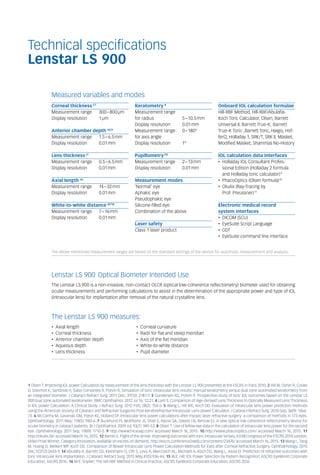
Lenstar LS 900
Measured variables and modes
Lenstar LS 900 Optical Biometer Intended Use
The Lenstar LS 900 is a non-invasive, non-contact OLCR (optical low-coherence reflectometry) biometer used for obtaining
ocular measurements and performing calculations to assist in the determination of the appropriate power and type of IOL
(intraocular lens) for implantation after removal of the natural crystalline lens.
Corneal thickness CT
Measurement range	 300 – 800 μm
Display resolution 	 1 μm
Anterior chamber depth ACD
Measurement range 	 1.5 – 6.5 mm
Display resolution 	 0.01 mm
Lens thickness LT
Measurement range 	 0.5 – 6.5 mm
Display resolution 	 0.01 mm
Axial length AL
Measurement range	 14 – 32 mm
Display resolution	 0.01 mm
White-to-white distance WTW
Measurement range 	 7 – 16 mm
Display resolution 	 0.01 mm
Keratometry K
Measurement range 	
for radius	 5 – 10.5 mm
Display resolution 	 0.01 mm
Measurement range 	 0 – 180°
for axis angle
Display resolution 	 1°
Pupillometry PD
Measurement range 	 2 – 13 mm
Display resolution 	 0.01 mm
Measurement modes
‘Normal’ eye
Aphakic eye
Pseudophakic eye
Silicone-filled eye
Combination of the above
Laser safety
Class 1 laser product
Onboard IOL calculation formulae
Hill-RBF Method, Hill-RBF/Abulafia-
Koch Toric Calculator, Olsen, Barrett
Universal II, Barrett True-K, Barrett
True-K Toric ,Barrett Toric, Haigis, Hof-
ferQ, Holladay 1, SRK/T, SRK II, Masket,
Modified Masket, Shammas No-History
IOL calculation data interfaces
	
‚ Holladay IOL Consultant Profes-
sional Edition (Holladay 2 formula
and Holladay toric calculator)9
	
‚ PhacoOptics (Olsen formula)10
	
‚ Okulix (Ray-Tracing by
Prof. Preussner)11
Electronic medical record
system interfaces
	
‚ DICOM (SCU)	
	
‚ EyeSuite Script Language
	
‚ GDT	
	
‚ EyeSuite command line interface
The above-mentioned measurement ranges are based on the standard settings of the device for automatic measurement and analysis.
The Lenstar LS 900 measures:
©HAAG-STREIT AG, 3098 Koeniz, Switzerland
12. Edition / 2020 – 02
HS-Art.No. 1511.7220032.02120
0297
HAAG-STREIT Holding AG
www.haag-streit-holding.com
HAAG-STREIT AG, Diagnostics
www.haag-streit.com
HAAG-STREIT AG, Verkauf Schweiz
www.haag-streit.ch
HAAG-STREIT Deutschland GmbH
www.haag-streit.de
HAAG-STREIT Far East
www.haag-streit-fareast.com
HAAG-STREIT Medtech AG
www.haag-streit-medtech.com
HAAG-STREIT Surgical GmbH
www.haag-streit-surgical.com
HAAG-STREIT UK
www.haag-streit-uk.com
HAAG-STREIT USA
www.haag-streit-usa.com
CLEMENT CLARKE Ltd.
www.clement-clarke.com
HS DOMS GmbH
www.hs-doms.com
IPRO GmbH
www.ipro.de
John Weiss Ltd.
www.johnweiss.com
Möller-Wedel GmbH & Co KG
www.haag-streit-surgical.com
Möller-Wedel Optical GmbH
www.moeller-wedel-optical.com
OptoMedical Technologies GmbH
www.haag-streit-surgical.com
Reliance Medical Inc.
www.haag-streit-usa.com
SPECTROS AG
www.spectros.ch
Members of HAAG-STREIT Group
HAAG-STREIT AG
Gartenstadtstrasse 10
3098 Koeniz
Switzerland
Phone +41 31 978 01 11
Fax +41 31 978 02 82
info@haag-streit.com
www.haag-streit.com

Lenstar 900 'Improving Outcomes' Brochure

  • 1.
    LENSTAR 900 Improving outcomes Traditionand Innovation – Since 1858, visionary thinking and a fascination with technology have guided us to develop innovative products of outstanding reliability: Anticipating trends to improve the quality of life.
  • 2.
    02 | 03LENSTAR 900 Lenstar 900 Outstanding optic measurement results While the introduction of optical biometry revolutionized cataract surgery in the late 1990s, Haag-Streit is writing the latest chapter in biometry history with its Lenstar 900. The Lenstar 900 provides highly accurate laser optic measurements for ev- ery section of the eye − from the cornea to the retina − and is the first optical biometer on the market that can measure the thickness of the crystalline lens. With its integrated Hill-RBF, Olsen and Barrett formulas and the op- tional IOL Toric Planner considering the posterior cornea, the Lenstar 900 provides the user with latest technology in IOL prediction for any patient. Dual zone keratometry, with 32 measurement locations or topography measurement with the optional T-Cone, provides reliable and precise mea- surements for the K values, axis, and astigmatism that are essential to the sophisticated planning of toric lenses2,3 . The Lenstar 900 offers the optimal planning platform for superior refractive outcomes in cataract surgery, both now and in the future.
  • 3.
    Precise measuring datafor the Hill-RBF Method Lenstar 900’s precise measurement technique in combination with the unique Hill-RBF Method al- lows accurate prediction of the IOL power for every type of eye. To improve refractive outcomes, Len- star 900 is the optimal choice. Perfect K values – best toric results The Lenstar 900 features dual zone keratometry or T-Cone topography for precise astigmatism and axis measurement2,3 . The integrated Toric Calculator featuring Barrett12 , Hill-RBF and Olsen predicts toric IOL power, considering the posterior cornea for best refractive outcomes. For post-refractive cases – quick and reliable Barrett True-K, Shammas No-History and Masket IOL calculation methodologies can be used for post- refractive patients even without any clinical history available 5,6,13 .
  • 4.
    04 | 05EXPERT OPINION Lenstar 900 an excellent choice for toric and premium channel IOLs » The Lenstar 900 is a remarkably easy to use all-in-one IOL power calculation tool that delivers exceptionally accurate axial length, anterior chamber depth and lens thickness by optical biometry. At the same time, its dual zone autokeratometry feature is precise and uniformly consistent. The Lenstar 900 is an excellent choice for surgeons migrating towards torics and other premium channel IOLs where highly accurate outcomes are critical for success. « WA R R E N E . H I L L , M D , FA C S M E S A , A R I Z O N A , U S A
  • 5.
    T-CONE T-CONE Topography for torics– match the axis With the optional T-Cone toric platform, the axis and astigmatism measure- ment of Lenstar 900 is extended with true 11-ring Placido topography. This additional data improves the efficacy and safety of toric IOL surgery, eliminating the risk of irregularities and allowing the user to double check the axis location on the topography maps as well as in the surgical plan- ning sketch on high resolution images of the patient’s eye. The T-Cone is combined with the EyeSuite IOL Toric Planner for optimal planning of the intervention based on the Barrett Toric Calculator. DUAL ZONE KERATOMETRY OR T-CONE TOPOGRAPHY Precise measurements and intuitive planning – best toric results Lenstar 900’s unique dual zone keratometry provides axis and astigma- tism measurements,, equivalent to the "Gold Standard" manual kerato- metry2,3 recommended for toric IOL power calculations by manufacturers. The closely spaced 32 measurement point pattern improves precision, both delivering more data and minimizing the need for software data interpola- tion. Optionally, the Lenstar 900 can be equipped with the T-Cone topography add-on. That feature not only enables axis and astigmatism measurements but also offers full topography maps of the central 6  mm optical zone. In addition to topography, EyeSuite IOL also now features a toric IOL planning platform that is included with the T-Cone. QUICK AND RELIABLE BIOMETRY FOR ALL EYES Fast, precise and comprehensive for better refractive results The measurement process of the Lenstar 900 is fast and optimized to en- sure maximum patient comfort – users report five scans of both eyes in three minutes or less, optionally the Automated Positioning System (APS) features dynamic eye-tracking allowing easy automated measurement ac- quisition with a single click. The Dens Cataract Measurement (DCM) Mode ensures state-of-the-art cataract penetration. Each of the measurements can be validated for efficacy and adjusted, if necessary, to ensure com- plete biometry accuracy. In addition to the Hill-RBF, Barrett, Olsen and standard IOL calculation for- mulae EyeSuite IOL provides the user with a set of premium IOL calculation formulae for post-keratorefractive patients. Barrett True-K, Shammas No- History, and Masket formulae have proven their efficacy in several peer- reviewed studies and may be regarded as best-in-class5,6,13 . APS – EFFICIENT AND ACCURATE DUAL ZONE KERATOMETRY OR T-CONE TOPOGRAPHY
  • 6.
    06 | 07LENSTAR 900 MEASUREMENTS Complete optical biometry The all-in-one optical biometer and IOL planning platform Optical coherence biometry has revolutionized cataract surgery. Featuring OLCR technology, Lenstar 900 is rede- fining optical coherence biometry. Cutting-edge, multivariable IOL calculation formulae, such as the Olsen, Barrett, Holladay 2 formula or Hill-RBF Method for sophisticated IOL calculation, demand more than just the axial length and keratometry measurement. Lenstar 900 provides all the key biometric parameters si- multaneously. In a single measurement scan and using optical low co- herence reflectometry (OLCR), Lenstar 900 captures axial dimensions of all of the human eye’s optical struc- tures. Additionally, Lenstar 900 measures corneal curva- ture, white-to-white and more.
  • 7.
    Central corneal thickness CCT Asfor every other Lenstar 900 axial measurement, optical coherence biome- try is used to measure CCT with stunning reproducibility of ±2 μm. CCT is a key parameter in glaucoma diagnosis, and is also used for laser refractive surgery and/or to differentiate prior myopic or hyperopic LASIK procedures when there is no patient history. Keratometry K / Topography Topo Lenstar 900’s unique dual zone keratometry, featuring 32 marker points, pro- vides perfect spherical equivalent7 , magnitude of astigmatism and axis posi- tion2,3 , making it the biometer of choice for toric IOLs. With the optional T-Cone topography add-on, Lenstar 900 provides full topography maps of the cen- tral 6 mm optical zone that are crucial for cataract planning. White-to-white WTW Based on high-resolution color photography of the eye, every white-to-white measurement can be reviewed and adjusted by the user if necessary. As such, it is fully reliable for use with anterior chamber and sulcus-fixated pha- kic IOLs. It can also be used to determine advanced IOL calculation formulae. Pupillometry PD Measurement of the pupil diameter in ambient light conditions can be used as an indicator for the patient’s suitability for apodized premium IOLs, as well as for laser refractive procedures. Lens thickness LT Accurate measurement of the lens thickness is key to optimal IOL prediction accuracy when using the latest IOL calculation formulae, Olsen or Holladay 2. Measuring the lens thickness with Lenstar 900 significantly improves the IOL prediction accuracy of Holladay 2 and leads to a different IOL power selection in 30% of cases4 . Anterior chamber depth ACD Like all axial dimensions captured by the Lenstar 900, ACD is measured by opti- cal coherence biometry, providing more precision and reproducibility 7 . This allows ACD to be measured on phakic as well as on pseudophakic eyes8 . Additionally, the Lenstar 900 is able to display the anatomical anterior cham- ber depth (endothelium to anterior lens surface). Axial length AL OLCR technology, using a superluminescent diode as the laser source, enables measurement of the axial length of the patient’s eye, precisely on the patient’s visual axis and in the presence of dense media. The user can review and move all of the measuring gate positions on the A-scan if necessary. The Lenstar 900 A-scan appears very similar to an immersion ultrasound scan, for easy user interpretation. The advanced digital signal processing used with the Dens Cataract Measurement (DCM) mode provides cutting-edge perfor- mance with respect to penetration rates. Special eye conditions All of the described measurements are available for use on the regular eye, as well as for aphakic, pseudoaphakic and silicone oil-filled eyes. In case of error, users may even change the selected eye condition after completion of the measurement procedure.
  • 8.
    08 | 09IOL CALCULATION Intuitive and efficient The ultimate platform for toric IOL planning Lenstar 900 features a unique dual zone keratometer with a total of 32 marker points on two concentric rings of 1.65 and 2.3 mm in diameter for improved refractive outcomes with toric len- ses2,3 . It has now been complemented with an optional T-Cone topography add-on and the optional toric surgery planning platform EyeSuite IOL Toric Planner. The T-Cone enables the Lenstar 900 to provide true Placido topography of the central 6  mm optical zone. The toric surgery planning platform allows planning and optimization of the surgical procedure based on high-resolution and true color eye images taken with the Len- star 900, either in combination with the T-Cone, or simply based on the dual zone keratometry of the standard unit. The IOL To- ric Planner shows the implantation axis, the incision location and user-defined guiding meridians in the real patient image. Calculation of the toric IOL performed with the Barrett Toric Cal- culator, considers the front and back surface of the cornea as well as lens shape for optimum calculation results. The Barrett Toric Calculator demonstrated its superiority in studies12,14 and is the choice of the ASCRS as well as the APACRS for their on- line toric calculators. Incision optimization tools allow for precise placement of the incision to minimize the residual astigmatism based on the sur- gically induced astigmatism. Alternatively, the incision location is fixed and the optimal toric IOL is provided. Planning of the operation on real eye images allows the user to define recognizable, additional guiding lines to anatomical land- marks in the intraoperative view. They either serve as a base line point for the intraoperative orientation or as a fallback strat- egy if external marking is not successful. The planning sketch can easily be printed and hung near the microscope. AC LF ELP BARRETT
  • 9.
    OLSEN HILL-RBF METHOD A newapproach for IOL power selection The Hill-RBF Method is a purely data driven IOL calculation technique incor- porating pattern recognition based in artificial intelligence and sophisticated data interpolation. It features a boundary model for improved accuracy and confidence. RBF stands for Radial Basis activation Function a method used in mathematical modeling. The Hill-RBF Method performs as good in short and long eyes15 . Used on short eyes, it clearly outperforms Holladay16 and Hoffer Q16 and shows slightly better results than latest theoretical formula16 . The elemental advantage is achieved through the process of adaptive, dy- namic learning. Unlike static theoretical formulae, the Hill-RBF Method is an ongoing project and is continuously updating for an even better overall depth of accuracy. OLSEN Get the IOL position right – every time Estimating the postoperative IOL position is the key aim, but also the pro- verbial Achilles heel, of any IOL calculation formula. With its unique con- cept of the C-Constant, the Olsen formula calculates the postoperative lens position as a fraction of the crystalline lens thickness and the ACD. This approach allows accurate calculation of the lens position independent of the corneal status of the eye. The lens position is then used to calculate the IOL power based on ray tracing, the same technology used to design telescopes and camera lenses. POST-REFRACTIVE IOL CALCULATION Barrett True-K, Shammas No-History and Masket – for premium results The EyeSuite software for Lenstar 900 provides the user with a compre- hensive set of cutting-edge IOL calculation formulae for normal eyes. IOL Power calculation in patients with prior RK, LASIK or PRK, presenting with no history, is easily achieved with the on-board Barrett True-K, True-K Toric and Shammas No-History method.5,6,13 If the change in refraction is known, then the Barrett True-K with history, Masket and modified Masket formu- lae5,6,13 may also be used. IOLC =ACDpre +C×LTpre ACDPre LTPre POST-REFRACTIVE IOL CALCULATION HILL-RBF METHOD
  • 10.
    The EyeSuite softwareis designed for optimal patient flow in busy practices. Paired with Lenstar 900’s one scan – get all measure- ments technology and the Automated Positioning System (APS) biometry acquisition is fast. Sophisticated capture and analysis algorithms − as well as the possibility to review raw data of every parameter in detail to ensure correct measurement − result in full transparency and confidence that the biometry is accurate and precise. With EyeSuite software, Lenstar 900 is fully networkable and al- lows full real-time access to all data in a practice. Surgeons can check their biometry results or recalculate an IOL even in the OR. 10 | 11 EYESUITE PLATFORM Connectivity is key Open data and an intuitive user interface for optimal workflow Further, the EyeSuite script language or standardized interfaces, such as GDT or DICOM, connect easily to almost any electronic medical record system (EMR). EyeSuite’s open data interface, combined with Lenstar 900’s separate computer, allows autopopulation of the data fields in the latest fourth generation calculation tools − such as Holladay 2, the Holladay toric calculator (Holladay IOL Consultant) and Olsen (PhacoOptics). This not only saves valuable staff time, it also eliminates the risk of transcription errors.
  • 11.
    The Lenstar 900is now available in two basic versions: Lenstar 900 Essential and Lenstar 900 Pro. The Lenstar 900 Essential provides all basic functionalities of a stand-alone optical biometer for standard cataract care in a busy practice. As such the Lenstar 900 Essential features the unique Automated Positioning System (APS) as a standard, allowing automatic measurement acquisitions at a single click. A Lenstar 900 Essential may be upgraded on site to Pro at any time, offering the full range of functionality of the Pro version and access to all options available. The Lenstar 900 Pro features latest IOL calculation methodo- logies and more, for advanced technology IOL planning and allows access to all options like the T-Cone Toric Platform or the EyeSuite IOL Toric Planner. Furthermore it provides the user with full control over all raw measurements for quality check and with the possibility to easily export any measurement data for research purposes. Networkability is another feature of the Pro version allowing access to the measurements and IOL cal- culation from any PC in the practice. Options to the Lenstar 900 Pro are the T-Cone Toric Platform, providing true Placido Topography of the central 6 mm of the cornea for the comprehensive planning of toric IOL, combined with the EyeSuite IOL Toric Planner, which is available as an in- dependent option as well. The Toric planner enables the user to calculate the toric IOL based on the Barrett Toric including the True-K Toric formula for post refractive patients and to draw operation sketches based on high resolution eye images of the patient. The sketches fea- ture axis of implantation, flat and steep meridian of the cornea, incision location and size, as well as location of user selected anatomic landmarks for accurate transfer of the plan to surgery. 12 | 13 LENSTAR 900 FAMILY AND OPTIONS Your choice Lenstar 900 family and options – get the right tool for your needs
  • 12.
    Lenstar 900 Essential Lenstar 900 Pro OperationMulti user system Dense Cataract Measurement Mode (DCM) Automated Positioning System (APS) Measurements Axial length (AL) Central corneal thickness (CCT) Anterior chamber depth (ACD) Anatomic ACD (AD) Lens thickness (LT) Keratometry (K) Topography (Topo) * White to white (WTW) Pupillometry (PD) Quality control Display of standard deviation of repeated measure- ments Access to A-scan and imaging data Manual adjustments of measurement gates IOL Calculation Hill-RBF Method Hill-RBF / Abulafia Koch Toric Barrett Universal II Barrett True-K Barrett True-K Toric Barrett Toric Haigis HofferQ Holladay 1 Olsen SRK II and SRK/T Masket / Modified Masket Shammas No-History IOL constants Personalisation of IOL constants Networkability Electronic medical record interfaces (EyeSuite Script Language, GDT, EyeSuite Command Line Interface) DICOM (SCU) IOL calculation on additional workstations EyeSuite viewing stations included optionally available All Lenstar 900 Pro features and options are available to Lenstar 900 Essential users after an upgrade to Pro, which is possible on site at any time * This option is part of the T-Cone Toric Platform
  • 13.
    ‚ Axial length ‚Corneal thickness ‚ Anterior chamber depth ‚ Aqueous depth ‚ Lens thickness ‚ Corneal curvature ‚ Radii for flat and steep meridian ‚ Axis of the flat meridian ‚ White-to-white distance ‚ Pupil diameter 1 Olsen T. Improving IOL power Calculation by measurement of the lens thickness with the Lenstar LS 900 presented at the ESCRS in Paris 2010. 2 Hill W, Osher R, Cooke D, Solomon K, Sandoval H, Salas-Cervantes R, Potvin R. Simulation of toric intraocular lens results: manual keratometry versus dual zone automated keratometry from an integrated biometer. J Cataract Refract Surg. 2011 Dec; 37(12): 2181-7. 3 Gundersen KG, Potvin R. Prospective study of toric IOL outcomes based on the Lenstar LS 900 dual zone automated keratometer. BMC Ophthalmol. 2012 Jul 16; 12:21. 4 Lam S. Comparison of Age-derived Lens Thickness to Optically Measured Lens Thickness in IOL power Calculation: A Clinical Study. J Refract Surg. 2012 Feb; 28(2): 154-5. 5 Wang L, Hill WE, Koch DD. Evaluation of intraocular lens power prediction methods using the American Society of Cataract and Refractive Surgeons Post-keratorefractive Intraocular Lens power Calculator. J Cataract Refract Surg. 2010 Sep; 36(9): 1466- 73. 6 McCarthy M, Gavanski GM, Paton KE, Holland SP. Intraocular lens power calculations after myopic laser refractive surgery: a comparison of methods in 173 eyes. Ophthalmology. 2011 May; 118(5): 940-4. 7 Buckhurst PJ, Wolffsohn JS, Shah S, Naroo SA, Davies LN, Berrow EJ. A new optical low coherence reflectometry device for ocular biometry in cataract patients. Br J Ophthalmol. 2009 Jul; 93(7): 949-53. 8 Olsen T. Use of fellow eye data in the calculation of intraocular lens power for the second eye. Ophthalmology. 2011 Sep; 118(9): 1710-5. 9 http://www.hicsoap.com/ accessed March 16, 2015. 10 http://www.phacooptics.com/ accessed March 16, 2015. 11 http://okulix.de/ accessed March 16, 2015. 12 Barret G. Flight of the arrow: improwing outcomes with toric intraocular lenses, XXXII Congress of the ESCRS 2014 London, Video Prize Winner, Category Innovation, available on escres on demand, http://escrs.conference2web.com/content/23476/ accessed March 16, 2015. 13 Wang L, Tang M, Huang D, Weikert MP, Koch DD. Comparison of Newer Intraocular Lens Power Calculation Methods for Eyes after Corneal Refractive Surgery. Ophthalmology. 2015 Dec;122(12):2443-9. 14 Abulafia A, Barrett GD, Kleinmann G, Ofir S, Levy A, Marcovich AL, Michaeli A, Koch DD, Wang L, Assia EI. Prediction of refractive outcomes with toric intraocular lens implantation. J Cataract Refract Surg. 2015 May;41(5):936-44. 15 W.E. Hill; IOL Power Selection by Pattern Recognition; ASCRS EyeWorld Corporate Education; ASCRS 2016. 16 M.E. Snyder; The Hill-RBF Method in Clinical Practice; ASCRS EyeWorld Corporate Education; ASCRS 2016 Technical specifications Lenstar LS 900 Measured variables and modes Lenstar LS 900 Optical Biometer Intended Use The Lenstar LS 900 is a non-invasive, non-contact OLCR (optical low-coherence reflectometry) biometer used for obtaining ocular measurements and performing calculations to assist in the determination of the appropriate power and type of IOL (intraocular lens) for implantation after removal of the natural crystalline lens. Corneal thickness CT Measurement range 300 – 800 μm Display resolution 1 μm Anterior chamber depth ACD Measurement range 1.5 – 6.5 mm Display resolution 0.01 mm Lens thickness LT Measurement range 0.5 – 6.5 mm Display resolution 0.01 mm Axial length AL Measurement range 14 – 32 mm Display resolution 0.01 mm White-to-white distance WTW Measurement range 7 – 16 mm Display resolution 0.01 mm Keratometry K Measurement range for radius 5 – 10.5 mm Display resolution 0.01 mm Measurement range 0 – 180° for axis angle Display resolution 1° Pupillometry PD Measurement range 2 – 13 mm Display resolution 0.01 mm Measurement modes ‘Normal’ eye Aphakic eye Pseudophakic eye Silicone-filled eye Combination of the above Laser safety Class 1 laser product Onboard IOL calculation formulae Hill-RBF Method, Hill-RBF/Abulafia- Koch Toric Calculator, Olsen, Barrett Universal II, Barrett True-K, Barrett True-K Toric ,Barrett Toric, Haigis, Hof- ferQ, Holladay 1, SRK/T, SRK II, Masket, Modified Masket, Shammas No-History IOL calculation data interfaces ‚ Holladay IOL Consultant Profes- sional Edition (Holladay 2 formula and Holladay toric calculator)9 ‚ PhacoOptics (Olsen formula)10 ‚ Okulix (Ray-Tracing by Prof. Preussner)11 Electronic medical record system interfaces ‚ DICOM (SCU) ‚ EyeSuite Script Language ‚ GDT ‚ EyeSuite command line interface The above-mentioned measurement ranges are based on the standard settings of the device for automatic measurement and analysis. The Lenstar LS 900 measures:
  • 14.
    ©HAAG-STREIT AG, 3098Koeniz, Switzerland 12. Edition / 2020 – 02 HS-Art.No. 1511.7220032.02120 0297 HAAG-STREIT Holding AG www.haag-streit-holding.com HAAG-STREIT AG, Diagnostics www.haag-streit.com HAAG-STREIT AG, Verkauf Schweiz www.haag-streit.ch HAAG-STREIT Deutschland GmbH www.haag-streit.de HAAG-STREIT Far East www.haag-streit-fareast.com HAAG-STREIT Medtech AG www.haag-streit-medtech.com HAAG-STREIT Surgical GmbH www.haag-streit-surgical.com HAAG-STREIT UK www.haag-streit-uk.com HAAG-STREIT USA www.haag-streit-usa.com CLEMENT CLARKE Ltd. www.clement-clarke.com HS DOMS GmbH www.hs-doms.com IPRO GmbH www.ipro.de John Weiss Ltd. www.johnweiss.com Möller-Wedel GmbH & Co KG www.haag-streit-surgical.com Möller-Wedel Optical GmbH www.moeller-wedel-optical.com OptoMedical Technologies GmbH www.haag-streit-surgical.com Reliance Medical Inc. www.haag-streit-usa.com SPECTROS AG www.spectros.ch Members of HAAG-STREIT Group HAAG-STREIT AG Gartenstadtstrasse 10 3098 Koeniz Switzerland Phone +41 31 978 01 11 Fax +41 31 978 02 82 info@haag-streit.com www.haag-streit.com