Module 1
Introducing Deep Learning
LeNet - 5
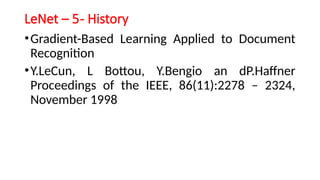
LeNet – 5- History
•Gradient-Based Learning Applied to Document
Recognition
•Y.LeCun, L Bottou, Y.Bengio an dP.Haffner
Proceedings of the IEEE, 86(11):2278 – 2324,
November 1998
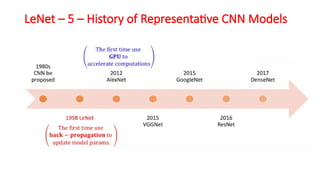
LeNet – 5 – History of Representative CNN Models
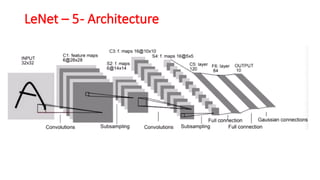
LeNet – 5- Architecture
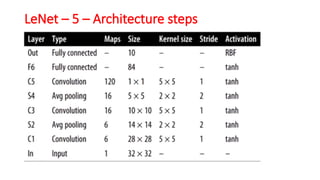
LeNet – 5 – Architecture steps
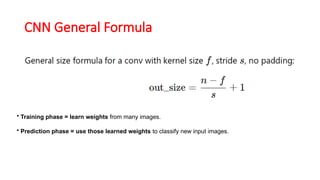
CNN General Formula
• Training phase = learn weights from many images.
• Prediction phase = use those learned weights to classify new input images.
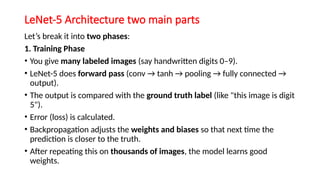
LeNet-5 Architecture two main parts
Let’s break it into two phases:
1. Training Phase
• You give many labeled images (say handwritten digits 0–9).
• LeNet-5 does forward pass (conv → tanh → pooling → fully connected →
output).
• The output is compared with the ground truth label (like "this image is digit
5").
• Error (loss) is calculated.
• Backpropagation adjusts the weights and biases so that next time the
prediction is closer to the truth.
• After repeating this on thousands of images, the model learns good
weights.
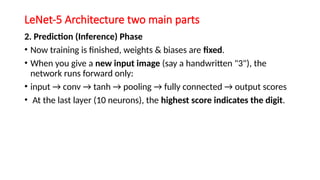
LeNet-5 Architecture two main parts
2. Prediction (Inference) Phase
• Now training is finished, weights & biases are fixed.
• When you give a new input image (say a handwritten "3"), the
network runs forward only:
• input → conv → tanh → pooling → fully connected → output scores
• At the last layer (10 neurons), the highest score indicates the digit.
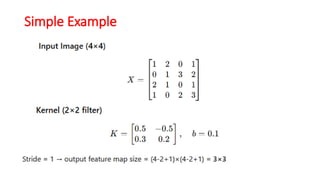
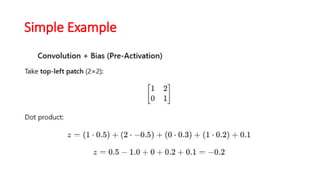
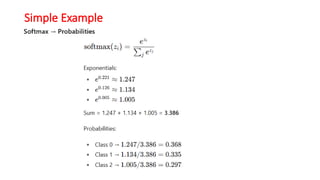
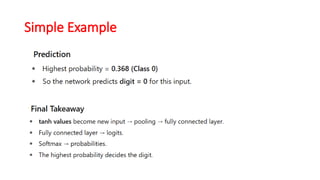
Simple Example
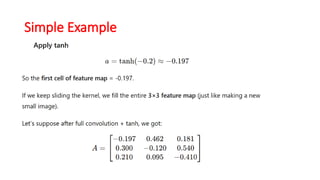
Simple Example
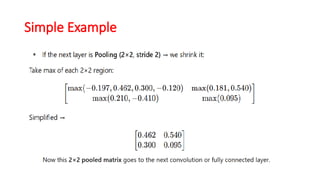
Simple Example
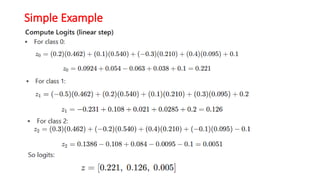
Simple Example
Simple Example
Simple Example
Simple Example
THANK YOU

LeNet 5 Model Architecture Deep Learning Concepts

  • 1.
    Module 1 Introducing DeepLearning LeNet - 5
  • 2.
    LeNet – 5-History •Gradient-Based Learning Applied to Document Recognition •Y.LeCun, L Bottou, Y.Bengio an dP.Haffner Proceedings of the IEEE, 86(11):2278 – 2324, November 1998
  • 3.
    LeNet – 5– History of Representative CNN Models
  • 4.
    LeNet – 5-Architecture
  • 5.
    LeNet – 5– Architecture steps
  • 6.
    CNN General Formula •Training phase = learn weights from many images. • Prediction phase = use those learned weights to classify new input images.
  • 7.
    LeNet-5 Architecture twomain parts Let’s break it into two phases: 1. Training Phase • You give many labeled images (say handwritten digits 0–9). • LeNet-5 does forward pass (conv → tanh → pooling → fully connected → output). • The output is compared with the ground truth label (like "this image is digit 5"). • Error (loss) is calculated. • Backpropagation adjusts the weights and biases so that next time the prediction is closer to the truth. • After repeating this on thousands of images, the model learns good weights.
  • 8.
    LeNet-5 Architecture twomain parts 2. Prediction (Inference) Phase • Now training is finished, weights & biases are fixed. • When you give a new input image (say a handwritten "3"), the network runs forward only: • input → conv → tanh → pooling → fully connected → output scores • At the last layer (10 neurons), the highest score indicates the digit.
  • 9.
  • 10.
  • 11.
  • 12.
  • 13.
  • 14.
  • 15.
  • 16.