




Hariprasad
Radhakrishnan
X-ray Image
ClassificationVersion 0.1
Base Tensorflow
Template
Aim
• To build a base template machine learning model capable of X-ray
image classification based on a finite list of thoracic diseases.
• To define and build a base model using Tensorflow and the newly
released tensorflow datasets, TFRecords and features from the latest
release of 1.4.
Dataset
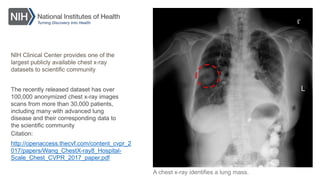
NIH Clinical Center provides one of the
largest publicly available chest x-ray
datasets to scientific community
A chest x-ray identifies a lung mass.
The recently released dataset has over
100,000 anonymized chest x-ray images
scans from more than 30,000 patients,
including many with advanced lung
disease and their corresponding data to
the scientific community
http://openaccess.thecvf.com/content_cvpr_2
017/papers/Wang_ChestX-ray8_Hospital-
Scale_Chest_CVPR_2017_paper.pdf
Citation:
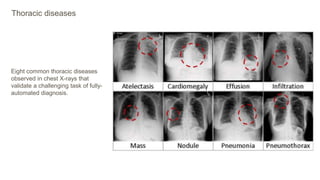
Eight common thoracic diseases
observed in chest X-rays that
validate a challenging task of fully-
automated diagnosis.
Thoracic diseases
Data Preparation
TFRecords
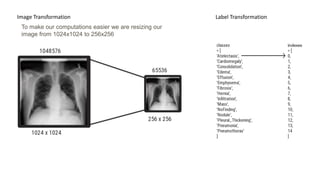
Image Transformation Label Transformation
To make our computations easier we are resizing our
image from 1024x1024 to 256x256
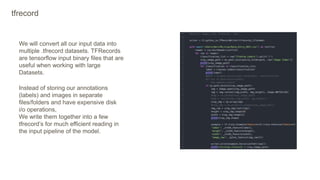
tfrecord
We will convert all our input data into
multiple .tfrecord datasets. TFRecords
are tensorflow input binary files that are
useful when working with large
Datasets.
Instead of storing our annotations
(labels) and images in separate
files/folders and have expensive disk
i/o operations,
We write them together into a few
tfrecord’s for much efficient reading in
the input pipeline of the model.
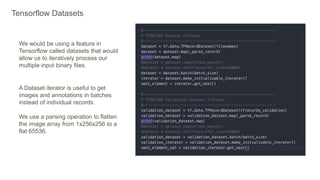
Tensorflow Datasets
We would be using a feature in
Tensorflow called datasets that would
allow us to iteratively process our
multiple input binary files.
A Dataset iterator is useful to get
images and annotations in batches
instead of individual records.
We use a parsing operation to flatten
the image array from 1x256x256 to a
flat 65536.
Model Definition
Tensorflow graph
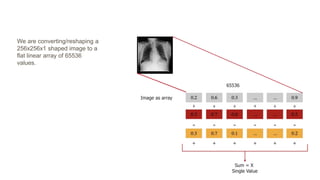
We are converting/reshaping a
256x256x1 shaped image to a
flat linear array of 65536
values.
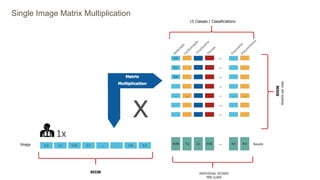
Single Image Matrix Multiplication
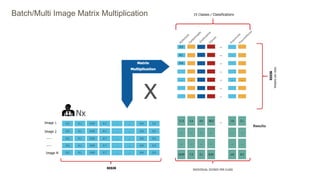
Batch/Multi Image Matrix Multiplication
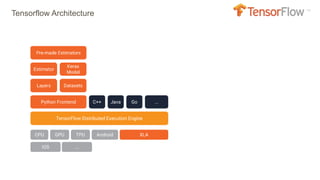
Tensorflow Architecture
TensorBoard
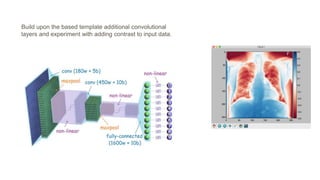
Next steps
Build upon the based template additional convolutional
layers and experiment with adding contrast to input data.

X ray Image Classification

  • 1.
  • 2.
    Aim • To builda base template machine learning model capable of X-ray image classification based on a finite list of thoracic diseases. • To define and build a base model using Tensorflow and the newly released tensorflow datasets, TFRecords and features from the latest release of 1.4.
  • 3.
  • 4.
    NIH Clinical Centerprovides one of the largest publicly available chest x-ray datasets to scientific community A chest x-ray identifies a lung mass. The recently released dataset has over 100,000 anonymized chest x-ray images scans from more than 30,000 patients, including many with advanced lung disease and their corresponding data to the scientific community http://openaccess.thecvf.com/content_cvpr_2 017/papers/Wang_ChestX-ray8_Hospital- Scale_Chest_CVPR_2017_paper.pdf Citation:
  • 5.
    Eight common thoracicdiseases observed in chest X-rays that validate a challenging task of fully- automated diagnosis. Thoracic diseases
  • 6.
  • 7.
    Image Transformation LabelTransformation To make our computations easier we are resizing our image from 1024x1024 to 256x256
  • 8.
    tfrecord We will convertall our input data into multiple .tfrecord datasets. TFRecords are tensorflow input binary files that are useful when working with large Datasets. Instead of storing our annotations (labels) and images in separate files/folders and have expensive disk i/o operations, We write them together into a few tfrecord’s for much efficient reading in the input pipeline of the model.
  • 9.
    Tensorflow Datasets We wouldbe using a feature in Tensorflow called datasets that would allow us to iteratively process our multiple input binary files. A Dataset iterator is useful to get images and annotations in batches instead of individual records. We use a parsing operation to flatten the image array from 1x256x256 to a flat 65536.
  • 10.
  • 12.
    We are converting/reshapinga 256x256x1 shaped image to a flat linear array of 65536 values.
  • 13.
    Single Image MatrixMultiplication
  • 14.
  • 15.
  • 16.
  • 17.
  • 19.
  • 20.
    Build upon thebased template additional convolutional layers and experiment with adding contrast to input data.