Associated Legendre Functions and Spherical
Harmomnics

A COURSE OF LECTURES

BY

A. K. Kapoor

SCHOOL OF PHYSICS
UNIVERSITY OF HYDERABAD

————————————————————————
** Printed on September 21, 2006
Contents
1 Associated Lgendre Functions
1.1 Introduction . . . . . . . . . . . . . . . . . . . . . . . . . . . . . .
1.2 Associated Legendre Functions: . . . . . . . . . . . . . . . . . . .

3
3
5

2 Sperical Harmonics

7

2
Chapter 1

Associated Lgendre
Functions
1.1

Introduction

The spherical harmonics appear in solution of partial differential equations with
spherical symmetry. For example, when physical problems require solutions of
the following equations involve boundary conditions having spherical symmetry.
One can solve the problem by separating the variables in polar coordinates.
1)Laplace equation
∇2 φ = 0
(1.1)
2)Heat equation
1 ∂φ
k ∂t

(1.2)

1 ∂2φ
c2 ∂t2

(1.3)

∇2 φ = −
3)wave equation
∇2 φ = −
Similarly,
4)Schroedinger equation
i¯
h

∂ψ
h
¯2 2
=−
∇ ψ + V (r)ψ
∂t
2m

(1.4)

for spherically symmetric potentialsis solved easily by separating the variables
in the spherical polar coordinates.
In all the cases 1) to 4) above the separation of variables in polar coordinates
leads to the θ − φ equation.
1
∂
∂ 2 Y (θ, φ)
∂Y (θ, φ)
1
sin(θ)
+
= λY (θ, φ)
sin(θ) ∂θ
∂θ
sin(θ)2
∂φ2

(1.5)

where λ is a constant coming from the separation of the variables. The spherical
harmonics are solutions of these equation subject to suitable boundary conditions. In almost all the cases of physical interest the boundary condition is that
Y (θ, φ) does not change when φ is increased by 2π
Y (θ + 2π, φ) = Y (θ, φ)
3

(1.6)
and that the solutions be nonsingular for the permitted range of values of θ
and φ. One obtains two differential equations from eq(5) when separates the
variables θ and φ. Thus we set
Y (θ, φ) = Y (θ)Q(φ)

(1.7)

we get the following equations for Y (θ) and Q(φ)
1
∂
∂Y (θ)
µ
Y (θ) − λY (θ) = 0
sin(θ)
+
sin(θ) ∂θ
∂θ
sin(θ)2

(1.8)

∂ 2 Q(φ)
= µQ(φ)
∂φ2

(1.9)

The solution of eq(9) subject to boundary condition eq(8) restricts the constant
µ to be −m2 and corresponding solutions of eq(9) are
Q(φ) = A exp(imφ),

m = 0, ±1, ±2....

(1.10)

Substituting for µ in eq(8) and changing the variables to x = cos(θ) one gets
the equation for Associated Legendre functions.
d
m2
d
Y (x) = 0
(1 − x2 ) Y (x) + λ −
dx
dx
1 − x2

(1.11)

For most physical application one demands that the solution remains finite for
−1 < x < 1 (corresponding to the range −π < θ < π ). This constrains λ
to be of the form l(l+1) where l is an integer ≥ |m|. Out of the two linearly
independent solutions of eq (12) only one meets this requirement. This solution,
upto overall multiplicative constant, is associated Legendre function denoted as
Plm (x).
The complete set of linearly independent solutions of eq(5) subject to the above
boundary conditions outlined above then given by.
Ylm (θ, φ) = Clm Plm (cos(θ))exp(imφ)

(1.12)

and allowed values of l are positive integral values 0, 1, 2, 3.... For a fixed l, m
can take values between -l and l in steps of 1. Thus
l = 0, 1, 2, 3....

(1.13)

m = −l, −l + 1, ....., l − 1, l

(1.14)

and, for each l one has

The constants Clm in the eq(12) are fixed by demanding
π

2π

∗
Ylm (θ, φ)Ylm (θ, φ)sin(θ)dθ = 1

dφ
0

(1.15)

0

The constant Clm is fixed upto a phase factor
|Clm |2 =

2l + 1 (l − m)!
4π (l + m)!

(1.16)

The function Ylm (θ, φ) are called spherical harmonics. we shall now discuss
some important properties of associated Legendre functions and the spherical
harmonics.
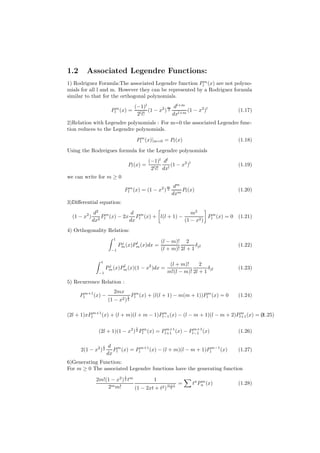
1.2

Associated Legendre Functions:

1) Rodriguez Formula:The associated Legendre function Plm (x) are not polynomials for all l and m. However they can be represented by a Rodriguez formula
similar to that for the orthogonal polynomials.
Plm (x) =

l+m
m d
(−1)l
(1 − x2 )l
(1 − x2 ) 2
l l!
2
dxl+m

(1.17)

2)Relation with Legendre polynomials : For m=0 the associated Legendre function reduces to the Legendre polynomials.
Plm (x)|m=0 = Pl (x)

(1.18)

Using the Rodreigues formula for the Legendre polynomials
Pl (x) =

(−1)l dl
(1 − x2 )l
2l l! dxl

(1.19)

we can write for m ≥ 0
m

Plm (x) = (1 − x2 ) 2

dm
Pl (x)
dxm

(1.20)

3)Differential equation:
(1 − x2 )

d
m2
d2 m
P m (x) = 0 (1.21)
Pl (x) − 2x Plm (x) + l(l + 1) −
dx2
dx
(1 − x2 ) l

4) Orthogonality Relation:
1
j
l
Pm (x)Pm (x)dx =
−1

(l − m)! 2
δjl
(l + m)! 2l + 1

1
j
l
Pm (x)Pm (x)(1 − x2 )dx =
−1

2
(l + m)!
δjl
m!(l − m)! 2l + 1

(1.22)

(1.23)

5) Recurrence Relation :
Plm+1 (x) −

2mx
(1 −

1
x2 ) 2

Plm (x) + (l(l + 1) − m(m + 1))Plm (x) = 0

(1.24)

m
m
(2l + 1)xPlm+1 (x) + (l + m)(l + m − 1)Pl−1 (x) − (l − m + 1)(l − m + 2)Pl+1 (x) = (1.25)
0
1

m+1
m+1
(2l + 1)(1 − x2 ) 2 Plm (x) = Pl+1 (x) − Pl−1 (x)

1

2(1 − x2 ) 2

d m
P (x) = Plm+1 (x) − (l + m)(l − m + 1)Plm−1 (x)
dx l

(1.26)
(1.27)

6)Generating Function:
For m ≥ 0 The associated Legendre functions have the generating function
1

1
2m!(1 − x2 ) 2 tm
m+1 =
2m m!
(1 − 2xt + t2 ) 2

m
tn Pn (x)

(1.28)
7) Misc Properties : The relations eq() and eq() are valid only for m ≥ 0. The
associated Legendre functions for m < 0 are related to those for m > 0 by
Pl−m (x) = (−1)m

(l − m)! m
P (x)
(l + m)! l

(1.29)

also
Plm (−x) = (−1)l+m Plm (x)

(1.30)
Chapter 2

Sperical Harmonics
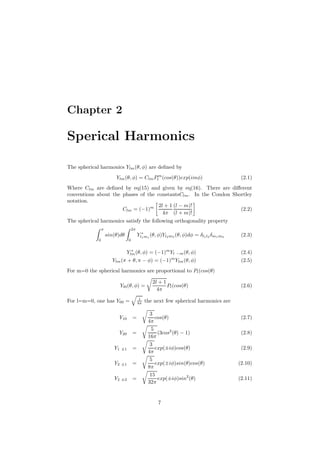
The spherical harmonics Ylm (θ, φ) are defined by
Ylm (θ, φ) = Clm Plm (cos(θ))exp(imφ)

(2.1)

Where Clm are defined by eq(15) and given by eq(16). There are different
conventions about the phases of the constantsClm . In the Condon Shortley
notation.
2l + 1 (l − m)!
(2.2)
Clm = (−1)m
4π (l + m)!
The spherical harmonics satisfy the following orthogonality property
π

2π

Yl∗m1 (θ, φ)Yl2 m2 (θ, φ)dφ = δl1 l2 δm1 m2
1

sin(θ)dθ
0

(2.3)

0
∗
Ylm (θ, φ) = (−1)m Yl −m (θ, φ)
Ylm (π + θ, π − φ) = (−1)m Ylm (θ, φ)

(2.4)
(2.5)

For m=0 the spherical harmonics are proportional to Pl (cos(θ)
Yl0 (θ, φ) =
1
4π

For l=m=0, one has Y00 =
Y10

=

Y20

=

Y1

±1

=

Y2

±1

=

Y2

±2

=

2l + 1
Pl (cos(θ)
4π

(2.6)

the next few spherical harmonics are
3
cos(θ)
4π
5
(3cos2 (θ) − 1)
16π
3
exp(±iφ)cos(θ)
4π
5
exp(±iφ)sin(θ)cos(θ)
8π
15
exp(±iφ)sin2 (θ)
32π

7

(2.7)
(2.8)
(2.9)
(2.10)
(2.11)

Legendre associé

  • 1.
    Associated Legendre Functionsand Spherical Harmomnics A COURSE OF LECTURES BY A. K. Kapoor SCHOOL OF PHYSICS UNIVERSITY OF HYDERABAD ———————————————————————— ** Printed on September 21, 2006
  • 2.
    Contents 1 Associated LgendreFunctions 1.1 Introduction . . . . . . . . . . . . . . . . . . . . . . . . . . . . . . 1.2 Associated Legendre Functions: . . . . . . . . . . . . . . . . . . . 3 3 5 2 Sperical Harmonics 7 2
  • 3.
    Chapter 1 Associated Lgendre Functions 1.1 Introduction Thespherical harmonics appear in solution of partial differential equations with spherical symmetry. For example, when physical problems require solutions of the following equations involve boundary conditions having spherical symmetry. One can solve the problem by separating the variables in polar coordinates. 1)Laplace equation ∇2 φ = 0 (1.1) 2)Heat equation 1 ∂φ k ∂t (1.2) 1 ∂2φ c2 ∂t2 (1.3) ∇2 φ = − 3)wave equation ∇2 φ = − Similarly, 4)Schroedinger equation i¯ h ∂ψ h ¯2 2 =− ∇ ψ + V (r)ψ ∂t 2m (1.4) for spherically symmetric potentialsis solved easily by separating the variables in the spherical polar coordinates. In all the cases 1) to 4) above the separation of variables in polar coordinates leads to the θ − φ equation. 1 ∂ ∂ 2 Y (θ, φ) ∂Y (θ, φ) 1 sin(θ) + = λY (θ, φ) sin(θ) ∂θ ∂θ sin(θ)2 ∂φ2 (1.5) where λ is a constant coming from the separation of the variables. The spherical harmonics are solutions of these equation subject to suitable boundary conditions. In almost all the cases of physical interest the boundary condition is that Y (θ, φ) does not change when φ is increased by 2π Y (θ + 2π, φ) = Y (θ, φ) 3 (1.6)
  • 4.
    and that thesolutions be nonsingular for the permitted range of values of θ and φ. One obtains two differential equations from eq(5) when separates the variables θ and φ. Thus we set Y (θ, φ) = Y (θ)Q(φ) (1.7) we get the following equations for Y (θ) and Q(φ) 1 ∂ ∂Y (θ) µ Y (θ) − λY (θ) = 0 sin(θ) + sin(θ) ∂θ ∂θ sin(θ)2 (1.8) ∂ 2 Q(φ) = µQ(φ) ∂φ2 (1.9) The solution of eq(9) subject to boundary condition eq(8) restricts the constant µ to be −m2 and corresponding solutions of eq(9) are Q(φ) = A exp(imφ), m = 0, ±1, ±2.... (1.10) Substituting for µ in eq(8) and changing the variables to x = cos(θ) one gets the equation for Associated Legendre functions. d m2 d Y (x) = 0 (1 − x2 ) Y (x) + λ − dx dx 1 − x2 (1.11) For most physical application one demands that the solution remains finite for −1 < x < 1 (corresponding to the range −π < θ < π ). This constrains λ to be of the form l(l+1) where l is an integer ≥ |m|. Out of the two linearly independent solutions of eq (12) only one meets this requirement. This solution, upto overall multiplicative constant, is associated Legendre function denoted as Plm (x). The complete set of linearly independent solutions of eq(5) subject to the above boundary conditions outlined above then given by. Ylm (θ, φ) = Clm Plm (cos(θ))exp(imφ) (1.12) and allowed values of l are positive integral values 0, 1, 2, 3.... For a fixed l, m can take values between -l and l in steps of 1. Thus l = 0, 1, 2, 3.... (1.13) m = −l, −l + 1, ....., l − 1, l (1.14) and, for each l one has The constants Clm in the eq(12) are fixed by demanding π 2π ∗ Ylm (θ, φ)Ylm (θ, φ)sin(θ)dθ = 1 dφ 0 (1.15) 0 The constant Clm is fixed upto a phase factor |Clm |2 = 2l + 1 (l − m)! 4π (l + m)! (1.16) The function Ylm (θ, φ) are called spherical harmonics. we shall now discuss some important properties of associated Legendre functions and the spherical harmonics.
  • 5.
    1.2 Associated Legendre Functions: 1)Rodriguez Formula:The associated Legendre function Plm (x) are not polynomials for all l and m. However they can be represented by a Rodriguez formula similar to that for the orthogonal polynomials. Plm (x) = l+m m d (−1)l (1 − x2 )l (1 − x2 ) 2 l l! 2 dxl+m (1.17) 2)Relation with Legendre polynomials : For m=0 the associated Legendre function reduces to the Legendre polynomials. Plm (x)|m=0 = Pl (x) (1.18) Using the Rodreigues formula for the Legendre polynomials Pl (x) = (−1)l dl (1 − x2 )l 2l l! dxl (1.19) we can write for m ≥ 0 m Plm (x) = (1 − x2 ) 2 dm Pl (x) dxm (1.20) 3)Differential equation: (1 − x2 ) d m2 d2 m P m (x) = 0 (1.21) Pl (x) − 2x Plm (x) + l(l + 1) − dx2 dx (1 − x2 ) l 4) Orthogonality Relation: 1 j l Pm (x)Pm (x)dx = −1 (l − m)! 2 δjl (l + m)! 2l + 1 1 j l Pm (x)Pm (x)(1 − x2 )dx = −1 2 (l + m)! δjl m!(l − m)! 2l + 1 (1.22) (1.23) 5) Recurrence Relation : Plm+1 (x) − 2mx (1 − 1 x2 ) 2 Plm (x) + (l(l + 1) − m(m + 1))Plm (x) = 0 (1.24) m m (2l + 1)xPlm+1 (x) + (l + m)(l + m − 1)Pl−1 (x) − (l − m + 1)(l − m + 2)Pl+1 (x) = (1.25) 0 1 m+1 m+1 (2l + 1)(1 − x2 ) 2 Plm (x) = Pl+1 (x) − Pl−1 (x) 1 2(1 − x2 ) 2 d m P (x) = Plm+1 (x) − (l + m)(l − m + 1)Plm−1 (x) dx l (1.26) (1.27) 6)Generating Function: For m ≥ 0 The associated Legendre functions have the generating function 1 1 2m!(1 − x2 ) 2 tm m+1 = 2m m! (1 − 2xt + t2 ) 2 m tn Pn (x) (1.28)
  • 6.
    7) Misc Properties: The relations eq() and eq() are valid only for m ≥ 0. The associated Legendre functions for m < 0 are related to those for m > 0 by Pl−m (x) = (−1)m (l − m)! m P (x) (l + m)! l (1.29) also Plm (−x) = (−1)l+m Plm (x) (1.30)
  • 7.
    Chapter 2 Sperical Harmonics Thespherical harmonics Ylm (θ, φ) are defined by Ylm (θ, φ) = Clm Plm (cos(θ))exp(imφ) (2.1) Where Clm are defined by eq(15) and given by eq(16). There are different conventions about the phases of the constantsClm . In the Condon Shortley notation. 2l + 1 (l − m)! (2.2) Clm = (−1)m 4π (l + m)! The spherical harmonics satisfy the following orthogonality property π 2π Yl∗m1 (θ, φ)Yl2 m2 (θ, φ)dφ = δl1 l2 δm1 m2 1 sin(θ)dθ 0 (2.3) 0 ∗ Ylm (θ, φ) = (−1)m Yl −m (θ, φ) Ylm (π + θ, π − φ) = (−1)m Ylm (θ, φ) (2.4) (2.5) For m=0 the spherical harmonics are proportional to Pl (cos(θ) Yl0 (θ, φ) = 1 4π For l=m=0, one has Y00 = Y10 = Y20 = Y1 ±1 = Y2 ±1 = Y2 ±2 = 2l + 1 Pl (cos(θ) 4π (2.6) the next few spherical harmonics are 3 cos(θ) 4π 5 (3cos2 (θ) − 1) 16π 3 exp(±iφ)cos(θ) 4π 5 exp(±iφ)sin(θ)cos(θ) 8π 15 exp(±iφ)sin2 (θ) 32π 7 (2.7) (2.8) (2.9) (2.10) (2.11)