K.Chiranjeevi et al. / (IJAEST) INTERNATIONAL JOURNAL OF ADVANCED ENGINEERING SCIENCES AND TECHNOLOGIES
                                                                                       Vol No. 6, Issue No. 1, 077 - 080


       Automatic Detection of Glaucoma Disease In Eye

                       K.Chiranjeevi                                                           Prabhakar Telagarapu
                       Dept.of. ECE                                                                 Dept.of. ECE
                   GMR Institute of Technology                                                   GMR Institute of Technology
                  Rajam,Srikakulam Dist,AP,India                                               Rajam,Srikakulam Dist,AP,India
                   Chiru404@gmail.com                                                          Prabhakart2@gmail.com


          Abstract— Glaucoma arises due to the inadequate fluid         group of diseases of the optic nerve involving loss of retinal
flow from the drainage canals of the eye, leading to the                ganglion cells in a characteristic pattern of optic neuropathy.
crystallization of the fluid in the cornea and iris regions.            Eye has pressure just like blood, and when this intraocular
Especially in closed angled Glaucoma, fluid pressure in the eye         pressure (IOP) increases to dangerous levels, it damages the
increases because of inadequate fluid flow between the iris and         optic nerve. This can result in decreased peripheral vision and,
the cornea. One important technique to assess patients at risk of       eventually, blindness. Glaucoma is similar to ocular
Glaucoma is to analyze ultrasound images of the eye to detect the       hypertension but with accompanying optic nerve damage and


                                                                                   T
structural changes. Currently, these images are analyzed                vision loss. Although raised intraocular pressure is a
manually. In this paper, an algorithm is proposed to                    significant risk factor for developing Glaucoma, there is no set
automatically compute this accretion from the ultrasound images         threshold for intraocular pressure that causes Glaucoma. One
of the eye. Apart from improving the contrast of the low                person may develop nerve damage at a relatively low pressure,
resolution ultrasound image, the algorithm aims to determine the
                                                                        while another person may have high eye pressures for years
exact location of the apex point of the anterior chamber region
for efficient angle calculation. It is highly imperative to detect
                                                                        and yet never develop damage. Untreated Glaucoma leads to
                                                                        permanent damage of the optic nerve and resultant visual field
                                              ES
Glaucoma in its early stages for diagnosis and hence the
algorithm also addresses the importance of precise results with
effective immunity towards speckle noise. This work shows a
technique to improve the efficiency of clinical interpretation of
                                                                        loss, which can progress to blindness. In this paper, the Closed
                                                                        Angle Glaucoma is addressed, in which the fluid at the front
                                                                        of the eye cannot reach the angle and leave the eye. The angle
                                                                        gets blocked by part of the iris. People with this type of
Glaucoma in ultrasound images of the eye.
                                                                        Glaucoma have a sudden increase in eye pressure. Symptoms
                                                                        include severe pain and nausea, as well as redness of the eye
Keywords- Glaucoma, drainage canals, cornea, and iris region,           and blurred vision. This status requires immediate medical
ultrasound images.                                                      attention.

                       I.   INTRODUCTION                                          II.   CURRENT TECHNIQUES TO DETECT
                                                                                              GLAUCOMA
                           A
          Glaucoma is a group of diseases that can steal sight
without warning or symptoms. Some of the alarming facts
about Glaucoma are (1) Glaucoma is a leading cause of                            Regular Glaucoma check-ups include two routine eye
blindness, (2) There is no cure for Glaucoma yet, (3) Everyone          tests: Tonometry and Ophthalmoscopy.
is at risk and (4) There may be no symptoms. Nearly half of
those with Glaucoma do not know they have the disease. This             2.1 Tonometry
has been shown repeatedly in studies conducted in developed                      The Tonometry test measures the inner pressure of
countries. Glaucoma is a potentially blinding disease that
 IJ

                                                                        the eye. Usually drops are used to numb the eye. Then the
affects 66 million persons worldwide. It is the second leading          doctor or technician will use a special device, called
cause of blindness worldwide. The disease is characterized by           Tonometer, which measures the eye’s pressure. The normal
typical changes in the optic nerve (the nerve that connects the         range of this pressure is in between 10mmHg and 22mmHG.
eye to the brain) with associated visual field defects (the area
seen by the eye). Since the outer portion of the visual field is        2.2 Ophthalmoscopy
the first to be affected and most types of Glaucoma are                           Ophthalmoscopy is used to examine the inside of the
asymptomatic the disease is often diagnosed once significant            eye, especially the optic nerve. In a darkened room, the doctor
vision/field has been lost. Therefore, early diagnosis is               will magnify the eye by using an ophthalmoscope (an
essential so that treatment to halt/slow progression can be             instrument with a small light on the end). This helps the doctor
instituted. Glaucoma study from Chennai city and rural                  look at the shape and color of the optic nerve.If the pressure in
Tamilnadu reveals that every 1 on 3 patients above 40 years             the eye is not in the normal range (10mmHg to 22mmHg), or
having vision related problems were diagnosed with                      if the optic nerve looks unusual, then one or two special
Glaucoma. When the Glaucoma is understood and managed,                  Glaucoma tests will be done. These two tests are called
humans can continue to live their life fully. Glaucoma is a             Perimetry and Gonioscopy.


         ISSN: 2230-7818                  @ 2011 http://www.ijaest.iserp.org. All rights Reserved.                      Page 77
K.Chiranjeevi et al. / (IJAEST) INTERNATIONAL JOURNAL OF ADVANCED ENGINEERING SCIENCES AND TECHNOLOGIES
                                                                                       Vol No. 6, Issue No. 1, 077 - 080


2.2.1 Perimetry                                                            based algorithms without compromising on the speed,
                                                                           accuracy, sensitivity, cost and compatibility of the product.
          The Perimetry test is also called a visual field test.           Ultrasound images of eye are usually associated with poor
During this test, the patient will be asked to look straight
                                                                           resolution, poor contrast, noise and divaricated anterior
ahead and then indicate when a moving light passes his/her                 chamber edges. Algorithm is proposed to effectively mitigate
peripheral (or side) vision. This helps draw a ―      map‖ of
                                                                           the above challenges.
patient’s vision.
2.2.2 Gonioscopy                                                                               III. ALGORITHM DESIGN
         Gonioscopy is a painless eye test that checks if the                        This algorithm describes a new method to detect
angle where the iris meets the cornea is open or closed,                   features in ultrasound images, which shows good performance
showing if either open angle or closed angle Glaucoma is                   in detection of difficult features. The developed techniques
present.                                                                   make use of major image processing methods and
                                                                           fundamentals. In order to calculate the clinical parameters of
                                                                           interest, new region classification and segmentation
                                                                           techniques are developed as well as other signal processing
                                                                           techniques are used to locate the scleral spur. The ultrasound
                                                                           images of the eye are very noisy, with poor resolution and
                                                                           weak edge delineation, which required the development of a
                                                                           three-step method to overcome these challenges. The complete
                                                                           algorithm is shown in Figure 3.1.


                                                                                      T
                                                  ES
                          A
              Figure 2.1 Clinical parameters in Gonioscopic images
 2.3 Manual Calculation of AOD from Ultrasound Images of
                              the Eye
 IJ

        In this method, the doctor examines the Ultrasound
                                                                                                  IV. RESULTS
image of the patient’s eye and he/she estimates the angle
between the iris and the cornea. If the estimated angle is less            The angles between iris and cornea for Ultrasound images of
than 190, then the eye is treated as Glaucoma affected,                    different patients are calculated and decision about the
otherwise as normal eye. But the manual estimation may be                  presence of Glaucoma is made follows.
wrong.                                                                     4.1 Results for Ultrasound Image 1
2.4 Disadvantages of Current Techniques
        Manual analysis of eye images is fairly time
consuming, and the accuracy of parameter measurements
varies between experts. For this reason, an algorithm is
developed to automatically analyze eye ultrasound images.
The proposed algorithm is expected to reduce the processing
time taken by the existing techniques of manual/computer-                                     Figure 4.1: Input Ultrasound Image 1


        ISSN: 2230-7818                      @ 2011 http://www.ijaest.iserp.org. All rights Reserved.                                Page 78
K.Chiranjeevi et al. / (IJAEST) INTERNATIONAL JOURNAL OF ADVANCED ENGINEERING SCIENCES AND TECHNOLOGIES
                                                                                       Vol No. 6, Issue No. 1, 077 - 080


 TABLE :1 Comparison of Results with Current Techniques for Image 1        4.3 Results for Ultrasound Image 3


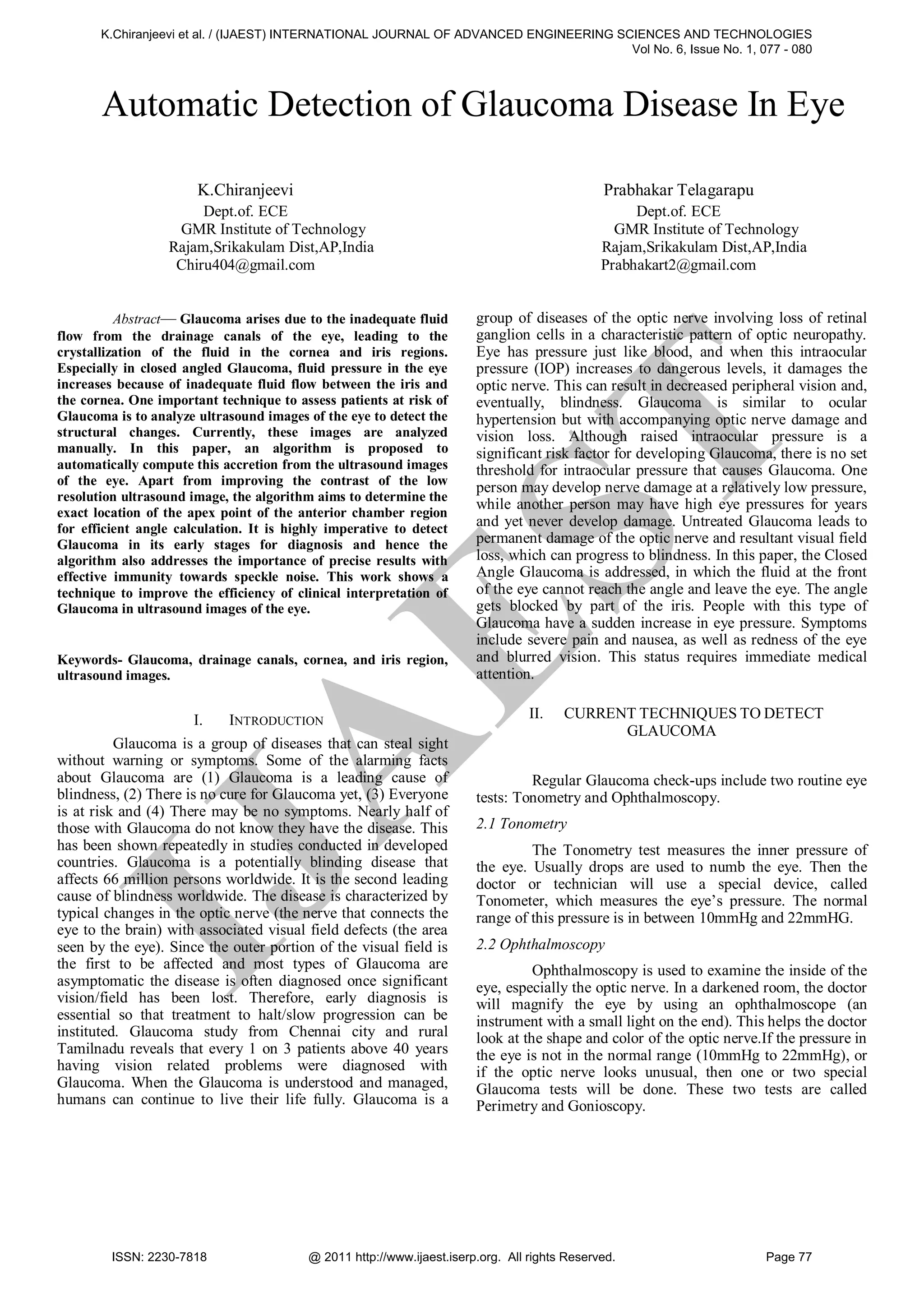
As the Intraocular Pressure is same as the threshold value, the
status of Glaucoma cannot be decided using Tonometry. As
the Perimetry method is the visual filed of the patient, in this
method also the status of Glaucoma cannot be decided. Even
though AOD is greater than 190 in the case of Gonioscopy and
direct view, which decided that Glaucoma is present, the
developed algorithm detected Glaucoma, as AOD is less than
190.
4.2 Results for Ultrasound Image 2


                                                                                      T
                                                                                              Figure 4.3: Input Ultrasound Image 3

                                                  ES                         TABLE :3 Comparison of Results with Current Techniques for Image 3


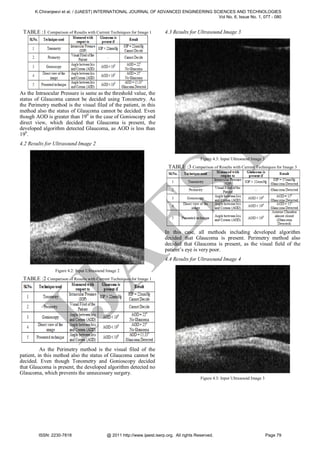
                                                                           In this case, all methods including developed algorithm
                                                                           decided that Glaucoma is present. Perimetry method also
                                                                           decided that Glaucoma is present, as the visual field of the
                                                                           patient’s eye is very poor.
                           A
                                                                           4.4 Results for Ultrasound Image 4

                 Figure 4.2: Input Ultrasound Image 2
 TABLE :2 Comparison of Results with Current Techniques for Image 1
 IJ


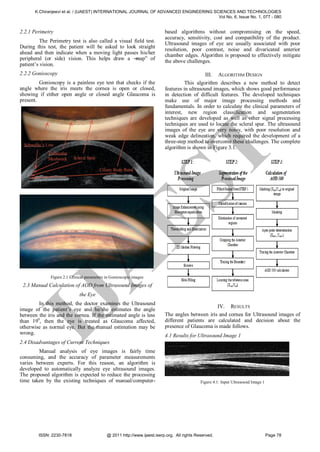
          As the Perimetry method is the visual filed of the
patient, in this method also the status of Glaucoma cannot be
decided. Even though Tonometry and Gonioscopy decided
that Glaucoma is present, the developed algorithm detected no
Glaucoma, which prevents the unnecessary surgery.
                                                                                              Figure 4.3: Input Ultrasound Image 3


        ISSN: 2230-7818                      @ 2011 http://www.ijaest.iserp.org. All rights Reserved.                                Page 79
K.Chiranjeevi et al. / (IJAEST) INTERNATIONAL JOURNAL OF ADVANCED ENGINEERING SCIENCES AND TECHNOLOGIES
                                                                                       Vol No. 6, Issue No. 1, 077 - 080


 TABLE :4 Comparison of Results with Current Techniques for Image 4      patient’s ultrasound image, leading hopefully to an increase in
                                                                         efficiency and a reduction of cost.

                                                                                               ACKNOWLEDGMENT
                                                                         The Authors wish to thank Guru Kamesh Reddy,
                                                                         JTO,AP,India. For his sugessions which have the improved
                                                                         the presentation of the material in this paper.

                                                                                                       REFERENCES

                                                                         [1]        R. Youmaran, P. Dicorato, R. Munger, T.Hall, A. Adler -
                                                                                    Automatic Detection of Features in Ultrasound Images of the Eye,
         In this case, all methods including developed                              IMTC 2005 – Instrumentation and Measurement Technology
algorithm decided that Glaucoma is present.                                         Conference, Ottawa, Canada, 17-19 May 2005.
                                                                         [2]        Xiaoyang Song, Keou Song, Yazhu Chen - A Computer-based
          In ultrasound imaging, speckle noise severely                             Diagnosis System for Early Glaucoma Screening, Proceedings of
degrades the visual quality of the image. In order to achieve                       the 2005 IEEE Engineering in Medicine and Biology 27th Annual
high accuracy when extracting features, speckle must be                             Conference Shanghai, China, September 1-4, 2005.
filtered without destroying any important characteristics in the         [3]        Rafael C. Gonzalez, Richard E. Woods, ―          Digital Image
image. In the developed algorithm, speckle noise was reduced                        Processing‖, Second Edition, Pearson Education Asia Publications.


                                                                                     T
using a multi-scale algorithm. It is worthwhile to investigate a         [4]        Rafael C. Gonzalez, Richard E. Woods, Steven L. Eddins, ― Digital
different speckle reduction technique that do not depend on                         Image Processing using MATLAB®‖, Pearson Education Asia
the selection of the window size and that can be used on the                        Publications.
ultrasound images of the eye before edge enhancement. One                [5]        Glaucoma Research Foundation - funding innovative research to
                                                                                    find a cure for Glaucoma.251 Post Street, Suite 600, San
easy way to reduce speckle is to average multiple uncorrelated                      Francisco, CA.
images of the same object obtained from different spatial
positions. However, this procedure is computationally costly
                                                ES
and will increase the processing time of the algorithm. It
seems to design an algorithm for fine enhancement, which
does not require the selection of a fixed window size and to
reduce speckle noise based on each pixel surrounding area.
                                                                                                 K.Chiranjeevi received B.E Electronics and
                                                                                                 Communication        Engineering     from

                                                                                                 from JNTU Kakinada, He is working as Asst.
                                                                                                 Professor in GMR Institute of Technology. His
                                                                                                                                               J.N.T.U.
                                                                                                 Anantapur, and M.Tech Instrumentation and Control


                                                                                                 research interests are in Signal Processing and Image
However, for images with very poor resolution, more iteration                                    Processing.
can be applied until all pixels lying in the same local
neighborhood have similar intensity values close to the initial
spike value. If this technique shows improvement in speckle
                                                                                                  T.Prabhakar received M.Tech degree from Jawarlal
reduction and does not destroy edges in the original image, the
                                                                                                  Nehru Technological University Kakinada, Andhra
enhancement process in the algorithm will require less                                            Pradesh, India. B.Tech degree in Electronics and
iteration, resulting in a considerable reduction of the                                           Communication Engineering from SIR C.R.Reddy
processing time.
                          A
                                                                                                  College of Engineering, Eluru, Andhra Pradesh,
                                                                                                  India. He is joined as Lecturer in the Department. Of
                                                                                                  Electronics and Communication Engineering at
                        V.    CONCLUSION                                                          GMR Institute of Technology, Rajam, Srikakulam
         This thesis has developed an algorithm to                       District, Andhra Pradesh, India in 2002. Prior to join in this Institute he
                                                                         worked as a Service Engineer in Machine Diagnostics and Deployed to work
automatically identify clinical features in ultrasound images of         at National Remote Sensing agency, Department. Of. Space, Hyderabad for 1
the eye. The algorithm computes the AOD 500 used to                      year 1 month and Trainee Programmer in Indo Tech Computers, for 8 months
measure the presence and severity of glaucoma. Overall, the              in Hyderabad. He is presently working as Senior. Assistant Professor in the
 IJ

algorithm predictions are very advantageous compared to the              Department. Of Electronics and Communication Engineering at GMR
technologist’s observation. In the processed images, features            Institute of Technology. Having Total experience is 12 years out of which 10
                                                                         years in Teaching (GMRIT) and 2 Years in Industry. His research interests are
were correctly identified in 97% of the cases. 3% of images              Communication, Signal Processing and Image Processing. He has published
presented inaccurate approximation of the clinical parameters.           10 Technical papers in various International journals and conferences. He is a
The difficulties encountered in measuring clinical parameters,           life member of ISTE Since 2002.
which are associated with the speckle noise, poor contrast,
poor resolution, and weak edge delineation present in the
processed ultrasound images, are accurately eliminated.
However, the designed algorithm failed for a few of images,
where more noise is present. The algorithm was designed with
a goal of robustness through the use of enhancement process
on the original image, and by validation of the proper
segmentation of the anterior chamber at each step. Overall, the
benefit of this work is the ability of algorithm to reduce the
processing time and improve processing consistency for each


        ISSN: 2230-7818                    @ 2011 http://www.ijaest.iserp.org. All rights Reserved.                               Page 80

Lee youtaidanny _fyp

  • 1.
    K.Chiranjeevi et al./ (IJAEST) INTERNATIONAL JOURNAL OF ADVANCED ENGINEERING SCIENCES AND TECHNOLOGIES Vol No. 6, Issue No. 1, 077 - 080 Automatic Detection of Glaucoma Disease In Eye K.Chiranjeevi Prabhakar Telagarapu Dept.of. ECE Dept.of. ECE GMR Institute of Technology GMR Institute of Technology Rajam,Srikakulam Dist,AP,India Rajam,Srikakulam Dist,AP,India Chiru404@gmail.com Prabhakart2@gmail.com Abstract— Glaucoma arises due to the inadequate fluid group of diseases of the optic nerve involving loss of retinal flow from the drainage canals of the eye, leading to the ganglion cells in a characteristic pattern of optic neuropathy. crystallization of the fluid in the cornea and iris regions. Eye has pressure just like blood, and when this intraocular Especially in closed angled Glaucoma, fluid pressure in the eye pressure (IOP) increases to dangerous levels, it damages the increases because of inadequate fluid flow between the iris and optic nerve. This can result in decreased peripheral vision and, the cornea. One important technique to assess patients at risk of eventually, blindness. Glaucoma is similar to ocular Glaucoma is to analyze ultrasound images of the eye to detect the hypertension but with accompanying optic nerve damage and T structural changes. Currently, these images are analyzed vision loss. Although raised intraocular pressure is a manually. In this paper, an algorithm is proposed to significant risk factor for developing Glaucoma, there is no set automatically compute this accretion from the ultrasound images threshold for intraocular pressure that causes Glaucoma. One of the eye. Apart from improving the contrast of the low person may develop nerve damage at a relatively low pressure, resolution ultrasound image, the algorithm aims to determine the while another person may have high eye pressures for years exact location of the apex point of the anterior chamber region for efficient angle calculation. It is highly imperative to detect and yet never develop damage. Untreated Glaucoma leads to permanent damage of the optic nerve and resultant visual field ES Glaucoma in its early stages for diagnosis and hence the algorithm also addresses the importance of precise results with effective immunity towards speckle noise. This work shows a technique to improve the efficiency of clinical interpretation of loss, which can progress to blindness. In this paper, the Closed Angle Glaucoma is addressed, in which the fluid at the front of the eye cannot reach the angle and leave the eye. The angle gets blocked by part of the iris. People with this type of Glaucoma in ultrasound images of the eye. Glaucoma have a sudden increase in eye pressure. Symptoms include severe pain and nausea, as well as redness of the eye Keywords- Glaucoma, drainage canals, cornea, and iris region, and blurred vision. This status requires immediate medical ultrasound images. attention. I. INTRODUCTION II. CURRENT TECHNIQUES TO DETECT GLAUCOMA A Glaucoma is a group of diseases that can steal sight without warning or symptoms. Some of the alarming facts about Glaucoma are (1) Glaucoma is a leading cause of Regular Glaucoma check-ups include two routine eye blindness, (2) There is no cure for Glaucoma yet, (3) Everyone tests: Tonometry and Ophthalmoscopy. is at risk and (4) There may be no symptoms. Nearly half of those with Glaucoma do not know they have the disease. This 2.1 Tonometry has been shown repeatedly in studies conducted in developed The Tonometry test measures the inner pressure of countries. Glaucoma is a potentially blinding disease that IJ the eye. Usually drops are used to numb the eye. Then the affects 66 million persons worldwide. It is the second leading doctor or technician will use a special device, called cause of blindness worldwide. The disease is characterized by Tonometer, which measures the eye’s pressure. The normal typical changes in the optic nerve (the nerve that connects the range of this pressure is in between 10mmHg and 22mmHG. eye to the brain) with associated visual field defects (the area seen by the eye). Since the outer portion of the visual field is 2.2 Ophthalmoscopy the first to be affected and most types of Glaucoma are Ophthalmoscopy is used to examine the inside of the asymptomatic the disease is often diagnosed once significant eye, especially the optic nerve. In a darkened room, the doctor vision/field has been lost. Therefore, early diagnosis is will magnify the eye by using an ophthalmoscope (an essential so that treatment to halt/slow progression can be instrument with a small light on the end). This helps the doctor instituted. Glaucoma study from Chennai city and rural look at the shape and color of the optic nerve.If the pressure in Tamilnadu reveals that every 1 on 3 patients above 40 years the eye is not in the normal range (10mmHg to 22mmHg), or having vision related problems were diagnosed with if the optic nerve looks unusual, then one or two special Glaucoma. When the Glaucoma is understood and managed, Glaucoma tests will be done. These two tests are called humans can continue to live their life fully. Glaucoma is a Perimetry and Gonioscopy. ISSN: 2230-7818 @ 2011 http://www.ijaest.iserp.org. All rights Reserved. Page 77
  • 2.
    K.Chiranjeevi et al./ (IJAEST) INTERNATIONAL JOURNAL OF ADVANCED ENGINEERING SCIENCES AND TECHNOLOGIES Vol No. 6, Issue No. 1, 077 - 080 2.2.1 Perimetry based algorithms without compromising on the speed, accuracy, sensitivity, cost and compatibility of the product. The Perimetry test is also called a visual field test. Ultrasound images of eye are usually associated with poor During this test, the patient will be asked to look straight resolution, poor contrast, noise and divaricated anterior ahead and then indicate when a moving light passes his/her chamber edges. Algorithm is proposed to effectively mitigate peripheral (or side) vision. This helps draw a ― map‖ of the above challenges. patient’s vision. 2.2.2 Gonioscopy III. ALGORITHM DESIGN Gonioscopy is a painless eye test that checks if the This algorithm describes a new method to detect angle where the iris meets the cornea is open or closed, features in ultrasound images, which shows good performance showing if either open angle or closed angle Glaucoma is in detection of difficult features. The developed techniques present. make use of major image processing methods and fundamentals. In order to calculate the clinical parameters of interest, new region classification and segmentation techniques are developed as well as other signal processing techniques are used to locate the scleral spur. The ultrasound images of the eye are very noisy, with poor resolution and weak edge delineation, which required the development of a three-step method to overcome these challenges. The complete algorithm is shown in Figure 3.1. T ES A Figure 2.1 Clinical parameters in Gonioscopic images 2.3 Manual Calculation of AOD from Ultrasound Images of the Eye IJ In this method, the doctor examines the Ultrasound IV. RESULTS image of the patient’s eye and he/she estimates the angle between the iris and the cornea. If the estimated angle is less The angles between iris and cornea for Ultrasound images of than 190, then the eye is treated as Glaucoma affected, different patients are calculated and decision about the otherwise as normal eye. But the manual estimation may be presence of Glaucoma is made follows. wrong. 4.1 Results for Ultrasound Image 1 2.4 Disadvantages of Current Techniques Manual analysis of eye images is fairly time consuming, and the accuracy of parameter measurements varies between experts. For this reason, an algorithm is developed to automatically analyze eye ultrasound images. The proposed algorithm is expected to reduce the processing time taken by the existing techniques of manual/computer- Figure 4.1: Input Ultrasound Image 1 ISSN: 2230-7818 @ 2011 http://www.ijaest.iserp.org. All rights Reserved. Page 78
  • 3.
    K.Chiranjeevi et al./ (IJAEST) INTERNATIONAL JOURNAL OF ADVANCED ENGINEERING SCIENCES AND TECHNOLOGIES Vol No. 6, Issue No. 1, 077 - 080 TABLE :1 Comparison of Results with Current Techniques for Image 1 4.3 Results for Ultrasound Image 3 As the Intraocular Pressure is same as the threshold value, the status of Glaucoma cannot be decided using Tonometry. As the Perimetry method is the visual filed of the patient, in this method also the status of Glaucoma cannot be decided. Even though AOD is greater than 190 in the case of Gonioscopy and direct view, which decided that Glaucoma is present, the developed algorithm detected Glaucoma, as AOD is less than 190. 4.2 Results for Ultrasound Image 2 T Figure 4.3: Input Ultrasound Image 3 ES TABLE :3 Comparison of Results with Current Techniques for Image 3 In this case, all methods including developed algorithm decided that Glaucoma is present. Perimetry method also decided that Glaucoma is present, as the visual field of the patient’s eye is very poor. A 4.4 Results for Ultrasound Image 4 Figure 4.2: Input Ultrasound Image 2 TABLE :2 Comparison of Results with Current Techniques for Image 1 IJ As the Perimetry method is the visual filed of the patient, in this method also the status of Glaucoma cannot be decided. Even though Tonometry and Gonioscopy decided that Glaucoma is present, the developed algorithm detected no Glaucoma, which prevents the unnecessary surgery. Figure 4.3: Input Ultrasound Image 3 ISSN: 2230-7818 @ 2011 http://www.ijaest.iserp.org. All rights Reserved. Page 79
  • 4.
    K.Chiranjeevi et al./ (IJAEST) INTERNATIONAL JOURNAL OF ADVANCED ENGINEERING SCIENCES AND TECHNOLOGIES Vol No. 6, Issue No. 1, 077 - 080 TABLE :4 Comparison of Results with Current Techniques for Image 4 patient’s ultrasound image, leading hopefully to an increase in efficiency and a reduction of cost. ACKNOWLEDGMENT The Authors wish to thank Guru Kamesh Reddy, JTO,AP,India. For his sugessions which have the improved the presentation of the material in this paper. REFERENCES [1] R. Youmaran, P. Dicorato, R. Munger, T.Hall, A. Adler - Automatic Detection of Features in Ultrasound Images of the Eye, In this case, all methods including developed IMTC 2005 – Instrumentation and Measurement Technology algorithm decided that Glaucoma is present. Conference, Ottawa, Canada, 17-19 May 2005. [2] Xiaoyang Song, Keou Song, Yazhu Chen - A Computer-based In ultrasound imaging, speckle noise severely Diagnosis System for Early Glaucoma Screening, Proceedings of degrades the visual quality of the image. In order to achieve the 2005 IEEE Engineering in Medicine and Biology 27th Annual high accuracy when extracting features, speckle must be Conference Shanghai, China, September 1-4, 2005. filtered without destroying any important characteristics in the [3] Rafael C. Gonzalez, Richard E. Woods, ― Digital Image image. In the developed algorithm, speckle noise was reduced Processing‖, Second Edition, Pearson Education Asia Publications. T using a multi-scale algorithm. It is worthwhile to investigate a [4] Rafael C. Gonzalez, Richard E. Woods, Steven L. Eddins, ― Digital different speckle reduction technique that do not depend on Image Processing using MATLAB®‖, Pearson Education Asia the selection of the window size and that can be used on the Publications. ultrasound images of the eye before edge enhancement. One [5] Glaucoma Research Foundation - funding innovative research to find a cure for Glaucoma.251 Post Street, Suite 600, San easy way to reduce speckle is to average multiple uncorrelated Francisco, CA. images of the same object obtained from different spatial positions. However, this procedure is computationally costly ES and will increase the processing time of the algorithm. It seems to design an algorithm for fine enhancement, which does not require the selection of a fixed window size and to reduce speckle noise based on each pixel surrounding area. K.Chiranjeevi received B.E Electronics and Communication Engineering from from JNTU Kakinada, He is working as Asst. Professor in GMR Institute of Technology. His J.N.T.U. Anantapur, and M.Tech Instrumentation and Control research interests are in Signal Processing and Image However, for images with very poor resolution, more iteration Processing. can be applied until all pixels lying in the same local neighborhood have similar intensity values close to the initial spike value. If this technique shows improvement in speckle T.Prabhakar received M.Tech degree from Jawarlal reduction and does not destroy edges in the original image, the Nehru Technological University Kakinada, Andhra enhancement process in the algorithm will require less Pradesh, India. B.Tech degree in Electronics and iteration, resulting in a considerable reduction of the Communication Engineering from SIR C.R.Reddy processing time. A College of Engineering, Eluru, Andhra Pradesh, India. He is joined as Lecturer in the Department. Of Electronics and Communication Engineering at V. CONCLUSION GMR Institute of Technology, Rajam, Srikakulam This thesis has developed an algorithm to District, Andhra Pradesh, India in 2002. Prior to join in this Institute he worked as a Service Engineer in Machine Diagnostics and Deployed to work automatically identify clinical features in ultrasound images of at National Remote Sensing agency, Department. Of. Space, Hyderabad for 1 the eye. The algorithm computes the AOD 500 used to year 1 month and Trainee Programmer in Indo Tech Computers, for 8 months measure the presence and severity of glaucoma. Overall, the in Hyderabad. He is presently working as Senior. Assistant Professor in the IJ algorithm predictions are very advantageous compared to the Department. Of Electronics and Communication Engineering at GMR technologist’s observation. In the processed images, features Institute of Technology. Having Total experience is 12 years out of which 10 years in Teaching (GMRIT) and 2 Years in Industry. His research interests are were correctly identified in 97% of the cases. 3% of images Communication, Signal Processing and Image Processing. He has published presented inaccurate approximation of the clinical parameters. 10 Technical papers in various International journals and conferences. He is a The difficulties encountered in measuring clinical parameters, life member of ISTE Since 2002. which are associated with the speckle noise, poor contrast, poor resolution, and weak edge delineation present in the processed ultrasound images, are accurately eliminated. However, the designed algorithm failed for a few of images, where more noise is present. The algorithm was designed with a goal of robustness through the use of enhancement process on the original image, and by validation of the proper segmentation of the anterior chamber at each step. Overall, the benefit of this work is the ability of algorithm to reduce the processing time and improve processing consistency for each ISSN: 2230-7818 @ 2011 http://www.ijaest.iserp.org. All rights Reserved. Page 80