
Humanising the enterprise
Lee Bryant, Social Business Summit, March 2010
I confess, I am a traditionalist
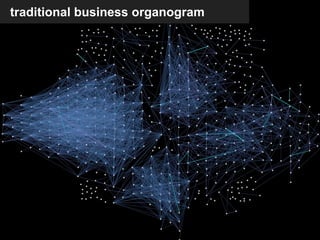
traditional business organogram
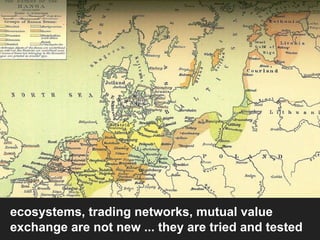
ecosystems, trading networks, mutual value
exchange are not new ... they are tried and tested
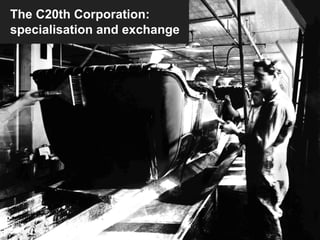
The C20th Corporation:
specialisation and exchange
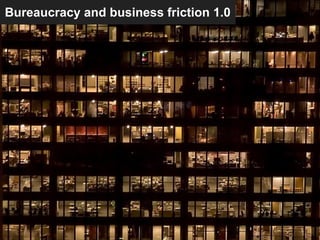
Bureaucracy and business friction 1.0


  structures that dampen network effects
  to get worse the more people use them
Network effects and Collective intelligence


 structures that harness network effects
 to get better the more people use them
In the C21st, we are able to
  create new structures that
have both intimacy & scale
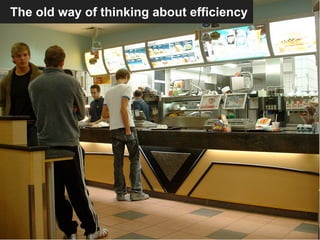
The old way of thinking about efficiency
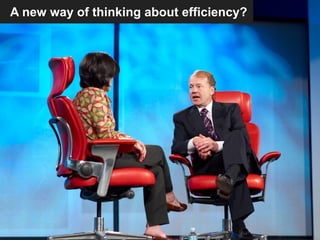
A new way of thinking about efficiency?


      John Chambers, CISCO:
What used to be "me" is now "we"
The goal is to get more products to
market faster ... Fifteen minutes and
 one week to get a [business] plan
  that used to take six months!"
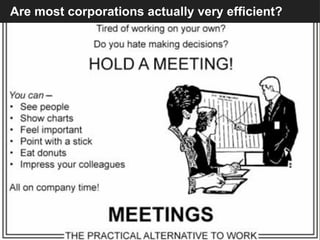
Are most corporations actually very efficient?
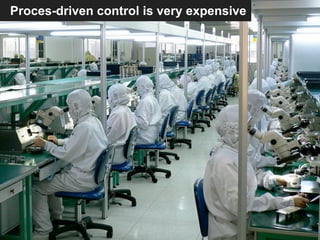
Proces-driven control is very expensive
“Efficiency is doing things right;
effectiveness is doing the right things.”
            – Peter Drucker
How can we design more
effective organisations ?
Social Business Design: humanising the enterprise
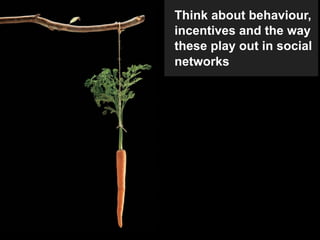
Think about behaviour,
incentives and the way
these play out in social
networks
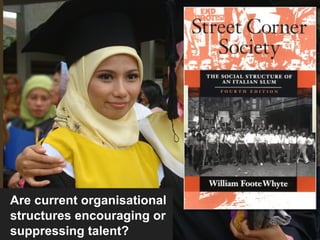
Are current organisational
structures encouraging or
suppressing talent?
Are current organisational
structures encouraging or
suppressing talent?
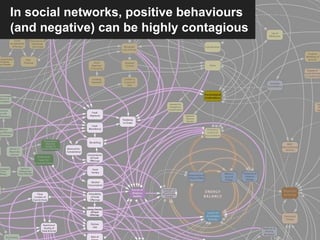
In social networks, positive behaviours
(and negative) can be highly contagious
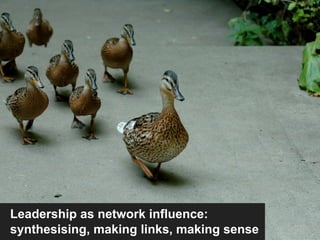
Leadership as network influence:
synthesising, making links, making sense
Some basic enablers for effectiveness:
1. healthy internal & external social networks
2. open data driving performance & feedback
3. a culture of getting things done together
4. sharing as a by-product of doing work
Collaboration & collective action
have never been easier or cheaper.
  This has profound implications
    for organisational design.
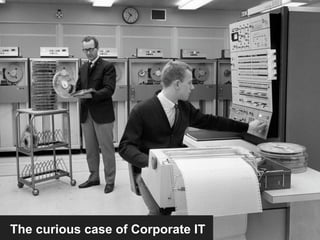
The curious case of Corporate IT
How do we go about creating a new
  ‘business operating system’ ?


                               © 2009 Dac
(1) a strategic framework


                            © 2009 Dac
Social Business Design
archetypes (lenses)


                         [social business design]
Social Business Design
                         connections
archetypes (lenses)


                         [social business design]
Social Business Design
                         connections
archetypes (lenses)


                          collaboration


                         [social business design]
Social Business Design
                         connections
archetypes (lenses)


                          collaboration

         culture
                         [social business design]
Social Business Design
                         connections
archetypes (lenses)


 content


                          collaboration

           culture
                         [social business design]
New capabilities
                     connections
required ?


 content


                      collaboration

           culture
                     [social business design]
New capabilities
                     connections
                     network-centric
required ?
                      management


 content


                      collaboration

           culture
                     [social business design]
New capabilities
                     connections
                     network-centric
required ?
                      management


 content


                      collaboration
                        creating a
                      sharing culture
           culture
                     [social business design]
New capabilities
                         connections
                         network-centric
required ?
                          management


 content


       focus on data
                          collaboration
                            creating a
         & signals for
        performance       sharing culture
            culture
        improvement
                         [social business design]
New capabilities
                          connections
                          network-centric
required ?
                           management


 Helping
 filter for
 content
relevance


        focus on data
                           collaboration
                             creating a
          & signals for
         performance       sharing culture
             culture
         improvement
                          [social business design]
(2) create an underlying social
   technology infrastructure


                                  © 2009 Dac
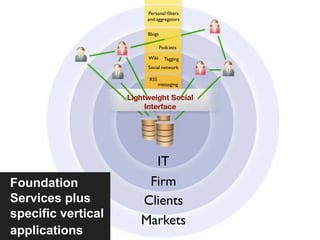
Personal filters
                         and aggregators

                         Blogs

                                 Podcasts

                         Wiki      Tagging
                         Social network

                          RSS
                                messaging

                    Lightweight Social
                         Interface


                         IT
Foundation              Firm
Services plus          Clients
specific vertical
                       Markets
applications
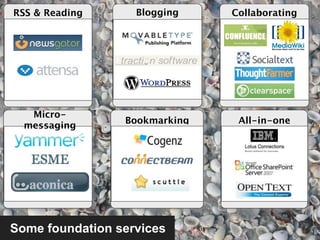
RSS & Reading      Blogging    Collaborating


     Sui             Sui            Sui


   Micro-
                 Bookmarking    All-in-one
  messaging


     Sui             Sui            Sui


Some foundation services
(3) then build ‘situated’ tools for
  specific needs and use cases


                                  © 2009 Dac
Start by supporting existing behaviours
with better, networked tools and features
and finally...


                © 2009 Dac
measure, monitor and use open data
 to create positive feedback loops


                               © 2009 Dac
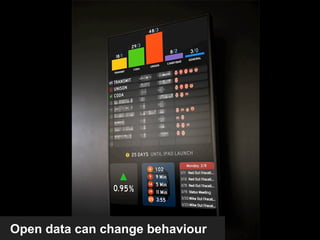
Open data can change behaviour
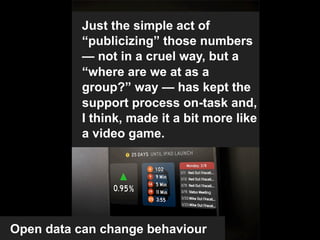
Just the simple act of
          “publicizing” those numbers
          — not in a cruel way, but a
          “where are we at as a
          group?” way — has kept the
          support process on-task and,
          I think, made it a bit more like
          a video game.


Open data can change behaviour
But don’t fall into the ROI trap and measure the
wrong things just to get the seal of approval
Thank you for listening


        Lee@headshift.com


             http://www.headshift.com
I am lee@headshift.com and live at
http://www.headshift.com

Except where otherwise stated, photos courtesy of Flickr using Creative Commons
license.
Thanks to the following photographers:

http://www.flickr.com/photos/dplanet/94442623/
http://www.flickr.com/photos/djbrady/2304740173/sizes/l/
http://www.flickr.com/photos/joeshlabotnik/305410323/sizes/l/
http://www.flickr.com/photos/paul_irish/2379958609/sizes/l/
http://www.flickr.com/photos/notsogoodphotography/503637906/
sizes/o/
http://www.flickr.com/photos/euan/2342134129/
http://www.flickr.com/photos/thayer18/2473764858/
http://cyber.law.harvard.edu/publications/2008/
Mapping_Irans_Online_Public/interactive_blogosphere_map
http://paperbackdreams.com/images/uploads/Future_Shock_1971.jpg
http://www.flickr.com/photos/migrainechick/3185150010/sizes/o/
http://www.flickr.com/photos/wili/2628869994/
http://michaelreeve.files.wordpress.com/2009/02/
braveheart-1-1024.jpg
http://www.flickr.com/photos/ivanatm/2081065914/
http://www.flickr.com/photos/pedrosimoes7/1301014184/sizes/l/
http://www.flickr.com/photos/brianboulos/36957265/
http://lh6.ggpht.com/_uYeCdeWUudM/RquSSy_X2oI/AAAAAAAAADU/
OuYTkaNKa3w/flyover.jpg
http://www.flickr.com/photos/jurvetson/52581560/sizes/l/
http://img386.imageshack.us/img386/1141/is5vb.jpg
Thank you!
Feedback:   http://dach.is/l

Lee Bryant at SBS2010

  • 1.
    Humanising the enterprise LeeBryant, Social Business Summit, March 2010
  • 2.
    I confess, Iam a traditionalist
  • 3.
  • 4.
    ecosystems, trading networks,mutual value exchange are not new ... they are tried and tested
  • 5.
  • 6.
  • 7.
    Bureaucracy and businessfriction 1.0 structures that dampen network effects to get worse the more people use them
  • 8.
    Network effects andCollective intelligence
  • 9.
    Network effects andCollective intelligence structures that harness network effects to get better the more people use them
  • 10.
    In the C21st,we are able to create new structures that have both intimacy & scale
  • 11.
    The old wayof thinking about efficiency
  • 12.
    A new wayof thinking about efficiency?
  • 13.
    A new wayof thinking about efficiency? John Chambers, CISCO: What used to be "me" is now "we" The goal is to get more products to market faster ... Fifteen minutes and one week to get a [business] plan that used to take six months!"
  • 14.
    Are most corporationsactually very efficient?
  • 15.
  • 16.
    “Efficiency is doingthings right; effectiveness is doing the right things.” – Peter Drucker
  • 17.
    How can wedesign more effective organisations ?
  • 18.
    Social Business Design:humanising the enterprise
  • 19.
    Think about behaviour, incentivesand the way these play out in social networks
  • 20.
    Are current organisational structuresencouraging or suppressing talent?
  • 21.
    Are current organisational structuresencouraging or suppressing talent?
  • 22.
    In social networks,positive behaviours (and negative) can be highly contagious
  • 23.
    Leadership as networkinfluence: synthesising, making links, making sense
  • 24.
    Some basic enablersfor effectiveness: 1. healthy internal & external social networks 2. open data driving performance & feedback 3. a culture of getting things done together 4. sharing as a by-product of doing work
  • 25.
    Collaboration & collectiveaction have never been easier or cheaper. This has profound implications for organisational design.
  • 26.
    The curious caseof Corporate IT
  • 27.
    The curious caseof Corporate IT
  • 28.
    How do wego about creating a new ‘business operating system’ ? © 2009 Dac
  • 29.
    (1) a strategicframework © 2009 Dac
  • 30.
    Social Business Design archetypes(lenses) [social business design]
  • 31.
    Social Business Design connections archetypes (lenses) [social business design]
  • 32.
    Social Business Design connections archetypes (lenses) collaboration [social business design]
  • 33.
    Social Business Design connections archetypes (lenses) collaboration culture [social business design]
  • 34.
    Social Business Design connections archetypes (lenses) content collaboration culture [social business design]
  • 35.
    New capabilities connections required ? content collaboration culture [social business design]
  • 36.
    New capabilities connections network-centric required ? management content collaboration culture [social business design]
  • 37.
    New capabilities connections network-centric required ? management content collaboration creating a sharing culture culture [social business design]
  • 38.
    New capabilities connections network-centric required ? management content focus on data collaboration creating a & signals for performance sharing culture culture improvement [social business design]
  • 39.
    New capabilities connections network-centric required ? management Helping filter for content relevance focus on data collaboration creating a & signals for performance sharing culture culture improvement [social business design]
  • 40.
    (2) create anunderlying social technology infrastructure © 2009 Dac
  • 41.
    Personal filters and aggregators Blogs Podcasts Wiki Tagging Social network RSS messaging Lightweight Social Interface IT Foundation Firm Services plus Clients specific vertical Markets applications
  • 42.
    RSS & Reading Blogging Collaborating Sui Sui Sui Micro- Bookmarking All-in-one messaging Sui Sui Sui Some foundation services
  • 43.
    (3) then build‘situated’ tools for specific needs and use cases © 2009 Dac
  • 45.
    Start by supportingexisting behaviours with better, networked tools and features
  • 46.
    and finally... © 2009 Dac
  • 47.
    measure, monitor anduse open data to create positive feedback loops © 2009 Dac
  • 48.
    Open data canchange behaviour
  • 49.
    Just the simpleact of “publicizing” those numbers — not in a cruel way, but a “where are we at as a group?” way — has kept the support process on-task and, I think, made it a bit more like a video game. Open data can change behaviour
  • 50.
    But don’t fallinto the ROI trap and measure the wrong things just to get the seal of approval
  • 51.
    Thank you forlistening Lee@headshift.com http://www.headshift.com
  • 52.
    I am lee@headshift.comand live at http://www.headshift.com Except where otherwise stated, photos courtesy of Flickr using Creative Commons license. Thanks to the following photographers: http://www.flickr.com/photos/dplanet/94442623/ http://www.flickr.com/photos/djbrady/2304740173/sizes/l/ http://www.flickr.com/photos/joeshlabotnik/305410323/sizes/l/ http://www.flickr.com/photos/paul_irish/2379958609/sizes/l/ http://www.flickr.com/photos/notsogoodphotography/503637906/ sizes/o/ http://www.flickr.com/photos/euan/2342134129/ http://www.flickr.com/photos/thayer18/2473764858/ http://cyber.law.harvard.edu/publications/2008/ Mapping_Irans_Online_Public/interactive_blogosphere_map http://paperbackdreams.com/images/uploads/Future_Shock_1971.jpg http://www.flickr.com/photos/migrainechick/3185150010/sizes/o/ http://www.flickr.com/photos/wili/2628869994/ http://michaelreeve.files.wordpress.com/2009/02/ braveheart-1-1024.jpg http://www.flickr.com/photos/ivanatm/2081065914/ http://www.flickr.com/photos/pedrosimoes7/1301014184/sizes/l/ http://www.flickr.com/photos/brianboulos/36957265/ http://lh6.ggpht.com/_uYeCdeWUudM/RquSSy_X2oI/AAAAAAAAADU/ OuYTkaNKa3w/flyover.jpg http://www.flickr.com/photos/jurvetson/52581560/sizes/l/ http://img386.imageshack.us/img386/1141/is5vb.jpg
  • 53.
    Thank you! Feedback: http://dach.is/l

Editor's Notes

  • #3 I have to confess, I am a traditionalist. I like to do business the old-fashioned way, in the way Doug described this morning.
  • #4 Most forms of business have traditionally been located within social networks, communities and ecosystems. Traditional business was about relationships and succeeding through skill and ingenuity, but with social relations mitigating against cheating and pillage.
  • #6 The C20th was about scale - Taylorism, specialisation and exchange, process over people, bureaucracy.
  • #10 At best, this approach seeks to achieve efficiencies for repeatable processes, but much of business is about exceptions or as my friend Sig calls it "Barely Repeatable Processes" That is partly because of an obsession with individual efficiency rather than value.
  • #12 Are C20th corporations efficient? NOW WAY!! "Process is an embedded reaction to prior stupidity" (Shirky) and arguably a testament to a lack of trust in people. In a process-driven organisation, exceptions or problems lead to new processes, which creates a gradual inflation of internal costs to the point that it becomes prohibitively expensive to get anything done in many large organisations today.
  • #13 relationships, loyalty, commitment to each other. Good and bad. More efficient, resilient, lower cost models of coordination based on incentives and mutual interest rather than power and coercion Our new cultural ecosystem is more traditional, and closer to traditional models trade, business and socialisation than the new, dangerous ideas of the C20.
  • #16 we have gone far enough with process - we now need to learn how to better support and augment human interaction and human intelligence
  • #17 We are learning a lot about how people work individually and collectively. Nudge, behavioural economics: people are motivated by social connections / status / signals, not just carrot and stick or price signals.
  • #19 At the Frankfurt E0 summit last November, Julien el Nestour from Schlumberger quoted a classic sociology study from William Foote Whyte about bowling among poor Italian gangs in Boston in the late 1930's. It turns out that gang members' position in the hierarchy were very good predictors of their bowling scores, and when they bowled without the gang, they would often score very differently. By a variety of means, the gang preserved its hierarchy and thereby inhibited individual performance.
  • #20 Christakis talks about how behaviours are contagious. If a first degree contact is obese, you have a 45% increased risk of obesity, but this risk is not confined to people you even know - the effect is observable even at 4 degrees of separation. He demonstrates how positive behaviours, such as pay it forward, and even happiness are contagious too.
  • #24 Corporate IT initially co-evolved with corporate structures, adopting the philosophy and structure of mid-C20th business. But by codifying the assumptions of the Taylorist corporation, it made them permanent. So, even as businesses have changed their view of what they do and how they do it, the internal systems they rely on have not. The result is a bizarre situation where IT is a cost-centre that can tell anybody in the business what tools to use and how to use them, rather then being a business enabler. This is a major barrier to change for existing businesses, whilst new competitors are emerging with no legacy to manage and therefore significantly lower costs and greater agility
  • #27 OUR METHODOLOGY - YOU MAY FIND IT USEFUL AS AN APPROACH TO HELP PLAN THE CHANGES YOU NEED TO ADDRESS IF YOU WANT TO DO THIS RIGHT
  • #28 OUR METHODOLOGY - YOU MAY FIND IT USEFUL AS AN APPROACH TO HELP PLAN THE CHANGES YOU NEED TO ADDRESS IF YOU WANT TO DO THIS RIGHT
  • #29 OUR METHODOLOGY - YOU MAY FIND IT USEFUL AS AN APPROACH TO HELP PLAN THE CHANGES YOU NEED TO ADDRESS IF YOU WANT TO DO THIS RIGHT
  • #30 OUR METHODOLOGY - YOU MAY FIND IT USEFUL AS AN APPROACH TO HELP PLAN THE CHANGES YOU NEED TO ADDRESS IF YOU WANT TO DO THIS RIGHT
  • #31 OUR METHODOLOGY - YOU MAY FIND IT USEFUL AS AN APPROACH TO HELP PLAN THE CHANGES YOU NEED TO ADDRESS IF YOU WANT TO DO THIS RIGHT
  • #32 OUR METHODOLOGY - YOU MAY FIND IT USEFUL AS AN APPROACH TO HELP PLAN THE CHANGES YOU NEED TO ADDRESS IF YOU WANT TO DO THIS RIGHT
  • #33 OUR METHODOLOGY - YOU MAY FIND IT USEFUL AS AN APPROACH TO HELP PLAN THE CHANGES YOU NEED TO ADDRESS IF YOU WANT TO DO THIS RIGHT
  • #34 OUR METHODOLOGY - YOU MAY FIND IT USEFUL AS AN APPROACH TO HELP PLAN THE CHANGES YOU NEED TO ADDRESS IF YOU WANT TO DO THIS RIGHT
  • #43 Panic.com recently talked about a project status board that shared live support information among their team, which was a lovely example not only of open data, but also the power of data visualisation. Presumably the Obama administration understood the power of data visualisation when they hired Edward Tufte, the visualisation guru, to help explain the recovery plan to the public. In the UK, Windsor Council struggled with ways to cut their energy use in council buildings. Eventually they just published live usage data every 30 minutes, and without any enforcement, they saw consumption drop by over 15%. Every company has a wealth of untapped data, from the simple (clickstream data, sales figures) to the complex (sensor output, system output). Where it is not explicitly secret, why not open it up and let your employees make sense of it in their own way.
  • #44 instead decide what success looks like on a local level for each use case and each user group - if these all add up then you will achieve ROI, but a bigger issue is ROA - how do you return value for the cost of the attention your people invest in your internal systems