A Case Study On
Street Light Conversion from Sodium Vapour Lamps to LED’s
BasedOn
(ICFAI UNIVERSITY STREET LIGHT CONVERTION SYSTEM)
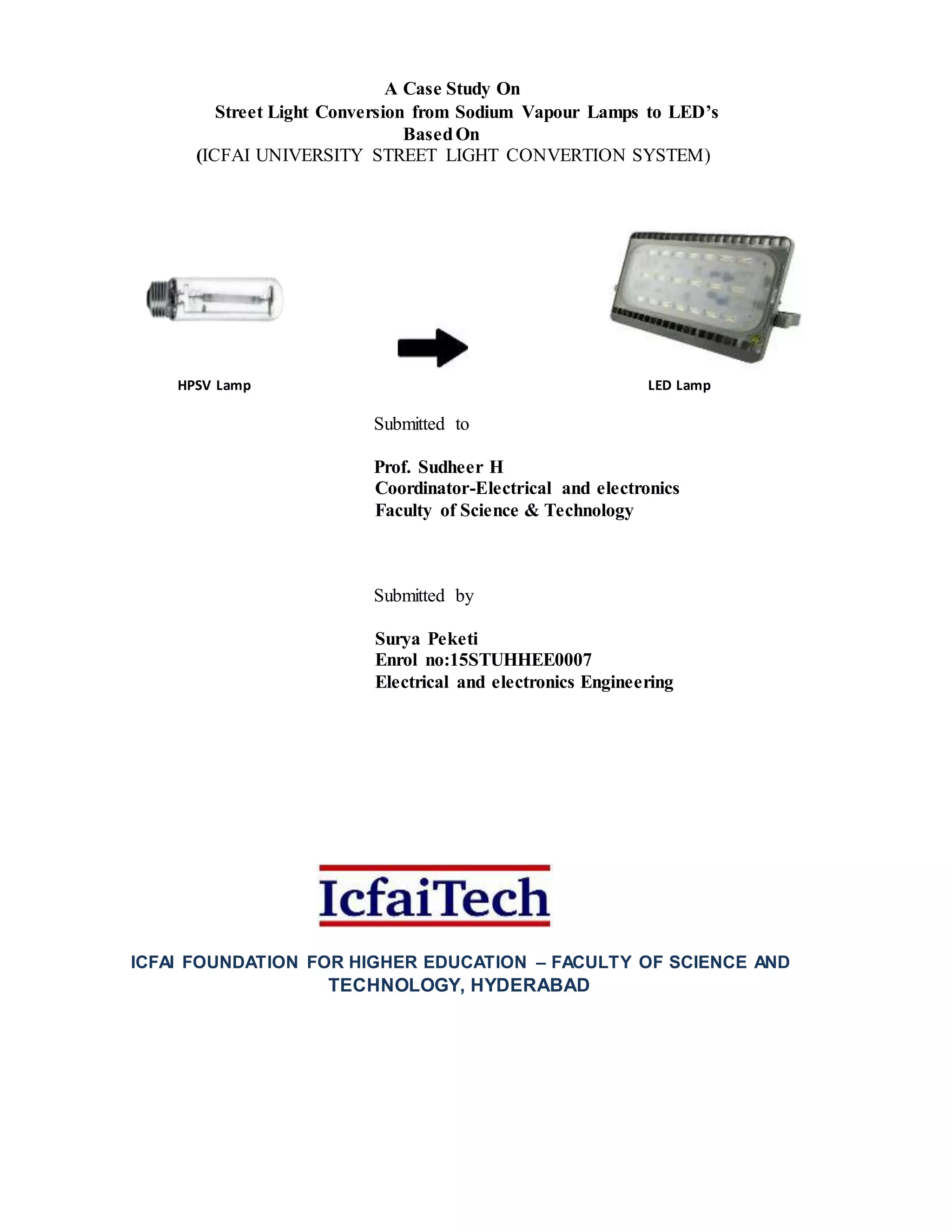
HPSV Lamp LED Lamp
Submitted to
Prof. Sudheer H
Coordinator-Electrical and electronics
Faculty of Science & Technology
Submitted by
Surya Peketi
Enrol no:15STUHHEE0007
Electrical and electronics Engineering
ICFAI FOUNDATION FOR HIGHER EDUCATION – FACULTY OF SCIENCE AND
TECHNOLOGY, HYDERABAD
Abstract :
The energy saving potentialy possible with changing in street light lamps. The
case study in an engineering university deals with the replacement of existing
high-pressure sodium vapour lamps to LED’s. This lighting scheme will have
high energy saving, which increases the efficiencymore the 70 percentage. The
LED lighting scheme provides additional advantages as cool light, decreased
maintenance cost, longer life, more flexibility, easier handling. with the save of
energy we can utilize the energy for other purpose. It is always preferred over
energy conservation over energy generation. It is always preferred over energy
conservation over energy generation.
Introduction:
In olden age, incandescence and fluorescence lamps were the main focus in
illumination technology. With development in SV, MV and metal halide, make
possible to replace this old technology. But none of these technologies could
improve the efficacy exceeding 200 lumens per watt and efficiency beyond 60-
70%. The current technology of CFL has improved the efficiency and it has
really proved standards. The obstacle in becoming popular is the initial cost and
the decrease in illumination over the use. These days with support of government
taxes and improvement in manufacturing technology the initial cost has come to
the vision of common man. The obstacle in becoming popular is the initial cost
and the decrease in illumination over the use. These days with support of
government in taxes and improvement in manufacturing technology the initial
cost has come to the vision of common man. With the advent of commercial
LEDs in the 1960s,however, a new kind of lighting became available. LEDs will
consume less electricity than conventional lighting including CFL’s and can
produce less of the parasitic byproduct heat. Now the LED are available with
different color improving RI and giving a better look and cool light. To produce
a white (Solid State Light) SSL device, however, a blue LED was needed, which
was later discovered through materials science and extensive research and
development of Gallium Nitride. With use of LED’s, now it is possible to create
white light by combining the light of separate LED’s (red, green and blue) or by
placing a blue LED within a special package with an internal light conversion
phosphor (some of the blue output becomes red and green) with the result that
the LED light emission appears white which is good to human eye.
LED’s as Lightening Source:
Working principle of LED:
LEDs differ from other light sources in the way they produce light An LED, is a
semiconductor diode. It consists of a chip of semiconducting material treated to
create a structure called a p-n junction. When connected to a power source,
current flows from the p-side to the n-side and not in the reverse direction. The
electrons and electron holes flow into the junction from electrodes. When an
electron meets a hole, it falls into a lower energy level, and releases energy in
the form of a photon (light). The color emitted by the LED depends on the
materials used to make the diode.
Benefits in LED’s:
1. LED life span: The most significant advantage of LEDs when
compared to traditional lighting solutions is the long lifespan. The average LED
lasts 50,000 operating hours to 100,000 operating hours or more compared to
HPSV lamps. Less frequent replacement and Low maintenance cost.
2. LED Energy Efficiency: it consumes less power compared to HPSV
lamps.it is energy efficiency and luminous efficiency. result in a 60-75%
improvement in the overall energy efficiency of the facility’s lighting.
3. Improved Safety With LED’s: Safety is the one of the important role
in electricity.the most often overlooked advantage when it comes to LED
lighting. The number one hazard when it comes to lighting is the emission of
heat. LEDs emit almost no forward heat while traditional bulbs like incandescent
convert more than 90% of the total energy used to power them directly into heat.
4. LEDs Have Great Color Rendering Index (CRI): A measurement of
a light’s ability to reveal the actual color of objects as compared to an ideal light
source (natural light). High CRI is generally a desirable characteristic. LEDs
generally have very high (good) ratings when it comes to CRI.
5. LEDs Provide Instantaneous Turn On & Do Not Have Issues With
Frequent Switching: LEDs turn on and off instantaneously. There is no warm-
up period like in the case of metal halide lamps. Additionally, frequent switching
doesn’t cause degradation in the device.
6. LED Lights Are Environmentally Safe: LEDs do not have the
environmental issues common to traditional lighting solutions
like fluorescent or mercury vapor lights. Both of these traditional solutions
contain mercury internal to the bulb and thus require special handling at the end
of the product’s useful lifespan.
LED’s vs HPSV:
High Pressure Sodium Vapor (HPSV) lights, similar to LPS lights, are a specific
type of gas-discharge light (also known as a High Intensity Discharge, HID or
arc light). The principal difference between low- and high-pressure sodium lights
is the operating pressure inside the lamp. As indicated by the name, “high”
pressure sodium vapor lights operate at a higher internal pressure. The arc tube
is made of aluminum oxide and the sodium metal is combined with several other
elements like Mercury which counter-balances the yellow glow with some white
to light blue emissions whereas LED’s have an extremely long lifespan relative
to every other lighting technology (including fluorescent lights). New LEDs can
last 50,000to 1,00,000hours or more. The typical lifespan for a fluorescent bulb,
by comparison, is 10-25% as long at best. LEDs are extremely energy efficient
relative to every other commercially available lighting technology. There are
several reasons for this to include the fact they waste very little energy in the
form of infrared radiation. they emit light directionally over 180 degrees.
Comparison of LED’s and HPSV lamps
LED HPSV
CCT 2600~10000 4000~8000
Response <1s <60s
Light out theory Semi-conductor HG Vapour
Direction Specific direction All direction
Life 50000~100000 hrs 6000hr
Reliability High Middle
Resistance High Low
Disadvantages High initial price Hg pollution
Calculations:
Refrences:
1) https://www.ledinside.com/knowledge/2009/2/led_street_light_design
_tech_200902
2) http://www.edisontechcenter.org/SodiumLamps.html#hps
3) https://www.researchgate.net/publication/299355345_Analysis_on_ene
rgy_efficiency_and_optimality_of_LED_and_photovoltaic_based_street_li
ghting_system
4) http://www.jatit.org/volumes/research-
papers/Vol4No11/10Vol4No11.pdf
5) https://www.stouchlighting.com/blog/led-vs-hps-lps-high-and-low-
pressure-sodium
6)

Led project

  • 1.
    A Case StudyOn Street Light Conversion from Sodium Vapour Lamps to LED’s BasedOn (ICFAI UNIVERSITY STREET LIGHT CONVERTION SYSTEM) HPSV Lamp LED Lamp Submitted to Prof. Sudheer H Coordinator-Electrical and electronics Faculty of Science & Technology Submitted by Surya Peketi Enrol no:15STUHHEE0007 Electrical and electronics Engineering ICFAI FOUNDATION FOR HIGHER EDUCATION – FACULTY OF SCIENCE AND TECHNOLOGY, HYDERABAD
  • 2.
    Abstract : The energysaving potentialy possible with changing in street light lamps. The case study in an engineering university deals with the replacement of existing high-pressure sodium vapour lamps to LED’s. This lighting scheme will have high energy saving, which increases the efficiencymore the 70 percentage. The LED lighting scheme provides additional advantages as cool light, decreased maintenance cost, longer life, more flexibility, easier handling. with the save of energy we can utilize the energy for other purpose. It is always preferred over energy conservation over energy generation. It is always preferred over energy conservation over energy generation.
  • 3.
    Introduction: In olden age,incandescence and fluorescence lamps were the main focus in illumination technology. With development in SV, MV and metal halide, make possible to replace this old technology. But none of these technologies could improve the efficacy exceeding 200 lumens per watt and efficiency beyond 60- 70%. The current technology of CFL has improved the efficiency and it has really proved standards. The obstacle in becoming popular is the initial cost and the decrease in illumination over the use. These days with support of government taxes and improvement in manufacturing technology the initial cost has come to the vision of common man. The obstacle in becoming popular is the initial cost and the decrease in illumination over the use. These days with support of government in taxes and improvement in manufacturing technology the initial cost has come to the vision of common man. With the advent of commercial LEDs in the 1960s,however, a new kind of lighting became available. LEDs will consume less electricity than conventional lighting including CFL’s and can produce less of the parasitic byproduct heat. Now the LED are available with different color improving RI and giving a better look and cool light. To produce a white (Solid State Light) SSL device, however, a blue LED was needed, which was later discovered through materials science and extensive research and development of Gallium Nitride. With use of LED’s, now it is possible to create white light by combining the light of separate LED’s (red, green and blue) or by placing a blue LED within a special package with an internal light conversion phosphor (some of the blue output becomes red and green) with the result that the LED light emission appears white which is good to human eye.
  • 4.
    LED’s as LighteningSource: Working principle of LED: LEDs differ from other light sources in the way they produce light An LED, is a semiconductor diode. It consists of a chip of semiconducting material treated to create a structure called a p-n junction. When connected to a power source, current flows from the p-side to the n-side and not in the reverse direction. The electrons and electron holes flow into the junction from electrodes. When an electron meets a hole, it falls into a lower energy level, and releases energy in the form of a photon (light). The color emitted by the LED depends on the materials used to make the diode. Benefits in LED’s: 1. LED life span: The most significant advantage of LEDs when compared to traditional lighting solutions is the long lifespan. The average LED lasts 50,000 operating hours to 100,000 operating hours or more compared to HPSV lamps. Less frequent replacement and Low maintenance cost. 2. LED Energy Efficiency: it consumes less power compared to HPSV lamps.it is energy efficiency and luminous efficiency. result in a 60-75% improvement in the overall energy efficiency of the facility’s lighting. 3. Improved Safety With LED’s: Safety is the one of the important role in electricity.the most often overlooked advantage when it comes to LED lighting. The number one hazard when it comes to lighting is the emission of heat. LEDs emit almost no forward heat while traditional bulbs like incandescent convert more than 90% of the total energy used to power them directly into heat. 4. LEDs Have Great Color Rendering Index (CRI): A measurement of a light’s ability to reveal the actual color of objects as compared to an ideal light source (natural light). High CRI is generally a desirable characteristic. LEDs generally have very high (good) ratings when it comes to CRI. 5. LEDs Provide Instantaneous Turn On & Do Not Have Issues With Frequent Switching: LEDs turn on and off instantaneously. There is no warm- up period like in the case of metal halide lamps. Additionally, frequent switching doesn’t cause degradation in the device. 6. LED Lights Are Environmentally Safe: LEDs do not have the environmental issues common to traditional lighting solutions like fluorescent or mercury vapor lights. Both of these traditional solutions contain mercury internal to the bulb and thus require special handling at the end of the product’s useful lifespan.
  • 5.
    LED’s vs HPSV: HighPressure Sodium Vapor (HPSV) lights, similar to LPS lights, are a specific type of gas-discharge light (also known as a High Intensity Discharge, HID or arc light). The principal difference between low- and high-pressure sodium lights is the operating pressure inside the lamp. As indicated by the name, “high” pressure sodium vapor lights operate at a higher internal pressure. The arc tube is made of aluminum oxide and the sodium metal is combined with several other elements like Mercury which counter-balances the yellow glow with some white to light blue emissions whereas LED’s have an extremely long lifespan relative to every other lighting technology (including fluorescent lights). New LEDs can last 50,000to 1,00,000hours or more. The typical lifespan for a fluorescent bulb, by comparison, is 10-25% as long at best. LEDs are extremely energy efficient relative to every other commercially available lighting technology. There are several reasons for this to include the fact they waste very little energy in the form of infrared radiation. they emit light directionally over 180 degrees. Comparison of LED’s and HPSV lamps LED HPSV CCT 2600~10000 4000~8000 Response <1s <60s Light out theory Semi-conductor HG Vapour Direction Specific direction All direction Life 50000~100000 hrs 6000hr Reliability High Middle Resistance High Low Disadvantages High initial price Hg pollution
  • 6.
  • 8.
    Refrences: 1) https://www.ledinside.com/knowledge/2009/2/led_street_light_design _tech_200902 2) http://www.edisontechcenter.org/SodiumLamps.html#hps 3)https://www.researchgate.net/publication/299355345_Analysis_on_ene rgy_efficiency_and_optimality_of_LED_and_photovoltaic_based_street_li ghting_system 4) http://www.jatit.org/volumes/research- papers/Vol4No11/10Vol4No11.pdf 5) https://www.stouchlighting.com/blog/led-vs-hps-lps-high-and-low- pressure-sodium 6)